At the shelter, they told me I could take the little one home that same day, but the giant would need to stay behind. I had come prepared for one small dog, one quiet companion, one simple change to a house that had become too still.
I drove forty minutes with the heater blowing dry air over my hands, an old paper coffee cup rattling in the cup holder whenever my SUV hit a rough patch. The morning light was bright, cold, and too honest through the windshield.
All the way there, I repeated the same sentence like it was a promise I could make true by saying it enough times. Just one dog. One little dog. Something manageable. Something that would not turn my life upside down.

My youngest son had left for college a few weeks earlier, and the house had changed in a way I did not know how to explain. The laundry room stayed quiet. The hallway lights stayed off. Nobody dropped shoes by the door.
I did not want drama. I did not want some huge decision that would make people shake their heads at me later. I wanted a small dog that would nap near the couch while I folded towels and made the rooms feel lived in again.
When I pulled into the shelter parking lot, sunlight flashed against the chain-link fence. A volunteer was carrying a stack of clean towels through the side entrance, and a small American flag near the front door moved lightly in the wind.
Inside, the shelter smelled like bleach, wet fur, and donated kibble. Dogs barked from every direction, not in one clean sound, but in layers—sharp yips, deep barks, tired whining, metal gates rattling whenever someone walked past.
I checked in at the front desk at 10:17 a.m. and wrote my name on the visitor clipboard. The woman behind the counter asked what I was looking for, and I told her the truth as plainly as I could.
“One small dog,” I said. “Quiet, if possible.”
She nodded like she had heard that exact sentence more times than she could count. Then she came around the desk, picked up a folder, and led me through the door into the kennel row in the back.
The sound changed as soon as we stepped inside. It became heavier and closer, bouncing off the concrete walls. The air was warmer back there, full of damp blankets, nervous animals, and the sharp clean smell of the morning mop.
We passed dogs that jumped at the gates, dogs that spun in circles, dogs that pressed their noses through the chain-link and watched us with desperate hope. I tried not to look too long at any of them, because looking too long felt like making a promise.
Then the volunteer stopped in front of one kennel and lowered her voice.
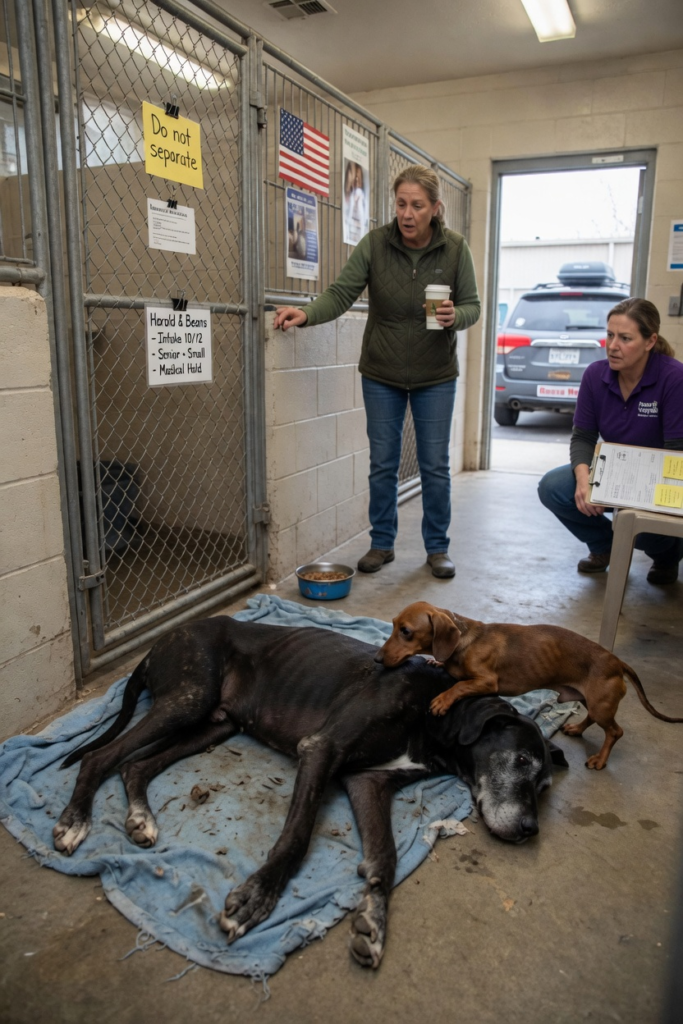
On a thin blue blanket that barely covered the concrete floor, an old black Great Dane lay stretched out like a tired horse. His muzzle had gone white, and his ribs rose slowly under loose skin with every breath.
Curled against his side was a tiny brown Dachshund. He was pressed so tightly into the Great Dane’s body that, for a second, he barely looked like a separate dog. He looked like a small, warm shadow trying not to disappear.
Neither dog came to the gate. Neither barked. They did not perform sadness, which somehow made it worse. They looked as if they had been waiting too long for someone they still believed might walk through the door.
“The big one is Harold,” the volunteer said. “The little one is Beans.”
She told me they had arrived together three months earlier after their owner, Arthur, had a stroke and was moved into a care facility that did not allow pets. There was no dramatic abandonment story, no villain in the parking lot, no easy anger to hold onto.
That almost made it harder. Sometimes lives break without anyone meaning for them to. One hospital stay, one care facility, one rule about pets, and two old dogs end up behind a kennel gate waiting for a voice that cannot come back.
The intake sheet clipped to the gate had a line written across it: inseparable senior pair. On the adoption folder, there was a yellow sticky note on the front, the corners curled slightly from being handled too often.
Do not separate.
I read those three words twice before I looked back at the dogs. Harold opened one eye. He did not stand up, wag, or try to charm me. He simply watched me with the exhausted patience of an old dog who had seen plenty of people feel sorry and leave anyway.
Beans did not lift his head at all. He kept sleeping against Harold’s chest, his little body tucked into the rise and fall of that old dog’s breathing. As long as Harold breathed, Beans seemed to believe the world could still be held together.
The volunteer said the shelter had tried more than once to see how the dogs handled being apart, even just for short practical moments. Every time, Beans stopped eating. Harold would not leave the door. The staff stopped pretending it was a small issue.
“People ask about Beans all the time,” she said quietly.
I understood why before she finished the sentence. Beans was small. He looked easy to carry, easy to fit into a house, easy to explain to family. Harold was different. Harold was enormous, old, stiff, and expensive before anyone even wrote a check.
Some families had asked about Harold too, she told me. But once they heard about his age, his joints, and the cost of caring for a dog his size, they backed away. Not cruelly, maybe. Just practically.
Eleven people had asked to adopt only one of them.
The shelter had said no every time.
I stood there with my fingers curled around the strap of my purse and felt my sensible plan start slipping through my hands. I thought about my small house, my narrow back door, my old carpet, my budget, and the way my son would look at me if I told him I had brought home a Great Dane.
I had come for a dog that would make life softer, not heavier. I had come for something I could lift with one arm, not an old giant who would need space, patience, money, and help getting through doorways.
Then the volunteer crouched beside the kennel gate and called, “Beans.”
The little dog woke so suddenly his paws slipped against the blanket. His head jerked up, and his eyes darted around the kennel. When Harold did not respond right away, Beans scrambled toward the big dog’s face in silent panic.
He did not bark. He did not cry. He pushed his nose into Harold’s neck again and again, trembling so hard I could see it through the gate. It was not cute. It was not dramatic. It was fear with no sound.
Harold opened both eyes.
Only then did Beans calm down.
The little Dachshund climbed back against Harold’s side and tucked himself into the hollow near Harold’s chest. He let out a tiny sigh so soft I almost missed it under the barking from the kennels around us.
On the kennel card, someone had written in black marker: Beans only sleeps if he can touch Harold.
That sentence did something to me. Not because it was poetic. Because it was practical, the way shelter notes are practical. It was not trying to make anyone cry. It was just there to keep the next person from making a mistake.
I stood in front of that gate for a long time. Long enough for “just one dog” to start sounding less like a boundary and more like an excuse. Long enough to realize I was not looking at two separate adoptions.
I was looking at one life divided into two bodies.
Taking only the easy half would not be kindness. It would be convenience dressed up as rescue. And deep down, I knew that if I walked out with Beans and left Harold behind, I would see that old dog every time my house got quiet.
I asked the volunteer what would happen if no one adopted them together.
She looked down and stroked Harold’s ear through the gate. Her silence landed harder than any answer she could have given. There are some questions shelter workers hear all the time, and some answers they are too tired to say out loud.
So I asked for the paperwork.
“Both sets,” I said.
The volunteer looked at me quickly, as if she had not heard correctly. Then she stood, gathered the folder from the hook by the kennel, and led me back toward the office without saying anything that might scare the moment away.
At the desk, the paperwork covered more of the counter than I expected. Adoption application. Senior dog care authorization. Medication instructions. Release forms. A copy of the intake sheet. The folder edges were soft from being opened and closed too many times.
At 11:42 a.m., the volunteer stamped the folder. I signed my name beneath Harold’s, then beneath Beans’s. My hand shook hard enough that the pen scratched across the paper, and I had to pause before the last line.
For one second, I almost backed out.
It was not because I did not care. It was because I did. Caring had a cost, and I could already see the shape of it. Bigger food bags. Vet appointments. Slow mornings. A house rearranged around an old dog’s body.
I thought about my son saying, “Mom, what were you thinking?” I thought about the stairs. I thought about the grocery money. I thought about the empty rooms that had pushed me into that shelter in the first place.
Then, from the kennel row, Beans pushed his nose through the bars toward Harold’s face again.
And I signed anyway.
Getting them outside was not simple. Harold needed time to stand. His legs were stiff, and the effort seemed to move through his whole body. Beans stayed close to his shoulder, matching every slow step with his tiny legs.
The volunteer walked beside us with the folder tucked under her arm. Another staff member held the door open. Bright sunlight hit the concrete sidewalk, and the noise of the kennels dropped behind us as the door swung shut.
My SUV waited by the curb with the back hatch open. Inside, I had spread an old blanket across the cargo area, thinking it would be enough for one small dog. Looking at Harold now, I realized how little I had understood what I was agreeing to.
Still, Harold kept moving forward, one careful step at a time. Beans walked beside him, pressed so close their shoulders brushed. Every few feet, the little dog glanced up at Harold’s face, checking him, reading him, staying connected.
The volunteer’s voice softened behind me. “Take your time.”
I bent down first for Beans because that was the practical thing to do. Lift the little one in, then help Harold. Simple. Reasonable. The kind of sequence any person would choose when trying to move two dogs into a car.
But just before I touched him, Beans stopped.
He looked toward the shelter door. Then he looked at Harold. Then he looked at me, and something in his tiny body changed. He trembled, not from cold, but from understanding.
For one awful second, he thought it was happening again.
The separation. The hands reaching. The big body left behind. The world split in half by someone else’s good intentions.
I reached for him slowly, whispering that it was okay, but he stiffened under my hands. His paws dug into the concrete. His eyes stayed locked on Harold, and the old Great Dane lifted his head as if he felt the panic before anyone else did.
Then Harold made a sound behind me.
It was not a bark. It was low, rough, and broken, pulled from somewhere deep in his chest. Every person on that sidewalk froze. The volunteer’s hand tightened around the adoption folder, and Beans twisted toward him with his whole body.
Nobody moved for a heartbeat.
In that moment, the whole shelter seemed to shrink down to one old dog, one little dog, an open SUV hatch, and the terrible mistake both animals thought was about to happen again. The blue blanket waited inside the kennel behind them.
I let go of the plan I had made in my head. Harold first, Beans second, small dog before big dog, practical before emotional. None of that mattered if the order itself broke the only thing keeping them steady.
I stepped back and looked at the volunteer. She understood before I said anything. Her eyes were wet, but she nodded. Slowly, carefully, we changed everything right there on the sidewalk.
Because this was never about taking home one dog.
It was about keeping a promise two dogs had already made to each other long before I ever signed my name. And as Beans pressed himself against Harold’s shoulder in the bright shelter parking lot, I finally understood what that yellow note had really been trying to tell every person who passed their gate.
Do not separate was not a preference.
It was the rescue.