CNU-I thought my ex-husband had successfully erased me when he walked away with the house, the cars, and every dollar we had saved. Then a stranger found me behind a dumpst…
The morning I climbed into a dumpster behind a foreclosed mansion and came back out with a walnut chair leg in one hand, I had no idea I was less than an hour away from becoming the kind of woman people write glossy magazine profiles about and secretly hate at cocktail parties.
At that point I was just cold, hungry, and trying not to think too far ahead.
The mansion sat on a hill above a neighborhood I had no business being in, one of those old-money streets with iron gates and stone lions and hedges trimmed into shapes so precise they looked edited. The bank had taken the property months earlier. Contractors had already stripped out the obvious valuables, but houses that rich have layers. Drawer pulls. Antique hardware. Old millwork. Furniture legs from pieces too broken to resell whole. A lot of people see trash and feel pity or disgust. I had trained myself to see line items. A carved leg from a nineteenth-century side chair could become two hundred dollars if cleaned and sold to the right restorer. A brass sconce without its matching pair could still move online to someone trying to save an old house on a teacher’s budget. Poverty gives you an eye for fragments. It turns scavenging into a form of accounting.
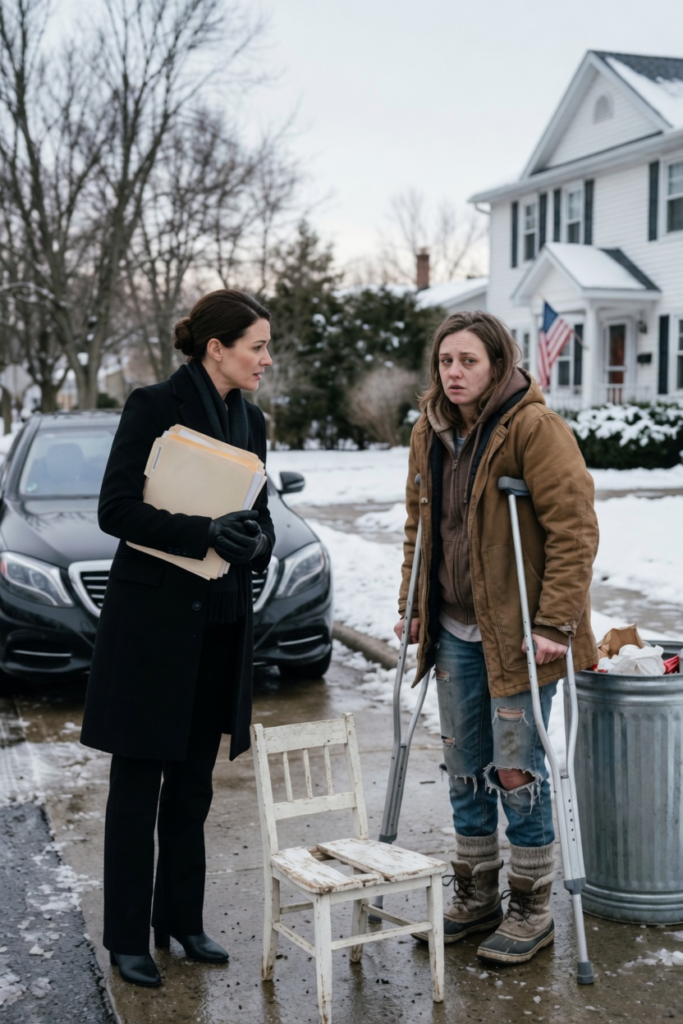
I was elbow-deep in a black contractor bag, fingers numb from the March cold, when a woman’s voice behind me said, “Excuse me, are you Sophia Hartfield?”
Nobody ever expects a stranger in a charcoal suit and Italian shoes to know their full name while they are half folded over a dumpster at seven in the morning.
I startled hard enough to knock my shoulder against the metal side. Something clattered deeper in the bag. I turned, still clutching the chair leg, and found a woman standing a few feet away on the cracked service drive behind the house. Mid-forties maybe, sleek black coat, dark hair pinned back, face composed in the specific way expensive lawyers’ faces are composed, as if expression is something to be used only when strategically necessary.
For one ridiculous second, Richard’s voice flashed through my mind from the day he’d thrown my suitcase onto the lawn outside the house we had shared: Nobody’s going to want a broke homeless woman like you.
The thing about humiliation is that it echoes long after the moment passes. It can attach itself to the most ordinary movements. Climbing out of a dumpster at dawn, wiping your hands on filthy jeans, meeting the eyes of a woman who belonged in a world of polished floors and boardrooms—that was exactly the kind of scene his cruelty would have loved.
I hauled myself over the edge and dropped to the pavement. “That’s me,” I said. “If you’re here to repo something, this chair leg is literally all I own.”
Instead of looking alarmed or offended, she smiled.
“My name is Victoria Chen. I’m an attorney representing the estate of Theodore Hartfield.”
Everything inside me went still.
Uncle Theodore.
Even after ten years of silence, his name still moved through me differently from everyone else’s. My parents died when I was fifteen in a pileup on I-80, and the world as I knew it cracked down the middle. My great-uncle Theodore—my mother’s uncle technically, though family titles get blurry when people start raising children who weren’t originally theirs—had stepped into the wreckage and taken me home. He was already rich then, already impossible, already famous enough in the architecture world that people in certain circles said his name with an odd little mixture of reverence and resentment. He lived in a five-story brownstone in Manhattan that had been photographed for magazines more times than I could count. He wore hand-tailored jackets and sketched on linen paper and could look at a building for fifteen seconds and tell you which year the third-floor windows had been replaced. He was exacting, difficult, arrogant, and more generous with belief than any adult I had ever known.
He had also not spoken to me in ten years.
I stared at the attorney and felt the cold air slide between my ribs.
“What about him?”
Her expression shifted, softened by a degree. “Your great-uncle passed away six weeks ago. I’m very sorry.”
I should say I reacted with dignity. I did not. My first thought was no, because some part of me had always filed Theodore under fixed structures—the kind of men who become a piece of architecture themselves, too embedded in the skyline of your inner life to ever vanish completely. My second thought was shame, because the last time I had heard his voice was in anger and the last thing he had heard from me was worse.
Then Victoria said, “He left you his entire estate.”
The chair leg slipped from my fingers and hit the pavement.
Three months earlier, I had still been middle class. That’s the ugliest thing about falling from a decent life into survival mode: it happens so quickly that your mind doesn’t downgrade with your circumstances right away. For a while you still think like someone who has options. Then the options get counted against utility bills and legal retainers and grocery totals and finally you’re waking up in a storage unit with a quilt over your knees and a phone charger running from an extension cord and realizing your standards have been in active retreat for weeks.
When I caught Richard cheating, I was stupid enough at first to think the betrayal itself would be the worst part. It wasn’t. The worst part was the speed with which the rest of the structure revealed itself. The house was in his name because his accountant had said it was cleaner that way. The investment accounts were mostly protected. The prenup I signed at twenty-two because I was “in love and didn’t care about money” turned out to be a work of legal brutality written by someone who understood very well how young women underestimate the future. Richard got the house, the cars, the portfolio, the furniture, the narrative. I got a settlement so small it could be described in one line item and the knowledge that ten years of playing wife to a successful man had somehow left me financially lighter than I had been at twenty-one.
His parting gift, after the papers were signed, was to stand in the foyer while I zipped a suitcase and say, with that polished contempt he always used when he thought he was being honest rather than cruel, “Good luck finding anyone who wants damaged goods.”
He said it like a diagnosis.
The weeks after that became a study in practical disgrace. I stayed with a friend for eleven days until her boyfriend started asking if I had a timeline. I moved my things into the cheapest storage unit I could find and slept in my car twice and once in the unit itself, though technically that wasn’t allowed. I had an architecture degree I had never used professionally because Richard had always made it sound romantic not to work. “I make enough for both of us,” he used to say, as if financial dependence was an act of devotion instead of a strategy. By the time I understood the cage, I had spent ten years decorating it.
Dumpster diving wasn’t glamorous, but it was mine. I pulled furniture from trash, stripped it down, repaired what I could in the rented storage unit using tools I bought secondhand, then sold the pieces online. I knew materials. I knew craftsmanship. I knew the difference between veneered junk and old wood with history still in it. Architectural training had not prepared me for this life exactly, but it had taught me how to see structure where other people saw mess. That turned out to be useful.
Now this attorney was standing in front of me saying Theodore Hartfield was dead and had left me everything.
“There must be some mistake,” I heard myself say.
She gestured toward a black Mercedes parked neatly at the end of the drive.
“There isn’t. But this is probably not the best place for the conversation.”
I looked down at myself. Filthy jeans, old thermal shirt, hair scraped back badly, hands blackened with dust and grime. I almost laughed.
“I’m not exactly Mercedes-ready.”
“You are the sole heir to an estate currently valued at just over fifty million dollars,” she said. “I think the car can survive the dust.”
I followed her in a trance.
The backseat smelled like leather and expensive restraint. Victoria handed me a folder as the driver pulled away from the curb.
“Your great-uncle left you the Manhattan residence, his car collection, three investment properties, substantial liquid assets, and controlling interest in Hartfield Architecture.”
I opened the folder and saw photographs first. The brownstone on East Sixty-Eighth. The garage with three Ferraris I had only ever seen under covers. Portfolio statements. Property summaries. Headshots of board members. The numbers on the pages blurred and reassembled in ways my brain could not yet process.
“Hartfield Architecture is currently valued at approximately forty-seven million dollars,” Victoria said.
I looked up at her. “He cut me off.”
The words came out harsher than I intended, but grief has a way of stripping politeness from old wounds.
She held my gaze steadily. “He stopped speaking to you. Those are not the same thing.”
There is a kind of pain that arrives not because you have lost something, but because a sentence brushes against a hope you had buried too long ago to safely touch.
“He left me all of this after ten years of silence.”
“There is one condition,” she said.
Of course there was.
I almost smiled.
“What condition?”
“You must assume the role of CEO of Hartfield Architecture within thirty days and maintain it for at least one year. If you refuse, or if you are removed during that time, the estate liquidates and the corporate controlling interest transfers to the American Institute of Architects.”
I stared at her.
I actually laughed then, one short cracked sound. “That’s funny.”
“It was not intended as humor.”
“No, I know. It’s just… I haven’t worked a single day as an architect.” My voice went thin around the truth of it. “I graduated at twenty-one. I got married at twenty-two. My husband liked my degree because he thought it made me sound interesting at dinner.”
Victoria watched me very carefully. “Mr. Hartfield believed you never stopped being an architect. He believed you were delayed.”
I looked back down at the folder. Plans, values, conditions, the whole strange inheritance laid out like a dare.
“When do we leave?”
She did not look surprised. That unsettled me more than if she had.
“Tomorrow at eight. Pack light. Everything else you need will be waiting.”
I thought about the storage unit. The garbage bag in the trunk that held everything I owned.
“Trust me,” I said, “packing light won’t be a problem.”
That night in the hotel, I took the longest shower of my life.
The water ran gray off me at first, then warmer, cleaner. I stood under it until my skin hurt and tried to imagine Theodore dead. Tried and failed. In my mind he remained eternal in exactly one posture: standing over a drafting table in shirtsleeves, one hand on his hip, the other holding a pencil like a conductor’s baton, eyes narrowed at some line on the page that had disappointed him by being merely good when it might have been better.
He had raised me in a world of blueprints and books and disciplined beauty. After my parents died, I arrived at his house raw and furious and half-feral with grief, and he did the only thing Theodore Hartfield ever knew how to do with broken things: he gave me structure. There were breakfast times and homework hours and museum days and site visits. He taught me to read buildings the way some people read weather. He taught me that materials tell the truth if you learn how to listen. When I turned seventeen and showed him a community center design I had done for a school competition, he spent three hours critiquing it and then, at the end, tapped the page with his finger and said, “You are going to build things that outlast people who underestimate you.”
I spent years believing him.
Then I met Richard.
Richard was thirty-two when I was twenty-one and displaying my final-year project in the architecture school gallery. He had expensive shoes, a lawyer’s voice, and the kind of confidence that looks like certainty to young women raised around men who never quite knew how to fill a room. He complimented my design. Asked questions that made him sound interested. Took me to dinner somewhere with tablecloths so white they made me nervous. Within six months we were engaged.
Theodore refused to attend the wedding.
I can still hear that final phone call before the silence began.
“You are making a mistake,” he said.
“You don’t know him.”
“I know men who need women smaller than themselves. I have worked with them all my life. You are choosing a cage and calling it love.”
I had been furious. Young enough to think defiance was depth.
“You just hate that I’m choosing my own path.”
“No,” he said quietly. “I am heartbroken that you are walking away from the one you built.”
He didn’t come to the wedding. I married Richard anyway. Then I spent ten years slowly becoming a decorative version of myself.
It didn’t happen in one dramatic moment. That’s the trick. Men like Richard don’t usually slam doors in year one. They edit. They erode. At first he said I didn’t need to rush into work. We should enjoy marriage. Then he suggested delaying the licensing exams until things were less busy socially. Then when I tried freelancing—little additions, kitchen redesigns, deck plans for neighbors—he started scheduling weekend trips on my deadlines and acting wounded when I refused. “I just miss you,” he’d say, or “I thought marriage meant we were a team.”
By year four, my degree had become a conversation piece. By year six, it was what he called my “cute architecture thing.” By year eight, it was a private humiliation I barely mentioned.
The only rebellion I kept was quiet. I took online continuing education courses in secret. Read journals. Filled notebooks with designs I had no client for and no courage to pitch. Apartment complexes with shared green spaces. Libraries with daylight courtyards. Low-cost modular housing that still allowed for dignity. Buildings for a future I wasn’t living in. Richard found the notebooks once and laughed.
“That’s adorable,” he said. “But if you have this much spare energy maybe focus on the powder room. The Robertsons are coming Friday.”
In the hotel room, I opened my storage tote and took out the stack of those notebooks. Seventeen of them, filled over ten years. I sat on the edge of the bed in a white robe with my hair wet around my shoulders and read through my own secret life. The early drawings were derivative in ways that embarrassed me. Too much Theodore in the lines, not enough of myself. But the later ones had become something else—sustainable, human, textured, practical without losing beauty. I had been growing all along. Just nowhere anyone could see.
My phone buzzed. A message from Victoria: Car at 8. Bring everything you own. You won’t be coming back.
I looked at the garbage bag in the corner. The suitcase. The notebooks. That was my whole life reduced to movable weight.
Fine, I thought.
Then let it be light.
We flew private the next morning.
I had never been on a private plane before. There’s no charming way to admit that without sounding either impressed or disdainful, and I was honestly too stunned to pick one. The cabin was cream leather and polished wood and quiet in the way great wealth is quiet—no scrambling, no friction, no visible logistics. Just movement without effort. Victoria worked through documents while I stared out the window at the shrinking Midwest beneath us and tried to feel something coherent about the fact that twenty-four hours earlier I had been climbing into dumpsters before dawn and now I was being handed briefing papers on a company that had my name on the door.
“What should I expect from the board?” I asked finally.
“That you will decline,” she said without looking up.
“Why?”
“Because you have no résumé in the field, no executive experience, and a decade of apparent absence. Several of them have probably already been positioning themselves to acquire influence once the estate resolved.”
I turned another page. Headshots. Bios. Share percentages.
“So they think I’m a placeholder.”
“They think you’re a sentimental mistake.”
I smiled without humor. “Then Uncle Theodore still knows how to make an entrance.”
New York rose out of the late-morning haze like a proposition. Steel and stone and glass, the whole city standing there with all its appetite exposed. I had not been back since college. Richard hated Manhattan, called it dirty and performative and full of people trying too hard. He preferred gated suburbs where every tree had been approved by committee. Looking down now as we descended, I realized part of what he hated was that cities are public ambition. They are impossible to control entirely. They don’t shrink for men like him.
The brownstone was exactly as I remembered and somehow more than that.
Tree-lined block. Narrow iron steps. Deep red-brown stone front with ornamental lintels and windows I knew by heart from magazine spreads and from standing under them at sixteen, craning my neck, trying to imagine how one man’s mind could turn shelter into statement so effortlessly.
Margaret opened the door before we rang.
She had been Theodore’s housekeeper for thirty years. She had also, in the months after my parents died, become the person who made sure grief didn’t swallow me whole by stealth. Soup on trays. Clean sheets. A hand on the back of my neck once when I broke down at the kitchen table and couldn’t stop. I recognized her immediately, even older now, even finer-boned, but with the same warm steady eyes.
“Ms. Hartfield,” she said, and then her face folded. “Oh, child.”
I hugged her before I could think about whether rich women in old houses still did that sort of thing.
“You remember me,” I said when we pulled back.
“I remember you stealing crackers from the pantry at midnight because you thought grief made you invisible.”
I laughed through tears.
“Welcome home,” she said.
Inside, the house was breathtaking and familiar enough to hurt. Theodore had never believed in empty grandeur. Every room had a purpose, a line of sight, a reason for the textures and volumes. Original moldings with knife-clean modern interventions. Old wood floors against sculptural lighting. Hidden climate systems. Art placed not for status but for conversation. The entire house was a manifesto against laziness.
Margaret led me upward.
“Your uncle’s suite is on the fourth floor,” she said. “But he had the fifth floor redone for you.”
I stopped on the stairs.
“For me?”
“Eight years ago.”
I turned and looked at her. “We hadn’t spoken in two years by then.”
Margaret’s expression softened into something almost unbearable.
“He never stopped expecting you back. He said talent like yours goes underground for a while, but it doesn’t die.”
The fifth floor was not a room. It was an act of faith.
Wall-to-wall windows. Drafting tables. Material shelves. An absurdly powerful computer setup. Drawers of pencils, markers, tracing rolls, sample binders. Books on adaptive reuse, urban equity, passive design, restoration. On one wall, framed and centered, was the rendering from my final-year project. The community center Theodore once said would change the world if I didn’t let love turn me stupid.
I touched the frame with two fingers and had to close my eyes.
A man’s voice behind me said, “He came up here every Sunday.”
I turned.
He was standing in the doorway with one shoulder against the jamb, tall, dark-haired, a little gray at the temples, face open in a way that instantly disarmed me. Handsome, yes, but not in the polished corporate sense. He looked like a man who had spent time on construction sites and in meetings and in the strange zone between the two. His suit fit beautifully, but there was something uncurated about him. A looseness around the mouth. Warmth in the eyes.
“I’m Jacob Sterling,” he said. “Senior partner at Hartfield.”
I took his hand.
“The Jacob Sterling who designed the Seattle Public Library expansion?”
His eyebrows lifted. “You know my work.”
“I know everyone’s work,” I said before I could stop myself.
The corner of his mouth moved.
“Theodore said the woman he was waiting for was in there somewhere,” he said. “Good to know he wasn’t romanticizing.”
I felt myself blush, which annoyed me. Victoria appeared beside him.
“Board meeting in one hour,” she said. “Margaret had clothing delivered.”
The closet in the bedroom held suits in my size.
Not approximate. My size.
Navy. Charcoal. Cream silk blouses. Black pumps. Structured coats. The sort of wardrobe assembled by someone who had either gone through my measurements in old records or simply believed so fully in my eventual return that details could be anticipated without embarrassment.
I chose a navy suit that made me look, to my own startled eye in the mirror, like the architect I had almost been.
The conference room at Hartfield Architecture sat on the top floor of the firm’s Midtown offices and had the sort of view that exists mainly to remind people how much money is in the room. Eight board members were already seated when Victoria and Jacob walked me in. Their faces arranged themselves in polite surprise, doubt, calculation, and one open expression of contempt from a silver-haired man at the far end who had probably already chosen my failure as his preferred outcome.
“Ladies and gentlemen,” Victoria said, “this is Sophia Hartfield, Theodore Hartfield’s great-niece and successor.”
The silver-haired man leaned back and folded his arms. “With respect, Ms. Hartfield has never worked a day in this industry. This is not succession. It’s sentiment.”
I had not planned what to say first, but the years with Richard taught me that if you let men like that name the frame, you spend the rest of the conversation climbing out of it.
I put one of my notebooks on the table and slid it toward him.
“This,” I said, “is a mixed-use sustainable development I designed three years ago from a storage unit in Ohio while restoring furniture for money because my husband had spent ten years teaching me that my degree was decorative. There are sixteen more.”
I met his gaze.
“If you would like to discuss whether I’m sentimental, I suggest you start by reviewing the work.”
He flipped the notebook open despite himself. One of the women two seats down leaned in. Another did too. I watched it happen—the involuntary shift from dismissing me to evaluating content. It gave me exactly the sliver of power I needed.
“You’re right,” I said. “I have never run a firm. I am not going to insult anyone by pretending otherwise. But I understand design. I understand clients. I understand what this company means. And I understand that if Theodore left it to me, he did not do it by accident.”
I let that sit.
“If you can’t work under someone you underestimated, there will be severance packages available by the end of day. If you can, then I suggest we stop mistaking legacy for stagnation and get back to building things that matter.”
No one spoke for a long beat.
Then Jacob leaned back in his chair with the faintest hint of a smile and said, “Well. Theodore would have enjoyed that.”
The man with the contemptuous expression did not stand down, but his face had changed. Annoyance, yes. Also caution.
That was enough for day one.
The first weeks nearly killed me.
Not literally, though there were nights I lay in Theodore’s guest room staring at the ceiling with the particular kind of fatigue that makes your bones feel grainy from the inside. But the learning curve was savage. Contracts. Pending projects. Personality maps. Political alliances in the office so subtle and old they had become architecture of their own. Theodore’s people loved him. They revered him. Some were prepared to transfer that loyalty. Others resented the vacancy and wanted the firm broken into manageable pieces they could control.
Jacob became my translator.
He walked me through projects, client histories, staffing patterns, office rituals, unspoken hierarchies. He never made me feel stupid for asking. He also never softened the truth.
“Carmichael,” he said on day three, handing me a file, “believes Theodore should have left him the company. He has thirty percent and twice that in ego. He’ll test you until something breaks.”
“Can I fire him?”
Jacob laughed. “Eventually, maybe. But not before you know where the cables run.”
The first real war began with an email.
Carmichael sent it to all senior staff at 7:11 one morning before I arrived.
Effective immediately, all design decisions for active projects require board review prior to client presentation.
By the time I read it, I could already feel Theodore’s ghost somewhere in the walls laughing meanly because he did love a challenge when it came with a fool attached.
“That’s not policy,” I said.
Jacob folded his arms. “No. It’s a power grab.”
I hit reply all.
This policy is not recognized and will not be implemented. Board review remains limited to projects exceeding ten million dollars as specified in the charter. Hartfield Architecture does not improve by bureaucratizing fear.
Send.
Jacob watched my face.
“You know he’s going to request a private meeting.”
“Good.”
He requested it fourteen minutes later.
When Carmichael sat across from me in Theodore’s office, he looked exactly like the kind of man who had been told for decades that his confidence was leadership and had never once been corrected by a woman with authority over his compensation.
“I am trying to protect this firm,” he said.
“From what?”
“From being turned into an experiment by someone who hasn’t earned the right to wield its name.”
I sat back in Theodore’s chair and let the silence do some work for me.
“My uncle left you thirty percent,” I said. “He left me control. If you don’t like the arrangement, your issue is with a dead man whose judgment built your wealth.”
That landed.
He left angry. Which was useful, because angry men make messy moves.
Mine came three weeks later before my first major client presentation.
The Anderson project was exactly the kind of job that cements leadership if it goes well and destroys it if it doesn’t. A tech billionaire wanted a Seattle headquarters that looked like innovation and functioned like an ecosystem. I had spent three weeks building the design with the engineering team—rainwater harvesting, responsive glass, green roof integration, passive seasonal optimization, flexible internal nodes instead of dead hallways. It was, in a word, good. Better than good. It was the first project in years that made me feel the old fierce clean joy architecture used to stir in me before life got in the way.
I arrived at the conference room fifteen minutes early.
My models were there.
My laptop was not.
Carmichael stood in the doorway holding it.
“Looking for this?” he asked.
My body went completely still. You don’t survive a decade with a controlling husband and three months of financial freefall without developing a refined sense for sabotage.
He set the laptop down with fake care. “Found it in the break room. Someone must have moved it.”
I opened it and my stomach dropped.
The presentation file was corrupted. Not glitched. Corrupted. Images missing. Slides shuffled. Renderings replaced with blank placeholders and error strings. All backups on the drive were unusable too.
Behind me I heard the clients approaching.
Jacob leaned in, saw the screen, and inhaled sharply. “Sophia—”
I closed the laptop.
“No.”
“What?”
“No panic.”
The clients entered.
I smiled. Stood. Introduced myself. Then, because there was no time left for fear, I walked to the whiteboard at the front of the room and uncapped a marker.
“Mr. Anderson,” I said, “your team told us you wanted a building that feels alive. So let me show you why ours will be.”
Then I drew.
Not beautifully at first. Fast. Functional. Massing blocks, orientation, sunlight logic, airflow, circulation. As I sketched, words came. The old ones. The real ones. This is how the building breathes. This is how water moves. This corner opens in winter and closes in summer. This terrace is not decorative; it’s a pressure release for the whole facade line. This lobby must feel like entering weather, not wealth.
At some point Jacob handed me another marker without interrupting and I switched colors for systems, another for landscaping. The room disappeared. It was just me and the work, exactly as it had always been before men with opinions got involved.
When I finished forty-five minutes later, the whiteboard was covered in a living skeleton of the project.
Mr. Anderson stood up.
He walked to the board, studied it, and said, “When can you start?”
After they signed, Jacob shut the conference room door and looked at me with something very close to awe.
“That,” he said, “was the most Theodore thing I’ve ever seen you do. Which is remarkable because it was also completely yours.”
IT traced the file corruption that afternoon.
Carmichael’s terminal.
6:47 p.m. the previous night.
I called an emergency board meeting before dinner.
Victoria came as counsel. Jacob came because I wanted one witness in the room who was there for the right reasons. Carmichael sat at the far end and made the mistake of looking bored.
I put the report on the table.
“My files were deliberately corrupted prior to the Anderson presentation,” I said. “IT has confirmed origin. This constitutes sabotage of a live client contract and material harm to firm interests.”
Carmichael’s expression shifted only when he saw the printout.
“I was reviewing them,” he said. “If something was accidentally—”
“Every backup?” Jacob asked mildly. “How very thorough of your accident.”
Carmichael snapped then, which I had been waiting for.
“She is untested. Theodore left this company to an amateur out of sentiment. I wanted to see if she would collapse under pressure.”
I almost laughed.
“Then you got your answer.”
I slid another document toward him.
“Here’s what happens now. You resign immediately and sell your stake back to the firm at fair market value, with a signed non-disparagement agreement. Or I pursue formal action for sabotage, breach of fiduciary duty, and whatever else Victoria would enjoy naming in court. You have until tomorrow at five.”
His mouth opened.
Then shut.
He resigned by noon the next day.
After that, something in the firm shifted.
Not magically. This wasn’t cinema. People didn’t suddenly adore me. But fear changed direction. The people who had been waiting to see whether I would blink now had an answer. The people who wanted to work rather than posture moved closer. My authority stopped feeling provisional and began, slowly, to root.
That same week Margaret found a leather-bound journal behind a row of architecture monographs in Theodore’s study.
“Ms. Hartfield,” she said, standing in the doorway with it in both hands, “I think this was meant for you.”
It covered fifteen years.
I sat in his study that night and read until the light outside the tall windows went black.
The early entries were about projects, board frustrations, details of materials and clients and the city. Then came pages about me. My drawings at sixteen. My school decisions. My engagement. My wedding. My marriage. My silence.
The first entry that mentioned Richard by name made my throat close.
March 15. Sophia married Foster today. I did not attend. Margaret says I’m being stubborn and cruel. Perhaps I am. But I cannot applaud while she walks into a cage.
December 8. Heard through Warren that Sophia is not working. Foster says she doesn’t need to. Of course he says that. Men like him understand immediately when a gifted woman can be reduced into ornament.
July 22. Started converting the fifth floor. Margaret believes me foolish to prepare space for someone who may never return. I told her talent can be delayed, not erased.
Then the later ones.
The illness.
The waiting.
The hope.
September 4. Doctor says six months, perhaps less. The pain is manageable. My chief discomfort remains that Sophia is still buried alive in that marriage.
December 20. Sophia filed for divorce. Thank God. I am too weak now to intervene directly in any useful way. Perhaps this was always going to be her own excavation.
March 8. Dying faster than expected. Victoria has instructions. The rest is up to Sophia. It always was.
I cried in Theodore’s study with the journal open in my lap and Margaret sitting nearby with her knitting, pretending not to watch me unravel. Grief is strange when it arrives braided with vindication. I had spent ten years telling myself his silence meant I had been wrong, discarded, perhaps even forgotten. Instead he had been watching from a distance he believed necessary, building me a place to return to before I knew I would need one.
“He loved you very much,” Margaret said softly when I could breathe again.
“I wasted so much time.”
“No,” she said. “You lived it. Those are not always the same thing.”
That night I called Jacob and asked him to come over.
He arrived without questions, which I appreciated. I handed him the journal. He read selected entries in silence, then closed it and rested both palms on the cover for a moment.
“He was right about you,” he said.
“About what?”
“That once you surfaced again, you’d be impossible to stop.”
I laughed weakly. “That sounds heroic. Mostly I feel under-rested and newly furious.”
“Those are not mutually exclusive.”
He was sitting in the chair opposite Theodore’s desk. The lamp lit one side of his face and left the other in soft shadow. I realized suddenly how much I trusted him, which was both comforting and terrifying. Trust had become, in the years with Richard, a thing I associated with being slowly robbed.
“Why are you helping me?” I asked.
He didn’t answer immediately.
“At first?” he said. “Because Theodore asked me to, years before he got sick. He told me if anything happened, the woman who walked through that door would either need someone to believe in her or someone to get out of her way. He said my job was to determine which.”
“And now?”
“Now?” He smiled a little. “Now I’m helping you because I have never seen anyone come back to themselves this ferociously and I don’t particularly want to miss it.”
Something in my chest shifted.
I looked down at my hands. They were stained with graphite from the whiteboard that morning and still a little ink-smudged from the journal.
“I don’t know how to do this,” I said.
“What?”
“This.” I gestured between us, at the room, at everything. “Trust someone. Want something. Build something with another person without assuming eventually they’ll resent my size or try to reduce it.”
Jacob was quiet for a moment.
Then he stood, came around the desk, and crouched in front of me so I had no choice but to look at him directly.
“We go slowly,” he said. “We tell the truth. We stop the minute it stops feeling kind. And if at any point you think I’m becoming him, you say it, and we deal with that in daylight.”
I stared at him.
“That sounds very emotionally literate.”
“I had sisters. Also therapy. Architects should all be in therapy.”
I laughed through the remains of tears.
The laugh startled both of us.
Then his hand closed around mine.
It was warm. Steady. Not owning. Not directing. Just there.
“I’m not Theodore’s request anymore,” he said. “I’m a man in your study asking whether you’d like not to be alone tonight.”
“Yes,” I said.
It turned out that was the right pace for us.
Not cinematic. Not rushed. Not the great cleansing love some women imagine after surviving a bad marriage. Something better. A mutual construction of trust from clean materials. We kept our work strict. We kept the rest honest. There were dinners in the kitchen after ten-hour days. Late-night sketch sessions. Arguments about circulation and libraries and whether brutalism had ever really deserved the hate. He saw my work as work, not as a charming extension of me. I discovered that respect can be erotic in a way bad men never understand.
The Hartfield Fellowship launched three months after Carmichael’s departure.
That idea had come to me the night I read the journals and found, in a locked drawer of Theodore’s desk, seventeen portfolios of his early failures. Not polished magazine drawings. The real ones. Crooked starts, abandoned massings, notes about sightlines that didn’t work and facades he later hated and structures he could not yet resolve. He had saved them all.
There was a note.
These are the failures I survived, it read. Teach them with these. No young architect should be fed only legends. They need process, frustration, revision. Especially the talented ones—they are often the most frightened of imperfection.
I built the fellowship from that principle.
We invited architecture students from underrepresented backgrounds for paid internships, real project work, mentoring, and access to Theodore’s process portfolios. The response was enormous. Over three hundred applications for twelve spots.
Emma Rodriguez was in the first cohort.
Twenty-two. Fierce eyes. Community college transfer. Portfolio full of designs for public shelters with gardens, clinics with daylight courtyards, schools that looked like someone had finally asked children what rooms make them feel safe. She reminded me of myself in all the useful and dangerous ways.
At the welcome meeting, I stood in the fifth-floor studio and looked at the twelve of them arranged around the tables where Theodore once imagined I might return.
“You are not here because anyone is doing you a favor,” I said. “You are here because talent does not emerge only from money or the right family or certainty at nineteen. We are investing in you because architecture should belong to people who understand what it means when buildings fail and what it means when they hold.”
Emma waited until the others filtered out.
“My family thinks architecture is a cute hobby,” she said.
I smiled. “Mine used to think that too.”
“What happened?”
“I got better than their opinion.”
That became, accidentally, the motto of the fellowship.
The feature in Architectural Digest came six months later and changed everything.
I had not wanted it, but Victoria insisted visibility mattered for fundraising and strategic positioning, and once she explained something in terms of leverage I tended to listen. The article was supposed to be about the fellowship and Theodore’s legacy. Instead the journalist made the unfortunate and irresistible decision to tell the full Cinderella-with-blueprints version: homeless ex-wife dumpster-dives her way to inherited empire, takes over legendary firm, ousts board saboteur, launches national mentorship program.
The internet, predictably, lost its mind.
Most of it was kind.
Some of it was not.
And a small, ugly piece of it found its way back to Richard.
He called first. I let it ring out. Then he emailed. Victoria laughed out loud when she read it.
Saw the article. Impressive. Maybe we should talk. I made mistakes too. Closure could be healthy.
“Closure,” Jacob said when I showed him. “Men really will rename opportunism if they think it sounds grown.”
I replied once.
Richard, you spent ten years convincing me that my talent was decorative. You no longer get access to any part of my life. Do not contact me again.
Then I blocked him.
He tried LinkedIn. Then he tried through Emma, who brought me the message looking half terrified and half delighted to be living inside such a wildly messy adult drama.
Then he filed a lawsuit.
That was the most Richard thing imaginable—not to come in through apology or shame, but through paperwork. He claimed that my architectural knowledge, developed during the marriage while he “financially supported” me, constituted a marital asset and that therefore some portion of my current earnings and business standing could be traced to his contributions.
When Victoria told me over speakerphone, I laughed so hard I had to sit down.
“That’s not a legal argument,” I said.
“No,” she replied. “It’s a male fantasy in a tie.”
It still had to be answered.
I went into storage and found the journals I had kept during the marriage. Not because I planned to use them someday. Because somewhere deep in me I had known I would need a witness, even if that witness was only my own handwriting.
We sat around my dining table—me, Victoria, Jacob—and read.
Entry after entry. Richard mocking my degree. Canceling site visits. Scheduling trips against freelance deadlines. Telling colleagues my architecture background was cute. Telling me I embarrassed him by speaking too passionately at dinner. Telling me I was lucky I didn’t have to work, lucky he made enough, lucky he tolerated my moods, lucky he still wanted me despite how intense I could be.
At one point I stopped reading and just stared at the page.
“I apologized,” I said.
“For what?” Jacob asked softly.
“For existing in ways he found inconvenient.”
Victoria looked up from the notes she’d been making.
“He filed a nuisance suit expecting embarrassment to make you settle,” she said. “He is about to become extremely important to my month.”
The judge dismissed Richard’s claims with prejudice in under an hour.
The counterclaims did real damage. Retaliatory litigation. Financial coercion history. Emotional abuse evidence. His attorney looked progressively more miserable as the hearing went on. Richard himself seemed genuinely shocked that the journals existed, that I had kept receipts on his cruelty, that the little humiliations he considered forgettable had become documentary evidence.
Outside the courthouse, reporters waited because the press had smelled the story already.
One of them asked how I felt about the ruling.
I looked straight at the cameras and said, “My ex-husband spent ten years trying to convince me I was too much and not enough at the same time. The court was kind enough to confirm that what I was, actually, was right.”
The clip circulated for weeks.
Other women came forward.
Richard’s business lost clients.
His reputation degraded exactly as men’s reputations do when the story they built around themselves stops being the only one available.
And the strangest part was that I felt almost nothing.
No triumph. No revenge. Just irrelevance settling over his name like dust.
He had lost the right to shape any room I entered.
The wedding happened in April, exactly eighteen months after the dumpster.
We kept it small by New York standards and enormous by emotional ones. Rooftop garden at the brownstone. Late spring air. White lights strung through the pergola. Margaret crying before the ceremony even started because apparently she had decided someone should.
I wore an ivory silk dress that moved like water and Eleanor Hartfield’s ring—Theodore’s wife’s ring—on one hand because Margaret insisted it had been left with instructions that it come to me “when she finally marries a man with decent posture and a working conscience.”
Emma stood beside me as maid of honor and looked nearly as emotional as Margaret. Victoria, who does not seem physically built for sentiment, dabbed once under one eye and then looked irritated with herself.
Patricia, Theodore’s oldest friend and former design partner, walked me down the aisle. Her hand in mine felt like history making a small practical blessing.
Jacob’s vows were simple and devastating.
“Sophia,” he said, “you taught me that partnership means making room for another person’s whole size. I promise never to ask you to be smaller for my comfort. I promise to challenge you, celebrate you, tell you the truth, and build with you in daylight.”
When it was my turn, I looked at him and said, “For a long time I thought being loved meant being made useful. Then I thought maybe it meant being admired from a distance. You taught me it can mean being known and still chosen. I did not know how hungry I was for that. I love you.”
At some point after dinner and before the dancing ended, Margaret pulled us aside and took us up to the studio. On the drafting table sat a leather portfolio none of us recognized.
Inside were Theodore’s final unbuilt designs.
Community centers.
Public libraries.
Affordable housing developments.
Schools.
There was a note.
These are the ones I did not have time for, it read. Build them better than I would have.
That became the next phase of our life.
The public initiative started small—one library, one community center, one partnership with a city willing to believe architecture should do more than flatter wealth. Then it grew. Emma led the first major project in Philadelphia. Another fellow designed a women’s health clinic in Phoenix with shaded courtyards and cooling walls. We built schools, housing, civic spaces. Buildings that held people with dignity even when their lives were not otherwise being held gently by the world.
Five years later, when my architecture school asked me to deliver commencement, I stood at the podium looking out at a hundred faces arranged in rows and thought about the girl I had been at twenty-one. Talented. In love. So eager to be chosen she walked willingly into a smaller life and called it maturity.
I told them the truth.
That you can disappear without physically going anywhere.
That you can misplace yourself in marriage, in fear, in politeness, in the habits of people who benefit from your uncertainty.
That architecture teaches the one lesson life eventually demands of everyone: everything built can be rebuilt, but first you have to tell the truth about the damage.
Afterward, three young women cried in line waiting to speak to me. One said her fiancé hated that she wanted a career. One said her parents thought architecture was impractical. One said she had never seen anyone with a story like hers standing where I had stood.
I told each of them the same thing.
“You do not need permission to become yourself.”
That night, back at the estate, I stood on the rooftop garden with Jacob beside me and the city spread below in glittering grids of possibility.
Emma texted. Just landed the San Francisco Community Center. Your blueprint is changing the country.
I smiled and sent back, Not mine. Ours.
Jacob looked over. “What?”
“Nothing,” I said. Then I laughed. “Actually, no. Everything.”
He wrapped one arm around my waist and looked out at the city with me.
The truth is, Theodore did leave me an empire. The brownstone, the cars, the money, the firm. But those were only the visible pieces. The real inheritance was stranger and more valuable.
He left me time enough to hit bottom and find out what in me survived impact.
He left me a profession I had nearly abandoned and a condition that forced me to return to it.
He left me proof, in the fifth-floor studio and the locked drawers and the journals, that being believed from a distance is still a form of love.
Most of all, he left me the chance to rebuild not back into the woman I was before Richard, but into someone better—truer, harder to frighten, more exact about what I would and would not permit near my life.
People talk about rising from the ashes as if the point is becoming recognizable again.
It isn’t.
The point is that when you rebuild yourself honestly, you do not return to who you were.
You become the person the fire revealed.
I was never Richard’s damaged goods.
I was never Theodore’s lost protégé.
I was never a woman waiting to be rescued by money.
I was an architect the whole time.
First of buildings.
Then of a life.
And in the end, that turned out to be the same skill.
THE END