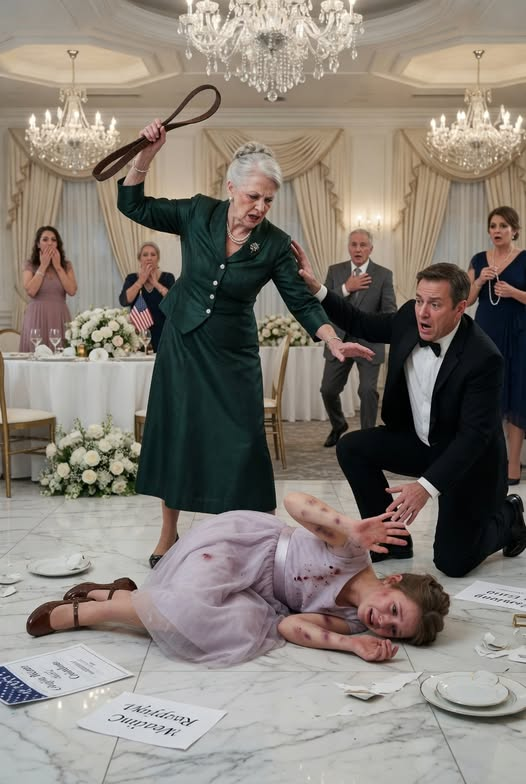
At my parents’ anniversary party, my sister took off her belt. She hit my 8-year-old daughter in front of 50 guests. My parents pinned her to the floor.
For most of my life, I knew the Crawford family had rules.
I just did not understand until that night that my daughter had been born into one without ever agreeing to it.
My name is Joanna Crawford Hale, and I grew up being told that family loyalty meant silence.
My father, Roger Crawford, called it discipline.
My mother, Diane, called it grace.
My sister Paige called it hierarchy, which was always just cruelty wearing better jewelry.
Marcus, my husband, had seen through them years before I did.
He noticed the way my mother could scan a room and decide who mattered before she even said hello.
He noticed the way my father’s voice got louder when waiters, nurses, assistants, or younger relatives did not move quickly enough.
He noticed the way Paige treated apology as something other people owed her.
I defended them longer than I should have.
That is one of the hardest truths to admit.
I did not defend their actions, exactly.
I defended the idea that people could be better in private than they were in public.
Then Ivy came along.
Ivy was 8 years old, curious in the way children are before the world teaches them that questions can be dangerous.
She collected smooth stones, named every neighborhood cat, and believed fancy events existed mostly so she could look at flowers and cake.
She had my mouth and Marcus’s serious eyes.
She also had a soft little habit of pressing two fingers against my wrist whenever she entered a crowded room.
It was her way of asking whether she was safe.
I had always squeezed back.
At 5:13 p.m. on the day of the anniversary party, I fastened the pearl buttons on her pale blue dress.
She turned in front of the mirror and asked whether Grandma Diane would like it.
I said, “Of course she will.”
I hated myself for how quickly the lie came out.
The invitation had arrived three weeks earlier, cream-colored cardstock with gold lettering and my mother’s preferred kind of elegance.
Forty Years of Marriage.
Roger and Diane Crawford.
Formal Attire Required.
There was a handwritten note at the bottom in Diane’s tight script: We expect the whole family.
Marcus read it once and put it on the kitchen counter.
“You know this will be miserable,” he said.
I did.
But old families train you to confuse attendance with love.
So we went.
The country club ballroom looked like it had been built for people afraid of sincerity.
White lights glittered around enormous flower arrangements.
Crystal chandeliers hung over round tables dressed in champagne-colored cloth.
A string quartet played near the front windows, soft enough that nobody had to admit they were listening.
My parents stood by the entrance like monarchs receiving tribute.
My father wore a tuxedo and a smile that looked practiced in boardrooms.
My mother wore a silver gown and enough diamonds to make every other woman in the room instinctively touch her own necklace.
“Joanna, you came,” she said when we reached her.
Her eyes moved over my dress, Marcus’s suit, then Ivy’s shoes.
Nothing about her face changed, but I felt the inspection like cold water down my back.
Ivy whispered, “Hi, Grandma.”
Diane bent slightly, not enough to be warm.
“Don’t spill anything on that dress,” she said.
That was the first warning.
The second was the seating chart.
Paige and her husband and Tanner were at Table 2, near my parents, near the cake, near the center of every photograph.
We were at Table 7, near the kitchen doors.
Marcus looked at the little card and murmured, “Charming.”
I told myself not to react.
That had been my job in the family for years.
Do not react.
Do not embarrass anyone.
Do not make the ugly thing uglier by naming it.
Paige arrived fifteen minutes later in a designer dress the color of ivory champagne.
Her son Tanner walked ahead of her, 12 years old and already carrying himself like a man who expected doors to open before he touched them.
Paige kissed my mother on both cheeks.
Then she looked at Ivy and smiled.
It was not a kind smile.
“Pretty dress,” she said. “Try to keep up tonight.”
Ivy looked at me, confused.
I placed my hand on her shoulder.
“Go sit with your dad, sweetheart.”
The speeches began at 7:05 p.m.
I remember the time because Marcus checked his phone under the table and showed me the screen with raised eyebrows.
Dad’s business partner spoke first.
He praised Roger’s leadership, Diane’s elegance, and the Crawford family’s “commitment to tradition.”
Aunt Felicity followed with a polished little speech about childhood summers and family values.
Then Paige stood.
She held her champagne flute with one wrist bent just enough to show her bracelet.
“My parents taught me family hierarchy,” she said. “Some are born to lead, others to serve.”
People laughed because they thought they were supposed to.
Ivy frowned.
She did not understand the joke.
That was because it was not a joke.
Dinner came in courses.
Filet mignon.
Chilean sea bass.
Tiny vegetables arranged like evidence.
The sommelier explained the wines while my father nodded like he had personally approved the weather in the vineyard.
For a while, nothing happened loudly.
That is how these families work.
The pressure builds under linen and crystal until everyone can pretend the table cracked for no reason.
Tanner grew restless during dessert service.
He pushed his chair back, walked around Table 2, then came toward Ivy with the lazy confidence of a boy who had never been told no by anyone who mattered.
“Come help me with dessert,” he said.
Ivy looked at me.
“No, thank you,” she said softly.
Tanner grabbed her arm.
His fingers closed around her wrist hard enough that her face changed.
Marcus stood so quickly his chair scraped the floor.
“Absolutely not.”
Paige laughed from behind Tanner.
“The eldest grandson, the heir,” she said. “She has to serve the boys.”
I thought I had misheard her.
Sometimes your mind gives you one last mercy before it lets the truth in.
My mother appeared beside us almost instantly.
“Tanner is the king of the family,” she said, as if she were explaining a seating arrangement.
Dad came up behind her.
“She’ll learn her place,” he said.
The room did not stop yet.
That may be the part I remember with the most anger.
People heard it.
They saw it.
But the music still played, and knives still touched plates, and someone at Table 4 laughed too loudly at something that was not funny.
I stood and pulled Ivy behind me.
“We’re leaving.”
Marcus reached for Ivy’s other hand.
Paige moved first.
She caught Ivy’s wrist and yanked her sideways.
Ivy stumbled, her little dress twisting around her knees.
“Paige,” I said.
My sister’s hand went to the belt at her waist.
The buckle scraped through the loop.
It was such a small sound.
Metal against fabric.
Then the room seemed to inhale.
Ivy said, “Mom?”
That one word has never left me.
The first strike landed across her arm and shoulder.
The sound was clean and flat.
A belt does not sound like discipline.
It sounds like the end of every lie adults tell about keeping children safe.
Ivy screamed.
I lunged.
My mother grabbed me from behind.
Her fingers dug into my upper arms with a strength I had never felt from her before.
“Do not embarrass this family,” she hissed.
Marcus shoved past his chair.
My father stepped in front of him, blocking him with both hands.
“Control your wife,” Roger snapped.
Marcus looked like he might tear the room apart.
Paige hit Ivy again.
“Feed your brother or get out!” she shouted. “You’re useless!”
Ivy tried to crawl away.
My father turned from Marcus and grabbed her.
For one second I thought he was going to lift her, protect her, end it.
Instead he pinned her to the floor.
He put one hand on her shoulder and forced her down while Paige stood over her with the belt.
That was the moment something inside me went very still.
Not numb.
Not helpless.
Still.
There is a kind of rage so cold it stops shaking.
I could feel my nails cutting my palms.
I could see a champagne bottle within reach.
I pictured it breaking against the table, pictured glass in my hand, pictured Paige stepping back afraid for the first time in her life.
Then I heard Ivy sob.
“Mommy.”
I looked at her.
“Ivy, look at me,” I said. “Baby, look at me.”
She tried.
Paige whipped her arms.
Her legs.
The belt struck fabric and skin, again and again, while my mother held me and my father held my daughter down.
Aunt Felicity stood with her water glass.
For one insane second I thought she was about to help.
She poured ice water over Ivy’s head.
“Stop crying!” she said.
The water darkened Ivy’s hair and soaked the front of her dress.
The room froze then.
Forks hovered halfway to mouths.
A waiter stood near the kitchen doors with a silver tray shaking in both hands.
A violinist lowered her bow.
Red wine spread across a tablecloth where someone’s glass had tipped without anyone reaching for it.
One guest stared at the centerpiece as if white roses could absolve him from what he was seeing.
Nobody moved.
That silence became part of the injury.
I have thought about that often.
Paige caused the bruises.
Roger held her down.
Diane restrained me.
Felicity humiliated her.
But an entire ballroom taught my daughter to wonder if she deserved it.
Marcus saw his phone on the floor near his shoe.
He had dropped it when my father shoved him back.
The screen was lit.
One call still active.
Later, the call log would show 7:46 p.m.
The country club front desk had answered.
That detail mattered.
So did the security incident report.
So did the waiter’s video.
So did the fact that the Crawford Foundation gala committee had three members in that room who later claimed they had seen “only the aftermath.”
But in the moment, all I saw was Paige raising the belt again.
Then the ballroom doors opened.
Two staff members came in first.
Behind them was a woman in a navy blazer with a radio clipped to her belt.
Behind her came a man I recognized from the club’s board photographs near the entrance.
My father’s expression changed before anyone said a word.
For the first time all night, Roger Crawford looked uncertain.
The woman in the navy blazer looked at Ivy on the floor, soaked and shaking.
Then she looked at Paige’s belt.
“Sir,” she said to my father, “take your hand off the child.”
He blinked.
My mother’s grip loosened.
I twisted free so hard I nearly fell.
Marcus reached Ivy first.
He dropped to his knees, pulled her against him, and covered her with his jacket.
She clung to him with both hands.
Paige still held the belt.
That was one of the first things the incident report would note.
Aggressor was still in possession of object used to strike minor child.
My father tried to stand tall again.
“This is a private family matter,” he said.
The board member looked at him without blinking.
“Not in my ballroom,” he said.
Then the waiter near the kitchen doors raised his hand.
He was young, maybe 19 or 20, with a face so pale I thought he might faint.
“I recorded it,” he said. “From the first strike.”
That sentence did what Ivy’s screaming had not done.
It made the guests move.
People shifted in chairs.
Someone whispered, “Oh my God.”
Aunt Felicity set the empty water glass down with a little click that sounded enormous.
Paige looked at the waiter, then at the belt, then at the people watching her.
Tanner stepped backward.
My mother said, “This is being misunderstood.”
I turned on her.
For the first time in my life, I did not soften my voice.
“No,” I said. “It was finally understood.”
The woman in the navy blazer spoke into her radio.
She gave the ballroom name, the words minor child, physical assault, and immediate assistance required.
Roger’s face went red again.
“You will regret humiliating this family,” he said to me.
Marcus stood with Ivy in his arms.
His voice was quiet.
“Roger, the only reason you are still standing is because I am holding my daughter.”
That was the second time the room went silent.
The first officers arrived within minutes.
I do not remember the exact number of minutes because my entire body had narrowed to Ivy’s breathing.
But the police report later listed the call dispatch at 7:49 p.m. and arrival at 7:56 p.m.
Seven minutes.
Seven minutes can be a lifetime when your child is wet, shaking, and asking why nobody stopped it sooner.
An officer asked who the child’s mother was.
I said, “Me.”
My voice did not sound like mine.
He asked if I wanted medical evaluation.
“Yes,” Marcus and I said at the same time.
Paige began crying then.
Not with remorse.
With outrage.
“She was being disrespectful,” she said. “She embarrassed Tanner.”
The officer looked at her belt.
Then he looked at Ivy.
Then he asked Paige to put the belt down.
She refused at first.
That refusal was in the report too.
Roger tried to intervene.
Diane tried to explain.
Aunt Felicity said something about children needing boundaries.
The young waiter sent the video to the officer before anyone could pressure him to delete it.
That young man did more for my daughter than 50 invited guests.
I think about him often.
At the hospital, Ivy let the nurse examine her only if Marcus stayed where she could see him and I held her hand.
Bruises were documented across her arms and legs.
There was swelling along one shoulder.
The nurse photographed everything with a careful tenderness that nearly broke me.
Ivy watched the camera flash and asked whether she was in trouble.
“No,” I said.
She did not believe me right away.
That is what violence does to children.
It makes them search themselves for the reason adults failed them.
The next morning, my phone was full of messages.
Some relatives said they were shocked.
Some said they had not seen everything.
Some said we should avoid making this public because my parents were important people.
My mother sent one text at 6:18 a.m.
You are destroying your father.
I stared at it for a long time.
Then I took a screenshot.
After that, I stopped answering emotionally and started documenting everything.
The hospital discharge papers.
The police report number.
The country club incident report.
The waiter’s video file.
The guest list.
The seating chart.
The text messages.
The timestamped call log from Marcus’s phone.
Every artifact told the same story my family wanted softened.
Paige struck an 8-year-old child with a belt.
Roger pinned that child to the floor.
Diane restrained the mother.
Aunt Felicity poured ice water on the child.
Fifty guests watched.
Only a stranger documented the truth.
Child Protective Services contacted us as part of the investigation because Tanner was also a minor in a home where violence had been called discipline.
That part surprised Paige more than the police did.
She had expected outrage from me.
She had not expected systems.
My father expected his name to fix it.
It did not.
The video made that impossible.
Several guests tried to revise their statements until investigators showed them what the recording captured.
People become very specific when silence is no longer deniable.
Aunt Felicity claimed she had poured water to “calm the child down.”
The video showed Ivy already on the floor, already crying, Paige already holding the belt.
Diane claimed she was restraining me to prevent a fight.
The video showed me trying to reach my daughter.
Roger claimed he had been “holding Ivy still so she would not injure herself.”
The video showed his hand forcing her shoulder down.
Paige claimed she had lost control for one second.
The video showed multiple strikes.
There are people who only tell the truth when lying becomes more expensive.
My parents learned that slowly.
The legal process was not clean or cinematic.
There were continuances.
There were statements.
There were relatives who wanted me to “think of the family.”
I told them I was.
I was thinking of the only family in that room who had needed protection and did not get it from them.
Paige eventually faced charges connected to the assault.
Roger’s actions were also reviewed because of the video and the officer’s report.
I will not pretend every consequence felt equal to the damage.
No verdict, no report, no public embarrassment can erase the way Ivy looked at me from the floor.
But consequences did come.
The country club revoked my parents’ event privileges.
The Crawford Foundation quietly removed Roger from several public-facing roles while the investigation unfolded.
Guests who had built careers on being seen at my parents’ table suddenly discovered moral language.
That was almost funny.
Almost.
We put Ivy in therapy with a child trauma specialist.
For weeks, she asked whether belts were allowed in our house.
Marcus removed every belt from our closet and put them in a sealed box in the garage until she felt safe again.
He did not make a speech about it.
He just did it.
One night, about two months later, Ivy came into the kitchen while I was washing a mug.
She said, “Mommy, I thought Grandma loved rules.”
I turned off the water.
“She does,” I said carefully.
Ivy looked at me.
“But not the right ones?”
I sat on the floor and pulled her into my lap.
“No,” I said. “Not the right ones.”
Healing did not arrive like a grand finale.
It arrived in tiny returns.
Ivy wore blue again.
She asked to go to a birthday party.
She laughed without checking the doorway first.
She stopped apologizing when adults nearby raised their voices.
The first time she asked Marcus to help her buckle a new pair of sandals, he looked at me over her head with tears in his eyes.
We did not attend another Crawford family event.
Diane sent letters.
Roger sent messages through attorneys.
Paige sent nothing for a long time, then one apology that mentioned “stress,” “miscommunication,” and “everyone’s emotions running high.”
I did not answer.
An apology that cannot name the harm is just another performance.
Ivy asked once whether she had to forgive them.
I told her forgiveness belongs to her.
Safety belongs to us.
Years of family training made that sentence feel rebellious.
Now it feels like the first honest rule I ever gave her.
An entire ballroom taught my daughter to wonder if she deserved it.
So we built a different room around her.
One where no child serves a boy because he was called an heir.
One where no adult hides violence behind tradition.
One where silence is not mistaken for loyalty.
And one where, when Ivy presses two fingers against my wrist, I squeeze back and mean it.