Eight days after Noah was born, Emily still moved through the apartment like her body belonged to someone else. Every step tugged somewhere deep. Every sound from the bassinet pulled her awake before she had fully slept.
The new apartment had been Michael’s pride when they moved in. He called it their fresh start, though Emily had paid the deposit from savings she built during years of double shifts and careful grocery lists.
Michael liked the parts of fatherhood people could photograph. He assembled the crib, posed with tiny socks in his palm, and sent smiling updates to relatives. At night, when Noah cried, Emily was usually the one standing.
She had excused it at first. He worked early. He was nervous. He said babies were better with mothers. She told herself marriage was full of uneven seasons, and this was simply one of them.
But the unevenness had a pattern. Michael wanted praise for effort before effort actually happened. He wanted credit for loving his family while Emily carried the weight of keeping that family alive.
His thirtieth birthday had been on the calendar for months. Dinner, drinks, a rented lake house, and a bill that made Emily stare at their checking balance longer than she admitted.
“I already paid,” he said whenever she questioned it. “It’s one weekend.”
One weekend meant $1,260 they did not have easily. One weekend meant Emily counting diapers and formula samples while Michael tried on a new white shirt in the hallway mirror.
By the eighth day after delivery, Emily knew something was wrong before she could name it. The cramps had changed. The heaviness had become a pull, then a rush that made the nursery tilt.
She was standing beside Noah’s crib when the first warm spill ran down her legs. For a breath, she did not understand it. Then she saw the cream-colored carpet begin to darken beneath her bare feet.
The nursery smelled of baby powder, laundry detergent, and copper. Noah made small fussy sounds in the crib. The dishwasher hummed from the kitchen, steady and useless in the middle of panic.
Emily grabbed the crib rail with one hand and pressed the other beneath her shirt. Her hospital bracelet was still on her wrist, cloudy plastic against swollen skin. She called Michael’s name once.
He came from the walk-in closet with his carry-on bag and his phone in his hand. The bag still had a store tag hanging from it, swaying like some ridiculous party decoration.
“Call 911,” Emily said. “I need to go to the hospital.”
Michael stopped several feet away. His eyes went to the floor, then to his watch, then back to his phone. He looked annoyed before he looked frightened, and Emily would remember that forever.
“Not today,” he said quietly. “My ride is downstairs.”
Emily thought she had misheard him. Noah began to cry harder. She tried to shift her weight, but her knee slid on the carpet and her fingers streaked red against the crib rail.
“This isn’t a mood,” she said. “This is blood.”
Michael’s jaw tightened. “Mom warned me you might get emotional after the baby.”
There were sentences that ended a marriage before anyone said divorce. Emily felt that one land. Not because it was loud. Because it told her exactly whose voice had been in his ear.
Michael’s mother had picked the nursery carpet and criticized the apartment before the boxes were unpacked. She liked rooms to look clean, babies to stay quiet, and wives to stop complaining before men noticed.
Emily had tried for years to be easy. She remembered birthdays, mailed cards, cooked meals, and softened Michael’s careless comments in front of other people. She called it peacekeeping because the other word was fear.
At 4:49 p.m., Michael looked down at his phone again. Emily saw the glow on his face. She saw the impatience. She saw him choosing the version of himself waiting downstairs.
“I paid $1,260 up front,” he said. “I’m not canceling everything because you want attention.”
Noah screamed then. Emily reached toward the phone on the floor, but her arm shook too badly. She told Michael to call her sister, call an ambulance, call anyone.
He zipped his suitcase instead.
“If it’s bleeding, put a towel down,” he said. “And don’t ruin my day.”
Emily grabbed his pant leg with two fingers. It was not dramatic. It was not strong. It was the smallest plea a person could make while trying not to pass out beside a crib.
“Look at me,” she whispered.
Michael pulled free. “Don’t use the baby to blackmail me.”
Then he left. The apartment door clicked, the elevator chimed, and the ordinary sounds of the building kept going as if a woman was not bleeding on a nursery floor eight days after childbirth.
For one ugly second, Emily wanted to throw something. She wanted to scream loud enough for every neighbor to know his name. But rage requires energy, and survival had already claimed what she had left.
Her phone lay near the closet. She hooked it with one fingernail and dragged it across the carpet. The screen smeared beneath her thumb before it recognized her touch.
At 5:03 p.m., Michael’s story appeared before she could dial. A glass of whiskey. A cake with the number thirty. The caption read: Birthday. Friends. Whiskey. Peace. Zero drama.
The first contact she called was not Michael. It was Sarah, the social worker from the prenatal clinic, whose number Emily had saved after an awkward conversation she had insisted was unnecessary.
“Emily?” Sarah answered. “Can you speak?”
Emily could hear Noah crying beside her shoulder. She could hear her own breathing turning shallow. She said the only words she could keep in order: “Blood. Baby. Husband left.”
Sarah did not waste time with disbelief. She asked whether the door was locked, whether the baby was breathing normally, whether Emily could stay awake. Her voice became a rope Emily held onto.
By 5:18 p.m., there was pounding at the apartment door. The building manager arrived with a locksmith because Sarah had called ahead and explained enough to make delay impossible.
By 5:22 p.m., a paramedic was kneeling beside Emily. Another set of hands lifted Noah from the crib. Someone said to document the room exactly as it was.
Photos were taken of the carpet, the crib rail, the phone screen, and the towel Emily had never reached. The hospital intake form later matched the time of the call and the condition they found her in.
At the hospital, Emily learned how close she had come to leaving Noah without a mother. The words were spoken gently, but there is no gentle way to describe a body losing too much blood.
Sarah stayed long after the first forms were finished. She asked about the lease, the deposit, the locks, and whether Michael had ever threatened to take the baby. Emily answered slowly, ashamed of every yes-adjacent silence.
The lease file changed everything. Michael had called the apartment his because he liked saying it. Legally, Emily was the primary tenant. The deposit receipt carried her name. His signature listed him only as an authorized occupant.
That did not fix the hurt. Paperwork cannot hold a newborn at midnight or unhear a cruel sentence. But paperwork can become a door when a woman has been told every exit is locked.
Sarah helped Emily contact the apartment office, the hospital records desk, and the county clerk. The process was not cinematic. It was forms, signatures, waiting chairs, and a paper coffee cup going cold beside Emily’s bed.
Her sister took Noah home from the hospital and packed what Emily needed from the apartment. Baby clothes, documents, medication, diapers, the small blue blanket from the crib. Nothing more than what mattered.
The nursery carpet was photographed, tagged in the incident notes, and a damaged strip was preserved after the apartment manager approved removal. The carpet by the crib had become evidence, just as surely as the timestamped story had.
Michael did not come home that night. He sent one text after midnight asking why Emily was “making this weird.” She did not answer. The screenshot went into the same folder as everything else.
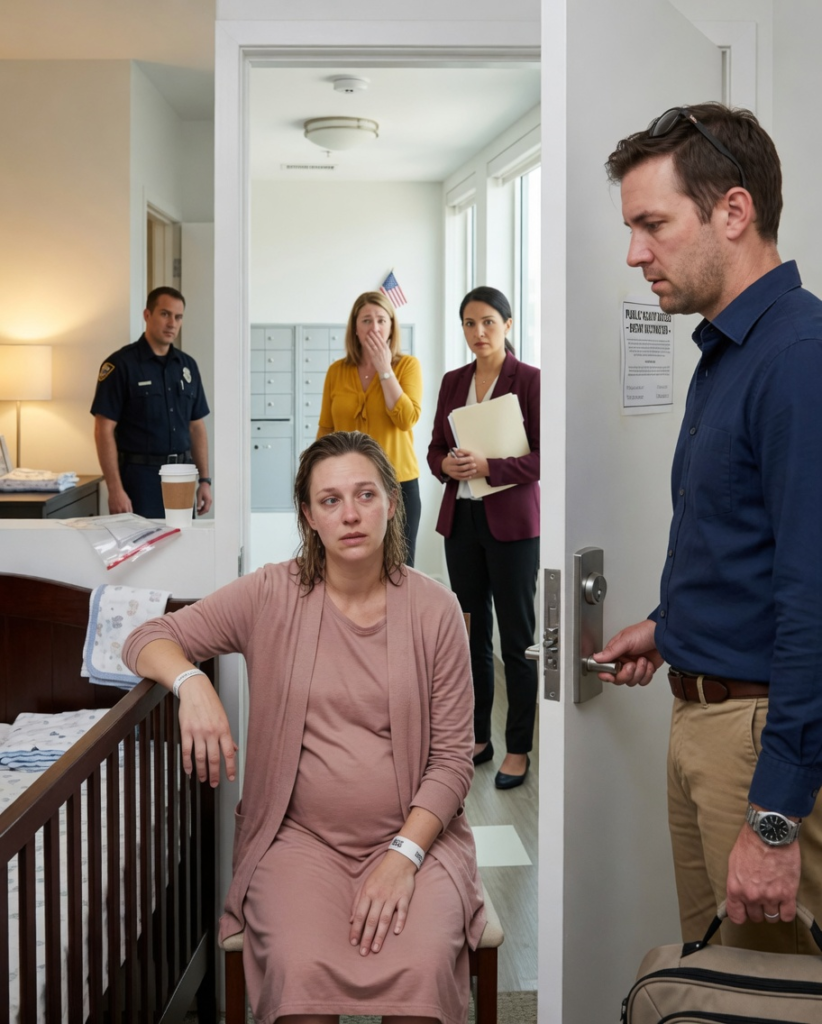
Three days later, Michael returned at 9:37 a.m. with sunglasses on and his birthday bag still in his hand. He expected the lock to open because men like Michael often confuse access with ownership.
The key would not turn.
A white notice with a county clerk stamp was taped to the door. The building manager stood near the mailboxes, and Sarah stood inside the apartment with a file folder against her chest.
Michael demanded to know where his son was. Sarah told him Noah was safe. She did not raise her voice. That calm seemed to frighten him more than anger would have.
Inside the nursery, the crib remained. The room was otherwise bare. On the mattress lay Noah’s folded baby blanket, placed over a clear evidence sleeve and the lease copy Michael had never bothered to read.
When Sarah explained what had been filed, Michael’s face changed. First came outrage. Then calculation. Then fear, thin and unmistakable, when he realized the story no longer belonged only to him.
His mother arrived later and tried to call it a misunderstanding. The building manager, who had seen the carpet and the hospital bracelet, turned away from her. Some defenses collapse when ordinary witnesses refuse to carry them.
The family court hallway was colder than Emily expected. She sat with Noah’s blanket folded in her bag and listened while professionals used measured words for the worst afternoon of her life.
There was no grand speech. There was no perfect revenge. There were temporary orders, custody conditions, medical records, and a quiet instruction that Michael was not to contact Emily except through approved channels.
Michael’s birthday photos disappeared from his page by evening. The screenshots did not disappear from the file. That was the first lesson Emily learned about proof: vanity loves an audience until the audience includes a judge.
Recovery took longer than people wanted it to. Emily still woke at the sound of elevators. She still felt her chest tighten when Noah cried too suddenly. Healing did not make the memory smaller right away.
But the apartment became quiet in a different way. Her sister brought groceries. Sarah checked in. The building manager left a paper coffee cup outside the door one morning with a note that simply said, “For when you’re ready.”
Months later, Emily replaced the nursery rug with a soft blue one she chose herself. She kept the crib near the window, where morning light touched the rail Noah liked to grip when he learned to stand.
She did not keep the old carpet. She kept the lesson.
The carpet by the crib had become evidence, but it had also become a line in Emily’s life. Before it, she had survived by making herself smaller. After it, she stopped mistaking silence for peace.
Noah would never remember the day his father walked out. Emily would. One day, when he was old enough, she would tell him a simpler truth: love is not who takes pictures beside you. Love is who stays when help is needed.
And on the first birthday Michael missed, Emily lit one small candle on a grocery-store cupcake, held Noah on her hip, and stood in the kitchen with the window open.
The dishwasher hummed. Sunlight crossed the floor. Noah laughed at nothing, the way babies do when the world still feels safe.
This time, it was.