There is a specific, profound kind of silence that you can only purchase with a decade of eighty-hour work weeks. It isn’t merely the absence of noise. It is the absolute absence of obligation. It is the rhythmic sound of rain tapping against triple-pane glass that you paid for with your own sweat, in a house you designed with your own mind, on a plot of land that bears your name—and only your name—on the deed.
My name is Carter. I am thirty-six years old, and I work as a remote architectural consultant for high-end commercial projects. Until a bitterly cold Tuesday evening, I was living in my own carefully constructed paradise.
My home isn’t a sprawling, ostentatious mansion. It is a modern, two-story A-frame sitting on three acres of rugged, wooded land overlooking the gray expanse of Lake Superior. It is isolated, battered by the wind, and freezing for half the year. It is exactly the fortress I require. I spent four grueling years building this place. I laid the exterior deck plank by plank. I sanded the exposed timber beams in the vaulted living room until the friction practically erased my fingerprints. Every iron fixture, every driven nail, represents a physical boundary I established between myself and the chaos of the world.
More specifically, it represents the boundary between myself and my family.
I love my parents, Arthur and Martha, in the abstract, detached way one might love a hurricane that has finally moved out to sea. You appreciate the raw, terrifying power of it, but you pray to whatever gods will listen that it never parks over your roof again. For the past two years, I had maintained what my therapist gently called “low contact.” I sent generous gift cards on birthdays. I made the requisite twenty-minute phone calls on Thanksgiving. I kept my answers short, polite, and completely devoid of any real details regarding my finances or my personal life.
The peace broke on a Tuesday.
I was deep in a state of flow in my loft office, finalizing a complex rendering for a firm in Chicago. My noise-cancelling headphones were securely on, shutting out the storm outside. My phone lay face down on the polished oak desk, set firmly to Do Not Disturb.
I didn’t hear the vehicle crunching up the quarter-mile gravel driveway. What broke my concentration was a sudden, sweeping arc of light. A pair of intense high-beam headlights sliced through the floor-to-ceiling windows, throwing harsh, moving shadows against my vaulted ceiling like searchlights sweeping a prison yard.
A cold dread coiled tightly in my gut. I pulled my headphones down, the sudden roar of the rain hitting the glass rushing into my ears. I walked to the edge of the loft and looked down.
It wasn’t a lost Amazon delivery driver.
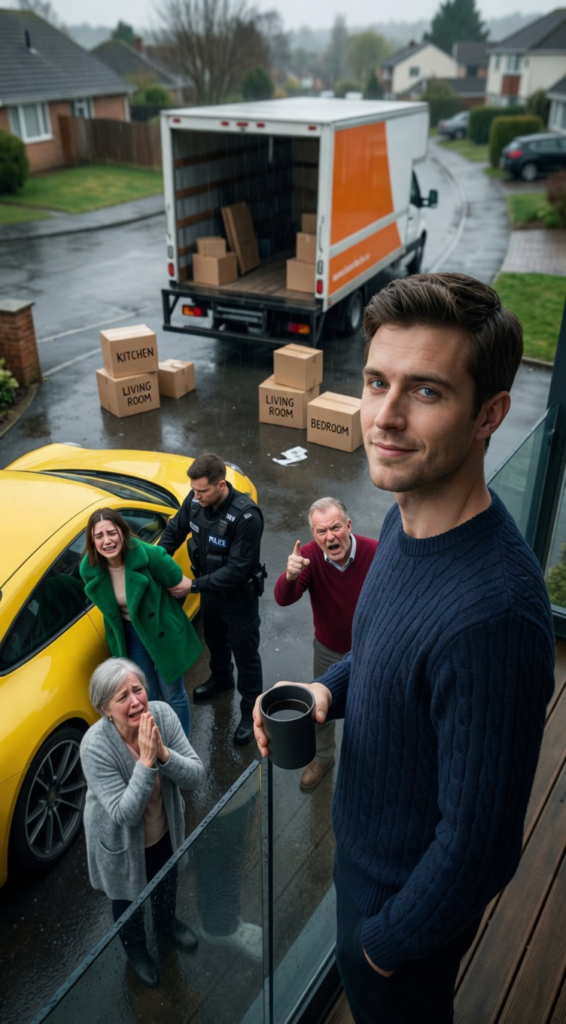
Idling on my driveway, its massive exhaust pipe spewing thick white smoke into the freezing rain, was a twenty-six-foot U-Haul moving truck. Behind it sat a beige Buick LeSabre.
My father’s car.
My brain refused to process the visual data. Why are they here? I snatched my phone from the desk. Beneath the crescent moon icon of the Do Not Disturb setting sat a terrifying cascade of notifications. Fifteen missed calls. Twelve frantic text messages.
Almost there. Traffic is awful.
Hope you have the driveway cleared.
Pick up the phone, Carter.
You do not rent a twenty-six-foot truck for a surprise visit. You rent a truck that size when you are uprooting your entire existence from Point A and dumping it at Point B. And Point B, God help me, was my driveway.
I watched, frozen, as the heavy door of the Buick groaned open. Arthur stepped out. He was sixty-five, a large, imposing man who had spent his entire life operating under the delusion that volume and authority were the exact same thing. He pulled his coat collar up against the biting wind and pointed aggressively at my front door. Martha emerged from the passenger side, clutching her oversized purse to her chest like a shield, looking frail and frazzled.
They did not look like parents dropping by to say hello. They looked like an invasion force preparing to breach the walls.
I descended the floating staircase, my palms slick with sweat. This is my house, I repeated to myself like a mantra. My deed. My rules. But as I flipped the exterior floodlights on, illuminating the driveway in a harsh, clinical white, I knew the hurricane had turned back. It was making landfall.
Arthur winced at the sudden light, spotted me through the glass door, and gave a dismissive, commanding flick of his wrist—a hurry up and open the door gesture. Instantly, I was sixteen again, being ordered to mow the lawn while my sister slept in until noon.
I unlocked the deadbolt and stepped out onto the covered porch, but I did not step aside. I planted my body firmly in the center of the doorframe.
“Dad. Mom,” I said, projecting my voice over the idling diesel engine. “What is going on?”
Arthur marched up the wet wooden steps, entirely bypassing any familial greeting. “Carter, thank God. The GPS on this rig is absolute garbage. Grab a coat. We need to start unloading the back before the mattresses get soaked.”
He reached for the door handle, fully expecting me to melt out of his way. I didn’t. I placed my hand flat against the door frame, stiff-arming my own father.
“Whoa, hold on,” I said, my voice dropping an octave. “Unloading? What mattresses? Dad, why are you here?”
Arthur stopped, his face contorting into a mask of pure indignation. “We’re moving in, Carter. Obviously. Now get out of the way, it’s freezing out here.”
“Moving in?” The words tasted like ash in my mouth.
Martha hurried up the steps, shivering dramatically, her eyes already welling with tears. “Oh, Carter, please don’t be difficult. It’s been the worst day of our lives. We’re utterly exhausted. Can we just go inside and have some hot tea?”
“Mom, I’m sorry you’re tired, but you can’t just show up with a U-Haul,” I said, my stance unwavering. “You have a four-bedroom house in Ohio. Why are you here?”
Arthur let out a heavy, explosive sigh. “We don’t have a house, Carter. We sold it. Closed at two o’clock this afternoon. Handed over the keys.”
The world seemed to tilt dangerously on its axis. “You sold the house? Why?”
“To save Chloe, obviously!” Martha cried out, her voice cracking. “Your sister was in terrible trouble. The bank was going to foreclose on her condo. They were threatening legal action. We couldn’t let our little girl go to jail or end up on the street!”
Chloe. My younger sister. The golden child. The thirty-year-old princess who had never heard the word “no” in her life.
“Let me make sure I am grasping this,” I said, speaking slowly, enunciating every syllable. “Chloe had debt. So you sold the house you’ve lived in for thirty years to pay it off.”
“We used the equity to clear her name,” Martha sobbed. “We’re completely broke, Carter. We gave the rest of the cash to her so she could get back on her feet. And since you have this massive, empty place, we figured we would take the ground floor suite.”
“You figured?” I asked, my grip on the doorframe tightening until my knuckles ached. “You didn’t think a phone call might be appropriate before you rendered yourselves homeless?”
“We are your parents!” Arthur roared, his face flushing a dangerous shade of purple. “We don’t need permission to stay with our son in a crisis. Family helps family. Now move!”
He stepped forward, actually planting his hands on my chest to physically shove me out of the way.
It was a fatal miscalculation. Something inside me—years of repressed anger, decades of being the family’s financial shock absorber—finally snapped. It wasn’t a loud break; it was a structural collapse. I shoved him back. Hard.
Arthur stumbled backward, his boots slipping on the wet wood, grabbing the railing to keep from falling. He stared at me in absolute shock.
“No,” I said, my voice harder than the stone foundation of the house. “You are not bringing a single cardboard box into my home.”
Martha shrieked. Arthur recovered his balance, his fists clenching, his eyes locking onto mine with a terrifying, desperate fury. He wasn’t going to take no for an answer. He took a heavy step forward, the wood of the porch groaning under his weight, preparing to force his way inside by any means necessary.
I slammed the heavy oak door shut just as Arthur’s shoulder hit the wood. The impact shuddered through the floorboards. I threw the primary deadbolt, then the secondary security chain, my heart hammering against my ribs like a trapped, panicked bird.
Through the thick, insulated glass, I could hear Arthur screaming my name, followed by the heavy, rhythmic thud, thud, thud of his boots kicking the bottom of the door.
I backed away into the dimly lit hallway, my hands trembling violently—not from fear, but from a massive surge of adrenaline. The nuclear option had been deployed. I had finally said no.
I knew the terrifying reality of tenancy laws. If I let them cross that threshold with their boxes, if they spent even a few nights under my roof, they would establish residency. I would have to drag my own parents through a months-long legal eviction process to ever get them out. They would become a permanent, cancerous fixture in my sanctuary.
I walked over to the wall-mounted smart-home tablet and pulled up the security camera feeds. The night vision rendered the porch in stark black and white. Arthur was pacing like a caged bear. Martha was slumped in one of the Adirondack chairs I had hand-painted just last summer, her face buried in her hands.
My phone buzzed in my pocket. Then it buzzed again. And again.
I pulled it out. The flying monkeys had been dispatched. In toxic family dynamics, abusers always recruit external forces to harass the boundary-setter. My phone screen lit up with texts from Aunt Diane, the undisputed gossip queen of our extended family.
Carter, I am looking at your mother’s Facebook post and I am physically shaking. How could you? They are elderly! You locked them out in a storm? You are a monster.
A cold sweat broke out on the back of my neck. I opened Facebook. There it was. A grainy, tear-stained selfie of Martha sitting in the dark front seat of the Buick. The caption was a masterpiece of manipulation: Heartbroken. Our own flesh and blood locked us out in the freezing rain after we sacrificed everything to save the family. We are homeless. Please pray for us.
Not a single mention of Chloe. Not a word about her debts.
I watched the camera feed. Arthur had given up on the door. He was marching around the perimeter of the house, a heavy flashlight in his hand, rattling the locked windows. When he found no entry points, he stopped in front of the gray utility box mounted on the exterior siding.
Don’t be stupid, Dad, I thought, my breath catching in my throat.
On the screen, he ripped open the metal panel and aggressively yanked the main breaker lever down.
The house plunged into absolute, suffocating darkness. The low hum of the refrigerator died. The glowing LEDs of the router blinked out. He thought he could freeze me out, or force the smart locks to disengage.
He had completely forgotten what I did for a living.
Five seconds later, a deep, mechanical thrum vibrated up from the basement. The dual Tesla Powerwall battery backups engaged. The lights flickered, stabilized, and washed the house in warm, defiant light.
I looked back at the iPad. Arthur was staring at the brightly lit windows, his mouth slightly open in utter confusion. He kicked the side of the house in frustration and stomped back to the Buick, slamming the car door behind him.
The night dragged on like a slow, agonizing fever dream. Around 2:00 AM, the dome light in the Buick clicked off. They had reclined the seats. They were actually going to sleep in my driveway to win a battle of attrition.
Sitting in the dark, wrapped in a heavy wool blanket, I opened my laptop. I needed raw data. I logged into the county property records database for their district in Ohio. I typed in their names. The sale record from that morning populated instantly.
Sale price: $620,000.
I stared at the screen, doing the math in my head. Their house had been paid off years ago. Even if Chloe’s debts were a catastrophic $200,000, that still left them with over four hundred thousand dollars in pure cash. Why were they sleeping in a car?
My fingers flew across the keyboard. I pulled up Chloe’s public Instagram profile. She had posted a story four hours ago. It was a boomerang video of her clinking a crystal glass of champagne in a pristine, luxurious hotel room at the Grand View Resort—a five-star spa two hours south.
The caption read: New beginnings! Manifesting abundance! Thanks Mom and Dad for believing in my vision. #CryptoQueen #GenerationalWealth
My blood ran ice cold. I scrolled down. Two days prior, she had posted a photo of a brilliant, canary-yellow Porsche Boxster convertible with a massive red bow on the hood.
They hadn’t just paid off her debt. They had liquidated their entire life’s work, handed her the cash, bought her a luxury sports car to project a “successful image,” and likely poured the remainder into whatever volatile cryptocurrency scam she was currently peddling.
They weren’t temporarily displaced. They were financially annihilated. They had bet their entire existence on Chloe’s delusions, and I was the backup plan they intended to bleed dry.
As the first gray, bleak light of dawn began to creep over the horizon, illuminating the soggy, collapsing cardboard boxes they had spitefully dumped on my lawn, I heard the distinct, high-pitched whine of a performance engine cutting through the morning mist.
A bright yellow sports car was turning down my gravel driveway. The golden child had arrived to claim her castle.
The yellow Porsche Boxster crept down the quarter-mile driveway, its low undercarriage scraping against the uneven gravel. It pulled up directly behind the U-Haul and gave two cheerful, obnoxious honks.
I stood on the second-floor balcony, a steaming mug of black coffee warming my hands, watching the theater unfold below.
Chloe hopped out of the driver’s seat. Despite the biting forty-degree weather, the convertible top was down. She wore oversized designer sunglasses and a pristine white faux-fur coat, looking as if she had just stepped off a film set rather than arriving at a hostage negotiation.
Arthur sat up in the Buick, rubbing his face vigorously. Martha practically fell out of the passenger door, her joints stiff, looking utterly miserable.
Chloe surveyed the soggy, ruined boxes scattered across my manicured lawn and visibly wrinkled her nose. “Ew,” she whined, her voice carrying easily up to the balcony. “Why is all our garbage outside? Did you guys seriously sleep in the car?”
“Carter wouldn’t open the door,” Martha croaked, wrapping her arms around herself for warmth.
Chloe tilted her head back and spotted me standing by the railing. She pulled her sunglasses down the bridge of her nose. “Carter! Stop being such a dramatic sociopath. Open the door. Mom looks like a zombie and I need to plug in my ring light.”
I took a slow, deliberate sip of my coffee. “Nice car, Chloe,” I called down, my voice flat and carrying over the wind. “Does it come with a heated garage, or do you sleep in the trunk?”
Chloe rolled her eyes dramatically. “Don’t be a jealous hater. It’s a business asset for my personal brand. Now come down here and unlock the door. I’m freezing.”
“You have four hundred thousand dollars in business assets,” I countered loudly. “Go buy a space heater.”
Her smug expression faltered, replaced instantly by the petulant rage of a toddler denied a toy. “It’s not liquid cash, you idiot! It’s capital investment! You wouldn’t understand because you’re a corporate slave working for a paycheck. I am building a decentralized empire! Mom and Dad are my seed investors. We’re going to quadruple their retirement in six months!”
“If your seed investors are so wealthy,” I yelled back, “why are they sleeping in a freezing Buick?”
Arthur slammed his car door, his face a mask of exhausted rage. He pointed a thick, shaking finger up at me. “That is enough! You do not disrespect your sister’s entrepreneurial spirit! We just need a place to stay while the portfolio matures. Six months, Carter. A year at the absolute most!”
“A year?” I laughed, a harsh, humorless sound that echoed off the pine trees. “You think I’m going to let you squat in my home while she plays venture capitalist with Monopoly money? You blew six hundred grand on a scam and a leased Porsche!”
“It’s not a lease!” Chloe shrieked, instantly defensive, confirming exactly what I suspected. “It’s a strategic financing vehicle! We just… we’re temporarily illiquid!”
Illiquid. A fancy word for destitute. They had literally zero dollars to their names.
“Go back to the spa, Chloe,” I said, turning my back on them. “And take your investors with you. You’re trespassing.”
I stepped back inside and slid the heavy glass balcony door shut, locking it with a satisfying click. I pulled the heavy blackout curtains, cutting off the sight of them, but I couldn’t block out the sound of Chloe screaming obscenities and violently kicking the cedar siding of my house.
I slumped against the kitchen counter, rubbing my temples. How does this end? I wondered. They had no exit strategy. They had burned their ships, and mine was the only island left.
A faint scratching sound drew my attention to the front door.
I walked quietly into the foyer. A piece of crumpled notebook paper had been forcefully shoved under the rubber weather stripping at the base of the door. I pulled it free and smoothed it out on the kitchen island. It was written in Martha’s elegant, looping cursive. The sheer audacity of the words made the breath catch in my throat.
Carter, since you are forcing us to negotiate like strangers, here are the terms for our residency.
Clause One: Dad and I will occupy the primary master suite on the first floor. Dad’s knees cannot handle stairs.
Clause Two: Chloe requires the upstairs guest room with the lake view for optimal natural lighting for her content creation.
Clause Three: You will move your office into the unfinished basement. You can buy space heaters.
Clause Four: We will contribute a combined $300 a month in rent. You will continue covering the mortgage, utilities, and property taxes, as it is legally your asset.
Clause Five: Family dinners are mandatory. You will cook five nights a week.
Sign below to accept.
My hands started to shake. It wasn’t adrenaline anymore. It was pure, unadulterated, blinding fury. They didn’t just want a roof over their heads. They wanted to strip-mine my life. They wanted to evict me from my own existence and relegate me to the concrete basement while they played royalty upstairs. All for three hundred dollars a month.
I grabbed a thick black Sharpie from the drawer. Across the entire page, in massive, jagged letters, I wrote two words: ABSOLUTELY NOT.
I marched to the front door, disengaged the deadbolt, but kept the heavy brass security chain locked. I opened the door exactly two inches and shoved the paper through the crack.
Arthur snatched it aggressively. He read my response, and the veins in his neck bulged against his collar.
“You selfish, ungrateful little bastard!” he bellowed, slamming his shoulder violently against the door. The chain pulled taut, groaning under the force, but the screws held deep in the frame. “I am your father! You owe me your life! Open this door!”
“I am thirty-six years old!” I roared back through the gap, my voice echoing in the small space. “I owe you nothing! Get off my property!”
I slammed the door shut and engaged the deadbolt. I leaned against the wood, my chest heaving, listening to Arthur kick the baseboards in a blind rage.
Then, over the sound of the kicking, I heard the heavy, rattling crunch of a commercial van tires on the gravel.
I lunged for the security tablet. Pulling up behind the Porsche was a battered white work van. On the side panel, in bold red lettering, it read: LAKESIDE LOCK & KEY – EMERGENCY SERVICES.
The blood drained from my face. Arthur was standing by the van, waving a wad of cash at a burly man in blue coveralls stepping out with a heavy-duty Makita drill in his hand. He wasn’t just trying to bully his way in anymore. He was paying a professional to break into my fortress.
I didn’t waste time thinking; I simply reacted. I sprinted into the living room, unlatched the heavy double-hung window, shoved the sash upward, and leaned halfway out into the freezing morning air.
“Hey!” I screamed, my voice tearing at my vocal cords. “Hey! Do not touch that door!”
The burly locksmith paused, his heavy drill lowering as he looked up at me, clearly startled. He glanced back and forth between me hanging out the window and Arthur standing furiously on the porch.
“He lost his keys!” Arthur shouted over me, stepping sideways to physically block the locksmith’s view of the window. “My son is inside. He’s… he’s mentally unstable. He’s having a severe episode and locked himself in. Just drill the core. I’ll pay you double your emergency rate right now.”
“I am the legal homeowner!” I roared, pointing a finger directly at the locksmith. “That man is trespassing! My name is Carter, and my name is on the deed. If you put a drill bit into that lock, I will sue your company into the ground, and I will have you arrested for aiding a breaking and entering!”
The locksmith took a wide, deliberate step backward. He looked at Arthur’s driver’s license, which Arthur was desperately trying to shove into his hands.
“Sir,” the locksmith said, his tone instantly shifting from helpful to suspicious. “Your ID says you live in Ohio. The plates on your car are from Ohio.”
“We just moved here yesterday!” Arthur lied, sweat beading on his forehead despite the cold. “This is our family vacation home. My son is squatting inside!”
“I have the property tax records, the utility bills, and the security codes!” I yelled down. “Leave the property now!”
The locksmith didn’t hesitate. He hooked the drill back onto his utility belt and held his hands up in surrender. “Look, buddy, I don’t get involved in domestic disputes. No proof of ownership, no service. Call the cops if it’s your house.”
Without another word, he spun around, climbed into his van, threw it in reverse, and backed up the quarter-mile driveway faster than I thought a commercial vehicle could move.
Arthur stood on the porch, his chest heaving, clutching his wallet in his hand. He looked at the retreating van, then slowly turned his gaze up to me. The mask had completely fallen. There was no fatherly authority left in his eyes—only raw, hateful vengeance.
He bent down, grabbed a heavy, painted ceramic garden gnome from the flowerbed—a stupid, ironic housewarming gift from Aunt Diane—and hurled it with all his strength directly at my face.
I ducked instinctively as the heavy ceramic smashed against the siding just inches below the window frame. A jagged chunk of shattered pottery ricocheted upward, striking the bottom pane of the window with a sharp CRACK, leaving a spiderweb fracture in the expensive glass.
“You ruined everything!” Arthur screamed, his voice breaking into a hoarse sob. “You ungrateful, hateful parasite! We sacrificed our lives for you!”
I stared at the shattered glass. I stared at the broken pieces of ceramic scattered in the dirt.
The line hadn’t just been crossed; it had been obliterated. This was no longer a toxic family dispute. This was destruction of property. This was violence.
I closed the window, locked it, and pulled my phone from my pocket. My hands were perfectly steady now. I didn’t call my therapist. I didn’t call Aunt Diane to argue.
I dialed 9-1-1.
“911, what is your emergency?” the dispatcher answered smoothly.
“I need a sheriff’s deputy at my residence,” I said, my voice eerily calm in the quiet house. “I have three hostile trespassers refusing to leave the premises. They have begun violently destroying my property, and I am in fear for my physical safety.”
“Are the trespassers known to you, sir?”
“Yes,” I replied, staring at the cracked glass. “They are my parents and my sister.”
Twenty minutes later, the crunch of gravel signaled the arrival of the law. I downloaded the security footage of Arthur cutting the power and throwing the gnome to my phone. I printed a copy of my property deed.
When I unlocked the front door and stepped onto the porch, a white Ford Explorer with SHERIFF emblazoned in gold letters had parked behind the Porsche. Its blue and red lights washed silently over the wet trees.
Deputy Miller, a broad-shouldered man I recognized from local town hall meetings, stepped out of the cruiser. He took one look at the U-Haul, the yellow sports car, the soggy boxes, and the shattered ceramic on the grass.
Arthur rushed forward instantly, employing his most respectable, aggrieved-citizen voice. “Officer! Thank God you’re here. My son is having a massive psychological breakdown. He’s locking us out of our own home. We just moved our entire lives here.”
Miller held up a hand, stopping Arthur in his tracks. He looked up at me standing on the porch. “Morning, Carter. Quite a mess you’ve got here. What’s the situation?”
“They don’t live here, Jim,” I said clearly. “They are trespassing. They showed up uninvited yesterday after selling their home in Ohio. They have never stepped foot inside this house, and I have formally denied them entry.”
Martha burst into dramatic tears, clutching Arthur’s arm. “We’re his parents! How can we be trespassing? We have an oral agreement to live here!”
“Do you have a lease, ma’am? Keys? Mail delivered here?” Miller asked, his voice neutral but firm.
“Well, no, because he locked us out!” Arthur sputtered indignantly.
“Then you haven’t established residency,” Miller stated flatly. “You are guests, and the property owner is revoking his invitation.”
Chloe scoffed from the hood of her Porsche. “We’re family, you rent-a-cop. It’s a civil matter. You can’t do anything.”
Miller’s jaw tightened. He looked at the shattered window. “Carter, you mentioned property damage on the call?”
I walked down the steps and handed Miller my phone. I played the crystal-clear night-vision video of Arthur tampering with the electrical breaker, followed by the daytime footage of him hurling the heavy ceramic gnome at my head.
Miller watched the videos in absolute silence. He handed the phone back to me and turned to Arthur. The polite, neighborly demeanor was entirely gone. His hand rested casually on his utility belt, inches from his handcuffs.
“Sir,” Miller said, his voice dropping to a dangerous register. “Did you intentionally cut the power to this residence and hurl a projectile at that window?”
“He provoked me!” Arthur shouted, pointing a shaking finger at me. “He was disrespecting me as his father!”
“Being a father doesn’t give you immunity from vandalism and criminal mischief,” Miller snapped. He squared his shoulders, looking at the three of them. “Here is how this is going to go. Option A: You pack your garbage back into that truck and vacate this property immediately, never to return. Option B: I arrest you for destruction of property, and I arrest your wife and daughter for criminal trespass. Make your choice right now.”
Absolute, suffocating silence fell over the driveway.
Chloe’s jaw dropped. Martha let out a terrified whimper. Arthur looked at Miller, realizing for the first time in his life that his volume and his demands meant absolutely nothing against the badge and the law.
Arthur slowly turned his head to look at me. His eyes were wide, pleading silently for me to call it off, to be the obedient son, to absorb their mistakes one last time.
I looked him dead in the eye, feeling the cold wind off the lake at my back.
“Option A sounds appropriate,” I said softly.
Arthur’s shoulders collapsed. The fight drained out of him, leaving only a hollow, defeated old man. He realized, finally and irrevocably, that the bridge was burned.
“Load the truck,” Arthur whispered to Martha. He looked back at me, his eyes filled with a venomous bitterness. “You are dead to us, Carter. You have no family.”
“I haven’t had a family in years, Dad,” I replied, turning my back on them. “I just had dependents.”
The fallout was as predictable as it was toxic.
By that evening, my extended family had formally declared war. My phone became a hazardous object, buzzing relentlessly with vitriolic text messages from cousins and aunts I hadn’t spoken to in a decade. They accused me of leaving my elderly parents to freeze on the streets. They claimed Martha was in the hospital with a stress-induced heart condition.
I didn’t argue. I didn’t defend myself in private messages. I executed a precise, surgical counter-strike.
I compiled the security footage: Arthur cutting the power, Arthur threatening the locksmith, Arthur shattering my window. I scanned the insane rental agreement demanding I live in my own basement. Finally, I took screenshots of Chloe’s public Instagram posts—the canary-yellow Porsche and the five-star champagne toasts—timestamped on the exact day my parents claimed they were destitute.
I posted the entire dossier on my public Facebook page with a single, unembellished caption:
“For those concerned: My parents sold their paid-off home for $620,000. They handed the cash to Chloe for a luxury vehicle and a cryptocurrency scheme. They then attempted to break into my home, demanding I live in my basement while they took my master bedroom. Here is the video of the resulting vandalism when I refused. I will not be commenting further. Anyone who supports this financial abuse is cordially invited to house them.”
The silence that followed was absolute and deafening.
Within an hour, Aunt Diane hurriedly deleted her dramatic posts. The hateful text messages ceased entirely. My cousin eventually messaged me a quiet, embarrassed apology, admitting he had no idea about the massive sum of cash or the sports car.
Through the small-town grapevine, I learned the grim reality of their subsequent weeks. After two nights at a miserable local Motel 6, the reality of their “illiquid” investments crashed down upon them. They were forced to surrender the leased Porsche, swallowing a massive financial penalty that evaporated whatever cash they had left.
With the remnants of Arthur’s monthly pension, they rented a dilapidated, unfurnished double-wide trailer in a park thirty miles out of town. Chloe, the golden child for whom they had sacrificed their entire empire, stayed with them for exactly six days before abandoning them to fly to Miami with a man she met on the internet, chasing another delusion.
Arthur tried to call me exactly once, about a month later. I let it go to voicemail. He didn’t apologize. He merely asked, his voice stiff with wounded pride, if I had any spare couches or mattresses I wasn’t using, as the trailer was cold and empty.
I blocked the number permanently.
It has been six months since the siege. Winter has fully descended on Lake Superior. The water is frozen over, a brutal, pristine sheet of jagged white ice stretching endlessly to the horizon. I paid a contractor to fix the broken window. I replaced the shattered ceramic gnome with a solid concrete statue of a gargoyle, one far too heavy for an old man to throw.
I spend my evenings working by the massive stone fireplace, the heat radiating against my skin. It is incredibly quiet here. Sometimes, in the dead of night when the wind howls against the glass, it is profoundly lonely.
I will not lie and pretend it doesn’t leave a scar. There is a very specific, gnawing grief in realizing you are effectively an orphan because your parents loved their own egos—and your sister’s delusions—more than they loved you.
But then I look around. I look at the towering timber walls I built with my own hands. I look at my bank accounts, which are no longer being chronically drained to extinguish the fires my family intentionally sets. I look at the absolute, untouchable peace I have cultivated in this fortress.
I realize that DNA is not a suicide pact. Family is not a blank check drawn against your own sanity. You are allowed to save yourself. When the hurricane inevitably turns back toward the coast, you are allowed to lock the doors, board up the windows, and refuse to let it tear your roof apart.
For the first time in my thirty-six years, I am no longer the safety net. I am simply a man in a warm house by a frozen lake, finally enjoying the silence he earned.