At my stepsister’s 500-guest wedding, the same family who threw me out at sixteen let me stand in the back of the ballroom like I was invisible, until Bianca stormed across the floor in her designer gown, mocked my dress, slapped me hard enough to turn heads, and called me garbage while half the room laughed—so I stayed silent, let her believe I was still the helpless girl they discarded, and watched her fiancé step between us with his face going pale; because the moment he recognized my name, he asked one question that made every investor, guest, and family member in that ballroom realize Bianca had just humiliated the woman who could destroy their entire future…
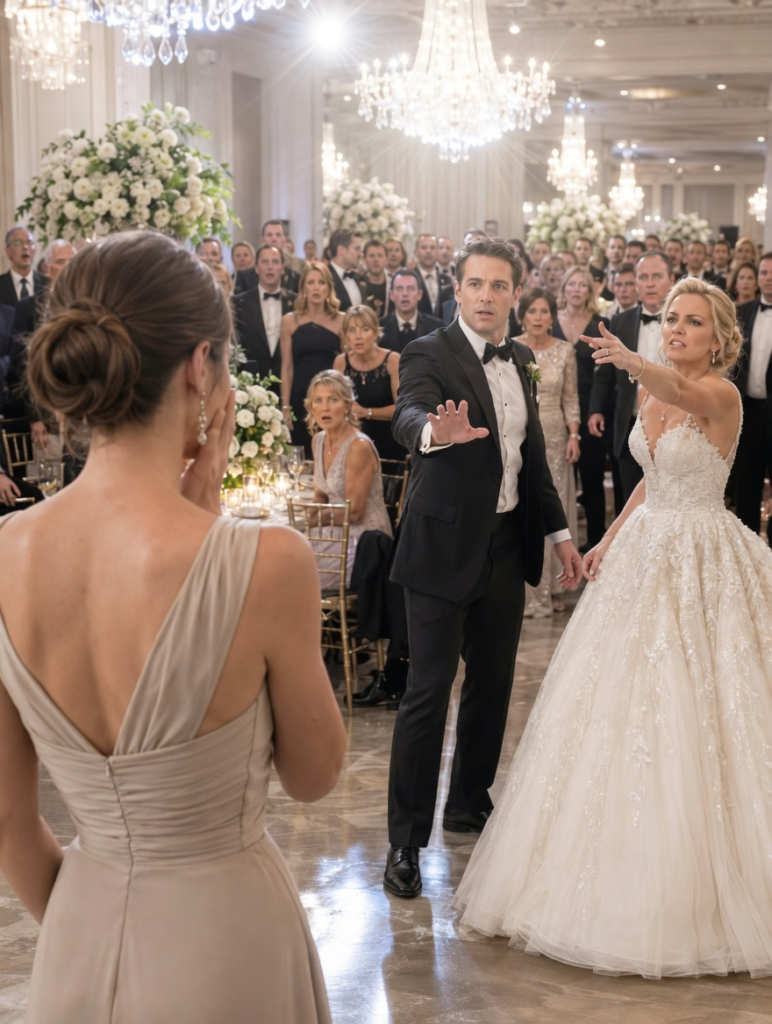
The slap landed so hard it turned my face toward the champagne tower, and for one brief second all I could see was light: gold light from the chandeliers, silver light from the mirrored wall behind the bar, and the glitter of five hundred glasses raised for a wedding that had just stopped being a wedding and become a public execution. My cheek burned in a hot, immediate pulse. The skin below my eye throbbed where Bianca’s palm had struck me. Somewhere, a woman gasped. Somewhere else, someone laughed. Then the laughter spread—not through the whole room, not cleanly, not unanimously, but enough. Enough people smiled behind champagne flutes. Enough guests leaned toward one another with hungry expressions. Enough bodies turned toward us with the relief of people who had been waiting all evening for something more interesting than speeches, string music, and money pretending to be elegance. I stood near the back wall of the ballroom, where I had been placed like an afterthought, wearing a simple dark dress I had bought for myself and no diamonds, no escort, no claim to the room except blood they had spent fourteen years pretending did not count. My stepsister stood in front of me in her cathedral-length gown, her hand still half raised, as if even she was surprised by how much she had enjoyed humiliating me in front of everyone. “You don’t belong here,” Bianca said, and her voice carried beautifully, as it always had. Some people are born with soft voices; others learn softness because it draws people closer. Bianca had never needed either. She had a voice designed for rooms to rearrange themselves around it. At thirteen, she could cry on command. At seventeen, she could make adults believe nearly anything if she widened her eyes at the right moment. At thirty, standing in a gown that probably cost more than my first apartment’s annual rent, she still had the same talent she had used all her life: the ability to turn her own cruelty into someone else’s shame. I did not touch my face. I did not step back. I did not say a word. That was the part she hated most. If I had shouted, she would have known the script. If I had cried, she would have won in a language she understood. But silence has a way of exposing the naked shape of a thing, and Bianca had always despised being seen clearly. Around us, the ballroom slowed. Conversations stumbled. Heads turned. The string quartet at the far end of the room faltered into an awkward half-finished phrase and then stopped entirely. A waiter lowered a tray because even hired staff know when they are suddenly standing inside a story they will tell later. Bianca took another step closer. Her veil trembled behind her shoulders. Diamonds flashed at her ears. Her makeup was immaculate, but color was rising too fast beneath her foundation now, anger fighting with champagne and panic. “Look at you,” she said, louder this time. “You really thought you could stand here with people like us?” Another ripple of amusement moved through the guests nearest us. People laugh too easily when they believe someone has already been judged for them. I stood there with a sweating glass of water in one hand and thought, not for the first time in my life, that cruelty becomes much easier for a room when it is performed by the bride. Then a man’s voice cut through the laughter like a blade. “Do you even know who she is?” Everything stopped. Not gradually. Instantly. The question did not just silence the room. It changed it. Bianca turned first, irritation twisting into confusion. I turned more slowly, already understanding that whatever happened next would divide the night cleanly into before and after. Julian Mercer—her fiancé, or perhaps no longer her fiancé even then—stood three steps behind her with one hand braced against the back of a gilt dining chair and the other still half curled at his side, as if he had moved before deciding to. He looked nothing like the smiling groom from an hour earlier, the man who had thanked guests, hugged elderly relatives, kissed Bianca’s cheek under a thousand camera flashes, and played his expected role so well that, for a dangerous second, I had almost pitied him. Now he looked stunned. Not embarrassed. Not merely angry. Stunned. And his eyes were on me. Not on Bianca. Not on the guests. On me. He took one breath, the way a man does when he wants to be sure his voice will come out steady, and then he said, much more quietly but somehow even more dangerously, “Miss Vance.” A murmur moved through the ballroom. I felt it more than heard it—the subtle shift of five hundred people recalculating what they thought they knew. Bianca gave a short, disbelieving laugh. “What are you doing?” Julian did not look at her. “Miss Vance,” he repeated, and this time it was not a question. It was recognition settling into place. For a moment, I considered sparing them. I could have ended it there. I could have smiled faintly, dismissed the whole thing, saved Julian from public collapse and Bianca from the wreckage gathering around her like storm pressure. I could have given Bianca one last gift she did not deserve: ignorance. But then my cheek burned again, and somewhere deep inside me, a sixteen-year-old girl heard a door slam behind her and a woman’s voice say, “Get out.” So I stayed where I was. Julian turned to Bianca at last. “Do you have any idea,” he asked, “what you just did?” His tone was quiet. Controlled. That frightened her more than shouting would have. “What are you talking about?” she snapped. “Relax. It’s nothing. She’s just—” “Stop.” He said it softly, almost intimately. It cut her off anyway. Then he looked around the ballroom, at the guests, the families, the investors, the society friends, the country-club women, the private-school graduates, the people who had spent their lives believing they could always tell who mattered by looking at the fabric of a dress, the cut of a suit, the size of a diamond. When he spoke again, he spoke to the whole room. “The woman you just slapped,” he said, “is Aar Vance.” The silence deepened. Then he finished the sentence that splintered the rest of the night. “She is the owner of Vance Global Holdings.”
Certainty did not leave Bianca’s face slowly. It shattered. Her lips parted, but no words came out, because for the first time in her life, she did not know which version of reality to perform. The ballroom held its breath. Five hundred people stood suspended in the exact moment where truth replaces assumption. Julian did not move, did not soften the blow, did not protect her. He understood something Bianca never had: some names do not need to be announced; they only need to be recognized. Bianca laughed. It was too sharp, too fast, and far too high. “No,” she said, shaking her head. “No, that’s not possible.” Her voice rose slightly, as if volume could rebuild the world she had just lost. “She’s lying,” Bianca added quickly, turning toward the guests. “This is some kind of joke. She—she grew up in my house. She had nothing.” That word lingered. Nothing. It echoed in the same space where laughter had lived only minutes before. I finally moved. Not dramatically. Not defensively. Just one step forward. And the room shifted again, because now they were not looking at a stranger anymore. They were looking at a possibility. “I did grow up in your house,” I said calmly. My voice did not carry force. It did not need to. Every word landed exactly where it needed to. Bianca seized on it immediately, desperate for anything she could use as a handle. “See?” she snapped, relief flickering back into her expression. “She’s admitting it.” But I did not stop. “I grew up there,” I continued, “until I was sixteen.” A pause followed, long enough for the memory to surface, long enough for discomfort to crawl beneath the jewels and silk and tailored tuxedos. “Until your mother decided I didn’t belong anymore.” That was the first truth. Not loud. Heavy. The room reacted differently this time. Not laughter. Not amusement. Something else. Discomfort. Because cruelty loses its charm when it is explained. Bianca’s face tightened. “You were a problem,” she said quickly. “You—” “I was inconvenient,” I corrected. Still calm. Still steady. “And you needed someone to be less than you so you could feel like more.” That landed harder than the slap, because this time everyone understood it. Julian exhaled slowly, his hand tightening against the back of the chair. “How long?” he asked me quietly. I met his gaze. “Long enough.” The second truth unfolded without effort. “I didn’t leave with nothing,” I said. “I left with clarity.” That word changed everything, because clarity is not survival. It is direction. “While you were building this life,” I continued, gesturing lightly toward the ballroom, the chandeliers, the towering flowers, the carefully curated perfection, “I was building something else. Something that didn’t require anyone’s permission.” Guests glanced at each other. Phones discreetly came out. Names were being searched. Connections were forming. They knew. Or at least they were beginning to. Julian turned fully toward Bianca. “Her company,” he said slowly, “just acquired the firm funding our expansion.” Bianca blinked once. Twice. “No,” she said again, but softer now. Not defiant. Desperate. “Yes,” Julian replied. And this time, he did not look at her like a partner. He looked at her like a liability.
The room fractured. Not loudly, but completely. Because now the humiliation had direction, and it was no longer pointing at me. Bianca stepped toward me, her voice dropping into something almost pleading. “You’re doing this on purpose,” she said. “You came here to embarrass me.” I tilted my head slightly. “No,” I said. “I came here because you invited me.” That was the next truth: her own decision, her own stage, her own moment turned against her not by my revenge but by her arrogance. The silence deepened because there was nowhere left to shift the blame. Julian straightened, stepping forward just enough to close the distance between us. “Miss Vance,” he said, his tone formal now, careful and recalculated, “I think we should discuss—” “No,” I interrupted gently. For the first time that night, I smiled. Not cruelly. Not dramatically. Just enough. “We already did.” Confusion flickered across his face. “Two weeks ago,” I continued, “when your team requested the partnership.” I paused. Then said, “I declined.” The final twist settled over the room with the weight of a chandelier coming loose. Because this night, this wedding, this entire performance of secured power and glittering permanence, had already been built on something that did not exist anymore. Bianca staggered back slightly, not physically but emotionally, as if every invisible scaffold holding her up had been kicked away at once. “You’re lying,” she whispered. But no one responded, because no one believed her anymore. Julian did not argue, did not defend, did not try to recover the situation. He understood something most of the room was only beginning to grasp: power does not need to shout. It only needs to stand. I set my glass of water down on the nearest table. The condensation left a faint ring on the polished surface. Temporary. Fading. Like everything else that had just happened. “I didn’t come here to take anything from you,” I said quietly. “I just stopped letting you define what I had.” Then I turned. Not rushed. Not dramatic. Just done. Behind me, the room did not erupt. It did not collapse all at once. It shifted, permanently, because five hundred people had just witnessed something far more powerful than humiliation. They had seen what happens when someone you discarded stops being someone you can ignore and becomes someone you cannot afford to offend.
But the story did not begin with that slap. It began fourteen years earlier, on a winter night when I was sixteen years old and standing on the front porch of a house that had never truly been mine, holding one duffel bag, one backpack, and a cracked phone with eleven percent battery. Snow was falling lightly—not enough to be beautiful, just enough to turn the air wet and mean. Behind me, the front door was closed. I could still hear my stepmother’s voice through it, sharp and high, telling my father not to let me back in because “the girl will ruin everything if you keep rewarding her behavior.” The girl. By then, that was what I had become in that house. Not Aar. Not my father’s daughter. Not family. The girl. I had been six when my mother died and eight when my father married Lorraine. Lorraine arrived with perfume, pearls, and Bianca, who was already practicing the delicate art of becoming the center of every room. My father, Henry Vance, was a kind man in the way weak men often are kind: privately, quietly, when no one stronger is asking them to choose. He loved me, I think. But he loved peace more. After my mother’s funeral, he seemed to move through life as if one more confrontation might shatter him. Lorraine understood that before I did. She did not need to forbid him from loving me. She only made loving me expensive. Every time he defended me, she cried. Every time he gave me attention, Bianca wilted. Every time I succeeded at school, Lorraine said I was trying to make Bianca feel stupid. Every time I stayed quiet, she said I was cold. Every time I spoke, she said I was ungrateful. By the time I was twelve, I had learned that facts did not matter if the room preferred someone else’s feelings.
Bianca and I were never sisters in any true sense. We were two girls placed under the same roof and handed opposite roles. Bianca was luminous, dramatic, needy, charming, and fragile whenever accountability came near. I was quiet, watchful, too serious, too stubborn, too much like my dead mother for Lorraine’s comfort. My mother, Elise Vance, had been a systems architect and early investor in medical logistics software, a woman who believed spreadsheets could reveal character faster than conversation. I remembered her most clearly at the kitchen table late at night, hair twisted messily behind her head, one hand on a coffee mug, the other moving across a legal pad filled with numbers and arrows. She used to tell me, “Aar, people lie, but patterns don’t.” I was too young to understand then. After she died, I kept that sentence like a coin in my pocket, turning it over whenever the world became difficult to read. Lorraine hated how much of my mother remained in the house: the books, the old files, the photographs, the way my father still paused near her office door. Slowly, Lorraine removed things. She replaced my mother’s blue curtains with beige ones. She donated her coats. She moved her framed degree from the hallway into a storage box. My father let it happen because grief had made him soft and Lorraine called softness healing. But she could not erase everything. My mother had left behind records. Accounts. A small trust. A storage unit. A network of people who knew exactly what kind of woman she had been. Lorraine did not know about most of that. Neither did I, at first.
At sixteen, I was already working after school at a local print shop, saving money in cash because Lorraine had once “borrowed” birthday money from my drawer and called me selfish when I asked for it back. I had excellent grades, not because anyone rewarded me for them, but because school was one of the few places where effort produced results that could not be cried away. Bianca hated that. She was pretty, socially gifted, and good at getting adults to overlook gaps in her performance, but she hated anything that suggested I had value she could not imitate. The year everything broke, I won a regional business innovation competition with a software concept for routing emergency medical supplies during severe weather disruptions. It was not sophisticated by adult standards, but it was real enough that one of the judges, a woman named Evelyn Marks, pulled me aside afterward and asked who had helped me design the model. “No one,” I said. She studied me for a long moment and handed me her card. “Call me when you turn eighteen.” I kept the card hidden inside a copy of Jane Eyre. Bianca found the certificate first. She told Lorraine I had embarrassed her at school by “acting superior.” Lorraine confronted me that night while my father stood near the kitchen island, rubbing the bridge of his nose. “You are poison in this house,” she said. “Everything is competition with you.” I told her I had worked hard. She said hard work meant nothing without humility. I said humility did not mean pretending to be less than I was. That was when Bianca began to cry.
The accusation came three weeks later. Bianca claimed I had stolen a bracelet from her room, a thin gold tennis bracelet Lorraine said had belonged to her grandmother. She said she found the clasp in my desk drawer. I had never touched the bracelet. I told them that. My father looked at me with exhausted eyes, wanting desperately for me to make the situation easier. Lorraine demanded I apologize. Bianca sobbed into a tissue, peeking over it now and then to see who was watching. I said no. “I didn’t take it.” Lorraine’s mouth hardened. “Then you are calling Bianca a liar.” I looked at Bianca. She lowered her eyes, but I saw the smallest smile at the corner of her mouth. “Yes,” I said. “I am.” The room exploded. Lorraine screamed. Bianca cried harder. My father said my name in warning. But something inside me, tired from years of bending, had finally refused to bend again. I told them to check Bianca’s closet. I told them to check the pawn receipt tucked inside her planner, because I had seen her with cash two days earlier and had learned, from my mother’s old lesson, that patterns mattered. Bianca’s face changed. Lorraine saw it too. For one bare second, the truth was visible. Then Lorraine chose her daughter anyway. “Get out,” she said. My father whispered, “Lorraine.” She turned on him. “If you let her stay, Bianca and I leave.” That was the entire trial. That was the verdict. My father looked at me, then at Lorraine, then at the floor. He did not say, “Stay.” He did not say, “This is your home.” He did not say, “I believe you.” He said, “Maybe a few nights at Aunt Marlene’s would help everyone calm down.” Aunt Marlene lived three states away and had not spoken to my father in years. I packed in silence. Bianca watched from the hallway, no longer crying.
I did not go to Aunt Marlene’s. I had seventy-three dollars, a prepaid bus pass, Evelyn Marks’s business card, and a storage unit key I had found years earlier in one of my mother’s old books. I spent the first night at a twenty-four-hour diner near the highway, pretending to read while the waitress refilled my coffee even though I had ordered only toast. Her name tag said June. At dawn, she slid a plate of eggs in front of me and said, “Somebody your age doesn’t sit in a place like this all night unless going home is worse.” I stared at the eggs. Then I cried. June did not ask questions. She only said, “Eat first.” That was the first lesson after being thrown away: kindness often comes from people with no obligation to provide it. By noon, I had called Evelyn Marks. I expected her not to remember me. She answered on the third ring and said, “Aar Vance, emergency medical logistics model. You are calling earlier than expected.” I told her I needed work. I did not tell her everything. She listened, then said, “Where are you?” Forty minutes later, a black sedan pulled up outside the diner.
Evelyn was not warm in the way people expect rescuers to be warm. She was precise, unsentimental, and allergic to self-pity. She put me in a small room above the offices of a medical distribution company she had co-founded, arranged for legal temporary guardianship through a friend of hers after my father signed paperwork without asking too many questions, and gave me a part-time job organizing shipping records. “You will finish school online,” she said. “You will work legally. You will keep receipts for everything. You will not confuse survival with identity.” At sixteen, I did not know whether to be grateful or terrified. I became both. Evelyn taught me the language of supply chains, contracts, vendor reliability, cold storage failure, rural hospital shortages, procurement fraud, and crisis routing. She also taught me not to apologize when entering rooms where no one expected me. “If you wait for permission,” she told me, “you will spend your life at the door.” I finished high school early. I enrolled in community college while working full time. I slept very little. I learned faster than exhaustion could stop me. At nineteen, I rebuilt a routing algorithm for a regional distributor after a snowstorm stranded medical supplies outside Des Moines. At twenty-one, I negotiated my first contract. At twenty-three, I bought out a failing logistics platform using money from my mother’s trust and a loan no one thought I deserved. At twenty-five, I merged it with two rural supply networks and renamed it Vance Global Holdings, because I wanted my mother’s name on something that could not be boxed up and donated.
People later called my rise sudden because they only noticed after the headlines. That is how the world talks about women who spend years building in rooms no one watches. Sudden success. Overnight fortune. Luck. Timing. I knew what it had been. It had been eighteen-hour days, freezing warehouse inspections, investor meetings where men called me “dear” until I corrected their numbers, nights sleeping on airport floors, failed software builds, lawsuits, debt, calculated risk, and the cold stubborn belief that I would never again stand on a porch with nowhere to go. Vance Global Holdings became the company hospitals called when weather broke roads, when ports locked up, when strikes halted shipments, when rural clinics needed critical supplies moved through impossible conditions. We grew because we solved real problems faster than larger companies wanted to admit they had. I did not become glamorous. I became necessary. There is a difference. Necessary people are not always liked, but they are rarely ignored for long.
I saw my father twice after I left. The first time was at my high school graduation, where he stood awkwardly near the back of the auditorium with a bouquet from a grocery store. Lorraine and Bianca were not with him. He looked older than I remembered. Smaller. He tried to hug me. I let him, but my arms stayed loose. “I’m proud of you,” he said. I wanted the words to matter more than they did. “Thank you,” I replied, because politeness had survived even when trust had not. He said things had been complicated. I said yes, they had. He said Lorraine missed me. That was a lie too clumsy to dignify. The second time was at his funeral six years later. Heart attack. Quick, like a cowardly exit. Lorraine wore black lace and grief like jewelry. Bianca stood beside her in dark sunglasses, checking who had noticed her sorrow. No one from the family spoke to me except an uncle who said, “You grew up pretty,” which told me he had no idea who I had become. Lorraine said, “Your father loved you in his way.” I said, “His way was insufficient.” She slapped me then too, though not as publicly as Bianca would years later. I left before the burial. Some families do not need graves; they bury you while you are alive.
The invitation to Bianca’s wedding arrived embossed in gold. I almost threw it away unopened. Then I saw my name written by hand on the inner envelope: Aar Vance. Not “and guest.” Not “family.” Just my name. Inside was a cream card inviting me to celebrate the marriage of Bianca Elizabeth Hale to Julian Mercer at the Grand Aurelia Hotel. Five hundred guests, according to the wedding website. Black tie. Three-day celebration. Registry links. A paragraph about destiny. I stared at the invitation for a long time, wondering why she had sent it. It was not remorse. Bianca had never apologized for anything unless she could collect interest on the performance. It was not affection. We had not spoken in years. It was not family obligation. She had abandoned that word the night she watched me leave with a duffel bag. Then I understood. She wanted me there as evidence. Not of reconciliation, but of superiority. A discarded stepsister in a plain dress standing at the back of a glittering ballroom would complete the portrait she had painted of herself: gracious, risen, generous enough to invite even the unfortunate girl from her childhood. I knew exactly what role she expected me to play. That was why I went.
I did not go to ruin her wedding. People never believe that, but it is true. If revenge had been my goal, I had cleaner tools. I could have let my acquisition team accelerate the purchase of Northbridge Capital, the financing firm behind Julian’s expansion, and leak the timing. I could have had legal send a cold letter at dawn. I could have ensured Bianca learned my name from a business headline before she ever saw me in person. But revenge requires intimacy, and by then Bianca was not intimate to me. She was history with lipstick. I went because a part of me wanted to test whether the old house still had power over my nervous system. I wanted to stand in the room and not shrink. I wanted to see Lorraine, if she came, and feel nothing. I wanted to prove to myself that I could walk into a place designed to exclude me and remain whole. My assistant, Mara, tried to talk me out of it. “You know this is bait,” she said, standing in my office with her tablet against her chest. “Yes.” “You do not have to accept bait just because it is addressed beautifully.” “I know.” “Then why?” I looked out over the city from the thirty-seventh floor of Vance Global headquarters. “Because sometimes you need to see the locked door from the inside.” Mara sighed. “Wear something expensive.” “No.” “Aar.” “No.” “At least take security.” “Discreetly.” She narrowed her eyes. “Define discreet.” “Two people in the hotel lobby. No one in the ballroom unless needed.” “I hate this.” “I know.” “Then please enjoy knowing I will be correct later.” She was often correct. It made her insufferable and useful.
Two weeks before the wedding, Julian Mercer’s team requested a partnership meeting. That was the first true coincidence, if such things exist. Mercer Development had been planning an expansion into medical real estate—urgent care networks, rural treatment centers, specialty clinics in underserved markets. The concept was not foolish. The execution was weak. Their financing depended on Northbridge Capital, which my company had quietly acquired after discovering Northbridge’s exposure to several unstable infrastructure ventures. Julian wanted access to our logistics capabilities, our government contracts, and our hospital network. His team did not realize who I was in relation to Bianca until late in the meeting, when someone mentioned the upcoming wedding. Julian himself was not present; he joined by video for the last ten minutes from what looked like an airport lounge. He was handsome in a composed, old-family way, with dark hair, direct eyes, and a voice trained by boarding schools and boardrooms. “Miss Vance,” he said, “we believe there is alignment here.” “There is not,” I said. His eyebrows lifted. Men like Julian were used to softened no’s. Strategic delay. Conditional interest. Requests for revised terms. “May I ask why?” “Your proposed network treats logistics as an accessory instead of a structural requirement. You are building clinics as real estate assets, not functional medical ecosystems. People will suffer for your vanity renderings.” Someone on his team shifted in discomfort. Julian studied me through the screen. “That is blunt.” “It is also free.” A faint smile touched his mouth despite himself. “And your formal answer?” “Declined.” He nodded slowly. “Then I hope we speak again under better circumstances.” “I doubt we will.” I meant professionally. Neither of us yet knew that, in two weeks, he would stand in a ballroom between me and his bride.
The Grand Aurelia Hotel on the night of Bianca’s wedding looked like a fantasy built by people afraid of restraint. White roses climbed gold arches. Crystal chandeliers dripped light over marble floors. Champagne moved through the room on silver trays. A live quartet played near a mirrored wall. The guests shimmered in black silk, navy velvet, diamonds, tuxedos, and the kind of perfume that announces money before conversation can. I arrived alone, gave my name at the entrance, and watched a young woman at the seating table hesitate. “Ms. Vance,” she said, scanning the chart twice. “You’re… general reception.” “Meaning?” “Standing cocktail area,” she said awkwardly. “There wasn’t a dinner seat assigned.” Of course there was not. I almost smiled. Bianca had invited me to a five-hundred-guest wedding and given me nowhere to sit. That was almost elegant in its cruelty. “That’s fine,” I said. I took a glass of water from a passing tray and moved toward the back wall. I recognized Lorraine near the front, wearing champagne satin and satisfaction. She looked older, sharper, preserved by expensive treatments and old bitterness. She saw me once across the room. Her gaze slid over my dress, my bare neck, my empty hands, then dismissed me. Good, I thought. Keep underestimating me. Bianca made her entrance twenty minutes later, and the room turned toward her like sunflowers toward heat. She was beautiful. I will not pretend otherwise. Some women wear bridal gowns; Bianca weaponized hers. The bodice glittered with hand-sewn crystals, the skirt moved like poured cream, and her veil trailed behind her long enough to require two attendants. She looked triumphant. Not happy. Triumphant. Julian watched her come toward him with an expression I could not fully read. Affection, yes. Pride, perhaps. But also something guarded. I wondered whether he already suspected that Bianca was a woman best admired from across a room.
The ceremony was theatrical, expensive, and emotionally thin. Vows about destiny. A reading from someone who had never met hardship without outsourcing it. Lorraine crying into a lace handkerchief. Bianca glancing toward the photographer every time she wiped her eyes. Julian saying the right words with the solemnity of a man entering not only marriage but merger. I stood at the back through all of it. No one spoke to me except a waiter who asked if I needed anything. “No,” I said. Then, after the ceremony, the reception opened like a stage set. Music. Toasts. First dance. A champagne tower. Laughter. Speeches about love, partnership, legacy, and family. Family. That word moved through me like cold air. Lorraine gave a toast about welcoming Julian into “our tight-knit family,” and I wondered whether anyone else noticed the empty place where truth should have been. Bianca danced with her mother, then with Julian, then with men who wanted to be seen dancing with the bride. I stayed near the back wall, watching patterns. Patterns never lie. Bianca’s gaze found me three times before she approached. The first time, satisfaction. The second, irritation. The third, decision.
She crossed the floor after the second champagne pour, when guests were loose enough to enjoy a scene and formal enough to pretend they were horrified. Two bridesmaids followed her, whispering, but she waved them back. Lorraine saw her moving and did nothing. Julian was speaking near the bar with two older men in dark suits. He did not notice at first. Bianca stopped in front of me, eyes bright. “You came,” she said. “I was invited.” “I didn’t think you would be brave enough.” “To attend a wedding?” She smiled. “To stand in a room with people who know what you are.” I looked around lightly. “And what am I?” She leaned close enough for me to smell champagne and expensive makeup. “Garbage that got lucky once and still thinks it belongs indoors.” I could have ended it then. I could have said my name loudly enough for the nearest guests to hear. I could have asked whether she wanted to discuss Northbridge, or Mercer Development, or the partnership Julian’s team had requested. But I wanted to see how far she would go when she believed nothing could stop her. So I said nothing. That angered her. “Look at your dress,” she said, raising her voice. “Did you buy it on clearance?” The guests nearest us turned. “You should be grateful I let you come at all.” I held my glass. “Are you finished?” Her hand moved before the sentence fully landed. The slap cracked through the ballroom.
And now the slap had become an earthquake. After Julian named me, after Bianca denied it, after I confirmed enough of the truth to make denial useless, the room remained frozen around us. Then movement began in fragments. Guests searched their phones. Someone whispered, “Vance Global?” Another said, “That Vance?” A man near the bar said, “They bought Northbridge last quarter.” A woman in diamonds murmured, “Oh my God.” Lorraine pushed through the edge of the crowd, her face stretched tight with confusion and fury. “What is going on?” she demanded. Bianca turned toward her mother with the expression of a child reaching for the one person who had always rewritten reality on her behalf. “Mom, tell them,” she said. “Tell them who she is.” Lorraine looked at me, and for one moment I saw the calculation fail behind her eyes. She had built her life on the assumption that people like me did not return with power. “She is my late husband’s daughter,” Lorraine said stiffly. “She was… troubled.” “Careful,” I said. My voice stayed low, but Lorraine heard the warning. Her mouth closed. Julian looked between us. “Troubled?” He said the word like it tasted bad. Bianca snapped, “She stole from me when we were kids. She was thrown out for a reason.” “No,” I said. The room turned back to me. “I was accused of stealing a bracelet Bianca had already pawned. Lorraine knew. My father knew enough to doubt. No one cared.” Bianca’s face twisted. “You can’t prove that.” “I can.” That was the first time fear truly entered her eyes. Not embarrassment. Fear. Because people like Bianca survive by trusting that old injuries were never documented. Mine were. Evelyn had taught me to keep records. Years later, when my lawyers cleaned up my mother’s estate files, they found the pawn receipt in a box Lorraine had forgotten my father kept. A gold bracelet, pawned three days before I was accused. Bianca’s signature. A minor’s signature, but hers all the same. I had not used it for years because I had no need to. But need changes.
Julian turned to Bianca with a stunned, disgusted softness in his face. “Is that true?” “No,” she said immediately. Too immediately. “She’s twisting everything. She’s always done that. She manipulates people. She acts quiet, but she’s—” “Stop,” Julian said again. This time his voice cracked at the edge. “You slapped her.” Bianca looked around, suddenly realizing the room she had expected to command was now judging her. “She provoked me.” There it was. The old family anthem. Whatever Bianca did, someone else had caused it. I felt strangely calm. Maybe because the worst had already happened long ago. This was only the delayed receipt. Julian took off his wedding ring. The gesture was small. Quiet. Devastating. Bianca stared at his hand. “What are you doing?” “I don’t know yet,” he said. “But I know I’m not standing here pretending this is normal.” “Julian,” Lorraine hissed, stepping closer. “Don’t be theatrical. Weddings are emotional. Bianca is under enormous pressure.” He looked at her. “She assaulted someone in front of five hundred people.” “Family has history,” Lorraine said. “This is complicated.” “No,” I said. “It is actually very simple. She hit me because she believed I was powerless. You defended her because that is what you have always done. The only thing complicated is how many years it took everyone else to see it.”
Phones were fully out now. Recording. Streaming. Messaging. The wedding planner hovered near the floral arch, pale with professional terror. The band stood silent. A server whispered into a headset. Bianca’s bridesmaids clustered near the dance floor, no longer certain whether loyalty required proximity. Julian’s parents appeared at his side, his mother’s face white, his father whispering furiously to someone on the phone. Money does not remove chaos; it only gives chaos better lighting. Julian turned toward me. “Miss Vance, I owe you an apology.” “No,” I said. “You owe yourself an explanation about why you almost married someone who could do that.” That struck him harder than I expected. He looked down. “You’re right.” Bianca made a sound like a wounded animal. “Are you serious? You’re taking her side? You know what this means for us?” Julian looked at her. “I am beginning to.” “Our expansion—” “Is dead,” I said. No one breathed. I had not intended to say more, but Bianca had invoked business as if it might still rescue her. “Vance Global will not partner with Mercer Development. Northbridge’s financing review will proceed under revised risk controls. Given the conduct I have witnessed tonight, and given the reputational exposure of the Mercer name being tied to a leadership team willing to overlook violence when convenient, I do not see a viable path forward.” Julian closed his eyes briefly. He knew the words were formal because they were real. Bianca whispered, “You can’t do that.” “I already did,” I said. “Two weeks ago. Tonight only confirmed I made the right decision.”
Then Lorraine lunged for the only weapon she had left. “You ungrateful little thing,” she hissed. “After everything we did for you.” I turned toward her fully. “You mean after taking my mother’s bedroom, my mother’s furniture, my father’s attention, and finally my home?” Her face flushed. “We fed you. We clothed you.” “You housed me because my father owned the house before he handed you the keys to his conscience.” A murmur moved through the room. Lorraine’s mouth trembled—not with grief, but with rage. “Your father would be ashamed of you.” That one almost landed. Almost. But I had spent years making peace with the fact that my father’s shame had never been a reliable compass. “No,” I said. “My father was ashamed of himself. That is why he avoided looking directly at what he let happen.” Lorraine’s eyes shone. “You think money makes you better than us.” “No. I think money made it impossible for you to keep pretending I was beneath you.” That silence was different. Sharper. Because there, finally, was the true thing. Money had not made me worthy. I had always been worthy. Money had only forced people like Lorraine and Bianca to confront the cost of their misjudgment.
Security arrived at the edge of the ballroom, uncertain whom to remove. Bianca pointed at me. “Get her out.” No one moved. Julian said, “No.” Bianca spun toward him. “This is my wedding.” “It was,” he said. That word ended more than the sentence. Was. Bianca heard it. Everyone did. She reached for him, but he stepped back. Not dramatically. Just enough. The distance between them became visible, public, irreversible. Lorraine grabbed Bianca’s arm and whispered something urgent, likely advice to cry, faint, recover, reframe. But Bianca was too far gone to perform delicately. “You ruin everything,” she screamed at me. “You always have. You ruined our family, and now you’re ruining my marriage.” I thought of sixteen-year-old me on the porch, snow in my hair, waiting for my father to open the door. I thought of the diner, June’s eggs, Evelyn’s sedan, the cold office where I learned how supply chains worked while other girls learned how to apply for college housing. I thought of every night I believed being discarded meant I had been disposable. “No,” I said. “I survived what you tried to make me. That is not ruining anything.” Bianca’s face collapsed then—not into remorse, but into the terror of someone who had lost control of the story.
I left before the wedding officially ended, though by then nothing official remained. The ballroom parted as I walked toward the exit. No one laughed. A few people lowered their eyes. A man I recognized from a hospital procurement conference looked as if he wanted to speak, then wisely decided not to. Near the doors, Julian caught up with me. “Miss Vance.” I stopped. He looked shaken, but not drunk or hysterical. That counted for something. “I am sorry,” he said. “For what happened tonight. For my part in bringing you here. For not knowing.” “Not knowing is not always a crime,” I said. “But what people do after knowing matters.” He nodded. “You were right to decline the partnership.” “Yes.” A faint, pained smile crossed his face. “You don’t soften much, do you?” “Not when softness would be dishonest.” He looked back toward the ballroom, where raised voices were beginning again. “I thought I knew her.” “You knew the version she used on you.” “And you?” he asked quietly. “What version did you know?” I glanced toward the open ballroom doors, where Bianca’s white veil flashed through moving bodies like a distress signal. “The one she used on people who couldn’t help her.” That answer seemed to settle heavily on him. He stepped aside. “Good night, Miss Vance.” “Good night, Mr. Mercer.” Then I walked out into the hotel lobby.
Mara was waiting near the front entrance with two security staff, her face grim with the particular fury of someone whose warnings had been proven correct. “You have a mark on your face,” she said. “I noticed.” “Do I need to call legal?” “Probably.” “Police?” I paused. Behind me, the wedding was unraveling in one of the most expensive ballrooms in the city. A younger version of me might have wanted Bianca arrested in her wedding gown. The image had a certain poetic quality. But I knew the difference between justice and appetite. “Document first,” I said. “We’ll decide after medical photographs.” Mara’s eyes narrowed. “You are handling this too calmly.” “I’m not calm. I’m efficient.” “That’s worse.” Outside, night air cooled my cheek. The hotel’s gold doors closed behind us. My car waited at the curb. As I slid into the back seat, my phone began to vibrate with alerts. News travels fastest when rich people embarrass themselves in formal wear. Mara sat beside me, already pulling up social feeds. “It’s spreading.” “Of course it is.” “Do you want me to suppress?” I looked out the window as the city moved past in streaks of white and red. “No.” “No?” “Let them see it.” Mara studied me. “All of it?” “All of it.”
By morning, the wedding was everywhere. Not the way Bianca had planned. Not as a society-page celebration of beauty, legacy, and Mercer-Hale union glamour. It was a scandal, clipped into angles and captions. Bride slaps mystery guest. Groom reveals guest is billionaire logistics CEO. Wedding implodes after family secret exposed. Some outlets got details wrong, as they always do. Some called me “heiress turned magnate,” which would have made Evelyn snort. Some called Bianca “emotional bride,” which made me want to throw my phone through a window. But the main facts survived: Bianca had slapped me, Julian had identified me, the partnership was dead, and the room had witnessed her cruelty in real time. By ten in the morning, Vance Global’s communications team had prepared a statement. I edited it myself. Vance Global Holdings confirms that CEO Aar Vance attended a private social event last night, where she was subjected to a physical assault. Ms. Vance is safe. Any business decisions involving Mercer Development and related financing partners were made prior to the event and were based on strategic, operational, and governance considerations. Vance Global does not enter partnerships where leadership culture presents unacceptable risk. We will make no further comment on private family matters. Mara read it and said, “That last sentence is a lie.” “It is a boundary.” “Same outfit, different shoes.” We released it at noon.
Bianca released her own statement at 12:17. It was a masterpiece of panic disguised as elegance. She apologized for “an emotional moment taken out of context,” claimed there was “painful family history,” insisted she had been “provoked by years of unresolved trauma,” and asked for privacy as she and Julian “processed this deeply personal matter.” Julian released his statement at 12:41. It was shorter. The wedding ceremony did not result in a legally filed marriage license. I am taking time to review personal and professional matters. I condemn physical violence in all forms. That was all. Bianca’s statement died on contact with his. By evening, Lorraine had called me fourteen times from three different numbers. I answered none. At 9:03 p.m., she left a voicemail. “Aar, this has gone too far. Bianca is devastated. Julian is threatening to walk away. Her reputation is destroyed. Whatever happened when you were young, we were all under stress. Your father would want peace. Please call me.” I listened twice, not because I was tempted, but because I wanted to hear what absence of accountability sounded like in its purest form. Whatever happened. Under stress. Peace. These are the words people use when they want the injured to do the cleaning.
Three days later, Bianca came to my office. She did not make it past the lobby. That was not an accident. Vance Global’s headquarters had security designed for political protests, activist disruptions, hostile takeover attempts, and once, a man who tried to deliver a live goat as part of a procurement dispute. Bianca in sunglasses and a cream coat did not rank high. I watched from my office camera feed as she argued with the front desk, one hand gripping a designer handbag, the other touching her cheek as if she were the wounded party. Mara stood beside my desk, arms crossed. “Do you want her removed?” “Not yet.” Bianca said something sharp to the receptionist, who maintained the serene expression of someone paid well enough not to care. “She looks smaller in fluorescent light,” Mara observed. “Most performances do.” After twelve minutes, Bianca pulled out her phone and called me. I let it ring. She called again. Then texted. You owe me a conversation. I replied: No. She looked down at her phone in the lobby, and for a second all the force went out of her posture. Then she typed again. You destroyed my life. I answered: You mistook exposure for destruction. She stared at the message. Then security escorted her out.
I thought that would be the last time I saw her for a while. It was not. One week later, Evelyn Marks invited me to lunch. Evelyn was seventy-two by then, retired from formal operations but still capable of frightening an entire boardroom with one raised eyebrow. We met at a small Italian restaurant she loved because, in her words, “the owner understands salt and discretion.” I told her everything. She listened without interrupting, as she had the day I called from the diner. When I finished, she took a sip of wine and said, “You did well.” From Evelyn, that was a standing ovation. “I didn’t do much.” “You stood still while a room changed its mind. That is not nothing.” “Bianca came to the office.” “Of course she did. People who build identity on dominance experience boundaries as theft.” I smiled faintly. “You should put that on a mug.” “I prefer invoices.” Then her expression softened in a rare, almost dangerous way. “Are you all right?” I wanted to say yes. It was my habit. Efficiency, containment, proof of function. Instead, I looked down at my hands. “I don’t know.” Evelyn nodded. “Good. That is more honest.” The waiter brought pasta. We ate quietly for a while. Then she said, “You understand that the public victory will not heal the private wound.” “Yes.” “Do you?” I looked at her. “I thought it would feel better.” “It will feel better later. First it will feel clarifying.” “That sounds like something people say when better is unavailable.” “Often.” She put down her fork. “You were not discarded because you lacked value. You were discarded because your existence challenged a lie they needed. Do not confuse those things, even now.” I had heard variations of that sentence for years. That day, finally, it entered me.
The legal fallout was quieter than the public scandal, but more important. Vance Global completed its restructuring of Northbridge Capital’s exposure, which effectively froze Mercer Development’s expansion plan. Julian’s board, already uneasy, demanded a governance review. Contracts were paused. Investors retreated into language about prudence. Bianca’s wedding became a case study in reputational risk before the marriage license was even filed. Julian requested a private meeting with me ten days after the wedding. Mara objected. Evelyn objected more elegantly. I agreed anyway because business requires separating character failure from strategic clarity, and Julian had, at minimum, chosen the truth when it cost him. He arrived at Vance Global without entourage, wearing a charcoal suit and the expression of a man who had slept badly for more than a week. We met in the small conference room, not the executive boardroom. I did not offer the symbolism openly, but he understood it: this was not a negotiation of equals yet. This was a hearing. “Thank you for meeting me,” he said. “This does not revive the partnership.” “I know.” “Then why are you here?” He folded his hands. “Because you were right. About the project. About the clinics being treated as real estate assets. About leadership culture. About me.” That last part surprised me. “You?” “I chose people and structures that made the renderings look good. I let financing lead function. I also almost married someone whose cruelty I had mistaken for confidence.” “Those are separate problems.” “I suspect they come from the same weakness.” He looked at the city beyond the glass. “I like polished things. It turns out polish hides rot efficiently.” That was honest enough to be useful. “What do you want, Mr. Mercer?” “A chance to rebuild the proposal correctly. Not now. Not with guarantees. I’m asking what would have to change.” I studied him for a long moment. “Everything you are proud of.” He gave a short laugh, humorless. “That sounds expensive.” “So is failure.”
We spoke for an hour. Not about Bianca. About clinics, rural access, cold-chain storage, local hiring, emergency routing, governance, conflict disclosures, and the difference between communities and markets. Julian listened. Really listened. That did not make him noble. It made him potentially salvageable. When he left, Mara entered with two coffees. “Well?” “He may learn.” “Men like that rarely do.” “Rarely is not never.” She handed me coffee. “You sound like Evelyn.” “That is cruel.” “Accurate.” I did not partner with Julian then. Months later, after he dismantled the original expansion team, withdrew from several vanity developments, and brought in operational leadership with public health experience, we approved a limited pilot under strict governance. It worked. Not perfectly. Nothing does. But better than the original plan would have. Julian and I never became friends exactly, though we developed a professional respect edged by the memory of a ballroom where everything nearly ended before beginning. He did not marry Bianca. He did not speak of her unless necessary. When asked publicly about the wedding, he used one sentence: “Some endings are merciful when they arrive early.” It was repeated everywhere. Bianca hated that most of all.
Lorraine tried again in person six weeks after the wedding. She appeared at a charity summit where I was speaking on disaster-response supply networks, wearing a navy suit and the look of a woman prepared to be tragic in public if required. She cornered me near a side hallway after my panel. “Aar.” I turned. She had aged since the wedding scandal, though bitterness can preserve certain features while corroding others. “Lorraine.” The absence of “Mom” landed. Her mouth tightened. “I need five minutes.” “No.” She inhaled sharply. “You won’t even hear me?” “I heard you for eight years.” “You have no idea what it was like.” That almost interested me. “What what was like?” “Raising another woman’s child. Living in a house haunted by her. Watching your father compare me to a ghost.” For the first time, she sounded less polished. Less rehearsed. Almost real. But real pain does not excuse what it creates. “You punished a child because you envied a dead woman,” I said. Her eyes filled. “I was young.” “You were thirty-eight.” “I made mistakes.” “You made choices.” She flinched at the same word I had once used on Bianca. Perhaps accountability has family resemblance too. “Bianca is falling apart,” she said. “She barely leaves her room. Her friends abandoned her. Julian won’t speak to her. People call her cruel online.” “She was cruel offline first.” “She’s my daughter.” “I was my father’s daughter.” Lorraine looked away. That, finally, struck something. “I know,” she whispered. It was the closest she had ever come to admission. But closeness is not arrival. “What do you want from me?” I asked. She wiped beneath one eye carefully, preserving makeup by habit. “Call her. Tell people it was complicated. Tell them you forgive her.” There it was. Not remorse. Reputation repair. I almost laughed, but the sadness of it stopped me. “No.” Lorraine’s face hardened again, the old structure returning. “You are colder than your mother ever was.” “No,” I said. “I am exactly as warm as safety allows.” Then I walked back into the summit hall, where people were waiting to discuss actual emergencies.
For months, Bianca haunted the edges of my life without touching it. She posted cryptic messages about betrayal, healing, false narratives, and women tearing down women. Then she deleted them when comments turned against her. She tried to give an interview to a lifestyle magazine, but the journalist asked about the slap, the pawned bracelet, and the wedding footage instead of her “journey,” so the interview never ran. Former friends leaked stories. A bridesmaid admitted Bianca had planned to seat me nowhere and “humble” me if I looked too confident. Someone from Lorraine’s circle confirmed the family had thrown me out at sixteen. The internet, which loves both cruelty and punishment, fed on her for a while. I did not participate. I did not correct every error. I did not enjoy every consequence. Public shame is a wild animal; once released, it bites beyond your command. But I also did not rescue her from it. That distinction mattered to me. I had not built my life to become Bianca’s cleanup crew.
One evening in early spring, a package arrived at my apartment. Not the penthouse near the office, but my actual home, a quiet place with books, wide windows, and a kitchen where I cooked badly but peacefully. Inside the package was a small gold tennis bracelet and a note. No return address. The bracelet was scratched, old, unmistakable. The note was in Bianca’s handwriting. I found it years ago in Mom’s things. She knew. I’m sorry. That was all. Two sentences. No explanation. No request. No performance. I sat at my kitchen island for a long time, looking at the bracelet that had cost me a home and, in another sense, given me a life. Mara would have said to send it to legal. Evelyn would have said objects have no morality, only history. I held it in my palm and felt nothing simple. Anger, yes. Grief, still. But also something like pity, and pity annoyed me because it suggested softness in a place I preferred sealed. I did not call Bianca. I did not write back. I placed the bracelet in a small archival box with the pawn receipt and sealed both in my safe. Not because I needed proof anymore. Because some evidence belongs not to court, but to the self. The next morning, I called June, the diner waitress who had fed me eggs at sixteen and whom I had found years later after buying the diner’s building to keep it from being demolished. She was retired in Florida by then and answered with, “If you’re calling before nine, somebody better be dead or rich.” “Neither.” “Then why?” “Do you remember the girl with toast?” She went quiet. “Honey, I remember every kid who looked like leaving home had teeth.” I told her about the bracelet. She listened, then said, “So the lie finally got tired.” “Something like that.” “And you?” “I’m not sure.” “That’s allowed.” June had a way of making permission sound like coffee being poured. “You eating?” she asked. “Eventually.” “Eat first.” Some lessons stay useful.
A year after the wedding, Vance Global opened its first fully integrated rural emergency supply hub under the restructured Mercer pilot. It served four states, reduced critical delivery delays by thirty-seven percent in its first quarter, and embarrassed several larger competitors whose executives had called the model unrealistic. At the opening event, Julian spoke briefly and well. No glitter. No vanity renderings. Just data, local partners, and gratitude directed toward the people who would actually run the place. Afterward, he stood beside me near a loading bay where refrigerated trucks moved in and out under a gray morning sky. “This is better than the original plan,” he said. “Yes.” He smiled faintly. “You could pretend to be less satisfied about that.” “I could.” “But you won’t.” “No.” He looked out at the trucks. “Bianca wrote to me last month.” I said nothing. “She said she is in therapy.” “Good.” “She asked whether I thought you would ever forgive her.” “What did you say?” “That I had forfeited the right to predict anything about you.” That answer surprised a laugh out of me. Julian looked pleased with himself. “Growth,” he said. “Careful,” I replied. “Too much self-awareness could damage your brand.” He laughed then, genuinely. We stood in companionable silence for a moment. Then he said, “Do you forgive her?” I watched a forklift move pallets of temperature-controlled medication toward a truck bound for three rural clinics. “Not in the way people usually mean.” “What way do you mean?” “I no longer organize my life around what she did. That is enough.” He nodded. “That sounds healthier than absolution.” “Most things are.”
Bianca and I did meet again, but not because she asked. It happened at Lorraine’s funeral two years later. Stroke. Sudden, though not peaceful, from what I heard. I almost did not go. Then I realized I was not going for Lorraine. I was going for the girl who had once stood at her father’s funeral and been told love came in insufficient forms. I wore black. The service was smaller than my father’s had been. Bianca sat in the front row, thinner, quieter, dressed without sparkle. When she saw me, she stiffened but did not look away. After the service, we stood under a bare tree near the cemetery path while mourners drifted toward cars. For a while, neither of us spoke. Then Bianca said, “She was awful to you.” The sentence did not sound rehearsed. It sounded as if it had cost something. “Yes.” “She was also my mother.” “Yes.” Tears filled her eyes, but she did not weaponize them. That was new. “I don’t know what to do with both.” “You live honestly with both.” She laughed once, brokenly. “You make everything sound like a board memo.” “Occupational hazard.” She wiped her cheek. “I am sorry for the slap.” I looked at her. “Only the slap?” Her face twisted. There it was—the doorway. The easy exit would have been yes. She did not take it. “No,” she said. “For the bracelet. For letting you leave. For enjoying it. For inviting you to the wedding so I could show everyone you were nothing. For needing you to be nothing.” That last sentence was the first apology that touched the true wound. I looked toward Lorraine’s grave, where workers were preparing to lower the casket. “Thank you for saying that.” Bianca nodded, crying silently now. “Do you forgive me?” she asked. There it was again, the question people ask when they want pain transformed into closure on their timeline. But this time, Bianca did not sound entitled to the answer. She sounded afraid of it. “Not yet,” I said. Her face crumpled, but she nodded. “Do you think you ever will?” I thought about it. “Maybe. But forgiveness, if it comes, will not return us to anything. There is nothing to return to.” She looked down. “I know.” For once, I believed she did.
Years have passed since the wedding night people still occasionally ask about in lowered voices, as if I might reveal some secret satisfaction beyond what the videos showed. They want to know how it felt when Julian said my name and the room went silent. They want to know if I planned it. They want to know if I enjoyed watching Bianca’s certainty break. The truth is less clean. In the moment, I felt my cheek burning. I felt sixteen and forty at the same time. I felt powerful, yes, but also tired. Mostly, I felt the strange emptiness that comes when a lie you carried for years finally becomes visible and you realize visibility does not undo the years. It only stops them from continuing in the same way. What changed that night was not my worth. My worth had not been waiting in the ballroom for Julian Mercer to announce it. What changed was the room’s ability to deny it. That matters, but it is not the same thing as healing.
Healing came later, in quieter forms. It came when I funded a scholarship for teenagers removed from unsafe homes and named it after my mother, Elise. It came when June visited headquarters and told my executive team I had once cried over eggs in a diner booth, which nearly made Mara choke on coffee. It came when Evelyn, frailer but still terrifying, sat in the front row of a conference where I spoke about logistics resilience and mouthed, “Too fast,” because apparently even global CEOs need pacing notes. It came when I bought my father’s old house after Lorraine’s estate sold it, not to live there, but to restore my mother’s office and turn the property into a transitional residence for young women aging out of foster care or leaving unsafe families. I kept the pantry doorframe with the old measurements, including mine, including Bianca’s, because history does not become safer when you paint over it. On the porch where I had once stood with a duffel bag, there are now two rocking chairs and a blue front door. No one leaves through that door without somewhere to go.
Sometimes, I visit alone. I stand in the restored office where my mother’s books sit on shelves again, where young women now use laptops at a long table and argue about business plans, college forms, budgets, and whether cheap coffee can ever be morally acceptable. I look at the window where evening light falls across the floor and think of my mother saying, “People lie, but patterns don’t.” She was right. Lorraine’s pattern was erasure. Bianca’s was performance. My father’s was avoidance. Mine, for a long time, was survival disguised as silence. Now I try to make my pattern different. Build. Document. Refuse. Protect. Open doors for those who were locked out. Leave the light on, not because everyone deserves access to me, but because no child should mistake darkness for destiny.
As for Bianca, she rebuilt some version of herself. Not the old glittering performance. Something smaller, more human, less certain. She moved out of the social circles that had once defined her and began working—actually working—for a nonprofit that supported arts programs in public schools. The first time I heard, I laughed because it sounded like image repair. Maybe it was at first. Many better lives begin with imperfect motives. Years later, she sent me a photo of herself in a classroom, paint on her sleeve, surrounded by children making paper collages. Her message said, I’m learning to be useful instead of impressive. I did not answer for two days. Then I wrote back, That is harder and better. We are not sisters now in the way sentimental people would like. We do not have holiday dinners. We do not pose for repaired-family photographs. But once a year, on my mother’s birthday, Bianca sends a donation to the Elise Vance House. She does not post about it. That, more than the money, tells me she may be changing.
Julian became a strong partner after he stopped trying to make moral shortcuts look strategic. He married someone else eventually, a pediatric surgeon with blunt opinions and no interest in society pages. I attended their wedding. Small, elegant, no champagne towers. At the reception, Julian introduced me to his wife as “the person who once saved me from the most expensive mistake of my life and then made me rebuild my business model from scratch.” His wife shook my hand and said, “Sounds like you owe her twice.” I liked her immediately. During the toast, Julian spoke about humility without making it sound like branding. I watched him dance later, relaxed in a way he had not been with Bianca, and felt no bitterness. Some people become better after public humiliation. Some become only quieter. Julian had chosen the first. That is rare enough to respect.
People sometimes think the night of Bianca’s wedding was the moment I became powerful. They are wrong. I became powerful in a diner at sixteen when I accepted eggs from a stranger and decided hunger would not kill my pride. I became powerful in Evelyn’s office when I learned contracts are only frightening until you understand who benefits from your confusion. I became powerful in warehouses, airports, boardrooms, cheap motel rooms, night classes, and every place I had to stand alone before anyone knew my name. The ballroom did not create my power. It merely revealed it to people who had mistaken simplicity for weakness. That is a common mistake. A dark dress does not mean poverty. Silence does not mean consent. Standing at the back of the room does not mean you do not own the building next door.
Every now and then, usually after some article resurrects the wedding footage under a headline like “Billionaire CEO’s Most Iconic Moment,” strangers ask me what I would say to my younger self, the girl on the porch with snow in her hair. I used to think I would tell her that one day she would be rich, respected, untouchable enough to make the people who laughed regret it. But that is not what she needed most. She did not need a promise of revenge. She needed a map out of shame. So I would tell her this: You are not nothing because they called you nothing. You are not homeless because they closed a door. You are not unloved because weak people failed to protect you. Keep the card. Make the call. Eat when kindness feeds you. Learn the patterns. Build something no one can take by rewriting a room. And when the day comes that someone raises a hand to remind you who they think you are, do not rush to explain yourself. Stand still. Let them show the room. Then let the truth arrive in its own voice.
The slap faded within days. The footage lasted longer. The lesson lasted longest. Bianca once believed she could define me because she had seen me thrown out with a duffel bag. Lorraine believed she could erase me because she had boxed up my mother’s things. My father believed silence could preserve peace because he had confused peace with not choosing. The wedding guests believed my worth could be measured from the back wall of a ballroom. They were all wrong. Worth is not assigned by the person holding the room’s attention. It is not revoked by cruelty. It is not proven by wealth, though wealth can make fools reveal themselves faster. Worth is what remains when the door closes, when the room laughs, when the people who should have protected you do not, and you still choose to build a life with your own name on it.
That night, after I left the Grand Aurelia and returned home, I stood in front of my bathroom mirror and looked at the red mark on my cheek. I touched it then, finally, with two fingers. It hurt. Not terribly. Just enough. I thought I would cry, but I did not. Instead, I washed my face, changed out of the dark dress, and sat by the window while the city moved below me. My phone buzzed endlessly. Mara sent updates. Evelyn sent one message: Eat. June sent a string of angry emojis she had recently learned to use incorrectly. Julian sent nothing. Bianca sent nothing until much later. For a long time, I sat in the quiet and let the evening replay without flinching. The laughter. The slap. Julian’s voice. Bianca’s certainty breaking. The room turning. Then I thought of the girl I had been, standing outside a locked door in the snow, believing exile was the same as ending. “You made it,” I whispered to her. “Not because they saw you. Before that.” Outside, the city lights shimmered, indifferent and alive. Inside, my home was quiet, warm, and mine. And for the first time in a very long time, the silence did not feel like being abandoned. It felt like peace.