At 5:12 p.m., I drove 4 hours to my dead wife’s mountain house to say goodbye.
Instead, two abandoned twin girls were standing on Beatrice’s porch with crusts of bread in their fists.
The drive up the mountain had been all switchbacks, pines, and memories I did not want.
Three months had passed since Beatrice died, and I had managed grief the way I managed everything else in my life: by scheduling it poorly and keeping it expensive.
I signed papers.
I took calls.
I let assistants move flowers from one dying arrangement to another.
I answered condolences with the same voice I used for market losses.
The only thing I had not done was come back to the house she loved most.
Beatrice had called it our quiet place.
I had called it impractical.
She would laugh, kiss my jaw, and say that was because I measured things by return and she measured them by breath.
This was the place where she read on the porch in wool socks, where she bought local honey from the church market, where she planted herbs in chipped enamel pots and insisted the mountain made every sadness tell the truth.
I came that evening to lock it, sort it, empty it, maybe finally sit in the silence long enough to hear her absence all the way through.
Then I saw the girls.
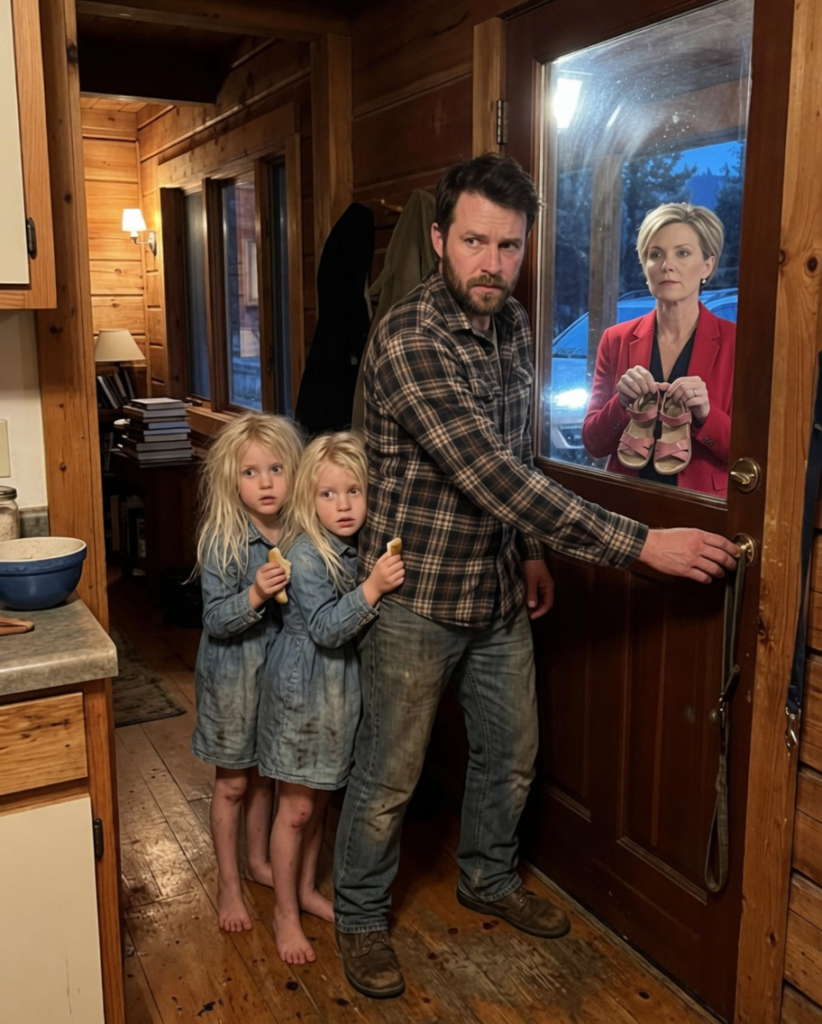
They stood near the porch swing in matching faded dresses, both barefoot, both holding crusts of bread.
They were so still that for one disorienting second I thought grief had finally made me hallucinate.
The wind chime clicked lightly against the cedar post.
Dust lifted from the gravel behind me.
A bird cried once from the tree line and went quiet.
I walked closer.
They were six, maybe a little older.
Pale hair tangled into knots.
Green eyes too old for their small faces.
Dirt ground into their ankles.
Scratches along both forearms.
One hem ripped open.
One bruise already yellowing near a wrist.
Hunger had sharpened them without thinning them completely; that told me this was not one bad day.
This was a pattern.
“What are your names?” I asked.
The girl on the left swallowed.
“June.”
The other barely moved.
“Joy.”
No car but mine.
No handbag.
No adult voices.
No lunchbox.
No water bottle.
No shoes anywhere on the porch.
“Where’s your mama?”
Joy looked down.
June tightened her grip on the bread until her knuckles whitened.
“Gone,” she whispered.
The word did not sound like loss.
It sounded like a rule.
“Are you hungry?”
June raised the crust a little.
“I am.”
“Then why aren’t you eating it?”
Joy answered without looking up.
“Soft bread is for people who belong.”
Every instinct I trusted sharpened at once.
I told them they could come inside.
They did not move until June reached into the neckline of her dress and handed me a folded grocery receipt with a phone number written on the back.
“She said call if we cry.”
I called.
A woman answered on the second ring.
She sounded composed, almost bored.
When I told her where I was and who I had found, she paused and then said, “They’re not staying there.”
No panic.
No relief.
No demand to know whether they were hurt.
Just possession and annoyance.
“You left them barefoot on a mountain porch,” I said.
Ice touched glass on her end.
“Do your job and stay out of family matters.” Then she hung up.
I had walked into the house grieving.
I walked out of that call operational.
Inside, the old place smelled like cedar, cold stone, and shut windows.
Dust silvered the entry table.
Beatrice’s blue ceramic bowl still sat by the sink.
The refrigerator hummed.
June flinched at the sound.
Joy stared at the fruit basket as if she expected someone to snatch it away.
I filled the sink with warm water and washed their feet one at a time.
Mud loosened in ribbons.
Cuts appeared under the dirt.
One heel had a splinter.
June kept one fist closed the whole time.
When I opened the pantry, both girls went rigid.
Canned soup.
Crackers.
Peanut butter.
Honey.
Joy slipped half a saltine into her pocket before taking another bite.
June swallowed too quickly and coughed, embarrassed by needing food too fast.
The receipt still lay on the counter.
Under the number, visible only in the brighter kitchen light, was another line written so faintly I almost missed it.
IF THEY SHOW UP, DON’T CALL LENORA LAST.
I knew the handwriting immediately.
Beatrice.
My dead wife had expected this enough to leave instructions.
I opened the drawer beside the stove, the one she always called the emergency drawer.
Beneath tape, batteries, and a spare flashlight sat the county sheriff’s card pinned under our extra house key.
Sheriff Mercer.
I called.
He listened without interrupting, asked me to keep the girls inside, lock the doors, and not open them for anyone until he got there.
At 5:52, headlights washed over the meadow.
June grabbed my sleeve.
“That’s her car,” she whispered.
“She always knocks twice.”
A woman stepped onto the porch.
Through the narrow pane of glass I saw neat hair, a cream cardigan, lipstick too deliberate for mountain dust, and a pair of little pink sandals dangling from one hand.
The first knock came soft.
The second came exactly the same.
“Girls?” she called.
Her voice was honey poured over ice.
“There you are.”
I did not open the door.
“Who are you?” I asked.
Her smile through the glass did not reach her eyes.
“Lenora.
Their aunt.
Their guardian.
They wandered off again.
I’ve been sick with worry.”
Behind me, June whispered, “Don’t let her count us.”
I turned just enough to see both girls huddled at the end of the hall.
Joy was staring at the sandals.
Her mouth trembled but she made no sound.
“Why were they alone?” I asked.
Lenora gave a small laugh, like I was inconveniencing her.
“You know how children are.”
I looked at the dirt baked up their legs, at the scratches, at the crusts still in their fists.
“No,” I said.
“I don’t think I do.”
She lowered her voice.
“This is family.
Don’t make it ugly.”
Red and blue light flashed across the porch before I could answer.
Mercer’s cruiser stopped hard in the gravel.
Lenora’s smile shifted instantly into concern.
“Sheriff, thank God.
The girls ran off barefoot.
I’ve been looking everywhere.”
Mercer came to the door first.
I opened it only wide enough to let him in, then locked it again behind him.
He took in the girls, the bread, the dirt, the fear in one sweep.
I handed him the receipt.
His expression changed when he saw the note.
“This is Beatrice’s writing?”
“Yes.”
He folded the paper carefully and tucked it into his pocket.
Then he crouched down several feet away from the girls, making himself smaller.
“I’m Mercer.
Nobody’s taking you anywhere right now.”
Joy leaned toward him so slightly it was almost invisible.
“Don’t let her take us downstairs again,” she whispered.
Something in the room hardened.
Mercer asked if a deputy was close.
He put in the call without looking away from Lenora through the glass.
Then he asked the girls if downstairs meant at Lenora’s house.
June nodded once.
“What happens downstairs?”
June’s throat moved.
“We wait quiet.”
“For how long?”
“Till she counts us and says we can come up.”
Joy added, “Soft bread is upstairs.”
Mercer looked at me.
We were past suspicion now.
He stepped outside to speak to Lenora on the porch while I stayed with the girls.
Through the window I watched her press a hand to her chest, shake her head, point toward the woods as if they were wild children who slipped leashes for sport.
Mercer did not react.
A deputy arrived minutes later and remained with her beside the car.
While they were occupied, I went back to the emergency drawer and looked deeper.
Behind the sheriff’s card was an envelope sealed with blue painter’s tape.
My name was written on the front in Beatrice’s hand.
Only if June and Joy come alone.
My hands shook opening it.
Inside was a letter and a stack of copied documents bound with a rubber band: church pantry sign-in sheets, school absence records, photographs of bruised knees and wrists, dates, times, license plate numbers, notes in Beatrice’s narrow slanting script.
The letter was four pages long.
I read it standing at the kitchen counter while the twins sat wrapped in two of Beatrice’s old quilts.
My love,
If you are reading this, then the worst thing I hoped would not happen has happened exactly the way I feared.
I should have told you earlier.
I kept thinking I needed proof first.
I kept thinking there would be another week.
I met June and Joy at the church market last spring.
Lenora Vale brought them twice.
The girls would not touch the bread table until I offered samples and Joy asked in a whisper whether they were “belonging bread.” I knew then something was wrong, but not how wrong.
She went on to explain that Lenora was a distant cousin on her mother’s side who had taken kinship guardianship after the girls’ mother died.
Lenora collected benefits, controlled who saw them, moved them between school absences and “homeschool weeks,” and presented herself as a patient savior to every official who knocked.
Beatrice had been trying to build a case slowly enough that it would hold and quickly enough that the girls would survive it.
She had invited them to the mountain house twice when Lenora thought they were at church activities.
She had shown them the porch, the pantry, the emergency drawer.
She had told them that if they were ever left here alone, or if she ever disappeared before she could come for them, they were to stay visible, hand over the receipt, and not go with anyone until Sheriff Mercer was called.
I asked Mercer later why he had not moved sooner if Beatrice had spoken to him.
He told me the truth I have hated ever since: concern is not the same as a warrant, and fear is not always enough to open a locked door unless someone in authority is willing to see what fear looks like.
Lenora had passed earlier checks with a clean kitchen, pressed dresses, and girls too frightened to say the wrong thing.
Mercer read the file.
Then he asked the twins, as gently as I have ever heard a grown man speak, whether there was a room downstairs.
June nodded.
Joy said, “She knocks twice before she opens it.”
That was enough for Mercer to make the call for an emergency warrant.
We drove to Lenora’s place in a small line of vehicles after dusk: Mercer, the deputy, a child services worker who had met us at the station, and me because the girls refused to let go of my hands until the worker promised she would sit beside them and not separate them.
Lenora’s house sat below the ridge in a tidy rental with flowerpots by the steps and white curtains in the windows.
It looked gentle.
That was the worst part.
Mercer entered first.
The kitchen gleamed.
A loaf of soft white bread sat on the counter beside a still-warm pan of dinner rolls.
In the trunk of Lenora’s car were the pink sandals and three more pairs of children’s shoes, all lined neatly in a milk crate.
The cellar door was behind a narrow hall closet.
It had a hasp on the outside.
When Mercer opened it, cool air came up carrying damp concrete, dust, and old fear.
Two little mattresses lay on the floor.
There was a plastic bucket in one corner, a stack of cracked coloring books, and a tin that held only crusts.
On a shelf above reach sat unopened jars of peanut butter and sleeves of crackers.
A second shelf held family photos turned face down.
The deputy found benefit paperwork in Lenora’s bedroom, along with bank deposits tied to the girls.
There were records of missed school, scripted explanations, and a notebook of punishments written in a hand that matched the labels on the cellar bins: quiet hour, no dessert, porch wait, no shoes.
Lenora stayed calm until Mercer carried the tin of crusts into the kitchen and set it beside the soft bread.
Then the mask slipped.
She called the girls ungrateful.
She said some children needed structure.
She said nobody understood what sacrifice looked like.
Mercer arrested her for child abandonment that night.
The other charges came fast after: neglect, unlawful restraint, fraud.
June and Joy spent the evening at the hospital with a pediatric nurse who knew how to ask small questions without breaking children open.
I stayed in the waiting room until they asked for me by description: the man with the dark jacket and the mountain house.
Joy fell asleep first, one hand buried in a packet of crackers she refused to let anyone throw away.
June stayed awake much longer.
She asked me whether Lenora knew where the house was because of Beatrice.
“Yes,” I said.
“Did Beatrice die because of us?”
The question hit like a blade.
“No,” I told her, because it was the truth Mercer had already given me.
Beatrice died in a rain-slick highway crash coming back from town.
But I also knew what June was really asking.
Did helping us make her leave later? Did loving us cost her something? “She died because roads can be cruel,” I said quietly.
“But she was helping you because she loved you.”
June stared at the blanket in her lap.
“She brought honey bread once.”
That was when I cried for the first time since the funeral.
Child services did not place children with a grieving finance executive on instinct, but Beatrice’s file changed everything.
So did the girls’ refusal to go anywhere I was not.
Mercer vouched for me.
My attorney stopped being useful in the abstract and became useful in the urgent.
Background checks were rushed.
Home visits were done.
Temporary placement was granted at my city house first, then amended so we could spend weekends at the mountain place because the girls slept there without nightmares.
The first month was a map of small emergencies.
Joy hid food in couch cushions, dresser drawers, and once inside a boot.
June stood by doors and windows whenever someone knocked, her whole body going still until she heard my voice.
They both ate too quickly at first.
They both apologized for taking baths too long.
They both asked permission to use blankets.
I bought shoes in every color they pointed at because I could.
Beatrice would have laughed at that solution and then kissed me for trying.
Mercer kept me informed as the case moved.
Forensic interviews supported everything in Beatrice’s notes.
School staff remembered the girls coming in hungry after “home weeks.” A church volunteer had once seen June wrap bread in a napkin and tuck it into her sleeve.
Lenora’s bookkeeping showed exactly how carefully she had monetized pity.
In the end she took a plea that spared the girls a trial but not the truth.
Her guardianship was terminated.
She went to prison on the neglect and unlawful restraint charges, with fraud folded into the sentence.
Months later, after every waiting period a county could invent, June and Joy’s caseworker asked whether I intended to pursue permanent guardianship.
I looked at the girls in my kitchen while she asked it.
Joy was on a stool stirring muffin batter with far too much concentration.
June was reading the recipe aloud like a courtroom clerk.
Both of them had color in their faces.
Both of them had stopped flinching when the refrigerator hummed.
The house was louder, messier, stranger, and more alive than anything I had built on purpose.
“Yes,” I said.
The adoption took longer than my impatience liked and less time than my fear predicted.
On the day it became final, June wore a yellow dress Beatrice would have loved.
Joy chose bright blue sneakers and kicked her feet under the courtroom bench because she could.
When the judge asked whether they understood what was happening, Joy said, “It means I don’t have to hide crackers anymore.” Even the judge had to pause after that.
We kept their first names and added mine.
Then we drove to the mountain house.
I had expected the place to feel haunted forever.
Instead it felt occupied in the truest way: shoes by the door, a schoolbag tipped over by the stairs, two toothbrushes by the sink, a drawing of three stick figures taped crookedly to the refrigerator with a magnet from the church market.
That evening I baked bread because Beatrice had once tried to teach me and because memory can become a recipe if you repeat it enough.
The smell filled the kitchen before the sun went down.
Joy stood on a chair to watch.
June waited beside the counter with both hands folded, trying not to ask.
When I set the warm loaf on the board, Joy looked up at me and said, very carefully, “Is that for us?”
I nearly answered with something noble.
Something polished.
Something a man like me would have said before grief broke him open.
Instead I told the truth.
“It’s for my daughters.”
Joy cried first.
June held on longer, then broke all at once.
I had driven up that mountain to say goodbye to my wife.
Instead I found the last promise she had not lived long enough to make out loud.
Sometimes I still hear Lenora’s calm voice on the phone and wonder how many people mistake gentleness for goodness because cruelty is easier to accept when it speaks softly.
Sometimes I stand on the porch at dusk and look at the meadow and think about Beatrice’s handwriting on that grocery receipt, faint but stubborn, as if she knew the difference between being gone and being finished.
I still do not know whether she believed I would be brave enough when the door finally shook under those two practiced knocks.
I only know that the biggest red flag was never the bruises or the hunger or even the barefoot children on a porch.
It was how ordinary evil sounded when it said, without a tremor, that they were not staying there.