The Sound of Silence: The Vineyard Audit
Chapter 1: The Sound of Resentment
This is the chronicle of my own private coup d’état—the moment I stopped being a patient tenant in my own life and became the cold architect of my own vindication. They thought the sprawling hills of the Napa Valley Vineyard were wide enough to swallow my truth; they didn’t realize that even the most perfect landscape eventually cracks under the weight of a secret as heavy as mine.
The world was a chaotic symphony of clinking crystal, expensive laughter, and the rhythmic, honeyed thrum of a jazz quartet. To anyone else, the vineyard was a paradise of rolling green hills, golden sunlight, and the scent of fermenting grapes and expensive lavender. To me, it was a battleground where the weapons were whispers I couldn’t hear and glances I could feel like needles against my skin.
I sat at the edge of the reception, my eyes darting from face to face with the precision of a hawk. I was trying to piece together the fragments of a conversation I was barely invited to, reading the jagged shapes of lips and the subtle shifts in posture. I am profoundly deaf. Seven years ago, a bout of viral meningitis stripped the world of its melody, leaving me in a tomb of absolute stillness. My only bridge back to the living was the Cochlear Nucleus 7 processor hugging my right ear—a ten-thousand-dollar miracle of electrodes and processors that translated vibrations into a digital, metallic version of sound.
But even with the miracle of technology, a high-society wedding was a sensory nightmare. The background noise of three hundred guests was a crushing wall of static that made my head throb.
“Claire! Stop staring at the wine and help with the gift table!”
I didn’t hear the words, but I felt the sharp, aggressive vibration of a voice nearby—the kind of vibration that felt like a physical shove. I turned my head to see Evelyn, my mother-in-law, her face a mask of pinched, aristocratic irritation. Her lips moved with a rapid, staccato blur of motion that I struggled to track through the visual noise of the crowd.
I pointed to my ear and said softly—careful to monitor my own volume, a skill I practiced daily with the discipline of a monk—”Evelyn, please, there’s too much background noise. The processor is struggling with the wind and the music. I can’t process your speech right now. Can you slow down and look at me?”
Evelyn’s face contorted into a snarl. She didn’t slow down. Instead, she turned to the bride, my sister Sarah, who was busy adjusting her lace veil in a nearby gilded mirror.
“See?” Evelyn sneered, her voice reaching a pitch that made several nearby guests flinch. “She does it every time I ask for something. She can hear the music just fine when she wants to dance, but the second I ask her to help the ushers, she’s suddenly ‘stone deaf.’ It’s a convenient little scam, isn’t it? A way to play the princess while we do the work.”
Sarah snorted, her eyes cold as she looked at her reflection. “It’s her favorite way to steal the spotlight, Evelyn. ‘Poor Claire and her bionic ear.’ It’s pathetic. She uses that thing to ignore us when she’s bored, then plays the victim when we get frustrated. Honestly, her ‘disability’ has ruined the whole morning.”
I felt the familiar, cold sting of isolation. They didn’t believe in my deafness; they believed in my “selectivity.” To them, my neurological reality was a tool for manipulation, a “drama” I staged to avoid the duties of a “perfect” daughter and sister.
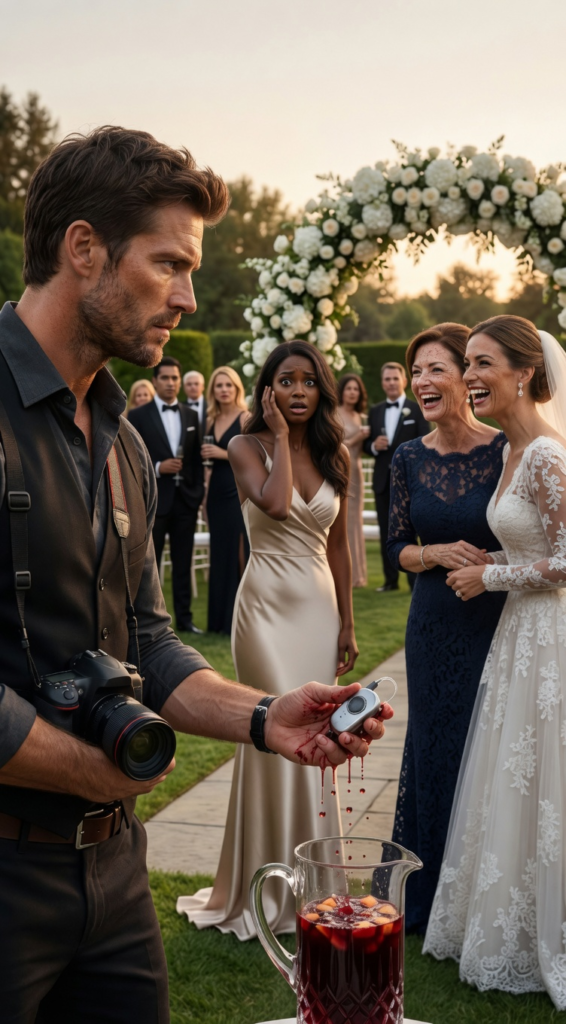
I looked across the lawn at the wedding photographer, a man the family knew only as Ben. He was a tall, observant man with a high-end Nikon camera, capturing every smile and every sneer with clinical detachment. But Ben wasn’t a photographer. His real name was Dr. Julian Vance, my specialized audiologist and the surgeon who had mapped the very electrodes inside my skull.
I had hired him three weeks ago. I knew my family was planning a “confrontation” about my “fake” deafness to clear the way for Sarah to take over my share of our father’s estate. I needed a witness who understood the medical reality they chose to ignore—a man who knew that my silence wasn’t a choice, but a condition.
Cliffhanger: As the reception officially began, I saw Evelyn whisper something to Sarah while gesturing toward the heavy, crystal sangria pitchers on the head table. A predatory, jagged smile crossed her face as she began to walk toward me, her hand reaching out like a claw.
Chapter 2: The Plunge into Silence
The assault came from behind, swift and surgical.
I was leaning over to pick up a fallen program—a delicate piece of vellum Sarah had spent thousands on—when a hand lunged at my right temple. It wasn’t a graze; it was a violent, calculated snatch that felt like my soul was being torn out through my ear.
There was a sharp, agonizing tug against my scalp, a momentary burst of white-noise static that felt like an electrical fire in my brain, and then—nothing.
The world didn’t just go quiet. It died. The jazz quartet, the laughter of the socialites, the rustle of the vineyard leaves—all of it was extinguished as if a candle had been snuffed out by a cold wind. I was plunged into a crushing, absolute silence that felt like being buried alive in a velvet coffin.
I spun around, my heart hammering against my ribs so hard I could feel the rhythmic thud in my very teeth. Evelyn stood there, her face twisted in a look of triumphant, narcissistic glee. She held my external processor up like a trophy, the delicate magnetic coil and cable dangling from her manicured fingers like a dead insect.
“STOP IGNORING ME!”
I couldn’t hear her scream the words, but I saw the veins in her neck bulge like blue snakes. I saw her mouth form the jagged, ugly shapes of the insult.
Then, she did the unthinkable. With a theatrical, high-pitched laugh that I could only feel as a vibration in the floorboards under my feet, she dropped the ten-thousand-dollar device into a deep, crystal pitcher of dark red sangria.
I watched in agonizing slow-motion as the processor sank into the sugary, acidic alcohol. Tiny, silver bubbles escaped from the microphone ports—the last gasps of a device that was, quite literally, my only connection to human reality. It settled at the bottom amongst the slices of orange and brandy-soaked berries, a piece of high-tech debris.
Sarah stood beside her, clapping her hands with a spoiled, childish delight. I couldn’t hear her, but I could read the mocking, cruel shape of her lips: “Don’t worry, everyone! Claire’s just doing her ‘silent protest’ again. She’ll stop faking once she realizes the bar is open and no one is looking at her!”
The guests—people my father called “friends”—began to laugh. I could see the rhythmic shaking of their shoulders, the wide, mocking arcs of their mouths. They thought it was a “prank.” They thought they were finally seeing the “liar” exposed.
I stood in the center of the terrace, my hands flying to my ears as if I could somehow hold onto the sound that was gone. The world felt tilted, the lack of auditory input making my vestibular system—my very sense of balance—waver. I was a ghost at my own sister’s wedding, trapped in a vacuum while they celebrated my humiliation.
Cliffhanger: I felt the world start to spin, the horizon line of the vineyard beginning to tilt dangerously to the left. I reached out for the table to steady myself, but my hand missed, and as I began to fall, I saw Dr. Julian Vance drop his camera and move toward the table with a lethal, terrifying focus.
Chapter 3: The Mockery of the Mute
The disorientation hit me like a physical blow. Without the constant input from my implant, my brain struggled to process the spatial reality around me. I stumbled, my hip hitting the edge of the mahogany head table with a dull thud I could only feel as a localized ache.
Sarah walked up to me, leaning her face inches from mine, her breath smelling of expensive champagne and malice. She began to mouth words with exaggerated, grotesque movements of her jaw, her eyes wide with a manic joy. “L-I-A-R,” she mouthed, over and over, her tongue flicking against her teeth. She pointed to the sangria pitcher and then to my face, laughing so hard that tears of mirth began to ruin her waterproof mascara.
She thought she was winning the “inheritance war.” She thought that by stripping me of my hearing, she had stripped me of my standing in the family. To her, I was no longer a sister; I was an obstacle that had finally been dismantled.
I looked at the pitcher. The sangria’s sugar, alcohol, and fruit acids were already eating away at the delicate internal circuitry of the processor. That device wasn’t just “tech”; it was a piece of neurological medical equipment, the result of years of calibration and surgical precision. It was currently being dissolved in cheap wine for the sake of a wedding “prank.”
Julian reached the table. He didn’t look at the family. He didn’t even look at Evelyn, who was busy boasting to a circle of aunts about how she had “fixed Claire’s attitude.”
He pulled a specialized, waterproof medical kit from his camera bag—tools he had brought specifically for this nightmare scenario. He used a pair of sterile forceps to fish the dripping processor out of the wine. His face was ashen, his jaw set in a line of cold, hard iron.
He looked at the device, then at the ruined internal seal where the sangria had penetrated the battery housing. He knew, as well as I did, that the processor was medically dead. Ten thousand dollars of technology, and seven years of auditory mapping, destroyed in ten seconds of pure spite.
Julian turned on a high-powered medical flashlight and pointed it directly at the ruined casing, then slowly turned his gaze toward the wedding videographer. He signaled with a sharp, commanding gesture, ensuring that the entire “prank” and the forensic aftermath were being recorded from multiple angles.
Evelyn finally noticed him. She sneered, her lips moving in a way that suggested she was telling “the hired help” to get back to work. She had no idea she was looking at a man who was about to dismantle her entire social and legal existence.
Cliffhanger: Julian didn’t back down. He reached for the wedding DJ’s microphone, which was resting on the nearby speaker, and I saw his thumb flick the “On” switch. The red light glowed like a drop of blood in the vineyard sun.
Chapter 4: The Audiologist’s Decree
“I’VE HEARD ENOUGH.”
The words didn’t come from a guest. They came from the massive wedding speakers, amplified to a volume that made the very air in my chest vibrate. The quartet stopped mid-note. The laughter in the room died as if a throat had been cut.
I couldn’t hear the sound, but I saw the room go deathly still. I saw the mocking smile die on Sarah’s lips, replaced by a flickering shadow of confusion.
Julian didn’t look like a “service-worker” photographer anymore. He stood in the center of the dance floor, holding my dripping, ruined processor in a sterile evidence bag. His posture was that of a man who owned the room, and everyone in it.
“I am Dr. Julian Vance,” he said, his voice (as I would later read in the court transcript) cutting through the Napa air like a surgical razor. “I am a board-certified audiologist and the surgeon who performed Claire’s cochlear implantation at the Vance Neurological Center. I am her primary medical provider, and I have been observing this ‘family event’ for the last four hours.”
Evelyn’s face turned the color of curdled milk. Sarah stepped back, her hand flying to her throat, her lace veil snagging on a chair.
“Evelyn,” Julian continued, his eyes locked on my mother-in-law with a predatory intensity. “You didn’t just ‘soak a scam’ today. You just destroyed a ten-thousand-dollar piece of neurological medical equipment, a Tier 1 medical device. In the eyes of the law, that is felony destruction of property. But the medical reality is far more severe.”
He stepped closer to the head table, looming over Sarah. “By violently ripping this processor from Claire’s head while the magnetic coil was engaged, you risked causing an internal electrode displacement or a sub-dural hemorrhage. You committed a felony assault on a disabled person under the Protective Services Act. And because I am her doctor, I am a mandatory reporter. I don’t have the option to stay quiet.”
The room was so silent you could have heard a grape fall from the vine. Sarah tried to scream that it was her wedding, that he couldn’t do this, that Claire was “faking” the depth of the loss.
“She isn’t faking anything,” Julian barked into the microphone, his voice echoing off the hills. “I have her brain scans on this tablet. I have the records of her seven-year struggle. And most importantly, I have your ‘confession’ and your laughter recorded on three different high-definition devices, including the wedding video you paid for. You just filmed your own indictment.”
Cliffhanger: I stood there in the center of the silence, watching the scene unfold like a movie with the sound turned off. I saw two Napa Valley Sheriff’s deputies walking through the vineyard gates, their hands on their belts. Sarah looked at me, her eyes full of a raw, naked terror, and for the first time, I realized I was the one holding the power.
Chapter 5: The Price of Silence
The “perp walk” was a masterclass in poetic justice.
Evelyn was led out in handcuffs, her silk designer dress stained with the very sangria she had used as a weapon of humiliation. She was weeping, her face a mask of ruined makeup, but no one was listening to her pleas anymore. Sarah followed her, her white veil trailing in the dirt of the vineyard, her “perfect” wedding reduced to a crime scene photo that would be featured in every tabloid in the state.
The guests—the “elite” circle that had laughed while I stumbled—were now scrambling to provide statements to the deputies, desperate to distance themselves from the scandal. The social capital they had spent decades building was gone in a single afternoon.
I sat in the back of an ambulance, the flashing red and blue lights the only rhythm in my silent world. Julian sat beside me, his presence a warm, steady anchor. He didn’t try to speak; he knew I couldn’t hear him. Instead, he pulled out a tablet and typed in large, clear letters:
“They are gone, Claire. They will never touch you or your legacy again. The device is a total loss, which makes it a Grand Larceny charge in this jurisdiction. We have everything we need for the District Attorney. You are safe.”
I looked at my reflection in the ambulance window. My ear felt cold and exposed without the weight of the processor, but for the first time in seven years, I felt a strange, new strength. I didn’t need to hear their apologies. I didn’t need to hear their excuses. I only needed to see them pay for the silence they tried to weaponize.
My father—the man who had stayed quiet while his daughters fought for years, the man who had allowed Evelyn to bully me just to keep the peace—approached the ambulance. He looked at me, his eyes full of a late-coming, useless regret. He reached out to touch my hand, but I pulled away with a cold, final precision.
He pulled out his own phone and typed a message, showing me the screen with trembling hands:
“I have the safe combinations to the family trust. Sarah and Evelyn are being legally removed as beneficiaries tonight. Everything is being transferred to your name, Claire. I’m so sorry I didn’t see it sooner.”
I looked at him, then at the flashing lights of the patrol cars receding into the distance. It was too little, too late for a father’s love, but the money would buy me the best medical care in the world. It would buy me a new life, far away from the people who thought my silence was a weakness to be exploited.
Cliffhanger: As the ambulance doors began to close, Julian handed me a small, velvet box he had retrieved from his bag. I opened it to find a prototype—a specialized, high-gain interim processor. He clipped it onto my ear, and as he flicked the switch, the first thing I heard wasn’t the wind or the sirens. It was the sound of my own steady, even breathing.
Chapter 6: The New Symphony
Six Months Later
The world was alive again, but the music was different now.
I stood in a quiet park in San Francisco, the sound of birds chirping in a crisp, digital clarity I’d never heard before. I had a brand-new, state-of-the-art Kanso 2 processor—the “Ferrari” of hearing technology—paid for by the massive settlement from my lawsuit against Evelyn and Sarah.
I was no longer hiding my disability. The new processor wasn’t flesh-colored; it was a deep, shimmering midnight blue, bedazzled with tiny, sparkling crystals. It was a statement of pride, a piece of armor rather than a secret to be ashamed of.
Dr. Julian Vance met me by the fountain. He smiled as I turned to face him, the sound of the water falling behind me like a curtain of silver bells.
“How’s the new map feeling, Claire? Any distortion in the high frequencies?” he asked. His voice was warm, clear, and perfectly balanced in my mind.
“I hear everything now, Julian,” I said, my voice steady and confident. “Especially the things people don’t say. I hear the truth, and it’s the most beautiful sound in the world.”
I pulled a news clipping from my pocket. Evelyn was serving a three-year sentence in a state facility for felony assault and destruction of medical property. Sarah’s marriage had ended in a messy, public annulment after the groom saw the high-definition video of her mocking me. The family estate had been liquidated to cover the legal fees and the massive settlement I had won. They were living in the very silence they had tried to trap me in.
I dropped the clipping into a nearby trash can. The “silence” that they had tried to weaponize had turned out to be the only thing loud enough to make me leave them behind forever.
I looked at a young girl playing near the fountain. She was wearing a bright pink cochlear implant, laughing as she chased a butterfly. I walked over, tapped my own crystal-covered processor, and gave her a wink.
She beamed back at me, her world as loud and vibrant as mine.
I walked away with Julian, the sound of the fountain and the distant city hum creating a beautiful, endless symphony. The final verdict was in: my hearing was a gift, my voice was a weapon, and for the first time in my life, I was the one conducting the music of my own future.