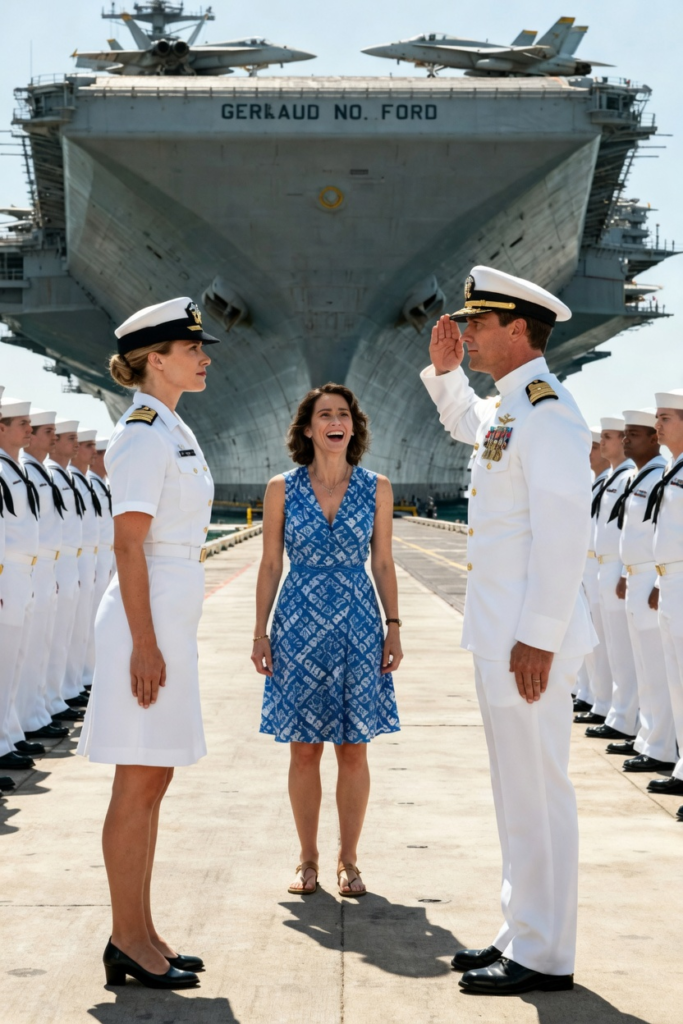
When My Sister Mocked Me as the Family Failure at Homecoming, Her Navy Husband Saw My Badge and Shouted the Words She Feared Most
My sister laughed into a rhinestone microphone and told three hundred people I was “the quiet one who just types emails for a living.”
Then she pointed at my jacket, at the tiny silver pin I had forgotten to remove, and said, “Honestly, Rachel, even your costume jewelry looks government-issued.”
Her husband stopped smiling.
The ballroom at the Chesapeake Bay Club went still in pieces.
First the laughter died near the bar.
Then the forks stopped against the plates.
Then Commander Evan Whitaker, my sister’s handsome Navy husband, pushed his chair back so fast the legs screamed against the polished floor.
He stood straight.
His face drained white.
And in a voice that cracked across the room like a rifle shot, he said, “Admiral on deck.”
Nobody moved.
Not my mother, with her pearls frozen against her throat.
Not my father, whose Scotch glass hovered an inch from his mouth.
Not my sister Lauren, whose perfect red lips were still curved around the last cruel word she had aimed at me.
I looked down at the pin on my lapel.
A small eagle.
Two stars.
Silver, clean, and very real.
I should have taken it off in the parking lot.
But I had been distracted.
By the black SUV idling across the street.
By the man in the gray suit pretending to smoke near the marina gate.
By the fact that my sister’s invitation had arrived two weeks after someone used her home Wi-Fi to access a classified Navy procurement file.
So no, I had not come to Chesapeake Bay for homecoming because I missed family.
I had come because someone in that ballroom was lying.
And now, thanks to my sister’s mouth, everyone had just learned I was not the harmless little woman they had spent twenty years underestimating.
Lauren blinked first.
“What did you just say?” she whispered.
Evan did not look at her.
He kept his eyes on me.
Shoulders squared.
Chin tucked.
The way officers stand when they realize they have been laughing in the presence of someone who can end their career before dessert.
“Ma’am,” he said.
One word.
That was all.
Not Rachel.
Not sis-in-law.
Not Lauren’s weird little sister.
Ma’am.
A tremor moved through the room.
I saw it ripple table by table.
The high school football coach who used to call me “bookworm” leaned toward his wife.
The mayor lowered his phone.
My cousin Matt, who had spent Thanksgiving asking whether I “still answered phones at the Pentagon,” sat back like the chair had turned hot beneath him.
Lauren stared at Evan like he had slapped her.
“Why are you calling her that?” she hissed.
I took a sip of water.
The ice clicked once against the glass.
“Because,” Evan said slowly, “that is Rear Admiral Rachel Monroe.”
A server dropped a tray near the dessert table.
China exploded on the marble.
Nobody looked away from me.
Lauren’s laugh came out thin.
Fake.
Too sharp at the edges.
“No, she’s not.”
I folded my napkin.
Set it beside my plate.
“Lauren.”
My voice was quiet.
That made it worse.
It always did.
When people are screaming, they expect you to scream back.
When they throw a knife, they want to see blood.
I had learned years ago that silence made cruel people nervous.
And calm made guilty people sloppy.
Lauren’s smile twitched.
“She works in admin,” she said, looking around the room for help. “She literally told Mom she writes briefings and answers emails.”
“I do write briefings,” I said.
A nervous laugh moved through the room and died quickly.
Evan’s hand tightened at his side.
My father finally put down his drink.
“Rachel,” he said, voice low, warning wrapped in embarrassment. “What is going on?”
That was my father.
Thomas Monroe.
Retired Navy senior chief.
Thirty years in uniform.
A man who had taught me how to shine shoes until I could see my face in them, then spent the rest of his life acting like my sister’s beauty pageant trophies outranked my commission.
He had not known.
Of course he had not known.
I had tried to tell him once.
Twelve years ago.
I had come home from Washington in a dark blue suit with a folder under my arm and a question in my mouth.
Dad, can we talk?
Lauren had arrived five minutes later with a broken engagement ring, mascara under her eyes, and a story about a man who did not deserve her.
My father had turned away from me.
“Not now, Rach.”
Not now became next week.
Next week became next year.
Next year became a silence big enough to bury a life inside.
I was not there to beg them to see me.
I was not there to explain every night I slept under fluorescent lights with a locked phone beside my hand.
I was not there to list the names of sailors whose lives had passed across my desk like coded prayers.
I was not there to make Lauren smaller so I could finally look big.
I was not there to punish my parents for loving the loud child more than the quiet one.
I was there because a breach had a fingerprint.
And that fingerprint led home.
Lauren gripped the microphone until the rhinestones pressed dents into her skin.
“This is insane,” she said. “Evan, sit down.”
He did not.
“Evan,” she snapped.
Still nothing.
That was the first mini-payoff of the night.
For years, Lauren had treated every room like a stage built for her.
For years, people had moved when she clapped, laughed when she smirked, apologized when she cried.
But her husband, her decorated commander, her shiny proof that she had married better than me, stood at attention for the sister she had just humiliated.
I watched that realization land on her face.
It was small.
But it was enough.
The homecoming party had been her idea.
A grand celebration for Evan’s return from deployment.
Gold balloons.
Navy blue tablecloths.
A slideshow of him in uniform.
A cake shaped like an aircraft carrier.
A banner that read WELCOME HOME, COMMANDER WHITAKER.
And beside the cake, in smaller letters Lauren had approved herself:
FAMILY IS OUR ANCHOR.
I almost smiled when I saw it.
Almost.
Because anchors could hold you steady.
Or drag you under.
“Rachel,” my mother said.
She did not sound proud.
She sounded accused.
As if my rank were a stain I had tracked onto the carpet.
“You never told us.”
Lauren whipped toward her.
“Because it’s not true, Mom.”
“It is true,” Evan said.
His voice was barely above a whisper now.
But every word carried.
“I saw her at Naval Station Norfolk six months ago. Closed-door briefing. Pacific fleet cyber readiness. They cleared the room when she entered.”
Lauren turned back to me.
Her eyes dropped again to the pin.
Then to my hands.
Then to the simple black dress she had mocked in the coatroom.
“You let me say all that,” she said.
There it was.
Not I’m sorry.
Not I didn’t know.
You let me.
I leaned back.
“I didn’t hand you the microphone.”
A sound passed through the room.
Not quite laughter.
Not quite a gasp.
A crack in the spell.
Lauren heard it and hated it.
Her cheeks flushed dark beneath her makeup.
“You always do this,” she said.
I tilted my head.
“Do what?”
“Act calm. Act above everyone. Act like you’re too good to fight back.”
“I’m not above anyone.”
“You walked in here like you were judging us.”
“No,” I said. “I walked in here at 7:04.”
Evan’s eyes moved.
He had noticed.
Of course he had.
Military men notice time.
Lauren had told everyone dinner started at seven.
My mother told me six-thirty.
I arrived early and spent thirty-four minutes in the parking lot watching a black SUV with Maryland plates idle near the service entrance.
At 6:58, my sister’s assistant Carrie carried a silver laptop bag through the rear door.
At 7:01, my brother-in-law took a call near the ice machine and said, “Not tonight. She’s here.”
At 7:04, I entered the ballroom.
Lauren had handed me a name tag that read RACHEL MONROE — GUEST.
Not family.
Guest.
I had stuck it to my jacket because I wanted to see who smiled.
People tell you everything when they think you are nobody.
They leave doors open.
They leave phones unlocked.
They let sentences fall unfinished.
They say names they should swallow.
And my family had always thought I was nobody.
“Mom,” Lauren said, her voice shaking now, “tell her to stop.”
My mother looked at me with the old disappointment.
The kind that had lived in her face since I cut my hair short at nineteen and chose Annapolis over the University of Virginia, where she had already imagined me joining Lauren’s sorority and marrying someone with a summer house.
“Rachel,” she said, “this is Lauren’s night.”
There it was again.
The family anthem.
Lauren’s night.
Lauren’s pain.
Lauren’s wedding.
Lauren’s miscarriage.
Lauren’s divorce scare.
Lauren’s house renovation.
Lauren’s husband’s promotion.
Lauren’s everything.
Even when I had called from a military hospital in Germany after shrapnel tore through my left shoulder, Mom had said, “Can this wait? Lauren’s caterer just canceled.”
I had hung up before the nurse could see my face.
Now I looked at my mother across a table full of crab cakes and champagne flutes.
“It was Lauren’s night,” I said.
Lauren narrowed her eyes.
“Was?”
The ballroom doors opened.
Two men entered.
One in a dark suit.
One in Navy dress blues.
No one recognized the man in the suit.
Several people recognized the Navy captain.
Captain Miles Hart.
Director of Fleet Security Review.
The kind of man who could make a room nervous simply by not smiling.
Evan recognized him immediately.
His posture stiffened even more.
“Captain Hart,” he said.
Lauren stepped backward.
“Why is there another officer here?”
Captain Hart’s eyes moved once across the room.
He did not salute me because protocol did not require turning a family humiliation into a parade.
But his nod was enough.
“Admiral.”
The second wave hit harder than the first.
My mother sat down.
My father stood up.
Lauren whispered, “No.”
Captain Hart stopped beside my chair.
“We confirmed the signal path,” he said softly.
I nodded.
“Source?”
He glanced toward the head table.
Toward the floral centerpiece.
Toward the little gold clutch purse beside Lauren’s champagne glass.
“Device is still active.”
Lauren followed his eyes.
So did I.
Her hand moved too fast.
That was her mistake.
People who are innocent look confused.
People who are guilty reach.
Lauren reached for the clutch.
Captain Hart’s suited man moved first.
He was broad, efficient, and silent.
He took the purse before Lauren’s fingers touched the clasp.
“Excuse me,” Lauren barked. “That’s mine.”
The man opened it.
Inside were lipstick, a powder compact, a key card from the hotel upstairs, and a phone I had never seen before.
Not Lauren’s pink-cased iPhone.
A black prepaid device.
The kind bought with cash from a gas station rack.
My father said, “Lauren?”
Her mouth opened.
Nothing came out.
Evan finally moved.
Not toward me.
Toward his wife.
“Tell me that isn’t yours,” he said.
Lauren looked at him, then at me.
And there, in the space between fear and pride, I saw her choose the wrong mask.
She smiled.
Barely.
“That?” she said. “I’ve never seen it before.”
The suited man held up the phone.
Its screen lit with an incoming message.
No ringtone.
Just a white rectangle on black glass.
Captain Hart read it without touching anything.
His jaw tightened.
“What does it say?” Evan asked.
Nobody answered.
I stood.
The room held its breath as if my chair had made the final decision for everyone.
I crossed the floor slowly.
My heels made small, clean sounds on the marble.
Click.
Click.
Click.
Lauren watched me like I had changed shape in front of her.
Maybe I had.
Maybe in her mind I had always been sixteen, sitting at the edge of her bed, helping her memorize lines for school plays while she called me boring.
Maybe I had always been twenty-two, coming home for Christmas in a plain sweater while she showed everyone the diamond tennis bracelet her boyfriend bought her.
Maybe I had always been thirty-one, alone at the airport with one carry-on and a classified phone, while Mom told relatives I “worked with computers.”
People do that.
They freeze you at the size that makes them comfortable.
Then they panic when you move.
I stopped in front of Lauren.
“Who gave you the phone?”
She swallowed.
The microphone still hung from her hand.
“Rachel,” she said, voice sweetening. “Come on. This is ridiculous. You know me.”
“I do.”
Two words.
Flat.
Sharp.
That landed.
Her eyes flashed.
“You really want to do this here?”
“No,” I said. “But you did.”
Evan looked sick.
“Lauren.”
She turned on him.
“Oh, don’t start looking at me like that.”
“Like what?”
“Like I embarrassed you.”
He stared at her.
“You did.”
The words hit harder than any accusation I could have made.
Lauren’s face cracked.
For one second, she looked like the little girl who used to stand in the hallway listening to Dad polish his medals, desperate for him to look up.
Then the crack sealed.
She became marble again.
“This is a misunderstanding,” she said. “Rachel is making it dramatic because that’s what she does. She disappears for years, comes back with secrets, and suddenly everyone is supposed to bow?”
“No one bowed,” I said.
Evan’s voice was hoarse.
“I stood at attention.”
Lauren glared at him.
“Same thing.”
“No,” he said. “It isn’t.”
I almost felt sorry for him.
Almost.
He had married into our family thinking Lauren’s confidence was charm.
Thinking her cruelty was wit.
Thinking her hunger was ambition.
But hunger does not stop when it gets fed.
It gets sharper teeth.
Captain Hart stepped closer.
“Mrs. Whitaker, this device transmitted from your home network at 0217 last Thursday. It accessed a restricted file path tied to Naval procurement review.”
Lauren laughed again.
But this laugh had no music.
“I don’t even know what that means.”
“You don’t have to,” I said.
Her eyes cut to me.
I continued, “Someone only needed your Wi-Fi, your guest access credentials, and your husband’s old CAC reader.”
Evan closed his eyes.
His face told me everything.
He had brought work home.
He knew better.
But marriage makes people careless with locked drawers.
Love makes people assume the person across the breakfast table would never walk a stranger to the door.
“I threw that reader away,” he whispered.
Lauren said too fast, “You did.”
Captain Hart’s suited man tapped the burner phone screen with a gloved finger.
“Message preview includes the words: ‘She’s wearing stars. Abort dinner plan.’”
My mother covered her mouth.
The mayor stood up, then thought better and sat back down.
My cousin Matt whispered, “Dinner plan?”
I looked at Lauren.
Her pupils had gone wide.
Not at the accusation.
At the word abort.
That told me something important.
She was afraid of the sender.
Not of me.
Not yet.
“Who was supposed to receive something tonight?” I asked.
Lauren shook her head.
“No.”
“Lauren.”
“No.”
“Was it in the slideshow laptop?”
Her lips parted.
There.
Mini-payoff number two.
The laptop.
On the far side of the stage, the giant screen still showed a frozen photo of Evan in uniform beside an American flag.
Lauren’s assistant Carrie stood near the projector cart, pale as paper.
I had seen her carry that silver laptop bag through the service entrance before dinner.
I looked at Captain Hart.
He lifted two fingers.
The suited man moved toward the stage.
Carrie tried to step back.
“Ma’am,” he said, calm and not asking.
She started crying before he reached her.
“I didn’t know,” she blurted. “Mrs. Whitaker told me it was a tribute video.”
Lauren spun around.
“Carrie, shut up.”
That was the third mini-payoff.
Lauren never yelled at staff in public.
She saved that for kitchens, hallways, and parking lots.
But fear strips polish.
Carrie put both hands over her mouth.
Too late.
Everyone had heard.
My father’s face had changed.
Not enough.
But enough.
The old Navy chief had awakened behind the embarrassed parent.
He looked at the phone.
Then the laptop.
Then at his daughter.
“Lauren,” he said, “what did you do?”
She stared at him.
For one aching second, I saw the wound under the performance.
Not regret.
Not guilt.
Something uglier.
Resentment.
“You finally ask me that,” she said quietly.
My mother whispered, “Honey.”
Lauren looked at her.
“No. Don’t honey me.”
“Lauren, please.”
“No.” Lauren’s voice rose. “You all want to look shocked now? You made her a ghost and then you’re shocked when she comes back as a war hero?”
“I never said I was a war hero,” I said.
“I wasn’t talking to you.”
The room went silent again.
There it was.
The motive.
Not the whole conspiracy.
Not the names behind the burner phone.
But the thing that made her useful to them.
Jealousy.
Old.
Patient.
Fed at every birthday, every holiday, every dinner where my accomplishments were too complicated to brag about and hers came with photographs.
Lauren had built a life around being seen.
Then she married a man whose world cared about ranks she did not understand and missions she could not post on Instagram.
And somewhere along the way, someone had noticed that wound.
Someone had pressed a thumb into it.
Someone had told her that access was power.
“Mrs. Whitaker,” Captain Hart said, “step away from the stage.”
Lauren did not move.
Instead, she lifted the microphone again.
The speakers shrieked with feedback.
Several people flinched.
I did not.
“Everyone wants a show?” she said.
Her voice shook, but her chin stayed high.
“Fine. Let’s have one.”
“Lauren,” Evan said.
She ignored him.
“She comes back after years of making us feel small, and suddenly she’s some secret admiral? And all of you are eating it up because power looks prettier when it surprises you.”
I watched her carefully.
Her left hand was empty.
Her right held the microphone.
Her eyes kept flicking toward the cake table.
Not the laptop now.
The cake.
I turned my head slightly.
The cake was ridiculous.
Three tiers.
Blue icing.
Tiny edible jets.
A plastic aircraft carrier on top.
Beside it sat a framed photo of Evan in uniform.
And behind the photo, half-hidden by a spray of white roses, was a small black case.
Not part of the decor.
Not there when I walked in.
My pulse did not change.
That was one of the first things the Navy taught me.
Fear could happen.
Panic was optional.
“Captain,” I said.
He followed my gaze.
His eyes sharpened.
The suited man was still near the stage.
Too far.
Evan saw the case at the same time.
He moved without thinking.
“Don’t,” I said.
He froze.
Lauren smiled.
Tiny.
Triumphant.
Not because she had planned the case.
Because she realized I had seen it.
And she still did not know whether I could stop it.
“Everybody stay seated,” I said.
My voice did not rise.
It cut.
People obeyed before they understood why.
That was the difference between noise and command.
My father stepped forward.
“Rachel—”
“Sit down, Chief.”
The title hit him like cold water.
He sat.
My mother stared at me.
For the first time in my life, she looked afraid of interrupting me.
I walked toward the cake table.
Slowly.
Not because I wanted drama.
Because sudden movement makes frightened people unpredictable.
Lauren’s fingers tightened around the microphone.
“You think you can control every room?” she said.
“No.”
Click.
Click.
Click.
“I control this one.”
The room held its breath.
The black case sat behind the flowers, matte and ugly among all that frosting and gold ribbon.
I did not touch it.
I leaned close enough to see the seam.
A thumbprint lock.
Cheap.
Commercial.
Not a bomb.
A storage case.
I exhaled once through my nose.
“Evan,” I said.
“Yes, ma’am.”
“Did you bring any presentation materials tonight?”
“No, ma’am.”
“Awards? Challenge coins? Gift for your wife?”
“No.”
Lauren said nothing.
“Mrs. Whitaker,” Captain Hart said, “who placed the case?”
Lauren’s mouth opened.
Before she answered, the ballroom doors banged open again.
This time, it was not Navy.
It was a boy.
Maybe nineteen.
Hotel uniform.
Face sweaty.
Breathing hard.
“Mrs. Whitaker,” he blurted, “the man said if you don’t check your phone, he’s leaving.”
Every head turned.
The boy realized too late that the room was wrong.
Lauren went still.
Captain Hart moved toward him.
“What man?”
The boy swallowed.
“The guy from the marina entrance. Gray suit. He said to tell Mrs. Whitaker the tide doesn’t wait.”
My mother made a small sound.
My father rose again, slower this time.
Evan turned toward his wife like he no longer knew what language she spoke.
“The tide doesn’t wait,” he repeated.
Lauren closed her eyes.
Just for a second.
But I saw it.
Recognition.
Fear.
And something else.
Relief.
As if the worst part was no longer hiding.
The burner phone buzzed again in the suited man’s hand.
He read the screen.
His face changed.
“Admiral,” he said.
I looked at him.
He turned the screen slightly.
This time, the message was not for Lauren.
It was a photo.
Taken through the ballroom window.
A photo of me standing beside the cake table.
Beneath it were seven words.
OPEN THE CASE OR THEY OPEN HERS.
For the first time that night, I felt cold.
Not because of the threat.
Because of the attached image below the message.
A woman tied to a chair.
Gray hair.
Blood on her temple.
A silver locket at her throat.
My mother stopped breathing when she saw it.
“No,” she whispered.
My father grabbed the back of his chair.
I knew that locket.
So did everyone in my family.
It belonged to Aunt Margaret.
My father’s older sister.
The woman who had vanished from our lives when I was nine.
The woman my parents said had moved to Arizona and wanted no contact.
The woman whose birthday card had arrived every year in handwriting that never looked the same twice.
Lauren stared at the image.
Then at my father.
And her voice broke in half.
“Dad,” she whispered, “why is Aunt Maggie alive?”