And next to the pen was a blue folder with my name handwritten on it.
It wasn’t just any folder. It was one of those rigid office folders with elastic straps on the corners and papers arranged with a care that was almost offensive. As if everything inside were perfectly reasonable. As if it weren’t an ambush sitting at my own table.
My father sat upright in his chair, back straight and hands folded over his stomach. My mother stood by the sideboard in silence, making that characteristic gesture of hers—pursing her lips whenever she wanted to look offended ahead of time. My brother, Oscar, sat with one leg crossed over the other, staring at his phone with a calmness that made me want to rip it out of his hand.
Anna was still in the bedroom with the baby.
I was still wearing the same t-shirt from the day before. I hadn’t slept at all. I had spent the early morning hours switching between the banking app, cloud recordings, and a notebook where I had been jotting down dates, amounts, and screenshots—as if I needed to prove to myself that I wasn’t overreacting.
That it wasn’t just another “family misunderstanding.” That I wasn’t being cruel. That what I saw was exactly what it looked like.
My father pointed to the folder with two fingers. “Sit down, Alex.” I didn’t sit. “What is that?” “A solution,” he said. Oscar let out a little smirk without looking up from his phone.
My father opened the folder and turned a paper toward me. It was a loan guarantee application. My name was printed on it several times. So was the name of a company I didn’t recognize. Below that, the amount: $90,000.
Ninety thousand. It took me a few seconds to look back at my father. “You can’t be serious.” “I couldn’t be more serious,” he answered with a tranquility that lit a fire inside me. “Your brother needs an opportunity. That’s all. A push. You have a steady salary, an apartment, stability. To you, this doesn’t represent that much.” “Ninety thousand dollars doesn’t represent that much?”
My mother finally stepped in. “Don’t start dramatizing. It’s just to help your brother get started. Between family, these things are done.” I looked at her. Then at Oscar. “And stealing from me falls under ‘these things’ too?”
The living room went still. My brother slowly raised his head. My mother blinked. My father didn’t change his posture, but I saw his jaw muscle tighten. “I don’t know what you’re talking about,” he said. I let out a dry laugh. “Of course you do.”
I pulled the old phone out of my pocket and set it on the table next to the pen. Then I set down my main phone and opened the banking app. I made the transactions visible. Small transfers, spaced out. Eight hundred here, six hundred there, four-fifty, nine hundred. Discreet enough to go unnoticed if one were tired or trusting. Or both.
“This started almost two months ago,” I said. “And here are the emails with verification codes that were deleted from my main phone.” My mother went pale first. Oscar was the second to react. “That doesn’t prove anything.” “No. This does.”
I opened one of the recordings from the living room camera. It didn’t need sound; the image was enough. My mother picking up my phone from the table. Oscar leaning in to look at the screen. My father watching the hallway. Then another video. Another date. The same routine. More confident. Faster. Like someone repeating something that had already worked before.
My father reached for the phone, but I pulled it away before he could. “Don’t even try it.” The silence was no longer awkward. It was filthy.
My mother was the first to switch strategies. “You don’t understand anything,” she said, and her voice even trembled with the exact tone she used when she wanted to play the victim. “All of this was out of necessity. Your brother is going through a rough patch.” “Then let him go through it without sticking his hand in my account.” Oscar leaned forward. “Watch your tone.”
I looked at him. Sometimes it takes years to see your own family without the fog of habit. I had always seen Oscar as the wayward older brother who could still be saved. The one who bounced between absurd jobs, get-rich-quick schemes, and shady friendships. The one who always arrived with a new explanation and an old debt. My mother protected him, my father justified him, and I did what I had done my whole life: patched things up, kept quiet, lent money, and didn’t ask too many questions.
But the man sitting in front of me didn’t look like a brother in trouble. He looked like someone who had grown accustomed to walking into my house like he had already decided what everything was worth. “Don’t talk to me about tone in my living room,” I told him.
My father rested both hands on the folder. “Your head is getting filled with nonsense because of your wife.” That was the only thing that made me sit down. Not to obey him—but to keep from lunging at him. I leaned forward. “Don’t you dare bring Anna into this.”
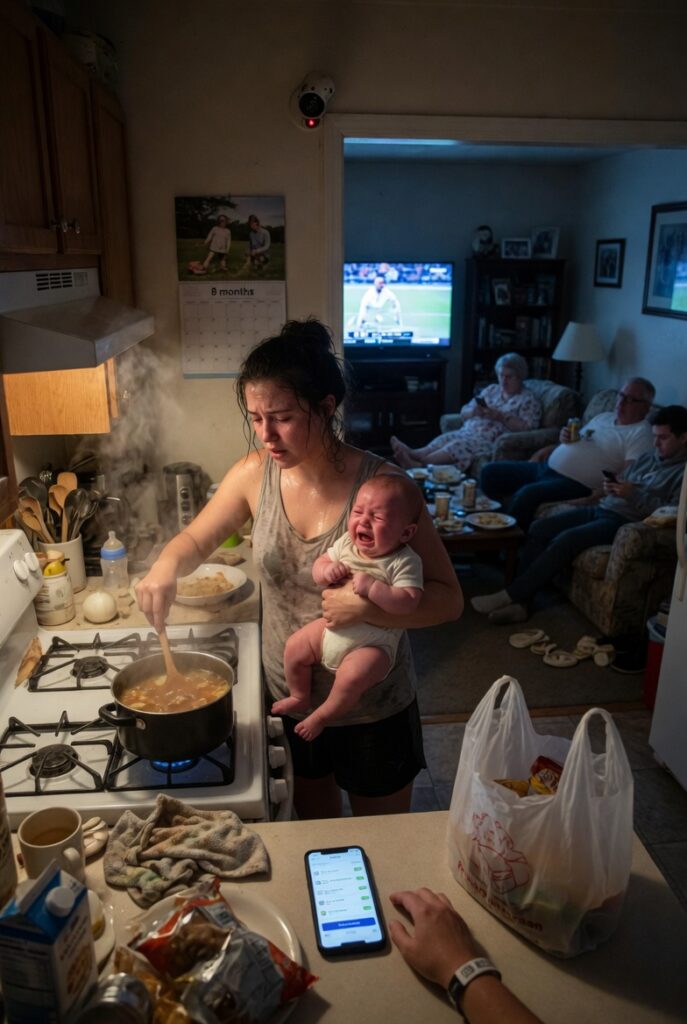
My mother snorted. “And who brought her in? If that girl has you brainwashed…” “That girl,” I cut her off, “has been cooking, cleaning, and taking care of a baby while the three of you behaved as if she owed you something.” My mother crossed her arms. “Because a house with a small child needs organization.” “No. It needs functional adults.” Oscar burst out laughing. “She handles you beautifully.”
I didn’t respond. I pulled something else out of my pocket: a folded sheet of paper. It was the list I had made during the night with all the dates and amounts. I tossed it onto the folder in front of my father. “You have one hour to pack your things.”
My father didn’t even look at the paper. “We’re not leaving.” He said it so calmly that I felt a strange jolt. Not because he intimidated me, but because he sounded like a man who still believed he held a better card. “This isn’t a discussion,” I said. “Oh, no?” Oscar placed his phone face down on the table. “And what are you going to do? Call the police and tell them your parents took some money? You’ll look like a lowlife.” “I’d rather look like a lowlife than an idiot.”
Then my father pushed the folder toward me again. “Sign.” For a second, I thought I hadn’t heard him correctly. “Excuse me?” “Sign the guarantee and this gets settled between us. The transfers were a mistake, a bad decision. It’ll be paid back little by little and nothing happens. But if you turn this into a war, you take everyone down with you. Including your wife.”
The air changed. It wasn’t an open threat, not yet. It was worse. It was the casual way he pronounced “including your wife.” “What does that mean?” My mother answered before he could. “It means no one comes out clean if you insist on making a scandal. Anna uses the household account too, doesn’t she? She buys things, she moves money. Anyone could think anything.”
I looked at her slowly. “Are you telling me you’re going to pin this on Anna?” No one answered.
And in that second, I understood the conversation I had overheard during the night much better than I had wanted to admit. It wasn’t just about squeezing more money out of me. It was about creating an exit. A scapegoat. If I refused, if I checked, if I reported them, they had the next move ready: smear Anna, put her in the middle, say she was the one manipulating, she was the one spending, she was the one touching my accounts, and that I was just confused because of my wife.
I heard a sound behind me. A soft rustle. Anna was in the hallway with the baby in her arms. I don’t know how long she had been listening. Her face was white and her eyes were wide, more out of disappointment than fear. Our son leaned his head on her shoulder, half-asleep, one hand closed around the collar of her shirt.
My mother managed to smile at her. “Oh, honey, don’t be like that. This is just business between men.” Anna said nothing. She only looked at me. And in that look, I understood the true extent of my delay. All the exhaustion of the last few weeks. All the “don’t worry,” “they’ll get over it,” “just hang in there,” “they’re my parents.” She had been holding up an entire household while I kept waiting for shame to do the job that was actually mine to do.
I stood up. “Anna, go back to the room.” But she didn’t go back. She walked all the way into the living room and stood by my side. She held the baby with one hand, and in the other, she held something small. She set it on the table. It was a key. The key to the filing cabinet in the office.
She looked at me. “Your brother went in there last night while you were sleeping on the sofa,” she said very slowly. “He thought I didn’t see him. He tried to open the drawer where you keep the deed to the apartment.” Oscar stood up abruptly. “That’s a lie.” Anna didn’t even look at him. “He couldn’t open it because I’ve had the key for a month.”
My father turned toward me, truly surprised for the first time. “You gave her the keys to your papers?” Anna took a deep breath. Then she spoke a sentence so serene it still echoes in my mind: “No. He gave them to me because someone in this house had to think clearly.”
Oscar took a step toward her. “Careful what you say.” And that was when everything broke.
I don’t remember moving, only standing between my brother and Anna, pushing him back with such force that his chair fell to the floor. My father stood up too. My mother started screaming. The baby woke up crying. For two seconds, the living room was exactly what we had been pretending for months it wasn’t: a dangerous place. “Not one more step toward her,” I said.
Oscar looked at me with a rage so pure there was nothing left of family in it. “You’re going to regret this.” “Pack your things.” “This apartment is a family asset too,” my mother blurted out, almost shrieking. “Everything you have, you built with our help.” I turned to her. “No. I built it by working. And the little I gave you, you mistook for permission.”
I pulled out my phone and dialed 911. This time, there was a reaction. My father tried to lower his tone, change his approach, suddenly try to build bridges. “Alex, don’t do something stupid.” “The stupid thing was letting you in.”
The dispatcher answered. I explained that I needed assistance because three family members who were temporarily at my residence were refusing to leave and there were unauthorized movements on my accounts. While I spoke, my mother started crying with those dry sobs that in another time would have been enough to make me feel guilty. Oscar was insulting me under his breath. My father kept repeating that this would be settled without police, without a scene, “like adults.”
But the scene had already been happening for months. It’s just that I had been calling it “cohabitation.” When I hung up, Anna was still by my side. She hadn’t backed up an inch. “Go into the bedroom with the boy,” I told her. “No.” “Anna…” “I’m not hiding anymore.”
I looked at her. She was exhausted, yes. She was shaking a little, yes. But there was also something new in her. Or maybe it wasn’t new. Maybe I just hadn’t wanted to see it before: a limit.
The twenty minutes until the police arrived were the longest of my life. No one sat down. No one spoke normally. My mother went from crying to resentment. My father retreated into a silence full of calculation. Oscar paced back and forth like a caged beast, glancing sideways at the door, the office, the kitchen. Twice I had to step in front of him when he pretended to go to the bathroom but was actually trying to get closer to the hallway leading to the bedrooms.
When the doorbell rang, I felt something like air after a storm. I explained the situation to the officers at the door, showing them the banking app, the recordings, and my family members’ refusal to leave the premises. They couldn’t resolve the financial issue right then, of course, but they could document it, mediate the exit, and issue a formal warning. That was enough to deflate my parents’ courage significantly.
My mother looked at me as if I had betrayed her. “Calling the police on your own parents… there’s no coming back from this.” I didn’t respond.
My father was the last to go into the guest room to pack his things. He came out with his suitcase closed and an expression I had never seen on him. It wasn’t rage. It was something else. Something darker and colder. He stopped before reaching the door. “This doesn’t end here.” One of the officers turned to him. “Sir, I recommend you don’t say things that could be interpreted as a threat.” My father changed his expression instantly. “I’m not threatening. I’m hurting. That’s all.” But I had already seen the other side. The true one.
My brother passed by me carrying a black backpack. In the side pocket, a folded folder peeked out that wasn’t his. I pulled it out before he crossed the threshold. It was from the office. Inside were photocopies of my ID, three old pay stubs, and a simple copy of the deed to the apartment. I looked at him. “Was this a mistake too?” He didn’t answer. He smiled. A short, twisted smile of a man caught halfway who still believes he has something left.
I watched them leave across the landing with their suitcases, followed by the officers to the elevator. My mother was still crying. My father wasn’t. Oscar didn’t look back. I closed the door and bolted it. Then my legs finally shook.
Anna put the boy in his travel crib and came back to the living room. For a few seconds, we stood among open suitcases, a fallen chair, the pen still on the table, and the blue folder for the loan guarantee, as if none of it had actually happened. “I’m sorry,” I said. She didn’t answer immediately. “I don’t need you to say ‘I’m sorry’ for today,” she finally replied. “I need you to understand why I was afraid before today.”
I didn’t know what to say. Because I understood and I didn’t. Because a part of me was still ashamed of having taken so long. Because another part wanted to justify myself and knew I shouldn’t. Because the house, though emptier, still smelled of tension. So I did the only honest thing I could do. “I took too long.” Anna nodded, her eyes full of something that wasn’t exactly forgiveness. “Yes.”
That night we hardly cleaned up anything. We sat in the kitchen while the baby finally slept, and I showed Anna everything: the transfers, the recordings, the emails with deleted codes, the loan guarantee folder. She listened in silence, holding a cup of chamomile tea she didn’t drink. When I got to the part of the conversation from the night before—about using her data, smearing her name, putting her in the middle—she closed her eyes for a moment. “I thought your mother hated me,” she said. “I didn’t think they could go that far.” “Tomorrow I’m going to the bank to block everything and file a report.” “Tomorrow we are going,” she corrected. I nodded.
At two in the morning, when we finally seemed to be letting our guard down, I remembered the folder I had taken from Oscar. I opened it on the dining table again with more composure. I had already seen the photocopies. There was also a sheet with handwritten account numbers. But there was something else, folded at the bottom: a printed document from a notary.
I unfolded it. It wasn’t a draft for a loan guarantee. It was a request for power of attorney. My name. My ID. And a text where I authorized my father to represent me in matters related to “present and future real estate assets.”
I felt the same chill as with the bank recordings. “Anna.” She came closer. “What is it?” I pointed to the signature at the bottom of the document. It looked very much like mine. Too much. But it wasn’t mine.
Anna put a hand to her mouth. “Alex…” Below that, in a corner, was a stamp for a scheduled appointment for the following Monday. That is, in three days. At a notary’s office in the suburbs of Philadelphia. I read the text again, slower this time. They didn’t just want me to guarantee a loan. They wanted the power to move the apartment. My apartment. The place where our son slept.
Then my phone rang. No caller ID. We looked at each other. I answered. I didn’t speak first. Neither did they on the other end for two seconds. All I heard was breathing. Then my father’s voice, low, serene, drained of any emotion. “Check the deed to the garage again before you go to the bank tomorrow.”
My blood ran cold. “What have you done?” I heard a short exhale, almost a laugh. “Me? Nothing. The problem is everything you signed without looking back when you still trusted us.”
The call cut off. Anna was still looking at me. I was still looking at the forged document on the table. And for the first time since I closed the door behind them, I understood that kicking them out of the house had only served to reveal part of the damage. The rest of it was still out there. Moving. Waiting. And perhaps it had already begun long before I came home that night and found my wife cooking with our son in her arms.