Part 2
Dr. Aris did not speak for several seconds.
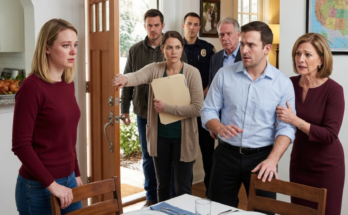
In those few seconds, the entire Coleman family leaned forward as if the future of their bloodline were glowing on the ultrasound monitor. David’s mother clasped her hands together, already trembling with joy. Megan’s lips curved into a victorious smile. His father, who rarely showed emotion, straightened his back with the solemn pride of a man preparing to welcome an heir.
Allison lay on the examination bed, one hand resting theatrically over her stomach.
David’s face was bright with expectation.
“Well?” he demanded, unable to wait any longer. “Doctor, say it. My son is healthy, right?”
Dr. Aris slowly lifted the transducer from Allison’s abdomen.
The silence changed.
It became colder.
He wiped the gel away with a clinical calmness that made Allison’s smile falter. Then he turned off the machine.
Discover more
family
Family
David blinked. “Why did you turn it off?”
Dr. Aris looked at him. “Mr. Coleman, I need to ask a few questions.”
Megan scoffed. “Questions? Just tell us the baby’s gender.”
“There is no baby.”
The sentence fell into the room like a sheet of ice.
For a moment, no one moved.
David laughed first, a short, sharp sound. “What?”
Dr. Aris repeated, slower this time. “There is no pregnancy.”
Allison’s face drained of color.
David’s mother staggered backward. “That’s impossible.”
Dr. Aris kept his voice steady. “Her uterus is empty. There is no fetus. No heartbeat. No gestational sac. Nothing consistent with a pregnancy at this stage.”
Megan pointed at Allison’s stomach. “Then what is that?”
The doctor looked briefly at Allison, then back at David. “Bloating, perhaps. Hormonal medication may also cause swelling. But she is not pregnant.”
David turned to Allison.
She was staring at the ceiling.
“Allison,” he said.
She did not answer.
“Allison.”
Still nothing.
His voice dropped, shaking with something more dangerous than anger. “Tell me he’s lying.”
Allison’s lower lip trembled. “David, I—”
“Tell me,” he roared.
His mother burst into tears. His father shouted for everyone to calm down. Megan grabbed Allison’s purse from the chair and dumped it onto the floor.
Lipstick, tissues, receipts, a compact mirror, and several folded papers scattered across the tiles.
Megan snatched one of the papers.
Her expression shifted from outrage to disbelief.
“What is this?” she hissed.
David seized it from her.
It was a printed ultrasound image.
A baby curled like a comma in grainy black and white.
At the top, in small letters, was a name.
Not Allison Reed.
Not Allison Coleman.
The name was Catherine Vale.
My name.
And the date was six years ago.
It was the ultrasound photo from my second pregnancy.
The one I had once framed for David’s office.
The one that had disappeared after he moved his things into the guest room months ago.
David stared at it as if it had burned his fingers.
Dr. Aris frowned. “That image is not from this clinic.”
Allison sat up so quickly the paper sheet crumpled around her waist. “I can explain.”
Megan slapped her.
The sound cracked through the room.
“You fraud!” Megan screamed. “You lied to us!”
Allison pressed a hand to her cheek, tears spilling instantly. “I had no choice!”
“No choice?” David’s voice was low now. “You told me you were carrying my son.”
“I thought I could get pregnant before anyone knew!” Allison cried. “I was going to! I just needed more time.”
David looked as if he had aged ten years in a minute.
His mother clutched the edge of the chair. “You made us throw away Catherine and the children for nothing?”
Allison’s eyes flashed. “You didn’t need me for that. You already hated Catherine. You were just waiting for an excuse.”
No one had an answer to that.
Outside the clinic, the sky was bright and blue.
Inside that room, the Coleman legacy cracked straight down the middle.
While they were drowning in their own humiliation, I was buckling my daughters into the back seat of the Mercedes.
Emma, my eldest, was nine. She had David’s dark lashes and my stubborn chin. She sat very still, too old for comfort yet too young to understand why adults could destroy a home with signatures and cruel words.
Rose was six and still holding the stuffed rabbit she had carried since toddlerhood. She looked out the window at the courthouse steps growing smaller behind us.
“Mom,” Emma asked softly, “are we really leaving?”
“Yes.”
“Forever?”
I looked at her in the rearview mirror.
There are moments when a mother must choose between telling the whole truth and giving a child something strong enough to hold on to.
“We are going somewhere safe,” I said. “Somewhere we can breathe.”
Rose leaned her head against the window. “Is Dad coming?”
The question cut deeper than the divorce decree.
I had spent years protecting David’s image in front of them. I had turned his missed birthdays into “business trips,” his coldness into “stress,” his favoritism toward an imaginary son into something nameless that I swallowed so my daughters would not have to.
But that morning he had said, in front of a mediator, that if I wanted to drag the children along, I could.
Less hassle for his new life.
“No,” I said gently. “He isn’t.”
Rose hugged her rabbit tighter, but she did not cry.
That hurt most of all.
The driver, Mr. Hale, met my eyes in the mirror. He had worked for my grandfather when I was a child, long before I became Catherine Coleman, long before I folded myself into a marriage that taught me silence could become a cage.
“Airport, Miss Catherine?” he asked.
“Yes.”
My phone vibrated before we reached the highway.
It was my lawyer, Nora Finch.
“Catherine,” she said, brisk as ever. “The divorce documents are filed. His waiver of custody rights is recorded. His verbal statement about relinquishing responsibility was included in the mediator’s notes. I’ve also sent the property recall notices.”
I looked out at the passing buildings.
“What about the condo?”
“Technically owned by Vale Holdings through the Celadon Trust. He has thirty days to vacate, but given the clause about marital misconduct and fraudulent occupancy, we can shorten that to seventy-two hours.”
“And the car?”
“Registered under your family office. Retrieval team is already waiting.”
Family
I closed my eyes.
For twelve years, David had called me lucky to live in his world.
For twelve years, his family had treated every comfort I provided as proof of his success.
The condo overlooking the river? My father’s wedding gift to me.
The car David drove to impress investors? Purchased through my trust.
The emergency funds that saved Coleman Logistics from bankruptcy three times? Quietly wired by me, without my name attached, because David said a husband should never appear weaker than his wife.
Even the antique watch his father wore to charity galas had been bought at auction by my grandfather and gifted through me.
The Coleman legacy had never been theirs.
It had been borrowed.
“What about the corporate line?” I asked.
Nora paused. “Are you sure?”
I looked back at Emma and Rose.
Emma was pretending not to listen. Rose was tracing shapes on the fogged glass with one finger.
“Yes,” I said. “Pull it.”
“That will collapse their operating credit.”
“They should have thought of that before they threw my daughters away.”
Nora’s voice softened. “Understood.”
I ended the call and placed the phone face down in my lap.
The airport appeared ahead, glass and steel shining under the late morning sun.
Five minutes after the divorce, I had left the building.
Forty minutes after the divorce, I was leaving the country.
By noon, David called me twenty-seven times.
I did not answer.
At 12:18, his first message arrived.
Catherine, pick up. There’s been a misunderstanding.
Then another.
Did you know Allison wasn’t pregnant?
Then:
You set this up, didn’t you?
Then:
The condo locks aren’t working.
Then:
Why is my car gone?
Then:
Call me right now.
At the gate, Emma touched my sleeve.
“Mom, is he angry?”
I deleted the messages.
“Not at us anymore.”
That was the first promise I made to my daughters as free women.
And I kept it.
The flight to London was long, but for the first time in years, no one demanded that I justify myself.
No mother-in-law called to ask why dinner wasn’t ready.
No sister-in-law sent photos of Allison with captions meant to wound.
No husband came home smelling of another woman’s perfume and told me I was imagining things.
Rose slept with her cheek pressed against my arm. Emma watched the clouds below us and asked whether our new home would have a garden.
“Yes,” I said.
“A big one?”
“Very big.”
“Can we plant lavender?”
“We can plant anything you want.”
She considered that seriously.
“Then I want lavender for Rose and sunflowers for me.”
I smiled for the first time that day.
“Done.”
When we landed, my brother Adrian was waiting in the private arrivals lounge.
He was taller than I remembered, or perhaps I had spent too long shrinking myself beside David. Adrian wore a navy coat and the expression of a man restraining a thousand questions because two little girls were present.
Emma stared at him suspiciously.
Rose hid behind my coat.
Adrian crouched to their level.
“You must be Emma and Rose,” he said. “I’m Uncle Adrian.”
Emma narrowed her eyes. “Mom never said she had a brother.”
His gaze flicked to me, not accusing, only sad.
“Your mom had to deal with a lot,” he said. “But I’m here now.”
Rose peeked out. “Do you have snacks?”
Adrian pulled two chocolate bars from his pocket with the solemnity of a magician revealing his final trick.
Rose immediately decided he was acceptable.
The house was in Richmond, not too far from the river. It had belonged to my grandmother, then to my mother, and then to me. David had never seen it. He had known I came from “old money,” but he had dismissed my family as distant and irrelevant after I cut contact to preserve his pride.
Family
That had been my greatest mistake.
I mistook sacrifice for love.
Love should never require a woman to erase the people who would run toward her when everyone else walked away.
The first night, after the girls fell asleep in twin beds beneath a canopy of embroidered stars, I stood alone in the kitchen and finally allowed myself to shake.
Adrian found me there.
He said nothing. He only placed a cup of tea in front of me.
I wrapped my hands around it.
“I stayed too long,” I whispered.
“Yes,” he said.
The honesty stung, but it also steadied me.
Then he added, “But you left.”
That was when I cried.
Not the elegant tears of a heroine in a film.
I broke.
I cried for the woman I had been at twenty-four, certain she could make a cold man gentle if she loved him hard enough. I cried for the birthdays David forgot and the anniversaries I celebrated alone. I cried for Emma’s quiet disappointment and Rose’s careful cheerfulness. I cried for every dinner where Megan called me plain and his mother called me barren because daughters did not count.
Adrian sat beside me until the storm passed.
Then he slid a folder across the table.
“What is this?” I asked, wiping my face.
“Your life, waiting for you to take it back.”
Inside were documents from Vale Holdings, my family’s investment firm. Before my marriage, I had trained in acquisitions. I had a sharp mind, a brutal memory for numbers, and a talent for finding weakness in companies pretending to be strong.
Then David told me ambitious wives made insecure husbands.
So I stepped down.
My father had been furious. My mother had cried. Adrian had stopped speaking to me for three months.
And David had smiled.
He had called it devotion.
The folder contained a board resolution appointing me interim chair of our European division.
I stared at it.
“I don’t know if I remember how,” I said.
Adrian laughed softly. “Catherine, you once dismantled a hostile takeover in forty-six minutes while eating cold noodles from a paper cup.”
“That was a long time ago.”
“Then start with something simple.”
He flipped to the last page.
Coleman Logistics.
Their debts, credit lines, hidden losses, inflated contracts, and dependency on Vale-backed guarantees were all laid bare in neat columns.
David’s empire was not a fortress.
It was a stage set.
And I had been holding the walls upright from behind the curtain.
Adrian tapped the page.
“Decide what you want.”
For years, people had asked what David wanted.
What his parents wanted.
What his family needed.
Family
What Allison deserved.
No one had asked me that.
I looked toward the dark hallway where my daughters slept.
“I don’t want revenge,” I said.
Adrian raised an eyebrow.
I corrected myself. “Not the messy kind.”
His mouth curved.
“I want everything legal. Clean. Documented. No gossip campaigns. No tricks. I want every borrowed thing returned. I want every lie exposed by its own paperwork. I want my children protected. And I want David Coleman to understand that cruelty has an invoice.”
Adrian lifted his tea.
“To invoices.”
Back home, David was discovering the first line item.
By evening, his car had been repossessed from the clinic parking lot.
By the next morning, the condo building’s management had disabled his access card.
By noon, Coleman Logistics received notice that Vale Holdings was terminating all informal guarantees and requesting immediate review of outstanding bridge loans.
By three o’clock, David called again.
This time, he left a voice message.
I listened once.
His voice was ragged.
“Catherine, we need to talk. I know things got ugly yesterday, but you can’t just destroy my company. Whatever happened between us, I’m still the father of your children.”
I paused the message there.
For years, I had wanted him to say those words.
Father of your children.
Not “your girls.”
Not “your responsibility.”
Not “less hassle.”
But now the words had arrived hollow, dressed in panic instead of love.
I deleted the message.
On the third day, Allison was arrested for fraud.
Not because she lied about being pregnant. People lie about many things; the law does not always care.
She was arrested because she had forged clinic records, stolen a copy of my old ultrasound image, altered medical documents, and used David’s corporate card to pay for “specialist appointments” that never existed.
Megan sent me a message from an unknown number:
You must be happy now.
I typed one sentence back before blocking her.
No. I am free.
Freedom, I learned, was not dramatic every day.
Sometimes it was small.
It was Emma choosing yellow curtains.
It was Rose sleeping through the night.
It was eating dinner without checking whether the soup was too salty for David’s mother.
It was waking at six and realizing no one in the house hated me.
Within two weeks, the girls started school.
Emma struggled first. She was cautious with other children, suspicious of kindness, and too quick to apologize. Her teacher called me after the first week.
“She’s very bright,” Mrs. Whitcomb said, “but she seems afraid of making mistakes.”
I gripped the phone tighter.
“That’s my fault,” I said before I could stop myself.
“No,” Mrs. Whitcomb said gently. “It means she learned fear somewhere. But she can unlearn it.”
That became my private prayer.
Let them unlearn it.
Rose adapted faster. She came home one afternoon announcing that she had two best friends, a mortal enemy named Clara, and a plan to become either a veterinarian or a queen.
“Can I be both?” she asked.
“Yes,” I said. “Queens may own dogs.”
She nodded, satisfied.
At night, after they slept, I worked.
Vale Holdings welcomed me back with polite caution. Some of the older board members remembered the girl I had been before marriage and wondered whether motherhood had softened me.
They learned quickly.
I did not shout.
I did not threaten.
I simply read everything.
Numbers tell the truth when people cannot afford to.
By the end of the first month, I had identified three failing subsidiaries, two profitable acquisitions, and one executive who had been hiding losses behind inflated overseas contracts.
When I presented the findings, the boardroom went silent.
Then Sir Malcolm Pryce, who had once told my father that daughters were “too emotional” for succession, cleared his throat.
“Impressive work, Ms. Vale.”
I smiled.
“It’s Ms. Vale again now.”
He inclined his head.
“Ms. Vale.”
The name settled over me like armor.
Meanwhile, David’s world narrowed.
The Coleman family tried first to blame Allison.
Family
Then the doctor.
Then me.
Then each other.
David’s mother claimed she had always liked me.
Megan insisted she had only repeated what David told her.
His father quietly attempted to negotiate with Vale Holdings behind David’s back.
Nora forwarded me every letter.
Most were pathetic.
One was memorable.
Mrs. Coleman wrote:
Catherine, as women, we understand each other. A family should not be broken over one mistake. David was deceived. He needs guidance, not punishment. The children need their father.
I stared at that line for a long time.
The children need their father.
Perhaps they once had.
But need is not the same as having.
A child can need water and still be handed poison.
I replied through my lawyer:
Mr. Coleman voluntarily waived custody and financial responsibility during mediation. Any future contact with the children must be requested through legal counsel and approved by a child psychologist. Harassment will be documented.
David did not like that.
A week later, he flew to London.
I knew before he landed because Nora tracked the legal noise he made everywhere he went. He had no address for us, so he went first to Vale Holdings headquarters. Security refused him entry.
Then he went to my brother’s office.
Adrian refused to see him.
Finally, he appeared outside the girls’ school.
That was his second mistake.
The school called me immediately. So did security. By the time I arrived, David was standing across the street in an expensive coat that no longer fit his life. He looked thinner. His hair was uncombed. His eyes were bloodshot.
The moment he saw me, he stepped forward.
“Catherine!”
Two security officers blocked him.
Other parents glanced over. I hated that. I hated that even in another country, even after I had run across an ocean, his chaos could still reach the edges of my daughters’ world.
I walked toward him but stopped several feet away.
“You cannot be here,” I said.
His eyes searched my face, as if expecting to find the old Catherine there—the one who softened when he looked tired.
“I just want to see my children.”
“They are not available.”
“I’m their father.”
“Then you should have remembered that before you called them less hassle.”
Pain flashed across his face.
Good, I thought.
Then I hated myself for thinking it.
“I was angry,” he said. “Allison had manipulated me. My family was pressuring me. You know how they are.”
Family
“Yes,” I said. “I do.”
“That’s why you should understand.”
“No, David. That is why I should have left sooner.”
He dragged a hand through his hair.
“I made mistakes.”
“You made choices.”
He looked past me toward the school gates. “Do they ask about me?”
I could have lied.
I did not.
“Rose did at first. Emma stopped long ago.”
His mouth trembled.
“She stopped?”
“She learned not to wait for people who never arrive.”
That broke something in him.
For one brief moment, I saw not the arrogant man from the mediator’s office, not the husband who paraded his mistress before me, but a man standing in the ruins of a life he had destroyed with his own hands.
“I can fix this,” he said.
“No.”
“You don’t know that.”
“I do.”
“Catherine, please.” His voice cracked. “Allison is gone. My family is falling apart. The company—”
“There it is.”
He froze.
I smiled sadly. “You almost made it about the girls. Almost.”
“That’s not fair.”
“Fair?” I repeated. “You want fair now?”
He flinched.
I stepped closer, lowering my voice so only he could hear.
“Fair would have been Emma not crying alone after you missed her school recital because Allison wanted dinner by the lake. Fair would have been Rose not asking whether girls were born wrong because your mother prayed for a grandson at our dinner table. Fair would have been me not begging for basic respect in a home I paid for.”
His face turned pale.
“You never told me Rose said that.”
“You were busy choosing names for a son who did not exist.”
He had no answer.
A car pulled up behind me. Adrian stepped out, followed by two private security officers.
David’s expression hardened with humiliation. “So this is what you are now? Hiding behind your family money?”
Family
“No,” I said. “Standing with it.”
Adrian came to my side.
David looked between us and laughed bitterly. “You planned all of this.”
I shook my head.
“That is what you still don’t understand. I didn’t need to plan your downfall. I only stopped preventing it.”
The police arrived five minutes later.
David was warned not to approach the school again.
He shouted my name as they led him away from the gate.
I did not turn around.
That evening, Emma found me in the garden.
The lavender had just started to bloom. Rose’s section was crooked, overwatered, and filled with little hand-painted stones. Emma’s sunflowers were still small green stalks reaching upward with fierce optimism.
“Was Dad at school today?” she asked.
I set down the watering can.
“Yes.”
She nodded slowly.
“Did he want to see us?”
“Yes.”
Her face gave nothing away.
“Do we have to see him?”
“No.”
She looked at me then, and for the first time in months, I saw a child instead of a small soldier.
“Really?”
“Really.”
Her eyes filled with tears.
I opened my arms, and she walked into them.
Not rushed.
Not dramatic.
Just tired.
I held her tightly.
“I thought,” she whispered, “if he came, you’d make us go.”
I kissed the top of her head.
“I will never hand you to someone who makes you feel unwanted.”
She cried then.
Quietly, because Emma did everything quietly.
A minute later, Rose came outside and saw us hugging. She ran over, alarmed.
“Are we sad?”
“A little,” I said.
She considered this, then wrapped her arms around both of us.
“Then we need biscuits.”
So we went inside and ate biscuits for dinner.
Healing did not arrive like sunrise.
It came like that.
In crumbs.
In lavender.
In a little girl saying what she needed and believing she would be heard.
Six months after the divorce, Coleman Logistics filed for bankruptcy protection.
The news reached me on a rainy Tuesday morning while I was reviewing an acquisition in Milan. Nora sent the notice with no commentary.
I read it twice.
I expected triumph.
Instead, I felt tired.
David had inherited a company with history, employees, and opportunities. He had hollowed it out to feed appearances. His father had signed risky loans. Megan had used company funds for “brand consulting” that appeared to involve luxury hotels and handbags. His mother had hosted charity events with money owed to suppliers.
They called it legacy.
It was appetite.
Vale Holdings bought the only profitable division at auction three months later.
Not out of sentiment.
Out of strategy.
The logistics network was useful, the staff skilled, and the contracts salvageable once stripped of Coleman vanity.
At the first transition meeting, I asked for one thing.
“No Coleman family member retains executive authority.”
Family
The board agreed unanimously.
David tried to contest the sale.
He failed.
Megan tried to claim unpaid consulting fees.
She failed.
His father suffered a mild stroke soon after and retired from public life. His mother moved in with Megan, which I considered punishment enough for both of them.
Allison took a plea deal.
She received probation, mandatory restitution, and a record that would follow her longer than David ever had.
I saw her only once after that.
It was almost a year after the divorce, outside the courthouse where the final custody order was being confirmed. I attended remotely for most hearings, but this one required my presence.
Allison stood near the steps, thinner than before, her blonde hair tied back, her face bare of makeup.
For a moment, I thought she might insult me.
Instead, she said, “Catherine.”
I stopped.
Nora immediately stepped closer, but I lifted one hand.
Allison swallowed.
“I hated you,” she said.
“I know.”
“I thought you had everything.”
I almost laughed.
She looked down. “David said you were cold. That you trapped him. That you didn’t understand him.”
“He always did prefer women who believed his version first.”
Her mouth twisted. “He told me if I gave him a son, I’d never have to worry about money again.”
There it was.
Not love.
A transaction disguised as romance.
“I was stupid,” she whispered.
“You were cruel,” I said. “Stupidity does not steal another woman’s ultrasound photo.”
She closed her eyes.
“I know.”
I should have walked away.
But there was something broken in her that reminded me of myself, and I hated that too. Not because she deserved my sympathy, but because recognizing someone’s damage does not erase the damage they caused.
“Why weren’t you pregnant?” I asked.
She gave a hollow laugh.
“I tried. For months. Nothing happened. Then David started talking about timelines and announcements and his mother kept calling me every day. I panicked.”
“So you built a lie.”
“I thought I could make it true before anyone noticed.”
“That is not how truth works.”
“No,” she said. “I know that now.”
I looked at her for another second.
Then I said, “I hope you learn to want a life that doesn’t require stealing someone else’s.”
She cried then.
I left her on the courthouse steps.
Inside, the final custody order was entered.
Full legal and physical custody to me.
Supervised visitation for David, contingent on psychological evaluation, parenting classes, and the children’s consent as recommended by a therapist.
David objected.
Of course he did.
He appeared in court wearing the suit from our wedding reception. I recognized it immediately. It had been altered at the waist, but the fabric was the same. Once, I had thought him handsome in it.
Now he looked like a man wearing a memory that no longer belonged to him.
When the judge asked if he had anything to say, David stood.
“I love my daughters,” he said.
Emma and Rose were not present, thank God.
The words entered the courtroom and found no place to land.
The judge looked over the record.
“Mr. Coleman, you waived parental responsibility during divorce mediation.”
“I was under emotional distress.”
“You failed to attend six scheduled therapy intake sessions.”
“I had financial complications.”
“You appeared at the children’s school in violation of preliminary boundaries.”
“I was desperate.”
The judge removed her glasses.
“Mr. Coleman, desperation is not parenting.”
David sat down.
The order was granted.
Afterward, in the hallway, he approached me.
Nora moved to block him, but I shook my head.
This was the last conversation, and I knew it.
David stopped a few feet away.
For once, he did not look angry.
He looked empty.
“Do they hate me?” he asked.
“No.”
Hope flickered in his eyes.
“They are healing,” I said. “Those are not the same thing.”
He nodded slowly.
“I lost everything.”
I studied him.
His company, his mistress, his condo, his car, his family’s admiration, his imagined son.
Family
Everything, he said.
Still, he did not understand.
“No,” I said quietly. “You lost us first. Everything else just followed.”
His eyes reddened.
“I loved you once,” he said.
I believed him.
That was the saddest part.
“I loved you too,” I replied.
His breath caught.
Then I finished, “But I finally learned to love my daughters and myself more.”
I walked away.
He did not follow.
One year after the divorce, the girls and I held a small party in the garden.
Not for the court order.
Not for the company.
Not for any victory that required someone else’s defeat.
It was Rose’s seventh birthday.
She wore a crown of paper flowers and declared herself queen-veterinarian of the entire lawn. Emma, now ten, had grown taller and louder. She laughed more easily. She corrected adults without apologizing first. Her sunflowers towered over the fence, bright and shameless.
Adrian came with too many gifts.
Nora came with a cake.
Mrs. Whitcomb came with a book of pressed flowers from the class.
At sunset, after everyone left, the girls and I sat beneath the old apple tree.
Rose had frosting on her nose.
Emma leaned against my shoulder.
“Mom,” she said, “are we going to stay here?”
I looked at the garden.
The lavender had spread beautifully. The sunflowers bent toward the last light. The house behind us glowed warm through every window.
“Yes,” I said. “This is home.”
Rose yawned. “Good. I like home.”
Emma was quiet for a while.
Then she asked, “Are you happy?”
A year earlier, I would have lied automatically.
I would have said yes because mothers were supposed to be strong, because women like me were supposed to be grateful, because admitting pain felt like failure.
But my daughters deserved a better language.
“I am becoming happy,” I said.
Emma considered that.
“I think I am too.”
Rose raised her hand sleepily. “I am already happy.”
We laughed.
Later, after they went to bed, I opened the drawer of my desk and took out the copy of the divorce decree.
For a long time, I had kept it as proof of escape.
Now I no longer needed proof.
I placed it in a folder with the old ultrasound photo that Allison had stolen and the first drawing Emma made in London and the birthday card Rose had written with half the words spelled wrong.
Not wounds.
History.
Then I wrote a letter.
Not to David.
Not to Allison.
To the woman I had been.
Catherine,
You thought leaving would destroy you.
It didn’t.
It returned you to yourself.
You thought your daughters needed a complete family.
Family
They needed a safe one.
You thought silence was dignity.
Sometimes, dignity is keys on a table, a suitcase in hand, and no explanation given to people committed to misunderstanding you.
You were never abandoned.
You were waiting for yourself.
Welcome home.
I folded the letter and placed it at the front of the folder.
Outside, the garden was dark except for the pale path of moonlight across the lavender.
My phone buzzed once.
A message from an unknown number.
I knew before opening it.
David.
Catherine, I’m sorry.
Three words.
A year too late.
I looked at them without anger.
Then I deleted the message.
Not because forgiveness was impossible.
But because peace was more important than reopening the door to someone who only knocked after burning down the house.
I turned off the lamp and went upstairs.
In their room, Emma and Rose slept tangled in blankets, their faces soft with dreams. On the windowsill, Rose’s stuffed rabbit sat beside Emma’s book. The nightlight cast tiny stars across the ceiling.
I stood there for a long time.
Once, the Coleman family had gathered in a clinic to celebrate a son who did not exist.
They had called him the heir to their legacy.
But here, in this quiet room, breathing softly beneath a sky of painted stars, were my real legacy.
Not heirs to a name built on pride.
Not bargaining chips in a war of adults.
Just two girls who would grow up knowing they were never less.
Never burdens.
Never “less hassle.”
I kissed them both.
Then I closed the door gently.
Downstairs, the house settled around us, old beams creaking like a sigh of relief.
The divorce had ended my marriage.
But it had begun my life.
And this time, no one else would hold the pen.