PART 2 — The Man in Bed 213
When I opened my eyes, the world came back in pieces.
First, the sound.
A steady beep. A soft hiss. Shoes whispering across polished floors. Somewhere far away, someone laughed, and the laugh felt offensive because I was not sure I was alive yet.
Then came the pain.
It bloomed under my ribs, dull and deep, like someone had planted a stone inside me and stitched my skin closed around it. I tried to move, but my body refused. My eyelids fluttered. The ceiling above me was white, blurred at the edges, haloed by fluorescent light.
“Jessica?”
A woman’s voice. Gentle. Professional.
I forced my eyes to focus.
Nurse Clara stood beside me, the same nurse who had checked my bracelet before surgery. Her gray hair was pinned tight, but one curl had escaped near her temple. Her eyes were wet.
Discover more
books
book
Bed
That frightened me more than the pain.
“Am I…” My throat felt like sandpaper. “Am I dead?”
Her mouth trembled into a smile.
“No, sweetheart. You’re very much alive.”
Alive.
The word cracked something open in me.
I inhaled sharply, and the pain punished me for it. Clara lifted a straw to my lips.
“Small sip.”
The water tasted like mercy.
I swallowed and tried again. “Did they get it?”
She glanced toward the door.
“The surgeon will explain everything, but yes. The procedure went better than expected.”
I closed my eyes.
Better than expected.
Not perfect. Not miraculous. But enough.
Enough to keep breathing.
Enough to remember.
Evan.
His text came back like a blade sliding between my ribs.
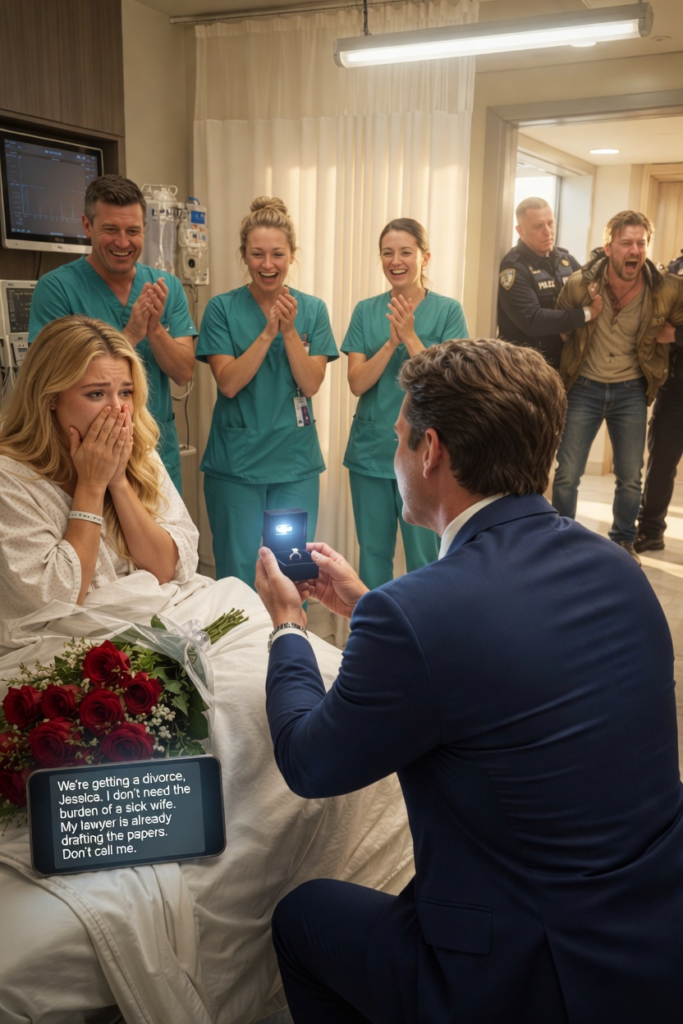
We’re getting a divorce, Jessica. I don’t need the burden of a sick wife.
The pain in my body suddenly seemed honest. The pain from Evan was dirty. Cowardly. It had no right to exist inside a hospital room where people fought so hard to stay alive.
Then another memory surfaced.
Mark.
The chair by my bed.
Beds & Headboards
His calm voice.
The trash in your life has finally taken itself out.
My insane joke.
If I survive this, maybe we should just get married and call it a day.
His answer.
Okay.
My eyes opened.
“Mark,” I whispered.
Clara blinked. “What?”
“The man in the next bed. Mark Grant. Is he okay?”
Something changed in her face.
It happened so quickly I almost missed it. Surprise first. Then disbelief. Then something dangerously close to panic.
“You remember him?”
“Of course I remember him.” My voice was faint, but irritation gave it strength. “He was kind to me when my husband decided to become a villain at three in the morning.”
Clara pressed her lips together.
“Jessica…”
“Where is he?”
She hesitated.
That hesitation made my heart stumble.
“Is he dead?”
“No,” she said quickly. “No. He’s alive.”
“Then where is he?”
Before Clara could answer, the door opened.
A doctor stepped in, tall and silver-haired, wearing the expression of a man who had delivered both good news and bad news so often that his face had learned how to reveal neither too early.
“Mrs. Hale,” he said, then paused. “Jessica.”
Mrs. Hale.
I hated the name on his tongue.
“I’m Dr. Whitmore. Your surgery was successful. We removed the mass entirely. There were complications with bleeding, but we controlled them. You’ll need further treatment, and we’ll run more tests, but this morning you won.”
I turned my face away before he could see me cry.
I had won.
And I had lost everything.
Maybe that was what survival was sometimes. Not a celebration. Just being forced to stay and sort through the wreckage.
“Thank you,” I whispered.
Dr. Whitmore nodded. He explained more—margins, pathology, follow-up, recovery—but my mind caught only pieces. Clara adjusted something near my IV.
When he finally left, I turned back to her.
“Mark.”
Clara looked at the closed door as if hoping someone else would enter and rescue her from the question.
“Jessica, before you went into surgery, you said something to him.”
“I know what I said.”
“You asked him to marry you.”
“I was drugged, terrified, and abandoned. I’m not proud of the timing.”
Clara’s eyes widened.
“Do you have any idea who you just asked?”
I frowned.
“A decent man.”
She let out a small, shocked laugh.
“Oh, honey. That too.”
The door opened again.
This time, no doctor entered.
A man did.
He wore a charcoal suit, perfectly tailored, with a white shirt open at the collar. There was no hospital gown, no IV pole, no sign of the patient from the next bed except the face. The same strong jaw. The same serious eyes. The same quiet presence that had kept me from falling completely apart.
Beds & Headboards
Mark Grant stood in my doorway holding a bouquet of white tulips.
I stared at him.
My drugged brain attempted to connect the man who had been in a hospital bed beside mine with this polished stranger who looked like he belonged on the cover of a business magazine.
“Are you…” I swallowed. “Are you real?”
One corner of his mouth lifted.
“I’ve been asking myself the same thing about you.”
Clara muttered something about checking another patient and hurried out, but not before giving him a look so loaded with meaning that I knew she had not told me everything.
Mark came closer.
He looked tired. Not weak exactly, but stretched thin, as though life had pressed hard on him and he had refused to break out of stubbornness.
He set the tulips on the table.
“I hear you won.”
“That’s what they tell me.”
“Good.”
His voice softened on the word.
I watched him carefully.
“You’re wearing a suit.”
“I am.”
“You were in a bed last night.”
“I was.”
“Were you actually a patient, or do rich men just nap in hospitals for dramatic effect?”
His smile deepened slightly.
“So Clara told you.”
“She started to. Then you appeared like a guilty secret.”
Mark pulled the chair closer and sat down. The same chair. The one he had dragged to my bedside before my surgery. The sight of him in it made something inside me loosen.
“I was a patient,” he said. “Observation after a minor procedure. My security team wanted a private room. I refused.”
“Why?”
“Because private rooms are too quiet.”
The answer was simple. Honest. Lonely.
I looked at him more closely.
“Who are you, Mark?”
He folded his hands.
“My full name is Marcus Grant.”
The name meant nothing at first.
Then it did.
Grant.
Grant Medical Center.
The plaque in the lobby. The new surgical wing. The foundation commercials. The charity galas I had seen on local news while eating cereal at midnight, thinking people like that existed in a different universe.
“You’re that Grant?”
He looked mildly uncomfortable.
“My grandfather founded Grant Industries. I run the foundation now. Among other things.”
I blinked at him.
“You own the hospital?”
“No. That would be a conflict of several kinds. But my family funded a large part of the oncology wing.”
Family
I let my head sink back into the pillow.
“Oh my God.”
“You didn’t know.”
“Obviously I didn’t know. Do you think I’d propose marriage as a joke to a hospital benefactor?”
His gaze held mine.
“You didn’t propose because of money.”
“I didn’t propose at all. I made a deathbed joke.”
“You weren’t on your deathbed.”
“You didn’t know that.”
“No,” he said quietly. “I didn’t.”
A silence settled between us.
Not awkward. Heavy.
I looked at the tulips.
“Why are you here?”
He answered without hesitation.
“You asked me to marry you.”
My heart lurched.
“Mark.”
“I’m not here to take advantage of a woman who just survived surgery,” he said. “I’m here because before they wheeled you away, you looked at me like I was the only solid thing left in the world. And for some reason, I wanted to be worthy of that look.”
Tears burned my eyes.
“I’m married.”
“Not for long, according to Evan.”
The sound of my husband’s name in Mark’s voice was calm, but something dangerous moved under it.
“You don’t know him.”
“I know enough.”
“You know one cruel text.”
“I know a man who can send that text before his wife’s cancer surgery has revealed the most important part of his character.”
I turned my face away.
“I loved him.”
“I know.”
“I built a life with him.”
“I know.”
“I don’t want to be someone’s tragic charity case.”
Mark leaned forward.
“Then don’t be.”
The firmness in his voice made me look back.
“Jessica, listen to me. I came here to say one thing. You owe me nothing. Not gratitude, not affection, not a promise made under terror. But you do owe yourself a chance to live without begging someone cruel to become kind.”
I cried then.
Not elegantly. Not like women in movies, with one shining tear down a cheek.
I cried like someone whose body had been opened and stitched and whose life had been torn apart at the same time. Mark did not touch me without permission. He simply sat there, steady as stone, until the storm passed.
When I finally wiped my face, I whispered, “You said okay.”
“I did.”
“Why?”
He looked down at his hands.
“My wife died six years ago.”
I went still.
“She had leukemia. By the end, people stopped visiting because sickness made them uncomfortable. They sent flowers. They sent prayers. But they stopped coming into the room.” His throat moved. “The night before she died, she told me not to let grief make me useless.”
I didn’t speak.
“I have spent six years funding buildings, writing checks, shaking hands, and pretending that was the same as being useful.” He looked at me. “Last night, when Evan’s text broke you open, I knew exactly what kind of loneliness had entered the room. And I hated that you had to feel it.”
My chest hurt in a place surgery had not touched.
“What was her name?”
“Anna.”
“I’m sorry.”
“So am I.”
His eyes were gentle, but not soft in a weak way. Gentle like hands that had learned how to hold something fragile without crushing it.
I tried to laugh and failed.
“This is insane.”
“Yes.”
“I can barely sit up.”
“I noticed.”
“My husband wants a divorce.”
“He sounds determined.”
“I have drains coming out of me.”
“Temporary problem.”
“I’m not marrying you.”
“I didn’t bring a priest.”
For the first time since waking, I laughed.
It hurt so badly that I gasped, and Mark immediately rose, alarmed.
“Don’t make me laugh,” I wheezed.
“I’ll try to be less charming.”
“That will help.”
He sat back down, and for a few seconds, we were just two damaged people in a hospital room, smiling at the absurdity of still being alive.
Then my phone buzzed.
Both of us looked at it.
It sat on the nightstand like a venomous insect.
I stared until the screen lit again.
Evan.
Not a text this time.
A call.
Mark’s face hardened.
“You don’t have to answer.”
“No,” I said, reaching for the phone with shaking fingers. “I think I do.”
He started to stand.
“Stay.”
The word came out before I could soften it.
Mark sat.
I accepted the call and put it on speaker.
For a moment, there was only static and Evan’s breathing.
“Jessica?” he said.
His voice was not remorseful. It was irritated.
I closed my eyes briefly.
“Yes.”
“You finally picked up.”
“I was in surgery, Evan.”
“I know that.”
The casualness of it made my hand tighten around the phone.
“What do you want?”
“I need you to be reasonable.”
Mark’s eyebrows moved slightly.
Reasonable.
The favorite word of people who had already done something unforgivable.
Evan continued. “My lawyer says it’ll be smoother if we present this as mutual. I don’t want drama.”
I looked at the ceiling and almost laughed.
“You don’t want drama.”
“No. And before you get emotional, understand that this has been building for a long time.”
“Funny. You never mentioned it before my tumor.”
He sighed.
“There it is. You’re going to make this about your illness.”
The room went silent.
Even the machines seemed to hold their breath.
I looked at Mark. His expression had gone completely still.
A strange calm entered me.
Maybe survival had burned through the part of me that used to apologize for bleeding.
“Evan,” I said, “where are you?”
“At home.”
“Our home?”
“For now.”
“Are you alone?”
He paused too long.
That pause told me everything I needed.
A bitter smile touched my mouth.
“Is she there?”
“Jessica—”
“What’s her name?”
“This is exactly the kind of emotional reaction I was talking about.”
“What’s her name?”
He exhaled sharply.
“Lena.”
I searched my memory.
Lena.
His assistant. Twenty-six. Bright smile. Sent Christmas cards from the office with glitter pens.
“Oh,” I said softly. “Of course.”
“It didn’t start like that.”
“It never does in your version.”
“You’ve been sick for months.”
My body went cold.
“And that made you lonely?”
“It changed everything.”
“No,” I said. “It revealed everything.”
I saw Mark’s eyes flicker at the echo of his own words.
Evan’s voice sharpened. “You think you’re so noble because you got cancer?”
“No. I think I’m done listening.”
“Jessica, don’t be stupid. You have no money without me. You haven’t worked full-time since treatments started. You need health insurance. You need the house. You need—”
Health
“I need a lawyer,” I said.
He laughed.
It was the same laugh I had once loved across dinner tables and rainy Sunday mornings. Now it sounded like a lock clicking shut.
“With what money?”
Mark reached into the inside pocket of his suit, took out a business card, and placed it on my blanket.
Grant Legal Foundation.
Patient Advocacy Division.
I read it twice.
Then I smiled.
“With help,” I said.
Evan scoffed. “From who? Some charity nurse?”
Mark leaned closer to the phone.
“From me.”
Silence.
“Who is this?” Evan demanded.
“Marcus Grant.”
Another silence.
This one was longer.
When Evan spoke again, the confidence had thinned.
“Grant? As in—”
“Yes.”
Mark’s voice was quiet. Almost bored.
“Jessica is recovering from major surgery. If you contact her again today for any reason other than to apologize, your messages will be forwarded to counsel. If you remove property from the marital home, destroy financial records, cancel insurance, or attempt to pressure her while she is medically vulnerable, that will also be documented.”
Evan said nothing.
Mark continued, “And Mr. Hale?”
“What?”
“You miscalculated.”
He reached over and ended the call.
I stared at the phone.
Then at him.
Then back at the phone.
“That was…”
“Rude?” he offered.
“Magnificent.”
He inclined his head.
“I have my moments.”
My eyes filled again, but this time I did not feel broken.
I felt protected.
That was more dangerous.
Because protection was easy to mistake for love when you were wounded.
I knew that.
So did he.
For three days, Mark visited every morning.
Not for long. Never enough to overwhelm me. He brought flowers once, then stopped when I told him the room looked like a funeral home. He brought books instead. Mysteries. Poetry. A ridiculous paperback about a woman who inherited a haunted bakery.
Books & Literature
“You chose this?” I asked, holding it up.
“The cover had a cat wearing a detective hat. It seemed medically necessary.”
I laughed, and it hurt less each time.
Clara watched us with an expression that grew more smug by the hour.
“You know,” she said one afternoon while changing my dressing, “half the hospital thinks Mr. Grant is made of marble.”
“He isn’t.”
“I noticed. He argued with the vending machine for stealing his dollar this morning.”
“Did he win?”
“No. But he threatened to endow it.”
I laughed so hard Clara had to tell me to breathe.
On the fourth day, my lawyer came.
Not Mark’s lawyer.
Mine.
Her name was Denise Alvarez, and she wore red lipstick sharp enough to cut glass. She explained everything with the steady brutality of someone who had seen weak men try to punish women for needing them.
“Your husband’s timing is cruel,” she said, closing a folder, “but legally, it may help us. His text creates a record of abandonment during serious illness. His affair may also matter depending on financial misconduct. Do you share accounts?”
“Yes.”
“Has he moved money?”
“I don’t know.”
“We’ll find out.”
She said it like a promise.
For the first time, I understood that divorce was not only heartbreak. It was logistics. Documents. Passwords. Bank statements. The archaeology of betrayal.
Evan had been busy while I was being scanned, poked, diagnosed, and cut open. He had opened a separate account. Paid for hotel rooms. Bought jewelry I had never seen. He had also tried to cancel my supplementary insurance the day after my surgery.
Denise found the request.
Mark’s foundation helped block it.
When she told me, I did not cry.
I simply stared at the wall until the old Jessica—the one who had baked Evan banana bread when he was stressed, who had ironed his blue shirts for big meetings, who had believed marriage meant standing together when life turned ugly—quietly folded herself away.
In her place, someone new sat up straighter.
Someone sore, pale, stitched, and furious.
Two weeks after surgery, I was discharged.
I had nowhere to go.
That was the most humiliating sentence in the world.
My house was legally half mine, Denise reminded me. I could return. Evan could not simply throw me out.
But the idea of sleeping in that bed, walking through rooms where Lena might have touched my coffee mugs and stood barefoot on my kitchen tiles, made nausea rise in my throat.
Beds & Headboards
“My sister’s apartment has stairs,” I told Clara as she packed extra gauze into a paper bag. “I can’t manage stairs yet.”
“There are rehabilitation suites,” she said too casually.
I narrowed my eyes.
“Funded by who?”
She smiled.
“I didn’t say anything.”
Mark appeared ten minutes later.
“No,” I said before he opened his mouth.
He paused in the doorway.
“I haven’t said anything.”
“You have a face that says you’re about to offer something expensive.”
His eyebrows lifted.
“I wasn’t aware of that face.”
“You definitely have it.”
He entered with his hands in his pockets. “There is a recovery residence connected to the foundation. Private rooms. Nurses on call. Physical therapy. Patients stay until they can safely return home.”
“I’m not one of your projects.”
“No.”
“I’m not Anna.”
His face changed.
The words had come out harsher than I intended, but I refused to take them back entirely. They were necessary. For both of us.
Mark was quiet for a moment.
“No,” he said. “You’re not.”
“I need to know you understand that.”
“I do.”
“Do you?”
His gaze met mine.
“Anna hated tulips,” he said.
I blinked.
“What?”
“She thought they looked smug. You like them but resent them in medical settings. Anna read historical biographies. You like haunted bakeries. Anna cried when angry. You become terrifyingly polite.” A faint smile touched his mouth. “You are not my wife, Jessica. I remember exactly who she was. And I’m beginning to know who you are.”
My throat tightened.
“I can’t pay for a suite.”
“You don’t need to. Your insurance covers part. The foundation covers the rest for patients who qualify.”
“Because you made sure I qualify?”
“Because you do qualify.”
I studied him.
He did not flinch.
“Why are you doing this?”
He stepped closer, then stopped at the foot of the bed.
Beds & Headboards
“Because you need a safe place to heal. Because I can help. Because help is not ownership.”
I looked down at my hands.
They were thinner than I remembered.
“Evan used to help me,” I said. “Then he kept score.”
“I won’t.”
“You say that now.”
“Yes,” he said. “I do.”
There was no defense in his voice. No insulted pride. He simply accepted that my trust had been damaged and that he did not get to demand it back on behalf of the entire male species.
That was when I began to trust him.
Not fully.
But enough.
The recovery residence looked nothing like a hospital. It had wide windows, soft chairs, and a courtyard where winter trees stood like black lace against the sky. My room had pale walls, a real quilt, and a view of the fountain.
For the first week, I slept.
For the second, I learned the shape of my altered body.
The scar frightened me at first.
I looked at it in the bathroom mirror, one hand braced on the sink, and felt a wave of grief so strong I had to sit on the toilet lid.
The scar was not ugly.
That almost made it worse.
It was neat. Efficient. A line drawn by someone who knew exactly what they were doing. But it divided me into before and after.
Before: wife, homeowner, dependable Jessica, the woman who made casseroles for neighbors and remembered birthdays.
After: patient, almost-divorcee, woman proposed-by-accident to a millionaire in a hospital bed.
I touched the scar with two fingers.
“You lived,” I whispered.
The woman in the mirror looked uncertain.
So I said it again.
“You lived.”
A knock sounded.
I pulled my robe closed. “Come in.”
Mark entered holding two paper cups.
Then he saw my face and stopped.
“I can come back.”
“No.”
He waited.
I hated how good he was at waiting.
“I looked at the scar,” I said.
His expression softened.
“Ah.”
“Ah?”
“The first time is usually a war.”
“You sound experienced.”
“Anna had a port scar she called her second mouth because everyone kept trying to speak through it.”
A laugh broke through my tears.
“That’s horrible.”
“She was very funny.”
“She sounds like it.”
He handed me a cup.
“Tea. No vending machines were harmed.”
I took it.
We sat by the window while the fountain threw silver threads into the cold air outside.
“Can I ask you something?” I said.
“Yes.”
“Why were you really in that shared room?”
He looked out the window.
“I told you. Private rooms are too quiet.”
“That was true. Not complete.”
A long pause.
Then he nodded.
“I was there for a biopsy.”
My heart clenched.
“Mark.”
“It was benign.”
I exhaled.
“You could’ve led with that.”
“I didn’t want the dramatic gasp.”
“You absolutely deserve the dramatic gasp.”
His mouth curved.
“For a few weeks, I thought I might be following Anna.”
The room shifted around us.
“I’m sorry,” I said.
“It made me realize something humiliating.”
“What?”
“I have spent years building places for people to heal, but I have not built a life for myself.”
The tea warmed my palms.
“What kind of life do you want?”
He looked at me then.
“One that isn’t only a monument to what I lost.”
I had no answer.
Not because I didn’t understand.
Because I did.
Recovery was slow, and betrayal was slower.
Some mornings, I woke hopeful. Other mornings, my body ached, my hair came out in the shower from stress and treatment, and Evan’s words replayed until I wanted to crawl out of my own skin.
I began physical therapy with a woman named Ruth who believed sympathy was best delivered through squats.
“Again,” she said every session.
“I hate you.”
“Good. Hate is energy. Again.”
Mark sometimes walked with me in the courtyard afterward. At first, I needed a cane. Then only his arm. Then neither.
He never tried to hold my hand.
That became its own kind of intimacy.
Not taking what he wanted just because I was close enough to reach.
One afternoon in March, Denise called.
“Are you sitting down?”
I sat on a bench beneath a bare maple tree.
“Yes.”
“Your husband is contesting spousal support.”
I laughed once.
“Of course he is.”
“He’s claiming you abandoned the marital home.”
“I was recovering from surgery.”
“I know. He also claims your relationship with Mr. Grant began before he asked for a divorce.”
The world went quiet.
Mark, standing beside the fountain, turned at the look on my face.
Denise continued, “He’s trying to frame your medical recovery support as an affair.”
I closed my eyes.
There it was.
The cruelty had evolved.
It had put on a suit.
“What do we do?”
“We document. We respond. We do not panic.”
“I’m not panicking.”
I was absolutely panicking.
When the call ended, Mark sat beside me.
“What happened?”
I told him.
His jaw tightened the same way it had the night he read Evan’s text.
“I’m sorry,” he said.
“Don’t.”
“Don’t what?”
“Don’t apologize like this is your fault.”
“His accusation involves me.”
“His cowardice involves him.”
A proud flicker moved through Mark’s eyes.
Then I said what had been growing in me for weeks.
“I want to go home.”
His expression sharpened with concern.
“To the house?”
“Yes.”
“Jessica—”
“I need to see what he did. I need my things. I need to stop being afraid of rooms I paid for.”
He studied me.
“Then you shouldn’t go alone.”
“I wasn’t planning to.”
I expected him to offer a driver. A lawyer. A security guard.
Instead, he said, “Tell me when.”
We went the next morning with Denise, her assistant, and a locksmith.
The house looked exactly the same from the outside.
That felt like an insult.
The blue shutters still needed repainting. The porch light still leaned slightly crooked. The hydrangeas I had planted before my diagnosis were brown and sleeping under winter’s last grip.
My key did not work.
Of course.
The locksmith changed that.
Inside, the air smelled wrong.
Not dirty. Not abandoned.
Wrong.
A sharp floral perfume clung to the hallway. Lena’s, I guessed. On the side table where I used to drop grocery receipts, there was a pair of sunglasses that weren’t mine.
In the kitchen, one of my mugs sat in the sink with lipstick on it.
Red.
I stared at it for a long time.
Mark stood behind me, silent.
Denise took photographs.
Every room became evidence.
In the bedroom, my clothes had been shoved into garbage bags and pushed into the closet. Lena’s dress hung on the back of the door. A silver one. Cheap, glittering, young.
Something inside me snapped so quietly no one heard it but me.
I walked to the closet and pulled out the first garbage bag. Then the second. My sweaters tumbled onto the floor. A framed photo of my mother had been wrapped in a bath towel and cracked across the glass.
I picked it up.
My mother’s smiling face split beneath the fracture.
I had not cried when I saw the lipstick mug.
I had not cried when my key failed.
But that photograph broke me.
Mark stepped forward.
I held up a hand.
“No.”
He stopped.
I set the frame carefully on the bed.
Beds & Headboards
Then I turned to Denise.
“I want everything I’m entitled to.”
Her red mouth curved.
“There she is.”
I looked around the room.
The bed where Evan had slept while I vomited after treatments.
The dresser we bought secondhand and painted white.
The curtains I hemmed by hand because money had been tight then, before promotions and better suits and Lena.
“I want the house sold,” I said. “I want half of every account. I want reimbursement for whatever he spent on her from marital funds. I want my medical coverage secured. And I want his text entered into the record.”
Denise nodded.
“Done.”
Mark said nothing, but when I finally looked at him, his eyes held something fierce and bright.
Not pity.
Respect.
That evening, Evan showed up at the recovery residence.
He should not have been able to get past the front desk, but Evan had always been charming when charm benefited him. He wore the navy coat I had bought him for our anniversary. His hair was perfect. His face was arranged into wounded nobility.
I was in the lounge, reading beneath a lamp, when I heard his voice.
“Jessica.”
My body reacted before my mind did.
A cold rush. A tightening. A desire to apologize for existing.
Then I remembered my scar.
You lived.
I closed the book.
Books & Literature
“What are you doing here?”
He approached slowly, hands open, like I was a wild animal.
“I needed to see you.”
“No.”
He flinched.
“I made mistakes.”
“Yes.”
“I handled things badly.”
I almost laughed.
“You texted your wife for a divorce hours before surgery because you didn’t need a sick wife.”
His face flushed.
“I was scared.”
“So was I.”
“I know.”
“No,” I said. “You don’t. You were inconvenienced. I was scared.”
His mouth tightened.
“Is Grant here?”
There it was.
Not remorse.
Jealousy.
“No.”
“Are you sleeping with him?”
I stared at him.
“You really came here to ask that?”
“You move into his charity hotel, he pays for your lawyer—”
“He did not pay for my lawyer.”
“You expect me to believe that?”
“I no longer care what you believe.”
Evan stepped closer.
“I think you’re being manipulated.”
That did make me laugh.
It came out sharp and clean.
“You had your mistress drinking coffee from my mug in my kitchen, and you think I’m being manipulated by the man who helped keep my insurance active?”
His expression flickered.
“You went to the house.”
“Yes.”
“You had no right to bring strangers into our home.”
“Our home,” I said. “Careful, Evan. You keep forgetting that part.”
He lowered his voice.
“Jessica, we can settle this between us.”
“No, we can’t.”
“I don’t want this getting ugly.”
“You made it ugly at 3:00 AM.”
He looked at me then, really looked, and I saw the moment he understood that the woman he had expected to find—frightened, pleading, grateful for any crumb of affection—was gone.
His anger surfaced.
“You think he’ll want you when you’re not some tragic little project?”
The words landed.
They hurt.
But they did not destroy.
Before I could answer, a voice behind him said, “Yes.”
Mark stood in the doorway.
Not in a suit this time. In a dark sweater and coat, snow melting on his shoulders.
Evan turned.
His face changed in the presence of money. It was disgusting to watch. He became smaller and more polished at once.
“Mr. Grant.”
“Mr. Hale.”
“This is a private conversation.”
“No,” I said. “It isn’t.”
Both men looked at me.
I stood slowly. My body still protested, but I stood.
“Evan, you don’t get private access to me anymore. You don’t get to corner me, insult me, frighten me, or rewrite what happened. Everything goes through Denise.”
His jaw clenched.
“You’re making a mistake.”
“I made one eight years ago. I’m correcting it now.”
For a moment, he looked like he might say something unforgivable.
Then Mark took one step forward.
Just one.
Evan swallowed whatever poison was on his tongue.
“You’ll regret this,” he said.
“No,” I answered. “I’ll recover from it.”
He left.
The room felt cleaner once he was gone.
I sat down because my legs were shaking.
Mark came closer.
“Are you all right?”
“No.”
“Fair.”
I looked up at him.
“You said yes.”
He tilted his head.
“When?”
“When he asked if you’d want me if I wasn’t tragic.”
Mark’s face softened.
“That was an easy answer.”
“You don’t know that.”
“Yes, I do.”
I studied him. “You haven’t kissed me.”
His stillness changed.
“No.”
“Why?”
“Because wanting to and having the right to are different things.”
My heart began to pound.
“And if I gave you the right?”
His breath caught.
It was small. Almost invisible.
But I saw it.
“Jessica.”
“I’m not asking for marriage. I’m not asking for forever. I’m asking whether you’re standing at a distance because you don’t want me, or because you’re afraid wanting me makes you like him.”
Something flickered across his face.
Pain. Recognition.
Then he crossed the room slowly, giving me every chance to stop him.
I didn’t.
He knelt in front of my chair so I would not have to tilt my healing body upward. His hand rose, paused near my cheek, and waited.
I leaned into it.
His palm was warm.
When he kissed me, it was gentle.
Not cautious in a cold way. Cautious like reverence. Like he knew exactly how much damage careless hands could do.
I had expected fireworks, maybe. Something dramatic enough to match the madness that had brought us here.
Instead, I felt peace.
A quiet, astonishing peace.
As if some locked room inside me had opened and fresh air had entered.
When he pulled back, his eyes searched mine.
I smiled.
“That was very decent of you, Mark Grant.”
His laugh was low and surprised.
“I aim to be consistent.”
Spring came slowly.
So did the divorce.
Evan fought over everything.
The house. The savings. The car. Even the stand mixer my sister had given me before the wedding. Each objection made Denise happier in a predatory way.
“He’s bleeding money to avoid giving you money,” she told me. “Men like that eventually tire themselves out.”
Lena tired first.
She left Evan in May after discovering he had told friends she was “a mistake during a difficult time.” She sent me one email.
I’m sorry. I believed things he told me about you. I know that doesn’t fix anything.
I stared at the message for a long while.
Then I replied.
It doesn’t. But I hope you learn faster than I did.
I never heard from her again.
My pathology reports were cautiously good. Treatment continued. Some days were brutal. I lost weight. I lost patience. I lost the ability to pretend inspirational quotes were anything but wallpaper over terror.
Mark stayed.
Not dramatically. Not with speeches.
He drove me to appointments when I wanted him to. He stayed away when I wanted my sister. He learned which crackers I could tolerate after nausea. He did not tell me I was beautiful when I felt like a ghost; he told me I was here.
That mattered more.
In June, the house sold.
I did not attend the final walkthrough.
I took my mother’s repaired photograph, my books, my winter coat, and the chipped yellow bowl I used for pancake batter. Everything else became numbers on paper.
Books & Literature
On the day the divorce was finalized, Denise called at 9:12 AM.
“It’s done.”
I was sitting in the courtyard, now green and bright with summer. Mark sat across from me, reading emails on his phone.
I closed my eyes.
Jessica Hale no longer existed.
I thought I would feel joy.
Instead, I felt grief.
Not for Evan as he was.
For the man I had invented because I needed my marriage to make sense.
“Thank you,” I told Denise.
“You’re free,” she said.
Free.
The word felt too large to hold.
After I hung up, Mark looked at me.
“It’s over?”
“It’s over.”
He set down his phone.
“What do you need?”
I thought about it.
Not champagne. Not revenge. Not a speech.
“Pancakes,” I said.
He blinked.
“Pancakes.”
“In my yellow bowl.”
His smile came slowly.
“I can do pancakes.”
“You can cook?”
“No.”
“Then this should be healing for both of us.”
We made pancakes in the small kitchen at the recovery residence. Ruth wandered in, declared our batter “structurally suspicious,” and took over flipping. Clara arrived after her shift with strawberries. Denise sent a bottle of sparkling cider and a card that said: Never marry a man who fears hospital rooms.
I laughed until I cried.
That evening, Mark and I walked by the river.
The city lights trembled on the water. My hair was growing back unevenly. My scar pulled when I moved too fast. I had a folder full of follow-up appointments and a future that no longer had a floor plan.
Mark stopped near the railing.
“I have something for you.”
I groaned.
“If it’s a hospital wing, I’m pushing you into the river.”
“It’s not a hospital wing.”
He took a small box from his coat pocket.
My breath stopped.
He saw my expression and immediately said, “Not that.”
I exhaled.
“Good.”
He opened it.
Inside was a key.
I stared.
“To what?”
“An apartment.”
I stepped back.
“Mark.”
“Before you panic, it’s not mine. It’s yours if you want it. Lease in your name. Paid for six months through a patient transition grant that existed long before you met me. After that, you decide. No strings.”
I looked at the key.
Then at him.
“You arranged this?”
“I asked Clara to give you the application. You filled it out three weeks ago and forgot.”
I frowned.
“I thought that was for parking assistance.”
“It was a very broad form.”
I laughed, but tears blurred the key.
“I can’t keep accepting help.”
“Yes, you can,” he said. “But you can also reject this. That’s the point.”
The point.
Choice.
Evan’s love had narrowed my world until every option led back to him.
Mark’s love—if that was what this was becoming—kept opening doors and telling me I did not have to walk through them.
I took the key.
“Thank you.”
He nodded.
I closed my fist around it.
Then I said, “Ask me again.”
He went still.
“What?”
“The question.”
His face changed. Hope and fear crossed it so quickly my heart ached.
“Jessica, you don’t have to—”
“I know.”
“It’s the day your divorce was finalized.”
“I know.”
“You’re still healing.”
“I know.”
“We can wait.”
“We will wait.” I stepped closer. “I’m not saying we should get married tomorrow. I’m saying I want the question to exist for real this time. Not as a joke. Not as a life raft. Not because I’m afraid. Because I survived, and you were there, and somehow in the ruins of the worst night of my life, something honest began.”
The river moved darkly beside us.
Mark looked at me as if I had just handed him something breakable and priceless.
Then he knelt.
Right there on the riverside path, in front of joggers, pigeons, and a man playing saxophone badly under the bridge.
He did not have a ring.
Only both hands open.
“Jessica,” he said, voice rough, “will you let me love you slowly, honestly, and without keeping score? And someday, when you’re ready, will you marry me?”
I cried.
Of course I cried.
But I was smiling when I did.
“Yes,” I said. “Slowly. Honestly. Someday.”
He stood, and I kissed him first.
One year later, the courtyard at Grant Recovery House was full of tulips.
White ones.
I had forgiven them.
Not Evan. Not entirely. Maybe not ever.
But tulips, yes.
The ceremony was small. My sister stood beside me. Clara cried before the music even started. Ruth threatened to make everyone do lunges if they blocked the aisle. Denise wore red lipstick and looked deeply satisfied.
Mark waited beneath the maple tree where I had once taken the call about Evan’s accusations. He wore a dark suit and an expression so open it nearly undid me.
I walked without a cane.
Slowly, but on my own.
My dress was simple, cream-colored, with sleeves that did not hide my scar when I moved. I had considered hiding it. Then I remembered the bathroom mirror, the woman who had touched that line and whispered, You lived.
So I let it show.
When I reached Mark, he took my hands.
No ownership.
No rescue.
Just recognition.
The officiant spoke about love, but I barely heard him. I heard instead the echo of a hospital monitor. The wheels of a gurney. A cruel message arriving in blue light. A stranger’s voice telling me the trash had taken itself out.
Then vows.
Mark went first.
“Jessica, I met you on the worst night of your life. I will never call that fate, because you deserved a gentler road to happiness. But I am grateful every day that I was in that room, in that chair, beside that bed. I promise never to confuse your strength with invulnerability. I promise to stand beside you without standing in your way. I promise to love the life we build more than the grief that brought us here.”
Beds & Headboards
By the time he finished, Clara was openly sobbing.
Then it was my turn.
I looked at Mark.
“I once asked you to marry me because I thought I might die and needed to laugh at the terror. You said okay as if my life was not ruined, as if I was not too sick, too abandoned, too much. You saw me at my weakest and did not mistake weakness for worthlessness. So here is my real vow: I will not make you pay for wounds you did not give me. I will not disappear into fear when love asks me to be brave. I will choose you freely, not because you saved me, but because you helped me remember I was worth saving.”
Mark’s eyes shone.
The rings were simple.
The kiss was not.
Afterward, we ate pancakes instead of cake.
In my yellow bowl, Ruth had mixed the batter herself, claiming she did not trust “romantic amateurs” with flour ratios.
Near sunset, as guests wandered through the courtyard and music floated over the tulips, Clara came to stand beside me.
“You know,” she said, “when you asked him that question before surgery, I thought anesthesia had started early.”
I smiled.
“I thought despair had.”
“And now?”
I looked across the courtyard.
Mark was kneeling to speak to a little boy from the recovery house, solemnly accepting a toy dinosaur as if it were a diplomatic gift.
“Now I think sometimes the heart tells the truth before the mind is ready.”
Clara squeezed my hand.
“You got your clear ending.”
I watched Mark look up and find me.
His smile came slowly, like sunrise.
“No,” I said softly. “I got my beginning.”
But later that night, after the flowers had been gathered, after the guests had gone, after my feet ached and my heart felt too full for my ribs, I stood alone for a moment beneath the maple tree.
My phone buzzed.
For one sharp second, memory seized me.
Blue light.
Three in the morning.
A message that had once ended my life.
I looked down.
It was a text from an unknown number.
For a breath, I knew.
Evan.
I opened it.
Jessica, I heard you got married. I don’t expect a reply. I just wanted to say I’m sorry. For all of it. You deserved better.
I stared at the words.
Once, they would have torn me open.
Now they were only words.
Too late to be medicine.
Too small to be poison.
Mark came up behind me, not touching until I leaned back into him.
“Everything all right?”
I turned off the phone.
“Yes.”
“Who was it?”
“The past.”
His arms came around me, warm and careful.
“What did it want?”
I looked at the tulips glowing under the garden lights, at the windows of the recovery rooms where other frightened people were learning how to live after disaster, at the man whose steady kindness had become my home.
“Nothing I need to answer.”
Mark kissed my temple.
Above us, the maple leaves moved softly in the night wind.
For the first time in a long time, my body did not feel like a battlefield.
My scar was there.
My grief was there.
My history was there.
But so was I.
Alive.
Loved.
Free.
And when Mark took my hand and led me back toward the light, I went with him—not as a woman rescued from the edge of death, not as someone’s burden, not as a tragic story with a romantic twist.
I went as Jessica Grant.
A woman who had survived the knife, the abandonment, the fear, and the long road back to herself.
And this time, when the doors opened before me, they did not swallow me whole.
They welcomed me home.