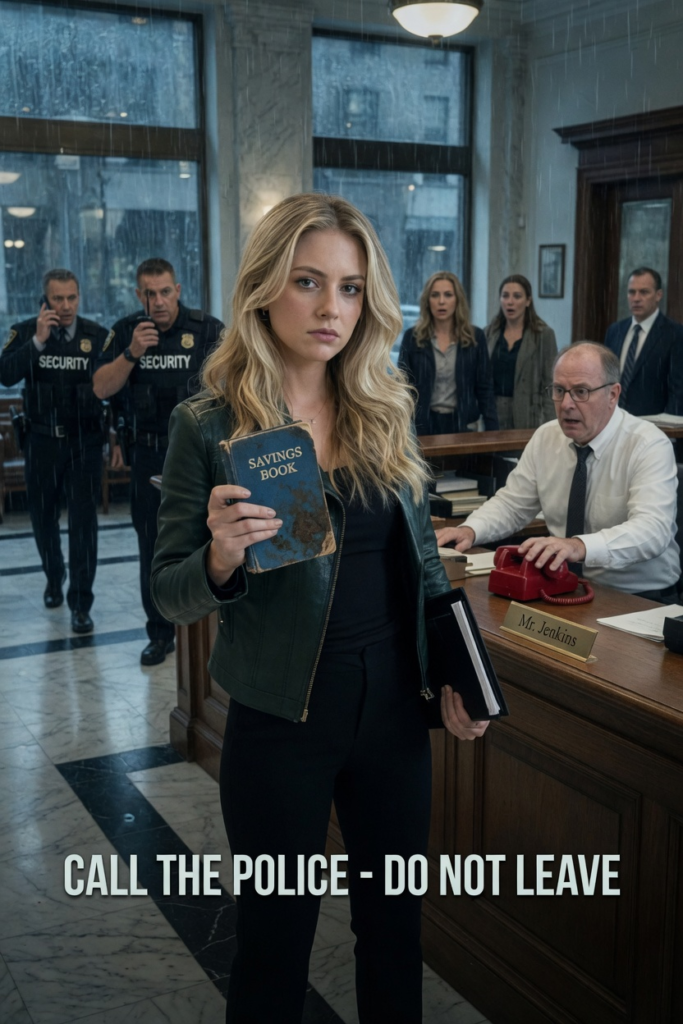
“What is happening?” I demanded. “What is this?”
Mrs. Patel came around the counter. “Please come with me.”
“No. Not until you tell me something.”
She glanced toward the glass doors, as if expecting someone to appear there.
Then she lowered her voice.
“Your grandmother made arrangements with this bank years ago. Very specific arrangements. If that passbook was ever presented by anyone claiming to be Elise Hale, we were required to verify your identity, contact law enforcement, and secure the building.”
My fingers went cold.
“Why?”
“Because three people tried to access this account before you.”
“Who?”
Mrs. Patel hesitated.
I already knew.
“My father,” I said.
She didn’t answer.
She didn’t have to.
A small sound escaped me. Not a laugh. Not a sob. Something between both.
“What did he do?”
Mrs. Patel looked at the blue passbook still lying on the teller counter.
“He tried to prove you were dead.”
The lobby tilted.
I grabbed the edge of the counter.
The teller whispered, “Miss Hale?”
I stared at Mrs. Patel.
“What?”
“Fourteen years ago,” she said carefully, “someone attempted to close the account using a death certificate for Elise Marianne Hale.”
My mouth went dry.
“I was twelve.”
“Yes.”
“I was alive.”
“Yes.”
Rain tapped harder against the glass.
Grandma’s voice rose in my memory.
When they laugh, let them. Then go to the bank.
I pressed a hand to my stomach.
“My father filed a death certificate for me?”
“A forged one,” Mrs. Patel said. “The bank rejected it. Your grandmother was notified. She came here the next morning with you.”
I shook my head. “I don’t remember that.”
“You were young. Your grandmother asked us not to discuss the details with you. She said you had already survived enough.”
A memory flickered.
Grandma’s hand gripping mine too tightly.
A woman in a navy suit giving me a lollipop.
Grandma crying in the car afterward, then pretending she had allergies.
My heart broke in a new direction.
“He tried to erase me,” I whispered.
Mrs. Patel’s face held the grave kindness of someone who had seen enough money to know it could become a weapon.
“He tried to take what was legally yours.”
Before I could ask what she meant, red and blue lights flashed against the wet windows.
Two police cars pulled up outside.
My first instinct was panic.
Then came something else.
A strange, hard relief.
For once, my father’s name had brought police to protect me, not to intimidate me.
Mrs. Patel guided me into a small office behind the teller line. It smelled like paper, coffee, and lemon cleaner. A framed photograph of the bank from 1926 hung on the wall. The teller brought the passbook and my license, then closed the door.
I sat in a chair across from Mrs. Patel’s desk.
My hands would not stop shaking.
Two officers entered first. One was young and broad-shouldered. The other was a woman in her fifties with sharp eyes and silver threaded through her dark hair.
“Miss Hale?” the woman asked.
“Yes.”
“I’m Detective Rowan. This is Officer Diaz. We’re here because of the bank alert, not because you did anything wrong.”
The fact that she said it immediately nearly made me cry.
“Okay.”
Detective Rowan sat across from me. “May I see the passbook?”
Mrs. Patel handed it to her.
The detective opened it with care. Her expression changed when she saw the account title.
“Elise Marianne Hale Custodial Reserve,” she read aloud. “Trustee Margaret Hale.”
Margaret.
Grandma.
The detective looked at Mrs. Patel. “Is Bell on his way?”
“Yes,” Mrs. Patel said. “I called him after dispatch.”
Mr. Bell.
The lawyer from the cemetery.
The man who had watched me walk away as if he knew the ground was about to split open.
My anger flared.
“He knew?”
Detective Rowan’s gaze returned to me. “He knew enough to tell us your grandmother left instructions.”
“Then why didn’t he say anything at the funeral?”
Mrs. Patel and Detective Rowan exchanged a look.
The detective answered. “Because your grandmother’s instructions said no one was to interfere unless you came here willingly with the original passbook.”
“That sounds like her,” I said bitterly.
Grandma believed choice mattered. Even painful choice. Especially painful choice.
She had given me the book, but I had to be the one to climb into the grave mud and take it back.
Detective Rowan placed the passbook on the desk between us.
“Miss Hale, I’m going to explain what I can. Some of it may be difficult.”
I stared at the little blue book.
“Today can’t get much worse.”
No one smiled.
That should have warned me.
Detective Rowan opened a folder. “Your grandmother filed multiple reports over the years alleging financial exploitation, forgery, and coercion by Victor Hale.”
“My father.”
“Yes.”
The word father felt rotten now.
“She believed he stole funds from accounts belonging to your late mother, Lydia Vale Hale, and from a trust established for your benefit after your mother’s death.”
My mother’s name struck me harder than expected.
Lydia.
No one said it much.
Grandma had said it softly. My father never said it at all.
“She also believed Victor illegally sold property that had already been placed in trust for you.”
“The house,” I said.
Mrs. Patel looked down.
The room became too small.
When I was twelve, Victor sold Grandma’s house.
That was how I remembered it.
I remembered standing on the porch while men carried out furniture. I remembered Grandma holding my shoulders from behind as my father told her she was lucky he was handling things before she lost the place completely. I remembered begging him not to sell it because it was the only home that still smelled like my mother’s perfume in the upstairs hall.
He had leaned down and said, “Homes belong to people who can pay for them.”
Grandma had gone white but silent.
That night, she moved us into a one-bedroom apartment above a pharmacy.
I thought she had lost the house.
I never knew he had stolen it.
Detective Rowan continued. “Your grandmother pursued civil action quietly for years. The problem was that Victor controlled many of the family documents. Some records vanished. Some witnesses changed their statements. Some bank employees retired before the case was ready.”
“And the passbook?”
Mrs. Patel touched the cover. “This book is not merely a record. Under the original terms, possession of the passbook by the beneficiary allows access to attached instruments.”
“In English,” I said.
“It is a key,” she said. “To accounts, certificates, and a safe-deposit box your grandmother maintained under strict presentation rules.”
The room went silent.
A safe-deposit box.
Grandma had not left me a book.
She had left me a door.
Outside the office, the front doors rattled.
Officer Diaz turned sharply.
A man’s voice boomed through the lobby.
“Open this damn door!”
My blood turned to ice.
Victor.
Detective Rowan stood.
The voice came again, muffled by glass but unmistakable.
“My daughter is in there! She stole property from a grave!”
Mrs. Patel’s eyes closed briefly.
Officer Diaz moved to the office door.
Detective Rowan looked at me. “Stay here.”
But I was already standing.
Through the blinds, I saw my father outside the bank doors, rain dripping from the brim of his black funeral hat. Celeste stood beside him under a black umbrella, her veil lifted, lips tight with fury. Mark hovered behind them, phone in hand, recording.
My father pounded on the glass.
“ELISE!”
I flinched.
Detective Rowan noticed.
Then her expression hardened.
She walked into the lobby with Officer Diaz.
Mrs. Patel stayed with me, but I could hear everything.
“Victor Hale?” Detective Rowan called through the door.
“Yes,” my father snapped. “Open up.”
“I’m Detective Rowan. Step back from the door.”
“My daughter is mentally unstable. She took an item that does not belong to her.”
I almost laughed again.
There it was.
The same old script.
Unstable.
Dramatic.
Confused.
A woman becomes inconvenient, and suddenly she becomes crazy.
Detective Rowan’s voice stayed calm. “The bank is currently closed due to a police matter. You need to step back.”
“That book is part of my mother’s estate.”
“No,” I whispered.
Mrs. Patel touched my arm.
“It is not,” Detective Rowan said.
My father went still.
“What?”
“The passbook was legally bequeathed to Elise Hale. If you have a dispute, contact the probate court. Now step back.”
Celeste stepped forward, her voice sweet and sharp. “Detective, I understand Elise has probably told you some emotional story, but she has always had difficulties. Her grandmother encouraged delusions.”
Mrs. Patel muttered, “Unbelievable.”
Mark lifted his phone higher.
My father pointed toward the office. “She is not leaving with that book.”
Detective Rowan’s voice dropped.
“You don’t decide that.”
My father’s face changed.
I had seen that change before. The slight stiffening. The cold flare in his eyes. The mask slipping just enough for the cruelty beneath to breathe.
“Do you know who I am?” he asked.
“Yes,” Detective Rowan said. “I do.”
Something in her tone made Celeste lower the umbrella an inch.
My father noticed too.
Detective Rowan continued. “I know you attempted to close a custodial account fourteen years ago using fraudulent death records. I know you were named in multiple financial exploitation complaints filed by Margaret Hale. And I know an attempt was made at 8:43 this morning to access a restricted account connected to her estate.”
Celeste’s face went white.
Mark’s phone dipped.
My father did not move.
“That’s absurd,” he said.
“Then you won’t mind answering questions at the station.”
“I’m not going anywhere.”
Officer Diaz placed one hand near his belt. “Sir, step away from the door.”
My father looked past them.
Somehow, even through the glass, his eyes found mine behind the office blinds.
He smiled.
Not because he was winning.
Because he wanted me to remember he had once been able to make me afraid.
Then he mouthed one word.
Mine.
The girl I used to be would have stepped back.
The girl who hid behind Grandma at twelve.
The girl who apologized when adults slammed doors.
The girl who believed love had to be earned by being quiet.
But that girl had climbed into grave mud and taken back what belonged to her.
I opened the office door.
Mrs. Patel whispered, “Miss Hale—”
I walked into the lobby.
My father’s smile deepened when he saw me.
“There she is,” he called. “Come outside, Elise.”
“No.”
The word was small.
But it was clean.
Celeste’s eyes narrowed.
My father leaned close to the glass. “You don’t know what you’re playing with.”
I lifted the passbook.
“No,” I said. “But Grandma did.”
For the first time, fear moved across his face.
It passed quickly, but I saw it.
So did Detective Rowan.
My father stepped back from the door.
“This is family business,” he said.
“No,” the detective replied. “It’s evidence.”
That was when Celeste turned and walked away.
Not ran.
Not dramatically.
She simply turned, snapped her umbrella closed, and moved quickly toward the parking lot.
Mark stared after her. “Mom?”
Detective Rowan looked at Officer Diaz.
“Stop her.”
Celeste heard.
She ran.
For a woman in funeral heels, she moved fast.
Officer Diaz shoved through the side door and sprinted after her across the wet pavement. Celeste reached a silver Lexus, yanked the door open, and threw herself inside.
The engine roared.
Then died.
Officer Diaz had grabbed the keys through the open window.
Celeste screamed so loudly I heard it inside the bank.
My father’s face darkened.
Detective Rowan opened the front door.
“Victor Hale, you are coming with me.”
He laughed once. “On what charge?”
“For now? Obstruction, harassment, and suspicion of attempted financial fraud.”
He looked at me again.
This time there was no smile.
Only a promise.
“This isn’t over.”
Grandma’s voice answered inside me.
Wolves growl loudest when they smell the trap.
I looked at him through the rain-streaked glass.
“Yes,” I said. “It is.”
But I was wrong.
It was not over.
It was only beginning.
Mr. Bell arrived twenty minutes later with his tie crooked, his coat soaked, and his face gray with worry.
He stopped when he saw me.
“I’m sorry,” he said.
I stood in Mrs. Patel’s office with the passbook clutched to my chest. “For what?”
“For the cemetery.”
“You let him throw it into her grave.”
Pain crossed his face. “Your grandmother was very specific. I was not to intervene unless you asked me directly or brought the book here yourself.”
“That’s cruel.”
“Yes,” he said quietly. “It was also wise.”
I wanted to hate him for saying that.
I couldn’t.
Because somewhere inside me, I knew Grandma had understood something no one else did.
If Mr. Bell had stopped my father, Victor would have claimed the book mattered because the lawyer acted like it mattered.
If the lawyer had urged me to take it, my father would have accused him of manipulating me.
If anyone had protected me in that moment, Victor would have found a way to turn my inheritance into someone else’s scheme.
So Grandma had left me alone with the choice.
Not because she didn’t love me.
Because she trusted me.
The realization hurt.
Mr. Bell removed a sealed envelope from his briefcase.
“Your grandmother asked me to give you this after the passbook was accepted by the bank.”
I stared at the envelope.
My name was written across the front in Grandma’s careful hand.
Elise.
I sat before opening it.
Inside was a letter, two pages folded around something small and hard.
A brass key.
My breath caught.
Mrs. Patel whispered, “The safe-deposit key.”
I unfolded the letter.
My darling Elise,
If you are reading this, then you were braver than they expected and exactly as brave as I knew you were.
I am sorry I could not explain everything before I left. I tried more than once, but your father watched me closely near the end. He always feared poor old women less than he should.
That little book is not useless. It is proof.
Banks changed. Records moved to computers. Men like your father learned to lie with papers. But that passbook was opened under old rules, and old rules can be stubborn. It connects to accounts, documents, and a safe-deposit box that Victor could not touch without you or me.
He tried. More than once.
Do not be afraid of what you find. The truth will hurt, but lies already hurt you. At least truth leaves a clean wound.
Mr. Bell will help. Mrs. Patel will help. Detective Rowan can be trusted. If any of them are gone by the time this reaches you, trust the records before you trust family.
Your father stole from you. He stole from your mother. He stole from me. Worst of all, he tried to teach you that stolen things were never yours to miss.
They were yours.
You were always worth protecting.
I love you more than every dollar, every brick, every acre, every memory inside that house.
When they laugh, let them.
Then go to the bank.
Grandma
By the time I finished, I was crying so hard I could barely see the key in my palm.
No one spoke.
Even Detective Rowan, who had returned after Victor and Celeste were placed in separate patrol cars, stood silently near the door.
Mr. Bell waited until I folded the letter.
“There is more,” he said.
Of course there was.
With Grandma, there was always more.
Mrs. Patel led us downstairs to the vault.
The bank basement smelled like metal and dust. Fluorescent lights buzzed overhead. Safe-deposit boxes lined the walls in neat bronze rows, each one with a tiny keyhole and a number.
Mrs. Patel stopped at Box 117.
My hands trembled as I inserted the brass key.
Mrs. Patel used the bank key beside it.
Both turned.
The box slid out with a heavy metallic scrape.
She carried it into a private viewing room.
No one touched it for a moment.
It sat on the table between us, long and narrow, like a coffin for secrets.
Detective Rowan set up a small recording device.
“With your permission,” she said. “Given the active investigation.”
I nodded.
Mr. Bell placed his briefcase on the floor. Mrs. Patel stood by the wall. Officer Diaz remained outside the door.
I lifted the lid.
Inside were envelopes.
Not jewelry.
Not cash.
Not the kind of treasure my half-brother Mark would have joked about.
Paper.
Grandma had buried my inheritance in paper.
The first envelope was marked:
FOR ELISE — MONEY
I almost laughed through my tears.
Grandma had labeled it like a kitchen drawer.
Inside were bank statements, certificates of deposit, and a summary sheet prepared by Mrs. Patel.
The number at the bottom made no sense.
I stared at it.
Then stared again.
$1,842,611.09
“That can’t be right,” I said.
Mrs. Patel’s voice was gentle. “It is.”
“No.”
“Your grandmother deposited the proceeds from several investments your mother left to you. She added her own savings over the years. There were also insurance proceeds that were recovered after litigation. The funds were locked in conservative instruments. They grew.”
I shook my head.
Grandma had worn the same winter coat for nine years.
She cut coupons.
She watered down soup.
She once spent an entire evening repairing my school backpack because she said new ones were overpriced.
And all that time, she had been guarding nearly two million dollars for me.
“Why did we live above the pharmacy?” I whispered.
Mr. Bell answered softly. “Because if Victor believed your grandmother had access to money, he would have never stopped.”
My stomach twisted.
Grandma had chosen hardship as camouflage.
For me.
The second envelope was marked:
FOR ELISE — HOUSE
My fingers went numb before I opened it.
Inside was the original deed to the Hale house.
Not the little apartment.
Not some forgotten parcel.
The house.
The white house on Orchard Lane with the wraparound porch, the stained-glass window, the lilac bushes my mother planted before I was born.
The only place I had ever felt completely safe.
A second document was clipped behind it.
Trust Transfer: Lydia Vale Hale to Elise Marianne Hale.
My mother had left the house to me.
I covered my mouth.
“My mother owned it?”
Mr. Bell nodded. “Your grandmother transferred the property to Lydia after Victor began pressuring her to sell. Lydia placed it in trust for you shortly before she died.”
“But he sold it.”
“Yes.”
“How?”
Mr. Bell’s face darkened. “Forged guardianship papers. A falsified court order. A notary who later disappeared from the state.”
Detective Rowan leaned forward. “We have been trying to prove that for years.”
“Who owns it now?” I asked.
Mr. Bell hesitated.
I knew before he said it.
“A holding company connected to Celeste’s brother.”
The room became very quiet.
I thought of Celeste laughing behind her funeral veil.
Poor girl. Always so dramatic.
She had been living off stolen walls.
Grandma had not lost the house.
They had taken it.
A heat rose through me so clean and fierce it did not feel like rage. It felt like clarity.
“What can we do?”
Mr. Bell’s tired eyes sharpened.
“With this? A great deal.”
The third envelope was marked:
FOR THE POLICE
Detective Rowan put on gloves before opening it.
Inside were copies of checks, notarized statements, photographs, and a flash drive. There was also an old microcassette in a plastic sleeve.
At the sight of it, Mr. Bell closed his eyes.
“What is that?” I asked.
Detective Rowan read the label.
Victor — August 14 — Kitchen
Mr. Bell exhaled.
“Margaret recorded him?”
“She recorded everything after he tried to close Elise’s account,” the detective said.
Mrs. Patel nodded. “She used to joke that if men wanted women to be quiet, they should not teach us how machines worked.”
That sounded exactly like Grandma.
Detective Rowan placed the cassette aside. “We’ll process this properly.”
“No,” I said.
Everyone looked at me.
“I want to hear it.”
Mr. Bell’s expression softened. “Elise—”
“I want to know.”
Detective Rowan studied me for a long moment.
Then she asked Mrs. Patel, “Do you have equipment that can play this?”
Mrs. Patel gave a grim little smile.
“This bank has been open since 1911. We have equipment for everything.”
Ten minutes later, an old recorder sat on the table.
Detective Rowan pressed play.
Static filled the room.
Then Grandma’s voice.
Younger than I remembered. Stronger.
“Get out of my kitchen, Victor.”
My father laughed. “It was never your kitchen after Lydia signed it over.”
“She signed it for Elise.”
“She was my wife.”
“She was leaving you.”
Silence.
I stopped breathing.
Then my father’s voice returned, lower.
“Careful.”
Grandma said, “I know about the insurance. I know about the account. I know you tried to file Elise dead.”
“You can’t prove anything.”
“I don’t need to prove it to you. I need to protect her.”
“You’re an old woman with a sewing tin and a pension.”
“And you’re a thief wearing your dead wife’s ring.”
A chair scraped.
My father’s voice became a hiss. “Lydia should have listened. She always thought you’d save her too.”
Grandma’s voice shook, but did not break. “What does that mean?”
“It means some women learn too late what happens when they try to leave.”
The tape crackled.
I felt every hair on my arms rise.
My mother had died in a car accident when I was four.
That was all anyone ever told me.
Rainy road. Lost control. Instant death.
Grandma asked, “Did you hurt my daughter-in-law?”
My father laughed once.
Not denial.
Not outrage.
A laugh.
“You’ll never prove that either.”
The tape ended.
The room disappeared.
For a few seconds, I was nowhere.
Not in the bank.
Not in my body.
Not twenty-six years old.
I was four again, standing beside Grandma in a black dress, asking why Mommy was sleeping in a box.
My father’s voice echoed.
Some women learn too late what happens when they try to leave.
Detective Rowan spoke first.
“We need to take this into evidence.”
I stared at the recorder.
“Did Grandma think he killed my mother?”
Mr. Bell looked twenty years older.
“She suspected he may have caused the accident. She never had enough proof.”
“Did you know?”
“I knew she suspected. I also knew suspicion without evidence can destroy the person carrying it.”
I wanted to scream at him.
At Grandma.
At the police.
At my mother for leaving.
At my father for breathing.
Instead, I asked, “Is there more?”
Detective Rowan looked into the box.
“Yes.”
The fourth envelope was marked:
FOR ELISE — WHEN YOU ARE READY
No one moved to touch it.
I did.
Inside was a photograph of my mother.
Not the formal one Grandma kept on her dresser. Not the frozen, perfect mother of my memory.
This one was different.
Lydia sat on the back steps of the Orchard Lane house, barefoot, laughing at something outside the frame. She had my eyes. Or I had hers. Her hair was tied messily on top of her head, and one hand rested on her round pregnant belly.
Pregnant.
I turned the photo over.
Lydia and Elise, summer before everything.
There was a letter folded behind it.
My dearest Elise,
Your mother loved you loudly.
Victor will tell you she was fragile. She was not. She was frightened near the end, yes, but fear is not weakness. She was planning to leave him. She had already signed documents protecting the house and money for you. She wanted a life where no one shouted through walls.
She died before we could get her out.
I do not know if Victor caused the crash. I know only that Lydia feared him, and I know he profited from her death.
I spent years hating myself for not moving faster. But guilt is a house with no doors. I refuse to leave you inside it.
So here is the truth I can prove:
Your mother chose you.
She protected you.
Everything in this box exists because she wanted you safe.
Victor stole many things, but he did not steal that.
Do not let him.
Grandma
I pressed the photograph to my chest and folded over it.
This time, the sob that came out of me sounded like something tearing loose.
Mrs. Patel quietly left the room.
Mr. Bell looked away.
Detective Rowan did not comfort me. She simply sat there, steady and present, as if grief were a storm she respected enough not to interrupt.
When I could speak again, I asked, “What happens now?”
Detective Rowan picked up the envelope marked FOR THE POLICE.
“Now,” she said, “we stop letting him bury things.”
My father spent that night in a holding cell.
So did Celeste.
Mark was questioned and released, which made him furious enough to call me seventeen times before midnight. I did not answer. He left voicemails that began with threats and ended with panic.
“Elise, call me back. They took Mom’s phone. Dad says you’re lying. What did you do? What did Grandma have? Elise, seriously, this isn’t funny.”
Funny.
That word almost made me throw my phone across Mr. Bell’s guest room.
I did not go home that night because I did not have one.
My apartment felt too exposed. My father knew the building. Celeste knew my schedule. Detective Rowan advised me to stay somewhere secure until they knew who else might be involved.
Mr. Bell offered his guest room.
It was strange sleeping in the house of the man I had wanted to hate that morning. But grief makes alliances quickly when danger is honest.
His wife, Nora, made tea and toast I could not eat. She gave me a pair of wool socks and said, “Your grandmother once beat my husband at chess so badly he pretended the phone rang to escape.”
Mr. Bell muttered, “That is not how I remember it.”
“It is how everyone remembers it,” she said.
I almost smiled.
At three in the morning, I sat by their kitchen window with Grandma’s letter open on the table.
Mr. Bell came in wearing a robe and carrying two mugs.
“Couldn’t sleep?” he asked.
“No.”
He set one mug in front of me.
“I’m angry at you,” I said.
He sat across from me. “You should be.”
“You knew she had all this.”
“I knew pieces.”
“You let me think she left me nothing but a book.”
“Your grandmother believed Victor watched reactions more than words. If I had looked relieved or pleased, he would have known immediately.”
“He knew anyway.”
“Yes,” Mr. Bell said. “But too late.”
I looked down at the letter.
“Why didn’t she tell me before?”
He folded both hands around his mug.
“Because she was afraid you would confront him before the evidence was protected. She knew your heart. You would have demanded answers. Victor would have destroyed whatever he could reach.”
I hated that he was right.
“I feel stupid,” I whispered.
“You were lied to by people who depended on your trust. That is not stupidity.”
“My father tried to declare me dead.”
Mr. Bell’s eyes filled with pity, which I hated until I realized it was not pity for weakness. It was sorrow for harm.
“Yes.”
I stared at the dark window.
“Did he hate me that much?”
Mr. Bell took a long time to answer.
“I don’t think men like Victor hate in the ordinary way. I think they resent anything they cannot own. Your mother. Your grandmother. You. The house. The money. Love itself.”
My reflection in the glass looked pale and unfamiliar.
“He called me his daughter today.”
“Yes.”
“But he never meant it.”
Mr. Bell’s voice softened.
“He meant possession. Not love.”
That sentence entered me like a blade and a key at the same time.
Possession.
Not love.
It explained every birthday he missed but later used against me. Every cruel remark delivered as concern. Every time he called me ungrateful for wanting the things he had taken.
I thought of Grandma’s letter.
Your mother chose you.
I had spent my life feeling unwanted by my father. I had never understood that two women had built a wall of documents, secrets, and sacrifice around me because they wanted me to survive him.
“I want the house back,” I said.
Mr. Bell nodded.
“Then we fight for it.”
“I want the money protected.”
“It will be.”
“I want my mother’s case reopened.”
His face tightened.
“That may be harder.”
“I didn’t ask if it was hard.”
For the first time that night, Mr. Bell smiled.
“No,” he said. “You did not.”
By morning, the story had spread.
Not the real story.
Not yet.
But enough.
Victor Hale Arrested After Funeral Dispute.
Widower’s Son Accused in Estate Conflict.
Police Investigate Bank Incident Involving Prominent Local Family.
Prominent.
That word did a lot of work for cowards.
My father had spent decades building the kind of reputation small towns respect too easily. He sponsored baseball uniforms. Donated to the sheriff’s holiday drive. Bought expensive coffee for judges during election season. He wore clean suits and called women “sweetheart” in public. He shook hands with pastors while destroying people in private.
By ten that morning, I had six messages from relatives.
Aunt Paula: Elise, your father is devastated. Please don’t make this worse.
Cousin Grant: Whatever Grandma told you, she was confused at the end.
Uncle Stephen: Family matters should stay family matters.
I deleted them all.
Family matters.
That phrase had buried more crimes than cemeteries ever could.
At noon, Detective Rowan called.
“We executed a search warrant at Victor and Celeste’s house,” she said.
I stood in Mr. Bell’s study, staring at shelves of law books. “And?”
“We found documents in a locked cabinet. Copies of your mother’s trust transfer. A forged death certificate with your name. Drafts of court petitions claiming your grandmother had dementia. Also several blank notarized forms.”
My knees weakened.
“He kept them?”
“People like him often do. They think possession means control.”
Possession.
Not love.
“What about Celeste?”
“She’s asking for an attorney and blaming Victor.”
Of course she was.
“And Mark?”
“Angry. Scared. Maybe useful.”
“I don’t trust him.”
“Good,” Detective Rowan said. “Don’t.”
A pause followed.
Then her tone changed.
“There’s something else.”
I closed my eyes.
“What?”
“We found a file labeled Lydia.”
The room narrowed.
“What was in it?”
“Insurance documents. Old police reports. Photos of the car.”
My hand tightened around the phone.
“And?”
“I don’t want to discuss details until you’re with counsel.”
“That means it’s bad.”
“It means it matters.”
I went cold.
“Did he kill her?”
Detective Rowan was silent for three beats.
“I don’t know yet,” she said. “But I believe your grandmother had reason to ask that question.”
The next two weeks became a blur of offices, signatures, police interviews, and sleepless nights.
The bank froze all disputed access. The funds Grandma had protected were transferred under court supervision into an account only I and Mr. Bell could authorize until probate finalized. Victor’s attorneys tried to claim he had been acting under “reasonable belief” as Margaret Hale’s son.
Mrs. Patel destroyed that argument in twelve calm minutes.
At the emergency probate hearing, she testified that Victor had attempted to access the account multiple times using inconsistent claims: first that I was dead, then that Grandma had dementia, then that the passbook was lost, then that he was the rightful heir because I was “estranged.”
“Was Elise Hale estranged from Margaret Hale?” the judge asked.
Mrs. Patel looked directly at my father.
“No,” she said. “Margaret Hale came to this bank every month with photographs of her granddaughter in her wallet. She was not estranged. She was protective.”
Victor sat at the opposite table in a charcoal suit, expression bored.
Celeste was not beside him.
That told me everything.
She had already begun saving herself.
Mark sat in the back row, no longer laughing. His face was pale, eyes fixed on the floor. When I walked past him, he whispered, “I didn’t know.”
I stopped.
He looked up.
For once, he looked younger than me.
“I didn’t know about the death certificate,” he said.
I stared at him. “But you knew they mocked me.”
His mouth opened.
Closed.
“I thought it was just family stuff.”
“Cruelty is not family stuff, Mark.”
He flinched.
I walked away.
The judge granted temporary control of the trust assets to me. He also issued an order preventing Victor, Celeste, Mark, or their associates from accessing or selling any property connected to the disputed estate.
Then Mr. Bell presented the Orchard Lane documents.
Victor finally reacted.
He sat forward sharply.
“Those are not valid,” he snapped.
The judge looked over his glasses. “Mr. Hale, you will speak through counsel.”
Victor’s attorney put a hand on his sleeve.
Victor shook it off.
“That house was sold legally. My mother knew exactly what happened.”
Mr. Bell stood. “Your Honor, the sale relied on a guardianship order that the county court has no record of issuing. The notary stamp belonged to a woman who had died eight months before the document was allegedly signed.”
A murmur moved through the courtroom.
Victor’s face darkened.
The judge reviewed the papers for a long time.
Then he said, “This court is referring the matter to the district attorney for investigation of real estate fraud.”
My father turned slowly and looked at me.
For the first time in my life, I was not afraid of what I saw there.
Because now other people saw it too.
That was the beginning of his real punishment.
Not jail.
Not yet.
Visibility.
Monsters hate light more than cages.
The district attorney charged Victor first with fraud, forgery, attempted theft, and financial exploitation of an elder.
Celeste was charged with conspiracy and attempted unlawful access to restricted estate assets after bank logs showed the morning access attempt had come from her laptop.
Mark was not charged at first.
He came to my apartment three nights after the probate hearing.
I saw him through the peephole and almost called the police.
He stood in the hallway wearing a hoodie and jeans, no smirk, no swagger.
“Elise,” he said through the door. “Please. I’m not here for them.”
“That’s exactly what someone here for them would say.”
He gave a sad, humorless laugh. “Yeah. Fair.”
I kept the chain on and opened the door two inches.
“What do you want?”
He held up a manila envelope.
“I found this in Dad’s garage. In the freezer.”
“The freezer?”
“He hides things where Mom won’t look. She hates the garage.”
I did not take the envelope.
“Why bring it to me?”
His face crumpled slightly.
“Because I think he’s going to say I did things. I heard them fighting. Mom said if this goes bad, I’m old enough to take responsibility for some signatures because I ‘helped with paperwork.’ I didn’t. I mean, I signed stuff when they told me to, but I didn’t know.”
I stared at him.
There was the boy who had laughed at the grave.
And behind him, maybe, another victim raised by wolves and proud of his teeth until someone handed him a mirror.
“What’s in it?”
“I don’t know. I didn’t open it.”
“Why not?”
“Because for once, I wanted someone to believe I didn’t tamper with something.”
That hit harder than I expected.
I took the envelope through the gap.
It was cold.
Literally cold, damp from thawing.
Inside were photographs, negatives, and a small plastic evidence bag containing a car key.
A label on the bag read:
Lydia — spare key
My mouth went dry.
Mark saw my face.
“What is it?”
I closed the door and locked it.
Then I called Detective Rowan.
The new evidence changed everything.
The car key matched my mother’s old sedan.
The photographs showed the wreck from angles not included in the official report. One image focused on the brake line. Another showed a small clean cut near the fitting.
Detective Rowan reopened Lydia Hale’s death investigation within forty-eight hours.
The original accident report had been sloppy. Too sloppy. The officer who handled it had retired early and moved to Florida. He had also received three payments from a business account connected to Victor within six months of my mother’s death.
It took another month to find the mechanic.
His name was Paul Redding. He was seventy now, living alone in a trailer two counties over, with oxygen tubes in his nose and guilt sitting on his shoulders like a second body.
At first, he denied everything.
Then Detective Rowan played Grandma’s kitchen tape.
Victor’s voice filled the little room.
Some women learn too late what happens when they try to leave.
Paul Redding began to cry.
He confessed that Victor had paid him to “make the brakes unreliable, not deadly.” He said Victor claimed Lydia was trying to take Elise and disappear with “family property.” He said he thought the brakes would fail slowly, maybe scare her, maybe force her to come back.
“But rain came,” he whispered. “Road was slick. She went through the guardrail.”
He never went to police because Victor threatened him.
My mother had not died in an accident.
She had been murdered by a man who thought leaving him was theft.
When Detective Rowan told me, I did not cry.
Not then.
I sat in the police station interview room with both hands flat on the table and listened until she finished.
Victor was charged with murder.
The kind of sentence that changes the air in a room.
Murder.
Not suspicion.
Not family business.
Not old pain.
Murder.
Afterward, I walked outside and vomited beside Mr. Bell’s car.
He stood with one hand on my back, saying nothing.
There are no right words when the shape of your childhood changes.
For twenty-two years, I had believed my mother was taken by rain and bad luck.
Now I knew she was taken by ownership.
By the same cruel entitlement that made my father throw Grandma’s passbook onto a coffin and call it useless.
That night, I dreamed of the Orchard Lane house.
I was four years old, chasing my mother through the lilac bushes. She turned, laughing, arms open. Behind her, Grandma stood on the porch, younger, strong, sunlight in her gray hair.
Then the house vanished.
I woke with my hand stretched toward empty air.
The trial took nearly a year.
By then, I had learned that justice was not a lightning strike. It was a machine. Slow, loud, grinding, imperfect. It required forms and patience and coffee in paper cups. It required people remembering pain out loud while strangers objected to the way they remembered it.
Victor’s legal team tried everything.
Grandma was bitter.
The bank misunderstood.
The documents were old.
Paul Redding was unreliable.
Mark was a spoiled son trying to save himself.
Celeste was a frightened wife under Victor’s control.
I was greedy.
That one made me smile in court.
Greedy.
I had lived on instant noodles while nearly two million dollars sat untouched because Grandma knew survival mattered more than comfort.
I had worn thrift-store coats while my father used stolen money to buy Celeste diamonds.
I had watched my mother become a faded photograph because no one wanted to say her death had profit attached.
Greedy.
The prosecutor called Mrs. Patel, who explained the account history with a precision that made Victor’s attorney sweat.
She described the forged death certificate.
The attempted closures.
The passbook restrictions.
The morning Celeste tried to access the account after Grandma’s death.
Then Mr. Bell testified about the house transfer, the trust, and Grandma’s years of documentation.
Mark testified too.
He looked at me once before taking the stand.
Not asking forgiveness.
Not yet.
Just acknowledging the room we were both trapped in.
He admitted he had mocked me at the funeral. He admitted he had repeated things his parents said without questioning them. He admitted Celeste asked him to lie about having seen Grandma “confused” before her death.
“Was Margaret Hale confused?” the prosecutor asked.
Mark swallowed.
“No.”
“Was Elise Hale estranged from her grandmother?”
“No.”
“Did Victor Hale ever tell you why he disliked Elise?”
Mark’s eyes flicked toward his father.
Victor stared back, expressionless.
Mark looked down.
“He said she reminded him of Lydia.”
The courtroom went silent.
The prosecutor let that sentence sit.
Then came Paul Redding.
He walked to the stand with a cane and an oxygen tank. Victor watched him like a snake watches a wounded mouse.
Paul told the jury about the brake line.
About the money.
About Victor’s threat.
About seeing Lydia’s obituary and realizing “unreliable” had become dead.
Victor’s attorney attacked him for twenty minutes.
“Isn’t it true you are testifying to reduce your own liability?”
Paul nodded. “Yes.”
“So you would say anything to help yourself?”
Paul looked at the jury.
“I spent twenty-two years helping myself by staying quiet,” he said. “I’m done.”
That was the moment I felt the trial shift.
The recordings sealed it.
Grandma’s kitchen tape.
Victor’s own voice.
You’ll never prove that either.
Then the prosecutor played a second recording from the flash drive.
This one I had not heard before trial.
Grandma’s voice came first, thin but fierce.
“Tell me why, Victor.”
My father’s voice slurred slightly, probably drunk.
“Because she was leaving.”
“Lydia?”
“She was taking Elise. Taking the house. Taking the money. Women always think leaving means they get to keep what a man built.”
“You didn’t build her inheritance.”
“I built the life she wanted to walk out of.”
“You killed her.”
A pause.
Then Victor said, “She chose the road.”
The courtroom seemed to stop breathing.
I felt Mr. Bell’s hand cover mine.
Grandma’s voice on the tape trembled with rage.
“No. You chose the brakes.”
Static.
Then Victor whispered, “And you will choose silence if you want Elise safe.”
The tape ended.
No one moved.
Not even Victor.
For the first time, he looked old.
Not weak.
Never weak.
Just exposed.
As if the expensive suit had fallen away and the world could finally see the man underneath, standing in a kitchen threatening his own mother with his daughter’s safety.
The defense called Celeste.
It was a mistake.
She entered in a cream suit, pearls at her throat, hair soft around her face. The grieving wife costume had become the betrayed wife costume.
She said Victor controlled everything.
She said she never understood the accounts.
She said she believed Elise had manipulated Grandma.
She cried delicately.
Then the prosecutor showed the bank login records.
Celeste’s laptop.
Celeste’s password manager.
Celeste’s search history from the night Grandma died.
Can passbook account be cashed after death
How long before probate freezes assets
Can beneficiary be challenged for mental illness
How to prove elder dementia after death
Her tears stopped.
Then came the texts to her brother about Orchard Lane.
Celeste: If old woman dies before Victor fixes title, Elise may have claim.
Brother: Then make sure book disappears.
Celeste: Victor says he’ll bury it with her if he has to.
I turned slowly toward my father.
He had known.
At the cemetery, when he threw the passbook into Grandma’s grave, he had not thought it was useless.
He had hoped I would believe it was.
My father did not look at me.
Celeste was convicted of conspiracy, fraud, and attempted theft.
Victor’s verdict took two days.
Two days of sitting in a courthouse conference room with Mr. Bell, Mrs. Patel, Detective Rowan, Nora Bell, and—unexpectedly—Mark, who sat in the corner and barely spoke.
On the second evening, the bailiff entered.
The jury had reached a decision.
We filed back into the courtroom.
Victor stood as the jury returned. His face was carved from stone.
I watched the foreperson.
On financial exploitation: guilty.
Forgery: guilty.
Attempted theft: guilty.
Real estate fraud: guilty.
Conspiracy: guilty.
Witness intimidation: guilty.
Murder in the first degree: guilty.
The word did not explode.
It landed.
Heavy.
Final.
Victor Hale closed his eyes.
For a heartbeat, he looked almost peaceful.
Then he opened them and turned to me.
I expected hatred.
I expected blame.
Instead, he smiled.
That same cold smile from the cemetery.
But this time, it did not reach me.
It stopped somewhere between us and fell dead on the courtroom floor.
At sentencing, I spoke.
I stood at the podium with Grandma’s passbook in my hand.
Not because the judge needed to see it.
Because I did.
The blue cover had been cleaned, but a faint stain of cemetery dirt remained near the corner. I had asked Mrs. Patel not to remove it.
Some stains are proof.
“My grandmother Margaret Hale spent the last years of her life being called foolish, confused, bitter, and useless,” I began. “She was none of those things. She was patient. She was precise. She was brave.”
Victor sat at the defense table, hands folded.
I did not look away.
“My mother, Lydia, was called fragile. She was not fragile. She was a woman trying to leave a dangerous man with her daughter and her dignity intact. She should have lived.”
My voice shook then, but did not break.
“For most of my life, I thought my father simply did not love me. That hurt. But I understand now that the greater harm was not the absence of his love. It was the presence of his entitlement. He believed people belonged to him. Money belonged to him. Houses belonged to him. Women’s choices belonged to him. Even the truth belonged to him.”
The courtroom was silent.
I lifted the passbook.
“He threw this onto my grandmother’s grave and said it was useless. He was wrong. This little book carried my grandmother’s courage, my mother’s protection, and the truth he spent decades trying to bury.”
I looked directly at him.
“You did not bury it deep enough.”
Victor’s jaw tightened.
Good.
“I am not here to ask for revenge,” I said. “I am here to ask that the court recognize the length of the harm. My mother lost her life. My grandmother lost her home, comfort, peace, and years she should have spent free of fear. I lost childhood, history, and the chance to know the truth sooner. No sentence can restore that. But a sentence can say clearly that what happened was not family conflict. It was theft. It was abuse. It was murder.”
I stepped back.
The judge sentenced Victor Hale to life in prison without parole for my mother’s murder, plus consecutive sentences for the financial crimes.
Celeste received twelve years.
Her brother received five.
Paul Redding, because of his cooperation and failing health, received a reduced sentence, but he died eight months later in custody.
Mark was not charged.
That was harder for me than I expected.
Not because I wanted him punished forever, but because harm rarely distributes itself neatly. He had been cruel. He had also been raised inside cruelty. Both were true.
Three months after sentencing, he mailed me a letter.
Elise,
I don’t expect forgiveness. I don’t deserve it right now.
I keep thinking about the cemetery. I laughed because Dad laughed. That’s the ugliest sentence I’ve ever written.
I used to think being his son meant becoming like him before he turned on me. I didn’t understand he had already turned me into someone I hated.
I gave Detective Rowan everything else I found. There’s nothing left in the house.
I’m leaving town. Not running. Just trying to learn who I am when no one is telling me who to hurt.
I’m sorry for what I did.
Mark
I read it twice.
Then I placed it in a drawer.
Not the safe.
Some things deserve a chance to breathe before you decide where they belong.
The civil case over Orchard Lane ended that winter.
The holding company collapsed under the weight of fraudulent title transfers. Celeste’s brother signed a settlement from prison. The court restored the property to me, along with damages from Victor’s seized assets.
The first time I walked back into the Orchard Lane house, I carried Grandma’s passbook in my coat pocket.
Mr. Bell came with me.
So did Detective Rowan, though she claimed she was “just in the neighborhood,” which was ridiculous because she lived forty minutes away.
The house had been rented for years, then left vacant after the investigation began. The white paint peeled. The porch sagged. The lilac bushes were wild and tangled. Someone had removed the stained-glass window from the stair landing.
But when I opened the front door, the air still remembered.
Dust.
Wood.
Old wallpaper.
A faint trace of lavender, impossible and probably imagined.
I stood in the foyer and saw everything at once.
Grandma kneeling to tie my shoes.
My mother laughing on the stairs.
My twelve-year-old self crying while movers carried out boxes.
My father saying homes belonged to people who could pay for them.
He had been wrong about that too.
Homes belong to people who love them enough to return.
I walked room to room.
In the kitchen, one cabinet still had pencil marks on the inside panel.
Elise — age 3
Elise — age 4
Then a line, higher up.
Lydia — first house key, 19
Grandma had measured all of us there.
I touched the marks and finally cried.
Not the violent crying from the bank.
Not the hollow crying from the trial.
This was different.
This was grief finding its way home.
Mr. Bell stood in the doorway, eyes wet.
“She wanted you to have it back,” he said.
“I know.”
“What will you do with it?”
I looked around the ruined kitchen.
For months, people had asked me that.
What would I do with the money?
The house?
The name?
The truth?
At first, I thought the perfect ending would be taking everything Victor wanted and locking it away where no one could touch it.
But Grandma had not protected the house so it could become a museum of pain.
My mother had not signed documents so I could live guarded by ghosts.
They had wanted me safe.
Safe enough to live.
“I’m going to fix it,” I said.
Mr. Bell smiled. “Your grandmother would like that.”
“No,” I said, looking at the pencil marks. “She’d tell me to get three contractor estimates and not trust the cheapest one.”
Detective Rowan laughed from the hallway.
It was the first time I heard her laugh.
Spring came slowly.
So did repair.
The Orchard Lane house needed everything: roof, plumbing, wiring, windows, floors, paint, patience. I hired local workers and paid them well. I kept the porch boards that could be saved. I replanted the lilacs. I found an artisan two towns over who could recreate the missing stained-glass window from old photographs Grandma had kept.
The design was simple.
Blue glass.
Green leaves.
A small yellow bird in the corner.
My mother had drawn it when she was twenty.
I moved in on a rainy afternoon in June.
No ceremony.
No crowd.
Just me, a few boxes, and the little blue passbook.
I placed Grandma’s letter, my mother’s photograph, and the passbook in a new safe in the study.
Then I changed my mind.
I took the passbook back out.
It had spent enough time locked away.
I framed it in a shadow box with one line engraved beneath it:
WHEN THEY LAUGH, LET THEM. THEN GO TO THE BANK.
It hung near the front door.
Not as decoration.
As instruction.
With the recovered funds, I started the Margaret and Lydia Hale Foundation.
Its mission was simple: emergency legal and financial help for women and children escaping domestic abuse and family financial exploitation. Mr. Bell joined the board. Mrs. Patel taught free workshops about bank rights, trusts, and warning signs. Detective Rowan spoke once a month, though she pretended she hated public speaking.
The first woman we helped was named Ana.
She came into the office with a toddler on her hip, a bruise fading under makeup, and a husband who had emptied their joint account. She kept apologizing for asking questions.
I recognized the apology.
It was the sound of someone trained to shrink.
I sat across from her and slid a folder over the desk.
“You don’t have to apologize here,” I said.
She began to cry.
After she left, I went into the bathroom and cried too.
Not because I was sad.
Because something broken had become useful.
That felt like a miracle Grandma would approve of.
On the first anniversary of Grandma’s funeral, I returned to the cemetery.
This time, the sky was clear.
No rain.
No thunder.
No Victor.
I brought white roses for Grandma and lilacs for my mother.
Their graves sat side by side beneath an oak tree. Grandma’s headstone was new, paid for with money my father had tried to steal.
Margaret Hale
Beloved Grandmother
She Remembered Everything
Beside it:
Lydia Vale Hale
Beloved Mother
She Chose Love Over Fear
I knelt between them.
For a while, I said nothing.
Then I took the original brass safe-deposit key from my pocket.
I had kept it after the box was emptied. It no longer opened anything.
Or maybe it opened everything.
“I got the house back,” I told them. “The lilacs are blooming again. The porch still creaks, but in a charming way, not a lawsuit way.”
A breeze moved through the cemetery grass.
“I started the foundation. Mrs. Patel scares bankers into behaving. Mr. Bell still loses at chess. Detective Rowan laughs more than she wants people to know.”
My throat tightened.
“Mark wrote again. He’s in Oregon. He’s working as a mechanic, which feels ironic enough that Grandma would have a comment. He asked if someday he could visit your graves. I haven’t answered yet.”
I looked at my mother’s name.
“I know what happened now. I wish I didn’t. I’m glad I do. Both things are true.”
The cemetery was quiet.
No cruel laughter.
No black gloves.
No passbook thrown into dirt.
Only sunlight and the names of women who had loved me with all the power they had.
“I thought inheritance meant money,” I whispered. “Then I thought it meant truth. But I think maybe it means responsibility. To protect what protected you. To tell the story right. To stop handing silence down like a family heirloom.”
I placed the brass key on Grandma’s grave for a moment.
Then I picked it back up.
She would not have wanted it buried.
Grandma did not believe useful things belonged underground.
When I returned to Orchard Lane, the house was full of light.
The stained-glass bird threw yellow across the stairs. The kitchen smelled like lemon oil and fresh bread. On the table sat three bank folders, two foundation applications, and one badly repaired teacup I had found in a box of Grandma’s things.
I made tea.
Then I took out a notebook and wrote the first sentence of a letter.
To the girl who thinks no one left her anything,
I paused.
Outside, wind moved through the lilacs.
For years, I had been the girl standing at the edge of an open grave, mocked by people who mistook cruelty for power. I had been the girl with mud on her dress and an old blue book in her hand. I had been the girl who walked into a bank expecting humiliation and found an entire army of truth waiting behind a teller window.
Now I was someone else too.
A woman with keys.
A woman with records.
A woman with a house full of ghosts who did not haunt her.
They held the roof up.
I wrote the rest of the letter slowly.
To the girl who thinks no one left her anything,
Check again.
Sometimes love is hidden in old paper. Sometimes protection looks like a rule you do not understand yet. Sometimes the person who saved you had to do it quietly because the wolf was listening.
Do not let anyone convince you that what is yours becomes worthless because they throw it in the dirt.
Pick it up.
Walk away.
Go to the bank.
When I finished, I folded the letter and placed it in the foundation’s first welcome packet.
Then I stood in the front hall and looked at the framed passbook.
The little blue cover still bore the faint mark of Grandma’s grave.
My father had called it useless.
But that book had opened the bank vault.
It had reopened my mother’s case.
It had brought down a man everyone feared.
It had returned a stolen house.
It had turned grief into shelter for other women.
I touched the frame lightly.
“Not bad for old woman nonsense,” I whispered.
The house creaked around me, warm and alive.
And for the first time in my life, the silence did not feel like waiting for someone to come home.
It felt like peace.