For a while, I thought silence was the ending.
I thought healing would be a locked door, a blocked number, a little blue house with lavender by the porch and my name alone on the mortgage. I thought peace would arrive like a package, neat and whole, and all I would have to do was sign for it.
But peace is not a package.
It is a practice.
Some mornings, I still woke at 3:17 with my heart pounding, certain I had forgotten something. A bill. A shift. A text from my mother. A desperate voicemail from my father. Some old obligation hiding under the bed like a monster from childhood.
Then I would remember.
No one had access to me anymore.
Not my money.
Not my time.
Not the softest parts of me.
Still, my body learned freedom slower than my brain did.
I kept checking my bank account even when nothing was wrong. I kept saving receipts. I kept apologizing to furniture when I bumped into it. At work, when someone praised me, my first instinct was to shrink before I remembered I didn’t have to make myself smaller to be safe.
The house helped.
Every room became a quiet rebellion.
I bought yellow curtains because my mother hated yellow. I painted the kitchen cabinets sage green because Dad used to say color made a house look cheap. I put a big, ugly, comfortable chair in the living room because Jeffrey once told me my apartment looked like a waiting room.
Then I stopped waiting.
I planted tomatoes in the backyard and killed half of them by June. I learned the neighbors’ names. Mrs. Alvarez from next door brought me tamales when she found out I worked nights. Her grandson, Mateo, liked to sit on my porch steps and tell me elaborate lies about dinosaurs living under the sidewalk.
“You need a dog,” he announced one afternoon, licking popsicle juice off his wrist.
“I work too much.”
“Cats don’t care.”
“That’s true.”
So two weeks later, I adopted an orange cat with one torn ear and the suspicious glare of a retired landlord. The shelter had named him Pumpkin. I renamed him Stanley because he looked like he had opinions about interest rates.
Stanley hated everyone except me.
I considered that a compliment.
By August, my life had become something I recognized only in pieces. Work was still hard. Children still got sick. Parents still cried into my hands. Some nights still ended with me sitting in my car, too exhausted to turn the key.
But then I went home.
Home.
That word never stopped surprising me.
Not the house where I grew up, where love was measured against Jeffrey’s needs and always found me owing.
Not my old apartment, where every knock on the door made my stomach tighten.
My house.
My key.
My lavender.
My quiet.
Then the letter came.
It was waiting in the mailbox between a grocery flyer and a water bill.
No return address.
But I knew the handwriting before I opened it.
Jeffrey’s.
For almost a full minute, I stood on the porch holding the envelope while Stanley wound around my ankles like a warning.
I could have thrown it away.
I almost did.
Instead, I opened it with a butter knife because I refused to give it the dignity of trembling hands.
Barbara,
I don’t know if you’ll read this. I don’t blame you if you don’t.
That was how it began.
No nickname.
No Barb.
Barbara.
I sat on the porch chair, the sun dropping behind the maple tree, and read the whole thing.
Jeffrey wrote from a federal correctional facility two states away. His sentences were smaller than I remembered him being. He didn’t make excuses at first. He said prison had stripped the performance out of him. He said there were no navy blazers there, no riverfront brunches, no investors to impress, no parents to clap him on the shoulder and call debt potential.
He said he had started working in the prison library.
He said a counselor had asked him when he first learned that love meant winning.
He said he didn’t know how to answer because the truth made him sound pathetic.
Then came the apology.
Not polished.
Not pretty.
Not enough.
But real enough to make me put the letter down and stare into the yard.
I used your name because people trusted you, he wrote. I hated you for having something I couldn’t fake.
That line stayed in my chest for days.
I did not write back.
Forgiveness, I had learned, was not a door people could pound on until you opened it. It was not a prize for saying the right words after doing the wrong things. It was not a blanket thrown over a crime scene.
But I kept the letter.
Not in the evidence folder.
Not with the old damage.
I put it in a drawer in the kitchen beside takeout menus, batteries, and the instruction manual for a coffee maker I had never read.
A human place.
A maybe place.
Two months later, Dad had a stroke.
A cousin told me through a message I saw while eating cereal at midnight after a twelve-hour shift.
Your father is in the hospital. Your mother is alone. Whatever happened, this is bigger than pride.
I stared at the words until Stanley jumped onto the table and stuck his paw in my bowl.
Whatever happened.
People loved saying that.
As if pain were weather.
As if betrayal were fog.
As if the truth were a rude detail best softened for family gatherings.
I deleted the message.
Then I sat in the kitchen for a long time.
At two in the morning, I called the hospital where Dad had been admitted. I did not ask to speak to my mother. I did not give them permission to share my information. I simply asked the nurse on duty if Robert Miller was stable.
“He is,” she said. “Resting.”
“Thank you,” I whispered.
Then I hung up and cried.
Not because I wanted to run back.
Because part of me still remembered being a little girl waiting for him to look at me the way he looked at Jeffrey.
That little girl deserved to grieve.
But she did not get to drive the car anymore.
Dad survived.
I heard he went home with a cane and a speech therapist. I heard Mom told everyone the stress of Jeffrey’s case had nearly killed him. I heard she sold the house and moved into a condo with white carpets and no stairs.
I heard a lot of things.
I responded to none of them.
Winter came early that year.
The pediatric unit filled with coughs, fevers, frightened parents, and the sharp blue light of monitors. Noah came by again before Christmas, taller this time, carrying a handmade card covered in crooked stars.
Inside, in purple marker, he had written:
Thank you for helping me breathe.
I had to sit down after reading it.
His mother found me in the supply room pretending to count gauze.
“I’m sorry,” she said softly. “I didn’t mean to upset you.”
“You didn’t.”
She stepped closer. “Then what is it?”
I looked at the card in my hands.
For so long, my family had treated helping like emptiness. Like proof I had nothing better to do. Like I was a spare room they could store their needs inside.
But Noah’s card felt warm in my palm.
Helping had never made me small.
They had.
“I think,” I said, wiping my face, “I’m just finally understanding something.”
That Christmas, I did not go anywhere.
I worked the morning shift, came home exhausted, fed Stanley too much turkey from my plate, and fell asleep on the couch with the tree lights still on. At 9:08 that night, my phone buzzed.
Unknown number.
I almost ignored it.
Then I saw the message.
Barbara, it’s Mom. Please don’t block this number. I only want to say Merry Christmas.
I stared at it.
There were so many versions of me inside that silence.
The daughter who would have answered instantly.
The nurse who wanted to ask if she was eating, sleeping, managing Dad’s medication.
The wounded child who wanted her mother to suffer the silence she had earned.
The woman on the couch in her own house, with pine needles on the floor and a cat snoring beside her.
That woman typed back carefully.
Merry Christmas. I hope you and Dad are well.
Her reply came fast.
Can we talk?
My thumb hovered over the screen.
Then I wrote:
Not tonight.
For the first time in my life, a boundary did not feel like cruelty.
It felt like a handrail.
After that, my mother texted once a month.
At first, she wrote like nothing had happened.
Dad walked around the block today.
I made your grandmother’s soup.
I saw yellow curtains and thought of you.
I answered only when I wanted to, and never quickly enough for the old pattern to wake up.
Then, in March, she sent something different.
I was cruel to you. I knew it while I was doing it. I told myself you were strong, so it didn’t count. It counted. I am sorry.
I read that message in the hospital parking garage with my coat half on and my lunch untouched in my bag.
It counted.
Two words.
So small.
So late.
So enormous.
I did not forgive her then.
But something in me unclenched.
A week later, I agreed to meet her in a public park.
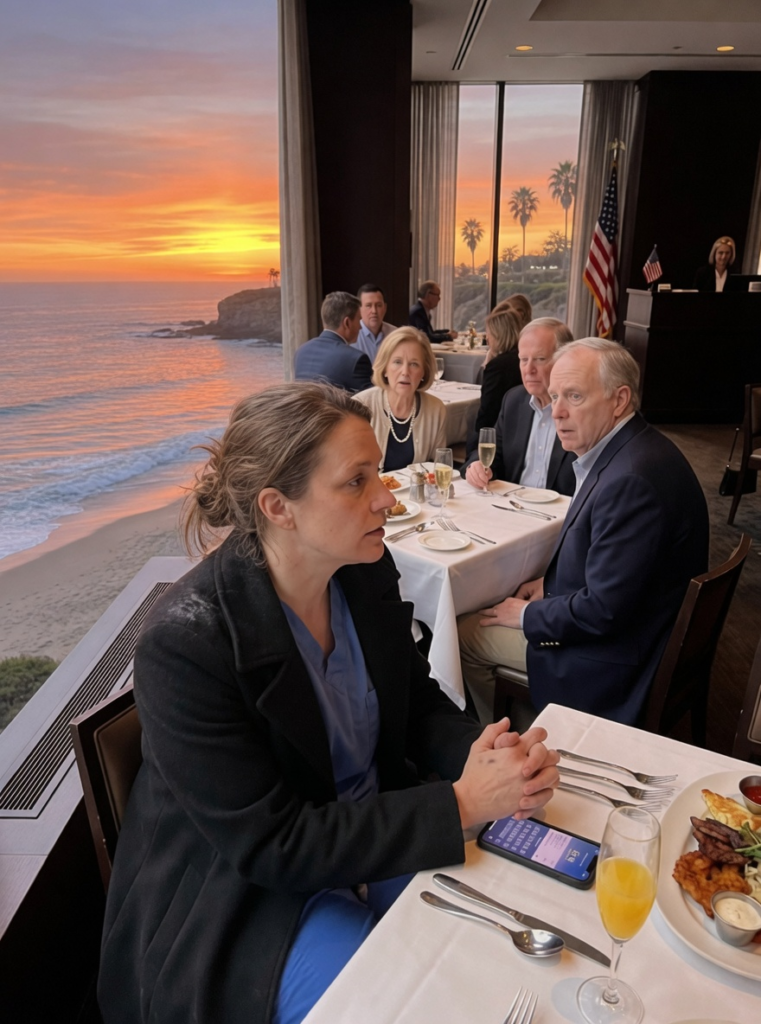
No brunch.
No riverfront windows.
No champagne.
Just a bench near a duck pond on a windy Saturday morning.
She looked older. Not elegantly older, not country-club older. Just tired in a way money couldn’t powder over. Her pearls were gone. Her hands twisted around a paper coffee cup.
When she saw me, she stood like she wasn’t sure whether she had the right.
“Barbara,” she said.
“Mom.”
She cried before she sat down.
I didn’t hug her.
That was the first truth.
I sat beside her anyway.
That was the second.
She apologized badly at first. Too much explanation. Too much Jeffrey. Too much your father was under pressure and I didn’t know what to do.
I almost left.
Then she stopped herself.
“No,” she said, pressing her fingers to her mouth. “No. Listen to me still trying to make it smaller.”
I looked at her.
She took a shaky breath. “I failed you. Not once. Over and over. I made you earn what I gave Jeffrey for free. I called it being practical. I called it being strong. It was favoritism. It was cowardice. And when you were grieving, I made you useful because I didn’t know how to comfort you.”
The pond wind moved through the bare trees.
For years, I had dreamed of that apology.
In my dreams, it healed everything.
In real life, it healed one inch.
But one inch was not nothing.
“I needed you,” I said.
Her face broke.
“I know.”
“You don’t get to need me now like nothing happened.”
“I know.”
“I’m not paying for anything. Not bills. Not lawyers. Not Dad’s care. Not Jeffrey when he gets out.”
“I know.”
“And if you insult my life again, even once, I’m gone.”
She nodded, crying silently. “I know.”
We sat there until the coffee went cold.
Before I left, she asked, “Are you happy?”
The question startled me.
Not because of the answer.
Because no one in my family had ever asked it without hoping I would say no.
I looked across the pond at a little girl throwing bread she wasn’t supposed to throw while her father laughed and pretended not to see.
“Yes,” I said. “I am.”
Mom closed her eyes.
“Good,” she whispered. “I’m glad.”
I believed her.
Not completely.
But enough for that morning.
Two years after the brunch, Jeffrey was released.
He sent one letter before he came home.
Barbara,
I’m not asking to see you. I’m not asking for help. I’m writing because my restitution payments begin next month, and I asked that confirmation be sent to the hospital foundation. I know it won’t undo anything. I know I don’t get to be proud of paying back what I stole. I just wanted you to know I’m not running from it anymore.
I folded the letter and put it in the kitchen drawer.
Then I went to the hospital.
That afternoon, a new ventilator arrived for the pediatric unit. It had a small plaque near the base, not flashy, not meant for donors to admire.
For the children who deserve every breath.
No names.
That had been my only request.
At the dedication, Angela Reyes found me near the back wall and handed me a cup of terrible coffee.
“You still hiding from applause?” she asked.
“Professionally.”
She smiled. “You know, the foundation board approved your proposal.”
I blinked. “The family assistance fund?”
“Full approval. Emergency lodging, meals, transportation vouchers, small grants. For parents who fall through the cracks.”
For a second, I couldn’t speak.
I thought of sleeping in my car during clinical rotations. I thought of families eating vending machine dinners for weeks. I thought of how many kinds of suffering never made it onto a chart.
“They said the name is up to you,” Angela added.
I looked through the glass at Noah, who was visiting again, showing Mateo—because somehow my porch dinosaur expert had become part of my hospital volunteer world—how to fold paper cranes.
A helper.
My mother had said it like a cage.
I smiled.
“The Breathing Room Fund,” I said.
Angela’s eyes softened. “That’s perfect.”
That night, I drove home under a violet sky.
Stanley met me at the door screaming like he had personally been abandoned for a decade. I fed him, kicked off my shoes, and opened the windows. Lavender moved in the dark outside. Somewhere down the street, Mateo laughed. My kitchen smelled like lemon soap and cat food and the soup Mrs. Alvarez had left on my porch.
My phone buzzed.
A message from Mom.
Your father asked about you today. I told him you were working. I told him you were doing good things.
A pause.
Then another message.
I should have said that more when you were little.
I sat at the kitchen table for a long moment.
Then I typed:
Yes, you should have.
I waited.
Her reply came a minute later.
I know.
No argument.
No guilt.
No bill hidden in the words.
Just two people standing on opposite sides of a bridge that might never be fully rebuilt, but no longer needed to be burned to keep me warm.
I set the phone down.
On the wall across from me, my nursing awards caught the soft light. Beside them hung a new framed photo from the hospital dedication. I was standing in the back, trying not to be noticed, while Noah grinned in front of the ventilator with both thumbs up.
This time, I was not half out of frame.
I made tea, carried it to the porch, and sat in the chair beside the lavender. Stanley jumped into my lap, heavy and warm. The house behind me glowed yellow through the windows.
For most of my life, I had mistaken being needed for being loved.
Now I knew the difference.
Need grabbed.
Love made room.
Need kept score.
Love told the truth.
Need asked how much more it could take.
Love asked whether I had eaten after my shift.
The sky deepened. The streetlights clicked on. My phone stayed quiet on the kitchen table, exactly where I had left it.
And for the first time, I understood that breathing on my own did not mean breathing alone.
It meant choosing the air.
It meant opening the window.
It meant filling my lungs with a life no one else got to spend.