1. The House of Silence and Scars
The Vance Estate in Fairfax, Virginia, was a masterpiece of deception.
From the curb, viewing its meticulously manicured lawn, the towering oak trees, and the pristine white picket fence, it looked like the architectural blueprint for a perfect, untouchable American life. But the moment you crossed that heavy oak threshold, the air drastically changed. The atmosphere turned suffocatingly heavy, thick with the scent of expensive, imported floor wax and the cold, metallic tang of absolute, silent terror.
I am Sophie Vance. To the outside world, I was the quiet, estranged daughter, a boring, unremarkable woman working late-night, graveyard shifts at the county courthouse archives.
To my family, I was a ghost. An invisible entity that barely registered on their radar, dismissed as dull and unthreatening.
But for eight agonizing years, I had been compiling what I secretly called the Black Ledger. It wasn’t a physical book. It was a massive, highly encrypted, hidden digital record containing every single sin, every dirty transaction, and every violent act my stepfather, Detective Richard Thorne, had ever committed.
Richard was a pillar of the law. He was a highly decorated, influential senior detective in the Fairfax precinct. He possessed a booming, charismatic voice that commanded respect from judges and politicians alike.
But behind the closed doors of our home, he was the storm that never ended. He was a monster who weaponized his badge, using it as an impenetrable shield to cover his sadistic cruelty.
He loomed largest over my older sister, Elena.
Elena used to be a brilliant, vibrant violinist. Now, she was confined to a wheelchair, her hands shaking violently from permanent, irreversible nerve damage. Twelve years ago, she had been involved in a horrific car “accident.” The official police report—filed and signed by Richard’s own colleagues—stated she had lost control of her vehicle on a rainy road.
I knew the truth. I knew Richard had deliberately, methodically cut the brake lines on her car to silence her after she had started asking dangerous questions about the sudden, mysterious death of our biological father.
Richard hadn’t managed to kill her, but he had shattered her body, trapping her in a prison of pain and dependency.
“Look at you,” Richard sneered during one of our mandatory, agonizing Sunday dinners just a few months ago. His voice was a low, terrifying vibration that actually made the crystal water glasses rattle on the mahogany table.
He stared at Elena, who was struggling, her hands trembling violently, to lift a fork to her mouth.
“A broken doll cluttering up my beautiful house,” Richard sighed, taking a slow sip of expensive red wine, his eyes glittering with dark amusement. He turned his gaze to my mother. “Why do we even keep her here, Margaret? She’s an eyesore. We should just institutionalize her.”
My mother, Margaret, didn’t even look up from her plate. She was a woman entirely devoid of a maternal soul, a sociopath who had married Richard for his perceived power and wealth, completely enabling his abuse as long as her lifestyle remained comfortable.
“She’s a burden, Richard,” Margaret agreed, her voice a mask of bored, aristocratic indifference. “Just ignore her. If we institutionalize her, the neighbors will talk. It’s better to keep her hidden upstairs.”
I sat across the table, my eyes fixed on my plate. I endured their cruelty in absolute silence. I didn’t scream. I didn’t throw a glass. I was waiting, patiently, like a sniper in a blind, for the final, definitive piece of forensic evidence to complete the Black Ledger and trigger the trap.
I thought I had more time.
But at 1:03 AM on a freezing Tuesday in late November, while I was deep in the dusty, silent basement of the courthouse cross-referencing ten-year-old closed case files, my burner phone vibrated violently against the metal desk.
I answered it immediately.
“Sophie…”
It was Elena. It was a panicked, broken whisper that made the blood freeze in my veins. It was a sound that told me, instantly, that our time had run out.
The final battle had just violently begun.
2. The Bloody Fridge
“Sophie… he knows… you have to run…”
The wet, bubbling gurgle of Elena’s voice struggling through the phone speaker paralyzed me for a fraction of a second. I could hear the horrifying, chaotic background noise filtering through the connection—the sickening, heavy thud of a body hitting linoleum, the shatter of breaking glass, and Richard’s booming, cruel laughter.
“Elena! Where are you? What happened?!” I shouted into the phone, my heart hammering a frantic, terrifying rhythm against my ribs.
I later learned exactly what had triggered the explosion.
Elena, suffering from severe insomnia due to her nerve pain, had rolled her wheelchair into the kitchen to get a glass of water. Richard was already there, drinking heavily. Elena’s damaged hand had jerked violently, dropping the heavy glass. It shattered on the imported tile.
The explosion of violence was instantaneous.
Richard didn’t just punish; he fed on the fear. The broken glass was merely a convenient excuse to unleash the sadism he kept bottled up at the precinct. He grabbed my disabled sister by her hair, yanked her out of her wheelchair, slammed her face-first into the massive, stainless-steel refrigerator, and drove his knee upward, shattering her nose with a sickening crunch.
As Elena lay bleeding on the white tile floor, gasping for air, Margaret stepped over her injured daughter to grab another bottle of wine from the fridge.
“It’s just a scratch,” Margaret shrugged, looking down at Elena with profound annoyance. “Clean it up before it stains the grout, Richard.”
While Richard went to the garage to fetch a mop, leaving his phone resting on the kitchen island, Elena managed to crawl through her own blood. Her trembling, bloody fingers grabbed his unlocked smartphone. She had been searching for something specific for months, whenever he carelessly left his devices unattended.
“I found it, Sophie,” Elena whispered frantically into the phone, coughing on her own blood, the sound tearing my heart to pieces. “I found the hidden folder on his cloud drive. The one labeled ‘Icarus.’ You were right. It wasn’t just the embezzlement… he killed him, Sophie. He killed our biological father. He poisoned him.”
“Elena, listen to me,” I commanded, grabbing my coat and sprinting toward the courthouse exit. “Send me the file right now. Drop the phone and lock yourself in the downstairs bathroom. I am coming.”
“He’s coming back…” Elena gasped in absolute terror.
The line went dead.
My heart didn’t race with blind panic. It dropped into the steady, lethal, hyper-focused rhythm of an investigator who has just identified the fatal, structural flaw in the enemy’s defense. The Icarus file was the missing link. It was the absolute, undeniable proof of patricide that I had been hunting for eight years.
I bolted from the courthouse, slamming the heavy doors behind me. I jumped into my unremarkable, grey sedan and drove directly into the teeth of a brutal, blinding winter blizzard.
The roads were a sheet of black ice, the wind howling violently against the windshield, drastically reducing visibility. A drive that usually took five hours was reduced to three hours of pure, terrifying, white-knuckle adrenaline.
I pushed the car to its absolute mechanical limits, praying to God I wasn’t too late.
I was driving back to the house of horrors, entirely unaware of the chilling, sanitized scene that was waiting for me in the kitchen.
3. The Scent of Bleach
I slammed the brakes, the car skidding to a halt halfway up the pristine driveway of the Vance Estate. I didn’t bother turning off the engine. I sprinted through the blinding snow, bounded up the porch steps, and threw the heavy oak front door open.
The howling wind rushed in behind me, sending a dusting of snow into the grand foyer.
The house was completely silent.
But the smell was overwhelming. It was the sharp, aggressive, chemical stench of industrial bleach—the unmistakable, terrifying scent of a freshly sanitized crime scene.
I unzipped my heavy winter coat, my hand instinctively dropping to the pocket of my slacks. I walked slowly, deliberately down the hallway toward the kitchen.
Elena was nowhere to be seen. Her wheelchair was missing. The shattered glass was gone. The white tile floor gleamed under the harsh, recessed lighting, perfectly clean, though a faint, pinkish hue stained the grout near the refrigerator.
Richard sat casually at the large granite kitchen island.
He was wearing a fresh, clean shirt. His silver detective’s badge, polished to a mirror shine, rested prominently next to a cup of steaming black coffee.
Far more ominously, his service weapon, a heavy, black Glock 19, lay completely flat on the granite counter, positioned strategically within inches of his right hand. The safety was off.
“Sophie?” Richard asked, looking up from his coffee. He adopted a practiced, perfectly modulated ‘officer-friendly’ tone, feigning surprise. “The roads are an absolute death trap out there in this blizzard. Why on earth are you here at this hour?”
“Where is Elena?” I demanded, my voice echoing loudly in the sterile, smelling room. I didn’t step closer. I kept my distance, analyzing the tactical layout of the room.
Richard sighed heavily, rubbing the bridge of his nose, the very picture of an exhausted, put-upon father.
“She had another one of her ‘episodes,’ Sophie,” Richard said, shaking his head with faux-sympathy. “She tripped trying to get water and hit her face hard on the fridge. She was bleeding quite a bit. She’s resting upstairs in her room right now. Margaret is with her.”
He took a slow sip of his coffee.
“I’m afraid we might actually have to commit her to a state facility this time,” Richard continued, his voice dripping with venomous pity. “She’s becoming a serious danger to herself. The nerve damage is clearly affecting her brain.”
“She didn’t fall, Richard,” I said, my voice dropping to a low, dangerous register.
Richard slowly lowered his coffee mug. The ‘friendly officer’ facade evaporated instantly, replaced by the dark, predatory smirk of the monster I knew. He let his right hand drift slowly, casually toward the Glock resting on the counter.
“And before you get any dramatic ideas about picking up a phone and calling my buddies at the precinct,” Richard sneered, his eyes glittering with arrogance and absolute malice. “Let me give you a reality check. No one believes a broken girl, Sophie. Especially when the police report comes directly from a highly decorated, senior detective. They’ll take one look at her medical history and sign the committal papers without a second thought. You have no proof. You have nothing.”
He thought he was untouchable. He firmly believed that the silver badge sitting next to his coffee cup was an impenetrable, magical shield that could deflect reality itself. He thought I was just a quiet, helpless archivist who would cower in the face of a gun.
I didn’t yell. I didn’t cry. I didn’t run.
I walked slowly, deliberately toward the island, fully unzipping my heavy winter coat.
I reached inside the inner pocket of my jacket. I didn’t pull out a weapon. I pulled out a thick, heavy, black leather folder.
It was the physical manifestation of the Black Ledger. Eight years of surveillance photos, hacked offshore bank emails, suppressed internal affairs reports, and secretly recorded audio files.
I slammed the heavy leather folder down hard onto the granite counter.
THWACK.
The sound made Richard flinch. I placed the folder directly next to his loaded gun.
“I didn’t come here to talk about Elena’s ‘fall,’ Richard,” I said, leaning forward, looking straight into his eyes.
4. The Icarus File
“I came to talk about Icarus.”
Richard’s hand violently twitched toward the gun. He stopped mid-motion. His eyes widened to an unnatural, comical degree, the pupils dilating in sheer, unadulterated shock. The arrogant smirk shattered completely, leaving his face looking like a wax mask melting under intense heat.
“Icarus,” Richard breathed, the word sounding like a curse on his lips.
“Elena successfully forwarded the encrypted files from your cloud drive to my secure server right before you ripped the phone out of her hands tonight,” I continued relentlessly, my voice a cold, sharp blade slicing through his delusions of safety. “She found the master directory.”
I opened the black leather folder, revealing a stack of documents marked with bright red forensic audit tabs.
“I have the wire transfer logs to the Cayman Island offshore accounts,” I stated, tapping the first document. “I have the forged, backdated warrants you used to raid rival drug houses, stealing their cash and booking it as ‘lost evidence’ to line your own pockets.”
Margaret walked into the kitchen, wearing a silk robe. She stopped dead in her tracks, her eyes widening in horror as she saw the black folder and the absolute panic radiating from her husband.
“But most importantly, Richard,” I said, my eyes locking onto his with terrifying intensity, ignoring my mother entirely. “I have the suppressed, original toxicology report you buried twelve years ago.”
Richard let out a short, ragged gasp, his chest heaving.
“You poisoned my father,” I declared, the words hanging heavy and lethal in the sanitized kitchen. “You induced a massive heart attack using untraceable potassium chloride so you could marry Margaret, take control of his estate, and drain his company’s assets. It wasn’t natural causes.”
I took a step closer, ensuring he felt the full weight of my hatred.
“And when Elena found discrepancies in the estate filings and started asking dangerous questions,” I hissed, “you cut the brake lines on her car. You didn’t just break her, Richard. You tried to murder a sixteen-year-old girl in cold blood.”
“You’re lying!” Richard roared. The sudden explosion of sound was deafening. He slammed his fist onto the granite counter, his face turning a furious, panicked shade of purple. “That’s completely inadmissible! It’s hacked evidence! It’s illegal! No judge will ever look at that garbage! It will be thrown out of court!”
His hand hovered menacingly over the grip of the Glock 19. He was a cornered, desperate animal, realizing that his entire life was imploding in front of him.
I smiled. It was a cold, triumphant, and utterly terrifying expression.
“It doesn’t matter if it’s admissible in a standard court right now, Richard,” I said smoothly, leaning back.
“What do you mean?” he demanded, his voice cracking.
“Because,” I replied, crossing my arms over my chest, “I didn’t just print this folder for you. Three hours ago, while I was driving through the blizzard, my automated server transmitted the fully unencrypted, unredacted contents of the Icarus file directly to the Director of Internal Affairs, the Special Agent in Charge of the local FBI field office, and the personal email of the State Attorney General.”
Richard slowly lowered his hand away from the gun. The furious red color drained from his face, leaving him looking sickly and grey. The silence filled the room, broken only by the violent wind howling against the windows, sounding like the screams of the dead he had buried.
He looked at the gun. He looked at the folder. He looked at me.
“If I’m going down, you’re coming with me, you little bitch,” Richard hissed, a feral, desperate light igniting in his eyes. His fingers aggressively wrapped around the black, textured grip of the Glock, his thumb moving to disengage the non-existent safety. He was going to shoot me.
“I wouldn’t do that, Richard.”
A new, deep, and incredibly commanding voice echoed from the front hallway, freezing Richard’s hand in place.
5. The Fall of the House of Vance
Three heavily armed State Troopers, clad in dark winter tactical gear, flanked by two stern-faced FBI agents wearing Kevlar vests with bold yellow lettering, stepped swiftly and silently into the kitchen.
Their service weapons were already drawn, the laser sights painting three steady, bright red dots squarely on the center of Richard Thorne’s chest.
“Drop the weapon, Thorne! Hands on the counter! DO IT NOW!” the lead FBI agent barked, his voice echoing with absolute, lethal authority.
Richard’s arrogant, untouchable facade didn’t just crack; it completely, catastrophically shattered into a million irreparable pieces.
The heavy Glock clattered loudly onto the granite island, slipping from his trembling fingers.
He didn’t try to fight. He didn’t try to run. He collapsed to his knees right there on the white tile floor, sobbing uncontrollably. The powerful, terrifying patriarch who had terrorized his family for over a decade was reduced to a weeping, pathetic mess, desperately begging his “brothers in blue” for mercy.
“Please! It’s a mistake! She set me up!” Richard wailed, tears streaming down his face as two heavily armored troopers slammed him roughly onto the bleached tile.
The cold, heavy steel of the handcuffs clicked shut over his wrists with a sharp, definitive sound. It was the sound of a permanent, inescapable cage locking into place.
Margaret shrieked in absolute terror, pressing herself flat against the kitchen wall, her hands flying to her mouth.
“I didn’t know!” Margaret cried hysterically, her eyes darting frantically between the federal agents and her handcuffed husband. The sociopathic, image-obsessed woman instantly, seamlessly threw the man she had enabled for a decade directly to the wolves to save her own skin. “He forced me! I was terrified of him! I had absolutely nothing to do with the money or the murder! You have to believe me!”
An agent grabbed her roughly by the arm, spinning her around and securing her hands behind her back.
“Save the performance for the grand jury, Margaret,” the agent said coldly, entirely unmoved by her tears. “You’re under arrest for conspiracy to commit murder, financial fraud, and accessory to severe child abuse.”
“No! Maya! Tell them!” Margaret screamed, struggling against the agent as she was hauled toward the front door.
I didn’t stay to watch them drag the monsters out of the house. The satisfaction of their arrest was secondary to my primary mission.
I turned my back on the kitchen, sprinted down the hallway, and ran up the grand, curving staircase, taking the steps two at a time. I rushed toward the master bedroom at the end of the hall, where I knew they had locked Elena after the assault.
The door was locked. I didn’t bother looking for a key. I took a few steps back, raised my heavy winter boot, and kicked the door violently, right near the handle. The wood splintered, the lock giving way with a loud crack.
I burst into the room.
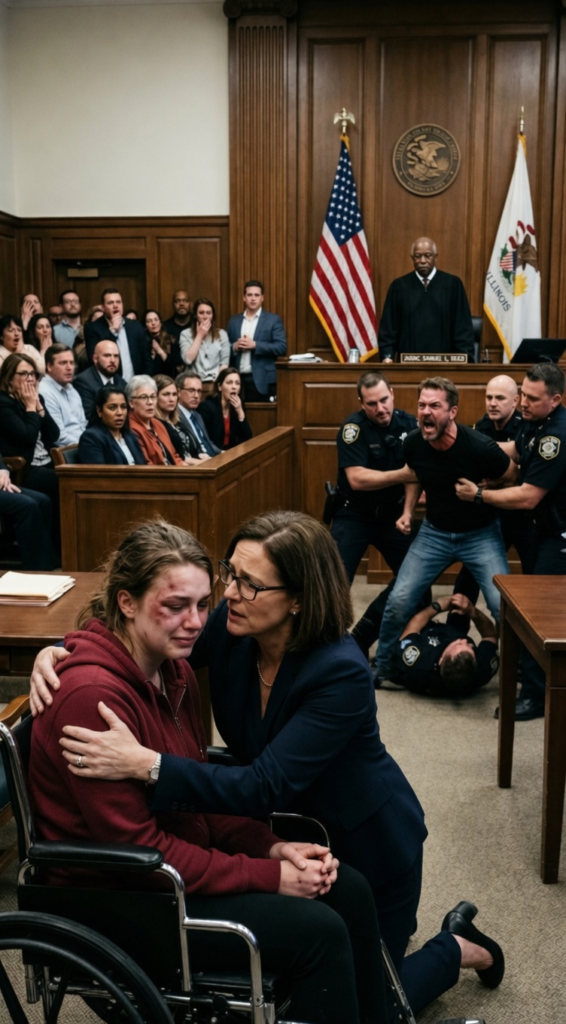
Elena was curled into a tight, trembling ball in the far corner of the room, wedged between the heavy oak wardrobe and the wall. Her face was a horrific, swollen, bloody mess. Her nose was visibly broken, and dark, angry purple bruises were already blooming across her cheekbones. She was shaking violently, terrified by the loud shouting and the sound of breaking wood downstairs.
“Elena!” I gasped, dropping to my knees on the thick carpet and sliding into the corner beside her.
I wrapped my arms tightly around her trembling body, pulling her close, burying my face in her hair.
“It’s over, El,” I whispered, my voice breaking. The adrenaline finally crashed, and for the first time in eight long, agonizing years, hot tears spilled over my cheeks. “The ghost is out of the system. We’re going home.”
6. The Unbroken Record
One year later.
The trial of Detective Richard Thorne was a massive, highly publicized national spectacle. The media devoured the story of the corrupt, high-ranking cop who had run a sophisticated criminal empire from the suburbs.
Faced with the overwhelming, irrefutable, and meticulously documented evidence contained within the Black Ledger—evidence that the FBI spent months verifying—Richard’s high-priced defense attorneys advised him to plead guilty to avoid the death penalty.
He was sentenced to life in a maximum-security federal penitentiary, entirely without the possibility of parole. He was stripped of his badge, his pension, and every shred of his dignity.
Margaret, whose claims of ignorance were completely destroyed by audio recordings I had secretly captured over the years detailing her active participation in hiding the stolen funds, received a twenty-five-year sentence for her complicity and accessory to attempted murder.
The sprawling Vance Estate in Fairfax was seized by the federal government under civil forfeiture laws and auctioned off. Through a complex civil suit I filed on Elena’s behalf, the millions of dollars generated from the sale, along with the recovered stolen assets from the offshore accounts, were placed into a massive, ironclad trust.
The trust fully funded Elena’s extensive, state-of-the-art reconstructive facial surgeries, her ongoing, intensive physical therapy for her nerve damage, and ensured she would never have to worry about financial security for the rest of her natural life.
We moved far away from Virginia. We bought a quiet, beautiful, sunlit house perched on a cliff overlooking the rugged, crashing coastline of the Pacific Northwest.
It was a crisp, clear Tuesday morning.
Elena was sitting on the expansive wooden porch, wrapped in a thick, comfortable sweater. Her face had healed beautifully, the scars barely visible. More importantly, her hands, while still carrying a slight tremor, were significantly steadier thanks to the advanced therapies she was receiving.
She was holding a paintbrush, carefully adding strokes of vibrant, cerulean blue to a watercolor painting of the ocean. She looked peaceful. She looked alive.
She wasn’t a broken doll. She was a magnificent, profound survivor.
I sat in a comfortable Adirondack chair beside her, a steaming mug of black coffee resting on the small table between us. I was reviewing a thick, highly classified case file on my encrypted tablet.
I wasn’t a ghost hiding in the courthouse archives anymore. Based on the extraordinary investigative work I had done to single-handedly build the RICO case against Richard Thorne, I had been recruited and hired as a Lead Investigator for the State Attorney General’s special anti-corruption task force.
I looked up from the tablet, watching the waves crash violently against the dark, jagged rocks below the house, transforming into brilliant white foam before receding back into the vast, deep ocean.
Richard had looked at my sister, trapped in a wheelchair, and seen a broken, useless girl whose words held absolutely no weight in his corrupt world.
He had looked at me, a quiet girl organizing dusty files in a basement, and seen a pathetic shadow he could easily ignore and eventually discard.
He, and my mother, were staggeringly, fatally arrogant.
They didn’t understand the fundamental truth of trauma. They didn’t understand that when you try to violently bury the truth, you don’t destroy it. You just force it underground. You force it to grow deep, powerful roots in the dark, gathering strength and waiting patiently for the absolute, perfect moment to tear the foundation of your entire life apart.
I smiled, taking a slow sip of my coffee, feeling the warm morning sun on my face.
I knew, with absolute, unshakeable certainty, that no monster would ever silence my family again.