At School, I Collapsed. Hit The Floor. I Couldn’t Move. My Teacher Said: “She’s Faking It.” Some Kids Laughed. Seconds Passed, No One Helped. Sirens Outside, A Paramedic Ran In. Dropped Beside Me, “She’s Not Responding.” He Looked Up At Her, “I’m Calling This In.” Her Face Went Pale.
Part 1
The first thing I remember after hitting the floor was the smell.
Not fear. Not panic. Not even pain.
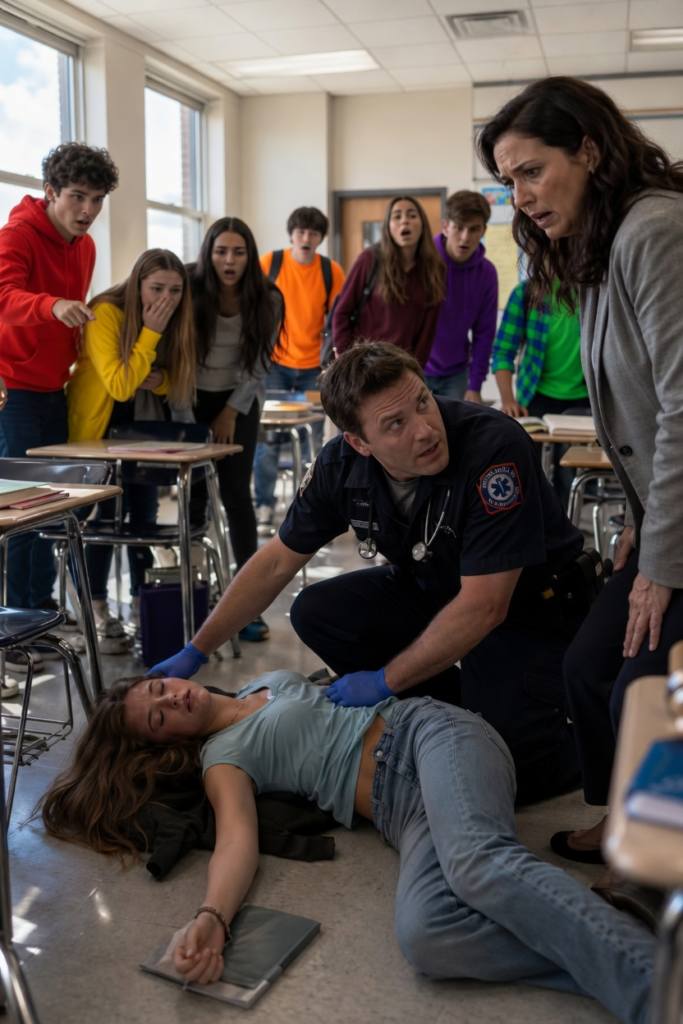
It was pencil shavings, old floor wax, and the sour lemon cleaner the janitors used every Friday but somehow never quite managed to rinse away. My cheek was pressed against the cold tile beside the third row of desks, and from where I lay, the classroom looked nothing like it did when I was sitting upright. Chair legs became black metal trees. Sneakers became faces. The underside of Maddie Holt’s desk had a wad of blue gum stuck to it, hard and dusty, with a strand of hair caught inside.
I noticed all of that because I couldn’t move.
Not my fingers. Not my mouth. Not even my eyes much, except for a slow, painful drift toward the bright strip of fluorescent light trembling above me.
Somewhere far above, Ms. Drennick sighed.
“She’s faking it.”
Her voice was flat, almost bored. Like I had dropped my pencil on purpose. Like I was trying to make the last twenty minutes of American History about me.
A few people laughed.
It was not the loud kind of laughter people admit to later. It was worse than that. Small, breathy, hidden behind sleeves. The kind that says everyone in the room knows it is cruel, but no one wants to be the first person to stop.
I wanted to say, I’m not. Please. Something is wrong.
But my tongue sat heavy behind my teeth, useless as wet cloth.
“Virelle,” Ms. Drennick said, closer now. I saw the pointed toe of one of her black heels stop beside my hand. “This is not going to work.”
My chest felt like someone had placed a cinder block on it, then slowly sat down. I tried to breathe deeper. The breath came in, but it did not reach far enough. It stopped somewhere high in my ribs and broke apart.
Behind me, Brandon whispered, “She does this all the time.”
I didn’t.
Not like this.
I had asked to go to the nurse before. I had put my head down more than once. I had stood up too fast and grabbed the edge of my desk while gray spots burst across my vision. I had told Ms. Drennick my hands were numb one morning, and she had said, “Then stop gripping your phone all night.”
After that, I learned to be quiet.
Quiet girls were easier. Quiet girls did not get notes sent home. Quiet girls did not make their mothers sigh at the kitchen table after double shifts and say, “Virelle, I need you to stop making trouble at school.”
So I had been quiet that morning too, at first.
I had sat through first period with my sweater pulled over my fingers because they felt like ice. I had swallowed the headache behind my eyes. I had stared at the clock during Ms. Drennick’s lecture on Cold War paranoia and tried to decide whether my heart was beating too slowly or too fast, because it kept changing its mind.
Then the room tilted.
I raised my hand.
Ms. Drennick kept talking.
I raised it higher.
Her eyes flicked toward me and away.
Finally I said, “Can I go to the nurse? I feel dizzy.”
She did not stop writing on the board.
“You felt dizzy yesterday.”
“I know, but—”
“Virelle.”
Just my name. Sharp. Warning.
The whole class heard it.
I sat back down.
Ten minutes later, I stood because she told us to pass forward our worksheets. My knees disappeared under me like trapdoors.
Now I was on the floor, listening to people decide what kind of girl I was.
A chair scraped.
“Should someone get help?” Lysa asked.
She sat two rows behind me and always smelled faintly like vanilla lotion. We had not really spoken except once, when she lent me a pen shaped like a cactus.
“She is conscious,” Ms. Drennick said. “She can hear us.”
Yes, I thought. Yes.
“Then why isn’t she moving?” Lysa asked.
There was a pause.
“Because she wants attention.”
The words went through me strangely. Not like a slap. Like a label being glued over my mouth.
My ears filled with ringing. I could still see shoes shifting around me. White Nikes. Brown boots. One red Converse with a broken lace.
Then the classroom door opened.
I heard a man’s voice, low and fast. “Where is she?”
The mood in the room changed before anyone said anything else. The air tightened. The laughter stopped as if someone had closed a drawer.
A pair of dark uniform pants appeared beside me. A bag hit the floor with a heavy thud. Someone dropped to their knees.
“Hey. Virelle? Can you hear me?”
His hand touched my shoulder. Firm. Warm.
I tried to blink.
Maybe I did. Maybe I only imagined it.
“She’s faking it,” Ms. Drennick said again, though this time her voice had an edge underneath it.
The paramedic did not answer her.
He checked my wrist. Then my neck. Then he leaned close enough that I could smell coffee on his breath and rain on his jacket.
“Virelle, try to squeeze my hand.”
I tried.
Nothing.
His fingers paused against my pulse.
For the first time, I heard something in the room that was not judgment.
Concern.
He looked up. Not at me.
At Ms. Drennick.
“How long has she been down?”
No one answered right away.
The fluorescent light buzzed above us. Somewhere outside the room, a locker slammed, normal life continuing like mine had not split open on the floor.
Ms. Drennick said, “A minute. Maybe two.”
Lysa’s voice came from behind him, small but clear.
“No. It’s been longer.”
The paramedic’s hand tightened slightly around my wrist.
“How much longer?”
Silence.
Then Lysa said, “At least five minutes.”
I could not see Ms. Drennick’s face, but I heard her heel shift backward on the tile.
The paramedic leaned over me again, his voice lower now.
“Stay with me.”
I was trying.
Then he reached for his radio.
And when he spoke into it, the classroom went so silent I could hear my own broken heartbeat stumble inside my chest.
Part 2
The radio crackled like static from another world.
“Unresponsive minor,” the paramedic said. “Irregular pulse. Possible cardiac involvement.”
Cardiac.
The word floated above me, too large to belong in a classroom with faded posters of presidents and a stack of missing homework slips clipped to the board.
Someone gasped.
Ms. Drennick said, “That’s not possible.”
I wanted to laugh, which was insane because I could barely breathe.
Not possible.
That was how adults talked when reality misbehaved in front of them. As if the body had to follow school policy. As if my heart needed permission to fail.
The paramedic ignored her.
Another responder came in, younger, with close-cropped hair and a silver watch that flashed under the lights. He crouched beside me and opened a black kit. I heard plastic tearing, Velcro ripping, the fast click of equipment being assembled.
“She reported symptoms?” he asked.
“She said she was dizzy,” the first paramedic replied.
“She says that all the time,” Ms. Drennick cut in.
A beat passed.
The younger paramedic looked at her. Not rudely. Not dramatically. Just looked.
Then he said, “That usually means someone should ask why.”
The room swallowed that sentence whole.
My chest tightened again, and this time it brought pain with it, a hot wire pulling from the center of me toward my left shoulder. My vision blinked dark at the edges.
The first paramedic noticed something.
“Pulse is dropping.”
“Dropping?” Ms. Drennick repeated.
She sounded different now. Less like a teacher. More like someone who had walked into the wrong room and found her name written on the wall.
A clip went onto my finger. A cuff wrapped around my arm. The pressure squeezed and released. Squeezed and released. The machine beeped, but not evenly. It stuttered.
Brandon muttered, “Oh my God.”
Nobody laughed at him.
I wanted to turn my head and look at Lysa. I wanted to thank her for saying something. I wanted to ask why one person speaking up felt bigger than all the people who had watched me fall.
Instead, I lay there while adults moved around me and my classmates learned, one by one, that a person could be wrong about someone and still have to watch what happened next.
“When did she ask to leave?” the second paramedic asked.
“About ten minutes before she collapsed,” Lysa said.
Ms. Drennick snapped, “You don’t know exactly.”
“I looked at the clock,” Lysa said.
That surprised me.
Even through the fog, that detail landed. She had looked at the clock. Why? Because she was annoyed? Because she was worried? Because she had seen something the rest of them hadn’t?
The first paramedic said, “What happened when she asked?”
No one answered.
That silence was different from the others. It had weight. It had memory.
I remembered it perfectly.
The chalky taste in my mouth. The heat behind my eyes. My own voice sounding thin when I said, “Please, I really don’t feel right.”
And Ms. Drennick saying, “Sit down. You’re disrupting class.”
Now the room remembered too.
“She told her no,” someone said.
It was Evan, I thought. He sat near the windows and never spoke unless called on.
Then another voice. “She said Virelle was being dramatic.”
“I didn’t say it like that,” Ms. Drennick said quickly.
There was a rustle behind me. Phones. I knew the sound because I had heard it a thousand times in hallways and cafeterias. Screens waking up. Cameras opening. Teenagers recording what adults hoped would disappear.
The first paramedic’s tone sharpened.
“I’m calling this in as delayed response from supervising adult.”
That did something to Ms. Drennick.
I could not see her clearly, but I saw her shoes stop moving. I heard the tiny inhale she tried to hide.
“Delayed response?” she said. “No. Absolutely not.”
The second paramedic placed an oxygen mask over my face. Cool air rushed in, smelling faintly of plastic and rubber. It helped, but not enough.
“She has unstable vitals,” he said. “We are not debating terminology.”
“I made a professional judgment.”
“Then it will be documented.”
Documented.
That word changed the room more than cardiac had.
Cardiac was about me.
Documented was about her.
The first paramedic leaned close again. “Virelle, can you hear me?”
I screamed yes in my head.
“Blink if you can.”
The light above me split in two. I fought for one tiny movement, one proof of myself. My eyelids trembled. Maybe they closed. Maybe they didn’t. I felt trapped inside my own skin, like I was banging on a locked window from underwater.
“She blinked,” Lysa said.
The first paramedic said, “Good. Good, Virelle. Stay with us.”
For a second, warmth moved through me. Not relief, exactly. More like grief. Because being believed should not have felt like being rescued from a burning house.
They prepared to move me.
The stretcher wheels rattled into the room, too loud against the tile. Desks had to be shoved aside. Someone knocked over a pencil case, and pens rolled across the floor like tiny bones. The smell of vanilla lotion passed near me.
Lysa.
“She told the truth,” she said.
I didn’t know if she meant me or herself.
Hands slid under me. My body shifted, and pain burst white behind my eyes. The monitor gave a frantic uneven beep.
“Careful,” the second paramedic said.
“I am,” the first answered.
Then, quietly, so quietly I almost missed it, Ms. Drennick said, “She can’t be that sick.”
The first paramedic looked at her.
His voice was calm.
“That’s what you already decided. That’s the problem.”
They lifted me.
As the ceiling tilted and the whole classroom spun slowly away, I saw Ms. Drennick’s face for the first time since I fell. Her lips were parted. Her skin looked gray under the fluorescent lights. But it was her eyes I remembered.
Not scared for me.
Scared of what I had become.
Evidence.
Part 3
The hallway lights passed over me in white bars.
One. Two. Three. Four.
Each one burned through my eyelids even when I tried to close them. The stretcher wheels rattled over a crack in the floor near the trophy case, and my body jolted. Pain flared again, sharp enough that a sound finally escaped me.
Not a word.
Just a broken breath.
“She vocalized,” the younger paramedic said.
“Good,” the first one replied. “Virelle, keep fighting.”
Keep fighting.
It sounded heroic when people said it later, but in the moment, fighting was not noble. It was ugly. It was counting the space between each heartbeat and wondering whether the next one would arrive. It was tasting metal under the oxygen mask. It was wanting my mom and also dreading the look on her face when someone told her she had almost believed everyone else over me.
The school nurse appeared near the front doors, pale and breathless, holding a clipboard against her chest.
“I wasn’t called,” she said.
The words sliced through everything.
The first paramedic slowed for half a second. “You weren’t called?”
“No. I heard the radio dispatch from the front office and came down.”
Behind us, someone said, “Oh.”
A staff member, maybe an aide. Maybe Mr. Larkin from math. I couldn’t tell. My vision kept smearing.
But I heard the paramedic’s reply.
“Add that to the timeline.”
Timeline.
There it was again. A word that meant minutes had become evidence. Ten minutes since I asked. Five or more on the floor. No nurse called. No assessment done. No one kneeling beside me until strangers arrived with a bag and a radio.
The glass front doors opened, and cold air hit my face. It had rained that morning. The sidewalk smelled wet, like mud and gasoline and old leaves crushed under tires. For one wild second, the air felt so good I thought I might be okay.
Then my heart stumbled.
The monitor changed its sound.
The paramedics moved faster.
The ambulance ceiling was lower than I expected. There were cabinets with clear doors, straps hanging from the walls, a smell of antiseptic so strong it covered almost everything else. Almost. Under it, I smelled rubber gloves and someone’s peppermint gum.
The doors slammed shut.
Sirens started.
After that, time came apart.
I remember the first paramedic asking my age.
Seventeen, I thought.
My mouth did not move.
I remember someone saying, “Pressure’s not where I want it.”
I remember the road vibrating through the stretcher.
I remember thinking about the worksheet still on my desk, half-finished. The question had asked: What happens when fear becomes policy?
I would have laughed if I could.
Then the ambulance tilted around a corner, and everything disappeared.
When I woke up, the room was dim.
Not dark. Hospitals never let you have real darkness. There was always a machine light, a line under the door, a tiny green blink from something watching your body work.
My first clear thought was that my hand hurt.
There was an IV taped there. The tape pulled at my skin when I moved. My fingers twitched, and I stared at them like they belonged to someone else. Thin. Pale. Alive.
“Virelle?”
My mother’s voice cracked on my name.
She was in the chair beside the bed, wearing her blue grocery store polo under a gray cardigan. Her hair was still in the tight bun she wore for work, but pieces had come loose around her face. She looked older than she had that morning.
She reached for me, then stopped, like she was afraid touching me might break something.
“Mom,” I whispered.
The word came out rough and tiny.
She covered her mouth.
“Oh, baby.”
I wanted to cry, but crying took energy I did not have.
A doctor came in not long after. Tall, kind-eyed, with a tablet in one hand and a pen tucked behind his ear. He explained things slowly, carefully, as if setting heavy objects down one at a time.
Cardiac rhythm disturbance.
Underlying condition.
Warning symptoms.
Possible weeks of progression.
Stress and dehydration may have worsened it, but did not cause it.
Delayed intervention increased risk.
That last part made my mother close her eyes.
“How delayed?” she asked.
The doctor hesitated.
That hesitation told me more than the answer.
“We’re still reviewing the emergency report,” he said. “But based on what we received, she was symptomatic before collapse and was down for several minutes before appropriate medical action was taken.”
My mother’s face changed.
I had seen her tired. Angry. Worried about bills. Worried about rent. Worried about my younger brother’s asthma inhaler running out before payday.
But I had never seen this.
This was the look of someone realizing the world had put her child in danger and then spoken calmly while doing it.
“She asked for help?” Mom said.
The doctor looked at me.
I nodded once.
My mother turned away.
Her shoulders shook, but she did not make a sound.
Later, when she thought I was sleeping, I heard her in the hallway. Her voice was low, controlled, the way it got when she was angrier than yelling.
“My daughter told an adult she felt dizzy. She collapsed in that adult’s classroom. And no one called the nurse?”
Another voice answered. The principal, I realized. Mr. Vale. Smooth, careful, full of words like unfortunate and concerning and gathering information.
Then my mother said something I had never heard her say to anyone before.
“No. You are not going to soften this.”
I opened my eyes.
The room was blurry. The IV tugged at my hand. My heart monitor beeped steadily beside me, like a small machine insisting I was still here.
On the rolling table near my bed, my phone buzzed.
Once.
Twice.
Then again and again.
I turned my head slowly.
The screen lit up with notifications.
Messages.
Videos.
My name.
And one text from an unknown number that made my stomach drop before I even opened it.
You need to know what she said after they took you out.
Part 4
I did not open the message right away.
I stared at it until the screen went dark, then watched my reflection appear in the glass. My face looked wrong. Smaller. Colorless. My hair was flattened on one side, and there was a red mark across my cheek from where I had been pressed against the classroom floor.
You need to know what she said after they took you out.
There are sentences that feel like doors.
You understand, before touching the handle, that whatever is on the other side will not let you be the same person again.
My mother came back into the room carrying a paper cup of coffee she hadn’t drunk. She took one look at my face and set it down.
“What happened?”
I swallowed.
“My phone.”
She picked it up from the table, glanced at the notification, and her mouth tightened.
“Do you know this number?”
I shook my head.
“Do you want me to open it?”
That question almost undid me.
Not because it was dramatic. Because she asked.
All day, people had decided what I meant, what I wanted, what was real. My mother, who had once told me to stop making trouble because she was exhausted and scared and human, stood beside my hospital bed and handed the choice back to me.
“Yes,” I whispered.
She opened it.
There was a video attached.
The thumbnail showed the classroom after I was gone. Desks pushed crooked. A pencil case spilled open. Ms. Drennick standing near the board with one hand pressed to her forehead.
My mother looked at me again.
I nodded.
She pressed play.
The video shook at first. Whoever recorded it had their phone low, half-hidden. Students were talking over each other.
Then Ms. Drennick’s voice cut through.
“Phones away. Now.”
No one moved.
“I said phones away.”
Lysa’s voice answered, “You called her a faker.”
“I responded based on months of behavior,” Ms. Drennick snapped. “You children have no idea what manipulation looks like.”
The word children sounded almost funny, considering they were the only ones who had told the truth.
Someone said, “She couldn’t move.”
Ms. Drennick’s face hardened.
“She has trained all of you very well.”
My mother inhaled.
On the video, Ms. Drennick went to her desk and grabbed a stack of papers with shaking hands. She tried to straighten them, but they slipped sideways.
Then she said it.
“She and her mother have been looking for a reason to make this school responsible for something.”
The room in the video erupted.
“What?”
“That’s messed up.”
“She literally almost died.”
Ms. Drennick said, “Enough.”
But it wasn’t enough.
Not anymore.
The video ended there.
My mother stood very still.
The coffee sat untouched beside the bed, a thin curl of steam rising from the little plastic lid.
I waited for her to say something about lawyers. Or the school. Or Ms. Drennick. Instead, she sat down beside me and took my hand carefully, avoiding the IV tape.
“Virelle,” she said, “I owe you an apology.”
My throat closed.
“No, Mom—”
“Yes.”
Her voice broke on the word, but she kept going.
“You told me you weren’t feeling right. More than once. I thought…” She wiped under one eye quickly, angry at the tear. “I thought you were overwhelmed. I thought maybe school was hard and you didn’t know how to say that. I let them make me doubt you.”
I looked at our hands.
Hers were rough from work, nails short, one small burn mark near her thumb from the bakery oven at the grocery store. I knew those hands better than my own.
“I didn’t know how to prove it,” I said.
“You should not have had to prove pain.”
That sentence stayed with me longer than any diagnosis.
By the next afternoon, the story had spread through school in the ugly, unstoppable way stories do. There were clips. Not just one. Three, then five, then more. The first clip showed me asking to go to the nurse. I did not know anyone had recorded that part. In it, my voice sounded small, embarrassed.
“Can I please go? I feel really dizzy.”
Ms. Drennick did not even turn around.
“Sit down.”
The second clip started after I fell. People were laughing. Someone said, “She’s so extra.” Then Ms. Drennick, clear as glass:
“She’s faking it.”
The third clip showed the paramedic saying, “Delayed response from supervising adult.”
That one spread fastest.
The school sent an email to parents that evening.
My mother read it aloud in the hospital room with a voice so dry it could have sanded wood.
An incident occurred involving a student medical emergency.
Appropriate procedures are being reviewed.
The safety of our students remains our top priority.
She stopped reading and laughed once. Not because it was funny.
“They don’t even say your name.”
“I don’t want them to.”
“That’s not the point.”
I understood what she meant, but part of me wanted to vanish. It is strange to almost die and still feel embarrassed about taking up space.
Then my phone buzzed again.
This time it was Lysa.
I got your number from Evan. Sorry if that’s weird. I just wanted to say I’m sorry I didn’t speak up sooner.
I stared at the message.
Then another came in.
Also, there’s something else. Ms. Drennick had a meeting about you last month. I heard part of it because I was waiting outside the office. I didn’t understand it then.
My pulse quickened, and the monitor beside me answered with a sharper beep.
My mother looked at the screen.
“What meeting?”
I typed with one shaking thumb.
What did you hear?
The reply came a few seconds later.
Your name. Her voice. And something about making sure your “pattern” was documented before your transfer request went through.
Transfer request?
I had never filed one.
And judging by my mother’s face, neither had she.
Part 5
The next morning, I woke to the sound of rain ticking against the hospital window.
For a few seconds, I forgot where I was. Then the tape pulled at my hand, the monitor beeped, and memory returned in pieces: tile against my cheek, oxygen plastic over my mouth, Ms. Drennick’s voice saying manipulation like she was teaching vocabulary.
My mother was already awake, sitting by the window with her phone in both hands. She looked like she had not slept.
“Mom?”
She turned too fast. “I’m here.”
“What’s wrong?”
Her face did that adult thing where emotions rearranged themselves behind the eyes before being allowed out.
“I checked your school portal.”
I waited.
“There’s a form in there,” she said. “A transfer consideration form.”
The rain tapped harder.
“I didn’t fill that out.”
“I know.”
She came to the bed and handed me the phone.
The portal screen was too bright, so I squinted. There it was under Student Services: Academic Environment Transfer Review. Submitted three weeks earlier.
Reason: repeated classroom disruptions, avoidance behaviors, suspected attention-seeking episodes, difficulty complying with redirection.
My mouth went dry.
At the bottom, under parent contact, there was a note.
Mother verbally agrees student may benefit from alternative placement.
My mother’s name was there.
Not signed. Typed.
Her face had gone rigid.
“I never agreed to that.”
The hospital room seemed to shrink.
I read the note again, slower, as if the words might change if I gave them a chance to be less awful.
Mother verbally agrees.
No.
My mother was tired, yes. She missed calls sometimes because she worked double shifts. She forgot permission slips. She bought off-brand cereal and apologized like it was a failure. But she did not hand me away.
“She lied,” I said.
My voice sounded strange. Not shocked. Flat.
My mother took the phone back as if she wanted to crush it.
“She put my name on something I never saw.”
A nurse came in then, cheerful until she saw our faces. She checked the monitor, asked about pain, adjusted the blanket around my feet. I answered automatically. Yes. No. A little. Thank you.
But inside, something was forming.
Not fear this time.
Shape.
For months, everyone had treated my symptoms like fog. Hard to prove. Easy to wave away. But this form was different. It had dates. Words. A record. Someone had been building a version of me on paper while I was still trying to understand what was happening inside my own body.
When the nurse left, my mother called the principal.
She put him on speaker.
Mr. Vale’s voice came through smooth and cautious. “Mrs. Marrin, I understand this is an emotional time.”
“My daughter is in a hospital bed,” my mother said. “Do not call this emotional like that makes it less factual.”
A pause.
“I apologize.”
“Who submitted a transfer consideration form for Virelle?”
Another pause. Longer.
“I would need to review that.”
“Review it now.”
I had never heard my mother speak like that. It scared me a little. It also made me feel safer than I had felt in months.
Keyboard clicking came faintly through the phone.
Mr. Vale cleared his throat. “It appears the form was initiated by Ms. Drennick and routed through Student Support.”
“With my consent listed.”
“I see that note.”
“I did not give consent.”
Silence.
“Mr. Vale,” my mother said, “why was a teacher trying to transfer my daughter out of her class?”
He answered too quickly.
“These forms are sometimes used when a student may benefit from a different learning environment.”
“My daughter asked to see the nurse because she was dizzy. She collapsed. Your teacher called her a faker. Now I find out that same teacher was documenting her as a problem before this happened.”
“I cannot discuss personnel matters.”
“Then discuss my child.”
He had no good answer.
After the call, my mother stood by the window, breathing through her nose. Rain blurred the parking lot outside. Cars crawled through puddles. Somewhere down the hall, a baby cried and was soothed.
“I should have pulled you out,” she said quietly.
“You didn’t know.”
“You told me.”
I had no answer for that.
Because she was right.
I had told her.
But I also knew what had happened each time. I would complain about dizziness. She would ask if I had eaten. I would say yes, even if breakfast had been a granola bar found at the bottom of my bag. She would ask if I was anxious. I would say maybe. She would say, “Try to get through today, baby. I can’t leave work unless it’s serious.”
Unless it’s serious.
How were we supposed to know when serious looked like headaches and cold fingers?
The cardiologist came by later and explained the next steps. More tests. Medication. A monitor I might need to wear for a while. No gym class. No caffeine. No ignoring symptoms.
That last one made him look over his glasses at both of us.
“Symptoms are information,” he said. “They are not personality flaws.”
I almost cried again.
By evening, the school district had called my mother. Then a woman from risk management. Then someone from Student Services who sounded terrified and kept saying, “We’re gathering facts.”
Facts were suddenly very popular.
At 8:17 p.m., Lysa sent another message.
I found someone who knows about the meeting.
Then:
It’s worse than I thought.
A minute later, a photo came through.
It was blurry, taken from an angle, probably quickly. A printed page on a desk. I zoomed in until the letters sharpened enough to read.
Behavioral Episodes – Marrin, Virelle
Under it were dates. More than I expected.
Beside three of them were notes in Ms. Drennick’s handwriting.
Claims dizziness.
Claims chest tightness.
Requests nurse during instruction.
Possible escalation if accommodated.
My fingers went cold again, but this time it had nothing to do with my heart.
Possible escalation if accommodated.
I read it twice before I understood.
She had not ignored my symptoms because she missed them.
She had ignored them because she believed helping me would encourage me.
And that meant the worst part was not what happened the day I collapsed.
The worst part was that she had prepared for it.
Part 6
I left the hospital with a paper bracelet still around my wrist and a heart monitor taped beneath my shirt.
The April air felt too bright. Too open. My mother drove slowly, both hands tight on the wheel, checking me every few seconds like I might disappear between traffic lights. I sat in the passenger seat with discharge papers in my lap and watched the town move past as if nothing had happened.
Same donut shop with the flickering sign.
Same laundromat window full of spinning colors.
Same high school billboard announcing Spring Arts Night like the building had not become the place where my body gave out while people laughed.
I was not ready to go home, but I was more not ready to go back.
Home meant questions from my little brother, Milo, who met us at the door wearing dinosaur pajamas even though it was four in the afternoon. He hugged me carefully around the waist.
“Mom said your heart got confused,” he whispered.
I looked over his head at Mom.
She gave me a helpless little shrug.
“That’s actually pretty close,” I said.
Milo nodded seriously. “Mine gets confused when I run too fast.”
“Then we both need better hearts.”
He thought about that, then said, “Or better instructions.”
Out of everyone, he came closest to the truth.
For three days, I stayed home.
The school sent assignments through the portal. Teachers sent careful emails full of concern and flexibility. Ms. Drennick sent nothing. Her name disappeared from my schedule, replaced by TBA.
Online, the videos kept moving.
People edited them badly, added dramatic music, captions, slow zooms on Ms. Drennick’s face. Strangers argued in comment sections about whether teenagers exaggerated illness, whether teachers were overworked, whether parents were sue-happy, whether girls were believed less when they said they were in pain.
I learned quickly not to read too much.
But sometimes I did anyway.
One comment stayed with me.
She looks awake. Why didn’t she just say something?
I stared at it until my vision blurred.
Because sometimes the prison is your own body, I wanted to type. Because consciousness is not control. Because being trapped and being dramatic are not the same thing.
I did not type anything.
My mother found me crying at the kitchen table that night with my phone face-down beside me.
She did not ask what I had read. She just sat across from me and pushed a mug of tea toward my hands. Peppermint. Too hot. The steam warmed my face.
“I spoke to an attorney,” she said.
I looked up.
She lifted a hand. “Before you panic, we’re not doing anything without talking to you. But I needed to know what our rights are.”
Our rights.
Another phrase I had never thought belonged to us.
People like us usually had responsibilities. Bills. Apologies. Late fees. Forms filled out in black ink. Rights sounded like something you needed time and money to have.
“What did they say?”
“That the school’s records matter. The videos matter. The paramedic’s report matters. And those notes…” Her jaw tightened. “Those notes matter a lot.”
The notes.
Possible escalation if accommodated.
The phrase had burrowed under my skin.
“What if they say she was just following policy?” I asked.
“Then the policy is sick.”
The next Monday, Mr. Vale asked if we could meet.
Not by phone. In person.
My mother said no at first. Then I said yes.
She stared at me like I had suggested walking into traffic.
“I want to hear what they say when they have to look at me,” I told her.
So we went.
The school looked smaller when I walked in through the front doors. Or maybe I had changed size inside myself. The security guard, who usually barely glanced up, stood when he saw me.
“Good to see you, Virelle,” he said softly.
I nodded.
The office smelled like printer toner and microwaved soup. A vase of fake tulips sat on the counter. Behind it, the secretary avoided my eyes.
Mr. Vale met us in the conference room with two other people: a district representative named Ms. Halloway, and a man from Student Services who kept clicking his pen until my mother looked at his hand and he stopped.
They offered water.
No one drank it.
Mr. Vale began with, “First, we are deeply relieved Virelle is recovering.”
My mother said, “Start with the form.”
He blinked.
“I’m sorry?”
“The transfer form. Start there.”
Ms. Halloway folded her hands. “We are still determining how that documentation was generated.”
“By Ms. Drennick,” I said.
Everyone looked at me.
My voice shook, but it worked. That alone felt like a miracle.
“She wrote I was escalating when accommodated. She wrote that I claimed symptoms. She wrote that helping me would make it worse.”
The Student Services man leaned forward. “Those notes were part of an informal classroom observation log, not a medical determination.”
“Exactly,” my mother said. “She had no right to make one.”
Ms. Halloway’s smile tightened.
“We understand the concern.”
“No,” I said.
The word surprised even me.
The room went still.
“You understand liability,” I said. “Not concern.”
My mother’s hand moved under the table and found mine.
I kept going.
“I asked for help. More than once. She decided I was lying before I hit the floor. Then when I hit the floor, she used the version of me she had written down to explain why she didn’t have to move.”
No one interrupted.
The air conditioner hummed overhead. A clock ticked too loudly on the wall. Through the blinds, I could see students crossing the courtyard, laughing with backpacks slung over one shoulder, free in the careless way I used to be.
Mr. Vale looked tired.
“Ms. Drennick is no longer teaching classes pending the outcome of the investigation.”
“Pending,” my mother repeated.
“Yes.”
“What outcome are you hoping for?” she asked.
He did not answer.
Ms. Halloway slid a folder across the table.
“We want to discuss support options for Virelle’s return.”
Inside were printed pages: counseling services, medical accommodation forms, an emergency action plan, permission to leave class if symptomatic, staff training review.
All good things.
All late.
I looked at the forms and felt nothing at first. Then anger, slow and clean.
“Will she apologize?” I asked.
The question landed strangely. Like no one had prepared for it.
Mr. Vale said, “That may not be advisable during an active review.”
Of course.
Apologies were risky when they had consequences.
I pushed the folder back.
“I don’t need her apology.”
My mother glanced at me.
I meant it.
In that moment, I understood something with a calmness that frightened me. There are apologies people want because they still hope the person who hurt them will become someone else. But I did not want Ms. Drennick to become kind in front of me. I did not want her tears. I did not want her explanation.
I wanted distance.
I wanted truth.
I wanted never again to hand her the power to decide whether my pain counted.
As we left the conference room, a door down the hall opened.
Ms. Drennick stepped out.
She froze when she saw me.
For one second, all the adults vanished from my awareness. It was just her and me in the narrow administrative hallway, beside a bulletin board covered in college flyers.
She looked smaller without a classroom around her.
“Virelle,” she said.
My mother moved slightly in front of me.
Ms. Drennick’s eyes flicked toward the heart monitor under my shirt, then back to my face.
“I heard you’re recovering.”
Her voice was soft.
Practiced.
I waited.
She swallowed.
“I hope you understand I had no way of knowing—”
I laughed.
It came out quiet and ugly.
And for the first time since I had woken up in the hospital, Ms. Drennick looked truly afraid.
Part 7
I did not yell at her.
That seemed to disappoint Ms. Drennick more than anything.
People like her knew what to do with hysterical girls. They could lower their voices, offer tissues, look wounded, say, “This is exactly what I mean.” They could turn emotion into evidence against you.
So I gave her none.
I stood in that hallway with my mother beside me and the district representative behind us, and I looked at the woman who had watched me lie on the floor.
“You had ways of knowing,” I said.
Ms. Drennick’s lips parted.
I kept my voice steady.
“I told you.”
The hallway went very quiet.
A classroom door clicked shut somewhere nearby. From the cafeteria came the faint crash of trays and laughter. Normal sounds. A normal school day. That almost made it worse.
Ms. Drennick’s face tightened.
“You have to understand, Virelle, there had been a pattern.”
There it was.
The word she loved most.
Pattern.
I had become a pattern before I was allowed to be a person.
“My symptoms were the pattern,” I said.
Her eyes shifted.
Not to my mother. Not to Mr. Vale. To Ms. Halloway, the district woman. Measuring. Calculating. Checking how much she could safely say.
“I followed my professional judgment,” she said.
“No,” my mother said. “You followed your bias.”
Ms. Drennick flinched as if the word had touched her skin.
“I cared about Virelle’s education.”
That almost broke my calm.
Because it was such an elegant sentence. So clean. So impossible to disprove if you had not been the girl under her stare every day. The girl raising her hand and shrinking before she even spoke. The girl learning that pain became suspicious when it interrupted a lesson plan.
“My education?” I said. “You tried to transfer me out.”
Her face changed.
Just a flicker, but I caught it.
So did Ms. Halloway.
“Virelle,” Mr. Vale said carefully, “we should continue this conversation—”
“No,” I said. “I’m done continuing conversations where adults say careful things until the truth gets tired.”
My mother squeezed my hand once.
Ms. Drennick’s eyes shone suddenly.
“I am sorry you were frightened.”
Not sorry I called you a faker.
Not sorry I left you on the floor.
Not sorry I wrote you into a file like a problem to be removed.
Sorry you were frightened.
It was the kind of apology that locked the door while pretending to open it.
I looked at her and felt something inside me settle.
“I don’t forgive you,” I said.
The sentence was not loud. It did not echo. It did not make anyone gasp.
But Ms. Drennick went pale.
“I’m a teacher,” she whispered, as if that alone should have protected her.
“You were my teacher,” I said. “That’s why it mattered.”
Then I walked away.
My knees trembled by the time we reached the car, and I hated that. I hated that my body still told the truth even when I wanted to look strong.
My mother waited until we were both inside with the doors closed.
Then she said, “I am so proud of you.”
I stared through the windshield at the rain starting again, fine drops gathering on the glass.
“I thought I’d feel better.”
“You might not for a while.”
“I thought saying it would fix something.”
“Maybe it did,” she said. “Just not the part that hurts.”
She was right.
The investigation moved faster after that hallway exchange. Or maybe I only noticed it more. Students gave statements. The nurse confirmed she had not been called. The paramedics submitted their report. The videos were reviewed. The transfer form became a bigger problem than the school expected, especially when Student Services admitted my mother had never been contacted.
Ms. Drennick resigned before the district finished.
That was the word used in the email.
Resigned.
Not fired. Not removed. Not held accountable in language anyone could screenshot and feel satisfied by.
Just resigned.
For one full day, I was furious.
Then Lysa came over after school with a plastic container of cookies her dad had made. They were burnt around the edges and too salty, and we ate five anyway while sitting on my porch steps in hoodies.
“I wanted her fired,” Lysa said.
“Me too.”
“Resigned sounds like she chose a peaceful retirement.”
“She’s thirty-eight.”
“Exactly. Dramatic.”
I laughed for real for the first time in weeks.
Lysa looked relieved.
After a while, she said, “People keep asking me what really happened.”
“What do you say?”
“That you fell. She didn’t help. The paramedics did. Everything else is just adults trying to make that sound complicated.”
I watched a car pass slowly through the wet street, tires whispering on asphalt.
“Why did you speak up?” I asked.
She picked at a burnt edge of cookie.
“My little brother has seizures,” she said. “Not the movie kind. Sometimes he just freezes. People think he’s ignoring them. Once a substitute teacher snapped in his face.”
I looked at her.
She shrugged, but her eyes were wet.
“When you were on the floor, everyone was waiting for someone important to decide it was real. I guess I got tired of waiting.”
The porch light hummed above us. Across the street, someone’s dog barked at nothing.
“Thank you,” I said.
She nodded once.
“Next time, we don’t wait.”
There should not have been a next time.
But life is not clean like that.
Two weeks later, back at school part-time, I was sitting in English when a freshman girl I barely knew raised her hand and asked to go to the nurse. She looked embarrassed. Her face was shiny with sweat.
The substitute teacher said, “Of course.”
No hesitation.
No sigh.
No public trial.
The girl stood, wobbled slightly, and three people moved at once to help her.
I felt my heart beat under the monitor patches.
Steady.
Strong enough.
And for the first time, I understood that surviving was not the whole ending.
Sometimes the ending was walking back into the place that failed you and watching it fail someone else less.
Part 8
By the last week of school, my story had become something people lowered their voices around.
Not because it was secret. Everyone knew. But because some stories grow teeth after they are told enough times, and people become careful not to put their fingers too close.
The classroom where I collapsed had a new teacher.
Her name was Ms. Alvarez. She wore bright scarves, kept peppermints in a jar on her desk, and had a voice that made even instructions sound like invitations. On my first day in her room, she met me at the door instead of waiting behind the desk.
“You sit wherever you’re comfortable,” she said. “And if you need to leave, you leave. No performance required.”
No performance required.
I almost cried right there between the recycling bin and the pencil sharpener.
I chose a seat near the window, not my old one. The old desk was still in the third row. Same scratched surface, same little triangle carved into the corner. For weeks, I thought I would need to sit there to prove something.
But healing, I discovered, was not always returning to the exact spot where you were hurt.
Sometimes it was choosing a different chair because you could.
The heart monitor came off in June.
The medication stayed. So did the checkups, the water bottle I carried everywhere, and the habit of noticing my pulse when rooms got too hot. My cardiologist said I was improving. He also said bodies remember fear, and I should be patient with mine.
I tried.
Some days were easy.
Some days a fluorescent light buzzed in a grocery store and my knees went soft.
Some days someone said “dramatic” jokingly and my whole body tightened before my brain caught up.
Some days I felt angry at everyone: Ms. Drennick, the school, my mother, myself, even the classmates who had apologized. Anger was easier than fear. It had edges. You could hold it like a tool.
But I did not want to build a house there.
My mother and I started walking after dinner. Slowly at first, just to the corner and back. Milo came sometimes, riding his scooter in loops around us, shouting updates about cracks in the sidewalk like he was reporting breaking news.
On one of those walks, my mother said, “I still hear you saying you didn’t feel good.”
I looked at her.
The sky was pink over the rooftops, and someone nearby was grilling onions. The smell made the whole block feel warmer.
“I hear myself not listening right,” she said.
I kicked a pebble into the gutter.
“You listened eventually.”
“Too late.”
I thought about Ms. Drennick in the hallway, offering me that careful little almost-apology. I thought about how badly people want forgiveness when consequences arrive. How they reach for it like a receipt that proves the debt is paid.
My mother was not doing that.
She did not ask me to tell her it was okay.
That was why, after a long silence, I said, “I forgive you.”
She stopped walking.
Milo nearly crashed into her ankles.
“Mom?”
She covered her face with one hand.
I added quickly, “That doesn’t mean it didn’t hurt.”
“I know.”
“And it doesn’t mean I’m pretending it’s gone.”
“I know.”
“And if I tell you something is wrong again—”
“I will believe you first,” she said. “Questions after. Belief first.”
That was enough.
Not perfect. Enough.
The school board meeting happened in July.
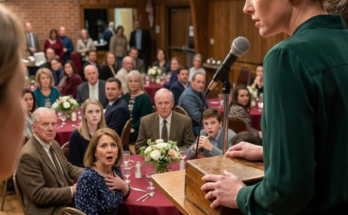
I did not want to go, but I went anyway. Not because I was brave. I was not. My hands shook so badly I had to hold my statement with both of them. Lysa sat behind me with her dad. My mother sat beside me. Milo stayed home with our neighbor because he thought school board meetings were “where joy goes to get erased,” and honestly, he was not wrong.
When they called my name, the room turned toward me.
I walked to the microphone.
It smelled like dust and old coffee. The speakers made a soft electric hiss.
I had written three pages.
I only read one.
“My name is Virelle Marrin,” I began. “In April, I collapsed in class after asking for medical help. My teacher said I was faking it. I was not.”
My voice trembled, then steadied.
“I am not here to ask for sympathy. I am here because what happened to me was not one bad moment. It was a series of decisions. A decision to label me. A decision to doubt me. A decision to treat symptoms as behavior. A decision to wait.”
The board members watched me with careful faces.
I kept going.
“Children should not have to prove they are worth checking on. A student asking for the nurse should not become a character test. If you are afraid some students may abuse the system, make a better system. Do not gamble with our bodies.”
Someone behind me sniffed.
I looked down at my paper, then back up.
“I survived. That does not make what happened less serious. It means there is still time to make sure the next student does not have to.”
When I sat down, my legs felt hollow.
Then Lysa’s dad started clapping.
One person.
Then Lysa.
Then my mother.
Then half the room.
Not everyone. Never everyone.
But enough.
By fall, the district had a new medical response policy. Teachers could not deny nurse access for reported chest pain, dizziness, faintness, shortness of breath, or neurological symptoms. Every classroom had emergency procedure cards posted by the door. Staff had training before the first day of school.
Ms. Drennick did not return.
I heard rumors. That she moved counties. That she was suing. That she was “taking time away from education.” I did not chase the truth. Her life had already taken too much room in mine.
On the first day of senior year, I walked into school with Lysa beside me and Milo’s ridiculous handmade bracelet on my wrist. It had plastic beads spelling HEART BOSS, because he said I needed a title.
The halls smelled like floor polish and perfume and new notebooks. Lockers slammed. Sneakers squeaked. Somewhere, a teacher laughed.
I paused outside Ms. Alvarez’s room.
The third-row desk was gone.
In its place was a small table with a jar of peppermints, a stack of hall passes, and a laminated sign.
If you feel unwell, tell me. I will believe you.
I stood there longer than I meant to.
Lysa nudged me gently. “You okay?”
I listened to my heart.
Steady.
Not perfect. Not fearless. But mine.
“Yeah,” I said. “I’m okay.”
And this time, when I walked into the classroom, nobody had to decide whether I was telling the truth.
I already knew I was.
THE END!