The first time my mother reached out after four years, she wrote as if the silence between us had been a small misunderstanding.
Not a wound.
Not a choice.
Not a sentence she had typed in a family group chat and allowed everyone else to accept.
Her message arrived on a Thursday afternoon while I stood in the kitchen of our farmhouse, waiting for biscuits to cool.
Lily was at the table, practicing spelling words with her tongue pressed to the corner of her mouth.
Outside the window, Marcus was fixing a fence line in the pasture, his old baseball cap pulled low as the late Virginia sun stretched long shadows across the grass.
My phone buzzed on the counter.
When I saw my mother’s name, my whole body went still.
For four years, there had been nothing.
No birthday call.
No holiday card.
No message when Lily’s adoption became final.
No note when my name appeared in the local paper for a reading initiative our school had built from scratch.
Then suddenly, there she was.
Hello, Ingrid.
I hope you are well.
I thought it might be nice to have lunch soon.
Your father and I would love to catch up.
It was so graceful it almost looked harmless.
That was my mother’s gift.
She could make cruelty look like etiquette if the lighting was right.
I read the message twice.
Then a third time.
Behind me, Lily stumbled over the word “necessary,” erased too hard, and let out a frustrated breath.
Outside, Marcus straightened from the fence and rolled his shoulders before bending back to the work.
My life was warm.
Real.
Quiet in the best ways.
But one polished little message had pulled an old room back around me.
My mother had always loved appearances.
She loved crystal glasses lined in perfect rows before guests arrived.
She loved candles that smelled expensive, holiday cards with coordinated outfits, and napkins embroidered with initials no one actually used.
She loved introducing her children like she was unveiling achievements she owned.
My sister, the surgeon.
My brother, the attorney.
She would say their titles before their names sometimes, as if the titles were the truest part.
Then she would turn to me.
And this is Ingrid.
That pause always told the rest.
I taught fourth grade at a public school tucked beyond winding roads, horse farms, soybean fields, and white churches with steep roofs and gravel parking lots.
I drove an aging Honda with a cracked cup holder.
I kept extra granola bars in my desk for children who arrived hungry but tried to pretend they were not.
I bought classroom books with my own money and spent Sunday nights cutting laminated vocabulary cards at the kitchen table.
I loved my work.
I loved watching a child’s face change when a sentence finally made sense.
I loved the little notes left on my desk in crooked handwriting.
I loved the stubborn, sacred labor of helping children believe they were not finished becoming.
My mother saw none of that.
To her, teaching was what people did when they lacked better options.
She never said it exactly that way in the beginning.
Her contempt came dressed in softer clothes.
At Thanksgiving one year, she placed my seat at the side table with
the toddlers while the main table glittered with china and stemware.
“At least you will have cheerful company,” she said, touching my shoulder as if she had rescued me from loneliness.
My sister looked down at her plate.
My brother checked his phone.
My father pretended to adjust the thermostat.
I sat with the children, cut their turkey, laughed when cranberry sauce fell on the floor, and told myself it was not worth making a scene.
Another time, my mother forgot my graduate ceremony entirely.
She sent a text two days later.
Hope it went well.
Proud you found something you enjoy.
I stared at those words in my cap and gown photos afterward, trying to decide whether they hurt more because they sounded kind from a distance.
Still, I kept showing up.
That is the part people miss when they judge someone for finally walking away.
They do not see the years before it.
They do not see the casseroles carried through doors where you never felt wanted, the birthday cards mailed to people who would not remember yours, the jokes swallowed, the insults softened in your own mind because you needed another explanation.
Maybe she is tired.
Maybe she does not realize how it sounds.
Maybe next time will be different.
Then came the screenshot.
It arrived after midnight from my cousin Rachel, who had always been kinder than the rest of them knew how to be.
Ingrid, I am so sorry.
That was all her first message said.
The image came through a second later.
I remember the blue-white glow of my phone in my dark apartment.
I remember sitting up in bed.
I remember knowing, before I even tapped it open, that something in my life was about to become impossible to unknow.
It was the family group chat.
My mother had written that all her successful children would be attending Mother’s Day dinner the next evening.
She had listed my sister and brother by name.
Then she added that I had chosen my path, and there was no need to include me because she no longer considered me her daughter.
My sister had replied with a heart.
My brother had written, Understood.
No one objected.
My sister had replied with a heart.
My brother had written, Understood.
No one objected.
coffee in the other.
“You must be Miss Fairbanks,” he said.
“And you must be the farmer everyone keeps talking about.”
His smile was quick and unguarded.
“I prefer local legend.”
I laughed before I could stop myself.
The children adored him immediately.
He showed them how apples were sorted, how goats recognized feeding buckets, how soil could tell a story if you knew what to look for.
He spoke to them like they were capable of understanding complicated things, which made them stand a little taller.
Later, while the students took turns feeding goats and asking questions faster than the volunteers could answer, Marcus handed me a paper cup of warm apple cider.
“That one is mine,” he said, nodding toward a little girl in a yellow jacket near the sunflower rows.
Lily.
She was listening intensely to a volunteer explain how sunflowers followed the light.
Her hair kept falling into her eyes, but she refused to push it back because both hands were wrapped around a tiny notebook.
“She talks about school all the time,” Marcus said.
“Mostly about you.”
“She is a wonderful student,” I said.
His expression changed, softened by something deeper than pride.
“She says you make her feel brave.”
The sentence stayed with me long after the buses pulled away.
So did he.
Marcus was not loud about his goodness.
He did not perform care in front of others and withdraw it when no one was watching.
He practiced it in the small places.
He remembered how I took my coffee.
He noticed when I got quiet.
He asked questions and waited for real answers.
He never once told me to forgive people just because they were family.
And Lily loved with the full force of a child who had decided you were safe.
She made me drawings.
She saved me the best apple from her lunch.
She called me Miss Fairbanks long after school ended because, she said, it sounded official and important.
They became home gradually, then completely.
Marcus and I married beneath an oak tree on the farm, with late-summer flowers in mason jars and a small bluegrass trio playing softly from the edge of the grass.
Rachel came and cried before the music even started.
My parents did not know about it.
Or if they did, they never said.
The next year, Lily’s adoption became final.
The judge smiled when Lily asked if she could sign something too.
Marcus wiped his eyes and pretended it was allergies.
I held my daughter’s hand and felt a door close behind me and another one open in front of us.
Life did not become perfect.
It became honest.
I earned another degree.
I moved from classroom teaching into instructional leadership, then into a district role focused on literacy and teacher development.
I spent late nights designing programs for students who were slipping through cracks everyone claimed were too expensive to fix.
I coached new teachers through their first hard years.
I learned how to sit across from officials in polished offices and argue for children whose names they had never bothered to learn.
I was still a teacher at my core.
Only now, my classroom had grown wider.
Then the state called.
I was in my office, eating crackers for lunch while reviewing
budget notes, when an unfamiliar number appeared on my phone.
I almost ignored it.
The woman on the other end introduced herself from the governor’s education office.
At first, I thought there had been a mistake.
Then she congratulated me and said I had been selected for one of Virginia’s highest educational honors, recognizing my work in literacy access, teacher mentorship, and community-based learning.
My hand tightened around the phone.
Across from my desk, pinned to a bulletin board crowded with student notes and old photos, was a piece of construction paper from a boy I had taught years earlier.
THANK YOU FOR BELIEVING IN ME.
The letters were crooked.
The marker had bled at the edges.
I cried harder over that paper than I did over the award.
When the local article ran, my family noticed within hours.
Not because they had missed me.
Because recognition had entered the room.
Rachel called me that evening, her voice careful.
“They know,” she said.
I was standing at the kitchen sink, rinsing blueberries while Lily set the table and Marcus checked something simmering on the stove.
“Who knows?” I asked, though I already understood.
“Your parents.
Your sister.
Your brother.
Your mother is talking like she plans to attend the ceremony.”
I closed my eyes.
Rachel continued, quieter now.
“She said it would look strange if the family was not there.
She said people might expect to see them.”
There it was.
Not love.
Optics.
Over the next few days, the messages began arriving through other people.
My sister wanted to know what color I was wearing so they could coordinate.
My brother asked Rachel about parking and reserved seating.
My father said my mother was emotional and hoped I would not “make things awkward.”
No one asked what I wanted.
No one asked how I felt.
No one said the words that would have mattered.
I am sorry.
That night, I sat at the kitchen counter with my speech notes spread in front of me.
Marcus rinsed dishes at the sink.
Lily worked through a homework packet with the seriousness of a Supreme Court clerk.
“I can stop them from coming,” Marcus said.
I looked up.
He was not angry in a reckless way.
He was steady.
Protective.
Ready to do whatever would spare me from being turned into scenery for people who had abandoned me.
I shook my head.
“No.”
He dried his hands and leaned against the counter.
“Then what do you want?”
I looked down at my notes.
At the names I had written.
Marcus.
Lily.
Rachel.
My students.
The teachers who stayed late.
The principals who took chances.
The families who trusted me.
“When the governor says my name,” I said slowly, “I want them to hear the truth without me ever needing to raise my voice.”
Marcus watched me for a long moment.
Then he nodded once.
“That is going to land.”
The ceremony was held at the state capitol on a bright morning that made everything look sharper than usual.
The white building rose against a pale blue sky.
Reporters stood near the steps.
Educators and officials moved through security with programs tucked under their arms.
I signed in with hands that were calmer than I expected.
Lily wore a navy dress and kept
smoothing the skirt even though it was already perfect.
Marcus wore a suit he hated and looked handsome enough to make me forget, briefly, why we were there.
“You have got this,” he said, squeezing my shoulder.
Lily leaned in and whispered, “You already did.”
We took our seats in the front row.
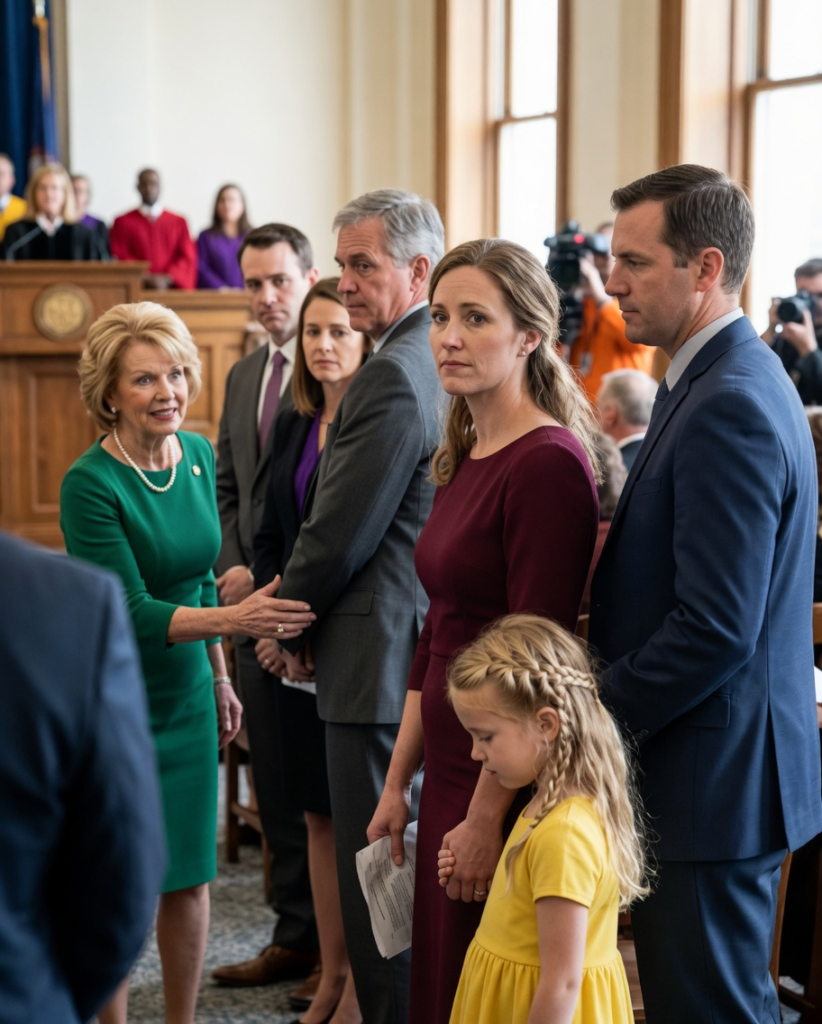
Three minutes later, I heard my mother’s voice behind me.
“There’s my daughter.”
Soft.
Sweet.
Public.
I turned.
My mother stood in the aisle in a cream dress, pearls at her throat, one hand lifted as if she had been reaching for me all along.
My father stood behind her, stiff and uncomfortable.
My sister wore a bright blue dress.
My brother held his phone like he was ready to document the reunion.
For one breath, nobody moved.
My mother smiled wider.
“Look at you,” she said, her voice trembling just enough for nearby people to notice.
“We are so proud.”
The words struck something old in me, but they did not open it.
I stood because I refused to let her loom over me.
“Hello, Mother.”
Her smile flickered at the formality.
Only for a second.
Then she leaned closer, lowering her voice while keeping the expression on her face warm for the room.
“Let us not do this today,” she said.
“This is important.”
“Yes,” I replied.
“It is.”
My sister stepped forward.
“Ingrid, can we just sit? People are looking.”
“They usually do,” I said.
My brother’s jaw tightened.
My father looked at the carpet.
My mother reached for my hand.
I let her take it, but I did not squeeze back.
“We should get a photo afterward,” she said.
“All of us together.
It will mean so much.”
“To whom?” I asked.
Her fingers went cold around mine.
Before she could answer, an usher approached and asked if they needed help finding their seats.
My mother glanced at the reserved row beside us, where a few empty chairs remained.
I had already handled that.
“Their seats are farther back,” I said gently.
My mother looked at me as if I had slapped her.
The usher checked the list.
“Yes, ma’am.
Row twelve.”
Row twelve was not humiliating.
It was a perfectly fine row.
But it was not visible enough for the story my mother had planned.
Her smile froze.
“Ingrid,” she whispered.
I looked at her calmly.
“You are welcome to stay.”
That was all.
No scene.
No raised voice.
No accusation in front of strangers.
Just a boundary, spoken plainly.
My family walked to row twelve in a silence so tight it seemed to pull the air with them.
The ceremony began.
Officials spoke about public education, community leadership, and the teachers who hold entire worlds together with underfunded classrooms and overextended hearts.
I heard only pieces of it.
My pulse was steady, but my body knew they were behind me.
Then the governor approached the podium.
When he said my name, the room rose.
“Dr.
Ingrid Fairbanks Hale.”
For a second, the applause blurred everything.
Marcus stood beside Lily, clapping with tears in his eyes.
Lily jumped once because she could not contain herself, then covered her mouth and laughed.
I walked to the stage.
The governor shook my hand and said something kind I barely processed.
A plaque was placed
in my arms.
Cameras flashed.
The applause settled into silence.
Then I stood at the podium.
From that height, I could see the whole room.
Front row: my husband and daughter.
A few rows behind them: Rachel, crying openly.
Row twelve: my mother, sitting perfectly upright, waiting.
I unfolded my speech.
“I became a teacher,” I began, “because someone once told me that the right adult at the right moment can change the direction of a child’s life.”
My voice sounded stronger than I felt.
“I have spent my career with children who needed to know that their worth was not determined by income, title, zip code, family name, or someone else’s disappointment.
I have watched students become readers after years of believing they could not learn.
I have watched new teachers find their confidence.
I have watched communities rise when the right people refused to give up.”
I paused.
My mother’s face had softened into something that might have passed for pride from far away.
Then I continued.
“I also know what it feels like to have your work dismissed because it does not impress the people you once hoped would love you better.”
The room went very still.
I did not look at row twelve.
I did not need to.
“So today, I want to thank the people who never made me choose between being successful and being kind.
My husband, Marcus, who taught me that steady love does not need an audience.
My daughter, Lily, who reminds me every day why bravery matters.
My cousin Rachel, who told me the truth when silence would have been easier.
My students, past and present, who gave my life more purpose than any title ever could.”
Marcus bowed his head.
Lily pressed both hands to her mouth.
Rachel cried harder.
“And to every teacher who has been called too soft, too ordinary, too replaceable, or not successful enough, I hope you know this: there are children walking through the world with stronger voices because you stayed.
That is not a low calling.
That is legacy.”
The applause came like weather.
I stepped back from the microphone, and for the first time in years, I felt no need to explain myself to my mother.
After the ceremony, there was a reception in a marble hallway lined with portraits and flags.
Educators hugged one another.
Reporters asked questions.
Lily showed my plaque to anyone who came within ten feet.
I had just finished speaking with a superintendent when my mother appeared beside me.
“Ingrid,” she said.
My father, sister, and brother stood a few steps behind her, arranged like witnesses.
My mother’s eyes were wet now.
Real tears, maybe.
Or maybe she had always known how to produce what the moment required.
“That was a beautiful speech,” she said.
“Thank you.”
She swallowed.
“I wish you had mentioned us.”
There it was again.
Not regret for what she had done.
Hurt over what she had not received.
I looked at her for a long moment.
“You removed yourself from that speech four years ago.”
Her lips parted.
My sister looked away.
My brother shifted his weight.
My mother’s voice dropped.
“You know I was upset when I wrote that.
Families say things.”
“No,” I said quietly.
“Families protect each other from things
like that.”
My father finally spoke.
“Ingrid, your mother made a mistake.”
I turned to him.
“And the rest of you agreed with it.”
Silence.
My brother’s face reddened.
“It was complicated.”
“It was a group chat,” I said.
“It was not complicated.”
My mother reached into her purse for a tissue.
“Are you really going to punish us forever?”
The question would have broken me once.
It would have sent me scrambling to prove I was not cruel, not difficult, not ungrateful.
But I was no longer the woman at the side table, trying to earn a place setting.
“I am not punishing you,” I said.
“I am living without pretending it did not happen.”
She stared at me as if she did not recognize what I had become.
Maybe she didn’t.
Marcus appeared at my side, one hand resting lightly against my back.
Lily stood beside him, holding the plaque against her chest like a shield.
My mother looked at Lily, then at Marcus, then back at me.
“We are still your family,” she said.
I felt Lily inch closer.
I took my daughter’s hand.
“You were,” I said.
It was not said with anger.
That surprised even me.
It came out almost tender, like the closing of a book I had carried too long.
My mother’s face changed then.
Not dramatically.
There was no collapse, no public breakdown.
Just a small, sharp recognition that the old rules no longer worked.
I did not give her the family photo she wanted.
I did not introduce her to the governor as my proud mother.
I did not hand her my achievement so she could wear it as proof that she had always believed in me.
Instead, I took pictures with Marcus, Lily, Rachel, my colleagues, my students who had come with handmade signs, and the teachers who had spent years building something with me.
My mother watched from the edge of the room.
Later that evening, after the plaque was propped on our mantel and Lily had fallen asleep on the couch still wearing one dress shoe, I opened my mother’s lunch invitation again.
For the first time, I answered.
Mother, I hope someday you understand that an apology is not the same thing as wanting access.
I am not available for lunch.
I wish you peace, but I am keeping mine.
I sent it before I could soften it.
Then I blocked the thread again.
Marcus read the message over my shoulder and kissed the top of my head.
Lily stirred in her sleep, muttered something about sunflowers, and tucked her hand under her cheek.
The house was quiet.
The pasture outside was dark.
And for once, the silence did not feel like rejection.
It felt like freedom.
Some people believed I should have forgiven my mother because she came back when the world was watching.
Others said the moment she called me her daughter in public after disowning me in private told the whole story.
I only knew this: love that waits for applause before it claims you was never love I needed to chase.