PART 1
“If your wife dies, at least she won’t keep you away from your real family anymore.”
That was what my mother said—right in front of a doctor—while my seven-day-old son burned with fever in my arms.
My name is Michael Torres. I’m thirty-two, living in a small rented apartment in East Los Angeles, working as a warehouse supervisor for a construction supply company. My wife, Valerie, has always been the kind of woman who apologizes even when she’s done nothing wrong—gentle, quiet, the type who endures more than she should.
A week before all this happened, she gave birth to our first child.
We named him Santiago—Santi for short.
I’ll never forget the way she looked at him in the hospital. Pale, exhausted, sweat clinging to her hairline… but smiling like she was holding the entire sky in her arms.
“Promise me no one will hurt him,” she whispered.
I promised.
I had no idea how badly I would fail.
Four days later, my boss called me into the office—urgent inventory issue in San Diego. I didn’t want to go. Valerie could barely walk. Her stitches hurt. Santi cried every couple of hours. But my mother, Carmen, grabbed my arm at the door.
“Go, mijo. I’m his grandmother. Who else is going to care for him better than me?”
My sister Brenda smiled behind her.
“Relax, Michael. We’ll feed Valerie, take care of the baby, keep everything running.”
Valerie leaned against the bedroom wall, trying to smile so I wouldn’t feel guilty.
“Just come back soon,” she said.
I kissed her forehead. I kissed my son’s tiny feet.
And I left.
For four days, I called constantly. My mom always answered. Valerie appeared briefly on video calls—dry lips, heavy eyelids.
“Why does she look so bad?” I asked.
“She just gave birth, Michael. What did you expect—her dancing?” my mother snapped.
Brenda laughed in the background.
“Your wife’s dramatic. Women have babies every day.”
Something inside me felt off.
But I believed them.
On the fourth day, I finished early. I didn’t tell anyone. I grabbed the first bus back, carrying a tiny red bracelet for Santi and a box of coconut candy Valerie loved.
I got home before sunrise.
The apartment door was slightly open.
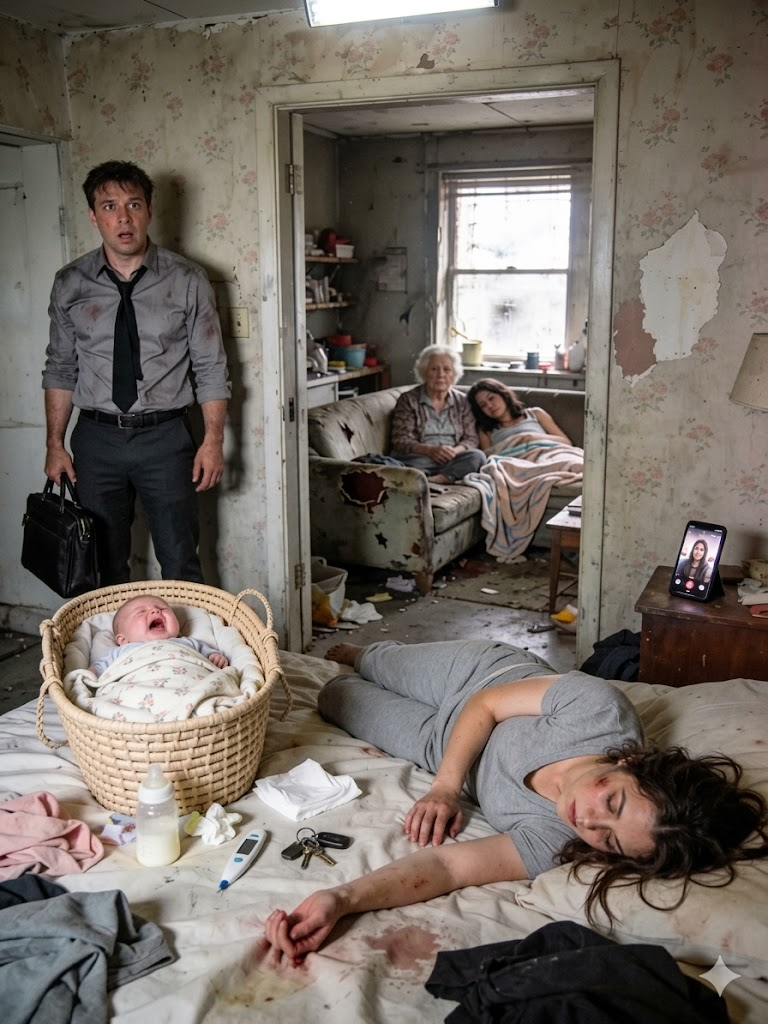
Inside, the living room was freezing—portable AC blasting. My mom and Brenda were asleep on the couch under thick blankets. Pizza boxes, soda bottles, chip bags everywhere.
No soup. No warm water. No clean baby clothes.
Then I heard it.
A cry.
Weak.
Dry.
Like my son had been calling for help until he had nothing left.
I ran to the bedroom.
Valerie lay unconscious on the bed, nightgown stained, hair tangled. Santi was beside her, wrapped in a dirty blanket, face flushed red, crying without tears.
“VALERIE!”
I shook her.
Nothing.
I touched my son—and terror shot through me. He was burning. Lips cracked. Diaper soaked. Neck raw.
I screamed.
My mother walked in, pretending surprise.
“What happened?”
“What happened?!” I roared. “That’s what I’m asking you!”
Brenda appeared, annoyed.
“You’re overreacting, Michael. Babies cry. Women sleep. You came in making a scene.”
I looked at them. At the blankets. The food. My wife’s cracked lips. My son’s burning body.
I didn’t say another word.
I picked Valerie up, wrapped Santi against my chest, and yelled for our neighbor to drive us to the hospital.
PART 2
At the ER, everything moved fast.
A nurse saw the baby and ran. Another took Valerie onto a gurney. A young doctor examined them both—quickly at first, then with a look that turned my blood cold.
She lifted Valerie’s sleeve.
Bruises.
On her wrists.
She looked at the baby. Then at me.
“Mr. Torres,” she said quietly, “you need to call the police. This is not normal postpartum weakness.”
“Police?” I repeated.
The word didn’t belong in my life.
But neither did what I had just seen.
The doctor introduced herself as Dr. Emily Carter. She didn’t soften anything.
“Your wife is severely dehydrated. She has a fever, infection in her stitches, and restraint marks. The baby is also dehydrated, febrile, and has pressure injuries. Someone prevented them from receiving care.”
My legs nearly gave out.
I already knew.
But hearing it made it real.
I called the police.
By the time officers arrived, my mother and Brenda had shown up at the hospital. My mother had her hair done, tears ready, voice trembling.
“My poor daughter-in-law,” she cried. “We cared for them day and night.”
Brenda chewed gum behind her.
For the first time in my life, they looked like strangers wearing familiar faces.
Officer Patricia Salgado led us into a small room. The doctor brought the medical file.
My mother spoke first.
“My son is confused. Valerie has always been delicate. Women nowadays can’t handle anything.”
The officer stared at her.
“Then explain why the baby hadn’t urinated properly for hours.”
Silence.
“Maybe she didn’t breastfeed him,” my mother said quickly.
My fists clenched.
The doctor stepped in.
“The baby had infected rashes. Marks on arms and legs.”
Brenda scoffed.
“He’s a newborn. Their skin marks easily.”
“And the bruises on the mother?” the officer asked.
Brenda stopped chewing.
My mother pressed her hand to her chest.
“She had a fever. Maybe she grabbed onto something.”
The lies came too easily.
The officer asked me to describe what I found.
I told her everything.
My mother cried louder.
“Since he got married, he changed. He doesn’t love the woman who gave him life.”
A week ago, that would’ve shattered me.
That day, it didn’t.
“Be quiet,” I said.
Her face froze.
“Mijo—”
“Don’t call me that.”
For a second, the mask dropped. Pure anger flashed through her eyes.
The officer saw it.
Then the doctor got a call.
“Mr. Torres. Your wife is awake.”
I ran.
Valerie looked small in the hospital bed. IV in her arm. Lips cracked.
“Vale,” I whispered.
Her eyes found mine—and filled with tears.
“Santi?” she asked.
“He’s alive. They’re taking care of him.”
She squeezed my hand weakly.
“I tried, Michael. I swear I tried.”
“I know.”
“No… listen. They didn’t let me call you.”
Officer Salgado stepped closer.
“Can you tell us what happened?”
Valerie glanced toward the door.
“They’re not here, right?”
“No,” I said. “They can’t come in.”
She nodded.
The first day, they gave her little food. Said eating too much would infect her stitches. Then they told her her milk was bad because the baby cried.
The second day, she developed a fever.
“I asked to go to a doctor. Your mom said all women go through this. Brenda said I was pretending to make you come back.”
She swallowed painfully.
“When I tried to call you, your mom took my phone. Said I wanted to separate you from your family.”
The officer kept writing.
“Then Santi cried a lot. I tried to feed him, but they said my milk was poisoned. They gave him water with a spoon. I told them newborns can’t drink water… your mom slapped me.”
I stood up so fast the chair fell.
The doctor grabbed my arm—not to stop me, but to steady me.
“Yesterday I tried to leave with the baby,” Valerie continued. “Brenda grabbed my wrists. Your mom tied my hands with my scarf. Said if I made a scene, she’d tell everyone I’d gone crazy after childbirth.”
My vision blurred red.
“They gave me pills. I don’t know what they were. I’d wake up and fade again. I could hear Santi crying… but I couldn’t move.”
I leaned over her hand.
“I left you alone.”
She cried.
“No. You trusted them. That’s different.”
But to me, it wasn’t.
The officer asked quietly, “Why would they do this?”
Valerie closed her eyes.
“For the house.”
Everything went cold.
My mother had been pressuring me for months—to use my savings for a house in her name. Said it was “for the family.” Valerie refused.
I argued with her about it.
God… I argued with her.
“Your mom said,” Valerie whispered, “that if I died, you’d come back to your real family. And if the baby died too… nothing would be between you anymore.”
In the hallway, shouting erupted.
“She’s lying!” Brenda screamed.
Then my mother:
“My own son is going to accuse me for some woman?!”
The police didn’t argue.
They took them away.
As she passed me, my mother spat:
“Blood calls, Michael.”
I looked at my son through the glass of the NICU.
“Yeah,” I said. “That’s why I’m choosing my son.”
PART 3
The final truth came from an old phone.
Before Santiago was born, I had set up a spare phone near his crib as a baby monitor. It recorded audio when it detected crying.
Brenda found it on the second day and turned it off.
But it had already saved six recordings.
Officer Salgado played them for me.
In one, my son cried for minutes while my mother said:
“Let him cry. His mother needs to learn.”
In another, Valerie begged:
“Please… water.”
Brenda replied:
“Tell your husband to buy you a house first.”
In the last recording, my mother’s voice was calm. Cold.
“If she gets too weak, we’ll say the fever took her. Who’s going to question it? She just gave birth.”
I threw up.
Justice didn’t come fast.
It came slow, messy, exhausting.
My mother and Brenda were arrested. They apologized when convenient, blamed Valerie, blamed me, blamed doctors, then blamed each other.
But they never came back into my home.
Santiago’s fever broke on the third day. The nurse said he had a strong heart.
Valerie recovered slowly. Her body healed.
But something in her had changed—something stronger.
One day, she asked me for three promises.
“Never ask me to live with them again.”
“I swear.”
“Never make me prove my pain for you to believe me.”
“I swear.”
“And never teach our son that cruelty is love just because it comes from family.”
I bowed my head.
“I swear. On him.”
We moved to a small apartment in Boyle Heights. It wasn’t perfect—but it was safe.
The trial began when Santiago was eleven months old.
Valerie testified.
She didn’t shout. Didn’t cry loudly. Just told the truth.
When the recordings played, the courtroom went silent.
Brenda broke first.
My mother didn’t.
When the verdict came—criminal negligence, domestic abuse, endangerment of a newborn—it wasn’t as long as my anger wanted.
But it was real.
When they took my mother away, she called my name.
I didn’t turn around.
At Santiago’s first birthday, we kept it small.
Our neighbor. Dr. Carter. Officer Salgado.
Valerie lit a candle.
Santi reached for the flame—I caught his hand just in time.
Everyone laughed.
Later that night, I held him on the balcony. The city hummed below.
Valerie stood beside me.
“Do you hate them?” she asked.
“Some days,” I said. “Other days… I feel nothing.”
She nodded.
“I hated them when I couldn’t lift my hand to touch my baby. Now I just don’t want them living inside me anymore.”
I held her closer.
“I’ll spend my life making it up to you.”
She shook her head.
“No, Michael. Spend your life doing it differently.”
And I did.
I learned how to care. How to listen. How to choose.
Because being a son doesn’t come before being a father.
And blood doesn’t prove love.
Love is proven when someone can’t stand—and you bring them water.
I chose too late once.
But every day since, I choose again.
My wife.
My son.
The truth.
And a home where no one has to beg to be cared for.