“I Found My 6-Year-Old Daughter Walking Alone On Route 9 Carrying My Baby Son,” I Whispered After My Shift Ended At 6:47 P.M. Her Pink Velcro Shoe Was Half Undone, Her Eyes Were Empty, And My Infant Was Wrapped In A Dish Towel, Crying So Hard He Could Barely Breathe. Twenty-three minutes earlier, I had trusted my parents to keep them safe. Twenty-three minutes later, I walked into their candlelit dinner and realized my children had barely escaped alive….
My shift ended at 6:47 p.m., and I remember that with the kind of precision people usually reserve for weddings, funerals, and the exact moment a doctor steps into a room and changes the shape of your life. I remember because I looked at the clock on the dashboard of my car as I pulled out of the employee lot behind Mercy General and did the math automatically, the way I always did back then. Twelve more minutes and I would be on Route 9. Twenty-three more and I would be in my parents’ driveway. If traffic stayed light and no one drifted under the speed limit on the county road, I could have both my children in my arms by 7:10. That was how I measured time in those days. Not in hours worked, not in shifts survived, not in bills paid. I measured it in the distance between me and Mia’s narrow shoulders under her school cardigan, between me and Noah’s warm cheek pressed against my collarbone.
It was late October, the kind of evening that looked as though the world was gently dimming itself. The sky had gone from pale silver to a soft iron gray, and the air through the crack in my driver’s side window smelled like dry leaves, wood smoke, and cold dirt. It was the sort of smell that always made me think, irrationally and briefly, that peace might still be a thing you could come home to. I had been on my feet for nearly twelve hours. My lower back ached. There was a faint crescent-shaped indentation on the bridge of my nose from my mask. My hands smelled like sanitizer and latex and the floral hand lotion Patricia from pediatrics kept in the break room because she claimed hospital soap could age a woman ten years in a season. My scrubs were wrinkled. I was tired enough that my thoughts were moving slowly, but not tired in the dangerous way. Tired in the ordinary, practiced way of a working mother who had gotten very good at functioning on love, coffee, momentum, and the belief that she was doing the best she could.
I had left the kids with my parents that morning just after seven. Mia had eaten half a banana in the back seat and complained that the seam inside her left sock felt weird. Noah had fallen asleep before we even hit the second stoplight, his mouth open, his eyelashes resting against his cheeks like commas. When I carried him into my parents’ kitchen, my mother had taken him from my arms with that brisk, competent motion she used for babies, as if motherhood was a task to be executed efficiently rather than an experience to be entered into with tenderness. Mia had run ahead to the den because she knew my father let her watch cartoons in there before school if she asked sweetly enough. Dana had been at the counter in yoga clothes, drinking coffee out of one of my mother’s oversized pottery mugs even though she didn’t live there anymore. She always seemed to be there anyway, suspended halfway between daughter and guest, occupying space without apology. She had ruffled Mia’s braid and said, “There’s my favorite little roommate,” and Mia, because she was six and still believed adults meant what they said kindly, had smiled.
Nothing about that morning had announced itself as the opening scene of a disaster. If anything, it had felt mundane in the most dangerous way. That is what I learned later about certain kinds of evil. They do not always arrive with noise. Sometimes they settle into the places you have already decorated as safe.
I turned off the radio after two songs because the sound felt intrusive. The road out of town unspooled ahead of me under the headlights, and I drove the way I always drove home from work: one hand on the wheel, the other resting near my phone in case the school called or my mother texted or Noah’s pediatrician’s office returned one of my increasingly frequent messages about his fussiness. He had been crankier than usual the last two weeks. Fussy in a way I had tried to interpret charitably. Maybe a growth spurt. Maybe his formula needed adjusting. Maybe he had inherited my tendency toward stomach trouble. Maybe.
I had said maybe so many times that month it had become a spell, a way of keeping certain fears from taking solid shape.
By the time I reached Route 9, dusk had thickened into that bruised, uncertain hour when the world seems briefly suspended between visibility and disappearance. Route 9 was the old road, the one people used before the bypass and the widened highway made most of the county move elsewhere. It cut through the back fields, past an abandoned dairy farm and a row of rusting mailboxes, then ran parallel to Harrove Fields before bending west. Nobody used it unless they lived off it, and even then not often. It was too quiet, too remote. In daylight it looked merely neglected. At night it became the sort of road where your own headlights felt like the only proof the world still existed beyond the hood of the car.
I eased down to forty when I turned onto it. Gravel clicked beneath the tires where the shoulder had broken down. The fields on either side were flat and colorless, their grass gone brittle and dull. The sky above them was an enormous, lightless sheet.
I saw the shape before I understood it. A small figure near the right edge of the road, moving not quickly, not erratically, but with an eerie, determined steadiness that did not belong to a child outside alone in the dark. I lifted my foot from the gas. My first thought was that someone’s kid had gotten away from a nearby house. My second thought, arriving so fast it felt like impact, was that the shoes looked familiar.
Pink Velcro. One strap undone.
The car had not fully stopped before I threw it into park and opened the door. My body moved faster than my mind could keep up. Gravel slid under my shoes. Cold air knifed into my lungs. The headlights illuminated her in flashes and edges as I ran, and with each step the details sharpened until denial became impossible.
“Mia!”
My voice came out wrong. Too thin. Too small. Not a mother’s voice. More like the sound a person makes in a nightmare when their mouth won’t work properly.
She did not turn.
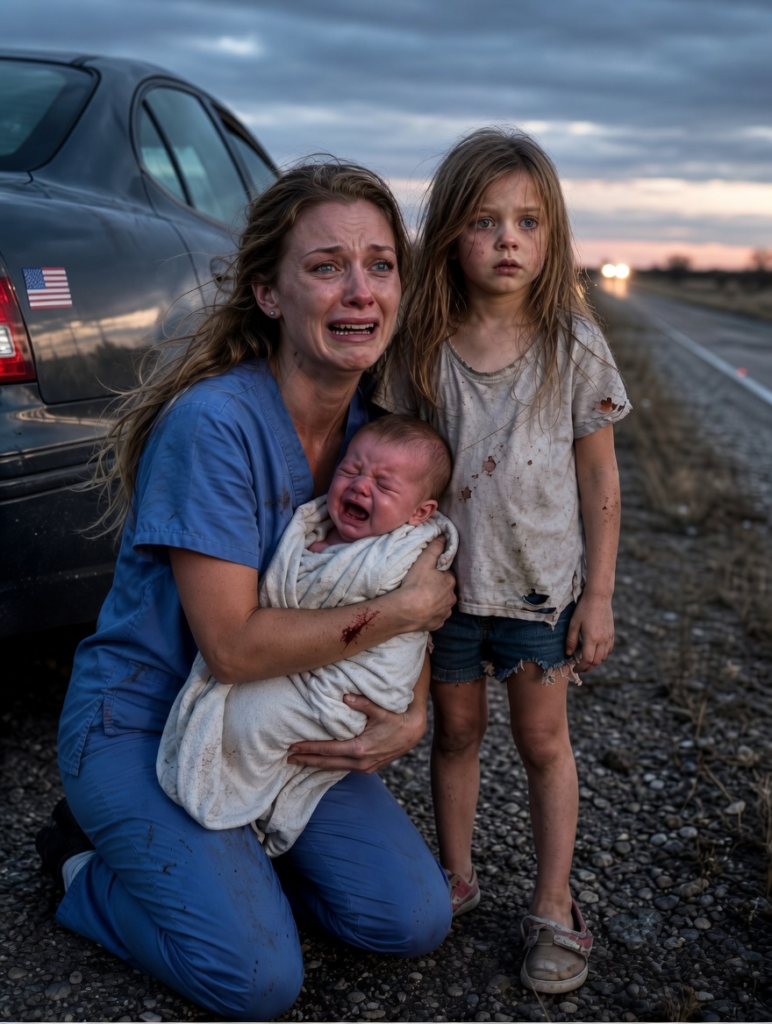
She was walking in a straight line down the narrow edge between pavement and grass as though she had fixed her eyes on some destination so far beyond me that I no longer occupied the same world. Her pink shirt was torn at the shoulder. Her leggings were filthy and ripped through at both knees. Her braid—my morning work, neat and tight and finished with the yellow elastic she insisted brought her good luck on Thursdays—had been torn apart. Her hair hung in dark, tangled mats across one side of her face.
And in her arms, clutched against her chest with the fierce, exhausted determination of a child carrying something far too heavy to set down, was Noah.
He was wrapped badly in what looked like a dish towel or a hand towel, some pale fabric that had slipped half off one shoulder. His face was red and mottled from crying. Tears had dried in tracks down both cheeks. His body shook with each breath, little desperate tremors that seemed too violent for someone so small. The noise coming from him wasn’t even proper crying anymore. It was the spent, ragged sound of an infant who had been screaming long enough to begin losing faith that anyone was coming.
I reached them and dropped to my knees in the gravel.
“Mia. Baby. Look at me. Mia.”
She stopped because my hands were on her, because I had interrupted the mechanism of her movement, but she did not come back to herself. Her eyes remained open and fixed somewhere over my shoulder. Not wild. Not tearful. Not even frightened in the ordinary sense. Emptied. Flattened. It was as if terror had already passed through her and taken whatever could be reached on its way out.
I took Noah first because instinct divided itself efficiently under pressure. I tucked him against my chest, one hand supporting his head, my heart banging so hard it felt painful. Then I cupped Mia’s face with my free hand.
“Mommy’s here,” I whispered. “I’m here. You’re okay.”
Nothing.
I pulled back the sleeve of her shirt without meaning to, driven by something primal and terrible. Under the fabric, blooming against the soft skin of her upper arm, were bruises. Dark. Oval. Deliberate. The size and placement of fingers.
For a second, everything in me went silent.
Not calm. Silence. A white, unnatural blankness, like the pause between lightning and thunder when the atmosphere itself seems to brace.
Then my phone was in my hand and I was dialing 911 with fingers so badly shaken I nearly dropped it twice.
The dispatcher answered on the second ring. Her voice was composed, practical, the kind of voice trained to become a railing for people already falling. Mine was no such thing.
“I need an ambulance,” I said, and then louder because the words were breaking apart, “I need an ambulance on Route 9 near the old Harrove Fields. I have two children. One is six years old, she’s unresponsive, and one is six months old. They both have bruises. Please. Please hurry.”
The dispatcher asked questions. Location. Description. Whether the children were breathing. Whether I was in immediate danger. I answered as best I could while lowering myself to the gravel with both of them. Noah was still making that awful, stuttering cry, quieter now against my body. Mia folded mechanically when I guided her down beside me, knees together, hands in her lap, eyes still fixed on that invisible point in the distance.
I kept touching her face, because touching her was the only way I could keep from screaming.
“I’m here,” I said over and over, the words becoming rhythm more than language. “Mommy’s here. You’re safe. You’re safe.”
Noah’s fist found the collar of my scrub top and closed around it. That tiny pressure nearly undid me. Even now, in pain, in fear, he knew me by pulse and scent and skin. He tucked his face under my chin with the exhausted certainty of a child returning to the center of his known universe.
The ambulance took eleven minutes to arrive.
People say things like that and expect the number alone to communicate the experience, as if time under terror behaves the way it does on a clock. It does not. Eleven minutes can stretch so wide it becomes almost uninhabitable. In those minutes I heard every sound separately: Noah’s breathing, shallow and hitching; the dry rasp of grass moving in the field; the distant bark of a dog far off across the road; my own voice, thinning with each repetition of the same promises; the occasional car passing on the highway several miles away like life continuing somewhere I could not reach. I watched the road behind us for the ambulance lights and every second without them felt accusatory.
When they finally came, blue and red strobes cutting across the fields like some unnatural dawn, I almost collapsed from the relief of no longer being the only adult present in the universe.
The paramedics moved quickly, but not frantically. That steadied me more than anything. One of them, a woman with dark hair pulled tight beneath her cap and eyes so calm they seemed deliberate, knelt beside Mia and spoke to her softly, as though Mia were still fully reachable by language. Another took Noah from my arms with practiced gentleness and began checking his airway, his ribs, his eyes. I saw the change in his face before he masked it. Professionals learn to smooth their reactions into neutrality, but there is always a moment before the training arrives. In that moment, truth flashes nakedly across them.
The woman by Mia looked up at me once, and the controlled expression on her face told me more than anything she said aloud. She asked, “Were they in anyone else’s care today?”
“Yes,” I said.
“Who?”
“My parents.”
The word scraped my throat.
She held my gaze for half a second longer than necessary. Something passed silently between us, not understanding exactly, but recognition. She had heard enough versions of this story to know when the first layer had only just been peeled back.
I followed the ambulance in my car to the hospital. My hands were slippery on the steering wheel. The road doubled once when tears blurred my sight, and I had to pull over long enough to wipe my face with the heel of my hand and force my breathing back into rhythm. By then the cold quiet had begun to settle in my chest. It was different from panic. Panic is hot, flailing, full of motion. This was older. Heavier. It sank into me with the certainty of a stone dropped into dark water.
I knew where my children had been.
I knew who had done this.
And before the ambulance had even disappeared around the bend, a second knowledge arrived, complete and wordless: I was going to drive to them.
Mercy General’s emergency entrance glowed too brightly against the dark, automatic doors opening and closing as people moved through them under fluorescent light. I parked badly, half over the line, and got out before the engine finished dying. A nurse I recognized from pediatrics intercepted me before I reached triage and told me where they had taken the children. Noah to an exam room, then imaging. Mia for evaluation and observation. Social work had already been notified. A physician would speak with me shortly.
I nodded because nodding was what remained available to me.
Then I asked, “Can you make sure they know I’m stepping out for a few minutes?”
Her expression changed. “Ms. Sloan—”
“I’m coming back,” I said. “I just need a few minutes.”
I do not know whether she believed me. I barely believed myself. But perhaps there was something in my face she recognized as too far gone to challenge. She hesitated, then said, “Be back soon.”
I drove the twenty-three minutes to my parents’ house in total silence….
Their porch light was on, the familiar yellow glow spilling across the front steps and the narrow sweep of driveway the way it had every night of my childhood. For most of my life that light had meant certainty. It meant supper was on. It meant my mother was somewhere inside moving between stove and sink. It meant my father had already changed out of his work boots and was settled in his chair. It meant, if you were lucky enough to be me at seven years old, that someone was waiting for you. Even after adulthood complicated my feelings toward them, I had retained that primitive response to the sight of it. Home.
When I pulled in that night, I understood for the first time that symbols do not lose their power simply because they cease to deserve it. The porch light was still beautiful. That made it worse.
I rang the bell once out of reflex and then opened the door without waiting, because I was still their daughter, because this had been my house before it had become the scene of a crime, because some small part of me wanted to catch them unprepared in the ordinary performance of themselves.
The smell hit first.
Pot roast. Garlic bread. Rosemary. Onion. The exact Thursday-night dinner my mother had made almost every week for thirty years. There were candles lit on the table. My father sat at the head of it, cutting meat into neat, measured pieces with the same concentration he brought to sharpening knives or balancing a checkbook. Dana stood near the sideboard, pouring herself a glass of red wine. My mother was carrying a dish from the kitchen, irritation already gathering on her face before she had even looked up fully enough to see me.
“Sloan,” she said. “What’s wrong with you? You look terrible.”
There I was in the doorway, dust on my shoes, dried tears on my face, dried tears from my baby on my shirt, and my mother’s first response was annoyance at my disruption of dinner.
That might have been the moment something in me finally crossed from disbelief into comprehension.
“Where are my children?” I asked.
Silence followed, but not the silence of guilty people unexpectedly confronted. It was the silence of people who had expected a confrontation eventually and resented being made to endure it before dessert.
Dana set down her glass with infuriating care. “We made a family decision.”
The phrase landed between us like something oily and obscene.
My father did not look up immediately. My mother set the dish on the table and smoothed her apron, a gesture so mundane it became unbearable.
“You work too much,” Dana continued. “You’re never present. The kids are better off here more often.”
I stared at her.
“We voted,” she said. “All three of us.”
I heard myself say, very quietly, “They were on Route 9.”
That got my father’s attention. He lifted his eyes.
“Alone,” I said. “In the dark.”
Nobody moved. Not one of them.
My skin went cold.
“Mia is unresponsive,” I said. “Noah has bruises on his arms. My six-year-old daughter was carrying my infant son down a road in the dark. What did you do to them?”
My mother sighed.
Not in distress. In fatigue. As if I were making a scene in a restaurant.
“You’re being dramatic, Sloan,” she said. “Children fall. They bruise. Mia is sensitive. You made her that way with all that coddling.”
“She’s not responding to her name.”
“She’s overtired.”
My vision sharpened in a strange way then, each edge in the room turning painfully clear. The candles. The gravy boat. A smear of red wine on Dana’s knuckle. The crease in my father’s shirt collar. I felt everything and nothing simultaneously. Grief burned away. Fear burned away. What remained was not even rage yet. It was a sudden, violent alignment. The pieces clicked into place. Comments I had excused. Bruises I had rationalized. Mia’s occasional refusal to get out of the car on Thursdays. Noah’s inconsolable crying after pick-up. The way my mother had begun insisting I was “too tense” and “imagining problems.” Dana telling me once, laughing, that Mia cried over “the smallest correction,” as if the phrase correction could stretch to cover anything.
I took two steps toward the table and slammed both hands down on it so hard the silverware jumped. Wine sloshed over the rim of Dana’s glass. My mother flinched. My father stood.
For one sharp, crystalline second, I saw something in all three of their faces that had not yet appeared that night.
Fear.
Not remorse. Not shame. Fear.
Because I was not begging anymore. I was not crying. I was not trying to persuade them into recognizing my reality. I had stepped fully into it without them.
“I want to know,” I said, each word exact, “what happened in this house today.”… PRESS LIKE AND Type OK below if you’re ready for the next part and I’ll send it right away
My shift ended at 6:47 p.m., and I remember that with the kind of precision people usually reserve for weddings, funerals, and the exact moment a doctor steps into a room and changes the shape of your life. I remember because I looked at the clock on the dashboard of my car as I pulled out of the employee lot behind Mercy General and did the math automatically, the way I always did back then. Twelve more minutes and I would be on Route 9. Twenty-three more and I would be in my parents’ driveway. If traffic stayed light and no one drifted under the speed limit on the county road, I could have both my children in my arms by 7:10. That was how I measured time in those days. Not in hours worked, not in shifts survived, not in bills paid. I measured it in the distance between me and Mia’s narrow shoulders under her school cardigan, between me and Noah’s warm cheek pressed against my collarbone.
It was late October, the kind of evening that looked as though the world was gently dimming itself. The sky had gone from pale silver to a soft iron gray, and the air through the crack in my driver’s side window smelled like dry leaves, wood smoke, and cold dirt. It was the sort of smell that always made me think, irrationally and briefly, that peace might still be a thing you could come home to. I had been on my feet for nearly twelve hours. My lower back ached. There was a faint crescent-shaped indentation on the bridge of my nose from my mask. My hands smelled like sanitizer and latex and the floral hand lotion Patricia from pediatrics kept in the break room because she claimed hospital soap could age a woman ten years in a season. My scrubs were wrinkled. I was tired enough that my thoughts were moving slowly, but not tired in the dangerous way. Tired in the ordinary, practiced way of a working mother who had gotten very good at functioning on love, coffee, momentum, and the belief that she was doing the best she could.
I had left the kids with my parents that morning just after seven. Mia had eaten half a banana in the back seat and complained that the seam inside her left sock felt weird. Noah had fallen asleep before we even hit the second stoplight, his mouth open, his eyelashes resting against his cheeks like commas. When I carried him into my parents’ kitchen, my mother had taken him from my arms with that brisk, competent motion she used for babies, as if motherhood was a task to be executed efficiently rather than an experience to be entered into with tenderness. Mia had run ahead to the den because she knew my father let her watch cartoons in there before school if she asked sweetly enough. Dana had been at the counter in yoga clothes, drinking coffee out of one of my mother’s oversized pottery mugs even though she didn’t live there anymore. She always seemed to be there anyway, suspended halfway between daughter and guest, occupying space without apology. She had ruffled Mia’s braid and said, “There’s my favorite little roommate,” and Mia, because she was six and still believed adults meant what they said kindly, had smiled.
Nothing about that morning had announced itself as the opening scene of a disaster. If anything, it had felt mundane in the most dangerous way. That is what I learned later about certain kinds of evil. They do not always arrive with noise. Sometimes they settle into the places you have already decorated as safe.
I turned off the radio after two songs because the sound felt intrusive. The road out of town unspooled ahead of me under the headlights, and I drove the way I always drove home from work: one hand on the wheel, the other resting near my phone in case the school called or my mother texted or Noah’s pediatrician’s office returned one of my increasingly frequent messages about his fussiness. He had been crankier than usual the last two weeks. Fussy in a way I had tried to interpret charitably. Maybe a growth spurt. Maybe his formula needed adjusting. Maybe he had inherited my tendency toward stomach trouble. Maybe.
I had said maybe so many times that month it had become a spell, a way of keeping certain fears from taking solid shape.
By the time I reached Route 9, dusk had thickened into that bruised, uncertain hour when the world seems briefly suspended between visibility and disappearance. Route 9 was the old road, the one people used before the bypass and the widened highway made most of the county move elsewhere. It cut through the back fields, past an abandoned dairy farm and a row of rusting mailboxes, then ran parallel to Harrove Fields before bending west. Nobody used it unless they lived off it, and even then not often. It was too quiet, too remote. In daylight it looked merely neglected. At night it became the sort of road where your own headlights felt like the only proof the world still existed beyond the hood of the car.
I eased down to forty when I turned onto it. Gravel clicked beneath the tires where the shoulder had broken down. The fields on either side were flat and colorless, their grass gone brittle and dull. The sky above them was an enormous, lightless sheet.
I saw the shape before I understood it. A small figure near the right edge of the road, moving not quickly, not erratically, but with an eerie, determined steadiness that did not belong to a child outside alone in the dark. I lifted my foot from the gas. My first thought was that someone’s kid had gotten away from a nearby house. My second thought, arriving so fast it felt like impact, was that the shoes looked familiar.
Pink Velcro. One strap undone.
The car had not fully stopped before I threw it into park and opened the door. My body moved faster than my mind could keep up. Gravel slid under my shoes. Cold air knifed into my lungs. The headlights illuminated her in flashes and edges as I ran, and with each step the details sharpened until denial became impossible.
“Mia!”
My voice came out wrong. Too thin. Too small. Not a mother’s voice. More like the sound a person makes in a nightmare when their mouth won’t work properly.
She did not turn.
She was walking in a straight line down the narrow edge between pavement and grass as though she had fixed her eyes on some destination so far beyond me that I no longer occupied the same world. Her pink shirt was torn at the shoulder. Her leggings were filthy and ripped through at both knees. Her braid—my morning work, neat and tight and finished with the yellow elastic she insisted brought her good luck on Thursdays—had been torn apart. Her hair hung in dark, tangled mats across one side of her face.
And in her arms, clutched against her chest with the fierce, exhausted determination of a child carrying something far too heavy to set down, was Noah.
He was wrapped badly in what looked like a dish towel or a hand towel, some pale fabric that had slipped half off one shoulder. His face was red and mottled from crying. Tears had dried in tracks down both cheeks. His body shook with each breath, little desperate tremors that seemed too violent for someone so small. The noise coming from him wasn’t even proper crying anymore. It was the spent, ragged sound of an infant who had been screaming long enough to begin losing faith that anyone was coming.
I reached them and dropped to my knees in the gravel.
“Mia. Baby. Look at me. Mia.”
She stopped because my hands were on her, because I had interrupted the mechanism of her movement, but she did not come back to herself. Her eyes remained open and fixed somewhere over my shoulder. Not wild. Not tearful. Not even frightened in the ordinary sense. Emptied. Flattened. It was as if terror had already passed through her and taken whatever could be reached on its way out.
I took Noah first because instinct divided itself efficiently under pressure. I tucked him against my chest, one hand supporting his head, my heart banging so hard it felt painful. Then I cupped Mia’s face with my free hand.
“Mommy’s here,” I whispered. “I’m here. You’re okay.”
Nothing.
I pulled back the sleeve of her shirt without meaning to, driven by something primal and terrible. Under the fabric, blooming against the soft skin of her upper arm, were bruises. Dark. Oval. Deliberate. The size and placement of fingers.
For a second, everything in me went silent.
Not calm. Silence. A white, unnatural blankness, like the pause between lightning and thunder when the atmosphere itself seems to brace.
Then my phone was in my hand and I was dialing 911 with fingers so badly shaken I nearly dropped it twice.
The dispatcher answered on the second ring. Her voice was composed, practical, the kind of voice trained to become a railing for people already falling. Mine was no such thing.
“I need an ambulance,” I said, and then louder because the words were breaking apart, “I need an ambulance on Route 9 near the old Harrove Fields. I have two children. One is six years old, she’s unresponsive, and one is six months old. They both have bruises. Please. Please hurry.”
The dispatcher asked questions. Location. Description. Whether the children were breathing. Whether I was in immediate danger. I answered as best I could while lowering myself to the gravel with both of them. Noah was still making that awful, stuttering cry, quieter now against my body. Mia folded mechanically when I guided her down beside me, knees together, hands in her lap, eyes still fixed on that invisible point in the distance.
I kept touching her face, because touching her was the only way I could keep from screaming.
“I’m here,” I said over and over, the words becoming rhythm more than language. “Mommy’s here. You’re safe. You’re safe.”
Noah’s fist found the collar of my scrub top and closed around it. That tiny pressure nearly undid me. Even now, in pain, in fear, he knew me by pulse and scent and skin. He tucked his face under my chin with the exhausted certainty of a child returning to the center of his known universe.
The ambulance took eleven minutes to arrive.
People say things like that and expect the number alone to communicate the experience, as if time under terror behaves the way it does on a clock. It does not. Eleven minutes can stretch so wide it becomes almost uninhabitable. In those minutes I heard every sound separately: Noah’s breathing, shallow and hitching; the dry rasp of grass moving in the field; the distant bark of a dog far off across the road; my own voice, thinning with each repetition of the same promises; the occasional car passing on the highway several miles away like life continuing somewhere I could not reach. I watched the road behind us for the ambulance lights and every second without them felt accusatory.
When they finally came, blue and red strobes cutting across the fields like some unnatural dawn, I almost collapsed from the relief of no longer being the only adult present in the universe.
The paramedics moved quickly, but not frantically. That steadied me more than anything. One of them, a woman with dark hair pulled tight beneath her cap and eyes so calm they seemed deliberate, knelt beside Mia and spoke to her softly, as though Mia were still fully reachable by language. Another took Noah from my arms with practiced gentleness and began checking his airway, his ribs, his eyes. I saw the change in his face before he masked it. Professionals learn to smooth their reactions into neutrality, but there is always a moment before the training arrives. In that moment, truth flashes nakedly across them.
The woman by Mia looked up at me once, and the controlled expression on her face told me more than anything she said aloud. She asked, “Were they in anyone else’s care today?”
“Yes,” I said.
“Who?”
“My parents.”
The word scraped my throat.
She held my gaze for half a second longer than necessary. Something passed silently between us, not understanding exactly, but recognition. She had heard enough versions of this story to know when the first layer had only just been peeled back.
I followed the ambulance in my car to the hospital. My hands were slippery on the steering wheel. The road doubled once when tears blurred my sight, and I had to pull over long enough to wipe my face with the heel of my hand and force my breathing back into rhythm. By then the cold quiet had begun to settle in my chest. It was different from panic. Panic is hot, flailing, full of motion. This was older. Heavier. It sank into me with the certainty of a stone dropped into dark water.
I knew where my children had been.
I knew who had done this.
And before the ambulance had even disappeared around the bend, a second knowledge arrived, complete and wordless: I was going to drive to them.
Mercy General’s emergency entrance glowed too brightly against the dark, automatic doors opening and closing as people moved through them under fluorescent light. I parked badly, half over the line, and got out before the engine finished dying. A nurse I recognized from pediatrics intercepted me before I reached triage and told me where they had taken the children. Noah to an exam room, then imaging. Mia for evaluation and observation. Social work had already been notified. A physician would speak with me shortly.
I nodded because nodding was what remained available to me.
Then I asked, “Can you make sure they know I’m stepping out for a few minutes?”
Her expression changed. “Ms. Sloan—”
“I’m coming back,” I said. “I just need a few minutes.”
I do not know whether she believed me. I barely believed myself. But perhaps there was something in my face she recognized as too far gone to challenge. She hesitated, then said, “Be back soon.”
I drove the twenty-three minutes to my parents’ house in total silence.
Their porch light was on, the familiar yellow glow spilling across the front steps and the narrow sweep of driveway the way it had every night of my childhood. For most of my life that light had meant certainty. It meant supper was on. It meant my mother was somewhere inside moving between stove and sink. It meant my father had already changed out of his work boots and was settled in his chair. It meant, if you were lucky enough to be me at seven years old, that someone was waiting for you. Even after adulthood complicated my feelings toward them, I had retained that primitive response to the sight of it. Home.
When I pulled in that night, I understood for the first time that symbols do not lose their power simply because they cease to deserve it. The porch light was still beautiful. That made it worse.
I rang the bell once out of reflex and then opened the door without waiting, because I was still their daughter, because this had been my house before it had become the scene of a crime, because some small part of me wanted to catch them unprepared in the ordinary performance of themselves.
The smell hit first.
Pot roast. Garlic bread. Rosemary. Onion. The exact Thursday-night dinner my mother had made almost every week for thirty years. There were candles lit on the table. My father sat at the head of it, cutting meat into neat, measured pieces with the same concentration he brought to sharpening knives or balancing a checkbook. Dana stood near the sideboard, pouring herself a glass of red wine. My mother was carrying a dish from the kitchen, irritation already gathering on her face before she had even looked up fully enough to see me.
“Sloan,” she said. “What’s wrong with you? You look terrible.”
There I was in the doorway, dust on my shoes, dried tears on my face, dried tears from my baby on my shirt, and my mother’s first response was annoyance at my disruption of dinner.
That might have been the moment something in me finally crossed from disbelief into comprehension.
“Where are my children?” I asked.
Silence followed, but not the silence of guilty people unexpectedly confronted. It was the silence of people who had expected a confrontation eventually and resented being made to endure it before dessert.
Dana set down her glass with infuriating care. “We made a family decision.”
The phrase landed between us like something oily and obscene.
My father did not look up immediately. My mother set the dish on the table and smoothed her apron, a gesture so mundane it became unbearable.
“You work too much,” Dana continued. “You’re never present. The kids are better off here more often.”
I stared at her.
“We voted,” she said. “All three of us.”
I heard myself say, very quietly, “They were on Route 9.”
That got my father’s attention. He lifted his eyes.
“Alone,” I said. “In the dark.”
Nobody moved. Not one of them.
My skin went cold.
“Mia is unresponsive,” I said. “Noah has bruises on his arms. My six-year-old daughter was carrying my infant son down a road in the dark. What did you do to them?”
My mother sighed.
Not in distress. In fatigue. As if I were making a scene in a restaurant.
“You’re being dramatic, Sloan,” she said. “Children fall. They bruise. Mia is sensitive. You made her that way with all that coddling.”
“She’s not responding to her name.”
“She’s overtired.”
My vision sharpened in a strange way then, each edge in the room turning painfully clear. The candles. The gravy boat. A smear of red wine on Dana’s knuckle. The crease in my father’s shirt collar. I felt everything and nothing simultaneously. Grief burned away. Fear burned away. What remained was not even rage yet. It was a sudden, violent alignment. The pieces clicked into place. Comments I had excused. Bruises I had rationalized. Mia’s occasional refusal to get out of the car on Thursdays. Noah’s inconsolable crying after pick-up. The way my mother had begun insisting I was “too tense” and “imagining problems.” Dana telling me once, laughing, that Mia cried over “the smallest correction,” as if the phrase correction could stretch to cover anything.
I took two steps toward the table and slammed both hands down on it so hard the silverware jumped. Wine sloshed over the rim of Dana’s glass. My mother flinched. My father stood.
For one sharp, crystalline second, I saw something in all three of their faces that had not yet appeared that night.
Fear.
Not remorse. Not shame. Fear.
Because I was not begging anymore. I was not crying. I was not trying to persuade them into recognizing my reality. I had stepped fully into it without them.
“I want to know,” I said, each word exact, “what happened in this house today.”
My father walked around the table with that deliberate, heavy calm large men cultivate when they want their bodies to speak before they do. He had always been good at making physical presence feel like an argument. He stopped close enough that I could smell aftershave and roast beef and the starch in his shirt.
“As your sister said,” he told me, “you don’t get a say.”
Then he grabbed me by the collar, dragged me backward, opened the front door, and shoved me out onto the porch so hard I hit the railing with my shoulder.
Pain shot down my arm. The screen door banged once against its frame. Before I could regain balance, the front door closed.
It did not slam. That would have implied emotion. It closed with terrible, ordinary finality.
I stood there under the porch light, staring at the door I had run through as a child after school, the door I had once believed could not shut against me in any meaningful way. Through the wood I could hear movement resume almost immediately. Chairs shifting. A fork against a plate. My mother saying something too muffled to catch. Then, astonishingly, Dana’s laugh.
I got back into my car because my knees suddenly would not hold me upright.
I sat in the driveway with the engine off and my hands in my lap. The porch light reflected faintly on the windshield. My phone buzzed in the cup holder and I jumped so hard my teeth hit together. Unknown number. Hospital prefix.
I answered before the second ring.
“Ms. Sloan?” a man said.
“Yes.”
“This is Dr. Reeves from Mercy General. I’m calling about your children.”
Everything in me narrowed to the sound of his voice.
“Your daughter is stable,” he said carefully. “She has no skull fracture or intracranial bleed, which is good. But we are concerned about her neurological presentation. She appears to be in a dissociative state consistent with acute stress trauma.”
I closed my eyes.
“The kind that develops over repeated exposure,” he added after a beat, “not typically from a single isolated event.”
The words went through me slowly, like cold entering water.
“There is also evidence of physical injury on both children that we are required by law to document and report.”
My fingers dug into the steering wheel.
“Your son has two healing rib fractures,” he said. “Our preliminary estimate is ten to fourteen days old.”
The world altered right there in my parents’ driveway.
It is a cliché to say I stopped breathing, but it is also true. My lungs forgot their function. Sound receded. The porch light, the dashboard, the steering wheel beneath my hand all seemed to move slightly away from me, not physically but perceptually, as if the universe had stepped back to make room for what had just entered it.
Ten to fourteen days.
Not today, then. Not only today. Not one monstrous lapse. Not one accident, one terrible afternoon, one isolated failure. A pattern. A duration. My son had been hurt and had remained hurt while I handed him back to them again. While I thanked my mother for helping. While I folded laundry and packed bottles and told myself I was lucky to have family close by.
Dr. Reeves kept speaking. Child protective services had been contacted. Law enforcement too. A social worker wanted to speak with me as soon as I returned. They were admitting both children overnight for observation.
I answered his questions. I think I thanked him. Then the call ended and I sat absolutely motionless in the dark for four full minutes, though it could have been forty. Time had become slippery, detached from sequence. I stared at the steering wheel and tried to understand how a human body survives the instant when ignorance becomes knowledge.
Every Thursday my mother made pot roast.
Every Thursday I had trusted them.
I drove back to the hospital under a sky gone fully black.
Noah was in a small crib under warm lights when I got there, wrapped now in proper blankets, tiny chest rising and falling beneath the bandaging around his ribs. A pediatric nurse named Patricia sat beside him humming under her breath. When she saw me, she rose immediately and stepped back without saying much more than, “Take all the time you need.”
I stood over him and looked.
That is another thing people do not tell you. Sometimes after terror, after action, after the frantic effort of rescue, there comes a stage in which you simply look. You look at the child who survived the thing you did not know was happening and the looking becomes its own kind of reckoning. His eyelashes fluttered faintly with sleep. One fist was tucked by his ear. There was a yellowing bruise near the inside of his upper arm and another along his side, partially hidden by the blanket. The image of those rib fractures existed for me now even without seeing them. Two tiny healed breaks inside a body that had never once in its life deserved roughness.
“Mommy’s here,” I whispered, because language still mattered even if he slept.
Mia was two rooms down.
The blankness in her eyes had softened by then into something more recognizable and therefore, in its own way, even more devastating. Exhaustion. Shock. Vigilance so total it had hollowed her out. Someone had changed her into a hospital gown. Her knees had been cleaned. There were abrasions there, raw but superficial. Her left wrist was wrapped where the skin had split. A stuffed rabbit sat beside her pillow, one of those hospital donations with bright stitched eyes and fur soft from too many washings.
I sat on the edge of her bed and took her hand. It was colder than it should have been.
“Mia,” I said.
Her gaze moved to me. Slowly. As though returning from very far away.
Then, with a suddenness that took my breath, tears welled in her eyes. Silent at first. Then the smallest, most broken sound escaped her, and she folded toward me like a structure whose supports had finally been removed. I gathered her carefully, mindful of bruises I could not see.
“I’m sorry,” she whispered into my scrub top.
I went still.
Those words. Not Mommy. Not It hurt. Not I was scared.
I’m sorry.
The sentence of an abused child. The confession of someone who has been taught responsibility for other people’s cruelty.
My throat closed so hard I thought I might choke.
“You have nothing to be sorry for,” I said, and heard the ferocity in my own voice. I made myself soften it. “Nothing. Do you hear me? Nothing.”
Her body shook. She clung to me with all the strength six-year-old arms can hold. The psychologist later told me that sometimes, after prolonged stress, a child’s first return to language comes through apology because apology feels safer than accusation. At the time all I knew was that every cell in my body wanted to tear the world open with my hands.
When she had cried herself into a rough, uneven quiet, I eased back enough to look at her face. There were finger-shaped bruises along the upper part of one arm. Faint marks at the jawline. A scrape behind her ear.
“Can you tell me what happened?” I asked very gently.
Her eyes immediately flicked toward the door. Her body locked.
I understood at once. The fear was not of remembering. It was of saying.
“It’s okay,” I told her. “You don’t have to tell me right now.”
She swallowed. After a long moment she whispered, “Grandpa got mad.”
Something hot and electric flashed through me so violently I had to brace my hand on the side of the bed.
“Why did Grandpa get mad?”
Her lower lip trembled. “Noah cried.”
I closed my eyes for one second and opened them again.
“What happened then?”
“He said stop.” Her voice shrank on the word. “He said babies can stop if they want to.”
I smoothed her hair back from her forehead because otherwise I might have broken the metal rail off the bed with my hands.
“And then?”
She looked at the rabbit, not at me. “Aunt Dana said I make everything worse.”
There are moments in a life when emotion becomes too large to feel all at once, so the mind, in self-defense, translates it into structure. Mine did exactly that. Not because I was cold. Because if I had let the full force of what I felt into my body in that moment, I would have ceased to be useful to my children.
So I became useful.
At 9:43 p.m., sitting in a plastic chair outside the pediatric observation wing while Mia dozed and Noah slept under monitoring, I called my attorney. Her name was Ellen Kessler, and she had once represented me during a tedious dispute with a former landlord over mold in an apartment. She answered on the second ring, sleepy at first, then instantly awake when she heard my voice.
“I need help,” I said.
She did not waste time on preamble. “Tell me what happened.”
I told her everything, or as much as could be fit into a first call made by a woman whose hands were still shaking. She listened without interrupting except to ask clarifying questions. Dates. Names. Injuries. Whether the hospital had documented. Whether CPS was involved. Whether the children were presently safe. At the end she said, “Do not go back there. Do not contact them except through counsel or law enforcement. Write down every detail you can remember tonight while it’s fresh, even if it seems small. Especially if it seems small.”
At 10:15 I called the detective assigned through the hospital report. Her name was Detective Lena Alvarez. Her voice had the calm, spare quality of someone who had long ago learned not to overpromise victims anything except rigor. She asked me to meet with her formally the next morning, but when I said, “I know they did this,” she replied, “Then we’re going to build something that proves it.”
At 10:52 I called my landlord and gave notice on the apartment I had chosen specifically because it was twenty minutes from my parents’ house and five from Mia’s school and affordable only because I relied on family childcare four days a week. I did not yet know where we would go. I only knew where we would not stay.
Then I opened my laptop.
It was nearly eleven-thirty by then. The hospital waiting area smelled like coffee that had been burnt six hours ago and industrial floor cleaner. A muted television in the corner was showing a sitcom with the captions on. A woman in the far chair was asleep with her purse in her lap. A janitor wheeled a yellow bucket silently past. And there, under fluorescent light, with my children behind secured doors, I began to build the record that would dismantle the people who had done this.
I wrote the date and time first.
Then I started moving backward.
Every bruise. Every incident. Every phrase I had dismissed because believing the worst about one’s own family requires an act of imagination many children are trained never to perform. Mia crying in the bathroom one Thursday morning because she “didn’t want to make Grandpa tired.” Noah screaming when my mother took him from his car seat. Dana texting me once, “Mia needs firmer handling. She manipulates.” My father remarking over dinner that “kids these days are too soft.” My mother telling me I was paranoid when I asked why Mia had a bruise shaped like a thumbprint near her elbow. Mia beginning to wet the bed again after being fully dry for a year. Noah arching away from my father’s voice at a cookout two weeks earlier. The time I arrived ten minutes early and found the house strangely, perfectly quiet before my mother opened the door too fast and too brightly and said, “Oh, you’re early,” as though I had disrupted something.
I documented texts. Saved voicemails. Forwarded emails to Ellen. I pulled pediatric visit summaries and cross-referenced dates. I wrote down exact Thursdays. What I had packed in the diaper bag. Which days Dana had been there. Which days she had not. Which bruises I had photographed casually for the pediatrician but then failed to push harder about when I was told, “Babies bump themselves all the time.”
Around 1:15 a.m., Patricia brought me a paper cup of coffee I had not asked for. I looked up in confusion and she simply said, “You need to stay upright.”
I thanked her.
She glanced at the laptop screen, then back at me. “Keep going,” she said softly.
I did.
The first formal interview happened the next day in a family consultation room off pediatrics, with beige walls and a box of tissues so aggressively present it might as well have been an instruction. Detective Alvarez sat across from me with a legal pad. A CPS caseworker named Janet Cole sat slightly to her left, hands folded, expression careful and unsentimental. Ellen came too, carrying a leather folder and the sort of contained focus I had come to understand as battle readiness.
I expected them to see me as frantic, unreliable, hysterical in the old sexist way that still clings to mothers under stress. Instead, because of the notes I had taken through the night, because grief had been translated into chronology, they saw what I needed them to see: a witness who had moved beyond shock into exactness.
When Detective Alvarez asked, “When did you first notice signs that something may have been wrong?” I did not say “I don’t know” or “maybe recently.” I said, “October 3rd, when Mia came home with a bruise on her inner arm and my mother told me she’d slipped getting out of the bathtub, though Mia had not bathed there that day because I had packed her school clothes still dry from that morning. Then again on October 8th, Noah cried when lifted under his arms. On October 12th, Mia wet the bed after Thursdays at their house for the second time in a week.”
Precision changes how people hear you. It should not have to. But it does.
The children remained in the hospital two nights. A skeletal survey confirmed Noah’s healing fractures and ruled out others. Mia’s exam documented bruising in various stages of healing. Her therapist, a child psychologist named Dr. Elaine Porter, began seeing her almost immediately because in acute trauma, early intervention matters. I liked Dr. Porter at once because she did not speak about Mia as fragile. She spoke about her as overwhelmed, frightened, and adaptive. “Children do whatever they must to survive environments adults create,” she told me. “Then we help them learn they no longer have to.”
On the third day, after emergency court orders and paperwork and interviews and one brutally efficient hearing in which I was granted temporary protective custody without contest because the hospital documentation was too strong to argue against, I loaded both children into my car and drove not to my apartment but to my friend Raina’s house an hour west.
Raina had been my best friend since nursing school, one of those women whose loyalty takes the form of practical intervention. When I called and said, “I need somewhere to go with the kids,” she had answered, “Guest room’s made. I’ll leave the porch light on.” When we arrived, there was soup on the stove, clean sheets on the bed, diapers stacked in the bathroom, and a small pile of children’s books beside the lamp as if she understood that survival depends partly on the presence of ordinary objects.
The first night there, Mia woke screaming at 2:14 a.m.
I was beside her before the sound fully formed, scooping her up from the narrow bed in the guest room, whispering, “You’re okay, you’re okay, I’ve got you.” She clung to my neck so hard I felt the tendons in her hands strain. Noah, in the portable crib nearby, startled awake and began crying too. So there we were, the three of us, lit by the low amber light of a borrowed lamp, all of us breathing too fast, all of us learning what safety would require now.
Trauma, I discovered, rearranges a household down to its smallest habits. Mia would not use the bathroom unless the door remained open and I stood where she could see my feet. Noah cried if set down abruptly. He flinched at sudden male voices on television. Mia hoarded crackers in the pockets of her cardigan despite never once in her life having been food insecure. She lined up her shoes by the door with military precision and checked three times each evening that mine were there too. If I stepped outside to take a call, even onto the porch, she followed. She refused to let anyone else buckle Noah into his seat. She asked me once, in a flat voice that echoed that first night on Route 9, “If people vote, can they take your kids?” I had to put my hand over my mouth before I could answer.
“No,” I told her. “No one gets to decide that except the law, and the law says I’m your mother.”
She studied my face. “Even grandparents?”
“Especially grandparents.”
At some point in those first two weeks, guilt arrived in full force.
Until then there had been too much to do. Then, because the children were physically safer and the machinery of the case had begun moving under its own procedural weight, space opened inside me and guilt flooded every inch of it. It moved like acid. I should have known. I should have seen. I should have stopped this sooner. What kind of mother delivers her children into danger repeatedly because the danger comes wearing her own mother’s face?
I said some version of that to Dr. Porter after a session one afternoon while Mia colored in her office and Noah slept in his stroller.
Dr. Porter leaned back slightly and regarded me with the blunt compassion of someone who has no patience for myths that harm survivors. “The people who abuse children are responsible for the abuse,” she said. “Not the parent who trusted family because nearly every social and cultural script in this country tells mothers they should be grateful for family help. You missed signs because the signs were disguised by familiarity. That is how this works.”
“I still should have known.”
“You know now.”
There was no softness in the statement. It was not meant as comfort. It was meant as direction.
“You know now,” she repeated, “and look what you’ve done with that knowledge.”
What I had done was move.
Within three weeks, with Ellen’s help and emergency leave paperwork from Mercy General, I found a small rental in a town three hours away, a place no one in my family had reason to visit and no claim to know by habit. It was a narrow two-bedroom duplex with beige carpet, a crooked mailbox, and a refrigerator that hummed louder than seemed medically advisable. The kitchen window looked out over a patchy backyard with one determined maple tree. The neighborhood was not charming, but it was quiet. The school district had decent reviews. There was a pediatric practice ten minutes away and a trauma-informed therapist in town who took my insurance after an appeal. The grocery store had those little kid-sized carts Mia liked to push. Safety, I was learning, is less a feeling than a collection of logistics.
We moved on a rainy Tuesday.
Raina drove behind me in her SUV loaded with boxes. Mia sat in the back seat beside Noah and held his dangling stuffed fox by one ear for most of the drive. She had begun talking more by then, though selectively and often in short bursts, as if language itself required rationing. When we pulled up to the duplex, she stared at it a long moment and then asked, “Do they know this place?”
“No,” I said. “Only us.”
That answer mattered enough that she asked it again in different forms for weeks. Do they know my school? Do they know the store? Do they know where we sleep? Each time I answered the same way. No. No. No. Repetition became mortar.
I returned to work part-time after the move, taking weekend shifts and two weekdays while a licensed childcare provider recommended by Mia’s therapist watched Noah and Mia attended school. It cost more than I could reasonably afford. Ellen helped me apply for victim assistance. Raina mailed me grocery gift cards without comment. Patricia from the hospital sent a box of hand-me-down baby clothes from her grandson. The mythology of self-sufficiency died quickly in those months. We survived because other people stood in the gap my family had blown open.
The investigation widened.
Detective Alvarez executed search warrants on my parents’ house. What she found became the spine of the prosecution: a pattern of control, recordings from a nanny cam my mother had forgotten existed in a side room, text exchanges between Dana and my mother complaining that Mia was “too dramatic” and that Noah “needs to learn to self-soothe,” photographs on Dana’s phone of Mia sitting alone on a bathroom floor with a caption reading, She’s doing her manipulation thing again. There were kitchen towels in the laundry room that matched the one Noah had been wrapped in. There were notes written in my mother’s hand about “correcting” Mia’s behavior. There was a date-marked incident on one of the recordings in which my father lifted Noah roughly under the arms while the baby screamed and Dana laughed from off-camera, saying, “You’re fine. God, this family creates weak kids.”
When Alvarez told me about the footage, I went to the bathroom of the precinct and vomited into a sink because the body keeps its own records too.
Mia’s testimony was handled with extraordinary care. Because of her age and the trauma involved, the forensic interview took place in a child advocacy center painted in bright colors meant to persuade small bodies they had not entered another institution. She was interviewed once, on camera, by a specialist so she would not be made to retell the story repeatedly. I watched later from the observation room through glass and wished, not for the first time, that rage could be weaponized legally.
She sat in a tiny chair swinging her feet and answered questions with solemn precision. She explained that Grandpa pinched Noah when he cried. That Grandma said Mia lied “with her face.” That Aunt Dana told her if she told Mommy anything, Mommy would lose her job and then “everybody would be homeless.” She described being made to stand in the laundry room because she “looked rude.” She described trying to carry Noah because “they left him on the floor and he was sad.” She described walking because she knew our car came on the road and because Route 9 “goes to where Mommy comes.”
That was the line that shattered everyone in the room.
Route 9 goes to where Mommy comes.
A six-year-old’s map of salvation.
The charges took four months to build. Child abuse. Neglect. Assault. Endangering the welfare of minors. Interference with custodial rights. More, after the digital evidence was processed. My father was arrested first. My mother and Dana two days later. There was a brief, lurid period in which extended relatives came awake like hornets, calling, emailing, sending messages through cousins I had not spoken to in years. Some accused me of exaggeration. Some pleaded for reconciliation. Some deployed the oldest family script of all: Think of what this will do to your mother.
I thought of what had already been done to my daughter.
I blocked numbers until my phone fell silent.
The few who believed me without qualification became dear to me in a way that bypassed blood entirely. My aunt Vivian, my father’s younger sister, drove three hours to sit at my kitchen table and cry with me because she had seen flashes of his temper as a child and spent forty years telling herself they had not meant anything lasting. “I’m sorry,” she said, over and over, hands around a mug gone cold. “I’m sorry I didn’t understand what I was seeing then.” It was the first apology from that side of the family that felt like truth instead of strategy.
Winter came. Then the edge of spring.
Healing did not proceed elegantly. Mia improved, regressed, improved again. She returned to school in stages. The first full week she made it through without crying at drop-off, I sat in my car afterward and wept so hard I had to wait fifteen minutes before I could drive. Noah’s laugh arrived in late December, sudden and bubbling, while I was making coffee and Mia was dancing in socks across the kitchen linoleum. He watched her fling herself in circles and erupted into delighted sound from his high chair. That laugh rebuilt something in me I had not realized had collapsed. Not hope exactly. More primitive than that. The belief that joy could still arise uninvited.
Mia started drawing again too.
At first the drawings were houses with no windows. Then roads. Then roads with cars. Then one day she brought home a picture from school of a woman with wild yellow hair standing beside two children under an enormous blue sky. All three of them were smiling. Across the top, in careful first-grade letters, she had written: MOMMY FOUND US.
I taped it to the refrigerator and left it there until the corners curled.
The legal process was a long corridor of paperwork, depositions, scheduling conferences, motions, continuances, and the peculiar cruelty of having one’s worst days translated into exhibits. Ellen walked me through every stage. She had a way of making the law sound like carpentry: measured, strategic, incremental. “We don’t need them to feel guilty,” she told me once in her office. “We need them to be proven responsible.” It became a kind of prayer.
My father took a plea deal to avoid trial.
Ellen called me the morning it happened. I was standing in the kitchen spooning applesauce into Noah’s bowl while Mia searched for her other mitten.
“He’s pleading guilty,” Ellen said.
The room did not spin. I did not cry. I felt only a grim settling, like a lock turning.
“To what?”
She listed the charges. Enough. Not everything, but enough for prison time. Enough for permanent protective orders. Enough that the state would no longer require me to prove, over and over, what kind of man he was.
“What about my mother and Dana?”
“They’re still going forward.”
Because neither believed consequences applied to her. Because denial had calcified into identity. Because women who build their self-image on sacrifice and superiority often cannot survive contact with the truth of what they have permitted.
Their trial was in March. Cold, wet, colorless March, when the courthouse steps looked permanently slick and everyone entering seemed to carry weather on their shoulders. I testified on the second day. So did Dr. Reeves, Dr. Porter, Detective Alvarez, Patricia, the radiologist, the forensic interviewer. The state presented the footage. The texts. The photographs. My documentation became a foundation so central that the prosecutor, a woman named Celia Boone with a voice like sharpened glass, referred to my timeline in closing as “the independent record that reveals not one catastrophic moment but a sustained pattern of escalating harm.”
My mother took the stand in her own defense.
I had wondered for months what it would feel like to hear her explain herself under oath. The answer was: like listening to a stranger imitate the broad contours of someone you once loved while draining every human truth from the performance. She said Mia was emotional. She said Noah bruised easily. She said I had always been unstable under pressure, oversensitive, eager to cast myself as a martyr. She cried once, delicately, at exactly the right moment. Dana testified too, angrier and less disciplined, calling the whole thing “an overreaction spiraled by social services hysteria.” At one point she referred to Mia as “that child,” and I watched the jury’s faces harden.
They were convicted separately.
I was not in the courtroom for sentencing.
That surprises people sometimes. They imagine justice as a scene you must witness directly in order to claim. But by then I understood something I had not understood at the beginning: the state’s punishment, though necessary, was not the center of my story. My children were.
On the day my mother and Dana were sentenced, Mia had her spring school play.
She was a tree.
When the teacher told me during rehearsals, apologetic, that Mia had only one line, I almost laughed. One line was plenty. One line was more than she could have managed six months earlier when speaking above a whisper felt unsafe.
I wore a gray wool coat because the afternoon was still cold. Noah, now sturdy and round-faced and newly obsessed with grabbing my earrings, slept in the carrier strapped to my chest. I sat third row center in the elementary school cafeteria, folding chair biting into the backs of my legs, surrounded by parents holding camcorders and paper programs and bouquets from the grocery store floral section.
The children shuffled onstage in costumes made mostly of felt and optimism. Mia stood near the painted backdrop, arms raised into branches, green crepe-paper leaves trembling around her wrists. She scanned the room once, found me immediately, and her face changed. Not dramatically. Just enough. She straightened. Rooted.
The play was some cheerful nonsense about seasons and friendship and the importance of rain. I remember none of it except the exact quality of the light falling across Mia’s hair and the warm weight of Noah asleep against me. When her moment came, she stepped forward half a pace and said into the microphone, clear as a bell:
“I am still standing.”
The line had been written for a tree in a children’s play. She delivered it like testimony.
Something in the room shifted. Perhaps only for me. Perhaps for anyone who had ever watched a child reclaim ground. My eyes filled so quickly I barely saw her bow.
Afterward, when the children were released from backstage chaos into the arms of waiting adults, Mia ran toward me through the milling crowd with both arms open. I caught her. Of course I did. Noah woke with a start, blinked at the commotion, then smiled as if all the necessary people were already present and the rest of the world could sort itself out.
Mia smelled like sweat and poster paint and the strawberry shampoo she had finally stopped insisting made her “look too noticeable.” She pressed her face into my neck and said, with absolute certainty, “You came.”
The words hit me so hard I had to close my eyes.
“I will always come,” I told her.
That was the truth forged on Route 9 the moment I recognized those pink Velcro shoes. Not that I would survive this. Survival is too passive a word, too accidental. The decision I made in that field-side gravel with one child in my lap and the other staring through me into some place no six-year-old should ever have to go was this: whatever they had tried to break, I would build around it until my children could stand inside something safer than what I had inherited.
In the months and years that followed, that decision became less dramatic and more demanding. It looked like consistency. It looked like answering the same reassurance question twenty times without impatience. It looked like therapy bills and trauma workbooks and practicing “safe touch” language in the bathtub with floating alphabet letters. It looked like learning that healing rarely announces itself in grand scenes. More often it arrives disguised as smallness.
The first time Mia let a teacher close the classroom door without panicking.
The first time Noah fell, bumped his head lightly on the coffee table, and cried for comfort rather than freezing in terror.
The first sleepover invite Mia accepted, though only after I met the friend’s parents twice and she drew a map of their house so we could talk through it together.
The first time she corrected an adult. A cashier at a store called her “sweetheart” in that absent-minded way strangers sometimes do, and when he added, “You’re such a shy little thing,” Mia looked him directly in the eye and said, “I’m not shy. I think first.” I almost applauded.
People occasionally asked whether I missed my family.
It is a strange question, but a common one. As if the human heart cannot hold grief and certainty at the same time. As if cutting away what harms you does not leave an absence just because the cutting was necessary. Of course I missed things. The version of my mother I believed in as a child. The idea of grandparents at school plays and holiday dinners and emergency babysitting and birthday cards signed in shaky cursive. I missed what I had thought I was giving Mia and Noah when I brought them there. I missed the possibility of being someone whose lineage could be offered to her children without qualification.
But missing is not the same as wanting back.
There was one letter from prison, eight months after sentencing. It came from my mother. Ellen had warned me it might happen eventually and advised me not to open anything without her reviewing it first. I almost threw it away unopened. Instead, I carried it to Ellen’s office and watched her slit the envelope with a metal opener while I sat rigid in the chair across from her desk.
She scanned the first page and exhaled through her nose.
“What?” I asked.
“It’s what I expected.”
She passed it to me anyway.
It contained, in three pages of looping blue ink, not one apology. Only self-pity, revision, complaint. She wrote that prison food was inedible. That Dana was not coping well. That the publicity in the local paper had humiliated them beyond measure. That she could not understand how I had become so vindictive. That mothers and daughters were supposed to reconcile because “in the end, family is all there is.”
I folded the pages carefully and handed them back.
“No,” I said.
Ellen nodded once and fed the letter into her shredder.
There were no more.
By the time a full year had passed, the acute phase of our fear had lessened. It did not vanish; trauma is not a stain that lifts cleanly. But it stopped determining every movement of every day. Mia turned seven. Then eight. Noah learned to run, then to climb, then to hurl himself recklessly into life with the resilience of children whose earliest wounds do not prevent later delight. We made traditions from scratch. Thursday nights became pizza-and-movie nights in explicit defiance of pot roast and candlelight and everything that dinner table had once represented. On our first Thursday in the duplex, I bought frozen pizza shaped like stars and let Mia spread too much cheese on top. We ate on the floor because the table was still in pieces. Noah, propped in his bouncer, kicked his feet and squealed at the sound of Mia singing along badly to the opening credits of an animated film. I remember thinking, with a fierce and almost bewildered gratitude, that we had invented a replacement faster than despair had predicted.
Years later, I can still summon the route of that drive home from the hospital with surgical accuracy. The dashboard clock. The cold through the cracked window. The empty fields. The headlights catching pink shoes at the road’s edge. I do not revisit it often on purpose. Memory does not require invitation. But when it comes, I no longer experience it solely as the night my life split open. It was also the night a lie ended.
That matters.
Because before Route 9 there had been a lie running quietly underneath the architecture of my life: that family is inherently safer than strangers, that love and access are mutually guaranteed, that history earns trust by default, that obedience is virtue, that daughters owe their parents endless interpretive generosity even at the expense of their own instincts. My children were hurt inside those lies. Saving them required breaking faith with all of them at once.
Sometimes I think about Mia at six years old, walking in a straight line down the side of a dark road with her baby brother in her arms, using the map in her mind to move toward the place where my car would appear. The image is unbearable and holy to me. Unbearable because no child should ever need that kind of courage. Holy because she had it anyway.
She is older now. She doesn’t remember everything, which is mercy. What she does remember comes in flashes. The laundry room. Noah crying. The road. My voice saying her name. Once, not long ago, while helping me fold towels, she asked, “Did you know it was me from far away?”
I looked at her, at the young face that still sometimes held echoes of the solemn child from that night but more often held mischief and argument and increasing confidence.
“I knew from your shoes,” I said.
She grinned. “The sparkly pink ones?”
“The very same.”
“I loved those shoes.”
“I know.”
She considered that, folding a washcloth into something unrecognizable. “I’m glad you looked.”
There are sentences a person spends the rest of her life answering, even if only inwardly.
I’m glad you looked.
So am I. So I did. So I will.
Noah, of course, remembers none of it consciously. His body may in ways none of us can fully map. But his biography belongs more and more to the life that followed. He is all elbows and laughter now, with a habit of talking in his sleep and an inexplicable devotion to construction vehicles. When he was five, he came home from kindergarten with a paper certificate that said BRAVEST HELPER because he had shared his snack with a crying classmate and offered him the class stuffed bear. I pinned it to the bulletin board and cried in the laundry room where no one could see.
Dr. Porter once told me that trauma survivors often become exquisitely attuned to the emotional weather of others. “It can become a burden,” she said, “but it can also become compassion if they are safe enough to choose it rather than be ruled by it.” I thought of that when Noah handed over his crackers to a stranger’s sad child. I thought of it when Mia, at nine, sat beside a new girl at lunch because “she looked like she was pretending not to be alone.” My children had not become hard in the ways violence intended. That is not a miracle exactly. It is work. Daily, unseen, cumulative work. But from the inside, sometimes it feels miraculous anyway.
As for me, I rebuilt too, though motherhood leaves women so little cultural room to discuss their own recovery without sounding selfish that I hesitated for years to name it. I slept eventually. I stopped checking every lock three times. I laughed without immediately feeling guilt for the existence of laughter in a house that had known fear. I dated once, badly, then later better. I bought a small house with blue shutters and a kitchen big enough for all three of us to stand in at once. I planted hydrangeas by the porch, though for a long time I thought I never would again because certain flowers felt colonized by other memories. The first time they bloomed, huge and reckless and blue against the siding, Mia said, “This house looks like it trusts itself.” I wrote the sentence down in my phone because children sometimes speak with the clarity adults spend decades trying to recover.
I kept all the records. Every court document. Every hospital report. Every photograph. Not because I live inside the case anymore, but because truth deserves an archive. Someday, if my children want exactness beyond what memory can bear, I will have it for them. Not to burden them. To spare them confusion. Abuse thrives in fog. We survived by making a ledger.
If there is one thing I wish more people understood, it is that monstrousness and normalcy are not opposites. My mother made perfect pot roast and pressed my prom dress and once sat beside me all night when I had pneumonia at fourteen. My father taught me to ride a bike and balance a checkbook and how to listen for black ice on the road by the sound the tires make. Dana braided Mia’s doll’s hair and knew exactly how to make Noah stop hiccuping by rubbing the soles of his feet. None of that canceled what they did. None of what they did erased that they once knew how to imitate care. That is what makes certain betrayals so difficult to narrate to people who have never lived them. They want villains to be consistent. They want cruelty to simplify retrospectively into obviousness. Real life almost never grants that kindness.
I did not go to my father’s funeral years later when I received word through Aunt Vivian that he had died in prison infirmary after a stroke. I did not send flowers. I did not speak ill of the dead, because there was no need. The truth had already outlived him. My mother remains alive somewhere I no longer track. Dana was released eventually under supervision to a county far from ours. Protective orders remain in place. The law, imperfect as it is, drew lines around us. The rest was up to time and boundaries and the daily practice of refusing inherited distortions.
Every now and then, driving home at dusk in late October, I will catch the smell of dry leaves and wood smoke through a cracked window and be carried backward so suddenly it feels physical. Then I look in the rearview mirror or the passenger seat or toward whatever version of home waits at the end of the road now, and I come back.
The children are not children in quite the same way anymore. That is how life proceeds, mercifully indifferent to whether we feel ready for its forward motion. Mia reads thick novels and rolls her eyes when I ask too many questions. Noah wants to learn drums. Their sneakers by the door are no longer pink Velcro and tiny socked feet. They are scuffed and growing too fast and impossible to keep track of unless I line them up mentally by year the way other people mark tree rings.
But I still count distance in relation to them sometimes. Not because I need to anymore. Because love keeps certain measuring systems long after emergency has passed.
How long until I can hold them again.
How far until I know they are both inside the same walls with me.
How many minutes until headlights cut across our driveway and the front door opens and the ordinary sounds of home begin.
People talk about resilience as though it is born in bright speeches and triumphant endings. In my experience it is born in much humbler places: in a six-year-old carrying her brother because no one else will; in a mother writing timelines under fluorescent lights instead of collapsing; in pizza on the floor because tradition has to be invented from scratch; in a child stepping onto a school stage and saying, with a paper-tree crown shaking on her head, I am still standing.
If you ask me now what happened on Route 9, I can tell you in the language of evidence. The time. The location. The injuries. The report. The charges. The plea. The convictions. I can tell you how long the ambulance took and what the doctor said and which statute allowed for the emergency order. I can tell you how cases are built when the first witnesses are too young to speak in full. I can tell you what dissociation looks like in a six-year-old and how healing rib fractures appear on a scan.
But if you ask me what it meant, the answer is something else.
It meant the end of looking away.
It meant that love, if it is real, sometimes arrives as rupture. Not softness. Not reconciliation. A blade through falsehood. A refusal. A door closed forever behind you while another is built with your own hands ahead.
It meant that motherhood is not merely nurture. Sometimes it is prosecution. Relocation. Documentation. The unglamorous ferocity of staying usable while your heart is breaking.
It meant that the safest thing I ever gave my children was not a house, or a neighborhood, or a family name. It was my willingness to believe what was in front of me once I finally saw it.
And it meant this above all: when my daughter stepped alone into the dark carrying her brother toward the road she knew I drove, she was not just surviving. She was reaching for me. My entire life since then has been my answer to that reaching.
I came.
I kept coming.
I always will.
THE END.