PART 1
Mateo was a 42-year-old man who seemed to have the world at his feet. As the owner of Mexico’s largest tequila logistics and export network, his life unfolded on the 20th floor of a skyscraper in the exclusive Polanco neighborhood of Mexico City. He had a bank account with too many zeros, a private driver, tailored suits, and a spectacular mansion in Lomas de Chapultepec. However, his obsession with work kept him blind to the reality brewing under his own roof.
That Wednesday morning, while signing contracts that would expand his empire into Europe, his personal phone rang. It was a number he rarely saw on his screen. He answered quickly. On the other end, he heard the trembling voice of Don Chente, the gardener who had worked for the family for over 15 years.
“Boss, sorry to bother you,” the old man murmured, his tone filled with anguish. “I know you’re busy, but it’s about Doña Esperanza. The little lady isn’t doing well. She’s nothing but skin and bones, boss. She spends her time staring out the window waiting for you, and she’s fading away on us.”
Mateo’s heart sank. Doña Esperanza, his mother, had always been the soul of the house. A woman from a small town in Jalisco who had raised him alone, grinding corn and selling tamales on the street to pay for his education. She always welcomed everyone with a huge smile and a plate of hot food. Suddenly, Mateo realized a painful truth: he hadn’t sat down to talk with her in three weeks, always excusing himself with business meetings.
Filled with guilt and a knot in his stomach, Mateo canceled his entire day’s schedule and ordered his driver to take him home immediately. When he arrived at the mansion, he crossed the enormous garden and entered through the main door. His wife, Valeria, a 35-year-old elegant woman obsessed with organic diets and social status, was in the living room flipping through fashion magazines. They had been married for eight years, and Mateo had always believed she took care of his mother as if she were her own.
“My love! What are you doing here so early?” Valeria asked, forcing a smile that didn’t reach her eyes.
“I came to see my mother. Don Chente called me very worried,” Mateo replied, scrutinizing his wife’s face.
Valeria rolled her eyes in annoyance. “That old gardener is such an exaggerator. Your mother is in the TV room. You know how 70-year-olds are — they get down, they lose their appetite. But I’m taking care of everything, don’t worry.”
Mateo ignored her and walked quickly toward the room. What he saw left him breathless. Doña Esperanza was sitting in an armchair, but she looked like a withered shadow of the strong woman he knew. Her traditional clothes hung off her body as if they were three sizes too big. Her cheeks were sunken, and the sparkle in her eyes had completely disappeared.
“Mom!” Mateo exclaimed, kneeling beside her.
Doña Esperanza jumped, almost frightened, then forced a weak smile. “My son… what a miracle,” she whispered in a faint voice.
At that moment, Valeria entered with a silver tray. “It’s time for your snack, Esperanza. The doctor said you must eat this.” Valeria placed in front of the old woman a plate with three unsalted slices of jicama and a bland bran cookie, along with a murky-looking tea.
Mateo remembered the breakfasts of his childhood: huevos rancheros, beans from the pot, sweet bread. “Is that all you’re going to eat, Mom? You’ve always had a good appetite.”
Doña Esperanza looked at the jicama and then up at Valeria. It was a quick glance, but Mateo caught it. It was a look of absolute terror. A look that asked for permission. “Yes, son,” his mother answered, lowering her head. “I’m old now, the old food hurts me.”
But Mateo knew his mother. He knew that was not something she would say. Hours later, pretending to work in his study, Mateo decided to silently observe the household dynamic. Near midday, he saw his mother tiptoe into the kitchen. The old woman opened the pantry with trembling hands and took out a small bag of sweet bread. She picked up a vanilla concha, closed her eyes, and brought it close to her face, just to smell it.
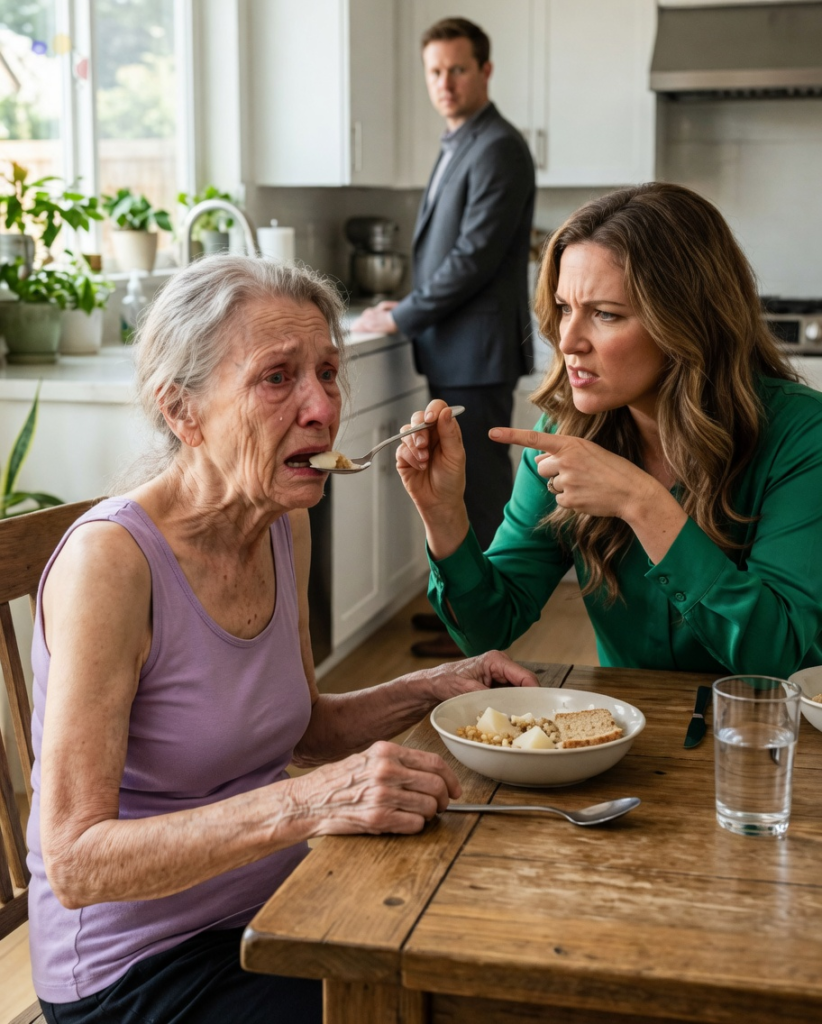
Out of nowhere, Valeria burst into the kitchen like a bird of prey. “Esperanza! What have I told you?!” his wife shouted, snatching the bread from her hands with shocking violence. Doña Esperanza shrank into herself, trembling, and began apologizing between sobs, like a little girl caught stealing.
Mateo felt his blood run cold and a blind rage began to cloud his vision. What was about to happen in that house would change their lives forever, because it was clear that something extremely dark and unforgivable was hiding behind his wife’s mask, and no one could imagine the true hell that was about to be unleashed.
PART 2
“Let go of that bread, Valeria!” Mateo’s voice thundered through the kitchen like a clap of lightning.
Valeria jumped, dropping the concha, which fell onto the marble floor. Doña Esperanza pressed herself against the kitchen counter, clutching her hands to her chest, her face bathed in tears.
“Mateo, my love, I… I was just watching her diet. Sugar is poison at her age!” Valeria stammered, trying to regain her elegant composure.
“Watching her diet? You’re treating her like a stray animal!” Mateo roared, moving toward his wife with a look that made her back up until she hit the refrigerator. “My mother was apologizing to you for wanting to eat a piece of bread. My mother — the woman who worked her fingers to the bone in two shifts so I wouldn’t die of hunger!”
Mateo slowly knelt beside Doña Esperanza, ignoring his wife, and took his mother’s bony hands. They were ice-cold. “Mom, look at me,” he pleaded, his voice breaking. “Why are you apologizing to her? Why do you look at her with such terror?”
Doña Esperanza couldn’t speak; she could only cry silently. It was then that Rosita, the cook who had worked for them for five years, came out of the pantry. Her eyes were also red from crying in secret.
“Mr. Mateo, forgive me for speaking up, but I can’t carry this on my conscience anymore,” Rosita said, wiping her hands on her apron. “Mrs. Valeria forbade me from preparing any Mexican food for your dear mother. Not even chicken broth, mole, or atole. She told me that if she caught me feeding her in secret, she would fire me without severance. Yesterday, Doña Esperanza begged me crying to make her some nata gorditas. She told me: ‘Rosita, I feel like a bad woman, a sinner, because I crave food and feel like everything I do is wrong.’”
Rosita’s words fell like stones on Mateo’s shoulders. A bad woman? His mother — the kindest person in the world — feeling like a criminal in her own home? Mateo stood up slowly. The air in the kitchen felt thick and suffocating.
“You made her feel guilty for wanting to eat?” Mateo hissed, looking at Valeria with deep disgust. “What else have you done, Valeria? Tell me now or I swear I’ll pack your bags today and you’ll never hear from me again.”
Valeria began crying desperately, but Mateo felt not an ounce of compassion. “Tell me the truth!” he shouted, slamming his hand on the granite counter.
“Her friends!” Doña Esperanza suddenly blurted out. The old woman’s voice, which until then had been a fearful whisper, rang clear. Everyone turned to look at her. Mateo’s mother straightened up slightly, as if her son’s fury had injected a spark of her old vitality. “She took my friends away, Mateo. I haven’t seen Doña Chuy or Doña Lupe in four months. Valeria tells them on the phone that I’m sick, that I’m sleeping, that I can’t receive visitors. She said they were a bad influence because we would get together to eat tamales and chat. I’m locked up, son. I’m a prisoner.”
Mateo felt like he couldn’t breathe. His mother loved those afternoons of lottery and café de olla with her comadres. It was her only connection to her roots since they had moved to this wealthy area.
“Sir,” Rosita interrupted again, walking to the service room and returning with a small shoebox. “Your mom asked me to keep this for her because Mrs. Valeria checks her drawers.”
Mateo opened the box. Inside were dozens of handwritten letters on school notebook paper. He picked one at random and began to read: ‘My son, today is Tuesday. I remembered when I used to take you to the town fair. I miss the smell of churros with sugar so much. Sometimes I think that if I die soon, I’ll stop being a burden to your wife. I feel like I’m in the way. I love you very much, but I know you’re too busy for my nonsense.’
A single tear rolled down the millionaire’s cheek, wetting the paper. The pain in his chest was so sharp that for a second he thought he was having a heart attack. He turned toward Valeria, who was now on her knees on the floor, sobbing uncontrollably.
“You intercepted her letters. You isolated her. You starved her. You stole her dignity and her joy of living,” Mateo said in a dangerously cold tone. “Why? Why do you hate my mother so much?”
“I don’t hate her!” Valeria screamed, choking on her own tears. “I don’t hate her, Mateo, I swear! I was terrified she would die because of me!”
Silence filled the kitchen, broken only by Valeria’s sobs. She lifted her face, her makeup completely ruined. “When I was 15, my grandmother lived with us. My parents went on a trip and left her in my care. She had severe diabetes. I… I was a stupid teenager. I wanted to go to a quinceañera party. My grandmother asked me for a piece of cake and a bottle of soda she had hidden. I gave them to her so she would let me leave peacefully. When I came back in the early morning… she was in a diabetic coma. She died three days later. It was my fault. I killed her because I didn’t take care of her, because I let her eat junk!”
The revelation hit everyone in the room. The trauma Valeria had carried for twenty years had exploded in the worst possible direction. Seeing Doña Esperanza growing old had paralyzed her with terror. In her guilt-ridden mind, she believed the only way to keep her alive was by controlling every bite, every outing, every emotion — turning herself into a ruthless jailer.
Doña Esperanza, with a strength that seemed to have returned suddenly from the depths of her soul, took slow steps toward her daughter-in-law. She bent down with difficulty and took Valeria’s face between her hands, weathered by years of hard work.
“Girl,” Doña Esperanza said firmly, forcing Valeria to look her in the eyes. “What happened to your grandmother was a tragedy, but you were only a 15-year-old girl. You can’t carry someone else’s death on your shoulders forever. But listen to me well: by trying to save me by force, you almost killed me with sadness. Being alive isn’t just breathing. Being alive is tasting sweet bread, laughing with friends until your stomach hurts, living with dignity. You treated me like an old piece of furniture you were afraid of breaking, not like a human being.”
Valeria clung to Doña Esperanza’s legs, screaming for forgiveness and releasing two decades of repressed guilt. Mateo watched the scene, understanding that the true villain of the story was not malice, but fear disguised as love. However, the damage had been done and the rules had to change drastically.
“Stand up, Valeria,” Mateo ordered. “I forgive you, and my mother seems to as well because she has a heart we don’t deserve. But from now on, things will be done my way. And you’d better learn fast.”
That same afternoon, Mateo picked up his phone and made decisions he had postponed for years. He delegated 80 percent of his logistics responsibilities to his right-hand man at the company. He promised not to work on weekends anymore. Then he personally called Doña Chuy, Doña Lupe, and Doña Toña.
The following Sunday, the mansion in Lomas de Chapultepec no longer looked like the home of a stuffy millionaire, but like a real village party. In the immense garden, long tables were covered with brightly colored tablecloths. The smell of red pozole, carnitas, and freshly made tortillas filled the air, even drawing curious glances from the wealthy neighbors.
Doña Esperanza sat at the head of the main table, surrounded by her comadres, laughing heartily as she told stories from her youth. A plate overflowing with food sat in front of her. Color had returned to her cheeks and sparkle to her eyes; her soul had come back to her body.
Rosita the cook handed out plates with a huge smile, while Don Chente and his family also had seats at the table, because that day no one was staff — everyone was family.
In the kitchen, Valeria, wearing an apron over her designer clothes, was learning to make salsa in the molcajete under the strict but loving supervision of Doña Esperanza. She made mistakes, cried from the chili, but laughed. For the first time in her life, she was learning to let go of control and to love freely.
Mateo watched everything from the window. He understood that having a bank account with millions of dollars was worthless if he let the people who had given him life wither away forgotten in a luxury house. He learned the hard way that true care does not imprison, but gives wings. That love is not forbidding out of fear, but accompanying someone in their happiness.
Doña Esperanza raised her glass of hibiscus water from the table, seeking her son’s gaze from afar. She winked at him and took a big bite of a piece of corn bread. Mateo smiled, his eyes misty, knowing that he had finally returned to the only place that truly mattered: home. And sometimes life brings you to the edge of losing everything just to teach you the right way to love.