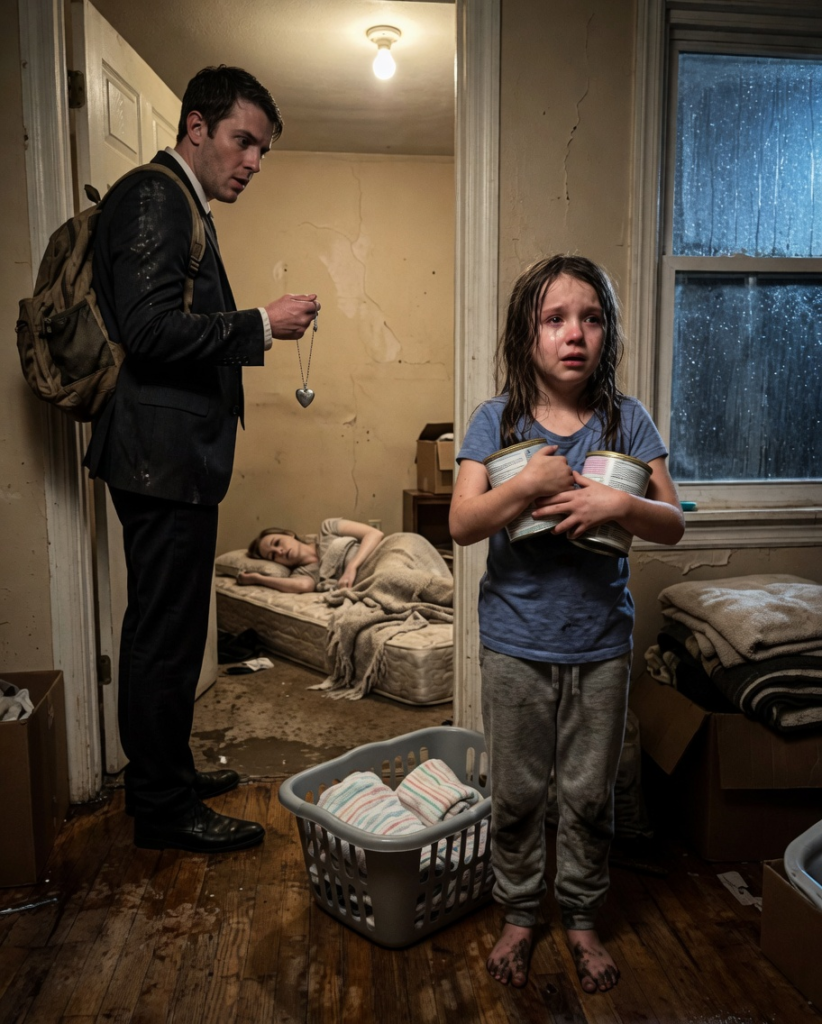
“Please forgive me… I’ll pay you back when I’m grown… my two baby brothers are home starving… Mom hasn’t opened her eyes in two days…”
Lucy’s voice barely made it past the storm raging outside.
She was on her knees in the middle of Star Market, her wet dress sticking to her thin legs, her small hands wrapped around two cans of infant formula as if someone might rip them away from her at any second.
No one in the crowd moved toward her.
No one bent down.
No one asked where her mother was, or how long the babies had gone without eating, or why a child with purple feet had walked into a luxury supermarket in the middle of a Phoenix downpour.
They only stared.
The polished marble floor beneath her reflected her trembling body like a cruel mirror.
Around her were shelves filled with imported wine, glass jars of olives, expensive cheeses, and fruit so carefully arranged it looked painted.
People who had come in from warm cars and warm houses stood with baskets on their arms, watching a hungry child beg for milk.
The manager, Richard Miller, stood over her like a judge.
He was broad, red-faced, and dressed in a charcoal suit that strained at the buttons.
His gold watch flashed when he pointed at the cans.
“Do you know what those cost?” he snapped.
“Almost two hundred dollars.
And you bring me coins from the gutter?”
Lucy flinched.
The coins she had placed on the counter were wet, dirty, and scattered.
A dime rolled slowly toward the edge before stopping near the cashier’s hand.
The cashier did not touch it.
“I didn’t mean to steal,” Lucy whispered.
“I was going to ask.
I just… I got scared.”
“Scared?” Richard repeated, loud enough for the nearby customers to hear.
“You walked in here, took merchandise off my shelf, and came to the counter with pocket change.
That is stealing.”
A woman in a cream-colored coat leaned toward her husband.
“Children like that are trained,” she murmured.
Her husband gave a dry laugh.
“Start them young, I guess.”
Lucy heard them.
Her face crumpled, but she did not let go of the formula.
“Please,” she said again, this time gripping Richard’s pant leg.
“My brothers are little.
They cry all night.
Mom hasn’t gotten up.
She’s cold, but she’s sweating.
I tried giving them water, but they spit it out.
Please, sir.
I’ll pay when I’m big.
I promise.”
Richard looked down at her hand on his pants as if it were filth.
“Get your hands off me.”
He jerked his leg away so hard she fell forward on both palms.
A few people laughed.
The sound was soft at first, almost nervous.
Then it spread.
Someone snickered near the bakery case.
A teenage boy lifted his phone, but his mother pushed it down only because Alexander Castle had entered the aisle behind them.
Alexander had come to Star Market for one thing: silence.
He had spent the entire day in meetings where men smiled while lying and shook hands while hiding knives behind their backs.
He had not planned to buy anything important.
He had only wanted to walk through a place where no one knew him well enough to ask for a favor.
Then he heard Lucy.
At first, he saw only the back of her head and the shaking line of her shoulders.
But when she turned, when the light caught her face, something inside him tightened.
It was not pity.
Pity was too soft a word.
It was recognition, though he did not know why yet.
He had seen desperation before.
He had once been a boy standing outside a hospital room with no money and no one listening.
He had spent the rest of his life making sure no door could be closed in his face again.
But this little girl’s fear had no armor around it.
“Security!” Richard shouted.
“Get her out, and call the police.
I want this handled properly.”
The guard stepped forward.
He was a young man with uncertain eyes, but he obeyed anyway.
His hand reached toward Lucy’s shoulder.
Alexander caught his wrist before it landed.
The guard froze.
“Don’t touch the child,” Alexander said.
His voice was not loud.
That made it worse.
Silence fell over the store so suddenly that the rain outside became audible again, drumming against the glass doors.
Richard turned, already irritated.
Then he saw who had spoken.
The color drained from his face.
“Mr.
Castle,” he said quickly.
“I’m sorry.
I didn’t realize you were here.
This is just a small security matter.”
Alexander did not look at him.
He looked at Lucy, still kneeling, still holding the cans with both arms.
“How much?” he asked.
Richard blinked.
“Sir?”
“The formula.
How much?”
“Two hundred dollars, give or take.
But she—”
Alexander opened his wallet, removed a stack of bills, and placed them on the counter.
“That is two thousand.”
The cashier stared at the money.
Richard’s mouth opened, then closed.
“Keep the change,” Alexander said.
“Use it to teach your staff the difference between theft and hunger.”
No one laughed now.
Alexander bent down.
His knees touched the same cold floor where Lucy had been humiliated.
He lifted the cans from the counter and placed them gently in her arms.
“Go home,” he said.
Lucy stared at him with red, swollen eyes.
“Thank you,” she breathed.
“Thank you, sir.”
She backed away as if kindness might change its mind if she moved too slowly.
Then she turned and ran toward the automatic doors, clutching the formula under her coat.
Richard tried to smile.
“Very generous, Mr.
Castle.
Of course, had I known the situation—”
Alexander looked at him then.
Richard stopped talking.
“You knew enough,” Alexander said.
He walked out without buying anything.
Outside, the rain hit him like thrown gravel.
His driver was waiting at the curb with an umbrella, but Alexander lifted one hand to stop him.
Across the parking lot, Lucy was running.
Barefoot.
In the dark.
Her small body bent over the cans as if the storm itself were trying to steal them.
Alexander stood beneath the supermarket awning for one second longer.
He told himself she was going home.
He told himself he had helped.
He told himself money was the only thing required.
Then Lucy stepped off the curb into ankle-deep water and nearly fell.
Alexander followed.
He kept his distance.
He did not want to scare her.
She turned twice, but the rain and darkness hid him.
She cut through side streets where the expensive stores disappeared and the sidewalks cracked.
The lights became fewer.
The houses became smaller.
Chain-link fences leaned into yards full of wet trash and broken plastic toys.
By the time she reached the old apartment building on Maricopa Street, Alexander’s suit was soaked through.
Lucy slipped through a side door that did not close properly.
Alexander paused outside.
The building looked abandoned from the street.
One window was covered with cardboard.
Another had a curtain hanging by one hook.
Water poured from a broken gutter and splashed into a bucket already overflowing near the stairs.
From inside came the thin, exhausted cry of a baby.
Then another.
Alexander went in.
The hallway smelled of mildew and old smoke.
Wallpaper peeled in long strips.
Somewhere above him, a television played to no one.
He followed the sound of Lucy’s voice to the back apartment, where the door was open just enough for light to leak through.
“Please don’t cry,” she whispered.
“I got it.
I got the milk.”
Alexander pushed the door gently.
The room was colder than outside.
A small lamp sat on the floor, its shade missing, throwing yellow light against walls stained by leaks.
There was no couch.
No table.
Only a cracked plastic chair, a pile of folded blankets, and a laundry basket lined with towels where two baby boys lay side by side, crying weakly.
Lucy knelt beside them, trying to twist open one of the cans.
Her fingers were numb.
She could not get the seal to break.
“Let me,” Alexander said softly.
Lucy spun around.
Fear flashed across her face.
“I didn’t steal from you,” she said quickly.
“You paid.
You paid, right?”
“I paid.”
“Then please don’t take us away.”
The words entered him like a blade.
“I’m not here to take you away.”
Her eyes searched his face, trying to decide whether adults could be believed.
Behind her, something moved on the mattress.
Alexander turned.
A woman lay there beneath a thin blanket, her skin gray-pale, her hair damp against her forehead.
She was too young to look so worn.
One arm hung over the edge of the mattress, her fingers curled loosely toward the floor.
Her breathing came in shallow pulls, each one sounding like it had to fight its way out.
He stepped closer.
Then he saw the locket.
It lay beside her pillow, half hidden under a folded cloth.
Silver.
Oval.
Scratched at the edge.
Alexander’s entire body went still.
He knew that locket.
He had bought it twenty years earlier from a street vendor outside a train station in Chicago.
He had been twenty-three then, poor in a way that made every dollar feel alive.
The vendor had said the silver was cheap, but Alexander had polished it with his sleeve until it shone.
He had given it to Emily Hart on a freezing December night and promised her that one day he would replace it with diamonds.
Emily had laughed and told him she did not want diamonds.
She wanted him to keep his promises.
Alexander reached for the locket with a shaking hand.
Lucy rushed between him and the mattress.
“Don’t,” she said.
“That’s Mom’s.
She said never let anyone take it.”
Alexander could barely speak.
“Your mother’s name is Emily?”
Lucy nodded slowly.
“Emily Hart?”
Her eyes widened.
“How do you know that?”
Alexander looked at the woman on the mattress again.
The years had changed her.
Hunger had hollowed her cheeks.
Illness had burned away the brightness he remembered.
But beneath the suffering was the same face he had carried privately through marriages he never made, deals he did not celebrate, and lonely rooms in cities that never became home.
“Emily,” he whispered.
The woman’s eyelids fluttered.
Lucy turned sharply.
“Mom?”
Emily’s lips parted, but no sound came.
Alexander took out his phone and called his private physician first, then an ambulance.
His voice was controlled, but his hand trembled.
“Severe dehydration, possible infection, two infants malnourished, child exposed to cold,” he said.
“Send help to Maricopa Street.
Now.”
Lucy stared at him.
“Are they going to take Mom?”
“They’re going to help her breathe easier,” he said.
“They’re going to help your brothers eat.”
“But we can’t pay.”
He looked down at her.
“You don’t have to.”
For the first time, her face changed.
Not into relief.
Not exactly.
It was something more fragile.
The possibility that the world might not close its fist around her.
Alexander opened the formula and warmed water from a kettle that barely worked.
He tested the bottles on his wrist as if he had done it a hundred times, though he had never once held a child this small.
Lucy watched him like a soldier watching a stranger handle a weapon.
When the first baby latched onto the bottle, the room seemed to breathe.
Lucy made a sound that was almost a sob.
“That’s Noah,” she said.
“The other one is Caleb.
Noah cries louder.
Caleb just gets quiet.
I hate when he gets quiet.”
Alexander looked at the second baby, whose eyes were half closed.
“How long has your mother been sick?”
“She coughed for a long time.
Then she got hot.
Then she said she just needed to sleep.
But she wouldn’t wake up right.
I tried to call people, but the phone got shut off.
I went to the church, but nobody was there.
I went to the store because Mom said babies can’t wait.”
She said it plainly, without drama.
That made it worse.
Sirens sounded outside fifteen minutes later.
Paramedics filled the room with blue gloves, bags, oxygen, and urgent voices.
Lucy backed into a corner with both hands over her ears.
Alexander knelt beside her.
“Look at me,” he said.
“They are helping.”
“They’ll be mad she didn’t take us to the doctor.”
“No,” he said.
“They’ll be mad no one helped sooner.”
Emily was lifted onto a stretcher.
As they raised her, the locket slid from the pillow and dropped to the floor.
Alexander picked it up.
The clasp had broken.
The front popped open in his palm.
Inside was an old photograph.
It was not the photograph he expected.
One side held a faded picture of Emily at twenty-two, smiling into sunlight.
The other side held a tiny hospital bracelet, folded carefully until only one name could be seen.
Lucy Castle Hart.
Alexander stared at it until the room blurred.
Castle.
Lucy’s middle name was his name.
Emily’s eyes opened for one second as the paramedics moved her toward the door.
She saw him standing there, soaked, holding the locket.
Her face crumpled.
“Alex,” she breathed.
Then she passed out.
At the hospital, everything moved fast and not fast enough.
Emily was taken behind double doors.
The babies were examined, warmed, fed, and monitored.
Lucy sat in a chair too big for her, wrapped in a blanket, refusing to sleep until someone promised her she would not wake up alone.
Alexander sat across from her.
He had made billion-dollar decisions with less fear than he felt waiting for a doctor to speak.
Near dawn, a physician came out and told him Emily had pneumonia complicated by dehydration and exhaustion.
She was critical, but alive.
The babies would recover.
Lucy had mild hypothermia and bruised feet, but no lasting damage if she rested.
Alive.
Alexander held onto that word.
When Lucy finally slept, curled sideways in the hospital chair, Alexander stepped into the hallway and opened the locket again.
Lucy Castle Hart.
He called his attorney and asked for an investigator, not because he doubted Emily, but because he needed to understand how twelve years of silence had turned into a child begging on a supermarket floor.
By noon, the answer began to arrive.
Emily had tried to contact him.
Not once.
Many times.
Letters had been sent to his old office, then to Castle Holdings.
Some had been returned.
Some had been signed for by assistants no longer employed.
One letter, scanned into an old company archive and forgotten, contained a line that made Alexander sit down hard in the hospital hallway.
I do not want your money, Alex.
I only need you to know that our daughter exists.
Our daughter.
The date was eight years earlier.
Alexander read it again and again until the words stopped behaving like words.
He had spent eight years believing Emily had left because she wanted a quieter life with another man.
That was what his former chief of staff, Daniel Reeves, had told him.
Daniel had said Emily refused calls.
Daniel had said she asked not to be bothered.
Daniel had said she had accepted a settlement and disappeared.
Alexander had believed him because believing it hurt less than chasing someone who had chosen to leave.
Now the lie stood in front of him with Lucy’s face.
By evening, Emily woke.
Alexander entered her room quietly.
She looked smaller against the white sheets, but her eyes were open.
They filled with tears the moment she saw him.
“The children?” she asked.
“Safe,” he said.
“Fed.
Warm.
Lucy is sleeping.
Noah and Caleb are being watched by nurses.”
Emily turned her face away, shame moving across it like a shadow.
“She went to the store, didn’t she?”
Alexander nodded.
Emily closed her eyes.
“I told her not to leave the apartment.
I couldn’t get up.
I heard them crying, and I couldn’t lift my head.
She kept saying she would fix it.
She’s eight, Alex.
She thought she had to fix it.”
His throat tightened.
“Why didn’t you tell me?”
Her eyes opened.
There was no anger in them at first.
Only exhaustion.
“I did.”
Those two words landed harder than any accusation.
“Emily—”
“I wrote letters.
I called your office until they stopped putting me through.
Daniel came to see me when I was pregnant.
He said you wanted proof.
He said you thought I was trying to trap you.”
Alexander’s face changed.
“Daniel said that?”
Emily nodded faintly.
“He brought papers.
Money.
He said if I signed, you would never question paternity, never fight me, never shame the baby publicly.
I tore the papers in half.
After that, no one answered.”
Alexander stood very still.
Daniel Reeves had been more than an employee.
He had been the man who guarded Alexander’s calendar, filtered his calls, handled personal crises, and used loyalty like a mask.
“I never knew,” Alexander said.
Emily looked at him for a long time.
“I wanted to believe that.
Then years passed.
Hunger is very convincing.
It tells you people forgot you because they chose to.”
Alexander’s hand tightened around the bed rail.
“Lucy is mine.”
Emily’s tears spilled silently.
“Yes.”
He looked through the glass window into the hallway, where Lucy slept under two blankets with a nurse seated nearby.
His daughter.
His child had knelt on a supermarket floor while strangers laughed.
His child had walked through rain with bleeding feet to save her brothers.
His child had known his name only as a broken instruction inside a locket.
The next morning, Alexander returned to Star Market.
Richard Miller saw him enter and hurried forward with a nervous smile.
“Mr.
Castle.
I hope everything was handled satisfactorily.
Terrible situation.
We were all just trying to follow policy.”
Alexander did not slow down.
Behind him came his attorney, two representatives from his foundation, and a local news producer Richard recognized too late.
“Bring me the security footage from last night,” Alexander said.
Richard’s smile collapsed.
“There may be privacy concerns.”
“Then let me be clear,” Alexander said.
“That child you humiliated is my daughter.”
The words seemed to empty the air from the store.
The cashier went pale.
The guard looked at the floor.
Customers nearby stopped moving.
Richard stared at him, unable to decide whether to apologize or deny everything.
Alexander stepped closer.
“You did not know she was mine when you degraded her.
That is the point.
You believed she belonged to no one important, so you treated her as if she belonged to no one at all.”
Richard opened his mouth.
Nothing came out.
By the end of the week, the footage was everywhere.
Not because Alexander wanted Lucy exposed, but because he blurred her face and released only what mattered: the manager’s words, the laughter, the hand reaching toward a child, and the moment an entire room chose cruelty over compassion.
Richard was fired before noon.
The cashier resigned.
Star Market issued statements, apologies, promises of training, and donations that sounded better on paper than they felt in the heart.
Alexander did something quieter.
He bought the apartment building on Maricopa Street through a housing nonprofit and moved every tenant into clean, safe units before renovations began.
He funded a clinic two blocks away and named it after no one, because Emily said poor people did not need monuments.
They needed doctors who answered the phone.
Then he went after Daniel Reeves.
The investigation uncovered hidden emails, intercepted letters, and financial records showing Daniel had redirected personal correspondence for years.
He had feared Emily would distract Alexander during a critical expansion deal.
He had decided, with the arrogance of a man who thought proximity to power made him powerful, that one woman and one child were acceptable losses.
When Daniel was confronted in a glass-walled conference room at Castle Holdings, he did not deny it for long.
“I protected you,” he said, his face tight.
“You were building something historic.
She would have complicated everything.”
Alexander looked at the man who had stolen eight years from him.
“You protected my schedule,” he said.
“Not my life.”
Daniel was removed by security and later charged for fraud connected to the settlement documents he had fabricated.
That punishment did not return a single night Emily had spent alone, or a single meal Lucy had missed, but it named the betrayal properly.
Sometimes justice begins there.
Emily recovered slowly.
The first time Lucy saw her sitting up in the hospital bed, she ran so hard that one nurse gasped.
Emily wrapped her arms around her daughter and wept into her hair.
“I got the milk,” Lucy whispered.
“I know, baby.”
“The man helped.”
Emily looked over Lucy’s shoulder at Alexander.
“Yes,” she said softly.
“He did.”
Alexander did not ask for forgiveness that day.
He paid the hospital bills, hired nurses, arranged housing, bought clothes, filled the refrigerator, and still understood that none of it erased absence.
Money could repair a roof.
It could not instantly repair a child’s belief that adults disappeared when needed most.
So he came every day.
At first, Lucy watched him carefully.
She accepted food from him but counted the containers.
She let him carry Noah but stayed close.
She asked him once whether rich people could go to jail, and he told her yes, if the law was brave enough and people told the truth loudly enough.
Three weeks later, she asked him a different question.
“Are you my dad?”
Alexander was sitting beside her in the hospital garden, where she had taken off her shoes just to feel dry grass under her feet.
He did not reach for her.
He did not soften the answer with pretty words.
“Yes,” he said.
“I am.
I didn’t know.
But I should have known.
And I am sorry.”
Lucy studied him.
“Mom said you were good before.”
He swallowed.
“I want to be good now.”
She looked down at her hands.
“Can my brothers come too?”
“Always.”
That was the first time she leaned against him.
Not fully.
Just her shoulder against his arm.
For Alexander, it was enough to break him.
Months later, Emily and the children moved into a bright house with a blue door, a backyard, and windows that opened without sticking.
Noah and Caleb grew round-cheeked and loud.
Lucy started school with new shoes, a purple backpack, and emergency snacks hidden in every pocket because she still did not trust full cupboards completely.
Alexander was there for the first day.
He stood beside Emily, both of them watching Lucy walk toward the school doors.
She turned once and lifted her hand.
Emily whispered, “She’s still scared it will vanish.”
Alexander nodded.
“Then we keep showing up until she believes it won’t.”
Emily did not answer right away.
Forgiveness had not arrived like a sunrise.
It came in small, uneven pieces.
In a ride to a doctor’s appointment.
In a midnight bottle for Caleb.
In Alexander sitting quietly while Emily told him how many nights she had hated him just to survive loving him.
He listened to all of it.
He did not defend himself with ignorance, because ignorance had still left them hungry.
One rainy evening almost a year after the night at Star Market, Lucy found the silver locket in a small velvet box on Emily’s dresser.
The clasp had been repaired.
The scratches remained.
Inside were three pictures now.
Emily.
Lucy as a baby.
And one new photograph of all five of them standing in the backyard, Noah reaching for Alexander’s tie, Caleb laughing in Emily’s arms, Lucy between her parents with one hand holding each of theirs.
Lucy closed the locket and pressed it to her chest.
“Can I wear it?” she asked.
Emily looked at Alexander.
Then she nodded.
“Yes,” she said.
“But only if you remember something.”
Lucy waited.
Emily touched her daughter’s cheek.
“You were never supposed to save all of us alone.”
Lucy’s eyes filled, but she did not cry.
She climbed into her mother’s lap like a much younger child and held on.
Alexander stood in the doorway, watching the family he had almost lost without ever knowing he had it.
That night did not become a clean miracle.
It remained a wound, even after it healed over.
A little girl had been mocked for trying to feed babies.
A mother had nearly died because every door closed at once.
A father had been robbed of the truth, but he had also been powerful enough that people assumed the truth would always find him.
It had not.
And maybe that was the part people argued about afterward.
Was Alexander a hero because he followed Lucy and saved them, or was he still responsible because his world had been built so high that Emily’s letters never reached him? Some people blamed Daniel.
Some blamed Richard.
Some blamed the crowd that laughed.
But Lucy, when asked years later what she remembered most, did not mention the money.
She remembered the cold floor.
She remembered the cans in her arms.
And she remembered the first adult who knelt down low enough to look her in the eyes.