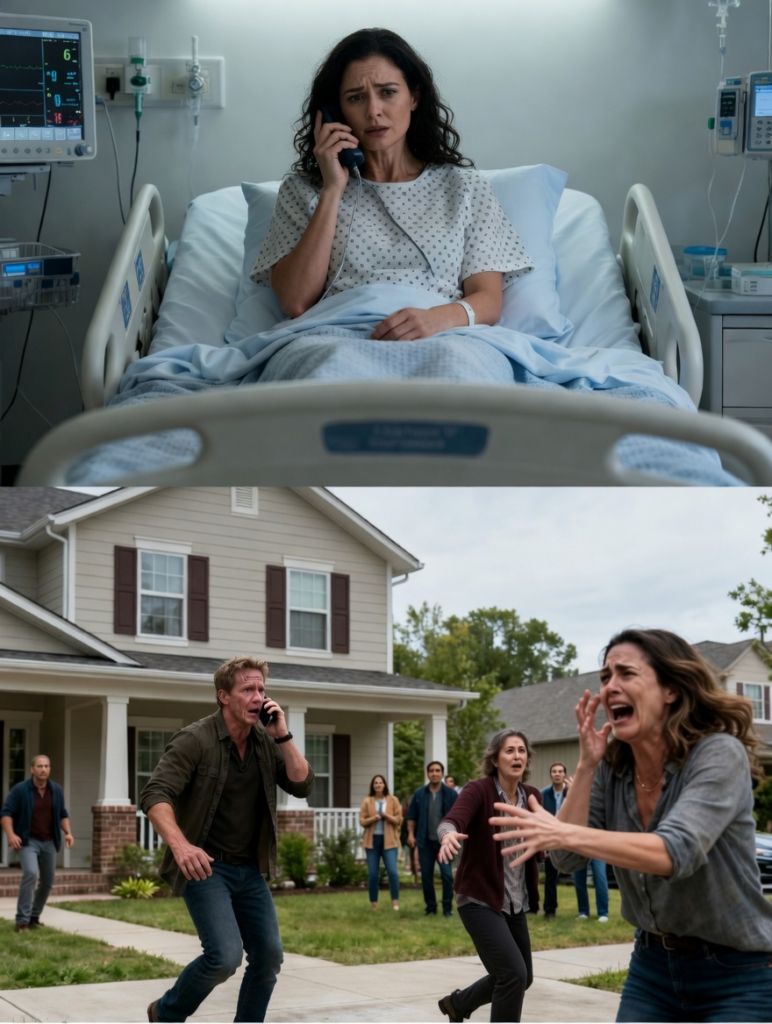
I Got Hospitalized For Exhaustion-But NO ONE From My Family Showed Up. No Visits. No Phone Calls. Just A Text From My Brother: “Hey, Can You Still Cover My Car Payment?” So I Stopped Pretending I Had A Family. I Did This. Three Days Later, My Dad Called Me In A Panic Because…
Part 1
The hallway outside the kindergarten speech room always smelled like bleach, wet coats, and graham crackers.
That’s the first thing I remember clearly.
The second thing is Mila’s sticky little hand slipping out of mine.
One second I was walking her back from group therapy, reminding her to use her “snake sound” instead of spraying spit every time she tried to say s. The next second the floor tilted so hard it felt like the building had been picked up and shaken. The white cinderblock walls blurred. Somebody said my name from very far away. Then everything went black.
When I woke up, I was under fluorescent lights so harsh they made the inside of my skull hurt.
A nurse with silver glasses was standing over me, tightening something around my arm. Blood pressure cuff. IV tugging at the back of my hand. My mouth tasted like pennies and old paper. There was a soft machine beep somewhere to my left and the sour-salty smell of hospital broth hanging in the room.
“Oh good,” the nurse said when she saw my eyes open. “You’re back with us.”
I tried to sit up too fast and instantly regretted it. The room swayed. My chest fluttered like something trapped was trying to get out.
“What happened?”
“You collapsed at work,” she said. “Dehydration, sleep deprivation, acute stress. Maybe your body finally filed a formal complaint.”
I let out a breath that was almost a laugh and almost a sob.
That was the thing about burnout. People liked to talk about it like it was a cute modern inconvenience. Light a candle. Take a bath. Say no more often. But there was nothing cute about waking up in a hospital gown that smelled faintly of industrial detergent and realizing your hands were shaking too hard to unlock your phone.
I worked as a speech therapist in a public elementary school outside Portland. Which meant I spent my days in a little room with low shelves, articulation cards, plastic mirrors, chipped puzzles, and a parade of children coughing directly into my soul. It was October. Half the school had some kind of cold. The heat clicked on and off with a metal groan. The nurse shared the adjoining office, so there was always someone crying, sneezing, throwing up, bleeding, or all four.
After school I did paperwork until my eyes crossed. Medicaid billing. Progress reports. Parent emails. Meeting notes. Then I went home to my studio apartment with its humming refrigerator and one narrow window overlooking a parking lot, and most nights I ate microwave noodles standing up because sitting down felt too much like surrender.
On weekends, I worked at a toy store in the mall.
I told people it was temporary. Just until things settled down.
Things never settled down.
The nurse checked my chart and softened a little. “You need to rest. And I mean actually rest, not fake rest where you answer emails from bed.”
I nodded, because that was easier than admitting my first thought had been whether I’d missed my Saturday shift.
When she stepped out, I reached for my phone.
I had enough sense left to text my family first.
Hey. I’m at the hospital. Collapsed at school. I’m okay, just exhausted. On fluids. Don’t worry. Love you.
I stared at the screen after I sent it.
My mom usually answered with dramatic speed when she needed something. My dad replied in blunt little bursts, like punctuation offended him. My younger brother, Josh, mostly communicated through emojis and Venmo requests. But still, this was different. Hospital different. Collapse at work different.
I figured at least one of them would call.
Nobody did.
Time in the hospital turned into little islands. A blood draw. A paper cup of ice chips. A doctor using the words “burnout” and “malnutrition-adjacent” in the same calm tone like he was describing cloud cover. Evening came. The room dimmed. Hallway wheels squeaked past. Somewhere down the corridor, a baby screamed with breathtaking commitment.
My phone stayed silent.
I checked it every few minutes anyway, because hope is embarrassing like that.
Maybe Mom was driving. Maybe Dad was in the garage and hadn’t heard it. Maybe Josh was asleep.
Three hours later, my phone buzzed.
My heart jumped stupidly.
It was Josh.
First came a sad face emoji.
Then: can you still cover the car thing?
I read it twice because my brain refused to process it the first time.
No are you okay.
No that sounds scary.
No want me to come.
Just the car thing.
I stared at the message until the letters started swimming.
And there it was, sudden and clean and awful, like a window breaking in winter.
I wasn’t a daughter. I wasn’t a sister. I was a utility.
A payment source with a pulse.
The nurse came back in and asked me how my pain was on a scale from one to ten.
“Physically?” I said.
She gave me a tired little smile. “Sure.”
“Maybe a three.”
“And otherwise?”
I looked up at the ceiling tile with the faint brown water stain in one corner.
“High enough to set something on fire.”
She actually barked out a laugh at that, then patted my blanket like I was six. “That’s at least honest.”
After she left, I opened the family group chat again.
Still nothing from my parents.
I could see they’d read my message. Those tiny little read receipts sat there like cold eyes.
I turned my face toward the wall.
The thing is, you can know you’re being used and still not let yourself name it. You can live inside a lie for years if the lie is familiar enough. I had spent most of my life being “the reliable one,” and reliability is just exploitation in a prettier sweater when you’re the only one expected to have any.
Lying there with an IV in my arm and the smell of canned chicken broth drying in the air, I started doing the math without even meaning to. The money I’d sent last month. The month before that. The second job. The canceled trip with friends. The used tires I kept putting off. The cheap groceries. The hundred little ways I kept my own life held together with staples and excuses while theirs floated on top of mine.
My phone buzzed again.
For one ridiculous second, I hoped it was Mom.
It was Dad.
Don’t forget mortgage due Thursday.
That was all.
No comma. No how are you. No are you still in the hospital.
Just a reminder, as if I’d texted them from a grocery line instead of an emergency room.
I put the phone down on my blanket and laughed.
It wasn’t a normal laugh. It came out dry and cracked, the kind that makes people glance over because they’re not sure whether to call security or a chaplain. I clapped a hand over my mouth, but it was too late.
Something inside me had shifted.
Not healed. Not hardened all the way.
Shifted.
The next morning they moved me to a quieter room on a floor that smelled less like bleach and more like overcooked oatmeal. A volunteer brought me tea I didn’t ask for. My body felt heavy, as if gravity had personally taken offense at me. And still, even then, my family managed to make my hospitalization about themselves.
By the end of the day, Mom had texted:
Can you send me 50? There’s a sweater sale and mine are all pilling.
An hour later:
Do you remember where you got that blender? Ours broke.
Then:
You okay? Just send it if you’re busy.
I looked at those messages until my vision blurred.
They knew where I was.
They knew I had collapsed.
And somehow sweaters still ranked above me.
That night, I opened the Notes app and typed one sentence.
They do not love me. They depend on me.
I read it over and over until it stopped feeling dramatic and started feeling true.
Then I turned my phone face down, listened to the IV drip into my arm, and made a decision that scared me so badly my whole body went cold.
For the first time in my life, I was going to stop rescuing them.
And I had no idea what would happen when they realized the machine they’d been feeding from had decided to unplug itself.
Part 2
When I was ten, my mother stood in my bedroom doorway at two in the morning wearing a pink robe and the expression of a woman asked to carry a cross she had personally built.
“Sweetheart,” she whispered, “Josh is crying again. Can you rock him for a little while? Mommy has such a migraine.”
I was already sitting up before she finished.
That was the trick of my childhood. They never phrased it like an order. It was always can you, would you, be a sweetheart, help me out, you’re the mature one. They wrapped responsibility in praise and handed it to me so often I started to confuse being needed with being loved.
Josh was a baby then, all damp curls and hot little fists. I remember lifting him from the crib and the smell of baby shampoo mixed with sour spit-up. I remember the weight of him on my shoulder while he cried into my neck. I remember swaying in the blue dark of his room, half asleep myself, feeling proud that I was the one who could fix things.
Mom said it all the time.
You’re the grown-up one.
You’re so strong.
You understand.
Those words followed me through my childhood like a song I didn’t know how to stop hearing.
By eleven, I was the one putting Josh to bed most nights.
By twelve, I was picking him up after school because Mom was too drained and Dad was “between things,” which could mean anything from freelance work to reorganizing screws in the garage while muttering about taxes.
By thirteen, I knew how to make boxed mac and cheese, check spelling homework, soothe a tantrum, and keep a toddler entertained while writing my own paper at the kitchen table under a flickering light.
When my friends talked about grounding or curfews, I couldn’t relate. My parents barely noticed where I was as long as I was useful.
The hospital gave me too much quiet, and quiet makes memory loud.
On my second night there, while the building settled around me in little clicks and distant rolling carts, I started remembering all the moments I had mistaken for proof that my family loved me.
Like the time I was fourteen and had finally been invited to a birthday party everyone in my class was going to. Bowling. Pizza. One of those impossible middle-school social chances where attendance felt like citizenship. I’d spent all week excited. That morning Mom touched Josh’s forehead, sighed like a widow in a period drama, and said, “You wouldn’t leave me alone with a sick child, would you?”
No anger. No yelling. Just guilt, soft and devastating.
So I stayed.
I watched photos go up online that night while Josh, perfectly recovered by dinnertime, threw a fit because his soup was “too wet.”
I told myself that was what family did. Sacrifice. Help. Show up.
Funny how the showing up only flowed in one direction.
On the third day in the hospital, I was cleared to leave the next morning if I could keep food down and stop looking like I might faint from the effort of blinking. A doctor with kind eyes and coffee breath went through my discharge instructions.
Hydrate.
Sleep.
No work for a week.
Actual meals.
Follow-up appointment.
He handed me the papers like they were simple. Like the hardest part would be remembering to drink water.
What I didn’t tell him was that my real illness had teeth, and it wore my last name.
During those three days, my family sent eleven messages.
None of them asked how I was doing.
Dad: Bill came in. Need your part by Friday.
Mom: If I order from that site today shipping is free. Could you send me 50?
Josh sent a Venmo request with the note: bless u sis.
Then another: serious tho.
Then a meme about being broke.
I didn’t cry when I read them. I went too far past crying for a while. I just got very still.
There’s a point where pain gets so sharp it stops feeling emotional and becomes structural. Like suddenly you can see the architecture of your whole life. Every beam. Every crack. Every room built around keeping other people comfortable.
I went home on a gray Thursday afternoon carrying a paper bag of prescriptions and wearing the same sweatshirt I’d collapsed in. The apartment smelled stale, like shut windows and old coffee. My refrigerator hummed its familiar engine-growl. Dust glowed in the weak strip of light by the sink.
Usually I hated how small the place felt. That day it felt sacred.
Nobody was there asking for anything.
I set my bag down and stood in the middle of the room listening to my own breathing.
Then my phone started buzzing.
First Josh.
Then Mom.
Then the family group chat.
I didn’t answer. I made coffee because the motions were familiar and I needed my hands busy. Filter, scoop, water, click. The smell rose warm and bitter through the apartment, and I sat by the window in my socks holding the mug between both palms like it was an anchor.
Only after the first cup did I look.
Mom: Sweetheart how are you? I’m worried.
Four minutes later:
We got the electric bill. Can you send the payment today so there’s no late fee?
Josh: you alive???
Then:
if yes, car thing due tomorrow
Dad: Your mother is upset. Don’t ignore us.
And then, a little later, the one that finally did it.
Dad: You didn’t forget the mortgage, did you?
I stared at that text until the edges of the screen went fuzzy.
It wasn’t just the lack of care. It was the certainty. The entitlement. The assumption that even from a hospital bed, even half-conscious, even medically ordered not to work, I would still arrange my life around theirs.
I opened the little spiral notebook I kept in my junk drawer and started writing down every single thing I paid for.
Mortgage contributions.
Electric.
Internet.
Josh’s car.
Josh’s “design course,” which turned out to be some online platform with more gaming content than education.
Grocery runs.
Their holiday gifts.
Emergency cash.
Cash for not-actually-emergencies disguised as emotional emergencies.
When I finished, my hand hurt.
I grabbed a calculator.
Then I did the total again because I thought I had to be wrong.
I wasn’t wrong.
Over the last three years, I had given them enough money to change my own life.
A decent apartment. A reliable car. A savings cushion. Dental work I kept postponing. An actual vacation somewhere with sunlight and no one asking me for a login password or utility transfer.
Instead, I had this studio, two jobs, chronic exhaustion, and a family that treated my collapse like an inconvenient billing delay.
That realization did something clean to me. Brutal, but clean.
Not rage. Not exactly.
Clarity.
I turned off my phone and took the first full nap I’d had in years.
When I woke up, it was dark outside and raining hard enough to blur the parking lot lights. The apartment smelled faintly like coffee and damp concrete. I sat up slowly, reached for my phone, and turned it back on.
It lit up instantly with missed calls and a pile of new messages.
Mom had switched tones.
I guess we don’t matter now.
Josh had escalated too.
wow so you really are doing this
Dad, blunt as ever:
Aaron. Answer your phone. What is wrong with you?
I sat there on my unmade bed, hair stuck to my cheek, feeling weirdly calm.
Then I typed the message that should have terrified me.
Dad, I can’t help this month. I have my own expenses.
I hit send before I could talk myself out of it.
Thirty seconds later he replied.
What do you mean you can’t?
Then:
We are counting on you.
Then:
After everything we’ve done for you.
Mom came next, faster than I’d ever seen her type.
So you’re abandoning your family while your mother is sick with worry?
Josh, because of course:
selfish much
I read every message. Slowly. Carefully.
Something inside me that had always rushed to soothe, explain, apologize, negotiate—something old and trained and tired—waited for me to perform its usual routine.
I didn’t.
Instead, I wrote:
I don’t owe you.
Then I turned my phone off again.
The silence after that felt so strange it almost made me dizzy.
I put on my coat and went outside just to move. The air had that wet Oregon cold that smells like leaves turning and asphalt darkening under rain. I walked with no destination until I ended up in a home goods store I’d passed a hundred times and never let myself enter because every nonessential dollar already belonged to somebody else.
Inside it smelled like cinnamon candles and cardboard.
I picked up a heavy green ceramic mug with a gold rim. Deep, glossy, beautiful. The kind of thing I’d normally call unnecessary.
I bought it.
Then I bought myself a pair of simple silver earrings from a jewelry counter two doors down. No occasion. No justification. Just because I liked the way they caught the light.
It wasn’t revenge shopping. It wasn’t even rebellion.
It was proof.
Proof that I was a person allowed to want things.
When I got home and turned my phone back on, there were twenty-two missed calls, eight voicemails, and one new message from my dad that made my stomach go cold.
Pick up. Urgent. Mom’s not well.
And when I finally answered, the first thing he said was so raw with panic that for one horrible second I believed him completely.
“If you want to see your mother alive,” he whispered, “you need to come now.”
Part 3
I did not ask sensible questions.
That is one of the humiliating things about hope. Even after it has been used against you for years, it still runs on instinct.
I didn’t ask whether an ambulance had come.
I didn’t ask which hospital.
I didn’t ask what the doctors said or why he sounded breathless but not surrounded by actual emergency noise.
I just grabbed my keys.
Rain hit the windshield in quick hard bursts all the way across town. The wipers thudded back and forth. My pulse kept pace. I drove with my shoulders locked and the terrible sentence from my father echoing in my head.
If you want to see your mother alive.
By the time I pulled up to my parents’ house, the porch light was already on. Yellow. Waiting.
Dad opened the front door before I knocked.
His face looked pinched and tired in the hallway light. He put a finger to his lips immediately, the way people do in movies when someone is gravely ill in the next room.
“She’s resting,” he whispered.
The house smelled like Vicks, lavender air freshener, and something fried from earlier. Familiar and slightly stale. My body reacted before my mind did. Same old hallway runner rug. Same framed landscape print Mom always said made the place feel “classy.” Same crack in the baseboard near the coat closet Josh had put there with a toy truck twenty years ago.
Everything looked normal, and that should have warned me more than it did.
Mom was in bed with the curtains drawn.
A small lamp on the dresser turned the room honey-colored. She looked pale against the pillows, hair brushed neatly back, hands folded over a blanket too carefully to be accidental. Josh sat beside her with the solemn expression of someone performing concern for an audience.
When Mom saw me, her face crumpled beautifully.
“Aaron,” she whispered.
My throat closed.
No matter how old you get, some part of you still remembers the shape of your mother before you remember the shape of her failures.
I crossed the room and sat on the edge of the bed. Her fingers felt cool and dry when I took her hand.
“I came as soon as I could.”
She nodded weakly, lashes damp. “I got so scared.”
Dad stepped into the doorway behind me, arms crossed tight across his chest. “Her blood pressure went through the roof. Chest pain. Could barely breathe this morning.”
“We almost called again,” Josh said quietly, eyes down.
Again.
That word mattered, but I was too rattled to catch it properly.
Mom squeezed my hand. “When you stopped answering, I thought…” Her voice trembled. “I thought you were gone from us.”
The sentence slipped under my ribs like a blade.
Gone from us.
Not collapsed at work. Not alone in a hospital bed while they texted about bills. Just the offense of my silence.
Still, guilt rose in me so fast it made me nauseous.
Maybe I had been too harsh. Maybe cutting them off cold had shocked her. Maybe all the little “stress episodes” she’d had over the years weren’t manipulation but fragility, and I was cruel for treating them as the same thing.
That was the worst part. They knew exactly where to touch me.
I stayed for two hours that first night.
I made tea. I found Mom’s blood pressure pills in the kitchen drawer where she always kept medications mixed in with rubber bands and takeout menus. I washed the two mugs Josh had left crusted in the sink. Dad paced. Josh kept sighing dramatically. The whole house moved in hushed theater.
By the time I left, I had agreed to come by the next evening too.
And the evening after that.
That weekend blurred into a version of my old life dressed up as compassion.
I picked up groceries.
I changed Mom’s sheets because she said the old ones felt “scratchy” against her skin.
I bought a ridiculously soft gray blanket from Target because the one on her bed looked thin and she said she’d been getting cold.
Then slippers. Fluffy ones. Pale blue.
I told myself I wanted to do something kind because if the situation was real, I would never forgive myself for withholding tenderness.
Nobody directly asked me for money those first couple of days.
That almost convinced me more than anything else.
Then on Monday, while I was rinsing blueberries at their sink, Mom said in that faint, drifting voice of hers, “The new medication is so expensive. Insurance hardly covered any of it. But don’t worry, we’ll figure it out.”
I didn’t answer immediately.
I watched water pearl on the blueberries and roll into the metal bowl. I felt the old mechanism inside me wake up, stretch, take over.
By the time I got back to my apartment that night, I had sent Dad one hundred and twenty dollars.
The next day the washing machine “broke.”
Dad mentioned it while rubbing his forehead. “Of course this would happen now. Your mother can barely stand. I don’t know how we’ll keep up with laundry.”
The machine had been making noises for years. I knew that. Still, two days later, I sent four hundred toward a replacement after Dad texted me three appliance links with captions like cheapest option and we’d never ask if it wasn’t necessary.
I heard myself say yes and barely recognized my own voice.
I was back in the harness.
The difference was that now I could feel the straps.
One evening, after four days of this strange relapse into duty, I was doing dishes in their kitchen when I finally asked the question that had been pressing on my sternum since I walked back into that house.
“Why didn’t any of you come when I was in the hospital?”
The water was running. Soap slid cool over my wrists. Behind me, the kitchen clock ticked too loudly.
Mom, at the table with a cup of tea, looked down at her hands.
Dad answered instead. “I twisted my ankle badly that week.”
I turned.
He did not have an injured ankle.
Not then. Not a brace. Not a limp. Not even the memory of one in his posture.
“As for your mother,” he continued, “she couldn’t leave me alone. We were worried. It was just bad timing.”
Bad timing.
I looked at him for a long second.
Then at Mom, who would not meet my eyes.
Then at Josh, slouched in the doorway pretending to scroll his phone.
I wanted to say something sharp enough to crack every plate in the room. Instead, I dried my hands and said, “Right.”
That was all.
I told myself families were messy. That maybe shame was keeping them vague. That maybe the details didn’t line up because stress fogged memory. That maybe I was being paranoid because I’d finally begun to see them clearly and now everything looked suspect.
Suspicion is exhausting in its own way. It makes you feel mean.
The next afternoon, I stopped at the bakery near my apartment for sourdough rolls and a coffee. The place smelled like sugar glaze and toasted crust. Steam fogged the front windows. A display case glittered with fruit tarts under warm lights.
As I was leaving, I nearly bumped into Mrs. Parker, who lived upstairs from my parents for years before moving to a condo across town. She was all red lipstick and jangly bracelets and smelled like gardenia perfume.
“Well, look at you,” she said. “How’s your mother doing?”
I shifted the paper bag in my arms. “Better, I think.”
She frowned politely. “Was she very sick?”
The question landed wrong.
“You heard she was sick, though?”
“No, dear. You just said it like I was supposed to know.” She laughed a little. “I only asked because I saw her last Friday at Bellamy’s.”
The bakery suddenly seemed too warm.
“Bellamy’s?”
“The department store? Makeup floor.” She smiled. “She looked great. We chatted for ten minutes. She said she was finally taking a little day for herself.”
Friday.
My brain snagged on the date so hard everything else dulled.
Friday was the day Dad called me in a panic.
Friday was the day I rushed over because he told me I might not see her alive.
“What time?” I heard myself ask.
Mrs. Parker adjusted the strap of her purse. “Oh, around six? Maybe a little after. Why?”
But I was barely hearing her.
Because on Friday, I had been at my parents’ house until just after five-thirty.
Mom had been weak. Pale. Whispering. Pressing one hand to her chest.
I had tucked the blanket around her legs myself.
I had kissed her forehead before I left.
And according to Mrs. Parker, less than an hour later she was standing under department store lighting swatching lipstick.
I smiled somehow. I said something normal somehow. I got to my car somehow.
Then I sat in the parking lot gripping the steering wheel until my knuckles ached.
Maybe Mrs. Parker got the day wrong.
Maybe she confused my mother with somebody else.
Maybe there was an explanation.
But in my body, some old animal part of me had already started to bare its teeth.
That evening I went to my parents’ house anyway.
I acted normal.
I brought soup.
I kissed Mom’s cheek.
I asked Dad if he needed anything from the store.
Then, while I was putting plates away in the kitchen, I heard Josh laughing in his room with the door half open.
“Yeah,” he said into his phone, “I really thought she was done this time.”
He laughed again.
A cold, easy laugh.
Then he said the sentence that snapped the last thread holding my denial together.
“Mom should seriously have gone into acting. Even I believed her.”
I stopped moving.
The plate in my hand suddenly weighed a hundred pounds.
Josh kept going, oblivious.
“No, for real, it was perfect. Dad with the panic voice, Mom in bed looking all tragic. Aaron came running. We got the blanket, the meds, the washer. Back on track.”
Back on track.
I set the plate down very carefully.
My reflection in the dark kitchen window looked strange to me. Pale. Flat. Not shocked, exactly. Shock is too dramatic a word for what happens when the truth finally stops asking permission to enter.
Josh turned and saw me standing there.
His face changed instantly. The blood drained out of it.
“Aaron—”
I didn’t raise my voice.
Didn’t cry.
Didn’t demand.
I picked up my coat from the back of the chair, slid my arms into it, and took my bag from the counter.
In the living room, Dad looked up from the television, startled. Mom straightened in her recliner too quickly for a dying woman.
That, more than anything, almost made me laugh.
I stood in the entryway with my hand on the doorknob and looked at all three of them.
“You really committed to the bit,” I said.
Nobody answered.
For one perfect second, their faces all matched—guilt, calculation, fear.
Then Mom’s eyes filled instantly. “Aaron, honey, listen—”
“No,” I said, and the word felt like a locked door sliding shut.
I opened the front door.
The night air hit my face cold and wet. Somewhere down the street, a dog barked. Rain ticked against the porch rail.
Behind me, Dad called my name once, sharp and warning, like I was still twelve and required retrieval.
I didn’t turn around.
Because by then, one thing had become horribly clear.
If they were willing to fake my mother’s possible death to get my money back, then I still had not seen the worst of what they were capable of.
And I had just made myself their enemy.
Part 4
The first thing I did when I got home was throw up.
Not because I was sick. Because betrayal has a physical taste, and apparently mine was acid and coffee and the bakery roll I never actually ate. I knelt on the bathroom tile with one hand braced on the tub and my hair stuck to my mouth, shaking so hard my teeth clicked.
Afterward I sat on the floor in the dark for a long time.
The apartment was cold because I’d forgotten to turn the heat on. The refrigerator hummed. Pipes ticked in the wall. Outside, tires hissed over rain-slick pavement. Everything sounded far away, like I was underwater.
I kept replaying Josh’s voice.
Back on track.
The blanket. The meds. The washer.
The smoothness of it was what gutted me. Not just that they lied. Not just that they manipulated me. But that they had a script. A system. A confidence born from success. This wasn’t a wild desperate act. It was an established method. Push this button, get this result.
And they knew me well enough to build the whole performance around my softest spot.
My phone started going off around nine.
I had left in too much silence for them to tolerate.
First Mom.
Then Dad.
Then Josh.
When I didn’t answer, the group chat lit up.
Mom: Please don’t do this.
Dad: Come back right now so we can talk like adults.
Josh: you overheard out of context
I laughed out loud at that one.
Out of context. As if there was a valid context for praising your mother’s fake medical crisis like a successful community theater production.
I set the phone facedown on the kitchen counter and opened the cabinet above the sink. Pasta, canned tomatoes, stale crackers, instant rice, tea. Normal things. Quiet things. Mine. I realized with a jolt that all evening I had still been carrying my purse clutched under my arm like I was ready to bolt again.
I made tea because I didn’t know what else to do with my hands.
The kettle rattled. Steam fogged the little window over the sink. Chamomile smelled like dust and apples. I stood there in my coat while the bag steeped, trying to picture what came next.
That was the thing nobody tells you about setting a boundary after years of exploitation. The decision itself is only one second. The aftermath is the real event. That empty space where obligation used to live feels less like freedom at first and more like withdrawal.
At ten-thirty, Dad called again.
Then he left a voicemail.
Then another.
By midnight I had seven voicemails and fifteen texts. Mom moved quickly from pleading to wounded. Dad moved from commanding to furious. Josh bounced between fake remorse and accusation depending on the minute.
I listened to only one voicemail.
Dad’s voice came through hot and clipped. “I don’t know what game you think you’re playing, Aaron, but your mother is beside herself. You’re acting cruel. Come back and stop making this worse.”
Stop making this worse.
I deleted it.
Then I did something I should have done years earlier.
I sat at my kitchen table with my laptop, a mug of cooling tea, and my notebook of expenses, and I started collecting proof.
Bank statements.
Venmo history.
Zelle transfers.
Screenshots of texts asking for money.
Mortgage contribution notes.
Electric bill reminders.
Josh’s car payment screenshots.
My pulse steadied the more methodical I got. Rage turned useful in my hands. I made folders by month. Labeled everything. Cross-referenced dates. If they wanted to turn this into a story about my cruelty, I was done relying on memory alone.
At one in the morning, my phone buzzed again with a text from Mom.
I can’t believe you’d punish me when I’m still recovering. After everything I went through this week.
I stared at those words until all I could see was the makeup counter at Bellamy’s.
I typed back before I could overthink it.
Mrs. Parker saw you shopping Friday night.
The read receipt came up almost instantly.
Then nothing.
No typing bubble. No denial. No outrage.
Just silence.
And that silence told me everything.
I slept badly. Dreams with no plot, just sensations: the smell of hospital broth, Josh laughing, my mother’s cool dry hand in mine, my father’s whisper at the phone. I woke before dawn with my neck aching and the taste of metal in my mouth.
There were new messages.
Dad: You are blowing this out of proportion.
Mom: I was feeling a little better that evening and needed a distraction.
Josh: wow stalking neighbors now?
I sat up in bed and laughed again, softer this time.
There it was. The pivot. Not apology. Never apology. Just minimizing, deflecting, mocking. The classic family shuffle.
By noon, Mom had escalated.
Mom: I hope you’re happy. I haven’t stopped crying.
Mom: You know stress affects my heart.
Mom: I guess my pain means nothing to you now.
The old guilt fluttered once in my chest, then hit something solid and dropped.
Because for the first time, I could see the mechanics while they were happening.
Every sentence she sent had a hook in it.
Not I’m sorry I scared you.
Not we were wrong.
Only your reaction is hurting me, therefore your reaction is the problem.
I didn’t reply.
Instead, I called in sick to my weekend job for the next two Saturdays. The manager sounded annoyed until I told him I’d been hospitalized. Then he got awkwardly nice, which almost made me cry more than kindness should have.
After that, I emailed my school principal and asked whether there was any employee counseling resource or short-term medical leave paperwork I should know about. Hitting send on that email made me feel both weak and strangely adult. Like maybe adulthood was not actually endless endurance. Maybe it was also admitting when your life had become unlivable.
Around three, there was a knock at my apartment door.
My whole body locked.
I don’t know what I expected exactly. Maybe all three of them. Maybe my dad using his public voice so neighbors would overhear and assume I was abandoning my sweet elderly parents to freeze in a ditch.
Instead it was Josh.
He stood in the hallway wearing a hoodie that smelled faintly of his cologne and old cigarette smoke, hands shoved in the pocket, expression halfway between boyish and irritated. He had always been handsome in that careless way that made people assume softness where there was mostly avoidance.
“Can I come in?”
“No.”
He rolled his eyes like we were squabbling over a borrowed shirt. “Okay, dramatic start.”
I stayed behind the chain lock.
“What do you want?”
He shrugged. “To talk.”
“Then talk.”
He exhaled through his nose, already annoyed that I was making him work. “You heard one conversation and made it into this giant thing. Mom was scared, okay? She did have an episode.”
“She faked it.”
“She exaggerated.”
I stared at him.
The hallway smelled like someone downstairs was cooking onions. The carpet outside my door had a bleach stain shaped like Florida. Somewhere a TV murmured through thin walls. All of it felt bizarrely vivid, like my senses had turned sharp to compensate for the years I’d spent dulling myself.
“Which is it?”
Josh shifted his weight. “She got emotional. Dad panicked. I made a joke on the phone because that’s how I deal with stuff.”
“You said ‘we got the blanket, the meds, the washer, back on track.’”
He looked away for half a second. “Okay, maybe it got out of hand.”
That sentence did something final to me.
Maybe it got out of hand.
As if my trust were a grocery bag that tore, not a human bond they had deliberately sawed through.
“I’m done,” I said.
He laughed once, short and disbelieving. “You can’t be done. They’re our parents.”
“I’m done paying for them.”
“That’s insane.”
“No,” I said. “What’s insane is pretending your mother might die so your sister keeps financing your life.”
He leaned in a little, lowering his voice. “You think you’re some victim, but honestly? You always liked being the hero. You liked being the responsible one because it made you better than us.”
I actually blinked.
There it was. The poison kernel I had half expected and still hated hearing.
This was not happening to me. I had wanted it. Needed it. Engineered it for superiority.
“Go home, Josh.”
His face hardened. “You’re really going to do this.”
“Yes.”
He stood there another second, maybe waiting for my expression to crack.
It didn’t.
He walked away muttering “unbelievable” under his breath, then kicked the stair rail on his way down like an overgrown teenager.
I locked the door. Then I locked the deadbolt too.
My hands were shaking, but not from fear. Not exactly. More like the body’s delayed reaction when it finally understands that what is breaking is also what is freeing it.
That night I changed every password I could think of.
Bank.
Email.
Streaming services.
The family Netflix I paid for and never used.
The grocery account Mom had my login for.
The auto-pay setup where Josh’s car payment came out of my checking every month.
Cancelling that one felt like slicing through a vein I had mistaken for duty.
I also called my bank and placed extra alerts on my accounts, just in case. The fraud specialist on the phone asked gently if I suspected unauthorized use.
“Not yet,” I said.
But even as I said it, I remembered the way Dad always asked casual questions about my savings. The way Mom once joked that if she really wanted to, she could probably guess all my passwords because mothers know everything. The way Josh treated anything I owned like it was one sad mood swing away from becoming communal property.
That night I slept with my phone on silent and a kitchen chair wedged under the apartment doorknob even though I knew that was irrational.
Or maybe not irrational. Maybe newly informed.
At 6:14 the next morning, I woke to three missed calls from an unknown number and one voicemail from my aunt Linda in Arizona, who had not spoken to me in over a year.
Her message was breathless with indignation.
“Aaron, I just heard what you’re putting your mother through. Call me back immediately.”
I sat straight up in bed.
The smear campaign had started.
And I knew my family well enough to understand that if they were willing to lie to me, they would lie about me twice as hard.
The only question was how many people were already listening.
Part 5
By lunchtime, I had heard from two cousins, Aunt Linda, my mother’s cousin Cheryl from Idaho, and a great-aunt who still mailed me twenty-dollar checks on birthdays but somehow now had strong opinions about filial duty.
It spread fast because shame travels faster than truth when it has a good costume on.
The messages came in every flavor.
Concerned: I’m sure this is all a misunderstanding.
Disappointed: I always thought you were the responsible one.
Accusing: How could you abandon your mother after a heart episode?
Religious: Honor thy father and mother.
Manipulative: You’ll regret this one day.
The thing about family gossip is that it arrives pre-chewed. By the time it reaches the outer branches, the story isn’t just wrong, it’s designed. Smoothed. Shaped for sympathy. My parents had clearly done the work.
I could practically hear my mother’s voice trembling into the phone.
Aaron just changed overnight. We don’t know what happened. We’re so worried. She’s cut us off after everything we sacrificed for her.
Sacrificed.
That word nearly made me laugh myself off the couch.
I was still in my pajamas, laptop open, cold coffee on the table, and every ping of my phone felt like someone flicking a bruise. For the first hour I ignored all of it. Then Aunt Linda left a second voicemail, this one sterner and slower, like she was addressing a teenager who’d keyed a church van.
That was when my anger changed form.
Up until then it had been molten. Personal. A hot flooded thing. But somewhere between Cheryl’s “your poor mama” text and my cousin Heather writing “maybe you should apologize before it’s too late,” the anger sharpened into strategy.
I opened Google Drive.
New folder.
I named it: For Anyone Concerned.
Then I started uploading.
Three years of bank statements with the relevant transfers highlighted.
Screenshots of text threads:
Mortgage due Thursday.
Can you send 50?
Need help with Josh’s car again.
Don’t let us sit in the dark.
Payment confirmations.
Venmo notes.
The screen capture of Josh’s “bless u sis” request.
The one where Mom thanked me for paying for Josh’s “course,” which turned out to be some subscription filled with design tutorials buried under gaming content and online forums.
I added dates beside everything.
Then I made a document called Timeline and wrote it plainly.
Collapsed at work.
Hospitalized.
Texted family from ER.
Received no call, visit, or check-in.
Received requests for money while hospitalized.
Told them I could no longer provide financial support.
Father called claiming mother was gravely ill.
Returned to help.
Later learned illness was exaggerated and used to manipulate me into resuming payments.
I did not editorialize. That was the important part. No dramatic adjectives. No therapy language. No “toxic” or “narcissistic,” even if both would have fit. I wanted the facts to do the work. Facts are colder than emotion, and cold survives scrutiny better.
Then I started replying.
Not to everyone. Only to the loudest ones.
Aunt Linda got:
Before you judge, please review this.
Heather got:
There is more context than what you were told.
Cheryl got:
I understand why you’re upset. Here is the financial history and timeline.
I copied the folder link and hit send so many times my thumb cramped.
Then I waited.
The silence that followed was almost theatrical.
It stretched for an hour, then two. A few people opened the folder right away. I could see it. Tiny digital footprints. My pulse jumped every time the access notification moved.
The first response came from Heather.
Oh.
That was it.
Three years of my life reduced to oh.
Then Aunt Linda called.
I let it ring twice before answering because petty satisfaction is still satisfaction.
Her voice came in careful now, all the certainty washed out of it. “I didn’t realize you were helping that much.”
“Most people didn’t.”
“Well,” she said, pausing in that way people do when trying to walk back a whole moral attack without technically apologizing, “your mother made it sound like you’d just… stopped caring.”
I looked around my apartment. At the stack of folded laundry on the chair. At the sun strip on the floor. At the chipped little table I kept meaning to sand and paint. My life had been so small for so long. Not empty. Just cramped by other people’s needs.
“No,” I said. “I stopped financing them.”
Another pause.
Then, to her credit, Aunt Linda said quietly, “That’s different.”
It was the closest thing to validation anyone in my family had ever offered.
By evening, the tide started to turn in tiny ways.
One cousin texted: I’m sorry. I had no idea.
Another never responded at all, which honestly felt better than another lecture.
A great-aunt mailed me a handwritten card a week later saying only, You deserve rest too.
But not everyone backed down.
My uncle Ray called to tell me that money shouldn’t matter between family. Easy position from a man who had never once paid their electric bill.
One cousin said, “They may have made mistakes, but you only get one mother.”
I nearly texted back, And thank God.
Instead I blocked him.
That became its own small ritual over the next few days. Block. Delete. Breathe. Block. Delete. Breathe.
Meanwhile, my immediate family went fully feral.
Mom sent paragraphs.
You have humiliated us.
How could you share private family matters?
I was actually sick and now no one believes me.
If something happens to me because of this stress, I hope you can live with yourself.
Dad sent shorter, meaner bursts.
You are airing dirty laundry to distract from your own cruelty.
This is not how decent people behave.
Take that folder down immediately.
Josh, predictably, went low.
hope the attention was worth it
ur literally obsessed with being a martyr
also thanks for getting my card frozen, psycho
That last one made me sit up.
I had not frozen his card.
I had canceled the automatic payment from my account. If his card had been frozen, that meant something else was happening on their end.
Interesting.
I didn’t reply to any of them.
Instead, I made soup. Real soup, with onions and celery and garlic, and the apartment slowly filled with a buttery savory smell that felt like a different kind of life. I chopped carrots while the phone buzzed itself tired on the counter. I let it.
There is power in continuing to sauté onions while somebody tries to drag you back into their chaos.
Two days later, my school principal called me into her office after dismissal.
I was braced for disappointment. I’d already used more sick time than I liked, and I still moved through the day with that post-collapse floaty weakness, like my body had not entirely forgiven me.
Instead, she closed the door, handed me a tissue I hadn’t asked for, and said, “You look exhausted, Aaron.”
The office smelled like copier toner and peppermint tea. Children’s artwork lined the wall behind her desk—lopsided pumpkins and shiny paper leaves with invented spellings written across them. I stared at a crayon turkey while deciding how much to say.
“My family situation is… bad.”
She nodded once. “You don’t need to explain more than you want to. But I want you to know you can apply for short-term medical leave if you need to, and the district counseling program is confidential.”
That was when my eyes burned.
Not because she had solved anything. Because she had offered help without requiring that I bleed for it first.
I took the pamphlet she slid across the desk.
On the way out, I ran into Ben from occupational therapy in the hallway. He was carrying a stack of sensory bins that smelled faintly like plastic dinosaurs and cinnamon rice. He took one look at my face and said, “You wanna get coffee after work?”
There are friends who ask what’s wrong because they want the story, and friends who ask because they’re prepared to sit in it with you. Ben was the second kind. I had known him two years and somehow only then realized it.
We went to a café near the school where the windows fogged up and the espresso machine hissed like an irritated cat. I told him more than I planned to tell anyone. Not every detail. But enough.
He listened without interrupting.
When I finished, he stirred his coffee once and said, “You know what’s wild?”
“What?”
“You say all of that like you’re still worried you might be overreacting.”
I opened my mouth to argue and then shut it again.
Because he was right.
I still had that reflex. That built-in family software asking whether maybe my standards were simply too high. Maybe wanting not to be financially harvested by your parents was selfish. Maybe fake illness wasn’t ideal but understandable under stress. Maybe I should have been more patient, kinder, softer, more open, more—
Ben shook his head like he could hear the whole spiral without me speaking it.
“Aaron,” he said, “people who love you do not stage emergencies to get your money.”
Simple. Flat. True.
The sentence landed in me like a nail hammered straight.
That night, after I got home, there was a certified letter taped to my apartment mailbox.
My stomach sank before I even touched it.
The envelope was from a law office I didn’t recognize.
My name on the front.
My parents’ city in the return address.
I carried it upstairs with numb fingers, set it on the table, and just looked at it for a full minute before opening it with a butter knife.
Inside was a formal-looking letter full of bluster and expensive phrasing.
Defamation.
Emotional distress.
Private financial records.
Family reputation.
It was unsigned except for the name of an attorney.
No actual case number.
No court stamp.
No direct demand except that I remove “false and damaging materials” and cease “harassment.”
I read it twice.
Then a third time.
And by the third read, my fear started curdling into disbelief.
Because I knew that attorney name.
Not personally. But I had seen it before.
At the bottom of one of the mortgage notices my father once forwarded me when he wanted “just a little extra” for fees.
The same lawyer handled collections.
Meaning one of two things was true.
Either my parents had somehow found money for legal intimidation while claiming they couldn’t afford groceries—
or they were so desperate that they’d repurposed the name of the person already involved in their debt.
Either way, the next move wasn’t going to be about guilt anymore.
It was going to be about pressure.
And I had the sickening feeling that the worst pressure point in my life wasn’t my parents.
It was the house.
Part 6
My parents’ house had always been spoken about like a family member.
The house needs help this month.
The house is all we have.
You can’t let us lose the house.
By the time I was old enough to understand money, the mortgage had become a kind of sacred emergency. Permanent. Untouchable. If groceries ran thin, it was because of the house. If Dad was irritable, it was the house. If Mom cried at the kitchen table with a pile of envelopes in front of her, the house hovered over everything like weather.
And because I was raised on guilt dressed as duty, I treated that mortgage like oxygen.
I paid toward it through grad school.
I paid toward it after my first school job.
I paid toward it while eating noodles in a studio apartment and pretending my life was just in a temporary holding pattern.
Never once did it occur to me to ask the question that finally arrived, icy and obvious, after I read that fake legal letter.
Whose house was it, really?
The next day, during my lunch break, I sat in my car in the school parking lot with the heater rattling and looked up the county property records on my phone.
Rain misted the windshield. Kids shrieked on the far side of the blacktop. My hands smelled faintly like dry-erase marker and apple slices from a student snack incident ten minutes earlier.
I typed in the address.
The page loaded slowly.
Then there it was.
Owner of record: not my parents.
My chest went cold.
The house was still legally under my grandfather’s estate trust.
I stared at the screen until the letters seemed to lose shape.
That could mean a lot of things. Probate delay. Transfer issue. Old paperwork. Technicality. But it also meant something more immediate and practical: for all the years they had told me I was helping “save the family home,” the legal status was far murkier than they’d ever admitted.
I clicked deeper.
Tax records.
Delinquent notices.
A lien filed the previous year.
I actually said “what” out loud in the empty car.
My parents weren’t just behind. They were behind behind.
And if there was already a lien, then the drama around the mortgage had likely been worse for longer than they ever told me. Which meant my contributions weren’t preserving stability. They were patching an active sinkhole.
All afternoon I moved through therapy groups like a ghost. Mirrors, flash cards, little voices saying rabbit like wabbit, glue stick caps rolling under tables. My mouth kept doing my job while the rest of me replayed years of conversations with new subtitles.
Just one more month, sweetheart.
We’re almost caught up.
This keeps the house safe.
Had any of that ever been true?
After school I drove to the county clerk’s office because I no longer trusted anything that came from my family’s mouths if it wasn’t cross-checked by paper.
The building smelled like wet coats, old carpet, and toner. Fluorescent lights hummed overhead. I took a number and sat between a man arguing with a parking ticket and a woman clutching a folder of divorce papers with both hands.
When my number was called, I asked questions in the calmest voice I could manage.
The clerk was efficient, bored, and unexpectedly kind. She printed copies. Explained the trust status. Pointed to dates. Arrears. Fees. A notice of intent that had already been issued months before.
Months.
I walked back to my car with the papers in an envelope and my whole body buzzing.
Dad had been texting me as if they were a late fee away from inconvenience.
In reality, they were on the edge of losing the house already.
And worse—much worse—I found a document showing a home equity line had been opened two years earlier.
I knew exactly when two years earlier was.
That was around the same time Mom told me she needed extra help because Dad had “a slow period” and Josh was “struggling emotionally.”
That was when I picked up the weekend toy store job.
That was when I canceled a trip to the Oregon coast with my friends because I “couldn’t swing it right now.”
They had extracted more from the house while extracting more from me.
I sat in the driver’s seat gripping the envelope and suddenly remembered a strange conversation from the year before. Dad had asked me, almost casually, whether I’d ever consider co-signing something “temporarily” if they needed it. I had laughed it off and changed the subject. He had let it go too easily.
Too easily.
By the time I got home, I was nauseous again.
I dumped the papers across my kitchen table and took photos of everything. Backed them up. Labeled them. I was halfway through scanning when my phone rang with an unknown number from my parents’ town.
I almost let it go to voicemail, then answered.
“Is this Aaron Hale?”
“Yes.”
“This is Denise from Cascade Recovery Solutions. I’m trying to reach Daniel Hale regarding a balance on—”
I hung up so fast I nearly dropped the phone.
Thirty seconds later, it rang again. Same number.
Then again.
I answered on the third.
“You have the wrong number.”
“We’ve been given this number as a secondary contact for Daniel Hale.”
My scalp prickled.
“Who gave it to you?”
A pause. Paper rustling on her end. “It was listed in the account notes.”
Of course it was.
Dad had given debt collectors my number.
Maybe years ago. Maybe recently. Maybe every time a bill got sharp enough to scare him.
That explained some of the weird voicemails I’d gotten over the past year—numbers I ignored assuming spam, messages that trailed off after asking for “the Hale residence” or “regarding an urgent account matter.”
Not spam.
My family’s unpaid life ricocheting into mine.
I told the woman clearly that I was not responsible, not an authorized contact, and that she was to remove my number immediately. She apologized in the practiced way of people who rarely mean it and ended the call.
I sat down very slowly.
Then I did something else I had never thought to do.
I pulled my credit report.
The loading bar felt like a countdown.
When it opened, I scanned every line with my heart in my throat.
Credit card. Mine.
Student loans. Mine.
Car loan. Mine.
No mystery accounts.
No fraudulent cards.
No secret utilities.
I exhaled so hard I got lightheaded.
Then my eyes caught an old inquiry from a lender I didn’t recognize.
Date: eighteen months ago.
I clicked.
It had been denied because of insufficient identity verification.
I did not know that lender. I had never applied.
The room went very still.
An inquiry isn’t the same as an account, I told myself immediately. Could be clerical. Could be error. Could be one of those random soft pulls from pre-approved nonsense.
But it was from a local lender in my parents’ town.
And suddenly that old casual co-signing question from Dad didn’t feel casual at all.
I was still staring at the screen when Ben texted.
Want company or soup?
I nearly laughed.
I texted back: both?
He showed up forty minutes later with Thai takeout and the kind of easy presence that doesn’t ask to be managed. We sat cross-legged on my floor because I still didn’t have a proper dining table, steam rising from little plastic containers that made the whole apartment smell like basil and fish sauce and heat.
I told him everything. The property records. The lien. The debt collectors. The credit inquiry.
He swore softly and set down his fork.
“That’s bad.”
“I know.”
“Do you think they tried to open something in your name?”
“I don’t know.” My voice came out thinner than I wanted. “And that’s the part making me feel insane. Because a week ago I would have told you they were selfish, dramatic, irresponsible. But criminal? I don’t know.”
Ben looked at me for a long second. “People don’t wake up one morning and fake a heart crisis for a washer if they’re operating on normal moral settings.”
That shut me up.
We ate in silence for a minute.
Then he said, “You need to freeze your credit.”
So I did.
Right there, with red curry going cold on the coffee table and the apartment dim except for the lamp by the couch, I froze my credit with all three bureaus. Changed more passwords. Added two-factor authentication to everything. The steps were boring, mechanical, almost insultingly ordinary for something that felt this intimate.
Defend your identity.
As if I had not spent my whole life trying to separate my selfhood from theirs.
At nine-fifteen, while Ben was rinsing takeout containers in my sink, there was another knock at the door.
This time it was not Josh.
It was a man in a brown uniform holding a clipboard.
“Delivery for Aaron Hale.”
My stomach dropped.
I signed automatically and shut the door.
Inside was a thick envelope from my parents.
No return card. No note on the outside.
Inside were three things.
A handwritten letter from my mother.
A copy of a “final notice” from the mortgage company.
And a sticky note in my father’s sharp block letters that read:
If you have any decency left, you will not let us become homeless.
I stood there in the middle of my kitchen with the papers in my hands while behind me the faucet ran and Ben said, “Aaron?”
I looked down at the mortgage notice.
Past due amount.
Default status.
Thirty days from legal escalation.
And at the bottom, in tiny ugly print, one line made the hair rise on the back of my neck.
Borrower contact references on file have been notified regarding prior delinquency.
Plural.
References.
Meaning I had not imagined the calls.
Meaning they had formally attached me to their debt story somewhere in the process.
And I had the terrible feeling that the next envelope was not going to ask me for money.
It was going to ask me for a signature.
Part 7
My mother’s letter was written on floral stationery I recognized from the top drawer of her desk.
That detail almost undid me.
There is something uniquely brutal about seeing manipulation in a handwriting that once signed your permission slips.
The ink had smudged in one corner, either from tears or a damp countertop or a calculated little touch of theater. With my mother, all three were equally possible.
Aaron,
I do not know who you have become. I barely recognize the coldness in you. We are your family. Families struggle. Families forgive. Families do not humiliate each other in public or dig through records like strangers looking for dirt.
Your father is under unbearable stress. Josh is spiraling. I am doing my best to hold this family together while my health continues to suffer. I never wanted you burdened by adult problems, but sometimes life gives us more than we can carry. I thought you, of all people, would understand that.
If you walk away now, after everything, I don’t know what happens to us.
Please remember who you are.
Love,
Mom
I read it twice, then set it down very carefully.
Please remember who you are.
As if who I was belonged to them. As if the entire crisis here was not that I had finally remembered too much.
Ben dried his hands and came over, reading my face before the paper. “Bad?”
“She wants me to go back to being convenient.”
He took the letter and skimmed it, eyebrows climbing higher by the line. “Wow.”
“Exactly.”
We looked at the mortgage notice together. He whistled under his breath at the numbers.
“That’s not ‘we just need a little help.’ That’s a sinkhole.”
“I know.”
“And what’s with the borrower references?”
I wrapped my arms around myself. “I think they listed me on purpose.”
His mouth hardened. “Then you need an actual attorney, not friends and folders and vibes.”
He was right, and I hated that he was right, because lawyers meant this was real in a way I could no longer manage with screenshots and willpower.
The next morning, before work, I called the legal aid clinic first. They were overloaded. Earliest consult in three weeks. I almost cried on the phone, not because the receptionist was rude—she wasn’t—but because my life had become the kind of situation that required waitlists and case triage.
Then I called a consumer protection attorney whose office had good reviews and an alarming website full of words like debt harassment and identity misuse. Miraculously, they had a cancellation and could see me Friday afternoon.
Friday felt both immediate and impossible.
The week crawled.
At school, I smiled at children and coached tongue placement and wrote progress notes while my mind ran parallel tracks underneath every task. My body still wasn’t fully recovered from the collapse. Some afternoons my vision fuzzed at the edges if I stood up too quickly. But there was no room in me left for gentle healing. Every day brought some new contact from my family or a collector or a relative who wanted to play morality referee.
Dad emailed me from a new account after I blocked the old one.
You have forty-eight hours to reconsider before permanent damage is done.
Permanent damage. He wrote like a man narrating a low-budget hostage movie.
Josh messaged me on Instagram when texts failed.
just admit you overreacted and fix this
fix this
That phrase made me laugh so hard I had to sit down on a hallway bench at work.
Fix this.
As if I had built the debt, told the lies, staged the illness, and spent years treating a daughter like a soft-bodied extension cord.
Mom, meanwhile, went back to frailty.
I got a message from an unknown number with a photo attached: her in bed, blanket up to her chest, eyes closed, a tissue box beside her pillow like a prop placed by an intern.
No caption.
Just the image.
I blocked that number too.
On Wednesday, a man from the mortgage company actually left me a voicemail. Not threatening. Just procedural. He said my number was listed as “family contact for occupancy confirmation” and that he needed to discuss the status of the property.
Occupancy confirmation.
The phrase sounded bureaucratic and harmless until it didn’t.
I called him back from work because I couldn’t stand not knowing.
He confirmed two useful, horrifying things.
One, my number had indeed been given as a contact on file by the borrowers.
Two, he asked whether I currently resided at the property.
“No.”
There was a short pause while he typed. “Do you ever receive mail there?”
“No.”
“Have you ever been represented as a contributing household member?”
My throat closed.
Represented by whom? On what?
“I don’t know,” I said carefully.
Another pause.
“Ma’am,” he said, and his tone changed just slightly, becoming more alert, “if you believe you were listed in connection with the account without your consent, I strongly recommend you document that.”
I wrote everything down after I hung up, hands cramping around the pen.
Friday afternoon finally arrived with the kind of hard blue sky Oregon gets after rain, sharp and cold and almost fake-looking. I drove downtown to the attorney’s office with my folder on the passenger seat and my stomach in knots.
The waiting room smelled like coffee, carpet cleaner, and the faint medicinal scent of someone’s hand lotion. A TV mounted in the corner played muted cable news. I sat under a framed watercolor of sailboats and tried not to imagine every possible worst-case scenario.
The attorney, Mira Patel, was younger than I expected and had the kind of focused stillness that made me trust her instantly. Her office shelves were lined with case binders and one stubborn succulent.
I laid it all out.
The financial support.
The hospitalization.
The fake crisis.
The debt collector calls.
The property records.
The credit inquiry.
The mortgage references.
The letter.
She listened without interrupting, only occasionally asking for dates or clarifications.
When I finished, she leaned back and folded her hands.
“First,” she said, “you’re doing the right things now. Freezing your credit. Keeping records. Not communicating emotionally. Good.”
The relief of hearing that from a professional nearly made me embarrass myself.
“Second, based on what you’ve shown me, I don’t think you’re currently legally liable for their mortgage. Being listed as a reference or contact is not the same as being a borrower.”
I closed my eyes briefly.
“However,” she went on, “I am concerned about two things. The credit inquiry, and the possibility that your information may have been used in support documents somewhere. That doesn’t necessarily mean fraud at the level of a loan in your name. It can mean inflated household income statements, occupancy misrepresentations, or attempts to use your identity as soft leverage.”
Soft leverage.
I almost laughed at how perfectly that fit my whole life.
“What do I do?”
“We send letters. One to the mortgage company clarifying you are not a resident, co-borrower, or authorized contact. One to any collector who calls. One to your family demanding they stop representing you in any financial capacity. And if the inquiry leads somewhere concrete, we escalate.”
She said it all so matter-of-factly. As if boundaries could be typed on letterhead and mailed into existence.
Maybe they could.
Before I left, she asked, “Do you want to report suspected identity misuse if we confirm it?”
I thought about my parents in that cramped house full of stale panic and entitlement. About my mother’s hand in mine while she whispered a lie. About my father telling me I might not see her alive. About Josh laughing with his friend.
“Yes,” I said.
My voice didn’t shake.
That night, for the first time in weeks, I slept almost normally.
Until 3:12 a.m.
That was when my phone began vibrating across the nightstand like something possessed.
Unknown number.
I ignored it.
Then another.
Then another.
Voicemail after voicemail stacking up in quick succession.
Half awake, heart pounding, I opened one.
A male voice, angry and tired: “Daniel, this is your final courtesy call before field escalation—”
Another: “Regarding the property at—”
Another: “Failure to respond may result in—”
I sat up fully then, blankets twisted around my legs, mouth dry.
They had not just given out my number.
They had forwarded calls to me.
Or changed something.
I didn’t understand the mechanics yet, but I understood the result.
In the middle of the night, their debt was now arriving in my bedroom on purpose.
At 7:06 a.m., before I had even brushed my teeth, Dad texted from yet another new number.
Maybe now you understand what pressure feels like.
I stared at the screen so long my coffee went cold in my hand.
Then I forwarded everything to Mira.
She replied nine minutes later.
Do not answer any more unknown calls. We’re filing a harassment notice today.
I was still holding the phone when another message came in.
Not from Dad.
From my bank.
Alert: A login attempt was made on your account from a new device.
And for one sick second, all I could think was this:
They had run out of ways to reach my money politely.
So now they were going to start reaching for it with gloves off.
Part 8
The login attempt had failed.
That was the first thing the bank representative told me when I called, pacing in my kitchen in mismatched socks while my untouched oatmeal congealed on the counter.
“No account access was granted, Ms. Hale. The password was incorrect, and the secondary verification wasn’t completed.”
I pressed my hand flat to the wall.
“Do you know where it came from?”
“A desktop browser. I can see a general location, yes.”
My parents’ town.
Of course.
I thanked her, added another security layer to the account, and hung up.
Then I stood there staring at the cheap paint on my kitchen wall, feeling something so strange it took me a second to name it.
Grief, yes.
Anger, obviously.
But underneath both was embarrassment so intense it burned.
Because once somebody tries to get into your bank account, there is no more ambiguity left to hide in. No more maybe they’re just desperate, maybe they’re thoughtless, maybe they’re emotionally immature but fundamentally decent. Decent people do not try to access your money when you say no.
They just don’t.
I forwarded the bank alert to Mira too.
By noon she had sent a formal cease-and-desist to my parents and notices to two debt agencies. She also had me file an identity theft report preemptively, not because a full theft had succeeded, but because documentation matters when people like my family start testing doors.
The process was cold and exhausting. Dates. Timeline. Evidence. Screenshots. PDFs. Every step required me to translate pain into administrative language.
Suspected unauthorized attempt.
History of financial coercion.
Possible misuse of personal identifying information.
It felt obscene and also weirdly clarifying.
I took the rest of the afternoon off work and sat at my little table with all my windows open even though the air was cold. I wanted the apartment to smell like rain instead of fear. Somewhere below, the bakery was roasting coffee. Every so often a warm yeasty drift floated up through the screen.
I kept thinking about childhood.
Not the obvious awful moments. The subtler ones.
How my parents always knew my social security number by heart but forgot my favorite color.
How Dad once said, joking-not-joking, “At least one of my kids knows how to be useful.”
How Mom cried when I moved into my studio apartment, not because she’d miss me, but because “the family budget is going to feel this.”
At the time I had laughed because what else do you do when a truth arrives dressed as a joke?
Around four, Ben came by with groceries and the sort of look people wear when they’re trying not to alarm you with their own alarm.
“Tell me the update like I’m a confused but supportive golden retriever,” he said.
So I did.
When I finished, he took a slow breath. “Okay. So they’re not spiraling. They’re escalating.”
“Yes.”
“And you’re safe?”
I looked around my apartment automatically. Deadbolt. Curtains. Phone on table. The new anxiety-shaped routines of my life.
“I think so.”
“Not good enough.”
He set the groceries down. “You should stay somewhere else for a couple nights.”
I shook my head too fast. “No. I don’t want to be chased out of my own place.”
“That’s fair,” he said. “Then at least let me fix the pathetic excuse for a strike plate on your front door.”
I blinked. “My what?”
He had already taken out his phone. “Your door. The hardware is flimsy. I noticed last week. If I can shoulder-check my way into your apartment, so can your idiot brother.”
Twenty minutes later he was in my hallway with a toolkit from his car, and I was standing there absurdly emotional over someone upgrading my door because he cared whether it held.
There are many kinds of love.
Some lie in bed and whisper just enough to get you to open your wallet.
Some install longer screws in your deadbolt and don’t make a speech about it.
That evening, as if on cue, Mom emailed me.
Not texted. Emailed. Subject line: Please read.
It was two pages of self-pitying poetry disguised as apology.
I’m sorry you feel hurt.
I’m sorry things have been misunderstood.
I’m sorry stress makes all of us behave imperfectly.
I carried this family for years in ways you never saw.
You were not the only one burdened.
Then the pivot.
If you continue shutting us out, I don’t know how we survive the month.
There it was. The whole truth wearing a nicer blouse.
I didn’t reply.
Instead, I went for a walk at dusk. The park across from my apartment was washed in that dim silver-blue light just before full dark. Wet bark. Muddy paths. Kids on scooters. A dog shaking rainwater in wide glittering arcs. I walked until my breathing settled and my thoughts stopped racing in straight lines.
Near the pond, I sat on a bench and called my grandmother’s sister, Aunt Mae.
She was eighty-one, sharp as a tack, and one of the only relatives who had not contacted me since the drama began. She lived in Nevada, collected costume brooches, and had the unnerving gift of hearing a lie through two states and a landline.
She picked up on the third ring.
“Well,” she said, “I’ve been waiting for you.”
That sentence nearly made me cry.
We talked for almost an hour.
She asked real questions. The kind with edges. Not “What happened?” but “When did it start?” Not “Can’t you work this out?” but “How long have they been taking from you?”
At one point she went quiet and then said, “Your mother was parentified too, you know.”
I leaned back against the cold bench slats. “I suspected.”
“She raised her younger brothers while your grandmother had spells. Doesn’t excuse anything. But these patterns grow like mold in dark houses.”
I watched a duck cut a V through the pond water.
“I know.”
“And sometimes,” Aunt Mae said, “the first person in a family to stop participating gets called cruel because everyone else was counting on the arrangement.”
The arrangement.
That was exactly what it was. Not love. Not support. An arrangement. One I had been born into without terms or consent.
Before we hung up, she said, “I believe you.”
Simple words. Heavy as gold.
When I got home, there was an envelope taped to my door.
No stamp.
No mail marking.
Just my name in Josh’s messy handwriting.
I took it inside with a feeling like ice sliding down my spine.
Inside was a single photo.
Me at sixteen, standing in the kitchen of my parents’ house with Josh on my hip and a pot boiling behind me. My face looked tired even then. There was a yellow sticky note attached to the corner.
Thought you should remember who was there for who.
No signature.
My hands went cold.
This was not about money anymore, not exactly. It was about control through memory. Through narrative. Through the old role.
You were needed. You belonged here. You owe us because your life was always tied to ours.
I showed the note to Ben and Mira. Both said the same thing in different language:
Document everything.
So I did.
I started a new folder:
Harassment.
I logged the delivery.
I logged the bank attempt.
I logged every collector voicemail.
I logged every contact from new numbers and the fake legal threat and the family members who kept trying to relay pressure.
The more I documented, the calmer I got. Not peaceful. Just less foggy. Like maybe the only way out of their emotional theater was fluorescent light and timestamps.
Three days later, Mira called with the first real break.
She had traced the suspicious credit inquiry.
It came from a local lender that had received an application draft eighteen months ago.
Applicant names: my parents.
Supporting household income listed: mine.
Not a co-signed loan. Not my identity stolen outright.
Something uglier in its own way.
They had attempted to leverage my income in a financing application without my knowledge.
Not enough to secure the loan, thanks to identity verification issues.
Enough to prove intent.
I sat at my desk at school after the kids had gone, staring at the phonics posters on the wall while the late afternoon sun turned them orange.
“How strong is that?” I asked.
“Strong enough,” Mira said, “that if they continue contacting or harassing you, we can escalate beyond letters.”
My throat tightened. “What does escalate mean?”
“It means consequences.”
When I hung up, I just sat there.
Consequences.
Such a simple word. Such an unfamiliar one in the context of my family. In our house, consequences had always flowed downward. To me. Miss a need, absorb a guilt. Set a limit, absorb a punishment. Tell the truth, absorb a story.
The idea that their actions could finally circle back onto them felt almost unreal.
That night Dad called from a blocked number.
Against my better judgment, I answered.
His voice came in flat and tired, stripped of theatrics.
“You’ve made your point.”
I said nothing.
“We’re willing to move past this,” he continued, as if he were granting mercy. “But you need to stop involving outsiders.”
Outsiders.
Meaning lawyers. Records. People who were not trained to squint until abuse looked like family loyalty.
“No.”
A beat of silence.
Then he said, low and hard, “If this house goes, it’s on you.”
I felt something in me go perfectly still.
“No,” I said again. “It was never on me.”
He hung up.
I stood in my kitchen listening to the empty line for a second longer than I needed to.
Because buried under his threat was an accidental confession.
The house was going.
And they knew it.
What I didn’t know yet was how far they were willing to go before it did.
Part 9
The sheriff’s notice went up on a Tuesday.
I know that because I was driving home from work past my parents’ neighborhood after an appointment and, against my better judgment, turned down their street. Not to visit. Not anymore. More like the way your tongue keeps going to a missing tooth.
The weather had turned sharp. Bare trees. Slate sky. Lawn edges gone brown. Their house looked smaller than I remembered, somehow, with two black garbage bags by the curb and a sagging wreath still hanging even though Christmas was long over.
And there on the front window, crooked under blue painter’s tape, was a paper with a county seal at the top.
I didn’t need to get out to know what it was.
Even so, I parked half a block away and walked past the house once, heart thudding.
Foreclosure proceedings.
Vacate timeline.
Contact information for the court.
The paper fluttered slightly in the wind, tapping the glass.
I stood there in my coat with my hands shoved in my pockets so hard my nails bit my palms, and I felt… not triumph exactly. Something sadder and cleaner than that.
The end of a lie.
Because for years the house had been the god everything was sacrificed to. My weekends. My savings. My health. My twenties. And now here it was, a beige two-story with peeling trim and a legal notice taped to the window, revealed at last as what it always had been: a structure full of people who took and took and took.
My mother must have seen me from inside.
The front door flew open so fast it hit the siding.
“Aaron!”
I kept walking.
She came down the path in slippers without a coat, her breath clouding in the cold.
“How dare you just drive by?” she called. “How dare you stand there like a stranger?”
I stopped and turned then, mostly because I wanted witnesses if she decided to make a scene. Mrs. Heller from next door was already pretending to trim dead hydrangeas while very obviously listening.
Mom’s cheeks were red with cold and fury. Not frailty. Not weakness. Fury.
Interesting.
“I didn’t come to see you,” I said.
That landed.
“You did this,” she hissed, gesturing wildly toward the notice. “You humiliated us. You turned family against us. You brought lawyers into this.”
“No,” I said. “You used my income in a loan application without my permission. You tried to get into my bank account. You gave debt collectors my number. You faked a medical emergency to get money from me. That’s what you did.”
Her face changed so fast it was almost impressive. Fury melted into grief. Eyes glittering. Lower lip trembling.
Classic.
“You always make everything sound so ugly.”
“It was ugly.”
“You have no idea what it’s like to be desperate.”
I looked at her standing there on the walk she might not own for much longer, in her soft sweater and expensive highlights and the slippers I had not bought for her because this pair was newer, and I thought about every year I spent believing my own hunger was less urgent than her discomfort.
“No,” I said. “You made sure of that.”
The front door opened again and Dad came out.
He didn’t bother with performance. He never did when angry enough.
“Go home, Marissa.”
Mom didn’t move.
Dad came down the walkway and stopped a few feet from me, close enough that I could smell coffee and stale garage dust on his jacket.
“This has gone far enough.”
I almost smiled.
“There’s nothing left to go,” I said.
His jaw worked. “You think you’re winning something here?”
“I’m not playing.”
He glanced toward Mrs. Heller, toward the paper on the window, toward the street. Assessing image. Always image.
Then he lowered his voice. “You owe your mother an apology.”
That was the moment I knew, bone-deep, that there would never be a version of this where they told the truth. Not privately. Not publicly. Not even to themselves. They would lose the house, the car, the entire structure of dependence they had built, and still narrate themselves as the injured party.
“No,” I said.
I walked away while he was still staring at me, and for once he did not call after me.
That night Josh posted on social media.
He didn’t name me, but he didn’t need to.
Crazy how some people forget who fed them, clothed them, and made sacrifices for them once they get a little money and think they’re better than everybody.
The irony was almost art.
Two of my cousins messaged to ask if he meant me. One added a laughing emoji after I sent back the folder link. I blocked Josh on everything.
The actual collapse of their life happened fast after that.
The car got repossessed first.
I heard from a cousin who lived near them and saw the tow truck at dawn. Josh apparently ran outside in socks screaming into the freezing air like the bank had committed a hate crime. I wish I were a better person than to enjoy that image, but I’m not, and healing does not require lying about where your satisfaction lives.
Then Dad’s garage equipment started disappearing. Not because he got a job. Because he sold tools online. The same tools he used to gesture at while talking about future projects that somehow never became invoices.
Mom, according to Aunt Mae’s information network, finally went to the employment office. I pictured her sitting beneath fluorescent lights explaining her ten-year work gap as emotional sensitivity to toxic environments and nearly choked on my tea.
They fought now, that much was obvious even from a distance.
Extended family gossip became less moralizing and more fascinated. Once people realize a family myth is cracking, they swarm the rubble. Suddenly everyone remembered strange things. Dad borrowing and not repaying. Mom crying at strategic moments. Josh dropping out of everything except convenience.
One cousin called to tell me, in a tone halfway between apology and confession, that my parents had once asked whether she would “temporarily receive some statements” for them if mail started getting complicated.
“Complicated how?” I asked.
“She didn’t say. I got weirded out and said no.”
Of course she did.
The pattern was bigger than me. I had just been the richest vein to mine.
About three weeks after the notice went up, Mira called to tell me the lender had formally responded to her inquiry. They admitted the income on the draft application had come from “a family-provided estimate.” No signed authorization from me. No verified consent. They were now flagging the file.
“Do you want to push for further action?” she asked.
I stared out my apartment window at the park. A little girl in a yellow coat was chasing pigeons in determined circles while her father laughed from a bench.
I thought about reporting. About statements. About hearings. About turning my family’s ugliness into public paperwork with sharper consequences than embarrassment and loss.
Then I thought about my own nervous system. The collapse. The weeks of adrenaline. The way even now my shoulders climbed toward my ears whenever my phone buzzed unexpectedly.
“I want them documented,” I said. “And I want them away from me.”
“That’s fair.”
Fair.
A word so small for the amount of damage underneath it.
The real ending came in pieces.
I got a short email from Dad, not blocked because it came through his work account from years ago.
We are relocating. There is no reason for further contact.
No apology. No self-awareness. Just the administrative tone of someone canceling magazine delivery.
A month later, I heard from Aunt Mae that they’d moved into a one-bedroom rental across town. All three of them. Mom, Dad, Josh. The image should have felt sadder than it did. Mostly it felt inevitable. A shrinking to fit the truth.
Then came the flying monkeys again, weaker this time.
A second cousin called to say maybe now that they’d “suffered enough,” I could help them get back on their feet.
I said, “No.”
She tried But they’re your family.
I said, “Not in any way that requires my participation.”
That ended that.
Spring came.
The trees outside my new apartment started leafing out in bright soft green. I say new apartment because, in the middle of all this, I moved. Quietly. Not far, just better. A one-bedroom over a bakery with park views and windows that actually opened without a fight. The first night there, I sat on the floor with takeout and listened to birds in the morning instead of the old parking-lot hum, and something in me unclenched so deeply I had to put my food down and just breathe.
I bought a real couch. Soft blue. Not because it was cheapest, but because when I sat on it in the showroom I smiled without meaning to.
I stopped working weekends.
I started sleeping more.
I joined a lap pool and relearned what it felt like to move through water without urgency.
Sometimes grief still hit in weird moments. The grocery store. A child at school talking about family game night. A mother braiding a daughter’s hair at the park. It wasn’t grief for the family I had lost. It was grief for the one I had been taught to hope for despite all available evidence.
Ben remained steady. Coffee. Walks. Silence when needed. Jokes when not. He never pushed. That was part of why I trusted him. Sometimes he’d bring pastries downstairs before school and we’d stand by my counter in our coats eating flaky croissants over the sink like people in a commercial for peace.
He kissed me for the first time in late April after helping me assemble a bookshelf.
Very practical beginning for a romance.
There was sawdust on his sleeve and one of the shelves was backwards and we were both laughing and then suddenly we weren’t.
It was gentle.
No fireworks. No fate.
Just a quiet kind of yes.
And because my life had finally become strange in the best possible way, that felt more miraculous than any grand gesture ever could.
I thought maybe that was the end of the story.
Then one Saturday in May, while I was watering herbs on my little balcony, my phone buzzed with a voicemail notification from an unknown number.
I almost deleted it unheard.
Instead I played it.
My father’s voice.
Flat. Tired. Unfamiliar in its lack of command.
“Aaron,” he said, “your mother wants to see you. This time it’s real.”
I stood there with the watering can dripping onto my bare foot, the smell of basil crushed under my thumb, and listened to the silence after his voice ended.
This time it’s real.
Maybe it was.
Maybe it wasn’t.
But after everything, there was only one question that mattered.
What kind of person was I now—and what, exactly, did I still owe to the people who taught me love was a debt?
Part 10
I did not call back immediately.
That alone would have been impossible a year earlier.
The old me would have thrown on shoes with mismatched laces and driven across town on pure reflex, heart pounding, already halfway apologizing to people who’d broken me. But healing, I was learning, is often just the slow installation of a pause where panic used to live.
So I stood on my balcony in the mild Saturday air and let the question settle.
This time it’s real.
The phrase was almost funny in its accidental honesty.
Ben came out of my kitchen a minute later with two mugs of coffee and one look at my face told him enough.
“What happened?”
I played the voicemail.
He listened without interrupting, then leaned one shoulder against the sliding door. Birds were making stupidly cheerful noises in the maple over the park. From downstairs came a warm drift of sugar and yeast from the bakery ovens.
“Do you believe him?” he asked.
“I believe my mother is capable of being sick,” I said. “I no longer believe my family deserves my instinctive trust.”
He nodded. “That seems healthy.”
I looked down at the watering can in my hand. “If it is real and I don’t go—”
“You don’t owe anybody access to you because they may finally be experiencing consequences with a pulse.”
Only Ben could say something that severe in a voice that gentle.
I laughed despite myself, then went quiet again.
The truth was, I didn’t know what I wanted. Not morally. Morally everyone always has opinions. Be the bigger person. Regret nothing. Life is short. Protect your peace. Forgiveness sets you free. People say these things like they’re universal truths when really they’re bumper stickers for situations they don’t have to inhabit.
What I wanted was simpler and much harder to get.
I wanted reality.
No performance. No hooks. No emotional invoices.
Just reality.
So I texted back three sentences.
Where is she?
What happened?
If I come, I’m not discussing money.
He replied fifteen minutes later.
St. Vincent’s. Heart issue. Fine.
Fine.
Even in an alleged emergency, he could not quite resist sounding irritated by my conditions.
I went anyway.
But I didn’t go alone. Ben drove, at my request, and waited in the hospital café downstairs because I knew myself well enough by then to understand that closure-seeking could quickly become vulnerability-opening if I walked in unanchored.
Hospitals all smell like the same false promise: antiseptic over fear.
The elevator ride up felt familiar in the worst way. Bright lights. Quiet rubber shoes on polished floors. Monitors beeping in irregular little rhythms. I checked in at the desk and the nurse pointed me to a private room near the end of the hall.
Mom looked smaller than I remembered.
That startled me first.
Not pale in the theatrical way she had staged before, but genuinely drained. No makeup. Hair limp around her face. Skin a little gray at the mouth. An IV in her hand. A heart monitor tracing indifferent mountains beside her bed.
Dad was in the chair by the window, elbows on knees. Josh leaned against the wall holding a paper cup of vending machine coffee. When I stepped into the room, all three looked up.
Nobody smiled.
That was new too.
Mom’s eyes filled immediately. “Aaron.”
I stayed near the door.
“What happened?”
She swallowed. “Arrhythmia. They’re still running tests.”
Her voice sounded papery. Real, probably. Or real enough to matter. People who lie often still get sick. One doesn’t cancel the other.
Dad stood. “Thank you for coming.”
I almost looked behind me to see who he thought he was talking to.
Josh stared at the floor.
Silence pooled in the room.
A machine beeped steadily. Someone laughed too loudly in the hallway outside, then the sound passed.
Mom touched the blanket with restless fingers. “I know you don’t want to hear from us.”
“That’s true.”
She shut her eyes briefly like I had slapped her.
Good, some mean little part of me thought. Let truth have texture for once.
Dad straightened. “Your mother asked to see you because there are things we need to say.”
I put up one hand. “If any of those things involve money, property, co-signing, helping out temporarily, or family obligation, I’m leaving.”
Josh winced before either parent did.
Interesting.
“No,” Mom whispered. “Not that.”
Then she started crying.
Not big manipulative sobs. Not the trembling gasp performance I knew so well. Just tired tears leaking sideways into her hairline while she stared at the ceiling.
“I ruined this,” she said.
The room changed temperature.
Dad made a small movement like he wanted to stop her. She kept going.
“I ruined how we all were. I took too much from you. I taught them it was normal.”
Them. As if the two men in the room had not been active participants. Still, it was more ownership than I had ever heard from her.
I didn’t move.
“I was so afraid all the time,” she said. “Of bills, of jobs, of being overwhelmed, of being abandoned, of failing. And every time you fixed something, it felt like relief. Then the relief became expectation. Then entitlement. I don’t know when that happened exactly. Maybe I do. Maybe I just didn’t want to know.”
Dad looked like stone.
Josh finally spoke, very softly. “Mom.”
She ignored him.
“When you stopped helping,” she said, “I thought I was going to die from panic. And then when I pretended…” Her mouth twisted. “No. When we pretended. That was evil. I know what it was.”
The word evil landed between us all like dropped glass.
I stood there in my coat gripping the strap of my bag so tightly my fingers hurt.
Part of me wanted to run.
Part of me wanted to sit down and let ten years of impossible longing climb into my lap like a child finally invited inside.
Because this—this—was the apology I had wanted my whole life. Not perfect. Not complete. But honest enough to scrape.
And still.
Still.
There was my body. My memory. The hospital bed. The silent phones. The fake crisis. The bank login. The loan application. The years.
Mom looked at me with wet, hollow eyes. “I don’t expect forgiveness.”
That, more than anything, made me believe she meant some of it.
Dad exhaled sharply and said, without looking at me, “I should have stopped it sooner.”
Should have. Not did. But even that from him sounded seismic.
Josh gave a humorless laugh. “I should probably stop pretending I’m the victim too.”
There it was. My family, suddenly speaking almost-plainly. Not because truth had transformed them into good people. Maybe because ruin had finally cornered them too tightly for performance.
I listened. I let them say what they wanted to say.
Then I said what I had come there to say, whether they apologized or not.
“I believe you’re sorry,” I said.
Mom broke all over again.
Dad looked up sharply.
Josh stared.
“But that doesn’t fix what you did. It doesn’t restore trust. It doesn’t make me safe with you. And it does not mean I’m coming back.”
The monitor kept beeping. Out in the hallway someone wheeled past a cart that rattled softly over the seams in the floor.
Mom’s tears slowed. She nodded once.
“I know.”
“I’m not paying your bills. I’m not reconnecting as if none of this happened. I’m not doing holidays out of guilt or showing up every time you need something. I can wish you health and still stay gone.”
Dad opened his mouth. Closed it.
Josh looked like he wanted to argue, then didn’t. Maybe for the first time in his life he understood that argument wasn’t a bridge anymore. It was just noise.
Mom whispered, “Will I ever see you again?”
I thought about lying. About saying maybe. About leaving the door cracked because cracked doors make people feel kinder.
But kindness without clarity had nearly ruined my life.
“I don’t know,” I said. “Probably not for a long time.”
Her face folded inward, not theatrically. Just a woman meeting the shape of her own consequences.
I stayed ten more minutes. Mostly because leaving immediately after that felt cruel in a way that had nothing to do with boundaries and everything to do with my own humanity. I asked the nurse a couple questions. Made sure Mom had what she needed. Told Dad where the cafeteria coffee was less terrible than the vending machine sludge. Ordinary things. Tiny neutral mercies.
At the door, Josh said my name.
I turned.
“I was awful to you,” he said. “Not just recently. Like… structurally.”
Despite myself, I almost laughed.
“That’s one word for it.”
He nodded, eyes wet but not collapsing into self-pity for once. “I don’t blame you for leaving.”
I believed that too, weirdly enough.
Then I left.
Ben was waiting downstairs with two muffins and one raised eyebrow. “How apocalypse-level was it?”
I sat across from him under the café’s fake ficus tree and let out a long breath.
“Complicated.”
“Ah,” he said solemnly. “The adult worst word.”
On the drive home, the sky turned pink behind the buildings and then deepened toward blue. I watched the city slide by and felt strangely light, not because the pain was gone, but because the question had finally been answered.
They could be sorry.
They could even mean it.
And I still did not owe them my life.
That night, after showering off the hospital smell, I stood in my kitchen barefoot and made pasta with browned butter and sage and too much parmesan. Ben put on some low jazz album I pretended to find annoying and then didn’t. The windows were open. Spring air moved through the apartment. Somewhere in the park a dog barked and someone laughed and a teenager was very badly playing guitar.
I set two plates on the table and realized my hands were not shaking.
For the first time since the collapse, there was no next crisis waiting in the corner. No text to dread. No hidden hook in an apology. Just a quiet room and my own life returning to me in inches.
Six weeks later, I got a final envelope from my father.
Inside was a single key.
The old spare to their house.
No note.
No explanation.
Just the key.
I turned it over in my palm, brass worn smooth from years in the junk drawer by the phone, and understood exactly what it meant.
Not reconciliation.
Not invitation.
An ending.
I dropped it in my kitchen trash.
And in the morning, I took the whole bag out without looking back.
Part 11
Six months after I collapsed in that hallway, my body no longer felt like a punishment I had to drag through each day.
That surprised me most.
Not the peace exactly. Peace came in flickers at first. A whole Saturday morning without dread. The pleasure of buying strawberries because I wanted them, not because they were on sale and stretchable. The strange luxury of reading an actual novel in bed with no spreadsheet of family expenses floating behind my eyes.
But my body changing—that felt miraculous.
I slept through the night.
My jaw unclenched.
The permanent knot between my shoulder blades loosened until one day I realized I could turn my head without pain.
I still worked at the school, and the kids still coughed on me like it was a civic duty, but now when dismissal ended, I went home. No second job. No panicked budgeting for someone else’s crisis. No Sunday mall shifts under fluorescent Christmas music while parents fought over action figures and toddlers licked display shelves.
Home had changed too.
My new apartment over the bakery smelled different depending on the hour. Early morning: butter and yeast. Midafternoon: coffee and sugar. Evening: that faint clean coolness of opened windows and watered plants. I had a blue couch, a bookshelf Ben and I assembled only mostly crooked, and a little dining table by the window where sunlight pooled in the late afternoon.
I bought art for the walls. Not expensive art. Just prints I liked. A heron in reeds. A messy abstract in rust and cream. A black-and-white photo of the Oregon coast that made me feel homesick for a solitude I was only just learning to enjoy.
I joined the community pool and started swimming laps twice a week. The first few times I cried in the locker room afterward, not from sadness exactly, but because moving my body for pleasure instead of survival felt like speaking a language I had once known and then forgotten.
I had friends now in a real way.
Not just coworkers I liked in passing, but people who texted me because they wanted to know if I’d eaten dinner. Ben, of course. Leah from third grade who discovered I made a great lasagna and decided that meant we were meant to host winter potlucks. Tasha, the school nurse, who once handed me a granola bar and said, “Your family sounds like a cult with bad interior design,” and earned my loyalty forever.
We built something soft and ordinary around each other. Coffee. Movie nights. Walks. Silence without performance. Nobody kept score.
As for my parents, they remained alive.
I know because Aunt Mae kept me updated with the kind of sparse accuracy I appreciated.
Mom’s heart issue turned out to be real but manageable. Medication. Stress reduction. Less salt. No mention, apparently, from any cardiologist of karma, though if one had, I would have respected the professionalism breach.
Dad picked up steadier contract work after the move. Josh got a job at a cell phone store, which everyone treated as if he’d landed a Supreme Court appointment.
They still lived together in the one-bedroom.
That detail pleased me more than it should have.
Not because I wanted them destroyed. I didn’t. Destruction is messy, and I had cleaned enough messes. But because reality had finally moved into the room with them. No more floating on my labor like it was weather. No more pretending need absolved behavior. If they wanted lights, rent, food, they had to produce those things themselves or face what followed.
Every now and then another relative would test the waters.
Your mom misses you.
Your dad says he understands if you need more time.
Josh is really trying now.
I responded once, the same way each time.
I wish them well. I am not available for reconnection.
Then I stopped responding at all.
People eventually get bored when a boundary doesn’t contain drama.
Near the end of summer, I drove to Seattle by myself for a long weekend because I felt like seeing water from a different city. I stayed in a little hotel that smelled faintly like cedar and old books. I walked Pike Place at opening before the crowds. Ate chowder alone. Bought earrings from a glass artist whose hands were scarred and beautiful. Sat on a ferry bench with wind slapping my hair around and thought, very quietly, This is what my life costs when no one else is living on top of it.
On the last morning of that trip, Ben called and asked if I wanted company at the aquarium, and I said yes, and when I saw him stepping off the train in his ridiculous green jacket looking pleased with himself, something in me settled further toward home.
Love, as it turned out, felt nothing like my family’s version of need.
It was not urgency.
Not guilt.
Not being indispensable.
Not earning scraps of tenderness through labor.
It was someone asking, “Do you want me there?” and being okay with the answer.
In October, exactly one year after I collapsed, I found the green mug I’d bought that first day I tried saying no. The gold rim had a tiny chip now. I ran my thumb over it while the kettle boiled, remembering the woman who had stood in a home goods store dizzy with grief because she had just discovered she was allowed to buy herself one beautiful thing.
I wished I could go back and tell her a few facts.
You are not selfish for leaving.
Being sorry is not the same as being safe.
A clear no will save your life faster than a loving maybe.
And the family you build after ruin can be smaller, quieter, truer than the one you were born into.
That evening I got one final email from my mother.
No drama. No guilt. No money.
Just this:
I still think about the child you were and how much I asked of her.
I am ashamed.
I hope your life is gentle now.
I stared at the screen for a long time.
Then I closed the email.
I did not reply.
Not because I wanted to punish her. Not because I needed the last word. But because not every apology requires a relationship as its reward. Some things can be acknowledged and still remain over.
Later, Ben came over with takeout and we ate on the couch with the windows cracked to the cool evening air. A movie played that neither of us was really watching. My feet were tucked under his leg. The bakery downstairs had just started its overnight prep, and the smell of bread drifted up warm and almost impossibly comforting.
At one point he looked over and said, “You seem different tonight.”
“I think I am.”
He smiled like that was enough information.
And maybe it was.
Because the story people like my parents tell is always the same at its core. That love means access. That history means ownership. That sacrifice, especially one they define for you, becomes a debt you never get to stop paying.
But the truth I learned under fluorescent lights, with an IV in my arm and silence where family should have been, was simpler than all their performance.
If people only show up for what you provide, then they are not showing up for you.
So I left.
I did not go back.
I did not save them from the lives they built.
I let them live inside the consequences of their own choices, and I built something else with the money, the time, the breath, and the tenderness they used to consume.
A quiet apartment.
Real friends.
A body that rests.
A love that does not demand payment.
A life that finally belongs to me.
And that, in the end, was the thing they never understood.
Walking away was not the cruelest thing I ever did.
Walking away was the first kind thing I had ever done for myself.
THE END!