Chapter 1: The Architecture of a Lie
This is the chronicle of my own private coup d’état—the precise moment I stopped being a tenant in my own life and became the architect of a dynasty’s destruction. I never told my husband that while he was busy staging our daughter’s disappearance, I was busy staging his total annihilation.
Silence in our house didn’t used to feel heavy. It used to feel like peace, the kind of quiet that follows a long day of laughter and the soft pitter-patter of a teenager’s footsteps echoing through the corridors of the Thorne Manor. But for the last seven days, the silence had become a physical weight, a suffocating shroud that smelled of stale coffee, expensive floor wax, and the metallic tang of unspoken terror.
Maya had been gone for a week. Seven days since she didn’t come home from her debate practice at St. Jude’s Academy. Seven days since my world fractured into a million jagged shards.
I sat at the mahogany dining table, my fingers tracing the rim of Maya’s untouched dinner plate. It was a habit now—setting a place for a ghost. Across from me sat Julian Thorne, my husband of eighteen years. He was the picture of “stately grief.” His expensive silk tie was slightly loosened, his eyes tired but sharp—a man playing the role of a grieving father to a captive audience of neighbors and local news cameras.
He took a slow, methodical sip of his black coffee. The steam rose to meet his face, a face that the world saw as handsome and dependable, but which I had come to see as a masterfully crafted mask.
“Clara, stop the theatrics,” he said, his voice a low, dangerous hum. “The police have already filed the report. She’s a runaway. She’s sixteen, hormonal, and clearly influenced by that ‘rebellious’ crowd she started seeing. Your ‘unstable’ grief is becoming embarrassing. It’s making the neighbors talk, and it’s bad for the firm’s reputation.”
I looked up at him, my vision blurred by a week of sleeplessness. My heart felt like it was being squeezed by an icy hand. “Runaways don’t leave their inhalers behind, Julian. They don’t leave their journals and their favorite sweaters. Maya didn’t run away. Someone took her.”
Julian set the cup down with a sharp, echoing clack against the porcelain. He leaned across the table, his eyes as cold and obsidian as the coffee he drank. “She saw how fragile you are, Clara. She saw the cracks in your psyche, the way you let the smallest stresses break you. She left because she couldn’t breathe in this house with a mother who is perpetually on the verge of a breakdown. If you keep this up—this public display of hysteria—I’ll have no choice but to tell the officers that you’re having another ‘episode.’ For your own protection, of course.”
He patted my hand, but his touch felt like the brush of a reptile’s skin. For months, Julian had been subtly seeding the narrative that I was losing my mind. He told our friends I was “forgetful.” He told our family doctor, Dr. Sterling, that I was “struggling with reality.” He had been building a cage made of my own reputation, and Maya’s disappearance was the lock he intended to snap shut.
But I wasn’t fragile. I was a mother. And Julian had made the fatal mistake of underestimating the “unstable” woman he had spent a decade trying to break.
Cliffhanger: Just as Julian stood up to leave the room, the telephone in the hallway rang—a shrill, piercing sound that made him freeze. He looked at the phone with a flicker of something that wasn’t grief, but calculated panic.
Chapter 2: The Sinister Essay
The school was a labyrinth of shadows and echoing hallways. I arrived at St. Jude’s Academy at 8:00 PM, my breath hitching in the cold night air. Ms. Aris, Maya’s homeroom teacher, was waiting for me in the faculty lounge. Her face was the color of parchment, and she was clutching a crumpled stack of papers as if they were a lifeline.
“Clara, I’m so glad you came alone,” she whispered, looking over her shoulder at the empty corridor. “I was clearing out the lockers for the semester break, and I found this tucked into the very back of Maya’s advanced history textbook. I didn’t grade it immediately… I thought it was just a creative writing assignment. But after she disappeared… I read it again. Clara, this isn’t fiction. This is a confession.”
I took the papers, my hands shaking so violently I almost dropped them. The title, written in Maya’s neat, slightly slanted handwriting, made my heart stop: “The Architecture of a Controlled Burn: A Private Audit.”
I read the first paragraph, and the world seemed to tilt on its axis. Maya hadn’t been “rebellious.” She had been a spy in her own home. She wrote about overhearing a “monster” in the study late at night—a man she called her father—plotting with an unknown voice on the phone. They were talking about a “controlled burn” of the Vance-West Warehouse, a shipping facility Julian owned. They discussed an insurance payout of ten million dollars and the “disposal” of any witnesses who saw the flammable materials being moved.
Maya had seen him. She had documented the exact time she saw Julian moving industrial canisters into the back of his car at 3:00 AM on a Tuesday.
“Clara? What are you doing here?”
I spun around, the papers crinkling in my grip. Julian stood in the doorway of the faculty lounge. He wasn’t wearing his “concerned father” mask anymore. His eyes were darting toward the papers in my hand, his posture tense, predatory. He had followed me.
“Ms. Aris, I’m sorry my wife bothered you,” Julian said, his voice dripping with that condescending charm that used to make me feel safe, but now made me feel sick. “She’s been very confused lately. Grief does strange things to a delicate mind.”
He walked toward us, his hand outstretched. He didn’t look worried; he looked annoyed. He snatched the papers from my hand before I could react. He scanned the first few lines, and I watched his jaw tighten. For a micro-second, the mask slipped. I saw a flash of pure, unadulterated venom in his gaze.
“This? This is what you called her for?” He let out a short, mocking laugh, then ripped the front page in half with a casual, violent flick of his wrist. “It’s a creative writing assignment, Ms. Aris! Maya always had a flair for the dramatic—a bit too much like her mother, I’m afraid. She probably wrote this to get back at me for grounding her. It’s fiction, nothing more.”
He gripped my arm with enough force to leave a bruise. “Let’s go home, Clara. I think it’s time we discussed your ‘treatment’ options with Dr. Sterling.”
Cliffhanger: As he dragged me toward the exit, I looked back at the torn paper on the floor. I saw a line written in faint red ink at the very bottom of the second page that Julian hadn’t noticed: “If I disappear, look where I hide my secrets. Behind the wood of the sentinel.”
Chapter 3: The Night of the Long Shadows
The drive back to Thorne Manor was a study in terror. Julian didn’t speak. He just gripped the steering wheel, his knuckles white, his breathing heavy and rhythmic. He didn’t look like a grieving father anymore; he looked like a man who was calculating the cost of a second “disappearance.”
When we reached the house, he didn’t let me go to the kitchen or the living room. He escorted me straight to our bedroom and locked the door from the outside.
“Stay here, Clara,” he said through the heavy oak. “I’m going to make some calls. We need to get you some help before you do something truly regrettable. You’re seeing ghosts in Maya’s homework. It’s pathetic.”
I sat on the edge of the bed, listening to the thud of his footsteps retreating toward his office. I knew what he was doing. He was calling his “associates.” He was finalizing the insurance claim for the Vance-West Warehouse. And he was deciding what to do with a wife who had seen the blueprint of his crimes.
But I wasn’t the woman I was seven days ago.
I waited. I counted my breaths, timing them to the slow, agonizing tick of the grandfather clock in the hall. When I heard Julian pick up the phone in his office and start a low, hushed conversation, I moved.
I didn’t use the door. I used the shared balcony that connected our bedroom to Maya’s. I climbed over the railing, my fingers numb with cold, and slipped through her window. The room was exactly as she had left it—the scent of her vanilla perfume still lingering in the air like a taunt.
Behind the wood of the sentinel.
I looked at her room. Maya loved mythology. In the corner of her room stood a large, hand-carved wooden statue of an owl—a Sentinel she had bought at an antique fair. I knelt by it, my heart hammering against my ribs. I began to pry at the wooden base of the statue with a letter opener I had snatched from the hallway.
The wood splintered, but I didn’t feel the pain in my fingers. Finally, the base gave way. Tucked into a hollowed-out compartment was a small, silver digital recorder wrapped in a school ribbon.
I pressed play, keeping the volume at the lowest setting, pressing the speaker against my ear.
Julian’s voice filled the space—cold, calculating, and devoid of any human empathy. “If the girl is a problem, move her to the rental cottage on Miller’s Creek. We can’t have her talking to the insurance adjusters about what she saw in the garage. Make it look like she ran away. I’ll handle Clara. I’ve already got the ‘instability’ narrative established. By the time the warehouse burns, Maya will be a distant memory.”
My breath hitched. She was alive. He hadn’t killed her—not yet.
Cliffhanger: Suddenly, the hallway light flickered. A long, dark shadow stretched across the floor of Maya’s room, ending right at my feet. I looked up to see Julian standing in the doorway, a heavy brass key in his hand and a look of murderous clarity in his eyes.
Chapter 4: The Predator’s Mask Dissolves
“Are you looking for something, Clara?”
I stood up slowly, the digital recorder hidden in the palm of my hand, tucked into the sleeve of my oversized sweater. I didn’t tremble. The fear that had defined my life for the last week had calcified into something harder, something sharper.
“I was looking for my daughter, Julian,” I said, my voice steady, sounding like the woman I used to be before he spent years trying to erase me. “I found her.”
Julian laughed—a dry, hollow sound that echoed off the posters on Maya’s walls. He stepped into the room, closing the door behind him. “You found a toy, Clara. You found a fantasy. You’re in your missing daughter’s room at midnight, prying apart her belongings. Do you have any idea how this looks? The doctors will call it a ‘psychotic break.’ I won’t even have to lie to the board.”
“You’ve been lying for years, Julian,” I said. I walked toward him, stepping out of the shadows and into the center of the room. “You lied about the business. You lied about the ‘business trips’ that were actually meetings with arsonists. And you lied when you said you loved our daughter.”
Julian’s eyes narrowed. He lunged at me, his hand raised as if to strike, his face contorted into a mask of sheer, murderous rage. “Give me the device, Clara. You’re acting hysterical again. Give it to me, or I swear to God, I’ll make sure you never see the sun again.”
I didn’t flinch. I didn’t move back. I hit ‘Play’ and turned the volume to the maximum.
The room was suddenly filled with Julian’s own voice, echoing with the confession of kidnapping and fraud. “…move her to the rental cottage on Miller’s Creek… I’ll handle Clara…”
Julian froze. The “arrogant father” mask finally dissolved into a look of sheer, breathless terror. His face turned a sickly shade of grey, the color of wet ash. He looked at the recorder as if it were a venomous snake. He realized that in his arrogance, he had forgotten that Maya was her mother’s daughter—she was observant, she was meticulous, and she knew how to hide the truth.
“I didn’t steal our future, Julian,” I whispered, the words tasting like victory. “I just reclaimed Maya’s life.”
“You think this saves you?” Julian hissed, his voice trembling as he realized his ten-million-dollar plan was now a life sentence. “It’s your word against mine. I’ll tell them you fabricated it. I’ll tell them you’re obsessed—”
“I’m not the one they’re going to be listening to, Julian,” I said, pointing toward the window.
Outside, the quiet suburban street was suddenly flooded with the blue and red strobe lights of six police cruisers. The Sunset Protocol I had initiated the moment I stepped into Maya’s room—a pre-set emergency text to my brother, Marcus, a high-ranking detective—had worked.
Cliffhanger: Julian lunged forward, trying to snatch the recorder, but the front door of the house was already being kicked off its hinges. The sound of heavy boots thundered up the stairs, but Julian reached into his waistband and pulled out a small, snub-nosed revolver. “If I’m going down, Clara, you’re coming with me.”
Chapter 5: The Audit of Miller’s Creek
The gunshot didn’t happen.
Before Julian could pull the trigger, the door to Maya’s bedroom burst open. My brother, Marcus, didn’t hesitate. A single, non-lethal shot from his service weapon struck the wall beside Julian’s head, and four officers swarmed the room, tackling my husband to the floor.
Julian was slammed against the wall—the very room where he had tried to erase Maya’s existence. He was dragged out of the house in handcuffs, weeping like a coward, promising to tell them everything in exchange for a lighter sentence. He offered up the location of the cottage, the names of his associates, the bank account numbers in the Cayman Islands—anything to save his own skin.
But I didn’t need his mercy. I was already in the back of Marcus’s car, clutching the recorder.
“We’re going to Miller’s Creek,” I told him, my voice iron.
We drove through the night, the sirens muted as we approached the remote woods. The Miller’s Creek Cottage was a dilapidated shack hidden behind a veil of weeping willows. My heart felt like it was going to burst. Please be okay. Please let her be okay.
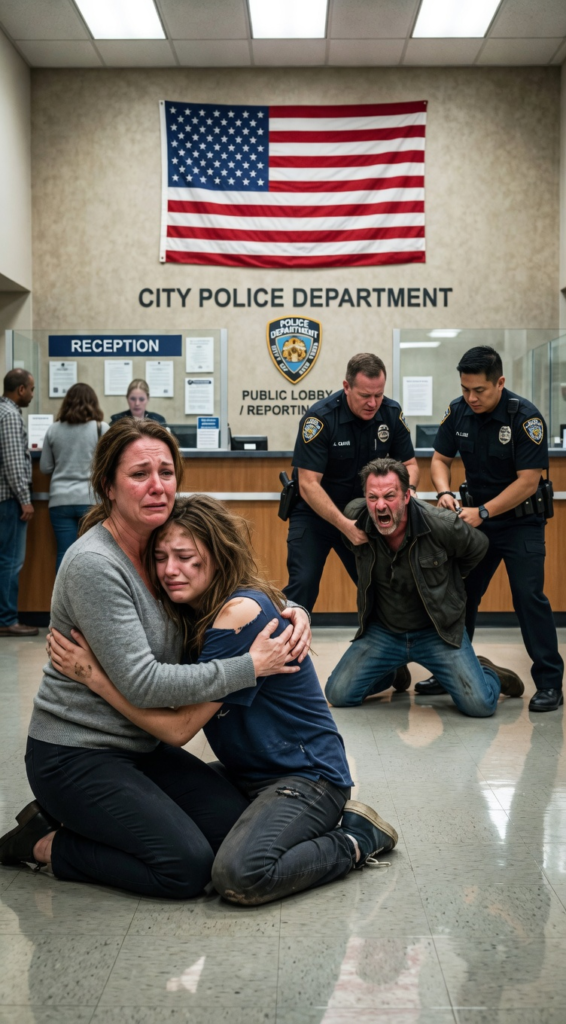
When the task force kicked down the door, the smell of damp wood and fear was overwhelming. And there, in a small back room, huddled under a thin blanket, was Maya. Her hands were zip-tied, her eyes wide with terror, but she was alive.
“Mom?” she whispered, her voice a fragile thread.
I didn’t wait for the officers to clear the room. I ran to her, pulling her into my arms, sobbing into her hair. “I’m here, Maya. I’ve got you. I’ve got you.”
As I held her, I realized that the “unstable” woman Julian had tried to create was gone. He had thought he could break me by taking the thing I loved most. He didn’t realize that by doing so, he had forged me into something unbreakable.
Cliffhanger: As Maya was being bundled into an ambulance for a check-up, she pulled me close, her voice a sharp whisper in my ear. “Mom, I kept the recorder… but I also kept his second ledger. It’s under the floorboards at the cottage. He didn’t just plan the fire, Mom. He talked about the ‘accident’ that killed Grandpa three years ago. It wasn’t a heart attack.”
Chapter 6: The Final Audit
The revelation of the ledger turned a kidnapping case into a first-degree murder investigation.
Julian wasn’t just a thief and a kidnapper; he was a murderer who had killed my father to gain control of the Thorne Legacy and the family’s estate. The ledger Maya had found contained meticulous notes on the “dosage” of medication he had used to induce my father’s “natural” passing.
Julian was a memory locked behind bars now, serving a life sentence without the possibility of parole. The Vance-West Warehouse never burned. The insurance money never came. His empire had crumbled into the dust of his own greed.
One year later, the sun was drenching the porch of our new home in a different city, a thousand miles away from the shadows of Thorne Manor. I sat in a rocking chair, watching Maya prepare for her high school graduation ceremony. She was wearing a bright yellow dress, her hair flowing free, her eyes sparkling with a light that had once been dimmed by fear.
I looked at the small silver recorder sitting on my desk—the relic that had saved our lives. It was silent now, but its presence was a reminder of the power of the truth. I realized that Julian’s mistake wasn’t just his greed; it was the fundamental error of every bully. He had underestimated the strength of a mother who had nothing left to lose but her child. He had mistaken my silence for weakness, and my love for vulnerability.
“We aren’t runaways anymore, Maya,” I said as she walked onto the porch, looking like the masterpiece she was.
Maya smiled, her eyes bright and free. “No, Mom. We’re the owners of the truth.”
I stood up, feeling the warmth of the sun on my face. I had conducted the final audit of my life, and for the first time, the balance was perfect.
If you want more stories like this, or if you’d like to share your thoughts about what you would have done in my situation, I’d love to hear from you. Your perspective helps these stories reach more people, so don’t be shy about commenting or sharing.