PART 2: THE WOMAN HE FORGOT TO FEAR
And for the first time in seven years, I saw Julian afraid.
Not angry.
Not offended.
Not wearing that beautiful wounded expression he used whenever he needed a room to love him.
Afraid.
It passed over his face like a shadow crossing stained glass—fast, distorted, almost holy in its ugliness. His fingers tightened around my wrist for half a second longer, one last claim, one final reminder that he believed my body was still his property.
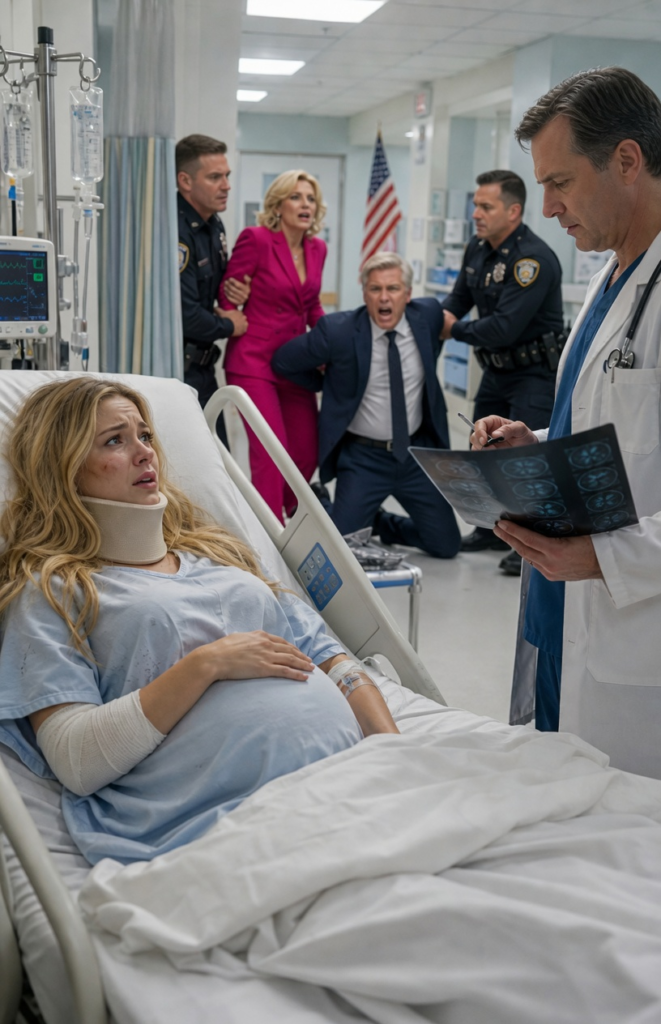
Then Dr. Samuel Hayes stepped between us.
“Remove your hand from my patient,” he said.
Julian laughed once, sharply. “Your patient? That is my wife.”
“She is my patient,” Dr. Hayes repeated, and there was something in his voice that made the air change. “And she is under emergency protective medical care until law enforcement arrives.”
The nurse moved toward the door. Julian turned so quickly she stumbled back.
“No one is calling the police,” he snapped.
There he was.
There was the man beneath the tears.
His mouth still trembled from his performance, but his eyes had gone flat. Cold. Familiar.
The nurse reached for the wall button.
Julian lunged.
Security came through the door before he made it two steps.
Two men, one woman, all in dark uniforms. Julian looked almost insulted, as if the hospital had misunderstood the rules of his world. In his world, doors opened for him. Men laughed at his jokes. Women lowered their eyes. Police officers took his donations. Doctors accepted his explanations.
But this room did not belong to him.
Not anymore.
“Sir,” the female security officer said, “step away.”
“You have no idea who I am,” Julian hissed.
Dr. Hayes didn’t move. “I know enough.”
Julian’s head snapped toward him. “She fell. My wife fell down the stairs.”
My lips parted.
No sound came.
My throat felt packed with ash. Pain throbbed behind my eyes. Every breath dragged fire across my ribs. The baby moved inside me—slow, frightened, alive.
Dr. Hayes turned toward me, not with pity, but with something steadier.
“Mrs. Vale,” he said softly, “you are safe right now. Blink once if you want him removed from the room.”
Julian’s gaze stabbed into me.
Remember.
Stairs.
My body remembered everything. The staircase banister against my back. His hand closing around my upper arm. The sound of Eleanor’s voice from the foyer saying, “Careful, Julian. Not where people can see.”
I looked at Dr. Hayes.
Then I blinked.
Once.
The room exploded.
Julian shouted my name like it was a weapon. Security grabbed him. He twisted, snarled, demanded lawyers, demanded hospital administration, demanded the chief of surgery, demanded his mother.
“Eleanor Vale sits on your charity board!” he yelled. “Do you hear me? My family built half this wing!”
Dr. Hayes looked at the security guards. “Out.”
Julian’s eyes met mine one last time before they dragged him backward.
And what I saw there was not love.
It was disbelief.
Not that he had hurt me.
Not that he had almost killed me.
But that I had blinked.
The door closed behind him.
The silence that followed was so complete I heard my own heart beating on the monitor.
Then I began to cry.
Not beautifully.
Honestly.
The nurse came to my side and loosened Julian’s fingerprint from my wrist with hands so gentle it broke something inside me. Dr. Hayes asked for scans, bloodwork, fetal assessment, a full trauma panel. His voice became a series of calm instructions, each one building a wall between me and the man outside.
A wall made of procedure.
A wall made of witnesses.
A wall made of law.
“Internal bleeding is suspected,” he said to the team. “Multiple rib fractures. Possible placental trauma. I want obstetrics in here now.”
The word placenta sent a cold wave through me.
“My baby,” I whispered.
It was barely sound.
But Dr. Hayes heard.
He leaned closer. “We are going to do everything we can for both of you.”
Both.
For years, Julian had spoken about the baby as if I were only the container.
His heir.
His blood.
His son.
Dr. Hayes said both.
A young obstetrician rushed in, followed by another nurse. They lifted my gown, checked monitors, pressed carefully around my abdomen. The baby’s heartbeat filled the room, fast and fierce.
The sound cracked me open.
I sobbed so hard pain tore through my ribs.
“Easy,” the nurse whispered. “Breathe slow. He’s here. He’s fighting.”
He.
I hadn’t been allowed to know.
Julian had wanted the gender reveal at Eleanor’s estate, under chandeliers, surrounded by people who would clap for his dynasty. He wanted blue smoke, champagne towers, my smile polished and empty beside him.
But the hospital told me the truth.
My son was alive.
And fighting.
“Mrs. Vale,” Dr. Hayes said, “I need to ask you something. You don’t have to answer now, but it may help us protect you.”
I closed my eyes.
“No stairs,” I whispered.
The nurse stopped moving.
Dr. Hayes remained very still.
“No stairs,” I said again, stronger. “He did this.”
The words did not echo dramatically. No thunder rolled. No music swelled.
But inside me, seven years of locked doors opened at once.
“He pushed me,” I said. “Then he kicked me when I couldn’t get up.”
The nurse covered her mouth.
Dr. Hayes closed his eyes for one second, and when he opened them again, the calm was still there—but now it had edges.
“Document everything,” he said.
A camera appeared. Measurements were taken. Bruises photographed. Fingernail marks recorded. My body, which Julian had tried to turn into a crime scene with no witnesses, began to testify.
The police arrived twenty minutes later.
Julian’s shouting had faded down the hall, but I could still feel him in the walls. His rage had a gravity. Even absent, it pulled at me.
Two detectives entered my room. The first was a tall woman with silver-threaded black hair pulled into a low bun. Her badge read VOSS. The second, younger and broad-shouldered, stayed near the door.
“I’m Detective Mara Voss,” she said. “This is Detective Chen. Dr. Hayes has explained the medical concern. We can wait until after surgery if—”
“No,” I said.
The word surprised even me.
Detective Voss’s face softened.
“I want to talk now,” I said. “Before his mother gets here.”
Something flickered in her expression. Recognition.
“Eleanor Vale?” she asked.
I nodded.
Detective Chen exchanged a glance with her.
So they knew the name.
Of course they knew the name.
Everyone in the city knew the Vales. Their foundation funded hospitals, museums, domestic violence galas. Eleanor wore pearls on magazine covers and spoke about protecting vulnerable women while teaching her son how to break one behind closed doors.
Detective Voss pulled a chair to my bedside.
“Tell me what happened tonight.”
I told her.
At first the words came unevenly, scraping out of me like glass. I told her about the argument at dinner because I had asked for my phone back. I told her how Julian smiled at the maid while gripping my thigh hard enough to make me bleed under the table. I told her how Eleanor told him I was becoming “ungrateful.”
I told her about the stairs.
But once I began, I couldn’t stop.
Seven years poured out.
The honeymoon bruise in Venice.
The “accident” with the cabinet door.
The winter night he locked me on the balcony for asking about missing money.
The day he made me quit my job and told my coworkers I was mentally unstable.
The therapist he chose.
The medication he insisted I take.
The driver who reported everywhere I went.
The password he changed.
The bank account emptied.
The friends he pushed away one by one until the only people left around me were paid by him, loyal to him, or afraid of him.
Detective Voss did not interrupt.
She wrote everything down.
When I stopped, exhausted, she asked quietly, “Do you have any evidence?”
Julian would have laughed at that.
He had built my cage carefully. No phone. No private email. No access to accounts. He checked drawers, pockets, books, bathroom vents. He even weighed the jewelry box once after finding a folded note hidden beneath velvet.
But Julian had one flaw.
He thought cruelty made him powerful.
It had made him careless.
“My locket,” I whispered.
The nurse looked down at the heavy gold oval resting against my collarbone.
Julian had given it to me on our first anniversary in front of seventy guests.
A symbol of devotion, he called it.
A collar, I had known immediately.
It was vintage, thick, ugly, and expensive. He made me wear it every day because he said it reminded people I belonged to him.
What he never knew was that the hinge had a false back.
Not because I bought it that way.
Because one night, after he passed out drunk, I sat in the laundry room with a screwdriver, a sewing needle, and hands that shook so badly I almost stabbed through my palm.
Inside that false back was a microSD card wrapped in waxed thread.
On that card were recordings.
Not all of them. Not enough to contain seven years. But enough.
Julian screaming.
Julian threatening.
Julian admitting he had bribed my first doctor.
Eleanor warning him not to leave marks before charity events.
Bank statements I had photographed from his laptop.
Transfers.
Shell companies.
Invoices from “consultants” who were actually private security men paid to follow me.
And one spreadsheet.
The spreadsheet that mattered most.
Before Julian Vale turned me into his fragile wife, I had been a senior forensic accountant. I had specialized in hiding places—money laundering, asset concealment, charitable fraud. I knew how dirty money moved when powerful people wanted it washed clean.
For three years, while Julian thought I was broken, I had been rebuilding numbers in my head.
Every overheard call.
Every carelessly discarded invoice.
Every donor dinner.
Every word Eleanor spoke when she forgot servants had ears.
The Vale Foundation was not just a charity.
It was a machine.
And I had mapped its gears.
The nurse carefully unclasped the locket.
For one terrifying second, I panicked.
Julian had fastened that chain around my neck so many times that part of me believed removing it would summon him back through the door.
But when it came free, cool air touched the skin beneath it.
I felt lighter by an ounce.
Detective Voss took the locket in gloved hands. “May I open it?”
“Yes.”
She did.
The false back resisted, then clicked.
The microSD card fell into her palm like a black seed.
Detective Chen let out a low breath.
Detective Voss looked at me differently then.
Not as a victim.
As a witness.
Maybe even as a threat.
“What’s on this?” she asked.
“My freedom,” I said.
The room went still.
Then Dr. Hayes returned, and the next part became pain, light, motion.
They rushed me into surgery.
The ceiling tiles slid above me like white cards being dealt by God. I remember asking for the locket. I remember someone saying it was evidence now. I remember begging them not to let Julian near the baby. I remember Dr. Hayes walking beside the bed, one hand steady on the railing.
“He will not get near either of you,” he said.
The operating room was cold.
Too cold.
My teeth chattered. My body shook. Voices moved around me in practiced rhythm. The anesthesiologist leaned over me and asked me to count backward.
I made it to ninety-seven.
Then darkness.
But not empty darkness.
I dreamed of stairs.
Not falling down them.
Climbing.
Every step hurt. Every landing was blocked by a door. Behind each door stood Julian, younger each time, smiling, apologizing, offering flowers, offering diamonds, offering the world if I would just forget what he had done.
At the last door, Eleanor stood instead.
She held my baby wrapped in blue silk.
“Fragile women don’t raise sons,” she said.
I reached for him.
She smiled.
The door slammed.
I woke screaming.
A nurse was beside me instantly. “You’re okay. You’re safe. Surgery is over.”
“My baby?”
“He’s in the NICU.”
The world narrowed to those words.
NICU.
Not dead.
Not gone.
NICU meant machines. Tubes. Monitors.
But it also meant alive.
“Take me to him,” I rasped.
“You need recovery first.”
“No.”
My voice barely existed, but the nurse heard the steel under it.
She glanced toward the door.
Dr. Hayes entered moments later. He looked tired now, his surgical cap in one hand, faint marks from his mask across his face.
“The bleeding is controlled,” he said. “You have three broken ribs, significant bruising, and trauma that triggered an emergency delivery. Your son is premature, but he is breathing with support. He is strong.”
My son.
The words passed through me like sunlight through ruins.
“Can I see him?”
Dr. Hayes hesitated. “Briefly. In a wheelchair. Only if your vitals stay stable.”
I nodded.
Ten minutes later, they wheeled me through corridors that smelled of antiseptic and coffee. Every bump sent pain through me, but I didn’t care. The NICU doors opened with a soft electronic sigh.
He was so small.
That was my first thought.
Julian had wanted an heir. Eleanor had wanted a legacy.
But the child inside the incubator was neither.
He was tiny.
Red-faced.
Wrapped in white.
His chest rose and fell with help from a machine, but it rose.
I pressed my palm against the glass.
“Hi,” I whispered.
His fingers curled.
The nurse smiled. “He knows your voice.”
I broke again.
Not from fear this time.
From love so fierce it frightened me.
“What’s his name?” the NICU nurse asked.
I opened my mouth.
Julian had chosen Vale names generations old. Augustus. Theodore. Charles. Names carved into stone buildings and trust funds.
But I thought of the first thing I had heard when the hospital became safe.
No.
A small word.
A holy word.
The first brick in the wall between us and him.
“Samuel,” I said, then looked at Dr. Hayes standing quietly behind me. “Not because of you exactly. Because tonight someone finally stood between us.”
Dr. Hayes looked away, clearing his throat.
“Samuel James,” I said. “James was my father.”
The nurse wrote it down.
Samuel James Vale.
Then I stopped.
“No,” I said.
Everyone looked at me.
I swallowed.
“Not Vale.”
My maiden name rose from memory like something rescued from a flooded house.
“Rowan,” I said. “His name is Samuel James Rowan.”
The NICU nurse smiled. “That’s a strong name.”
I touched the glass again.
“Yes,” I whispered. “It is.”
By morning, Julian had been arrested.
By noon, Eleanor had arrived.
No one warned me.
Maybe they tried.
Maybe I was asleep.
I woke to the scent of her perfume before I saw her: white roses and expensive poison.
She stood at the foot of my bed in a cream suit, pearls at her throat, diamonds at her ears, grief arranged across her face with museum-quality precision.
Two hospital security officers stood behind her.
Detective Voss stood beside the window.
That was how I knew something had changed.
Eleanor Vale was not used to entering rooms as someone being watched.
“My darling,” she said.
Darling.
In seven years, she had never called me that unless someone important was listening.
I said nothing.
She approached slowly, palms open.
“I am devastated. Julian is beside himself. This dreadful misunderstanding has gone too far.”
Detective Voss lifted her head.
Eleanor smiled at her. “Detective, surely you understand how fragile pregnant women can be after traumatic accidents. My daughter-in-law has struggled emotionally for some time.”
There it was.
The old net.
Fragile.
Anxious.
Unstable.
Eleanor’s favorite words were velvet ropes. Soft, elegant, impossible to cross.
“I’m not your daughter-in-law anymore,” I said.
Her eyes flicked to me.
Only for an instant did the mask slip.
Then she smiled sadly. “Pain medication can make people say dramatic things.”
Detective Voss moved closer. “Mrs. Vale, you were asked to wait outside.”
“My grandson is in this hospital,” Eleanor said.
“My son,” I corrected.
The room cooled.
Eleanor looked at me then. Really looked.
For years, she had seen the bowed head, the long sleeves, the careful smile. She had mistaken survival for surrender.
“You should think very carefully,” she said softly.
Dr. Hayes entered before I could answer. He carried a chart, but his eyes went straight to Eleanor.
“This patient has a restricted visitor list,” he said. “You are not on it.”
Eleanor laughed once. “Doctor, I appreciate your enthusiasm, but this hospital has enjoyed my family’s generosity for decades.”
“And your family’s generosity does not override patient consent.”
The words landed cleanly.
Eleanor’s smile thinned.
“Do you know what happens to people who embarrass my family?”
“Yes,” Detective Voss said. “That is one of the things we’re investigating.”
Eleanor turned very still.
For the first time, I saw a crack.
Not fear like Julian’s.
Calculation.
She looked from Detective Voss to Dr. Hayes, then to me. Her eyes stopped at my bare neck.
The locket was gone.
Her pupils changed.
She knew.
Maybe not everything.
But enough.
“Where is it?” she asked.
I smiled.
It hurt my ribs.
It was worth it.
“Evidence,” I said.
Eleanor did not speak for a moment.
Then she leaned closer, ignoring the security officers.
“You stupid girl,” she whispered. “You have no idea what you’ve done.”
“Yes,” I said. “I do.”
And I did.
That was the difference.
For years, I had been terrified of what would happen if I spoke.
But lying in that bed, stitched together, my son fighting behind NICU glass, I finally understood the truth.
Silence had not protected me.
It had protected them.
Detective Voss stepped forward. “Eleanor Vale, you need to come with us.”
Eleanor straightened. “On what grounds?”
“Witness intimidation, obstruction concerns, and pending review of evidence linking you to ongoing domestic abuse and financial crimes.”
For one exquisite second, Eleanor Vale forgot to be elegant.
Her mouth opened.
Nothing came out.
Then she recovered, because women like Eleanor always did.
“This is absurd,” she said. “I’ll call the mayor.”
Detective Voss nodded to Detective Chen, who appeared in the doorway.
“You can call your attorney first.”
Security escorted her out.
She did not scream like Julian.
She did something worse.
She looked back at me with a promise.
But this time, I did not look away.
The next three days became a war fought in whispers.
Doctors came and went. Social workers. Police. Prosecutors. A domestic violence advocate named Priya who sat beside my bed and explained things no one had ever explained to me before.
Protective orders.
Emergency custody.
Victim compensation.
Secure shelter.
Trauma counseling.
Legal aid.
Options.
That word felt almost foreign.
Options.
Julian had spent years making the world narrow until it contained only him.
Now strangers kept opening doors.
Some led to courtrooms. Some to recovery. Some to fear.
But they were doors.
I was allowed to choose.
The evidence from the locket spread like fire.
At first, the news reported only that Julian Vale, heir to the Vale real estate fortune, had been arrested after a “domestic incident involving his pregnant wife.”
By the second day, someone leaked that the wife had survived emergency surgery and the baby was alive.
By the third day, federal investigators became involved.
That was when Julian stopped pretending.
Detective Voss visited me in the afternoon, carrying a folder and a paper cup of coffee.
“He wants to see you,” she said.
My stomach tightened.
“No.”
“I expected that.” She sat down. “His attorney claims he only wants to apologize.”
I almost laughed.
Julian’s apologies had always been down payments on future violence.
“No,” I repeated.
Detective Voss nodded. “Good.”
“Good?”
She looked at me over her coffee. “Men like him use apologies as unlocked windows.”
I turned toward the NICU bracelet around my wrist.
“Has he asked about Samuel?”
“Yes.”
I went cold.
“He doesn’t know the baby’s name,” she added. “He asked about ‘my son.’”
Of course he did.
“Can he take him?”
Detective Voss’s face softened. “Not right now. Emergency protective custody has been granted to you. The hospital has security protocols in place. His access is restricted.”
“Eleanor?”
“Also restricted.”
I closed my eyes.
For the first time since waking, I slept for two full hours.
When I woke, there was a woman sitting in the chair beside my bed.
For one disoriented second, I thought it was my mother.
But my mother had died four years earlier, and Julian had refused to let me attend the funeral because I had “become hysterical.”
This woman had red hair streaked with gray, rain on her coat, and tears streaming down her face.
“Lena?” she whispered.
My sister.
Amelia.
My throat closed.
Julian had told me she stopped calling because she was tired of my drama. He told Amelia I wanted nothing to do with her because she had always been jealous of my marriage. He changed my number, blocked her emails, intercepted letters.
But grief does not erase recognition.
“Lena,” she said again, standing.
No one had called me that in years.
Julian preferred Helena. Formal. Controlled. Decorative.
But I had been Lena first.
Before the Vale house.
Before the locket.
Before fragile.
Amelia reached for me, then stopped, afraid to hurt me.
I held out my hand.
She took it and cried into my palm.
“I tried,” she sobbed. “I tried so many times. He said you didn’t want me. I came to the house once and security turned me away. I should have done more.”
“No,” I whispered. “He made sure you couldn’t.”
She bowed her head.
“I saw the news,” she said. “Then Detective Voss called because your advocate found my name in your old emergency contacts.”
Priya.
Another door opened.
“I have a son,” I said.
Amelia laughed through tears. “I know. Samuel.”
“You saw him?”
“Through the glass. He’s beautiful.”
The word struck me.
Beautiful.
Not like Julian’s tears.
Not like Eleanor’s lies.
Beautiful honestly.
Amelia stayed.
She brushed my hair when I was too weak to lift my arms. She read aloud from terrible magazines. She sat with Samuel when I had tests. She brought a small blue blanket she bought from the hospital gift shop and said, “It’s ugly, but it’s ours.”
Ours.
The fourth night, I asked her to bring me my laptop.
She hesitated.
“Are you sure?”
“No,” I said. “But I need to finish something.”
Detective Voss had copies of the locket files, but I had more than evidence of fists.
I had patterns.
Julian and Eleanor had hidden money through grief foundations, women’s shelters, redevelopment funds, medical charities. They stole in the language of kindness. They turned suffering into invoices.
And I knew where the bodies of the numbers were buried.
Amelia placed the laptop on the rolling tray over my bed.
My fingers trembled above the keyboard.
Not from fear.
From weakness.
From pain.
From the strange intimacy of touching a tool from my old life.
The screen glowed.
My reflection looked like a ghost.
But ghosts know where secrets are buried.
For six hours, between nurse checks and pain medication, I reconstructed the spreadsheet from memory. Account names. Routing patterns. Donor fund splits. Shell vendors. Property transfers. Julian had underestimated me in the way arrogant men often underestimate quiet women: he believed if he stopped me from speaking, I would stop thinking.
I had never stopped thinking.
At dawn, I sent the file to Detective Voss through the secure link she had given me.
The subject line read:
VALE FOUNDATION — FOLLOW THE RESTRICTED DONATIONS
Then I closed the laptop and slept.
The arrests began two days later.
Not all at once.
People like the Vales are not toppled in a single dramatic scene. They are dismantled by warrants, subpoenas, forensic audits, sealed indictments, frozen accounts, frightened assistants, and men in expensive suits suddenly remembering emails they once swore did not exist.
The CFO resigned.
Then cooperated.
Eleanor’s personal attorney withdrew.
Two board members claimed they had been misled.
Julian’s best friend, a banker named Miles, fled to Switzerland and was intercepted in Zurich.
The news vans camped outside the hospital.
Priya helped me release one statement.
Just one.
I wrote it myself.
My son and I are alive. We are healing. I ask for privacy, and I ask that anyone experiencing abuse be believed before they have to nearly die to prove it.
It aired everywhere.
For twenty-four hours, my face was blurred on every channel.
Then came the backlash.
There is always backlash when a woman survives loudly.
Anonymous sources called me unstable.
Old photos appeared of me smiling beside Julian at galas, as if smiling under threat proved love.
Commentators wondered why I had stayed.
Eleanor’s friends gave interviews describing her as “a champion of women.”
Julian’s legal team suggested I had fabricated abuse to gain control of marital assets.
Then Detective Voss released three seconds of audio through the prosecutor’s office.
Not the worst recording.
Not the most violent.
Just Julian’s voice, calm and clear:
“No one will believe you. I bought everyone who matters.”
Three seconds.
The world went quiet.
Then it turned.
Former employees came forward.
A maid named Rosa testified that she had seen Julian shove me against a pantry wall when I was six months pregnant. A driver admitted he had been ordered to report every place I went. A former assistant produced emails from Eleanor instructing staff to refer to me as “emotionally delicate” in all written communications.
Dr. Hayes testified medically.
The injuries did not match a fall.
The bruising showed multiple stages of healing.
The grip marks on my wrist were fresh.
The rib fractures were consistent with assault.
He spoke with the same calm he had used that first night. He did not embellish. He did not dramatize. He simply placed truth on the table and let it stand.
Julian’s attorney tried to corner him.
“Doctor, are you saying with absolute certainty that my client caused these injuries?”
Dr. Hayes looked at the jury.
“I am saying with medical certainty that Mrs. Rowan did not receive these injuries from one accidental fall down the stairs.”
Mrs. Rowan.
I cried when I heard the transcript.
By then, I had filed to restore my name.
Helena Rowan.
Not Vale.
Never again Vale.
The trial took seven months.
Samuel came home from the hospital after six weeks, still tiny but determined. Amelia moved into a rented cottage with me two towns away under a confidentiality program. Priya visited every Wednesday. Detective Voss checked in without making it feel like checking in.
Healing was not cinematic.
It was messy.
Some nights I woke convinced Julian was in the room.
Some mornings I vomited from panic after hearing keys in a door.
Sometimes Samuel cried and I cried with him because neither of us knew how to be calm in a world that had finally gone quiet.
But slowly, the quiet changed.
It stopped feeling like the pause before a storm.
It became peace.
I learned the sounds of my new life.
The kettle clicking off.
Amelia singing badly while folding laundry.
Samuel hiccupping in his sleep.
Rain on the roof.
My own voice saying no to things that did not feel right.
My own voice saying yes to things that did.
When I finally testified, the courtroom was packed.
Julian sat at the defense table in a navy suit, clean-shaven, pale, beautiful again.
He had perfected suffering during the months apart. His hair was longer. His eyes seemed hollow. He wore his wedding ring.
I wore no jewelry at all.
Eleanor sat behind him, spine straight, pearls glowing at her throat. She had been charged separately for financial crimes and obstruction, but her lawyers had severed parts of the case. Still, she came every day, not for love of her son, I think, but because control is an addiction.
When I walked to the stand, Julian looked at me with tears in his eyes.
Once, that would have undone me.
Now I saw the rehearsal.
The prosecutor asked my name.
“Helena Rowan,” I said.
Julian flinched.
Small.
But I saw it.
The prosecutor led me carefully through the years. I answered as clearly as I could. My hands shook, so I folded them in my lap. When my voice broke, I drank water. When Julian’s attorney objected, I waited.
Then came cross-examination.
Julian’s attorney was a polished man with silver glasses and a voice like warm milk.
“Mrs. Rowan, you stayed married to my client for seven years, correct?”
“Yes.”
“You attended parties with him?”
“Yes.”
“You smiled in photographs?”
“Yes.”
“You accepted expensive gifts?”
“Yes.”
“You never filed a police report before this incident?”
“No.”
He walked closer.
“Isn’t it true that you had access to considerable wealth as Mrs. Vale?”
“No.”
He smiled faintly. “But you lived in a mansion.”
“I was imprisoned in one.”
The courtroom shifted.
He adjusted his glasses.
“Mrs. Rowan, you want this jury to believe you were both helpless and, somehow, secretly collecting complex financial evidence against the Vale family?”
“No,” I said.
His eyebrows lifted.
“I want the jury to understand I was never helpless. I was trapped.”
The prosecutor looked down to hide a smile.
Julian’s attorney tried again.
“You claim my client controlled your communications, finances, transportation, and medical care. Yet you also claim you managed to hide recordings, documents, and spreadsheets for years. Which is it?”
I looked at Julian.
He stared back, eyes wet.
Then I looked at the jury.
“Both,” I said. “Survival often looks contradictory to people who have never had to do it.”
No one spoke.
The attorney’s smile faded.
He changed tactics.
“You were angry at your husband.”
“Yes.”
“You wanted revenge.”
I thought about that.
I thought about my son under glass.
My sister crying over my hand.
Dr. Hayes pressing the alarm.
The locket opening.
The first night I slept without Julian in the hallway.
“No,” I said. “I wanted a future.”
The courtroom went silent again.
Julian stopped crying.
There was his real face.
For just a second, the jury saw it.
The trial ended on a Thursday in November.
The sky outside was low and gray. Samuel was with Amelia at the cottage, wearing a ridiculous knitted hat shaped like bear ears. I kept a photo of him in my coat pocket and touched it so often the edge bent.
The jury deliberated for nine hours.
When they returned, I stood with Priya on one side and Amelia on the other.
Julian stood too.
His hands were clasped in front of him. His attorney whispered something. Julian nodded as if still certain the universe would correct itself.
The clerk read the verdicts.
Aggravated assault.
Guilty.
Domestic battery resulting in serious bodily injury.
Guilty.
Coercive control and unlawful confinement.
Guilty.
Witness intimidation.
Guilty.
Financial fraud charges tied to the Vale Foundation conspiracy would continue in federal court, but on the charges that mattered most to my body, my baby, my life—
Guilty.
Julian made no sound.
His mother did.
A small inhale.
Not grief.
Outrage.
The judge ordered Julian remanded pending sentencing.
As the officers moved toward him, he turned.
For the first time since the hospital, he spoke directly to me.
“Lena,” he said.
My sister stiffened beside me.
That name did not belong in his mouth.
I looked at him.
His eyes searched my face for the old reflex. The flinch. The apology. The softness he had trained into me.
He whispered, “I loved you.”
And finally, in a courtroom full of witnesses, I answered the lie he had used as a leash for seven years.
“No,” I said. “You owned me. You never loved me.”
The officers took him away.
Eleanor rose abruptly and walked out before anyone could see her son in cuffs.
But the cameras saw.
The whole city saw.
Two months later, Julian was sentenced to twenty-eight years in prison.
The judge called his actions “a sustained campaign of violence, coercion, and calculated concealment.” He mentioned my pregnancy. He mentioned Samuel’s premature birth. He mentioned the recordings. He mentioned the way Julian had tried to use social standing as a shield.
Julian stared at the table.
He did not cry beautifully that day.
He did not cry at all.
Eleanor’s ending took longer.
People like her do not fall.
They descend through appeals.
But the Vale Foundation collapsed under federal investigation. Assets were frozen. Properties were seized. Donors sued. Board members turned on one another with breathtaking speed. Eleanor was convicted of obstruction, fraud, and conspiracy the following year.
At sentencing, she wore black.
No pearls.
That was how I knew she was truly afraid.
She asked to address the court.
Her attorney looked nervous, but she insisted.
She stood, thin and severe, and turned slightly toward me.
I sat in the back row with Detective Voss, Priya, Amelia, and Samuel asleep against my chest.
He was fourteen months old by then, round-cheeked and solemn, with my father’s dark eyes.
Eleanor looked at him.
Then at me.
For one wild moment, I thought she might apologize.
Instead, she said, “You destroyed a family.”
The old words might have cut me once.
They did not even touch me now.
I stood, though no one had asked me to.
The judge looked like he might stop me, then didn’t.
“No,” I said. “I ended a crime scene.”
Eleanor’s face hardened.
The judge sentenced her to eleven years.
Not enough for everything she had done.
But enough for the world to know.
Enough for the name Vale to stop opening doors and start closing them.
Afterward, outside the courthouse, reporters shouted questions.
“Mrs. Rowan, do you feel justice was served?”
“Helena, what would you say to other women?”
“Do you forgive them?”
That last one made me stop.
Do you forgive them?
People love asking survivors about forgiveness. It makes pain easier for everyone else to digest. It turns horror into a lesson, violence into grace, survival into something tidy.
I shifted Samuel higher on my hip.
He woke, blinked at the cameras, and frowned with deep baby disapproval.
I kissed his forehead.
Then I looked into the nearest camera.
“I forgive myself,” I said. “That is the forgiveness that matters.”
No one shouted for a second.
Then the questions erupted again, but I was already walking away.
The cottage became ours permanently that spring.
Not the Vale estate. Not marble floors, not locked gates, not rooms where footsteps sounded like warnings.
A cottage.
White walls.
Blue shutters.
A garden Amelia insisted she could manage despite killing every houseplant she had ever owned.
The first thing I bought with money from the victim compensation fund was not furniture.
It was a doorbell camera.
The second was a crib.
The third was a small silver necklace with no locket, no hidden compartment, no history.
Just a tiny engraved word on the back.
Free.
I wore it when I returned to work.
Not full-time at first.
Consulting.
Then more.
A prosecutor who had worked the Vale case introduced me to a nonprofit that helped investigate financial abuse and charity fraud. They needed someone who understood numbers and cages.
I understood both.
My first case involved a shelter director stealing funds meant for women fleeing violence.
I stared at the spreadsheet for three minutes and found the pattern.
My supervisor said, “How did you catch that so quickly?”
I thought of Julian’s study.
The glow of his laptop.
The locket against my chest.
The years I spent memorizing transactions because paper could be found, but memory could not.
“Practice,” I said.
Samuel grew.
He grew slowly at first, then all at once.
His lungs strengthened. His laugh arrived late but loud. He hated peas. He loved ceiling fans. He learned to say “Mama” during a thunderstorm, his tiny hand pressed against my face as if checking that I was real.
On his second birthday, we invited only people who knew how to love without ownership.
Amelia baked a cake that leaned dangerously to the left.
Priya brought books.
Detective Voss arrived with a wooden puzzle shaped like animals and pretended not to cry when Samuel hugged her leg.
Dr. Hayes came last.
He stood awkwardly at the garden gate holding a wrapped gift and looking as if he might rather perform surgery than attend a toddler party.
Samuel toddled toward him immediately.
“Doc!” he shouted.
No one had taught him that.
Dr. Hayes crouched, smiling. “Hello, Samuel.”
Samuel placed a sticky hand on his cheek.
Dr. Hayes went very still.
I watched from the porch.
Some debts cannot be repaid.
Some should not be turned into romance or obligation or anything smaller than what they are.
Dr. Hayes had saved my life because it was his duty.
But more than that, he had believed my body when my voice was trapped.
That mattered.
He gave Samuel a picture book about planets.
“For when he wants to know there is more than one world,” he said.
I had to look away.
Later, after cake and candles and Samuel falling asleep in Amelia’s lap with frosting in his hair, I walked Dr. Hayes to the gate.
“Thank you,” I said.
He shook his head gently. “You already said that.”
“I’ll probably say it for the rest of my life.”
“Then I’ll probably keep telling you that you saved yourself.”
I smiled.
The garden smelled like rain and sugar.
“For a long time,” I said, “I thought the bravest thing I ever did was hide evidence.”
“It wasn’t?”
“No.” I looked back through the window at my son, sleeping safely under warm light. “The bravest thing I ever did was blink.”
Dr. Hayes smiled.
“Yes,” he said. “It was.”
Years passed.
Not without scars.
Scars are not doors you close once and forget. They are weather. They ache at strange times. They return in dreams. They teach the body to listen too closely.
But scars are also proof that the wound ended.
Samuel learned the truth in pieces appropriate for his age.
When he was three, he asked why he didn’t have a father at preschool breakfast day.
I told him, “Some people are not safe, even if they are family.”
When he was five, he asked if his father was dead.
I said, “No. He is in prison because he hurt people.”
Samuel thought about that carefully, then asked if prison had dinosaurs.
When he was eight, he asked if Julian had hurt me.
I told him yes.
He cried then, not because he missed Julian, but because children grieve the idea of what should have been.
I held him and said, “His choices are not your inheritance.”
That became our family rule.
Pain is not inheritance.
Violence is not inheritance.
Silence is not inheritance.
Love is.
Choice is.
Truth is.
On the tenth anniversary of the night Dr. Hayes pressed the alarm, Samuel and I climbed a hill behind our house to watch the sunrise.
He was tall for ten, all elbows and questions, carrying a backpack full of snacks he insisted were necessary for a twenty-minute walk.
At the top, the town spread below us in gold light.
He sat beside me on the grass.
“Mom?”
“Mm?”
“Do you ever wish none of it happened?”
The question entered me gently.
I looked at him.
His hair was messy. His shoelaces untied. His face open to the morning.
“Yes,” I said. “I wish no one had hurt us.”
He nodded.
“But,” I continued, “I don’t wish you away. I don’t wish this life away. I don’t wish myself away anymore.”
He leaned against my shoulder.
“Are we okay?” he asked.
I wrapped my arm around him.
The sun lifted above the trees.
For years, I thought okay meant untouched. Unbroken. A life with no darkness behind it.
I know better now.
Okay can mean rebuilt.
Okay can mean scarred and laughing.
Okay can mean safe enough to sleep.
Okay can mean your son asking hard questions on a hill because no one has taught him to fear the answers.
“We’re more than okay,” I said.
Samuel smiled.
Below us, our cottage windows caught the morning light. Amelia’s car sat crooked in the driveway. The garden was half weeds, half flowers, stubbornly alive.
My phone buzzed.
A message from Priya.
The shelter wing opens today. They’re ready for you.
I had almost forgotten.
Almost.
The Vale estate had been seized years earlier. After endless legal battles, part of the property was sold, part demolished, and part transferred through a restitution agreement to the city.
The east wing—the same wing where Eleanor once hosted charity luncheons about vulnerable women—had been converted into a secure recovery center.
Today, it would open under a new name.
The Rowan House.
Not because I wanted my name on a building.
Because names can be reclaimed.
Samuel and I arrived just before noon.
There were no chandeliers.
No champagne.
No photographers inside.
Only warm rooms, reinforced doors, legal offices, counseling spaces, a children’s playroom, a kitchen that smelled like cinnamon, and windows that opened toward the sun.
At the entrance hung a small plaque.
THE ROWAN HOUSE
For those who were not fragile. Only trapped.
Underneath, in smaller letters:
May every locked door meet someone brave enough to open it.
Priya stood beside me while the first families arrived quietly through the private entrance.
A young woman with a black eye held a toddler.
An older man with shaking hands clutched a folder of documents.
A teenage girl stared at the floor while a counselor spoke softly to her.
I watched them enter.
Not saved.
Not fixed.
Not magically healed.
But believed.
That was where freedom began.
Samuel slipped his hand into mine.
“This place used to belong to him?” he asked.
“Yes.”
“And now?”
I looked at the open doors.
At the advocates waiting.
At Detective Voss laughing quietly with Amelia near the coffee table.
At Dr. Hayes, older now, speaking to a group of medical residents about recognizing hidden injuries.
At the sunlight falling across the floor where Eleanor once walked like a queen.
“Now it belongs to people who need it,” I said.
Samuel squeezed my hand.
“Good.”
Yes.
Good.
A clear, ordinary word.
A perfect word.
That evening, after the opening, I walked alone to the old staircase.
It was not the same staircase from our house. That one was gone. Sold, stripped, demolished with the rest of the private residence.
But this staircase had the same polished wood, the same curve, the same kind of railing Eleanor used to decorate with white flowers for galas.
For a moment, my ribs remembered.
Memory is not always stored in the mind.
Sometimes it lives in bone.
I placed one hand on the banister.
Then I climbed.
One step.
Then another.
No one waited at the top.
No threat.
No whisper.
No beautiful tears.
Only a hallway filled with warm light and the distant sound of children laughing in the playroom.
Halfway up, I stopped and touched the silver necklace at my throat.
Free.
I thought of the locket.
The false back.
The tiny black card that had carried my truth when I could not.
I thought of Julian’s face when I blinked.
Eleanor’s face when she saw my bare neck.
Dr. Hayes saying both.
Detective Voss saying good.
Amelia calling me Lena.
Samuel breathing behind glass.
All of it lived in me.
But it no longer owned me.
At the top of the stairs, I turned and looked down.
For seven years, Julian had made stairs into an alibi.
A word that meant pain.
A word that meant silence.
A word that meant his story would replace my body’s truth.
Now stairs were only stairs.
Wood.
Dust.
Light.
Something to climb.
I descended slowly, smiling despite the tears on my face.
At the bottom, Samuel ran toward me.
“Mom! Aunt Amelia says I can have two cupcakes if you say yes.”
Amelia shouted from the kitchen, “That is not what I said!”
Samuel looked betrayed.
I laughed.
The sound surprised me sometimes even now.
How easily it came.
How fully it filled a room.
I crouched and brushed frosting from his chin.
“One cupcake,” I said. “And you have to eat dinner first.”
He groaned dramatically. “That’s injustice.”
I kissed his forehead.
“No,” I said. “That’s parenting.”
He ran off to negotiate with Amelia, because hope is partly believing another adult might give you better terms.
Priya came to stand beside me.
“You okay?”
I looked around Rowan House.
At the doors.
At the lights.
At the staircase behind me.
At my son trying to bribe Detective Voss with a paper napkin.
“Yes,” I said.
And I meant it.
Not because everything broken had been restored.
Some things never return in their original shape.
I would never be the woman I was before Julian.
I had mourned her for a long time.
Then one morning, while Samuel slept against my chest and sunlight crept across our cottage floor, I realized something.
The woman I was before Julian had not died.
She had carried me.
Quietly.
Stubbornly.
Through every locked room.
Through every lie.
Through every night I thought I could not survive.
She had hidden evidence in a locket.
She had remembered numbers.
She had blinked.
And then she had become someone new.
Someone not fragile.
Someone not fearless, either.
Fearless is a fairy tale.
Brave is better.
Brave means afraid and still reaching for the alarm.
Afraid and still telling the truth.
Afraid and still naming your son after safety instead of power.
Afraid and still building a house from the ruins of the place that tried to bury you.
That night, after everyone left, I locked Rowan House for the first time.
Not to keep people trapped.
To keep them safe.
Samuel waited beside me, sleepy and sugar-wild, his small hand wrapped around mine.
“Ready to go home?” I asked.
He nodded.
We stepped outside.
The evening air was cool. The sky had turned deep blue, the first stars appearing one by one.
Behind us, Rowan House glowed.
Ahead of us, the path was clear.
For once, no one followed.
No one watched from a dark car.
No one waited with a key in the lock.
I lifted Samuel into his booster seat, buckled him in, and kissed his nose.
“Mom?” he murmured.
“Yes?”
“Are doors good or bad?”
I paused.
Then I smiled.
“Depends who holds the key.”
He considered that with grave seriousness.
“Do we hold ours?”
I closed his door gently and looked back at the building shining behind us.
Then at my reflection in the car window.
My bare neck.
My steady eyes.
My name restored.
My son safe.
The monster imprisoned.
The matriarch fallen.
The money turned toward healing.
The lie dead.
The stairs only stairs.
I got into the driver’s seat, started the car, and took the road home.
“Yes,” I said, as the headlights opened the dark ahead.
“We hold ours.”