Carmen Reyes answered the call, she had already been awake for nearly eighteen hours.
Rubén Leñero General Hospital was still humming around her with the battered rhythm she had known most of her adult life: metal carts squeaking over tile, children coughing behind curtains, mothers whispering prayers over hot foreheads.
Exhaustion had become part of her body years ago.
What she never got used to was the sound of fear in a young person’s voice.
Rosa Mendoza sounded terrified.
She reminded Carmen that two years earlier she had brought in her son, a little boy with pneumonia who had survived because someone at the public hospital had bothered to keep looking when everyone else thought the case was straightforward.
Carmen remembered the face only after Rosa said the child’s name.
She remembered the mother’s hands too, rough from work and shaking from love.
Now Rosa was a nanny in one of the richest neighborhoods in the city, and the baby in her care was disappearing.
Not vomiting.
Not feverish.
Not covered in rash.
Not refusing food.
He simply kept losing weight, week after week, while specialists ordered tests, billed fortunes, and told the family there was no clear explanation.
Carmen almost said no.
She had a waiting room full of patients and a shift that would stretch into evening.
But something in Rosa’s silence after the words he is dying made her stop.
Carmen had learned to respect the people who lived beside a child every day.
Mothers, grandmothers, nannies, older sisters.
They often sensed danger long before medicine could name it.
When Rosa gave her the address in Lomas de Chapultepec, Carmen stared at the phone for a second after the call ended.
In all her years, she had crossed that city more times than she could count, but some drives still felt like passing through two different countries.
She made the trip after dark.
Her old Tsuru rattled through neighborhoods where taquerías spilled light and music into the street, past buses and concrete walls and stray dogs, and then farther west where the city smoothed itself into manicured hedges and guarded gates.
By the time she stopped in front of the Valdés house, she felt the day’s fatigue settling deep behind her eyes.
The mansion shone under controlled lighting, all glass and steel and deliberate perfection.
The guard at the gate looked at her car, then at her coat, then at her face, and his expression changed only when a voice over the intercom confirmed her name.
Rosa opened the front door before Carmen could knock.
She was younger than Carmen remembered, or maybe fear always made people look young.
Her uniform was spotless, but she had the brittle posture of someone who had not slept well in weeks.
Inside, the house was all marble, expensive wood, and the kind of silence money buys for itself.
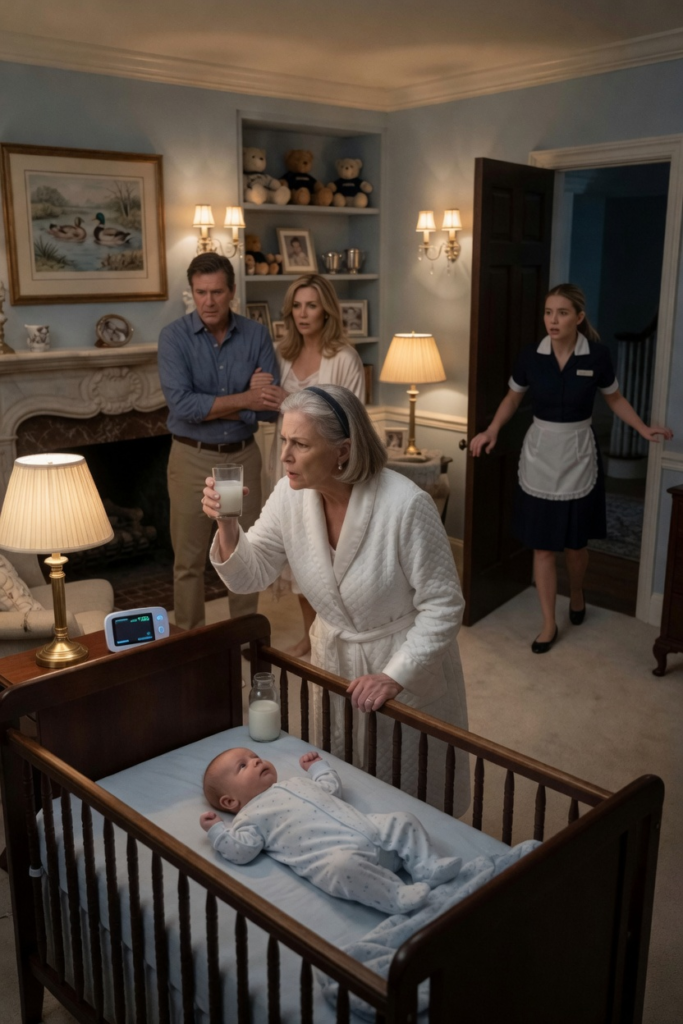
Even the nursery looked curated rather than lived in.
Blue walls, designer crib, imported toys arranged with almost ceremonial precision.
And in the middle of all that perfection, baby Sebastián looked like a child from a famine photograph brought into the wrong frame.
He was six months old and far too light in Carmen’s arms.
His wrists were thin.
His skin had gone pale in a way that
had nothing to do with complexion and everything to do with depletion.
But it was his face that caught her.
He did not reach out.
He did not protest when a stranger lifted him.
He only stared with grave dark eyes that seemed much older than six months.
A sick baby usually told the world something.
Through a cry, a stiff back, a refusal, a desperate hunger.
Sebastián carried himself like someone who had learned silence.
His father, Eduardo Valdés, met Carmen with open skepticism.
He looked like the sort of man who believed money was another word for certainty.
His suit fit perfectly.
His watch probably cost more than Carmen’s car.
He asked, without bothering to soften the insult, what a doctor from a public hospital could possibly offer after so many private specialists had failed.
Valeria, the baby’s mother, stopped him with a single look.
Her face was immaculate except for the eyes.
Those betrayed her.
They were swollen, rimmed red, and full of a panic that had burned quietly for too long.
Carmen examined Sebastián carefully.
Normal heart sounds.
Clear lungs.
Soft abdomen.
No visible infection.
No obvious birth defect that had somehow gone unnoticed.
She asked for copies of every study, and the stack Rosa handed her was thick enough to fill a folder.
Blood counts, thyroid panels, stool studies, abdominal ultrasounds, consultations with gastroenterology, neurology, nutrition.
Everything sat inside the bland category of essentially normal.
That was when Carmen stopped looking only at the baby’s body and started looking at the life around his body.
What did he eat?
Imported formula.
Organic purées.
Carefully measured portions.
The best of everything.
Who fed him?
Valeria, when she was home from the gallery.
Rosa during the day.
A longtime maid named Martina when shifts overlapped or when nights got difficult.
Eduardo, only occasionally.
How often did he wake hungry?
The answers became vague.
Valeria said he was such a good baby.
He slept for long stretches.
Sometimes all night.
Sometimes so peacefully she hated to disturb him.
Eduardo said a good routine mattered and that specialists had praised the household’s discipline.
Rosa lowered her eyes when she heard that.
Carmen asked to see a feeding.
Rosa prepared the bottle in front of her with impeccable care.
Sebastián drank eagerly and finished it all.
Nothing in the mechanics of feeding explained a body that kept thinning.
Then Carmen noticed the glass beside the armchair.
There was a white residue stuck to the bottom, not the film ordinary water leaves behind but the heavier, uneven ring of something dissolved.
When she lifted it toward her face, she caught a medicinal scent faint enough that most people would have missed it.
Rosa immediately claimed the glass was hers.
Carmen nodded, said little, and took it with her when she left.
She did not sleep that night.
At dawn she went straight back to the hospital, found a colleague in toxicology who still owed her favors from years of emergency consults, and asked for a quick screen before the official morning rush swallowed the lab.
By ten o’clock, she had an answer rough enough to alarm her and clear enough to trust.
The residue contained traces of a sedating antihistamine in a concentration that had no reason to be sitting at
the bottom of a nanny’s water glass.
The toxicologist could not tell her the exact dosing history from residue alone, but he did not need to.
The message was simple: someone had been dissolving medication in that room.
Carmen called Rosa from a hallway and kept her voice even.
Do not change anything, she said.
Do not confront anyone.
Feed the baby the way you always do.
I am coming back.
This time she arrived in daylight with a different tone.
She told Eduardo and Valeria that she had not ruled out an environmental cause and needed to observe the child for a full day and night.
Eduardo objected immediately.
He had meetings.
He hated intrusion.
He said their house was not a clinic.
Valeria interrupted him before he could finish.
She did not ask for details.
She only said yes with the exhausted force of a woman who had run out of pride before she ran out of fear.
Carmen spent the afternoon mapping the household the way another doctor might map symptoms.
She asked for feeding logs, diaper counts, and sleep records.
She checked the pantry, the sterilizer, the refrigerator, the nursery trash, the medications in the bathrooms, even the supply shelves in the laundry room.
What she found was not one dramatic clue but a pattern.
Sebastián’s night feeds had huge gaps.
Six hours.
Then seven.
Then sometimes nine.
For a six-month-old already underweight, that was not an admirable routine.
It was a warning.
The diaper counts dipped after nights when everyone praised him for sleeping well.
His mouth was often dry in the mornings.
Rosa admitted there were dawns when he was strangely difficult to rouse.
And the monitor in the nursery, which looked sophisticated enough to reassure any parent, was only half functional.
The camera was mounted, the screen glowed, but the recording feature had been unplugged from the unit downstairs.
It could show a live image if someone happened to watch it.
It kept no history.
That bothered Carmen almost as much as the lab result.
Late in the afternoon, when Valeria went downstairs to take a call and Eduardo disappeared into his office, Rosa finally spoke with the door half closed.
She said she had noticed for weeks that Sebastián was too quiet after Martina handled the late evening routine.
Not unconscious.
Not limp.
Just oddly heavy with sleep.
There were nights when the baby did not stir even when his diaper was full.
Rosa had mentioned it once, and Martina laughed and said a quiet baby was a blessing.
Another time Rosa hinted to Valeria that something felt wrong, and Valeria, pale and distracted, said Eduardo had a very strict approach to routines and the pediatric consultant had not objected.
That sentence lingered.
Eduardo had a strict approach.
Carmen asked who did the last feed most nights.
Martina.
Who was on duty tonight.
Martina.
As sunset darkened the nursery windows into mirrors, Carmen looked at the child again.
Sebastián did not seek faces the way babies his age usually did.
He watched the ceiling, the edges of the room, shadows.
When Rosa touched his cheek, he leaned into the warmth with a hunger that had nothing to do with milk.
That was when the full shape of it settled in Carmen’s mind.
This child had likely been underfed by schedule, sedated into silence, and emotionally abandoned in the very moments babies use to teach adults what they need.
His body was starving, yes.
But it was also adapting to a world that answered comfort with distance and crying with chemistry.
Carmen told Valeria, bluntly, that Sebastián should not be sleeping through such long stretches in his condition and that no one should be giving him any medication without a direct pediatric instruction.
Valeria looked stunned, then offended, then frightened in a way that seemed more intimate than before.
She said nobody was medicating him.
She said the specialists never said that.
She said maybe Martina had used herbal drops once or twice for gas.
Her voice weakened as she spoke.
Carmen asked for a guest room and said she would remain overnight.
The mansion grew unnaturally still after eleven.
Staff voices disappeared.
Doors shut softly.
Somewhere downstairs, glass clinked in Eduardo’s office as he took a late business call.
A decorative fountain outside whispered against the windows.
In the nursery, the lamp cast a dim pool of honey-colored light over the crib.
Carmen sat in the shadow of an adjoining sitting room with the nursery door cracked open.
Rosa had finished the ten o’clock bottle under Carmen’s eye.
Sebastián had taken it well.
Martina was supposed to handle the next check.
At half past midnight, the baby made a sound.
Not a cry.
Just a small dry whimper, almost as if he had forgotten how to ask properly.
Footsteps moved in the hallway.
Martina entered carrying a tray.
On it sat a bottle, a small spoon, and a glass with cloudy liquid at the bottom.
In her other hand she held a brown medicine vial.
She did not see Carmen at first.
Martina set the tray down beside the rocking chair, unscrewed the vial, tipped several drops into the glass, swirled it, then reached for the baby’s bottle.
Carmen stepped into the doorway.
Stop.
Martina froze so hard the spoon clicked against the glass.
For a second nobody moved.
The baby shifted in the crib.
The medicine smell lifted unmistakably into the room.
Carmen crossed the floor, took the glass, and looked at the label on the vial.
It was an over-the-counter sedating antihistamine, the kind people casually used for adults who wanted to sleep through the night.
Not for infants.
Not like this.
What have you been giving him?
Martina’s mouth trembled.
She said it was only a little.
Just enough to calm him.
Just enough so he would sleep.
Just enough so the house could rest.
Who told you to do this?
At first she shook her head, crying too fast to speak.
Then the words came in fragments.
She had done it for months.
Sometimes syrup.
Sometimes crushed tablets dissolved in water when the syrup ran out.
Eduardo hated noise.
He said the boy needed discipline.
He said investors stayed in the house and couldn’t hear a baby screaming at all hours.
He said Valeria was too fragile and too exhausted and that Martina was paid to solve problems, not announce them.
Did the mother know?
Martina covered her face and said once, maybe twice, Valeria had seen the bottle and turned away.
Eduardo told her it was pediatric
drops approved by a consultant.
After that, nobody asked questions they did not want answered.
Carmen called Rosa into the room, told her to take the baby immediately, and used her own phone to call emergency services and child protection.
She spoke clearly and fast.
Possible repeated chemical sedation of an infant.
Failure to thrive.
Need transport now.
Eduardo arrived before the call ended.
He took in the tray, the vial, the crying maid, the baby in Rosa’s arms, and his face changed from irritation to cold fury.
He demanded to know what Carmen thought she was doing in his house.
Carmen stood between him and the nursery.
Saving your son, she said.
He laughed once, sharply, like the accusation was absurd.
It is a few drops, he said.
Children need routine.
He’s been seen by the best doctors in the country.
You come in here from a public ward and suddenly you think you know everything.
The words hit the wall of the nursery and stayed there.
A few drops.
That was the first time Valeria heard it plainly.
She had come barefoot into the hall in a silk robe, drawn by the voices.
Her eyes moved from her husband’s face to the bottle in Carmen’s hand, then to Sebastián, limp against Rosa’s shoulder, then back to Martina.
Something inside her seemed to crack in real time.
She whispered, is that what you’ve been giving him?
Eduardo turned toward her with the reflex of a man used to controlling the room.
Don’t start, he said.
You were the one who kept saying you couldn’t take the crying.
You were the one collapsing every other day.
I solved it.
Valeria stared at him as if he had spoken in another language.
Then memory flooded her all at once.
The nights Sebastián slept too deeply.
The relief she had felt when the house stayed quiet.
The shame she shoved down when he seemed harder to wake in the mornings.
The one evening she had seen Martina holding a bottle and a spoon and accepted Eduardo’s calm explanation because it was easier than admitting fear.
She covered her mouth and began to sob.
When the ambulance team arrived, Carmen handed over the vial, the residue glass, and a concise report.
Eduardo tried to block the stretcher from leaving the nursery, then tried to talk in the clipped language of influence and legal representation.
It did not work on Carmen, and it did not work on the emergency physician who heard the words repeated infant sedation.
Sebastián was admitted before dawn.
The hospital tests over the next day confirmed what Carmen had suspected.
The baby had been repeatedly exposed to sedating medication.
He was dehydrated in a pattern consistent with long unattended stretches and irregular appropriate feeding.
More than that, the pediatric team documented something medicine hates because it is harder to quantify: profound neglect in the relational sense.
The baby had the physical signs of failure to thrive, but also the behavioral flattening of a child who had stopped expecting comfort to come when he signaled for it.
For the first forty-eight hours, even after the medication left his system, Sebastián hardly cried.
Nurses changed him, fed him, held him skin to skin, and he watched them with wary silence.
He startled
when someone moved too quickly.
He sucked greedily, then paused as if unsure there would be more.
Rosa visited and cried beside the incubator-style crib until Carmen finally guided her into a chair and told her to hold him anyway.
On the third night, just before dawn, Sebastián woke hungry and let out a raw, furious wail that echoed down the pediatric corridor.
Every nurse within earshot looked up.
One of them laughed with relief.
Another wiped her eyes.
Carmen, standing at the foot of the bed charting his weight, felt her own throat tighten.
It was the most beautiful sound in the room.
Not because he was in pain, but because he finally believed the world might answer him.
From there, the changes came in ounces and milliliters, in damp diapers and longer periods of eye contact, in the way his fists slowly unclenched.
His weight did not rebound overnight, but it moved the right direction for the first time in months.
He began to follow faces.
He fussed when a bottle was late.
He pressed his body into warmth instead of lying in mute surrender.
The legal aftermath was messier than the medicine.
Martina cooperated with investigators once she understood the alternative.
She turned over messages from Eduardo that were not explicit enough to read like a confession but plain enough in context: Keep him asleep.
I don’t want scenes tonight.
Use what worked yesterday.
Do not wake Valeria unless it’s serious.
There were pharmacy receipts too, purchased through drivers and assistants, all small enough to seem ordinary until someone placed them in a line.
Eduardo was charged with child endangerment while the larger investigation continued.
He insisted he had only wanted structure.
He insisted everyone was exaggerating.
He insisted wealthy families were judged differently because people enjoyed watching them fall.
None of that changed the toxicology report.
Valeria was not arrested, but child services did not spare her either.
They documented her failure to intervene, her emotional collapse, the degree to which she had allowed fear and convenience to override instinct.
She entered psychiatric treatment and intensive parenting counseling.
For a while, she saw Sebastián only under supervision.
Some people around the case wanted a simpler villain than that.
They wanted Eduardo to be the monster and Valeria to be the broken wife.
But cases involving children are rarely clean enough to let one adult carry all the blame.
Two months later, Carmen saw Sebastián in a follow-up room, thicker in the cheeks, stronger in the neck, gripping Rosa’s finger with surprising force.
Rosa had become part of the approved caregiving plan because the system trusted the person who had finally sounded the alarm.
Valeria arrived for the visit without makeup that day, looking smaller somehow, stripped of the polished surface she had worn like armor.
When she sat and offered her arms, Sebastián hesitated, then leaned toward Rosa first.
Valeria closed her eyes when that happened.
Carmen did not soften the truth for her.
Trust returns more slowly than weight, she said.
Keep showing up.
Valeria nodded as if the sentence hurt because she knew she had earned it.
By the end of the visit, Sebastián accepted the bottle from his mother and fell asleep against her chest without that old unnatural heaviness.
Just ordinary baby
sleep, warm and vulnerable and alive.
Valeria cried silently into his hair while Rosa looked out the window and pretended not to see.
Carmen left the room and stood for a moment in the hallway, listening to the noises she had heard for decades: crying infants, squeaking carts, nurses calling measurements to each other, life announcing itself without shame.
Later, when people talked about the case, they argued over the same question.
Some said Valeria deserved no mercy because a mother should know, because she had seen enough and chosen silence.
Others said Eduardo had built a house where fear sounded like order, and that by the time she understood what silence was costing her son, she had already been trained to doubt herself.
Carmen never found that debate easy.
She only knew this: the moment Sebastián’s thin body finally gathered enough strength to cry and expect someone to come, he began to live again.
And for a long time after, the most unsettling part was not that a rich family had almost lost a child in a mansion full of doctors, staff, and imported formula.
It was that the sound that ended up saving him was the very sound someone in that house had tried hardest to erase.