CHAPTER 1: THE CRACK IN THE RAINY NIGHT
The house at the end of Elm Street was a masterpiece of suburban camouflage. From the outside, it boasted a manicured lawn, a freshly painted white picket fence, and a porch swing that swayed gently in the breeze. But on this particular Tuesday evening, as a torrential rainstorm battered the roof and the wind clawed at the windowpanes like desperate fingernails, the house breathed with a suffocating, malignant life of its own.
Sixteen-year-old Mara stood at the kitchen sink, her hands submerged in lukewarm, soapy water. She was washing a ceramic dinner plate, her movements slow, methodical, and meticulously calibrated to produce absolute silence. In this house, noise was a currency that bought only pain.
The air in the kitchen was thick, heavy with the nauseating, lingering stench of burnt pot roast, mingling with the sharp, acidic bite of cheap whiskey. The whiskey meant Victor was home.
Victor Hale, the man who demanded to be called the “head of the household,” sat at the dining table just a few yards away. He was a broad-shouldered man of forty, a general contractor whose construction company was currently bleeding money and hemorrhaging contracts faster than he could drink. He was a man who measured his masculinity by the weight of his wallet, and lately, his wallet had been pitifully light. Out in the real world, Victor was a failure, a small man shrinking under the weight of his own incompetence.
But inside these walls, he was a god. And a god required sacrifices.
Mara kept her eyes fixed on the soapy water. She could feel his gaze burning into her back, a heavy, predatory weight. She knew the cycle intimately. The lost contract, the silent dinner, the heavy pouring of the amber liquid into the crystal glass. He was looking for a release valve, a way to bleed his societal humiliation into someone else’s physical agony. To Victor, Mara was not a stepdaughter; she was a punching bag, his cheapest and most reliable form of entertainment.
The scraping of wooden chair legs against the linoleum floor echoed like a gunshot.
Mara’s breath caught in her throat. She didn’t turn around. She rinsed the plate, her knuckles turning white.
“You missed a spot,” a thick, gravelly voice whispered right beside her ear. The stench of fermented grain and stale tobacco washed over her.
Mara kept her head bowed. “I’ll wash it again,” she said softly, her voice devoid of any inflection. Emotion was blood in the water.
“I don’t want you to wash it again. I want you to do it right the first time,” Victor hissed.
Before Mara could even register the shift in his weight, his large, calloused hand lashed out. The open-handed slap struck the side of her face with the force of a swinging brick. The impact sent a blinding flash of white light across Mara’s vision. Her head snapped violently to the side, her hip slamming against the edge of the granite counter. The ceramic plate slipped from her wet hands and shattered into a dozen jagged pieces in the stainless-steel sink.
A warm, metallic taste instantly flooded her mouth. The inside of her cheek was split open.
Victor let out a low, rumbling chuckle, taking a sip from the tumbler in his left hand. “Still standing, huh? You’re getting tougher, kid. Maybe too tough.”
“Victor. Please. That’s enough.”
The voice came from the threshold of the kitchen. Elaine, Mara’s biological mother, stood there, clutching the lapels of her plush pink bathrobe tightly across her chest. She looked like a frightened rabbit, her eyes darting nervously toward the windows, terrified that the neighbors might see through the blinds.
Elaine didn’t step forward. She didn’t place herself between the monster and her child. Her intervention was not born out of maternal instinct or protective rage; it was born out of a pathetic, cowardly desire to maintain the illusion of their perfect suburban life. She was an enabler wearing the mask of a victim, a woman who would gladly watch her daughter be dismantled piece by piece if it meant she didn’t have to face the terrifying reality of the man she had married.
Victor slowly turned his head toward his wife, his eyes narrowing into dark, venomous slits. “Excuse me, Elaine? Are you telling me how to discipline my own house?”
“No,” Elaine stammered, shrinking back into the shadows of the hallway. “No, Victor. Just… it’s late. The noise. The Hendersons next door…”
The mention of the neighbors, the implication that he might be judged by the outside world, was the wrong thing to say. It was a spark thrown onto gasoline.
Victor’s face contorted into an ugly, feral mask of pure rage. He snapped his attention back to Mara. “She thinks I’m making too much noise,” he growled. “She thinks I’m being unfair.”
He lunged forward. His massive, heavy hand shot out and clamped down on Mara’s right wrist with the crushing force of an industrial vice. Mara gasped, trying to pull away, but the floor was wet, and his grip was immovable.
“Let’s see what real noise sounds like,” Victor whispered, his eyes wide and manic.
He didn’t strike her again. Instead, he planted his feet, gripping her forearm just below the elbow with his other hand, and violently twisted her wrist backward and upward in a sudden, brutal, torqueing motion.
SNAP.
The sound was horrifyingly loud, a sharp, crisp, resonant crack that sounded exactly like a thick, dry branch being stomped on in the dead of a silent forest.
For a fraction of a second, there was no pain, only a sickening, profound wrongness. Then, the agony detonated.
It was a white-hot, blinding supernova of pain that swallowed Mara whole. It tore through her nerves, entirely consuming her consciousness. A ragged, guttural scream ripped its way out of her throat, tearing through the kitchen, loud enough to drown out the thunder outside.
Her right arm dropped to her side, hanging at a grotesque, unnatural angle. The bone had sheared in a spiral beneath the skin.
Mara collapsed to the linoleum floor, her knees hitting the shattered ceramic shards of the dinner plate. Tears poured down her face in hot, unblinking streams. She clutched her shattered arm to her chest with her good, trembling hand, gasping for air that suddenly felt too thick to breathe.
Elaine shrieked, finally rushing into the kitchen. But she didn’t drop to the floor to hold her agonizing child. She ran to the counter, wildly grabbing her purse and her car keys.
“We have to go to the hospital!” Elaine babbled frantically, her face pale with panic. “Oh my god, oh my god. Mara, look at me! You slipped. You were walking down the stairs in your socks and you slipped. Do you hear me?!”
Mara knelt on the floor, the world spinning in nauseating circles.
Victor crouched down beside her, his massive frame blocking out the kitchen light. The smell of whiskey washed over her face. He reached out and roughly grabbed her chin, forcing her tear-filled eyes to meet his cold, dead ones.
“Get the story straight, little girl,” Victor hissed, his voice dropping to a terrifying, deadly calm. “You fell down the stairs. Because if you say anything else, if you breathe a single word of this to anyone… next time, it won’t be your arm. It will be your neck. Do we have an understanding?”
Mara looked into the abyss of his eyes. She forced her body to tremble violently, letting out a pathetic, high-pitched whimper of submission. She nodded frantically, playing the exact role of the broken, terrified victim he demanded.
Victor smiled, a smug, satisfied smirk of absolute power, and let her chin go. He stood up, feeling like a god once more. He thought she was crying entirely out of fear. He thought he had broken her spirit just as easily as he had broken her bone.
He didn’t know the truth.
As Victor turned to grab his coat, Mara’s eyes drifted upward, past his broad shoulders, toward the ceiling. Mounted directly above the kitchen island was a standard, white plastic smoke detector.
Deep inside the plastic grating, invisible unless you knew exactly where to look, a microscopic red LED light blinked steadily in the darkness. Blink. Blink. Blink.
It had recorded the argument. It had recorded the slap. It had captured the exact, brutal torsion of his hands breaking her arm, and the cowardly, frantic cover-up orchestrated by her mother. It hadn’t missed a single frame.
Mara closed her eyes, letting the pain wash over her, a dark, terrifying smile blooming deep within her shattered soul.
Let the show begin.
CHAPTER 2: THE HOSPITAL OF LIES
The drive to the city’s General Hospital was a journey through a claustrophobic hell.
The interior of Victor’s heavy, steel-gray SUV was freezing. The air conditioning blasted aggressively, supposedly to keep the windows from fogging in the torrential rain, but Mara knew it was just another subtle exertion of Victor’s control. He liked the cold.
Mara sat in the center of the backseat, a small, shivering island of agony. She had wrapped her broken right arm in a thick bath towel, cradling it tightly against her ribs. Every time the heavy tires hit a pothole or a slick patch of asphalt, the jagged edges of the broken bone ground against each other, sending a fresh, blinding spike of electricity up her spine. She bit down on her own lower lip so hard that a steady trickle of blood ran down her chin, determined not to give Victor the satisfaction of hearing her moan.
In the passenger seat, Elaine was putting on a masterclass in frantic, neurotic delusion. She was clutching her leather purse to her chest, rocking slightly back and forth, muttering the script into existence.
“It was the wooden stairs,” Elaine babbled rapidly, staring blankly out the rain-streaked window. “You were wearing those fuzzy pink socks. I told you they were too slippery. You missed the third step from the top. You tumbled all the way down and landed on your arm. That’s what happened. It was just a terrible, clumsy accident. Right, Victor? Just a clumsy accident.”
“Exactly right, honey,” Victor replied smoothly. His hands rested lightly on the leather steering wheel. He was actually whistling. It was a cheerful, upbeat jazz tune that cut through the tension in the car like a serrated blade.
He was enjoying this. He was high on the adrenaline of the violence, intoxicated by the absolute, god-like power he held over the two women in the vehicle. He held their reputations, their safety, and their narrative entirely in his hands.
When they finally pulled under the harsh, glaring white canopy of the Emergency Room drop-off, the performance began in earnest.
Victor threw the car into park, rushed around to the backseat, and opened Mara’s door with an expression of deep, manufactured concern. “Come on, sweetheart. Let’s get you inside. Easy now,” he said loudly, ensuring the triage nurse smoking a cigarette near the sliding glass doors could hear him.
Elaine burst through the doors first, her face a mask of perfectly executed maternal hysteria. “Help! Please, somebody help my daughter! She fell down the stairs! I think her arm is broken!” she cried out, tears streaming down her carefully made-up face.
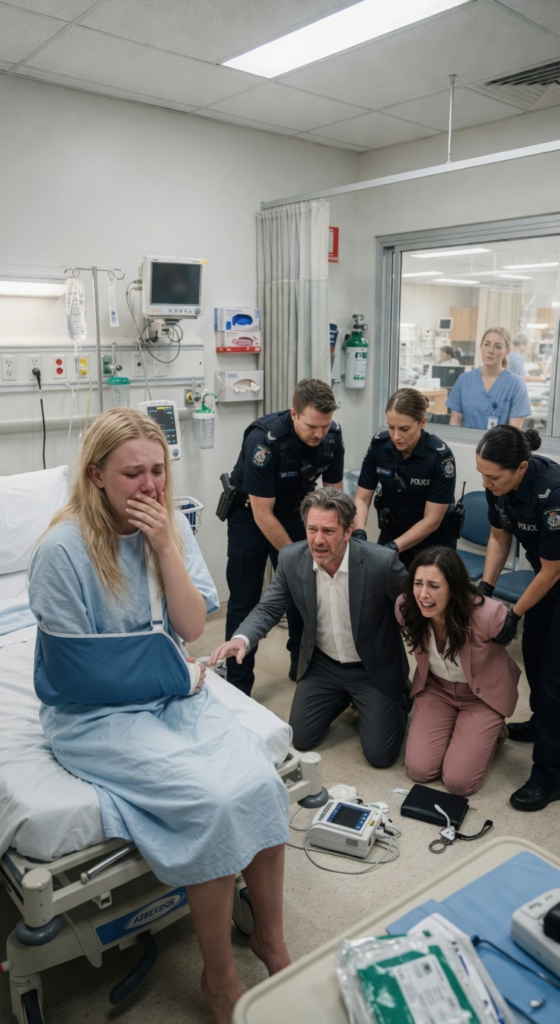
The triage team moved with practiced efficiency. Within minutes, Mara was whisked away in a wheelchair, navigating a labyrinth of sterile, bleach-scented hallways beneath aggressively bright fluorescent lights. They placed her in a private curtained bay, lifting her onto a stiff, white-sheeted hospital bed.
Victor stood right beside the bed, his hand resting heavily on Mara’s uninjured left shoulder. To the passing nurses, it looked like a comforting, protective gesture. To Mara, it was a physical threat, a heavy, suffocating reminder that he was right there, listening to every breath she took. Elaine stood at the foot of the bed, wringing her hands, tears continuously leaking from her eyes.
The curtain was suddenly pulled back.
A tall, sharp-featured man in his late fifties stepped into the bay. He wore navy blue scrubs and a white coat embroidered with Dr. Miguel Alvarez, Attending Physician. He had dark, deeply intelligent eyes framed by silver-rimmed glasses, and a demeanor that radiated calm, authoritative competence.
“Good evening. I’m Dr. Alvarez,” he said, his voice a deep, soothing baritone. He stepped up to the bed, immediately focusing his attention on Mara. “I understand we took a nasty tumble down the stairs?”
Before Mara could even open her mouth, Elaine launched into her manic monologue.
“It was awful, Doctor!” Elaine gasped, stepping forward and gripping the metal footboard of the bed. “She’s just so incredibly clumsy. She was wearing these slick, fuzzy socks, and she was running down the hardwood stairs in the dark to get a glass of water. She missed the third step and just tumbled all the way to the landing. She landed directly on her arm. I heard the crack from the living room!”
Dr. Alvarez did not interrupt. He listened to Elaine’s frantic, overly detailed explanation with polite stillness. He didn’t look at Elaine; he kept his eyes fixed entirely on Mara’s arm.
“Let’s take a look, Mara,” Dr. Alvarez said softly.
He gently, meticulously unwrapped the bloody bath towel. Even with his expert care, the movement sent a sickening jolt of pain through Mara’s body. She gasped, her back arching off the mattress, sweat beading on her forehead.
Dr. Alvarez’s hands stopped. His brow furrowed deeply.
He looked at the swelling, the profound deformity of the forearm. He didn’t need an X-ray to read the violent story written beneath the skin.
A fall down the stairs typically resulted in a transverse or oblique fracture—a clean break caused by blunt force trauma or attempting to brace against a flat surface.
But the deformity in Mara’s arm presented a classic, undeniable spiral fracture. The bone had not been snapped by an impact; it had been violently, aggressively twisted, sheared in half by extreme, opposing torsion. It was an injury virtually impossible to sustain from a simple, forward-tumbling fall. It required a twisting force applied by an external, massive power.
Dr. Alvarez’s dark eyes flicked upward from the shattered bone to Mara’s face.
He saw the fresh, dark purple bruising blooming along her left cheekbone. He saw the small, jagged laceration on her lower lip, still weeping blood. And as his gaze dropped just an inch, he saw the collar of her oversized t-shirt, pulled slightly askew, revealing a cluster of faint, yellowish-green oval bruises along her collarbone. The undeniable, faded fingerprints of a previous strangulation attempt.
The air in the small hospital bay seemed to drop ten degrees.
Mara looked back at the doctor. She didn’t cry. She didn’t mouth the word ‘help.’ She didn’t look away in shame. She held Dr. Alvarez’s gaze with a terrifying, ancient stillness. It was a look that stripped away all the noise, all the frantic babbling of her mother, all the heavy, threatening presence of her stepfather. It was a silent, profound transmission of absolute truth.
I know that you see it, her eyes said.
Dr. Alvarez held her gaze for three long seconds. He understood.
The polite, reassuring bedside smile on the doctor’s face vanished entirely, replaced by a mask of cold, clinical detachment. He stood up straight, gently laying a sterile drape over the broken arm.
“I see,” Dr. Alvarez said, his voice flat, completely devoid of its previous warmth. He turned to Victor and Elaine. “The break is quite severe. I’m going to need to administer a localized block before we take her to radiology. I also need to go to the supply room to gather a specialized traction splint.”
“Of course, Doctor. Whatever she needs,” Victor said smoothly, playing the role of the grateful father.
“I will be right back. Please, do not move her,” Dr. Alvarez instructed.
He turned on his heel and walked out of the curtained bay. But he didn’t turn left toward the medical supply closets. Through the narrow gap in the curtain, Victor watched the doctor’s retreating back.
Alvarez walked directly to the enclosed, glass-walled nurses’ station. He didn’t speak to the triage nurse. He walked straight to the secure phone mounted on the back wall, picked up the receiver, punched a button for an outside line, and rapidly dialed three digits.
9-1-1.
Victor’s eyes narrowed into dark, dangerous slits. The predatory instinct that had kept him out of jail for years flared to life, a cold alarm bell ringing in the back of his skull. He recognized the stiff, urgent posture of a man making a report.
Victor slowly turned his head, his gaze dropping back to the girl lying on the hospital bed. The mask of the concerned father melted away, revealing the terrified, cornered monster beneath.
“What did you do?” Victor whispered, his voice vibrating with lethal intent.
CHAPTER 3: THE LOCKED PANDORA’S BOX
The agonizing wait lasted exactly twelve minutes.
Victor paced the narrow confines of the hospital bay like a caged tiger. The heavy thud of his work boots against the linoleum was the only sound in the room, save for the rhythmic, terrified gasps of Elaine, who was practically chewing her fingernails down to the quick.
Mara lay perfectly still. The pain in her arm was a roaring, all-consuming fire, a heavy, throbbing bass drum echoing in her skull. But beneath the physical agony, her mind was a fortress of ice. The adrenaline of the impending collision sharpened her senses to a razor’s edge. She watched Victor pace, analyzing the erratic, fearful twitch in his jaw. The god of Elm Street was beginning to panic.
The sound of approaching footsteps broke the silence. They were not the soft, squeaking steps of a doctor wearing rubber-soled clogs. They were the heavy, measured, authoritative thuds of tactical boots.
The privacy curtain was violently yanked back on its metal rings.
Dr. Alvarez did not step into the room. Instead, two towering, uniformed police officers stepped into the narrow space. Their hands were resting casually, yet purposefully, on the thick black duty belts around their waists, mere inches from their sidearms.
The air in the room instantly solidified.
Victor stopped pacing. His face drained of color, but he forced his shoulders back, puffing out his chest to project dominance. He stretched his lips into a wide, entirely unconvincing smile.
“Evening, officers,” Victor said, his voice dripping with forced, jovial charm. “Is there a problem? We’re just waiting on the doctor to splint my daughter’s arm. She took a nasty spill down the stairs at home.”
The lead officer, a woman with sharp eyes and a tight, professional bun, didn’t return the smile. She looked at Victor, then at Elaine, and finally rested her gaze on Mara’s bruised, battered face.
“Mr. Hale,” the female officer said, her voice hard and uncompromising. “We received a mandated report from the attending physician regarding suspected, severe child abuse. We are going to need you and your wife to step out into the hallway immediately. We need to speak with the minor alone.”
“What? That’s absurd!” Victor barked, his voice rising in volume, attempting to use anger to control the narrative. “I know my rights! I am her father, and I demand to be present for any questioning!”
“You are her stepfather, Mr. Hale,” the second officer interjected smoothly, taking a deliberate step forward, invading Victor’s personal space. “And right now, you are a primary suspect in a felony assault investigation. You can step into the hallway voluntarily, or I can put you in handcuffs and drag you out. Your choice.”
Elaine let out a strangled, high-pitched wail. She lunged toward the bed, reaching out with trembling hands to grab Mara’s uninjured arm.
“Officers, please, you’re making a terrible mistake!” Elaine sobbed, her face a mask of pathetic, desperate cowardice. “Mara, honey, tell them! Tell them it was an accident! Tell them you fell! Please, baby, don’t let them do this to our family!”
“Ma’am, step away from the victim,” the female officer ordered, physically stepping between Elaine and the bed, her hand hovering over her pepper spray.
Victor realized the physical intimidation was failing. He backed slowly toward the curtain, his eyes locking onto Mara. The mask of charm was gone, replaced by a look of sheer, murderous malice. He stared at her, transmitting a silent, terrifying promise of what would happen if she betrayed him.
Be a good girl, his eyes screamed. Or I will kill you.
The officers ushered Victor and a weeping Elaine out of the bay, pulling the heavy curtain shut, isolating Mara in a small, private sanctuary of white fabric.
The female officer pulled up a rolling stool and sat down beside the bed. Her demeanor softened instantly, transforming from a hardened enforcer to a gentle, protective presence.
“Mara, my name is Officer Davis,” she said softly, pulling a small notebook from her breast pocket. “I know you’re in a lot of pain, and I know you are scared. But you are safe now. I promise you, that man cannot hurt you while I am in this room. You don’t have to protect him anymore. Can you tell me how your arm broke?”
Mara took a deep, shuddering breath. The pain in her arm flared, but she pushed it aside. The moment had arrived. The culmination of six months of silent, agonizing endurance.
She didn’t look at the floor. She didn’t cower. She sat up slightly against the pillows, ignoring the burning in her nerves, and looked Officer Davis directly in the eye.
“I didn’t fall down the stairs, Officer Davis,” Mara stated. Her voice was not a whisper. It was clear, resonant, and entirely devoid of the trembling fear that Victor had conditioned her to project. “Victor Hale broke my arm. He grabbed my wrist and he twisted it until the bone snapped. And he hits me almost every single day.”
Outside the curtain, Victor, who was straining to hear the conversation, erupted.
“She’s lying!” Victor roared, his heavy fists slamming against the wall of the corridor. “She’s a pathological liar! She’s hallucinating from the pain! You have no proof! It’s her word against ours, and her own mother will tell you she fell!”
Mara didn’t flinch at the sound of his rage. She calmly reached her uninjured left hand into the front pocket of her blood-stained jeans. She pulled out a cheap, prepaid smartphone with a cracked screen.
“Officer,” Mara said, her voice cutting through Victor’s muffled screaming. “Can you hold this for me? I only have one good hand.”
Officer Davis frowned in confusion but took the cracked phone.
Mara leaned forward and tapped her passcode onto the screen. She navigated past the generic apps, opening a folder labeled Calculus Homework. Inside the folder was a disguised, encrypted cloud-storage application. She tapped it open.
The screen populated with hundreds of files.
“I don’t need my mother to tell you the truth,” Mara said, her voice dropping to a low, chilling register of absolute certainty. “I have one hundred and twenty-four audio recordings. I have sixty high-definition video files. They are automatically backed up to a secure, remote server from a microscopic, motion-activated camera I installed inside the plastic casing of the smoke detector in our kitchen six months ago. All of these files are currently scheduled on a dead-man’s switch to auto-forward to the State Attorney’s Office of Child Protection at 8:00 AM tomorrow.”
Officer Davis stared at the screen, her mouth parting in sheer, absolute shock.
Mara reached out and tapped the very top file, time-stamped just forty-five minutes ago.
She pressed Play, and turned the volume to maximum.
The tinny, electronic speaker of the phone amplified the recording, projecting it clearly through the thin fabric of the hospital curtain.
Victor’s cruel, arrogant voice echoed through the emergency room corridor: “Still standing, huh? You’re getting tougher, kid. Maybe too tough.”
There was a pause, filled with the sound of Elaine’s weak protesting. Then, Victor’s voice dropped to a terrifying, violent hiss: “She thinks I’m making too much noise. She thinks I’m being unfair. Let’s see what real noise sounds like.”
And then, the sound played.
SNAP.
The horrifying, bone-chilling crack of Mara’s arm breaking echoed through the quiet hospital ward, followed instantly by her recorded, agonizing scream.
Outside the curtain, the hallway went dead silent.
Victor Hale froze, the blood draining from his face, leaving him looking like a reanimated corpse. His arrogant bluster, his claims of hallucinations, his entire, fragile empire of lies evaporated into thin air.
The Pandora’s box he had spent years trying to keep nailed shut with fear and violence had just been blown wide open by a sixteen-year-old girl holding a cracked cell phone.
The trap was sprung.
CHAPTER 4: THE MIRROR SENTENCE
The silence in the corridor lasted for exactly three seconds.
When the reality of the recording finally penetrated Victor’s narcissistic delusion, the mask of the “head of the household” didn’t just slip; it shattered into a million jagged pieces, revealing the raw, unhinged monster beneath.
He didn’t surrender. He didn’t drop to his knees. The profound, inescapable humiliation of being outsmarted by the child he considered nothing more than a punching bag ignited a primal, apocalyptic fury inside him.
“You little bitch!” Victor roared, a sound that was less human and more akin to a wounded, feral beast.
He lunged forward. He tore the heavy hospital curtain off its metal rings with a violent, tearing screech, exposing the small bay. His eyes were wide, bloodshot, and completely devoid of sanity. He wasn’t trying to escape; he was trying to reach Mara. He wanted his hands around her throat.
“I’ll kill you! I’ll tear your head off!” he screamed, his heavy work boots launching him toward the bed.
He never made it.
The male police officer waiting in the hallway tackled him from behind, driving a heavy shoulder into the small of Victor’s back. At the exact same moment, Officer Davis, reacting with lightning speed, drew her taser and fired.
The twin prongs embedded themselves deep into the thick fabric of Victor’s flannel shirt. Fifty thousand volts of electricity ripped through his nervous system.
Victor’s body seized violently, his muscles locking in a rigid, agonizing spasm. He crashed face-first onto the hard, cold linoleum floor of the hospital with a sickening thud, his nose breaking upon impact. A spray of bright red blood painted the white tiles.
The officers descended upon him immediately. Knees were driven into his back, pinning him to the floor. The metallic, heavy click-click-click of steel handcuffs ratcheting tightly around his wrists echoed through the bay. Victor thrashed blindly, spitting blood and saliva onto the floor, groaning in a mixture of physical pain and absolute, suffocating defeat.
Elaine, who had watched the entire violent spectacle unfold, completely collapsed.
She dropped to her knees just inside the doorway of the bay. She didn’t crawl toward her husband. Instead, she turned her desperate, pathetic gaze toward the bed. She clasped her hands together, tears streaming down her ruined makeup, attempting to launch her final, desperate performance.
“Mara, oh god, Mara!” Elaine wailed, rocking back and forth. “I didn’t know! I swear on my life, I didn’t know it was this bad! He manipulated me! I was terrified of him too! I’m a victim, baby, just like you! You have to tell them I didn’t know!”
Mara sat propped up against the pillows. Her broken arm throbbed relentlessly, a fiery agony burning through her veins. But as she looked down at the woman kneeling on the floor, she felt no anger. She felt no betrayal. She felt absolutely nothing. The well of maternal expectation had run completely dry.
Mara looked at her mother from high above, her eyes cold, analytical, and empty of pity.
“You knew,” Mara stated, her voice as flat and hard as concrete.
Elaine gasped, shaking her head frantically. “No! No, I swear—”
“In the video file dated August 14th,” Mara interrupted, her voice slicing through Elaine’s lies with surgical precision. “You stood by the refrigerator, drinking a glass of Chardonnay, while he held my head under the water in the kitchen sink for forty-five seconds. You watched the entire thing. You didn’t even put your glass down.”
Elaine’s mouth fell open, a strangled sob catching in her throat.
“In the video file dated September 2nd,” Mara continued relentlessly, stripping away every ounce of Elaine’s manufactured innocence. “After he kicked me in the ribs, you spent twenty minutes on your hands and knees scrubbing my blood out of the Persian rug with bleach, because the Hendersons were coming over for bridge night and you didn’t want them to see the stain.”
Mara tilted her head slightly, looking at the weeping, pathetic shell of her mother.
“You are not a victim, Mom,” Mara whispered, her voice carrying a terrifying, absolute finality. “You were the director of the play. You just didn’t like the ending.”
Before Elaine could formulate another lie, the heavy double doors of the ER corridor swung open.
A woman in her late thirties, wearing a sharp, tailored black blazer and carrying a thick leather briefcase, strode purposefully down the hallway. She bypassed the gawking nurses and stepped directly into the chaos of the ruined hospital bay.
She pulled a business card from her pocket and handed it to Officer Davis, who was currently hauling a bleeding, subdued Victor to his feet.
“Good evening, Officers. My name is Sarah Hayes,” the woman announced, her voice crisp, professional, and radiating authority. “I am a senior litigator for the State Child Advocacy Coalition. My client, Mara, has been in encrypted email contact with my office via her school’s library network for the past two months, compiling this evidentiary dossier.”
Sarah Hayes stepped forward, placing a protective, reassuring hand on the edge of Mara’s bed.
“We demand an immediate, emergency no-contact order against both Victor Hale and Elaine Hale,” Sarah stated, staring directly at the bleeding monster in handcuffs. “And we are formally pressing charges for aggravated felony assault, child endangerment, and conspiracy to commit physical abuse. The trap is closed, Victor. You’re done.”
The orchestration was flawless. Every avenue of escape, every possible manipulation, every lie Victor and Elaine had ever told had been meticulously mapped, anticipated, and destroyed by a sixteen-year-old girl typing in a school library.
The officers dragged Victor out of the room. He didn’t fight anymore. He slouched forward, leaving a trail of blood drops on the linoleum, a defeated, pathetic predator being dragged into the light. Elaine scrambled after him, weeping hysterically, begging the officers for mercy, her cries echoing down the long, sterile hallway until the heavy doors swung shut behind them.
The sudden silence in the bay was profound.
Mara let out a long, slow exhale. The adrenaline that had been sustaining her for the last hour finally began to recede, leaving behind the crushing, overwhelming reality of her shattered arm.
She turned her head. Standing quietly just outside the bay, holding a clipboard, was Dr. Alvarez. He had watched the entire scene unfold with a look of profound, silent respect.
Mara met his eyes. The terrifying, cold prosecutor vanished, replaced briefly by a tired, hurting sixteen-year-old girl. She offered him a small, incredibly weary, yet deeply relieved smile.
“Thank you, Doctor,” Mara whispered softly. “I think… I think I’m ready for that pain medication now. My arm is starting to ache.”
Dr. Alvarez smiled back, a warm, genuine expression that reached his eyes. “Right away, Mara. Right away.”
The curtain was pulled closed, shutting out the dark past, and enveloping her in the quiet, safe white space she had finally earned.
CHAPTER 5: A SKY WITHOUT A ROOF
Six months later, the justice system, usually a sluggish, bureaucratic beast, moved with terrifying, unprecedented speed.
When faced with sixty high-definition videos and over a hundred crystal-clear audio recordings, the defense strategy for Victor Hale completely collapsed. There were no plea deals offered. There was no sympathy from the judge. The trial lasted less than three days.
Victor was sentenced to fifteen years in a maximum-security state penitentiary, without the possibility of parole, for multiple counts of aggravated child abuse and felony assault. His construction company, already drowning in debt, was immediately liquidated. The heavy leather chair in the dining room, his throne of cheap whiskey and tyranny, was repossessed and sold at auction to pay his mounting legal fees.
Elaine Hale did not escape the blast radius. Confronted with undeniable video evidence of her complicity and active cover-ups, she was stripped permanently of her parental rights. She avoided prison time by testifying against Victor, but she was handed a five-year suspended sentence and a thousand hours of community service. Her country club friends abandoned her. Her neighbors shunned her. She was forced to move into a tiny, dilapidated apartment on the wrong side of the city, living the rest of her days in the very isolation and poverty she had sacrificed her daughter to avoid.
But for Mara, the world had fundamentally shifted on its axis.
It was a bright, unusually warm Saturday morning in early May. The air smelled of blooming jasmine and freshly cut grass.
Mara stood on the wide, wrap-around wooden porch of a sprawling Victorian house in the countryside. It was a specialized, highly vetted foster home run by a retired trauma nurse and her husband. The house was filled with light, the sound of dogs barking in the yard, and the chaotic, wonderful noise of safety.
Mara was wearing a simple, oversized yellow sundress. Her right arm, freed from the heavy fiberglass cast just two weeks prior, hung comfortably at her side. A long, faint, silvery scar ran down her forearm where the orthopedic surgeons had inserted a titanium plate to fuse the spiral fracture. She didn’t hide it. It wasn’t a mark of shame; it was a battle scar. It was the physical receipt for her freedom.
She no longer walked with her shoulders hunched forward, trying to make herself invisible. She no longer hid her face behind a curtain of long, unkempt hair. She stood tall, her posture relaxed, her eyes bright and clear.
In her hands, she held a heavy, professional-grade DSLR camera. It was a gift from Sarah Hayes, the lawyer who had fought so fiercely for her in court.
Mara raised the heavy camera, her fingers adjusting the focus ring with practiced, deliberate precision. She aimed the lens out over the rolling green hills, past the wooden fence, aiming directly up into the vast, endless expanse of the cloudless blue sky.
She closed one eye, peering through the viewfinder, framing the golden, blinding light of the morning sun.
As she adjusted the aperture, allowing the light to flood the sensor, a quiet, profound realization settled deep within her chest.
He used to call me his cheap entertainment, Mara thought, a soft, genuine smile touching her lips. He thought he was the master of the house, the director of a play where I was just a prop to be broken for his amusement. He thought that because I was silent, I was participating in his script.
She adjusted the shutter speed, perfectly balancing the exposure.
But he forgot the most fundamental, ancient rule of the theater, she mused, the warmth of the sun kissing her unbruised cheeks. The monster stomping around on the stage isn’t the one in control. The person sitting in the dark, quietly holding the camera, framing the shots, and deciding exactly what the audience will see… that is the person who truly owns the narrative.
Mara took a deep, unrestricted breath of the clean spring air. She pressed her finger down on the shutter button.
CLICK.
The mechanical sound was sharp, crisp, and permanent. She lowered the camera, looking at the glowing digital screen. The image was perfect. It was a picture of pure, unfiltered light, captured and contained entirely on her terms.
There were no shadows left to hide in. There was no roof to trap her screams.
Mara slung the camera strap over her shoulder, turned her back on the shadows of the porch, and walked down the wooden steps, stepping forward into the brilliant, boundless light of her new life.