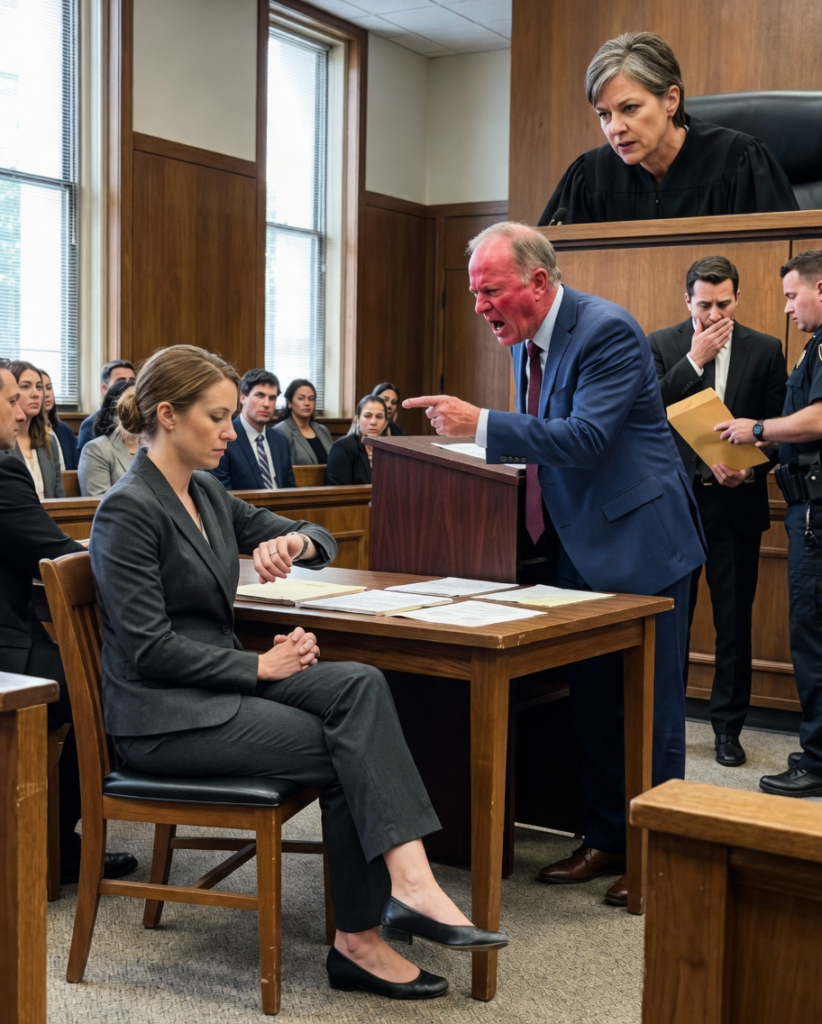
MY FATHER STOOD UP IN COURT AND SCREAMED THAT I WAS “MENTALLY INCOMPETENT”—A DRIFTER IN A SHOEBOX APARTMENT WITH NO HUSBAND, NO CAREER—AND THAT HE NEEDED EMERGENCY CONSERVATORSHIP TO “SAVE” MY TRUST FUND BEFORE I RUINED IT.
He expected tears.
He expected outrage.
He expected the old version of me—the one he had spent years training to defend herself just enough to keep him interested.
What he got instead was silence.
I sat at the respondent’s table in a charcoal suit that had cost less than one of his dinner bottles of wine, my scuffed leather flats tucked neatly under my chair, my hands folded in my lap.
When he paused to breathe, I checked my watch.
10:02 a.m.
Right on schedule.
That small movement made him smile.
He thought I was nervous.
The truth was, I was waiting for the sound a trap makes when it finally closes.
The Caldwell hearing had drawn a crowd because my father knew how to turn private cruelty into public theater.
Richard Caldwell had spent twenty-eight years building a reputation as a respectable man: polished real estate developer, donor to museums, chair of a hospital foundation, widower of the elegant Elise Vale Caldwell.
In photographs, he always looked like the kind of man who donated quietly and loved deeply.
In real life, he was a man who believed control and love were interchangeable.
He stood at the podium and pointed at me as if I were a stain he meant to explain away.
“She is unstable,” he said.
“She is isolated.
She has no husband, no children, no visible career, and she lives in a shoebox apartment downtown.
She has withdrawn from family, from society, from responsibility.
If the court doesn’t appoint a conservator immediately, she will squander the trust her mother died to leave her.”
He didn’t look at the judge while he said it.
He looked at the gallery.
That was always his method.
He never argued to persuade the person with power.
He argued to recruit witnesses to his version of reality.
I said nothing.
It infuriated him.
“Look at her,” he snapped.
“She won’t even speak.”
Judge Sullivan made a note.
The courtroom was all dark wood, brass lamps, and old habit.
People lowered their voices there without being asked.
My father was the only person in the room who behaved as if sound itself belonged to him.
At the counsel table to his right, his attorney, Thomas Bennett, kept nodding along with the practiced composure of a man who believed this would be simple.
Bennett had filed the petition three days earlier, wrapped in dramatic phrases about imminent harm and urgent intervention.
There was no psychiatric evaluation.
No medical finding.
No proof I was incapable of anything.
Just insinuation, class prejudice, and my father’s favorite argument: if I had chosen a life he didn’t approve of, I must not be qualified to choose it.
He had made that argument for years.
After my mother died, he used it more openly.
Elise Vale Caldwell had come from the money he spent his life pretending he had built.
The Vale family wealth wasn’t flashy, which made it harder to understand and harder to challenge.
It lived in municipal bonds, land trusts, warehouses no one noticed until cities grew around them, and careful holdings accumulated across generations.
My mother understood every line of it.
My father understood the public face of it.
When she died, he inherited grief and access, but not ownership.
The Vale trust had been structured long before I was born.
I was the primary beneficiary.
He was the acting trustee until I met the conditions to take full control.
He never expected me to meet them.
That part was not because I lacked the ability.
It was because he never bothered to see it.
When I was twenty-four, I left the Caldwell house after the third straight year of being told I was too sensitive when I objected to being spoken about like a decorative inconvenience.
I stopped attending his fundraising dinners.
I stopped showing up in photos.
I stopped answering assistants who called with scripted concern about my “adjustment.” He told people I was drifting.
That I was overwhelmed.
That I needed time.
What he meant was that I was no longer available for management.
I took my mother’s maiden name professionally.
Not to hide from him, exactly.
To stop being introduced through him.
I became Nora Vale on every credential that mattered.
I studied forensic accounting first because numbers don’t care who is louder.
Then I added fraud examination because patterns tell the truth that people spend fortunes trying to bury.
By thirty-two, I had built a compact, stubborn little firm that specialized in tracing money through shell entities, vanity partnerships, and family trusts designed to look cleaner than they were.
I didn’t advertise in magazines.
I didn’t go to galas.
I worked.
Quietly.
Thoroughly.
The kind of work that gets mistaken for absence by people who only respect spectacle.
The building my father mocked in court that morning was not a rental I could barely afford.
It was one of mine.
Four years earlier, I had bought it through an LLC called Vale House Holdings, renovated the plumbing, replaced the roof, and kept one small top-floor unit for myself because I liked the windows and because living modestly has a way of teaching people around you to reveal what they really think.
My father had driven by once, seen peeling trim before the final exterior repairs were completed, and told someone I was living in a shoe box.
He never checked the property records.
He never checked much.
That arrogance was why he made mistakes.
The first one appeared in a trust summary he assumed I would never read carefully.
A distribution deferment was explained with a bland accounting note that didn’t match the quarterly flow.
It was small enough to dismiss if you were used to being intimidated by paperwork.
I wasn’t.
A second inconsistency appeared six months later.
Then a tax schedule with a line item routed through a consulting entity I had never seen before.
Caldwell Strategic Advisory.
The name alone offended me.
I asked for a formal accounting.
My father laughed.
He called it emotional.
Said grief had made me suspicious.
Suggested I spend less time alone.
When I asked again in writing, I received a message from Bennett telling me informal family matters should not be escalated through hostile channels.
That was when I called Miriam Holt.
Miriam had been my mother’s attorney before she retired from active practice. She was seventy-one, sharp as winter glass, and had once told me that men who rely on charm in business usually panic when confronted with a paper trail.
I had not spoken to her in nearly three years.
She answered on the second ring and said, before I could finish my first sentence, “I wondered when you’d see it.”
Two days later I was sitting in her library with a sealed envelope on the table between us.
My mother’s handwriting was on the back.
Open only if Richard obstructs accounting, challenges capacity, or attempts control over Nora’s person.
I didn’t touch it at first.
Miriam did not rush me.
She poured tea and let silence work.
When I finally broke the seal, the first document was a trust amendment executed eleven months before my mother died.
It was specific in a way that took the air out of the room.
If Richard Caldwell ever sought legal control over my personal autonomy or financial agency by alleging instability without independent medical evidence, he would be deemed adverse to the beneficiary and subject to immediate suspension pending review.
A sealed accounting packet, maintained offsite by counsel and one independent compliance bank, would be released upon filing.
There was a letter under it.
My mother had known.
Not everything.
Not the totals.
But enough to worry.
Enough to write, in a hand I had not seen since the hospital months, that Richard only respected force when it arrived in a form he could not interrupt.
Enough to tell me that if the day ever came, I was not to waste one ounce of my strength trying to make him understand me.
I was to document him.
So I did.
For eighteen months, I built the case.
I traced transfers through three shells and two “consulting” entities with identical mailing addresses.
I matched trust outflows to acquisitions that never appeared on the books.
I found renovations on a condominium registered to a woman who had sat two rows behind my father at every charity dinner for years calling my mother a dear friend.
I found political donations routed through a nonprofit reimbursement structure.
I found a vineyard investment my father bragged about publicly as a private win, subsidized by money that had originated in the trust.
Every line carried just enough polish to discourage scrutiny.
But money hates disguise when enough time is spent following it.
I did not confront him.
I did not warn him.
People like my father are most honest when they think contempt is still working.
Then, three weeks before the hearing, I sent a final demand for full accounting and notice of intent to petition for removal.
He responded the way he always did when challenged by a woman he considered manageable.
He escalated.
The conservatorship petition arrived forty-eight hours later.
Miriam called me the moment she saw the filing.
“He triggered it himself,” she said.
She sounded almost disappointed by how predictable he had been.
We filed the companion petition under seal with exhibits, requested a synchronized release from the compliance bank named in my mother’s amendment, and asked the court to hear both matters together.
Judge Sullivan granted review.
The bank’s certified packet was scheduled to hit the docket at 10:02 a.m.
on the hearing date.
That was the time I checked my watch.
Back in court, my father was still talking when the bailiff walked in from the side door and handed Bennett the document that changed his face.
Bennett read the first line and went pale.
He understood faster than Richard did, which was probably why he survived long enough in wealthy families to bill by the hour.
Judge Sullivan waited until my father finished calling me incapable, then asked the question that split the morning open.
“You really don’t know who she is, do you?”
He looked offended.
“I know exactly who my daughter is.”
The judge’s expression did not move.
“Do you?”
She read from the filing in front of her.
“Ms.
Nora Vale Caldwell is a licensed forensic accountant, a certified fraud examiner, and principal of Vale Forensic Advisory.
She owns, through Vale House Holdings, the property you referred to as a distressed rental.
She has lived independently for eleven years, filed taxes without delinquency, managed multi-property holdings, and submitted verified reports in fiduciary disputes in this state and two others.”
The gallery stirred.
My father stared at me.
He had mocked my career because he had never taken the time to learn it.
He had mocked my building because he had never checked who owned it.
He had mocked my silence because he mistook restraint for weakness.
Judge Sullivan continued.
“Your petition alleges incapacity.
What I have before me instead is a substantial filing alleging your self-dealing as trustee.”
She motioned to the clerk, who handed my father a copy of the lead page.
He read the title.
Petition for Immediate Suspension of Richard Caldwell as Acting Trustee, Freeze of Disputed Assets, Accounting, Surcharge, and Referral of Suspected Fiduciary Theft.
The change in him was almost delicate.
His certainty didn’t collapse in one dramatic moment.
It leaked out of him.
His shoulders dropped by a fraction.
His mouth lost shape.
The blood shifted under his skin.
“This is ridiculous,” he said, but it came out too softly.
Judge Sullivan looked at Bennett.
“Counsel, were you aware of the amendment executed by Elise Vale Caldwell?”
Bennett swallowed.
“I was not provided that document by my client.”
My father turned on him.
“What amendment?”
The judge answered before Bennett could.
“The one that states any unsupported attempt by you to seize personal control over the beneficiary triggers automatic review, suspension, and release of independent financial records.”
For the first time, he looked afraid.
Not outraged.
Not insulted.
Afraid.
Then the bailiff carried a second folder to the bench.
Judge Sullivan opened it, scanned the top exhibit, and went still in the way serious people do when a number confirms their worst guess.
“Mr.
Caldwell,” she said, “would you like to explain why three million eight hundred thousand dollars left the trust through Caldwell Strategic Advisory at 9:14 a.m.
on the day of your wife’s funeral?”
The room stopped breathing.
He blinked at the page in front of him.
I knew exactly what he was seeing because I had seen it in enlargement the night before: the transfer date, the originating trust account, the intermediary shell, the destination ledger.
And the destination name was the one detail he had never expected anyone to connect.
Elise Holdings Annex.
It sounded harmless.
It wasn’t.
It was the acquisition vehicle used to purchase and renovate the downtown condominium where he had installed his longtime mistress six weeks after my mother’s diagnosis.
He tried to speak.
Nothing came out.
Then he found anger because anger had always been his emergency exit.
“This is a distortion,” he snapped.
“Routine movement.
Advisory allocation.
Perfectly authorized.”
“By whom?” Judge Sullivan asked.
He opened his mouth and stopped again.
My mother’s signature authority had ended with her death.
Mine had not yet vested at the time.
The only person who could have approved that transfer was the trustee.
Him.
Miriam stood when called and identified the amendment, the release instructions, and the compliance protocol my mother had established.
She did not dramatize anything.
She did not need to.
Facts grow their own teeth when arranged properly.
I spoke only once.
Judge Sullivan asked whether I wished to address the court.
I stood and said, “I am not asking the court to punish my father for underestimating me.
I am asking the court to protect the trust from the person who used my supposed weakness as cover for his theft.”
That was all.
It was enough.
The conservatorship petition was denied with prejudice.
Richard Caldwell was suspended as acting trustee before noon.
The court granted a temporary freeze on disputed assets, appointed an independent fiduciary to work with me during the formal accounting phase, and referred the matter to the district attorney’s financial crimes unit.
When my father interrupted the ruling twice, Judge Sullivan warned him once.
The second time, the bailiff stepped closer and he finally sat down.
He looked smaller seated.
I had never seen that before.
The rest took months, because real consequences move slower than humiliation.
But they came.
Once subpoena power widened the lane, the structure cracked quickly.
Bennett withdrew.
The independent fiduciary found additional unauthorized transfers, including art purchases stored under corporate insurance, private school payments for a child no one in our family had ever met, and a series of reimbursements tied to campaign events where my father had been thanked publicly for generosity funded with money that was never his.
The mistress sold the condominium three weeks after investigators contacted her.
It didn’t matter.
The paper trail had already been copied and certified.
My father tried a public statement first.
He called the matter a misunderstanding inflated by grief and internal family conflict.
Then he tried indignation, then victimhood, then partial denial.
By the time the criminal complaint was filed, none of it had room to breathe.
He eventually took a plea.
Not because he was sorry.
Because the accounting was too clean.
He pled guilty to fiduciary theft, filing false statements in trust administration, and tax-related fraud connected to diverted funds.
He avoided a longer sentence by surrendering properties, club shares, and a slice of the development company he had once introduced as proof of his brilliance.
Restitution restored most of what he had taken.
Not all of it.
Enough.
The mansion sold first.
Then the vineyard.
Then the illusion.
When the final orders were entered, I became sole acting trustee of my mother’s trust and dissolved the shell of dependence he had tried to lock around me.
I transferred recovered assets into conservative holdings, liquidated what needed to go, and used a portion of the restitution to establish the Elise Vale Fellowship in financial literacy and legal advocacy for women leaving coercive family situations.
My mother had loved practical things.
She would have preferred scholarships to marble plaques.
Miriam cried when I told her the name.
I kept the downtown building.
I kept my small apartment on the top floor too.
People asked why, after everything, I still lived there when I could have moved anywhere.
The answer was simple.
It had windows that caught the late afternoon sun in the kitchen.
The tenants were decent.
The stairs reminded me to stay inside my own life.
And once, a man with every advantage in the world had looked at that building and decided it proved I was nothing.
I liked making coffee there in the mornings.
It felt educational.
My father wrote me from prison once.
The letter was four pages of careful language and almost no truth.
He said he had been under pressure.
He said he had made temporary decisions.
He said he was sorry things had become so public.
He said he hoped, one day, we might both recognize the pain on all sides.
He never once wrote that he was sorry for trying to erase my mind in a courtroom.
He never once wrote that he was sorry for using my mother’s death as cover.
He never once wrote that he was sorry for not knowing me.
I did not answer.
The strangest part, in the end, was not discovering how much he had taken.
It was realizing how certain he had been that humiliation would still work.
That he could stand in a courtroom, call me incompetent, and trust that I would fold the way I used to when I was young and trying to earn softness from a man who only respected submission.
He lost because he stole, yes.
But he also lost because he never learned the difference between appearing powerful and being right.
Sometimes I still hear Judge Sullivan’s voice in that room.
“You really don’t know who she is, do you?”
It sounded devastating then.
Now it sounds almost merciful.
Because there are some men who deserve one final chance to understand the person standing in front of them before everything they built around a lie falls away.
My father had that chance.
He looked directly at me when it came.
And even then, even with the truth spread across polished wood in black ink and numbered exhibits, I’m not sure he ever understood that the worst thing he lost was never the money.
It was the moment he realized the daughter he tried to declare incapable had been the only adult in the room all along.