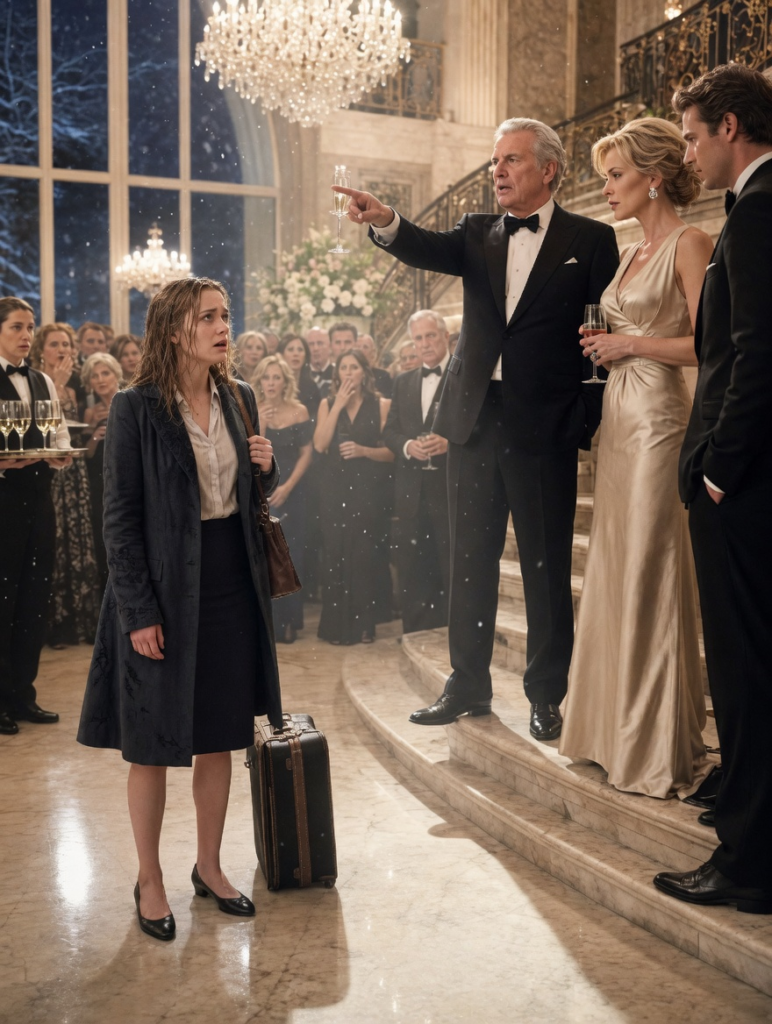
My parents gave my younger sister fifty-five million dollars in front of two hundred guests on Christmas Eve, then took my car keys, froze my credit card, and left me standing outside our iron gates in freezing rain with one suitcase and nowhere to go.
For a long time after that night, people asked me what I felt in that moment.
Rage, they expected me to say. Betrayal. Fear. Maybe humiliation.
But the truth was uglier than any of those.
I felt hope.
Even with the rain crawling under the collar of my wool coat, even with my fingers wrapped around the iron bars so tightly that the cold metal burned through my gloves, even with the golden windows of the Greenwich estate glowing behind my father like a theater set from a life I no longer belonged to, some ridiculous, loyal, damaged part of me still believed he might turn around.
I still believed my mother might come running down the steps with a blanket.
I still believed my sister might look out one of those tall windows, see me standing there, and remember that once, when we were children, she had cried in my bed during a thunderstorm and I had held her all night because she said I was the only person who made the dark feel smaller.
I still believed family meant there was a line they would not cross.
That was my fatal flaw.
Not kindness. Not weakness. Not failure.
Hope.
The gate in front of me was black iron, custom-forged, twelve feet tall, with the Morris family crest worked into the center in an elaborate knot of metal vines. My father loved that gate. He said it gave the estate presence. He said people needed to understand before they entered our driveway that they were approaching something important.
When I was little, I used to think the gate was beautiful. I thought it meant safety. Privacy. A boundary between the world and us.
Standing outside it that Christmas Eve, soaked through and shivering, I understood it for the first time.
It was not meant to keep danger out.
It was meant to keep people like me from getting back in.
“Dad,” I said, and I hated the sound of my own voice.
It came out thin. Almost childlike. The kind of voice I used when I was nine and had broken one of my mother’s porcelain angels and knew the punishment would not be loud, only cold.
Preston Morris stood on the other side of the gate with my keys in his hand.
My Subaru was parked six feet behind me on the circular driveway. Ten years old, silver, dented on the passenger side from the time I had clipped a mailbox during a February snowstorm in Stamford. It smelled faintly of coffee, old receipts, and the lavender air freshener I kept replacing even though it never really worked. It was not luxurious. It was not pretty. But it was mine.
At least, I had believed it was mine.
“I paid for it,” I stammered, reaching through the bars toward him. “Every payment. For five years. You know that.”
My father looked at me the way he looked at underperforming quarterly reports.
With irritation, not anger.
Anger would have meant I still mattered enough to disturb him.
“Paid through the corporate leasing structure using pre-tax bonuses,” he said. “Technically, the title belongs to Morris Holdings. You signed the transfer documents three years ago for tax efficiency.”
I stared at him.
“That was paperwork you told me to sign.”
“Yes,” he said. “And you signed it.”
My hand hung uselessly between us.
“Dad, it’s Christmas Eve.”
His expression did not change.
“You no longer work for us, Miranda. You don’t get the perks.”
The words were clean. Efficient. Practiced.
Then he turned away.
That was the part that stayed with me later. Not the announcement inside the house. Not my mother’s voice saying I was a burden. Not even the guests watching me like I was a stain on the marble floor.
It was the way my father turned his back.
No hesitation. No last glance. No conflict in his shoulders.
He simply walked toward the house, my keys jingling in his palm like loose change.
The sound grew softer as he crossed the wet stone path, climbed the front steps, and disappeared through the enormous double doors into warmth, music, champagne, and the rest of my family’s Christmas Eve engagement party.
The door closed.
And I waited.
I do not know how long.
Maybe two minutes. Maybe ten.
The mind does strange things when it cannot accept what the body already knows. My body knew I had been thrown away. My bones knew it. My skin knew it. My lungs knew it every time the rain turned my breath into a white cloud in front of my face.
But my heart kept counting seconds like mercy might still arrive on schedule.
One hour earlier, I had walked into that same house believing I would sleep in my old room.
I had lost my PR job three days before Christmas. The company had merged with a larger agency, and my entire department had been cut in a cheerful Monday morning email that used words like transition, restructuring, and gratitude. I had packed my desk in silence while people hugged in the hallway and pretended severance packages were not just polite eviction notices.
I was thirty-one years old, recently unemployed, and tired in the way people get tired when they have been pretending not to drown for too long.
The severance would cover rent for a couple of months. Maybe three if I canceled everything unnecessary and survived on grocery-store soup. But my lease was ending in January, and I had not renewed because I had believed, stupidly, that I could spend the holidays at home, reset, figure out my next move.
Home.
That word had done more damage to me than any insult ever could.
I arrived at the estate damp from the train, my hair flattened by sleet, my suitcase rolling behind me. I had expected the house to be quiet, maybe decorated for Christmas with my mother’s usual terrifying perfection. White roses. Gold ribbon. Real candles she never lit because she said open flames were tacky unless controlled by staff.
Instead, the driveway was packed with valet cars.
Through the windows, I saw crystal chandeliers blazing over two hundred people in black tie and cocktail dresses. A string quartet played near the staircase. Waiters moved through the foyer with silver trays of champagne. The entire house smelled of pine, expensive perfume, and roasted lamb.
Kinsley’s engagement party.
No one had told me.
Of course no one had told me.
My baby sister stood near the center of the foyer under soft romantic lighting, extending her left hand to anyone close enough to admire the diamond. She was twenty-six, golden-haired, small-boned, and effortless in the way only women who had never been required to lift anything heavier than a champagne flute could be. Her fiancé, Everett Blaine, hovered beside her in a navy suit, laughing at everything my father said.
When Kinsley saw me, her smile froze.
Not because she was surprised.
Because I had arrived looking real.
Not polished. Not invited. Not useful.
Just real.
“Miranda,” she said brightly, turning the word into a warning. “You made it.”
My mother turned then.
Genevieve Morris had built an entire personality out of elegant disappointment. She wore winter white silk and diamonds at her throat. Her blonde-gray hair was swept into a low twist, and her makeup was perfect in a way that suggested effort was vulgar but results were mandatory.
Her eyes moved over my damp coat, my suitcase, my worn work shoes.
Then she smiled as if I had tracked mud onto her soul.
“Darling,” she said. “We weren’t expecting you tonight.”
“I texted,” I said. “I said I was coming.”
“Yes,” she replied. “But you do that.”
Behind her, my father tapped a champagne glass with a spoon.
The sound rang through the foyer.
Guests quieted in waves. Conversations died. The quartet softened and stopped. Everyone turned toward Preston Morris, because everyone always did.
He stood near the bottom of the grand staircase in a charcoal tuxedo, broad-shouldered, silver at the temples, handsome in the way men with money are allowed to age into authority instead of deterioration. He held his champagne glass at chest height and looked around the room with calm satisfaction.
“Friends,” he said, “thank you for joining us tonight to celebrate Kinsley and Everett.”
A soft murmur of approval moved through the crowd.
Kinsley leaned into her fiancé’s arm.
I took one step toward the side hallway, hoping to escape before anyone noticed the suitcase.
Then my father said my name.
“Tonight is also a night for clarity. For legacy. For ensuring that what this family has built passes into hands capable of protecting it.”
My stomach tightened.
Genevieve did not look at me.
That was when I knew.
Preston continued, voice smooth and carrying. “After careful consideration, Genevieve and I have finalized the transfer of the Morris family trust. Effective immediately, the full value of the trust—fifty-five million dollars—will be transferred to Kinsley.”
Applause burst through the foyer.
A few people gasped. Someone laughed in delighted shock. Kinsley pressed both hands over her mouth, performing surprise badly enough that only people committed to believing her could possibly buy it.
My ears rang.
Not split.
Not placed under management.
Transferred.
All of it.
My father waited until the applause softened.
Then he looked directly at me.
“Miranda has demonstrated a consistent pattern of professional failure,” he said. “This family rewards success. Not mediocrity.”
The silence that followed did not feel empty.
It felt crowded.
Two hundred people holding champagne, watching me stand there with rainwater dripping from my hair onto my collar.
I remember Kinsley’s expression most clearly. Not pity. Not even triumph.
Relief.
As if some long-standing administrative error had finally been corrected.
I wanted to disappear. I wanted to scream. I wanted to become the sort of woman who could laugh coldly, throw a glass against the wall, and walk out with dignity.
Instead, I begged.
I wish I could rewrite that part. I wish I could tell you I stood tall and gave a speech that made every guest lower their eyes in shame. I wish I could say I saw them clearly in that moment and left before they could take another thing from me.
But trauma does not turn you into a heroine on schedule.
Sometimes it turns you into a child.
“Dad, please,” I said quietly. “I just lost my job. I only need a few weeks. Through the holidays. I can stay out of the way.”
My father looked bored.
“I’ll help with anything,” I continued. “I’ll make calls, organize files, whatever you need. I just need time to figure out where to go.”
My mother set down her wine glass.
The click against marble was sharp enough to cut.
“You’re a burden, Miranda,” she said. “We’re not running a charity for failed adults.”
Someone inhaled.
My face burned so hot I thought the room must be able to feel it.
“You need to leave,” Genevieve said. “Tonight.”
And because I had spent my whole life obeying the temperature of that house, I left.
I walked upstairs to the guest room because my childhood bedroom had been converted into Kinsley’s bridal wardrobe suite. I took the suitcase I had packed that morning with sweaters, toiletries, a framed photo of me and my grandfather, and three books I still had not finished. I went down the side staircase. I did not take food. I did not take jewelry. I did not even take the cash from the little bowl near the laundry room where my mother kept tips for delivery drivers.
I was still trying to be good.
That was the most humiliating part.
Even after being discarded, I was still careful not to steal from the people who had taken everything from me.
Now I stood outside the gate, watching the house lights go dark one by one.
The ballroom first.
Then the dining room.
Then the upstairs guest rooms.
The estate winked out like a ship leaving harbor without me.
My mother’s bedroom went dark last.
I imagined her removing her earrings, wiping off her lipstick, folding her silk robe across the chair. I imagined her settling into bed with the clean conscience of a woman who had never once mistaken cruelty for anything other than discipline.
My finger hovered over the intercom button.
I could press it.
I could ask for a blanket. A taxi. Anything.
But then I imagined my father’s voice crackling through the speaker, calm and satisfied, and I realized the cold was not the worst thing that could happen to me that night.
Hearing him say no again would be worse.
So I gripped my suitcase.
The handle was so cold it burned through my glove.
Port Chester was three miles east. I knew because I used to drive past it on my way to the train station, back when I had a car, back when I had a job, back when I had a family.
I turned away from the gate.
Away from the golden windows.
Away from every Christmas morning, summer barbecue, birthday dinner, graduation photograph, and carefully posed family portrait that had ever happened behind those walls.
Then I started walking into the dark.
The freezing rain turned the road into a black mirror. My suitcase wheels caught on every crack in the pavement, jerking my arm until my shoulder ached. My flats were not made for weather, or distance, or exile. Water seeped through the seams before I reached the first bend in the road.
I did not look back.
Not once.
Because I knew if I looked back, I might stop.
And if I stopped, I might wait at that gate forever.
By mile two, my feet had gone numb. Not comfortably numb. Not absent. Numb in the way that suggested pain was gathering somewhere deeper, waiting for warmth to return so it could announce itself.
Cars passed occasionally, headlights smearing through the rain. No one stopped. I did not blame them. A soaked woman dragging luggage on a private road after midnight on Christmas Eve did not look like someone to rescue. She looked like trouble with a backstory.
A Motel 6 sign appeared just after midnight.
Red and white neon flickered at the edge of Port Chester like a miracle too tired to fully commit.
Vacancy.
The word nearly made me cry.
Inside, the lobby smelled of burnt coffee, disinfectant, and carpet that had absorbed too many storms. The night clerk sat behind bulletproof glass, his chin propped on one hand as a tiny television played some late-night Christmas movie behind him. He looked up when I entered, and his expression shifted from boredom to caution.
“I need a room,” I said.
My voice sounded scraped raw.
He slid a form through the slot. “ID and card.”
I took out my wallet with fingers that barely worked. My driver’s license stuck to the plastic sleeve. My emergency credit card was still tucked behind it.
The one my father had given me years ago.
“For true emergencies only,” he had said.
I remember smiling then, touched by the gesture.
I handed the card through the slot.
The clerk swiped it.
The machine beeped.
He frowned.
“Declined.”
My heart dropped.
“Could you try again?”
He swiped it twice more.
Beep.
Beep.
Declined.
“Says here the card was reported stolen,” he said, leaning closer to his screen. “About twenty minutes ago.”
Twenty minutes.
That would have been right after my father took my car keys.
Right after he walked back into the house.
Right after he had time to pour another drink, remove his tuxedo jacket, and call a fraud line to make sure his daughter could not rent a motel room on Christmas Eve.
“Reported stolen?” I repeated.
The clerk looked at me differently then.
Not with sympathy.
With suspicion.
I saw his hand drift toward the phone.
I left before he could decide what kind of problem I was.
Outside, the cold hit harder than before, because for five minutes I had remembered warmth.
The bus stop on the edge of town was the only shelter I could find. Three walls of scratched plexiglass, a narrow metal bench, and an advertisement for a dental practice that promised brighter smiles in the new year. The plexiglass rattled whenever the wind blew. Rain leaked through one corner of the roof.
I sat down anyway.
My suitcase stood beside me like a useless witness.
I pulled out my phone, but the screen stayed black.
Dead.
The cold had killed the battery.
I laughed then.
Not because anything was funny.
Because grief sometimes trips over absurdity and becomes sound.
That was when I heard the whimper.
At first I thought it was the wind. Then it came again, softer, animal, afraid.
A dog was tied to the bus stop post with a length of frayed rope. Medium-sized, maybe forty pounds beneath all the soaked fur. Brown and white, with one torn ear and eyes too old for whatever age it actually was. It shook so hard the rope trembled.
Someone had left it there.
On Christmas Eve.
In freezing rain.
I stared at the dog, and the dog stared back.
“Well,” I whispered, “at least I’m not the only one having a bad night.”
I opened my purse and searched through receipts, lip balm, tissues, an old subway card, and one half of a stale turkey-and-Swiss sandwich wrapped in wax paper. I had bought it two days earlier and forgotten it existed.
I unwrapped it carefully.
The dog’s ears lifted.
“Don’t get excited,” I said. “It’s terrible.”
I broke off a piece and held it out.
The dog approached slowly, ribs visible beneath wet fur. It took the sandwich from my fingers with such gentleness that something inside me cracked.
I fed it bite by bite.
Half for the dog. Half for me.
Then more for the dog, because it looked at me like gratitude was the only language it still trusted.
When the sandwich was gone, it pressed against my leg.
I wrapped one arm around its wet body.
“We match,” I whispered. “Both thrown away on Christmas Eve.”
The dog sighed.
I nearly fell asleep like that.
Cold has a seductive stage. People do not talk about that enough. At first it hurts. Then it punishes. Then, if it gets deep enough, it starts making promises. Just close your eyes. Just stop fighting. Just rest.
I was drifting toward that dangerous softness when a voice came from the other end of the bench.
“Cold night.”
I jerked upright.
An elderly woman sat in the shadows.
I had not noticed her before. She was thin, maybe seventy or older, with gray hair hanging damp around her face. She wore a faded house dress under a cardigan too light for winter and bedroom slippers soaked dark at the toes. Her hands were folded in her lap, trembling.
“The worst,” I said.
My teeth chattered so badly the words almost broke apart.
Her eyes moved over me.
“Nice coat.”
I looked down at myself.
My wool coat was soaked through, heavy as a drowned animal, but it was still better than what she had.
“Warm?” she asked.
“It was,” I said.
She shivered violently.
I thought of my mother’s closet back in Greenwich. Cashmere coats arranged by color. Fur-lined gloves in drawers scented with cedar. Heated bathroom floors. Towel warmers. Silk robes.
Then I looked at the old woman’s blue lips.
I stood.
My body objected immediately.
“What are you doing?” she asked.
I shrugged off my coat.
The cold struck my blouse like a hand.
“Here,” I said.
She stared at me.
“No.”
“Yes.”
“You’ll freeze.”
“You’ll freeze faster.”
I draped the coat over her shoulders before she could argue again. She clutched it closed at her chest, and her eyes filled with something that looked like shock, though I could not imagine why. It was just a coat. A wet coat. A coat that could not save either of us for long.
But for a few minutes, it could save her more than me.
I sat back down in my blouse and slacks.
The cold became immediate and intimate. It slipped through the wet fabric, under my skin, between my ribs. My body began shaking so hard my jaw hurt.
The dog whined and pressed closer.
The old woman watched me.
“What’s your name?” she asked.
“Miranda.”
“Miranda what?”
I hesitated.
Names carry weight depending on who is holding them.
“Morris,” I said.
Her eyes sharpened.
“Preston Morris’s daughter?”
I looked at her.
“You know my father?”
“I know of him.”
“That makes two of us.”
She gave a small sound that might have been laughter.
“Why are you out here, Miranda Morris?”
“My family gave my sister everything tonight,” I said. “Then they took my car and froze my card. I think that’s the short version.”
“And the long version?”
I looked toward the dark road leading back to Greenwich.
“The long version is that I kept waiting for people to love me because I had already spent so many years loving them.”
The old woman said nothing.
For once, I was grateful for silence that did not punish me.
Ten minutes passed. Maybe fifteen.
My vision blurred at the edges.
Then headlights cut through the rain.
Not one car.
Three.
Black SUVs moved toward the bus stop in formation, smooth and silent, tires hissing on wet pavement. They stopped with unnerving precision. Doors opened. Men in dark suits stepped out holding umbrellas.
One of them approached.
He was tall, broad, perhaps in his forties, with dark hair, a severe face, and an accent I could not place until he spoke again.
Irish.
“Miss Morris?”
I stared at him.
“I’m Declan O’Connor,” he said. “Miss Vance would like a word.”
The elderly woman beside me stood.
Except she did not move like a freezing, fragile old woman anymore.
She removed my coat from her shoulders and handed it to one of the suited men. Underneath, she wore a perfectly dry cashmere sweater the color of storm clouds. The soaked slippers were gone, replaced by polished leather boots I could have sworn had not been there a moment before.
My mouth opened.
No words came out.
“Miranda,” she said, extending one hand. “Adelaide Vance.”
The name landed with the delayed force of recognition.
Adelaide Vance. Real estate billionaire. Philanthropist. Private investor. A woman who had built half of lower Manhattan twice, according to an article I had once helped a client bury because Vance had refused to buy advertising space in the right magazine.
“You passed,” she said.
I blinked.
“I what?”
“The test.”
I looked at the bus stop. The dog. The SUVs. The men with umbrellas.
“The test?”
“Yes.”
I might have been hypothermic, but I still had enough anger left to stand straighter.
“You pretended to be freezing at a bus stop to see if I’d give you my coat?”
Her mouth curved.
“Among other things.”
“That’s insane.”
“It was informative.”
“I could have died.”
“No,” she said. “Declan had paramedics two blocks away.”
“That does not make it less insane.”
“No,” Adelaide agreed. “It makes it controlled.”
I stared at her, too cold and exhausted to decide whether I hated her.
She studied me with pale, intelligent eyes.
“I have a talent,” she said, “for finding people who choose freezing over watching someone else suffer.”
“Congratulations,” I said weakly. “You found an idiot.”
“No,” she replied. “I found someone useful.”
That was how my second life began.
Not with a rescue.
With an assessment.
Declan guided me into the middle SUV, and the heated leather seat felt like stepping into heaven while still being too alive to deserve it. Someone wrapped a blanket around my shoulders. Someone else handed me a thermos of tea. The dog was lifted into the third SUV by a man who spoke to it gently, promising a veterinarian and food.
I should have asked more questions.
Instead, I held the tea in both hands and shook.
Adelaide sat across from me, no longer pretending to be helpless. She looked every inch the woman magazines described as formidable. Silver hair swept back. Wool trousers perfectly pressed. Eyes bright with a kind of merciless attention.
Declan handed me a folder.
“What is this?” I asked.
“Your credit report,” he said.
I opened it.
At first, the numbers did not make sense.
Then they did.
A loan guarantee.
Five hundred thousand dollars.
Morris Holdings, LLC.
Signed three days earlier.
With my name.
My signature.
Except I had never signed it.
The page trembled in my hand.
“No,” I said.
Adelaide’s voice softened, though not enough to become pity.
“Your father forged it.”
The tea turned sour in my stomach.
“He needed a personal guarantor for a commercial loan already underwater,” she continued. “He used you as insulation. If the company defaults, the lender comes after you.”
I stared at my signature.
The curve of the M. The slant of the final S.
A good forgery.
Better than a stranger could have managed.
Of course it was. Preston had watched me sign documents my whole life.
“He kicked me out,” I whispered.
“Yes.”
“And made me liable for half a million dollars.”
“Yes.”
I thought of my father’s face behind the gate. Calm. Business-like.
He had not simply abandoned me.
He had monetized me.
Something shifted inside my chest then.
People talk about breaking points as explosions. Mine was quieter.
A small internal click.
A door locking.
A window opening.
Hope finally leaving the room.
“What do you want from me?” I asked Adelaide.
She leaned forward.
“I’m offering you a job.”
I laughed once.
It hurt.
“I don’t have a coat, a car, or a working credit card.”
“You have character.”
“That doesn’t pay rent.”
“This will.” She folded her hands. “Two hundred and fifteen thousand dollars a year. Housing for the first twelve months. Training directly under me. Nine months of hell, if you last that long.”
“What kind of training?”
“The kind your father pretended to give you. Finance. development. Construction. Forensic accounting. Negotiation. Litigation strategy. Public narrative. How money actually moves. How power actually behaves. How to stop mistaking status for strength.”
I looked at the loan document again.
“What’s the catch?”
“You will work harder than you have ever worked. You will fail publicly. You will be humiliated repeatedly. I will not comfort you when the lesson is more useful than the comfort.”
“That’s your sales pitch?”
“Yes.”
“It needs work.”
For the first time, Adelaide smiled fully.
“You’ll also have access to legal resources to challenge the forged guarantee.”
“Why me?”
“Because I watched you lose everything and still feed an abandoned dog before yourself.”
My throat tightened.
I looked out the SUV window. Rain streaked the glass, distorting the streetlights into long golden wounds.
I thought of my father.
My mother.
Kinsley.
The trust.
The gate.
The keys.
For most of my life, I had wanted them to say I was enough.
That night, wrapped in a blanket in a billionaire’s SUV, staring at evidence that my father had turned me into collateral, I wanted something else.
Power.
Not applause. Not revenge, exactly. Not yet.
Power.
The kind that did not require permission.
“When do I start?” I asked.
Adelaide’s eyes gleamed.
“Right now.”
The first lesson was that rescue is not the same as salvation.
Rescue gets you out of the rain.
Salvation makes you learn why you stood in it so long.
Adelaide put me in a furnished apartment in White Plains with clean towels, a stocked refrigerator, and a bed so soft I cried the first night because comfort felt like accusation. The dog from the bus stop, whom I named Rusty because his ears were the color of old pennies, slept on the rug beside me after the vet cleared him. He flinched at sudden noises for weeks. So did I.
My legal case moved quickly at first. Adelaide’s attorneys challenged the loan guarantee, obtained security footage proving I had been at my former office when the document was supposedly signed, and forced the lender to pause collections pending investigation. But clearing my name completely would take time.
Everything took time.
Healing.
Learning.
Rebuilding.
And Adelaide did not allow me to confuse suffering with progress.
At six every morning, Declan picked me up in a black SUV that still felt too expensive for my life. He never played music. He rarely spoke before coffee. He handed me schedules, legal summaries, site reports, financial statements, and books with titles so dry they seemed designed to punish ambition.
The first week, I read until my eyes burned.
The second week, I cried in the bathroom at 2 a.m. because I could not understand capitalization rates.
The third week, Adelaide asked me in front of five senior staff members to explain the financing structure of a mixed-use development in the Bronx.
I got halfway through before confusing tax credits with abatements.
Adelaide let me finish.
Then she said, “Wrong.”
Not cruelly.
Worse.
Accurately.
Every eye in the room stayed on the conference table.
“Try again tomorrow,” she said.
That was it.
No reassurance. No motivational speech. No “you’re doing great.”
Just try again tomorrow.
So I did.
By February, Adelaide sent me to present a proposal for mixed-income housing in the South Bronx to a group of developers in a Manhattan boardroom with marble walls and views of the Hudson.
I wore a navy suit I had bought with my first paycheck. My hands shook so badly around the presentation remote that I had to grip it with both hands beneath the table until my turn came.
The proposal was sound. I had stayed up for three nights memorizing the numbers, the zoning requirements, the projected returns, the community impact statements.
I stood at the head of the table and began.
Seven minutes in, a developer in a gray suit interrupted.
“Who did you say you were again?”
I swallowed.
“Miranda Morris, executive director of special projects for the Vance Foundation.”
“Right,” he said, leaning back. “The trust fund kid.”
The room went still.
Heat crawled up my neck.
“I’m here to discuss—”
“No offense,” he said, in the tone men use when they are about to offend professionally, “but Adelaide, this is a waste of our time. Send someone who actually knows construction.”
Every old wound in me opened at once.
Professional failure.
Mediocrity.
Burden.
The words were not spoken, but my body heard them anyway.
I looked at Adelaide.
She sat at the far end of the table.
Calm.
Unmoved.
She did not defend me.
She did not rescue me.
She simply nodded toward the door.
Dismissed.
I gathered my materials while twelve people watched.
In the elevator, shame pulsed behind my eyes.
Adelaide stood beside me, hands folded over her cane.
“How did that feel?” she asked.
“Humiliating.”
“Good.”
I turned to her.
She pressed the lobby button.
“Now you understand the cost of walking into a room unprepared.”
“I was prepared.”
“No,” she said. “You memorized. That is not the same as knowing.”
I wanted to hate her.
Part of me did.
But the worst thing about Adelaide Vance was that she was usually right.
The next morning, she placed a stack of textbooks on my desk. Construction management. Forensic accounting. Affordable housing finance. Zoning law. Negotiation theory. Union labor structures. Tax credit compliance.
The pile nearly reached my chin.
“You have three months to master the basics,” she said. “Then you shadow Declan on site inspections.”
“What happens if I don’t master them?”
“Then you’ll be humiliated again.”
She left.
I opened the first book.
March disappeared into highlighters, spreadsheets, and coffee gone cold in mugs I forgot to wash. April became load-bearing walls, lien waivers, drainage systems, and late-night calls with city officials who thought speaking quickly would hide contradictions. May taught me that every budget contains a battlefield if you know where to look.
Declan took me to my first construction site in Port Chester on a gray morning that smelled of mud and diesel.
The irony was not lost on me.
Port Chester. The town where I had nearly frozen. The town where Adelaide had found me. The town where I would learn to build.
Declan handed me a hard hat and steel-toed boots.
“Keep up,” he said.
Then he walked into ankle-deep mud without waiting.
I learned that construction sites do not care about your trauma.
Mud will ruin designer pants the same way it ruins cheap ones. Contractors will not respect your degree if you cannot read a plan set. Weather will ignore deadlines. Cement trucks will arrive early when you are not ready and late when everyone is waiting. Men who call you sweetheart at 7 a.m. will call you boss by August if you know the contract better than they do.
The first time I climbed temporary stairs to inspect a second-floor framing issue, my legs shook.
“Afraid of heights?” Declan asked.
“Afraid of falling.”
“That’s sensible.”
“I thought you were going to tell me not to be afraid.”
“No,” he said. “Fear keeps fools alive. Just don’t let it make decisions for you.”
That became one of the rules I kept.
Fear can sit in the room.
It cannot hold the pen.
By June, my hands changed.
The soft skin I used to maintain with salon appointments and expensive lotion roughened. Calluses formed where clipboards rubbed against my fingers. My nails broke. My shoulders strengthened from carrying rolled drawings, boxes of files, and one memorable case of bottled water when the delivery guy left it at the wrong entrance.
I stopped checking Kinsley’s social media.
Then I checked once.
She was in Aspen, posing in white ski clothes beside Everett, captioning the photo: Built different.
I closed the app and went back to reviewing a subcontractor’s change order.
That felt like progress.
In July, Adelaide assigned me Project Beacon.
Twenty units of affordable housing for single mothers transitioning out of shelters. A small employment resource center on the first floor. Childcare partnerships. Financial counseling. Legal clinics. Not charity as performance, but infrastructure as dignity.
The land was a forgotten lot in Port Chester that flooded whenever it rained.
The budget was tight.
The timeline was worse.
The drainage report was a nightmare.
Adelaide drove me to the site, stood beside me in ankle-deep water, and said, “Fix it.”
Then she left.
For three days, I stared at the problem.
For three weeks, I chased answers.
Pump systems. French drains. Grading. Soil composition. Municipal runoff. Contractors who overcharged me because they thought I was too green to notice. Suppliers who delayed calls until I started cc’ing legal. Inspectors who respected documentation more than charm.
I learned to ask stupid questions early, before ignorance became expensive.
I learned to arrive before the crew and leave after them.
I learned that leadership did not mean being the loudest person on-site. Sometimes it meant standing in the rain with a thermos of coffee at 6:15 a.m. while a plumber explained why your schedule was fantasy and your assumptions were worse.
By September, Project Beacon was ahead of schedule.
The foundation was poured. Framing rose clean against the sky. The drainage system worked through two storms without a single flood. I stood inside what would become Unit 3B’s kitchen and placed my hand against an unfinished stud.
For the first time in months, I felt something unfamiliar.
Pride.
Not the fragile kind that depends on applause.
The solid kind.
The kind built from mud, math, sweat, and not quitting.
That was when Kinsley found me.
I was reviewing electrical rough-ins on a Thursday afternoon when I heard heels on plywood.
No one wears heels on an active construction site unless they are trying to make a point or have never had to live with consequences.
I turned.
Kinsley stood near the entrance, holding her phone up, recording. She wore cream trousers, a camel coat, oversized sunglasses, and the expression of someone delighted to discover evidence supporting her worldview.
“Miranda?” she called, sweetly. “Oh my God. Is that really you?”
The electrician beside me muttered something under his breath and walked away.
I should have told her to leave.
I should have called site security.
But old instincts are loyal to old prisons.
I stood there.
Kinsley stepped closer, careful not to touch anything dirty.
She angled her phone toward my boots.
“Look at this,” she said to the camera. “My sister used to work in PR, and now she’s literally digging ditches.”
“I’m working,” I said.
“I can see that.” She laughed. “This is so sad.”
My face went hot.
She circled me like I was an exhibit.
“The Morris legacy, everyone. Muddy boots and flannel. Dad always said people end up where they belong.”
Something in my chest tightened, but I said nothing.
That was what years of being punished for reacting had taught me.
Silence first. Survival second. Self-respect later, if there was time.
Kinsley posted the video before she left the site.
By the time I reached my truck, my phone had exploded.
Greenwich people shared it first. Then friends of friends. Then gossip pages that treated wealthy family cruelty as entertainment content.
There I was, muddy, tired, hair pulled back, standing on plywood while my sister mocked me.
Comments rolled in like stones.
She really fell from grace.
Imagine losing everything and ending up like that.
Her parents were right.
This is what happens when you disappoint your family.
I sat in the truck with my boots on the floor mat and felt shame rise up my neck.
Not because I believed them.
Because some part of me still feared they were right.
That is the cruelty of families like mine. They do not just reject you. They install their voices inside you first, so even when they are gone, you keep the punishment running.
My phone rang.
Adelaide.
“I saw the post,” I said immediately. “I’m sorry. I’ll handle—”
“Come to my office. Now.”
She hung up.
I drove to Manhattan expecting discipline, maybe reassignment. By then I knew Adelaide respected strength, and public humiliation was bad for foundations.
Instead, I found her and Declan in her office watching Kinsley’s video on a laptop.
Adelaide paused it on a frame of my boots.
“This,” she said, “is actually perfect.”
I stared at her.
“Perfect?”
Declan folded his arms.
“You were in PR, weren’t you?”
“Yes.”
“Then do PR.”
Understanding came slowly.
Then all at once.
Kinsley had given me something valuable.
A villain.
Not because I needed to invent one.
Because she had volunteered.
That night, I returned to the construction site after everyone left. The sky was purple, the half-built structure behind me skeletal against the dusk. I propped my phone on a stack of lumber and recorded until the light was almost gone.
I did not change clothes.
I did not clean my boots.
I looked straight into the camera.
“My sister is right,” I said. “I’m not in PR anymore. I’m building affordable housing for single mothers.”
I turned the camera slowly, showing the framed walls behind me.
“This is Project Beacon. Twenty families will live here. Twenty mothers will sleep behind locked doors without wondering where their children are safe. Kids will do homework at kitchen tables that don’t exist yet. Someone will cook dinner where I’m standing.”
My voice steadied as I spoke.
“If you think that’s embarrassing, then yes, I’m deeply embarrassed. But if you think building something that matters is worth supporting, we’re accepting donations.”
I posted it at 11:04 p.m.
By morning, the tide had turned.
Not gently.
Violently.
People called Kinsley elitist. Cruel. Shallow. Out of touch. Someone made a side-by-side image of her designer handbag collection and my muddy boots with the caption: Guess which Morris sister is actually working?
The donation page crashed twice.
In three days, Project Beacon raised forty thousand dollars.
In a week, sixty-eight.
Local news called.
Then state media.
Then a morning show producer who wanted me to stand in front of the site and talk about dignity, housing, and what wealthy families misunderstand about work.
Kinsley deleted her post.
Screenshots lived forever.
Adelaide came to the site the following Monday. She wore boots this time.
“You see it now?” she asked.
“See what?”
“That their opinion has no power unless you treat it as currency.”
I looked at the building.
At the workers.
At the future.
For the first time since Christmas Eve, I realized I no longer wanted my family to approve of me.
I wanted them to become irrelevant.
That afternoon, Declan found me near the construction trailer.
“We need to talk about your father,” he said.
He handed me a tablet.
On the screen was a security photo from a Manhattan restaurant. Grainy, but clear.
Preston Morris sat across from Julian Thorne.
I recognized Thorne from financial news segments. A miracle man, according to certain investors. Renewable energy visionary. Founder of Quantum Energy Tech. His company had different names depending on which article you read and which shell entity was being praised.
“Thorne’s under federal investigation,” Declan said. “Ponzi scheme, likely. FBI’s been building the case.”
I studied the photo.
My father leaned forward, eager and intent.
Desperate.
“How deep is he?” I asked.
“Not yet all the way. But he’s trying.”
Something cold settled inside me.
Not rage.
Not joy.
Clarity.
“He needs cash,” I said.
Declan nodded. “Badly.”
“How long before it collapses?”
“Six months. Maybe less.”
I handed back the tablet and looked toward Project Beacon, where men in hard hats lifted beams into place under a clean autumn sky.
“Then we have time to prepare.”
Declan watched me carefully.
“You’re not going to warn him.”
It was not a question.
“No,” I said. “I’m going to watch.”
Three weeks later, the lawsuit arrived.
A process server caught me outside the site trailer after lunch. He wore an apologetic expression and shoes too clean for the mud.
“Miranda Morris?”
“Yes.”
He handed me the envelope.
I read it standing beside a stack of drywall while cement dust clung to my sleeves.
Morris Holdings, LLC v. Miranda Morris.
Violation of non-disclosure agreement.
Damages sought: one hundred thousand dollars.
For a moment, I almost laughed.
The NDA was six years old, signed when Preston had briefly placed me at Morris Holdings as a junior analyst. I had organized files, sat in meetings where no one expected me to speak, and made coffee for men who called themselves strategists because they had inherited better chairs.
There was no violation.
No secret.
No damage.
This was not law.
This was hunger wearing a tie.
I drove straight to Adelaide’s office. She read the complaint twice.
“This is harassment,” she said.
“Yes.”
“Extortion.”
“Yes.”
“Desperation disguised as power.”
“Yes.”
Declan sat at the side table, already pulling records.
“He needs liquidity,” I said. “Quantum Energy Tech’s minimum buy-in is five hundred thousand dollars. He can raise most of it against the house, but not all. This lawsuit covers the gap.”
Adelaide’s eyes sharpened.
“You want to fight?”
“No.”
Declan looked up.
I placed the complaint on the desk.
“I want to settle.”
Adelaide did not speak.
“Immediately,” I continued. “Full amount. No negotiation.”
Declan stared at me.
“That makes you look weak.”
“Good.”
He leaned back.
Then understanding crossed his face.
Adelaide’s mouth curved into the smallest smile.
“You’re handing him rope.”
“I’m handing him exactly enough rope.”
The settlement conference happened in a gray office in White Plains that smelled of old carpet, printer toner, and legal exhaustion.
Preston arrived with Genevieve and their attorney.
My father wore a power suit. My mother wore pearls. Both looked at me as if my presence in the room was an inconvenience they had generously tolerated.
I came directly from the construction site.
Mud on my boots.
Project Beacon polo.
Hair in a low ponytail.
Their attorney began with a rehearsed speech about trust, confidentiality, reputational harm, and family business integrity. He had the exhausted eyes of a man who knew his case was garbage but his client still paid invoices.
I let him speak for four minutes.
Then I said, “We’ll pay the full amount today.”
Silence.
Preston blinked.
Their attorney blinked harder.
“You’re not going to negotiate?” my father asked.
“No.”
Genevieve’s lips parted.
She had expected tears. Fear. Explanation.
I gave her none.
My attorney slid the agreement forward. I signed where indicated.
Preston watched me with suspicion and satisfaction fighting across his face.
“Smart choice,” he said eventually. “Maybe you’re finally learning how the world works.”
I stood.
Before leaving, I looked at him directly.
“Sometimes the best move is no move at all.”
His brow furrowed.
He did not understand.
That was fine.
He would.
Back in my car, I sat in the parking garage and texted Declan.
It’s done. Funds transfer today.
His reply came quickly.
Thorne meeting tomorrow morning. Wire scheduled tomorrow afternoon.
I allowed myself one small smile.
Preston would take my settlement money. Combine it with the predatory hard-money loan he had secured against the Greenwich estate at eighteen percent interest with an acceleration clause buried in section fourteen. He would liquidate whatever he could. He would convince himself he was brilliant, bold, misunderstood, and just one miracle investment away from regaining control.
Then the FBI would freeze Julian Thorne’s assets.
My father had built his life on leverage.
Now leverage would teach him physics.
Kinsley posted that afternoon.
A screenshot arrived from an old acquaintance who pretended to be concerned but clearly wanted proximity to drama.
Sister paid up without a fight. Guess she finally knows her place. Some people are born leaders. Others are born followers. Family hierarchy. Know your worth.
I stared at the post.
Three thousand likes.
Laughing comments.
People who had watched me grow up now applauding my humiliation like it was a cocktail napkin anecdote.
Once, it would have shattered me.
Now I simply forwarded it to Declan for the file.
The trap was armed.
All I had to do was wait.
Waiting is harder than revenge stories make it sound.
Revenge in fiction is clean. A revelation, a confrontation, a perfectly timed collapse. In life, revenge is paperwork. Patience. Legal restraint. Not responding to bait. Not correcting lies before truth has evidence strong enough to stand on its own.
October became colder.
Project Beacon neared completion. Drywall went up. Cabinets arrived. The first mother selected for housing cried when she saw the size of the bedroom her two daughters would share.
“You mean this is just for them?” she asked.
“Yes.”
She covered her mouth.
No gala, no trust, no inheritance had ever made me feel as wealthy as that moment.
Meanwhile, Preston continued meeting Julian Thorne.
Declan tracked public filings. Adelaide’s attorneys monitored the forged loan case. I worked sixteen-hour days and slept with Rusty at the foot of my bed. My father’s world tightened around him, though he did not know it yet.
Then, on a Tuesday morning in late November, my assistant appeared in my office doorway.
“Miss Morris?”
I looked up from architectural plans for Project Beacon’s second phase.
“Your family is in the lobby. They don’t have an appointment.”
Declan, who had been leaning against the file cabinet reading emails, did not move.
But one eyebrow lifted.
“The FBI raided Quantum Energy Tech this morning,” he said. “Assets frozen. Thorne arrested.”
There it was.
The sound of a gate opening from the other side.
“Send them up,” I told my assistant.
I did not stand when they entered.
That was the first thing Preston noticed.
I saw it register.
His daughter sitting behind a desk, not rushing to greet him, not offering coffee, not smoothing over the awkwardness, not making herself smaller to preserve his authority.
Preston looked terrible.
His shirt was wrinkled and missing a collar button. His face had a gray undertone I had never seen before. Genevieve’s makeup was smeared beneath her eyes, though she had clearly tried to repair it in the car. Kinsley wore leggings, an oversized sweater, and a baseball cap pulled low. Her hair, usually glossy and arranged for maximum admiration, looked unwashed.
They sat only after I gestured to the chairs.
No one spoke for several seconds.
I let the silence educate them.
“Miranda,” Preston said finally. His voice cracked. “We need to talk. Family business.”
Family.
The word moved across the room and died before reaching me.
“What business?”
He swallowed.
“There has been a misunderstanding with an investment.”
“A misunderstanding.”
“A temporary liquidity issue,” he said, recovering some of his old cadence. “The hard-money loan against the house has an acceleration clause. We need bridge financing.”
“How much?”
His mouth tightened.
“Three and a half million dollars.”
Genevieve leaned forward.
“Just for thirty days,” she said. “Until we can restructure.”
Kinsley would not meet my eyes.
I leaned back.
“Walk me through the math.”
Preston’s jaw tightened.
“What?”
“Walk me through the math,” I repeated. “You took the one hundred thousand dollars from our settlement and invested it with Julian Thorne. You took out a hard-money loan against the Greenwich estate at eighteen percent interest. You missed the payment. The acceleration clause triggered. Quantum Energy Tech’s assets are frozen. Now foreclosure proceedings begin unless you produce three and a half million dollars.”
Genevieve made a small wounded sound.
Preston stared at me.
“How do you know that?”
“I learned how the world works.”
His face changed.
For the first time, I saw fear.
Real fear.
Not anger hiding behind authority.
Fear.
“You knew,” he said.
“I suspected.”
“You set us up.”
“No.”
I folded my hands.
“I settled a lawsuit you filed. You chose what to do with the money.”
“You knew Thorne was—”
“Under investigation? Yes.”
“You let us invest anyway?”
“I did not advise you. I did not solicit you. I did not forge your signature. I did not pressure you into a predatory loan. I did not tell you to risk your home on a miracle investment.”
Each sentence landed harder than the last.
Preston rose halfway from his chair.
“You manipulated us.”
“No,” I said. “I stopped protecting you from your own greed.”
Genevieve began to cry.
“Please,” she whispered. “We’ll lose everything.”
I looked at her.
A year earlier, that sound would have undone me. My mother crying had been a rare enough event that I used to treat it as a medical emergency. I would apologize for things I had not done just to restore the room.
Now I watched mascara gather under her eyes and felt only distance.
“The house is all we have,” she said.
“You have each other,” I replied. “Isn’t that what you told me? Family helps family?”
Kinsley’s head snapped up.
“That’s not fair.”
The laugh that came out of me was quiet and humorless.
“Fair?”
“You’re enjoying this.”
“No,” I said. “I enjoyed watching twenty families receive keys to safe apartments. This is just consequence.”
Preston gripped the armrests.
“You’re my daughter.”
I looked at him for a long moment.
“I was your daughter.”
His face twitched.
“Christmas Eve,” I said. “Outside the gate. That’s when I stopped.”
Genevieve pressed a hand to her mouth.
“We made mistakes.”
“No,” I said. “You made decisions. You chose Kinsley. You chose money. You chose to humiliate me in front of two hundred people. You chose to take my car keys in freezing rain. You chose to report my emergency card stolen. You chose to forge my name on a loan document.”
Kinsley whispered, “You can’t prove that.”
Declan stepped forward and placed a folder on my desk.
I did not open it.
“I can,” I said.
Kinsley’s face paled.
Preston looked suddenly older.
There are moments when powerful people realize the script has changed, and they do not know their lines anymore.
This was one of them.
Kinsley reached into her bag and pulled out her phone.
“I’m going live,” she said.
Genevieve hissed her name, but Kinsley ignored her.
“I’m telling everyone what you’re doing. I’m telling them you’re letting your own family become homeless while you sit here with foundation money and act morally superior.”
“Go ahead,” I said.
That startled her.
But pride is stubborn, especially when cornered.
She tapped the screen, propped the phone against a stack of files, and forced brightness into her voice.
“Hey, guys. So I’m here in my sister’s office. She’s the new head of this huge foundation, and our family is in crisis right now. We’re about to lose our home, and she has the power to help, but she’s refusing because she wants revenge.”
Comments began scrolling.
Kinsley’s voice grew steadier as the performance took over.
“My parents made sacrifices for her. We all did. And now she’s using money and power to punish us.”
I opened the folder Declan had placed on my desk.
Screenshots.
Kinsley’s construction site video.
Her captions mocking me.
Direct messages laughing about how the lawsuit had “bled Miranda dry.”
Posts about family hierarchy.
Comments calling me a failure.
I turned the folder toward her phone.
“Your viewers may want context,” I said calmly. “Start with these.”
Kinsley lunged for the phone.
Too late.
The comments changed before she ended the livestream.
Wait is that real?
Didn’t she mock her sister for building housing?
Is this about the Ponzi scheme?
Girl delete this.
She killed the feed, hands shaking.
Preston’s voice dropped low.
“You think this makes you better than us?”
“No,” I said. “I think it makes me done.”
Declan spoke from the doorway.
“Foreclosure proceedings begin in seventy-two hours. You should consult a bankruptcy attorney.”
They left without another word.
Preston could not look at me.
Genevieve stumbled once, and Kinsley caught her.
Through my office window, I watched them cross the parking lot to a dented sedan. Not a Mercedes. Not a chauffeured car. Just an ordinary used car with a cracked taillight.
They looked small.
That surprised me.
For so long, they had been giants inside my mind.
But distance reveals scale.
By evening, Kinsley’s livestream had been screen-recorded, dissected, reposted, and turned against her. People dug up every cruel post she had ever made about me. The same Greenwich circles that once laughed now performed outrage with theatrical enthusiasm. The Morris family went from powerful to radioactive in less than forty-eight hours.
The house foreclosed within a week.
I did not attend the auction.
Declan sent me a photo anyway.
The Greenwich estate stood dark behind the iron gate, a bank seizure notice taped to the door.
I stared at the image for a long time.
I expected satisfaction.
Maybe grief.
Instead, I felt a clean emptiness.
Not numbness.
Space.
The kind left after removing furniture from a room you never realized was suffocating you.
Preston and Genevieve moved into a one-bedroom apartment in Stamford. Kinsley stayed with a college friend until that friend’s fiancé reportedly objected to being filmed for content without permission. Everett ended the engagement quietly. The ring disappeared from Kinsley’s photos before her account went private.
The forged loan case resolved in my favor by mid-December. Evidence proved I had not signed the guarantee. The lender withdrew claims against me and turned its attention toward Morris Holdings and Preston personally. Adelaide’s attorneys advised me that criminal exposure remained possible.
I asked if I needed to do anything.
They said no.
For once, no was a gift.
Project Beacon opened on Christmas Eve.
Exactly one year after the gate.
The new Vance Foundation headquarters stood in lower Manhattan, all glass, limestone, and restrained elegance. The gala was not designed like my mother’s parties, where beauty existed mostly to intimidate. This room was warm. Soft light. Winter greenery. White tablecloths, yes, but also children laughing near the dessert station because the mothers from Project Beacon had been invited as honored guests, not charity props.
Two hundred guests filled the ballroom.
The number did not escape me.
I stood just inside the entrance wearing a charcoal silk dress Adelaide had insisted on having tailored. At my throat rested an emerald pendant she had placed there an hour earlier without ceremony.
“It belonged to my mother,” she said.
“I can’t take this.”
“You can.”
“Adelaide—”
“You built something,” she said. “Wear something that knows how to survive generations.”
Then she fastened it around my neck and squeezed my shoulder.
That was all.
From Adelaide, that was a speech.
Through the floor-to-ceiling windows, I could see Project Beacon glowing across the river in enlarged photographs displayed around the room. Forty families housed across the first phase and emergency expansion units. Employment programs already running. Legal clinics booked. Children registered for schools in January.
Families with keys.
Real keys.
Not symbols. Not perks. Not things someone could snatch through a gate.
Keys.
Declan appeared at my elbow during the reception.
His expression was neutral, which meant something had happened.
“We have a situation at the entrance.”
I already knew.
Some part of me had been waiting all night.
“The Morris family attempted to enter without invitations,” he said. “They claimed they were here to network with potential donors.”
I looked toward the glass doors.
“Of course they did.”
“Your father is wearing an old suit. Your mother keeps adjusting her coat. Your sister is filming.”
My mouth did not move, but something inside me sighed.
“And?”
“I informed them they’re on the permanent exclusion list.”
“Thank you.”
He hesitated.
“I also offered them these.”
He handed me three vouchers.
Soup kitchen. Three blocks south. Open until ten.
“The only assistance available tonight,” he said.
I looked at the paper in my hand.
Not cruel.
Not generous.
Exact.
Adelaide appeared beside us.
“You don’t have to see them.”
“I know.”
But I did.
Not for them.
For the girl at the gate.
The one who had waited.
I walked to the mezzanine overlook. From there, a floor-to-ceiling glass wall gave a clear silent view of the circular drive below. Outside, freezing rain had started again, silver under the lights.
My father stood beneath the portico, shoulders hunched against the cold. Genevieve clutched her purse with both hands. Kinsley held her phone at arm’s length, trying to frame herself with the building behind her.
They looked ordinary.
That was the final shock.
Not monstrous. Not grand. Not untouchable.
Ordinary people who had made cruel choices and mistaken money for immunity.
Preston looked up.
He saw me through the glass.
For a moment, neither of us moved.
Then he stepped forward.
Declan appeared below, smoothly blocking his path.
My father pointed upward, mouth moving. The glass was thick enough that I heard nothing, but I could read one phrase on his lips.
Your mother would want—
I almost laughed.
My mother was standing beside him.
Still, somehow, he had reached for a ghost more useful than the living woman he had spent decades letting sharpen herself into a blade.
I did not wave.
I did not smile.
I did not turn away dramatically.
I simply reached for the heavy velvet curtain and drew it across the glass.
The view disappeared.
When I turned around, warmth met me.
The ballroom. The lights. The people. The work.
A little girl in a navy velvet dress ran toward me, then stopped short with sudden shyness. Her mother, Maya Alvarez from Unit 2C, followed with tears bright in her eyes.
“I’m sorry,” Maya said. “She’s been waiting all night to say thank you.”
I knelt so I was eye-level with the child.
“What’s your name?”
“Lily,” she whispered.
“That’s a beautiful name.”
“We have a room,” she said.
Her mother covered her mouth.
“My own bed,” Lily added. “And Mom says nobody can make us leave if we follow the rules.”
The words entered me more deeply than any applause could have.
Nobody can make us leave.
I glanced toward the covered window.
Then back at Lily.
“That’s right,” I said. “You’re home.”
Later, after the speeches, after Adelaide introduced me not as a survivor but as a builder, after the donors pledged enough to fund the next phase, after Project Beacon mothers stood to applause that made several of them cry, I stepped onto a quiet balcony with a glass of champagne I barely wanted.
The December air was cold, but not cruel.
Below, the city glittered.
Across the distance, the housing complex glowed in the dark. Window after window lit gold. I could imagine the scenes inside. A woman making tea in a kitchen she trusted. A child arranging stuffed animals on a new bed. A teenager pretending not to be excited about having a desk. A mother locking her door and leaning against it, not in fear, but relief.
Rusty was inside somewhere, being spoiled by Adelaide’s assistant, who had decided he was the unofficial foundation mascot. Declan was near the entrance, probably preventing three crises I would never hear about. Adelaide was speaking with a state senator and somehow making him look like the junior partner in his own conversation.
I touched the emerald at my throat.
A year earlier, my father had taken my keys.
Now I understood something I had not understood then.
A key is not power.
A key is only access to a door someone else built.
Power is learning to build the door.
Power is owning the ground beneath it.
Power is making sure other people can walk through without begging.
My parents had handed my sister fifty-five million dollars in front of two hundred guests and called it legacy.
Then they took my car keys and froze my card because they believed money was the only thing standing between me and nothing.
They were wrong.
Nothing was where I learned what could not be taken.
They wanted me outside the gate.
I found the road.
They wanted me cold.
I learned to generate heat.
They wanted me silent.
I learned narrative.
They wanted me buried under their shame.
I learned construction.
And when they finally stood outside my building in freezing rain, waiting for me to become the daughter they could use again, I did not open the door.
Not because I had become cruel.
Because I had finally become free.
I lifted my glass toward the lights of Project Beacon.
Toward the families inside.
Toward Adelaide.
Toward Declan.
Toward Rusty.
Toward the woman I had been at the bus stop, shaking, soaked, still capable of handing over her coat.
For years, I thought my softness was the reason they hurt me.
Now I knew better.
My softness was the reason I survived them without becoming them.
And that, more than money, more than revenge, more than any gate or mansion or family name, was the inheritance I chose to keep.
THE END