WHEN I HELD MY NEWBORN IN WORN-OUT CLOTHES, MY GRANDFATHER FROWNED
Part 2
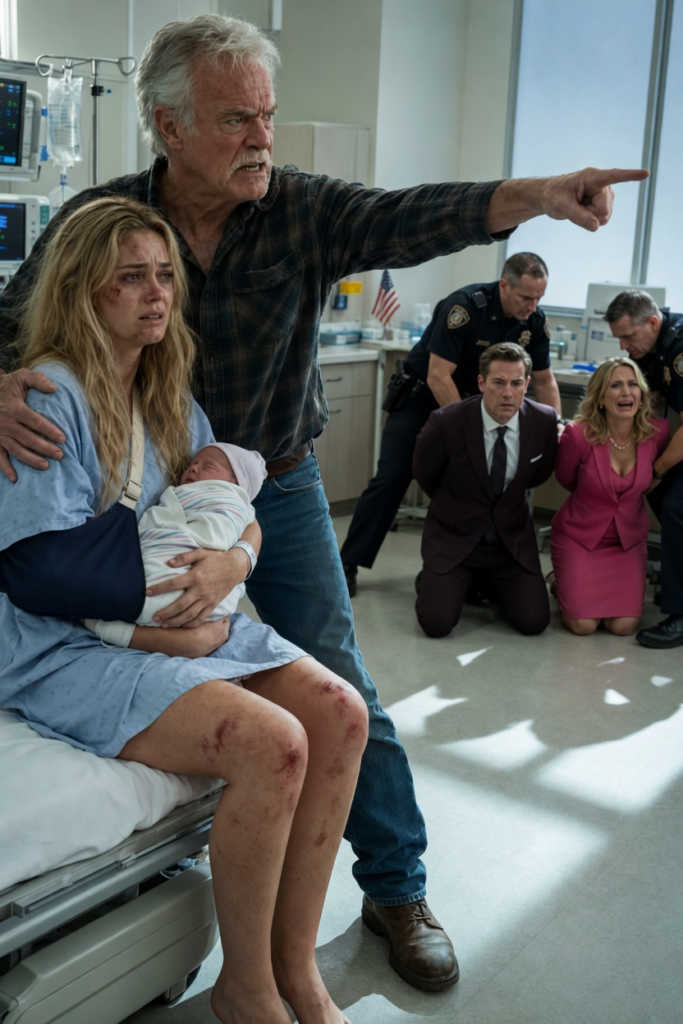
“No one leaves.”
My grandfather did not shout.
Victor Holloway never needed volume. His voice had the kind of weight that made other people lower theirs by instinct.
The rain kept striking the glass walls behind him. The chandelier above us scattered gold across the marble floor, making everyone in the room look richer, colder, and more guilty.
Adrian’s smile did not vanish.
That was the first thing I noticed.
It only adjusted.
A smaller smile now. A concerned husband’s smile. A man preparing to turn a crime into my instability.
“Victor,” he said gently, “I understand this is upsetting. But Lena hasn’t slept. She’s been under tremendous emotional strain.”
My baby made a tiny sound against my chest.
Noah.
My son.
Three weeks old, warm and breathing beneath a blanket so thin I had folded it twice to keep the cold from him.
I looked at Adrian.
“You didn’t know his name,” I said.
That stopped him.
The room shifted.
Patricia’s eyes darted toward my baby, then quickly away. Celeste stared at the floor. Elaine’s smile twitched.
Adrian blinked.
“What?”
“You haven’t asked his name once.”
His mouth opened.
Closed.
He looked at the baby, as if a name might be written somewhere on his forehead.
I helped him.
“His name is Noah Victor.”
My grandfather’s face changed again.
This time the crack went deeper.
I had named my son after him, even while I was being starved by people who claimed to be acting under his protection.
For a moment, Victor Holloway looked less like a billionaire and more like an old man who had just realized that money could travel faster than love, but arrive nowhere it mattered.
His assistant, Maribel, approached quietly with a phone pressed to her ear.
“Mr. Holloway, Mercer is on his way. Roth is already in the building. Vale is joining by secure call.”
“Good,” Grandfather said. “Lock down the west conference room. Bring security to every exit. No press. No staff gossip. No one without my authorization enters or leaves this floor.”
Elaine gave a brittle laugh.
“Victor, surely that is excessive.”
He turned toward her.
“Elaine, if my granddaughter says she never received the money I sent for her, and you handled the details, excessive has not yet begun.”
Her pearls rose and fell against her throat.
“Handled is a generous word,” she said. “I assisted. At your request. The young are careless with money, especially when they marry into responsibility.”
“You are not my blood,” Grandfather said.
The words landed like a slap.
Elaine’s face went still.
Patricia moved then, smooth and controlled, crossing the room with the practiced calm of a woman who had spent sixty years cleaning blood from white carpets without anyone noticing.
“Father,” she said, “perhaps we should take this privately. Lena has made a serious allegation. Serious allegations require evidence, not emotion.”
I looked at my aunt.
Patricia Holloway had always smelled faintly of gardenias and judgment. She wore grief like jewelry when my grandmother died, and ambition like skin after that.
For years, she had called me “bright” in the same tone people used for well-trained dogs.
Bright little Lena.
Scholarship Lena.
Poor dead Emily’s daughter.
The orphan Grandfather spoiled because guilt aged badly.
When my mother died, Patricia had placed a hand on my shoulder at the funeral and whispered, “You must learn not to need too much.”
I was eleven.
Now she stared at me as if I had brought mud into the house.
I shifted Noah higher against my chest and reached into the canvas diaper bag hanging from my shoulder.
Adrian saw the movement.
His eyes sharpened.
“What are you doing?”
“Answering Aunt Patricia.”
I pulled out the first folder.
It was not elegant. Not leather. Not embossed with the Holloway crest. It was a blue plastic folder with a cracked corner, the kind sold in drugstores for children’s homework.
Adrian stared at it.
Elaine stared harder.
Grandfather’s gaze dropped to it, then lifted to me.
“What is that?”
“The reason I came tonight.”
I placed the folder on the marble console beside the entrance.
My hand was steady.
That surprised even me.
During labor, my hands had shaken. When the clinic nurse told me my insurance had been terminated, they had shaken. When I washed Noah’s only blanket in the sink and held it under the hand dryer because the laundromat card was empty, they had shaken.
But not now.
Now I was calm.
Not because I was unafraid.
Because fear had already done its worst and found me still standing.
Adrian stepped forward.
I placed one hand over the folder.
“Don’t.”
He smiled again, but sweat had appeared near his hairline.
“Lena, sweetheart—”
“If you call me sweetheart again,” I said, “I will start with the Cayman account.”
The silence turned sharp.
Adrian stopped.
Elaine made a small sound.
Patricia’s fingers curled once, then relaxed.
Celeste lifted her eyes for the first time.
Grandfather’s voice was dangerously soft.
“What Cayman account?”
I opened the folder.
The first page was a transfer summary.
Not the original, of course. I was not stupid enough to bring originals into Holloway House. These were copies. Clean copies. Indexed. Dated. Numbered. Cross-referenced.
The originals were in three places.
One with a federal prosecutor I knew from my old life.
One with a journalist who owed me a favor.
One in a safe deposit box under a name Adrian had never learned because he had believed my past began when he chose me.
I turned the first page toward my grandfather.
“Your office wired five hundred eighty-two thousand dollars every month for twenty-six months,” I said. “The payments were marked as spousal living support, prenatal medical allocation, residence stabilization, and discretionary personal protection.”
Victor did not touch the page.
He looked at it as if it might explode.
“They were supposed to go to the household account,” he said.
“They did,” I said. “For an average of nine minutes.”
Grandfather’s eyes lifted.
“Explain.”
I turned the second page.
“Money entered the Holloway-Whitmore Domestic Support Account at First Meridian Private Bank. The account was opened under my married name, with me listed as primary beneficiary. Within minutes, standing transfer orders moved the funds into four secondary entities.”
I tapped the names one by one.
“Pearlgate Interiors. Vesper Bloom Consulting. Aster House Wellness. Laurel Domestic Management.”
Elaine’s lips parted.
Adrian’s jaw tightened.
Patricia looked at the page, then at Elaine, then away.
Grandfather saw that.
He always saw movement. That was how he had built an empire. Not by trusting what people said, but by noticing where they looked when money appeared.
“Who owns those entities?” he asked.
I turned another page.
“Pearlgate Interiors is controlled by Elaine Whitmore through a nominee director. Vesper Bloom Consulting is tied to Adrian. Aster House Wellness belongs to a Delaware trust that names Patricia as protector.”
Patricia’s face hardened.
“And Laurel Domestic Management?” Grandfather asked.
I looked at Adrian.
He did not move.
“That one is special,” I said. “Laurel paid the private investigator who followed me during my pregnancy. It also paid the attorney who drafted the separation agreement Adrian tried to get me to sign while I was in labor.”
My grandfather’s head turned slowly.
Adrian laughed once.
It was ugly because it arrived too late.
“That is absurd.”
I removed a folded sheet from the back pocket of the folder and held it up.
“Page fourteen. Your text to Elaine at 2:16 a.m. the night my water broke.”
I read it aloud.
“She is weak now. If she signs before delivery, custody is leverage.”
The room froze.
Elaine closed her eyes.
Adrian’s smile died at last.
Grandfather looked at my husband with something worse than anger.
He looked at him with recognition.
Like one predator had just identified another and found him poorly bred.
“You sent that?” he asked.
Adrian lifted his chin.
“No.”
I took out another page.
“Phone extraction. Time stamp. Device ID. Cloud backup. Deleted, recovered, preserved.”
He stared at me.
There it was.
The first true fear.
Not for what he had done.
For being caught.
Patricia stepped forward.
“This is ridiculous. Digital records can be manipulated. Lena worked in financial investigations. If anyone could manufacture—”
“Careful,” Celeste said.
Everyone turned.
My cousin’s voice had been quiet, but it cut through the room.
Celeste Holloway was twenty-eight, beautiful in the way money trains women to be beautiful—flawless skin, controlled posture, expensive sadness. She had never been cruel to me. Not kind either. She had simply floated through family dinners as if hovering above the consequences of her mother’s choices.
Now her champagne glass sat untouched on the mantel.
Patricia stared at her daughter.
“What did you say?”
Celeste swallowed.
“I said careful.”
Patricia’s face sharpened.
“Celeste.”
But Celeste did not look at her.
She looked at me.
Then at my grandfather.
“I saw the statements,” she said.
Patricia’s expression changed so quickly that only someone watching for guilt would have caught it.
I caught it.
So did Victor.
“When?” he asked.
Celeste’s hands trembled.
“Last spring. In Mother’s study. I was looking for the charity gala donor list. Her printer jammed. There were pages in the tray. Lena’s name was on them.”
Patricia’s voice was ice.
“You misunderstood.”
Celeste shook her head.
“No. I understood enough.”
“Then why didn’t you say something?” I asked.
I did not ask gently.
Celeste flinched.
Good.
Some guilt deserves to feel the room.
Her eyes filled.
“Because I was a coward.”
Patricia hissed, “Enough.”
“No,” Celeste said, louder now. “No, Mother. Enough was when you told me Lena was being dramatic because pregnancy made women unstable. Enough was when Adrian said she preferred simple living because it made her feel morally superior. Enough was when Elaine joked that poverty suited her better than pearls.”
Elaine’s face reddened.
“I never—”
“You did,” Celeste said. “In this room. With that glass in your hand.”
She pointed to the champagne.
The room inhaled.
I looked at Celeste and understood something I had not expected.
She had known.
Not all of it.
But enough.
And she had buried it because silence was the family language.
My grandfather’s face had gone pale.
Not weak pale.
War pale.
The lawyers arrived seven minutes later.
They did not come through the main entrance. They appeared from the private elevator near the east hall, three men and one woman in dark coats, carrying briefcases and the kind of urgency people reserve for fires, heart attacks, and billion-dollar betrayals.
Graham Mercer was first. Seventy, narrow, brilliant, with silver hair and eyes like sharpened steel.
Anita Roth came beside him, younger, calm, and terrifyingly organized. She was the litigation partner my grandfather used when he intended to leave nothing standing.
Vale appeared on the wall screen in the west conference room ten minutes later, his face lit by the cold blue of a secure connection.
By then security had shut the floor.
Phones were collected.
Elaine refused.
Grandfather did not argue.
He simply said, “Then leave without it and without counsel.”
She handed over the phone.
Adrian placed his down with a smirk that told me he had wiped it.
I almost smiled.
Men like Adrian always deleted doors and forgot windows.
We moved into the west conference room.
I had been there only twice before.
Once when Grandfather announced a hospital wing in my mother’s name.
Once when he told me my engagement to Adrian Whitmore was “socially useful but emotionally foolish.”
He had been right.
I hated that.
The conference room had a table carved from black walnut and windows overlooking the city. Tonight the rain made every light below bleed into the next. Noah slept against me, his cheek warm over my heart.
Maribel offered to take him.
I shook my head.
No one in that house was touching my son until the truth had a locked door around it.
Grandfather sat at the head of the table.
I sat to his right.
Adrian sat across from me with Elaine beside him.
Patricia chose the chair nearest Grandfather, as if proximity could erase evidence.
Celeste sat at the far end, alone, hands folded so tightly her knuckles had gone white.
The lawyers spread out.
Mercer opened a legal pad.
“Mrs. Whitmore,” he said to me, “before we proceed, do you have counsel present?”
“I don’t need counsel to tell the truth.”
Grandfather looked at Mercer.
“She will have counsel.”
“I can arrange independent representation immediately,” Roth said.
I looked at my grandfather.
“For tonight, I want to speak. Tomorrow, I’ll retain counsel.”
Victor nodded once.
“Proceed.”
Mercer turned to me.
“Tell us from the beginning.”
So I did.
Not the emotional beginning.
The financial one.
Emotion could come later.
I told them about the first missing payment, two months after the wedding. Elaine had said the family trust had procedures. Adrian had said wealthy households did not operate like ordinary checking accounts. Patricia had told me my grandfather was old-fashioned and disliked discussing women’s allowances directly.
Allowance.
That word had sat like a bone in my throat.
I had been twenty-six, newly married, and determined not to appear grasping. I had my own savings then. Not Holloway money. Mine. Money earned from six years in forensic accounting, tracing shell companies through spreadsheets while men in expensive suits underestimated me over conference tables exactly like this one.
Then Adrian convinced me to leave my job.
Not at once.
Men like Adrian do not lock the door on the first date.
They close it slowly and call every click love.
He said the press would dig into my clients. He said his family name required discretion. He said when we had children, I would want to be present. He said my grandfather had already arranged support beyond anything I could earn.
“I want you cared for,” he told me.
What he meant was controlled.
Within six months, my consulting contracts were gone.
Within eight, my personal accounts were “merged for estate efficiency.”
Within twelve, every financial question I asked became proof that I was anxious, ungrateful, suspicious, tired, hormonal, difficult.
Then came pregnancy.
Then came isolation.
Adrian moved me from our apartment to a small townhouse owned by one of Elaine’s entities “for privacy.” Staff disappeared. Bills arrived. Cards declined. The doctor’s office called about unpaid balances.
Each time I asked, Adrian sighed.
Each time Elaine smiled.
Each time Patricia said Grandfather was under pressure and I should not trouble him with household matters.
Then, in my seventh month, the private obstetrician canceled my appointment because the retainer had not been paid.
That was when I stopped asking and started auditing.
I told them how I found the first routing pattern through an old emailed bank alert Adrian had forgotten to delete from a shared tablet.
I told them how I recovered metadata from PDFs Elaine’s assistant had forwarded to the wrong address.
I told them how Laurel Domestic Management had paid for surveillance, legal intimidation, and a private postpartum facility I was never admitted to.
I told them how my signature appeared on medical reimbursement forms I had never seen.
I told them how a notarized authorization giving Elaine “temporary domestic financial oversight” was dated on a day I had been in Boston at a deposition for an old client, standing in front of six attorneys who could verify my location.
Roth looked up sharply.
“You were deposed that day?”
“Yes.”
“Transcript?”
“Certified copy in the folder.”
Roth’s expression changed.
Not surprise.
Satisfaction.
I continued.
I told them how my clinic deposit bounced.
How I called Adrian from a plastic chair beneath fluorescent lights while contractions tore through me.
How he said, “Then perhaps public care will teach perspective.”
Grandfather closed his eyes.
Only once.
Then he opened them.
“Say that again,” he said.
I looked at Adrian.
“He said public care would teach perspective.”
Adrian leaned forward.
“That is not the context.”
Grandfather’s voice dropped.
“There is context for denying my great-grandson medical care?”
Adrian spread his hands.
“She is dramatizing. The clinic was safe. She chose not to call me until the last moment because she wanted to punish me.”
“I called you thirteen times,” I said.
He looked away.
I slid another page across the table.
“Call log.”
Mercer picked it up.
Elaine whispered, “This is grotesque.”
I looked at her.
“Yes. It is.”
For the first time, she had no answer.
Then I told them about the eviction notice.
About selling my watch to buy formula.
About washing my hair with dish soap because the utilities had been turned off and I had to bathe at the clinic before bringing Noah home.
About standing outside Holloway House in the rain for twelve minutes before I could make myself enter, because some part of me still felt ashamed.
Ashamed.
That was the word that finally broke my grandfather.
He stood.
No one moved.
Victor Holloway walked to the window and stared out at the city he owned pieces of. His reflection looked older than his body. For one terrible second, I saw the truth: he was not only furious with them.
He was furious with himself.
Because he had trusted systems over blood.
Because every month he had sent money and mistaken transfer confirmations for care.
Because he had built an empire with eyes in every market and none on his own granddaughter.
When he turned back, the room changed with him.
“Anita,” he said.
Roth sat straighter.
“Yes, sir.”
“Civil action. Full recovery. Treble damages where available. Asset freezes before sunrise.”
“Yes.”
“Graham.”
Mercer lifted his pen.
“Trust review. Every authorization. Every signature. Every notary. Every intermediary. I want names, dates, exposure, and criminal referral options.”
“Yes, sir.”
“Vale.”
On the screen, Vale nodded.
“Already listening.”
“Prepare law enforcement packages. Wire fraud. Identity theft. Forgery. Elder exploitation if they used my name. Child endangerment if applicable. I want everything.”
Elaine stood so fast her chair struck the wall.
“This is madness.”
Security moved at the door.
Grandfather did not look away from the screen.
“Sit down.”
“I will not sit here while you threaten me with criminal charges over a family misunderstanding.”
He turned slowly.
“A misunderstanding is when a check is late. This is twenty-six months of diverted money and my granddaughter giving birth with a bounced hospital deposit.”
Elaine’s face twisted.
“She was never suited to this family.”
The words came out raw.
There she was.
No pearls now.
No polish.
Just the woman who had looked at my poverty and found it aesthetically appropriate.
Adrian hissed, “Mother.”
But Elaine was past strategy.
“She came from nothing,” Elaine said. “You all pretended not to see it because Victor wanted a redemption story for his dead daughter’s child. Adrian married beneath himself because this family encouraged it. Someone had to preserve what was being wasted.”
I almost laughed.
“Wasted?”
She pointed at me.
“You would have given it away. To clinics. Tenants. Friends with sob stories. Every girl from nowhere thinks generosity is virtue when she is spending money she did not earn.”
My grandfather’s hand struck the table.
The sound cracked through the room.
Noah woke and cried.
Immediately, every eye turned to him.
I stood and bounced him gently, pressing my lips to his hair.
“It’s all right,” I whispered. “Mama’s here.”
The room watched me soothe the baby they had starved before he was born.
No accusation I made could have been louder.
Elaine sat down.
Grandfather remained standing.
“Do not ever,” he said, each word controlled, “speak of my granddaughter’s worth again.”
Elaine looked at the table.
Victor turned to Adrian.
“And you?”
Adrian leaned back.
He had recalculated.
I saw it happen.
Elaine had lost control; Patricia was silent; Celeste had become unpredictable; the lawyers were circling; my grandfather was no longer confused.
So Adrian chose charm’s uglier cousin.
Blame.
“Lena knew exactly what this marriage was,” he said. “Let us stop pretending. She wanted access. I wanted legitimacy with your side of the family. It was mutually beneficial until she decided motherhood made her morally superior.”
My son quieted against me.
I stared at the man I had married.
The man whose hand I had held while he promised to love me in a vineyard under six hundred white roses.
The man who had once cried telling me his father made him feel worthless.
Maybe that was true.
Maybe some wound in him had been real.
But pain does not excuse cruelty.
It only explains where cruelty learned the language.
Adrian continued.
“She was given opportunities most women would kill for. Housing. Name. Security. If funds were reallocated, it was because she proved incapable of understanding the obligations attached to them.”
“Reallocated to where?” Roth asked.
Adrian glanced at her.
“I’m not answering legal questions without representation.”
Mercer smiled faintly.
“A wise first statement.”
Grandfather sat down again.
“Then listen instead.”
He pressed a button on the table.
“Maribel.”
Her voice came through the speaker.
“Yes, Mr. Holloway.”
“Have security escort Mrs. Elaine Whitmore, Mr. Adrian Whitmore, and Patricia Holloway to separate waiting rooms. They may contact counsel from landlines. Their mobile devices remain secured pending legal instruction. No external documents leave this floor.”
Patricia finally spoke.
“Father.”
He did not look at her.
“You too.”
Her face drained.
“I am your daughter.”
“And Lena is my granddaughter.”
“I did nothing.”
Celeste whispered, “Mother.”
Patricia turned on her.
“Be quiet.”
“No,” Grandfather said. “She will not.”
Patricia stared at him.
For the first time in my life, I saw my aunt understand that her father’s love had limits where betrayal began.
Security entered.
Adrian stood slowly.
He looked at me as he buttoned his jacket.
“You think this ends with you winning,” he said.
I held Noah closer.
“No. I think this ends with you counting.”
His eyes narrowed.
“Counting what?”
I looked at the folders on the table.
“Everything you thought I missed.”
They took him out first.
Elaine followed, pale and furious.
Patricia did not move until Victor finally looked at her.
That look did what security could not.
She rose.
At the door, she turned back.
“You always favored Emily,” she said.
The room went silent.
My mother’s name had been a ghost in Holloway House for eighteen years.
Grandfather’s face hardened with grief so old it had become architecture.
“Yes,” he said. “Because your sister had a heart.”
Patricia flinched.
Then she left.
The door closed.
And I was suddenly so tired I nearly dropped.
Celeste reached for me.
I stepped back.
Her hand fell.
“I deserve that,” she said.
“Yes,” I said.
She nodded, tears slipping down her face.
“I’m sorry.”
I did not answer.
There are apologies that arrive like ambulances after the house has burned down. Necessary, maybe. But they do not unburn the rooms.
Grandfather came to me.
Slowly.
As if approaching a frightened animal.
Maybe I was one.
He looked at Noah first this time.
Not the blanket.
Not the clothes.
His face.
Noah’s tiny mouth opened in sleep. One fist rested under his chin.
Grandfather’s eyes filled.
“May I?” he asked.
Those two words nearly undid me.
Because all night, people had taken.
Money.
Dignity.
My name.
My sanity.
My story.
And Victor Holloway, the man who could command banks and governments, asked permission before touching my child.
I nodded.
He reached out with one finger and gently touched Noah’s hand.
My son grasped it.
Victor inhaled sharply.
“Strong grip,” he whispered.
“He gets hungry,” I said before I could stop myself.
The words broke loose from somewhere ugly and true.
Grandfather looked at me.
“How hungry?”
I looked away.
Too proud.
Still.
After everything.
“Lena,” he said, and his voice was no longer the patriarch’s. “How hungry?”
The answer came out flat.
“Some days I ate once so he could have formula.”
Victor closed his eyes.
A tear moved down his face.
I had never seen my grandfather cry.
Not at my grandmother’s funeral.
Not at my mother’s.
Not when doctors told him his heart needed surgery.
He had treated tears like leaks in a dam: private, dangerous, to be repaired before anyone noticed.
But now he wept silently in front of his lawyers, his assistant, Celeste, and me.
“I sent enough,” he said.
“I know.”
“No,” he said. “I sent money. I did not send care.”
I had no defense against that.
The anger that had carried me into Holloway House began to tremble at the edges.
Behind it was exhaustion.
Behind exhaustion was grief.
Behind grief was the terrible, childish wish that someone had come sooner.
Grandfather saw it.
“I failed you,” he said.
The room seemed to hold its breath.
Victor Holloway did not apologize often. When he did, people framed the memory.
“I should have come myself,” he continued. “I should have asked why you stopped visiting. Why your calls shortened. Why Adrian always answered for you. Why Patricia said you needed distance. I should have known.”
I wanted to say it was not his fault.
Part of me even meant it.
But the larger part, the newly born mother in me, the woman who had been bleeding and afraid and alone, would not comfort him by lying.
“Yes,” I said quietly. “You should have.”
He nodded.
The answer hurt him.
He accepted it.
That was the first repair.
Roth closed the folder gently.
“Lena, do you have somewhere safe to sleep tonight?”
The question was practical.
Kind.
It nearly shattered me.
I looked down at my coat, at Noah’s blanket, at the diaper bag containing more evidence than diapers.
“No.”
Grandfather’s expression changed.
“Holloway House—”
“No,” I said immediately.
Everyone looked at me.
I softened my voice, but not my decision.
“Not tonight. There are too many ghosts here. Too many people who knew too much and did too little.”
Celeste looked down.
Grandfather absorbed it.
“Where then?”
“The clinic social worker gave me the name of a women’s residence.”
His face went stricken.
“No.”
I lifted my chin.
“Grandfather.”
“No,” he repeated, firmer. “Not because you are incapable. Because you are my granddaughter and you have a three-week-old child. You will have privacy, security, medical care, food, and counsel by morning. Not as charity. As restitution.”
“I don’t want to be managed.”
“Then you won’t be.”
“I don’t want staff reporting on me.”
“They won’t.”
“I don’t want Adrian near us.”
“He will not come within a mile of you unless a judge is feeling suicidal.”
Despite myself, I laughed.
It cracked through the room strangely.
Noah stirred again.
Grandfather’s mouth softened.
“I own a small brownstone on West Seventy-Third,” he said. “Your grandmother used it when she wanted to read and pretend I didn’t exist. No staff live there. Maribel can arrange a nurse only if you request one. Security can remain outside. You may dismiss anyone you dislike.”
“Can I change the locks?”
“They will be changed before you arrive.”
“Can I keep the address private?”
“Already done.”
I looked at him.
At the old man who had sent money and thought it was love.
At the grandfather trying, awkwardly and urgently, to learn the difference.
“All right,” I said.
He exhaled.
Then I turned to Celeste.
“You said you saw the statements.”
She nodded.
“Do you still have anything?”
Her face paled.
“Copies.”
Patricia had raised a coward, but not a stupid one.
“Where?”
Celeste hesitated.
Then she looked at Victor.
“In Mother’s foundation archive. Also in my cloud storage. I copied them after I saw Elaine’s name because I thought… I thought if it got worse, I could do something.”
“It got worse,” I said.
“I know.”
“No,” I said. “You don’t. But you can start.”
She nodded through tears.
“I will.”
And that was the second repair.
Not forgiveness.
Evidence.
By sunrise, Holloway House had become a war room.
I did not stay to watch all of it.
Maribel wrapped Noah in a cashmere baby blanket that still had a tag on it. I almost refused it out of pride, then looked at my son’s blue-tinged fingers and took it.
Pride does not warm babies.
Grandfather’s driver took us through rain-washed streets to the brownstone.
It was nothing like Holloway House.
No glass walls. No marble foyer. No portraits of dead men who looked disappointed by electricity.
It had brick steps, a green door, bookshelves, old rugs, and the faint smell of lemon polish. Someone had already stocked the kitchen. Not with champagne and imported pears arranged for display, but with bread, eggs, soup, tea, formula, diapers, wipes, clean towels, and a package of tiny cotton sleepers.
I stood in the nursery doorway and saw a crib.
A real crib.
White wood. Fresh sheets. A mobile of small felt clouds turning gently above it.
For one moment, I could not move.
Maribel stood behind me.
“I can remove anything you don’t want.”
I shook my head.
The diaper bag slipped from my shoulder.
I caught it.
Then I didn’t.
It fell to the floor.
And I finally cried.
Not beautifully.
Not quietly.
I sobbed so hard Noah woke and began crying too, startled by the sound of his mother becoming human again.
Maribel did not touch me.
She did not shush me.
She simply stood nearby and said, “You’re safe now, Ms. Holloway.”
Safe.
The word felt unfamiliar.
Like a language I had learned as a child and forgotten under pressure.
That morning, Noah slept in a clean crib for the first time.
I slept in a chair beside him because I still did not trust the world enough to close a door between us.
When I woke, there were three missed calls from an unknown number.
Then a message.
Adrian.
His voice was calm.
Of course it was.
“Lena, things escalated unnecessarily. My attorney will contact yours. I suggest you remember that public scandal cuts both ways. You have a child now. Stability matters. Think carefully before you turn this into something irreversible.”
I played it twice.
Then forwarded it to Roth.
Her reply came ninety seconds later.
Good. Keep everything.
For the first time in weeks, I smiled.
Adrian still believed threats worked because they had always worked on people with something to lose.
He did not understand that the night I stood in Holloway House with my son in a frayed blanket, I had already lost everything fragile.
What remained was not easily broken.
The next two weeks moved like a storm with legal stationery.
Emergency orders came first.
A judge froze accounts connected to Pearlgate, Vesper Bloom, Aster House, and Laurel Domestic Management. Adrian’s personal trading account locked minutes before he tried to move two million dollars into a Singapore vehicle. Elaine’s townhouse renovation fund was frozen mid-payment. Patricia’s foundation accounts were placed under independent review.
Roth filed a civil complaint under seal at first, then partially unsealed when Adrian’s attorney leaked a statement implying I suffered from postpartum paranoia.
That was a mistake.
Roth responded with documents.
Not all of them.
Just enough.
The public learned that more than fifteen million dollars intended for maternal care, housing, medical expenses, and family support had been diverted through shell entities over twenty-six months.
They learned my signature had appeared on authorizations I denied signing.
They learned the private hospital deposit bounced while monthly support continued leaving Victor Holloway’s accounts.
They learned Adrian Whitmore had not visited his newborn son.
By the third day, the press stopped calling me “the troubled Holloway heiress.”
They started calling it “The Whitmore Diversion Scandal.”
I hated every headline.
Even the sympathetic ones.
Public pity is still public ownership.
But headlines did what private pain could not: they made hiding impossible.
Adrian tried to counter.
He gave a statement through counsel describing himself as a “concerned husband facing a coordinated smear campaign by a powerful family.”
Then Celeste released her testimony.
Not to the press.
To the court.
But the court filing became public.
She described the statements in Patricia’s study.
The jokes.
The conversations.
The way Elaine referred to me as “a controllable liability.”
The way Adrian said, six months into my pregnancy, that “financial discomfort would make Lena more agreeable.”
That sentence traveled everywhere.
Financial discomfort.
People repeated it on television with disgust.
Women wrote essays about it.
Former employees came forward.
Elaine’s assistant produced archived emails.
A fired bookkeeper from First Meridian contacted Roth with concerns he had raised and been punished for.
The notary whose seal appeared on the oversight authorization swore she had never met me.
The deposition transcript proved I had been in Boston.
Then came the criminal inquiry.
Wire fraud.
Forgery.
Identity theft.
Conspiracy.
Financial abuse.
Adrian stopped calling.
Elaine stopped smiling.
Patricia stopped appearing in public.
My grandfather aged ten years in fourteen days.
He visited the brownstone every afternoon at four.
The first time, he brought flowers.
I told him flowers were useless.
The next day, he brought groceries.
The third day, diapers.
The fourth, nothing.
He simply stood at the door and asked, “May I come in?”
That was the day I let him hold Noah.
He sat in the armchair by the window, my son tucked carefully in his arms as if he were holding a rare document that might rewrite the future.
Noah stared up at him with unfocused newborn seriousness.
Grandfather stared back.
“I used to hold your mother like this,” he said.
I sat across from him, wrapped in a blanket, eating soup because Maribel had learned that I forgot food unless someone placed it directly in my hand.
“Was she quiet?”
“Never.”
That made me smile.
“She cried like the world had disappointed her personally.”
“She sounds like a Holloway.”
He looked at me.
“She was better than us.”
The room softened around her memory.
My mother, Emily Holloway, had run away from the family twice before she was twenty. The third time she stayed gone long enough to marry my father, a public school art teacher who died with her in a bridge accident when I was eleven.
Grandfather had raised me after that.
Not warmly.
But completely.
Best schools. Best tutors. Best doctors. Trust funds. Internships. Security. Everything a child could need except someone who knew what to do when she woke screaming from dreams of rain and twisted metal.
Patricia said grief made children manipulative.
Grandfather hired a therapist and never asked what we discussed.
That had been his love then: efficient, expensive, incomplete.
Now he looked at Noah and said, “I don’t want to make the same mistake twice.”
“Then don’t.”
He nodded.
“I am trying to learn how.”
“Start by asking instead of arranging.”
He considered that like a business problem.
Then nodded again.
“What do you need today?”
The question was so simple.
No one had asked it in months.
I looked toward the kitchen, where bottles stood drying on a clean towel.
“I need the divorce to be brutal.”
A faint smile touched his mouth.
“That can be arranged.”
“Grandfather.”
He corrected himself.
“That can be pursued according to your wishes.”
“Good.”
“And what else?”
I looked at Noah.
“I need custody locked down so tightly Adrian can’t use him as leverage.”
His face hardened.
“Yes.”
“And I need work.”
He blinked.
“Work?”
“I’m not going back to being someone money happens around. I want my license active. I want my own accounts restored. I want to consult on the investigation.”
“Lena, you just gave birth.”
“I noticed.”
“You need rest.”
“I need my mind back.”
He studied me.
Then, slowly, he smiled.
Not the polite smile from boardrooms.
A proud one.
“There she is,” he said.
I looked away because my throat tightened.
The next morning, Roth brought me a restricted consulting agreement.
“Not on your own case directly,” she said. “Conflict issues. But we can use you to map structures and explain patterns to the forensic team. Limited hours. Remote. Doctor-approved.”
“You already asked my doctor?”
“Your grandfather tried. I told him not to.”
“Thank you.”
“He pouted.”
“I wish I had seen that.”
“It was subtle. Like a disappointed eagle.”
I laughed.
Roth’s expression softened.
“You are allowed to enjoy small things while pursuing justice.”
“I’ll put that on a pillow.”
“Make it billable.”
I liked her immediately.
Work saved me.
Not completely.
Noah saved me more.
But work gave shape to the rage.
I mapped entity relationships while Noah slept. I traced transfers through domestic accounts, then offshore staging accounts, then luxury payments disguised as vendor retainers. I found duplicate invoice numbering in Pearlgate Interiors. I found Vesper Bloom had billed “reputation strategy” on the same dates Adrian met with divorce counsel. I found Aster House Wellness had paid Patricia’s personal chef under “maternal nutrition services.”
Maternal nutrition.
While I ate toast over a sink so my milk would not dry up.
When I found that one, I had to walk away from the laptop.
Grandfather was there that afternoon.
He found me standing in the nursery, one hand on the crib rail, breathing carefully.
“What happened?”
I handed him the printout.
He read it.
His face went blank.
That was how I learned the deepest Holloway rage made no expression at all.
“My daughter,” he said quietly, meaning Patricia, “billed your hunger as nutrition.”
I took the paper back.
“Yes.”
He turned toward the door.
“Where are you going?”
“To destroy her.”
“Not today.”
He stopped.
I was surprised he listened.
“Not like that,” I said. “Not in a rage. Rage makes mistakes. Documentation doesn’t.”
He looked at me for a long moment.
Then he nodded.
“You sound like your grandmother.”
“I thought I sounded like you.”
“My wife was smarter.”
“Then I’ll take it.”
That evening, Patricia came.
Not inside.
She appeared on the sidewalk beyond the security detail, wearing a camel coat and the expression of a woman insulted by consequences.
The guard called up.
“She says she wants five minutes.”
“No,” Grandfather said.
He was standing in the brownstone kitchen, learning to warm a bottle badly.
I looked through the front window.
Patricia saw me.
For a second, we stared at each other through old glass.
Then my phone rang.
Unknown number.
I answered without speaking.
“Lena,” Patricia said.
Her voice was smooth, but fear lived beneath it.
“Aunt Patricia.”
“Call off the dogs.”
I almost laughed.
“Which dogs? The civil attorneys, the forensic accountants, the federal investigators, or the journalists you created by leaking first?”
“You have made your point.”
“No. The documents made my point.”
“You think Victor will protect you forever?”
I looked at my grandfather. He watched me carefully, bottle in hand.
“I think I can protect myself.”
Patricia’s silence was brief.
“You were always arrogant.”
“No. I was trained by arrogant people. There’s a difference.”
Her breath sharpened.
“I did what was necessary for the family.”
“There it is,” I said. “The family. Not me. Not Noah. The family as a vault. The family as a brand. The family as your inheritance wearing human faces.”
“You know nothing about inheritance.”
“I know you wanted my mother’s share.”
That landed.
The silence changed.
I had not planned to say it.
But once spoken, the shape of it became obvious.
Patricia’s resentment had not begun with me.
It had begun with my mother.
Emily, the favorite.
Emily, the runaway.
Emily, who rejected Holloway power and still received Victor’s softest grief.
Emily, who died and became untouchable.
I was not just the scholarship girl.
I was Emily’s child.
A living reminder that Patricia had stayed, obeyed, performed, and still never been loved the same way.
“You should be careful,” Patricia said.
I looked at her through the window.
She looked smaller outside the house.
Not powerless.
But exposed.
“No,” I said. “You should have been.”
Then I ended the call.
Grandfather set the bottle down.
“I should have seen what she became.”
“What did she become?”
He looked toward the window.
“Hungry.”
I knew something about hunger.
The body’s kind.
The soul’s kind.
The kind that eats other people and still feels empty.
“Did you love my mother more?” I asked.
He looked pained.
“Yes.”
The honesty startled me.
“Did Patricia know?”
“Yes.”
“And you did nothing?”
“I gave Patricia companies. Seats. Houses. Influence.”
“That’s not what I asked.”
He sat slowly.
“No,” he said. “I did nothing.”
It was not an excuse.
Just a confession.
I sat across from him.
“Then do something now.”
His eyes lifted to mine.
“I am.”
“No. Not just lawyers. Not just punishment. Tell the truth. To her. To Celeste. To the board. To yourself.”
Victor Holloway looked almost frightened.
Not of court.
Not of scandal.
Of family truth.
Money had taught him to settle disputes without naming wounds.
But wounds unnamed become inheritance too.
“I don’t know if I can fix what I did to Patricia,” he said.
“Maybe not.”
“That is harsh.”
“Yes.”
He smiled faintly.
“You are very much my blood.”
“I know. I’m working on it.”
He laughed then.
A small, surprised sound.
Noah began crying upstairs, and I rose.
Grandfather reached for the bottle.
“I’ll bring this.”
“You overheated it.”
He looked offended.
“I followed instructions.”
“You treated the instructions like a merger document.”
“Is that bad?”
“For milk, yes.”
He looked down at the bottle like it had betrayed him.
For the first time, the brownstone felt like a home.
The divorce filing came ten days later.
I filed under my maiden name.
Lena Holloway.
Not Whitmore.
Never again.
Adrian responded aggressively, as expected.
He requested joint custody.
Not because he wanted Noah.
Because leverage was the only language he had left.
Roth warned me before sending the filing.
“It’s ugly.”
I stood by the nursery window, watching snow begin to fall.
“Read it.”
She did.
Adrian claimed I was emotionally unstable.
Financially vindictive.
Alienating him from his son.
Manipulated by Victor.
Unable to provide a stable environment without Holloway money.
He requested access to medical records, psychiatric evaluations, and supervised review of my communications.
By the end, I was smiling.
Roth looked concerned.
“Lena?”
“He still thinks shame works.”
“Yes.”
“Good.”
At the emergency custody hearing, Adrian wore navy.
He looked handsome, rested, and tragically misunderstood. His lawyer painted him as a devoted father excluded by a powerful maternal family. He spoke of reconciliation. Stability. Privacy. The importance of a child knowing both parents.
Then Roth stood.
She did not raise her voice.
She did not need to.
She entered the call logs.
Thirteen unanswered calls during labor.
The text about custody as leverage.
The clinic billing records.
The bounced deposit.
The diversion charts.
The voicemail threatening scandal.
The messages where Adrian referred to Noah as “the asset complication.”
The judge removed her glasses at that one.
Adrian’s lawyer requested a recess.
The judge denied it.
Temporary sole custody was granted to me.
Adrian received no visitation pending further review.
The order included a protective provision preventing him from contacting me except through counsel.
When it was over, I walked out of the courthouse into cold sunlight with Noah asleep against my chest in a clean blue blanket.
Reporters shouted my name.
I ignored them.
Grandfather’s car waited at the curb.
But before I reached it, a woman stepped from the crowd.
Not a reporter.
Elaine.
She wore sunglasses though the sky was gray.
Security moved, but she lifted both hands.
“I only want to speak.”
Roth stepped in front of me.
“No.”
Elaine looked past her.
“Lena.”
I should have kept walking.
But something in her face stopped me.
Not remorse.
Something close to ruin.
I nodded to Roth.
“One minute.”
Elaine removed her sunglasses.
She looked terrible.
That gave me no pleasure.
Or not enough to matter.
“Adrian is my son,” she said.
“Yes.”
“I protected him too much.”
I waited.
She swallowed.
“I taught him that consequences were negotiable.”
“Yes.”
“I did not think he would become cruel.”
I almost laughed.
“Elaine, you were cruel with him.”
Her mouth trembled.
“I know.”
The wind moved between us.
Noah slept.
Elaine looked at him and did not step closer.
That was wise.
“I cannot undo what I did,” she said.
“No.”
“I have instructed my attorney to cooperate on certain financial matters.”
Roth’s head turned slightly.
That was new.
Elaine continued.
“I will not take all blame. Patricia knew. Adrian directed much. But I signed things. I moved funds. I told myself you were ungrateful, because if I admitted you were suffering, then I had to admit I was making you suffer.”
Her eyes filled.
“I am sorry.”
I looked at this woman who had worn silk while I counted coins for formula.
Her apology did not feed the baby I had been.
It did not erase the clinic chair.
It did not warm the nights.
Still, truth has weight.
Even late truth.
“Cooperate fully,” I said.
She nodded.
“And do not ask me for forgiveness to make yourself feel clean.”
Her tears spilled.
“I understand.”
“No,” I said. “You don’t. But maybe one day you will.”
I walked past her.
Roth followed.
In the car, Grandfather looked at me.
“What did she want?”
“To begin saving herself.”
“And?”
“That’s between her and the prosecutors.”
He smiled grimly.
“Good girl.”
I looked at him.
“Don’t.”
He blinked.
“Don’t what?”
“Make my mercy another family asset.”
He absorbed that.
Then nodded.
“Understood.”
The criminal indictments came in March.
Adrian Whitmore was charged with wire fraud, conspiracy, identity theft, and forgery-related offenses.
Elaine Whitmore was charged too, though her cooperation altered the scope.
Patricia Holloway faced conspiracy, fraud, obstruction, and misuse of charitable foundation funds.
The trust officer at First Meridian resigned two hours before being arrested.
The notary seal had been stolen.
Two assistants took plea deals.
Three bankers lost licenses.
The scandal spread wider than any of us expected because theft, once mapped, often reveals it had friends.
Patricia fought hardest.
She claimed ignorance.
Then Celeste produced the archive.
Not just statements.
Recordings.
I did not know about those until Roth called me into her office.
Celeste sat there, pale but steady.
A small digital recorder lay on the table.
“My therapist told me to record conversations with Mother after she began denying things she had said,” Celeste explained. “At first it was for my own sanity.”
Roth pressed play.
Patricia’s voice filled the room.
“Elaine is useful because greed makes her predictable. Adrian is useful because vanity makes him careless. Lena is useful because suffering makes women quiet if you call it sacrifice.”
I felt the words enter my body like cold metal.
Celeste began to cry silently.
On the recording, Patricia continued.
“Father will never believe it until it is too ugly to ignore. By then the money will be clean.”
Roth stopped the audio.
No one spoke.
Celeste looked at me.
“I should have brought it sooner.”
“Yes,” I said.
“I’m sorry.”
“I know.”
This time, I meant it differently.
Not forgiveness.
But recognition.
Celeste had grown up under Patricia’s voice. I knew something about cages with velvet walls.
“Are you afraid of her?” I asked.
Celeste gave a broken laugh.
“Every day of my life.”
“Then testify afraid.”
She looked at me.
“That’s what courage usually is,” I said.
She nodded.
And she did.
Patricia took a plea six months later.
Not out of remorse.
Out of arithmetic.
The recordings made trial too dangerous.
Adrian held out longer.
He believed charm would find a crack.
It did not.
The day he finally accepted a plea agreement, I was at home feeding Noah mashed bananas in the brownstone kitchen.
He wore more bananas than he swallowed.
My phone buzzed.
Roth: He signed.
I looked at the message for a long time.
Noah slapped the high chair tray.
“Ba,” he said.
It was not a word yet.
Still, I chose to hear victory.
“He signed,” I told my son.
Noah laughed with banana on his chin.
That was how Adrian’s power ended.
Not with thunder.
With a baby laughing in a warm kitchen.
The divorce finalized before Noah’s first birthday.
I received full custody.
Adrian received no unsupervised visitation and none at all until completion of court-mandated evaluations after sentencing.
The diverted funds were clawed back in stages. Some had vanished into luxury, debt, and arrogance, but enough returned to make the number feel less like a wound.
Grandfather wanted to place everything directly under my control.
I refused part of it.
Not because I did not want what was stolen.
I did.
I wanted every dollar accounted for.
I wanted the record clear.
But I no longer wanted money to be the only answer to money’s violence.
So we created the Emily and Noah Holloway Fund.
Maternal medical care.
Emergency housing.
Financial abuse recovery.
Legal support for women whose poverty had been manufactured by someone else’s control.
Grandfather endowed it with fifty million dollars.
I added recovered funds from the entities that had billed my hunger as nutrition.
Roth joined the board.
Maribel cried when we asked her to be executive director.
Celeste volunteered to manage outreach partnerships, unpaid at first. She said she wanted to learn service without applause.
I watched her carefully.
Then I let her try.
She was good.
Not perfect.
But good in the way people are when they decide never to be protected by ignorance again.
Elaine testified at sentencing.
She did not ask to see Noah.
She did not ask to see me.
She stood in court and described what she had done.
Her voice shook.
But she did not soften it.
“I participated in starving a woman while calling it management,” she said. “I helped my son become a man who believed a wife’s need was leverage. I deserve punishment.”
Adrian looked at her like she had betrayed him.
Maybe she had.
Maybe truth feels like betrayal to people married to lies.
When it was my turn to give a victim statement, I carried no baby.
Noah stayed home with Maribel and my grandfather, who had become ridiculous about nap schedules.
I stood in court in a black suit I bought myself.
My hands did not shake.
I looked at Adrian.
“For two years, you tried to make me small enough to doubt my own hunger,” I said. “You failed.”
He stared straight ahead.
I looked at Elaine.
“You taught cruelty to call itself protection. I hope truth teaches you a different language.”
She cried.
I looked at Patricia.
“You wanted my mother’s ghost punished through me. But I am not my mother’s revenge, and I am not your wound. I am alive. My son is safe. That is the inheritance you could not steal.”
Patricia’s face was stone.
But her eyes were wet.
Then I looked at the judge.
“I do not ask the court for mercy or vengeance. I ask for accuracy. Name what happened. Sentence it clearly. Let the record show that financial abuse is not a misunderstanding because the thief wore pearls. Let the record show that neglect does not become care because money was once intended. Let the record show that my son will grow up knowing his mother told the truth.”
The courtroom was silent when I finished.
Adrian received prison time.
Patricia received prison time.
Elaine received a reduced sentence with cooperation, restitution, and supervised release conditions.
The bankers and intermediaries faced their own consequences.
No sentence gave back the nights I had been alone.
No sentence erased the smell of the clinic, the cold apartment, the humiliation of a declined card while buying diapers.
But justice does not restore innocence.
It builds a fence around the future.
That was enough.
Noah turned one in the garden behind the brownstone.
Not Holloway House.
I had not returned there since the night of the confrontation except for legal proceedings.
Grandfather offered to host the party in the ballroom.
I said no.
So we filled the small garden with yellow balloons, folding chairs, too many cupcakes, and a banner Celeste hung crookedly because she had never done anything practical without staff and was learning.
Noah wore overalls.
He had Victor’s frown and my mother’s eyes.
Grandfather arrived early carrying a wrapped box nearly as large as the child.
“No,” I said.
He froze on the garden path.
“You haven’t seen what it is.”
“It’s too big.”
“It is educational.”
“It is diamond-encrusted?”
He looked offended.
“Of course not.”
I raised an eyebrow.
He sighed.
“It is a hand-carved rocking horse.”
“With?”
He muttered, “Sterling details.”
“Grandfather.”
“They’re tasteful.”
“No.”
He looked past me toward Noah, who was trying to eat a napkin.
“What if I remove the sterling?”
“You may bring the horse next week after you learn moderation.”
He considered arguing.
Then handed the box back to his driver.
“Your mother would have let me.”
“My mother ran away from you three times.”
“Twice with style.”
I laughed.
So did he.
That was our language now.
Not perfect tenderness.
But trying.
During the party, Roth came with her wife. Maribel came with her grandchildren. Celeste came alone and spent twenty minutes helping a toddler find a lost shoe with the seriousness of a diplomat negotiating peace.
Near sunset, Grandfather tapped his glass.
Everyone turned.
I tensed.
He had promised no speeches.
Victor Holloway considered promises flexible when standing near attention.
“This is not a speech,” he said.
I crossed my arms.
“It is an acknowledgment.”
“Thin ice,” I warned.
The guests laughed.
He looked at me then, and his face softened.
“One year ago, my great-grandson entered my house wrapped in a frayed blanket, and I looked at the blanket before I looked at the child.”
The garden quieted.
Grandfather’s voice remained steady.
“That was the mistake of a man who had spent too long measuring evidence of care in the wrong currency.”
He turned slightly, including everyone.
“I had sent money and believed I had fulfilled love. I had built structures and believed they were protection. I had trusted names, signatures, and systems more than I trusted the silence of someone I should have known how to hear.”
My throat tightened.
Noah sat in the grass beside Celeste, banging a spoon against a plastic cup.
Grandfather looked at him and smiled.
“My granddaughter taught me that survival can be quiet and still be brave. She taught me that documentation can be a weapon in the hands of the righteous. She taught me that asking permission is sometimes the beginning of becoming family again.”
His eyes returned to mine.
“Lena, I am sorry. Not publicly for show. Publicly for record.”
The garden went still.
“I failed you. I failed your mother in ways I understood too late. I failed Patricia in ways that do not excuse what she did but helped shape the hunger that followed. I cannot repair all of it. But I can tell the truth. I can change what I control. I can listen before arranging. I can look at the child before the blanket.”
Tears blurred my vision.
Grandfather lifted his glass.
“To Noah Victor Holloway,” he said. “Who arrived with nothing to prove and changed everything.”
Everyone raised their glasses.
Noah shrieked happily and threw the spoon.
That was the end of the speech.
As speeches go, it was perfect.
Later, after the guests left, after Celeste took down the crooked banner, after Maribel packed leftover cupcakes, after Noah fell asleep upstairs with frosting in his hair despite my best efforts, Grandfather and I sat in the garden under string lights.
The night was warm.
The city hummed beyond the walls.
“I am selling Holloway House,” he said.
I turned.
“What?”
He stared into his tea.
“Too much glass. Too many ghosts.”
I waited.
He continued, “I am moving into the upper apartment here, if you permit it. Not permanently if you dislike it. Not intrusively. Separate entrance. Separate kitchen. I will ask before coming down.”
I stared at him.
Victor Holloway, billionaire patriarch, asking to live above a brownstone nursery like a lonely old man with too much money and one great-grandson.
“Why?”
He looked toward the upstairs window.
“Because I do not want Noah to know me as a portrait.”
The answer undid something in me.
“Rules,” I said.
He sat straighter.
“Of course.”
“No unannounced staff.”
“Agreed.”
“No buying him absurd things without approval.”
A pause.
“Define absurd.”
“Grandfather.”
“Agreed.”
“No using security to spy on me.”
“Agreed.”
“No managing my life because you are frightened.”
He looked at me.
That one was harder.
Finally, he nodded.
“Agreed.”
“And one dinner a week. No business unless I bring it up.”
His eyes warmed.
“That sounds less like a restriction.”
“It is not.”
He looked away quickly.
But I saw the tears.
“Then yes,” I said.
He closed his eyes.
Only for a moment.
“Thank you.”
The next morning, I took Noah to the clinic where he had been born.
Not because I wanted to relive it.
Because the Emily and Noah Fund had made its first grant there.
The waiting room looked the same: plastic chairs, tired mothers, fluorescent lights, a vending machine humming in the corner.
But behind the desk, the administrator cried when she showed me the new maternal emergency account.
“No more bounced deposits for women in active labor,” she said.
I held Noah on my hip.
He reached for her badge.
The nurse who had helped deliver him came out and recognized me.
Not from the headlines.
From the blanket.
“You’re the gray blanket mama,” she said softly.
I laughed and cried at the same time.
“I suppose I am.”
She looked at Noah.
“He looks good.”
“He is.”
“And you?”
I thought about the question.
A year earlier, I might have said fine because women learn to make that word a locked door.
Now I answered honestly.
“I’m healing.”
She nodded.
“That’s better than fine.”
“Yes,” I said. “It is.”
That afternoon, I returned to my consulting work.
Not full-time.
Not yet.
But enough.
I built a private practice investigating financial coercion in high-net-worth marriages and family structures. The irony was not lost on me. The press called me a survivor. Then an advocate. Then an expert.
I preferred accountant.
Numbers had never betrayed me.
People had.
But people, I was learning, could also repair.
Celeste became my first unexpected repair.
Six months after Noah’s birthday, she came to my office carrying two coffees and a stack of intake forms.
“I think we need a better screening tool for foundation applicants who don’t have formal bank records,” she said.
I looked up.
“We?”
She froze.
Then smiled awkwardly.
“I mean the fund. Not you and me. Unless… unless that is allowed.”
I studied her.
She had changed.
Not dramatically. Real change rarely arrives with violins. She wore less jewelry. Listened more. Apologized less often but more usefully. She had started visiting Patricia once a month in prison and always came back quiet.
“Sit,” I said.
She sat.
We worked for three hours.
At the end, she said, “Mother asked about you.”
I closed the file.
“No.”
“I know. I told her she lost the right.”
I looked at my cousin.
“Thank you.”
Celeste nodded.
“She cried.”
“What did you feel?”
She thought about it.
“Sad. Angry. Free. Guilty for feeling free.”
“That sounds about right.”
“She asked about Noah too.”
“No.”
“I told her that as well.”
I leaned back.
“Do you hate her?”
Celeste looked out the window.
“I hate what she did. I hate what she made normal. I don’t know if I hate her.”
“That’s honest.”
“Do you hate Adrian?”
The question surprised me.
I looked at the framed photo on my desk: Noah covered in frosting, Grandfather beside him looking offended by a party hat.
“No,” I said slowly. “I hate what he did. I hate who I became around him. I hate that he made my son’s beginning part of a legal file.”
I paused.
“But hate is intimate. I don’t want to live that close to him.”
Celeste nodded.
“I want that someday.”
“You will.”
Years moved.
Not quickly.
Healing years never do.
Noah learned to walk by chasing my grandfather’s cane down the hallway.
Grandfather pretended to be annoyed and secretly bought softer rugs.
Noah’s first clear word was “Mama.”
His second was “Vic.”
Grandfather claimed it as a title.
By age three, Noah believed Victor Holloway’s primary job was reading dinosaur books incorrectly so he could correct him.
“That is not a stego-saurus, Vic. That is a ank-a-saurus.”
“My apologies,” Grandfather said gravely. “I will retrain.”
The man who once terrified bankers now sat cross-legged on a nursery rug being educated by a toddler with jam on his shirt.
Every time I saw it, something in me healed in a place I had not known was still bleeding.
Adrian wrote letters from prison.
The first ones blamed me.
The later ones blamed his mother.
Then his childhood.
Then money.
Then shame.
I read none after the third.
Roth kept them in a file.
When Noah was old enough, I would tell him the truth in pieces appropriate to his age. Not poison. Not myth. Truth. His father had done harmful things. His mother had protected him. People are more than their worst acts, but we do not pretend the worst acts did not happen.
Elaine sent birthday cards.
No gifts.
Just cards.
At first I threw them away.
Then I began placing them in a box marked “Later.” Maybe Noah would want them someday. Maybe he would not. I would not decide his entire history for him out of my pain.
Patricia never wrote to me.
That was her last gift.
Three years after the night in Holloway House, the Emily and Noah Fund opened its first residential center.
Not shelter.
Residence.
I insisted on that word.
Shelter sounded temporary, like a hallway people passed through while waiting to be allowed back into real life.
Residence meant address.
Stability.
A place to receive mail.
A place to put a crib.
We named it The Gray House.
Not because of sadness.
Because of the gray coat I wore that night. The gray blanket Noah had been wrapped in. The color of the storm I walked through before truth opened a door.
At the opening ceremony, the press gathered again.
This time I invited them.
Grandfather stood in the front row holding Noah, who was now old enough to wave at cameras like royalty and then hide in Victor’s coat.
Celeste stood beside Roth near the entrance.
Maribel cried before anyone spoke.
I walked to the podium.
For a moment, the microphones looked like weapons.
Then I saw a young woman standing near the back, holding a baby against her chest. Her coat was thin. Her eyes were tired. Her chin was lifted with the brittle dignity of someone who had been told needing help made her small.
I knew that posture.
I began.
“Three years ago, I stood in a marble foyer holding my newborn son in worn-out clothes. Someone asked why the money had not been enough. I answered that I had never received it.”
The crowd quieted.
“That night changed my life. But the truth is, my life had already been changed by every month of silence before it. Financial abuse is not always a locked bank account. Sometimes it is a missing statement. A bill you were told not to worry about. A signature you do not remember giving. A partner who calls your questions anxiety. A family that confuses control with care.”
I looked at the young woman in the back.
“This house exists because no one should have to build a legal case while bleeding, hungry, and holding a newborn. It exists because support must arrive in hands, not just in accounts. It exists because care that cannot be verified is only a promise, and promises have failed too many women.”
Grandfather’s eyes glistened.
I continued.
“My son’s beginning was marked by theft, but his life will not be defined by it. Mine will not be either. This is not a monument to what was taken. It is a system for what must be restored.”
The applause came like weather.
Afterward, the young woman approached me.
Her baby slept in a pink hat.
“I don’t know if I belong here,” she whispered.
I looked at her coat.
Her tired eyes.
The careful way she held the child.
“You do,” I said.
Tears filled her eyes.
“No one believes me.”
I handed her my card.
“We start with records. Then we help them catch up.”
She laughed through tears.
That laugh was worth every headline.
That evening, we returned to the brownstone.
Grandfather was slower on the stairs now. Noah held his hand, solemnly helping him climb one step at a time.
“Careful, Vic,” he said.
“Yes, sir,” Grandfather replied.
I walked behind them, one hand ready though neither asked.
At dinner, Noah refused carrots. Grandfather attempted bribery with cake. I threatened both of them with steamed broccoli. Celeste arrived late with files. Roth called about a new case. Maribel scolded everyone for letting the soup cool.
The house was noisy.
Lived in.
Imperfect.
Mine.
After Noah fell asleep, I went to the small desk by the window and opened the old blue folder.
The cracked one I had carried into Holloway House.
Most of its contents now belonged to courts, archives, or history. But I kept copies of the first transfer chart, the bounced hospital notice, Adrian’s text, and a photograph Maribel had taken one week after we moved in: Noah asleep in his clean crib beneath felt clouds.
I added one more document that night.
The deed to The Gray House.
Then I closed the folder.
Grandfather stood in the doorway.
“Still working?”
“Remembering.”
He came in slowly.
“Dangerous habit.”
“Necessary one.”
He nodded.
For a while, we stood at the window together.
The city shone beyond the glass, not like silver knives now, but like scattered stars that had fallen close enough to touch.
“I have revised my will,” he said.
I looked at him.
“Grandfather.”
“No surprises. No tests. No hidden structures.” He lifted one hand. “I learned.”
“Did you?”
“Mostly.”
I smiled.
He continued.
“You and Noah are protected. Celeste is provided for independently. Patricia’s former share funds the residences.”
I looked at him sharply.
“Is that vengeance?”
“No,” he said. “At least, not only.”
I waited.
He sighed.
“It is accuracy. Patricia spent years preserving a family image while destroying family duty. Let her portion become duty.”
That felt right.
Hard.
But right.
“And Holloway House?” I asked.
“Sold.”
“To whom?”
“A university.”
I blinked.
“For what?”
“A center for ethics in finance.”
I stared.
Then laughed so hard I had to sit down.
Grandfather looked pleased with himself.
“Too much?”
“No,” I said. “Perfect.”
He smiled.
Then his face softened.
“I am proud of you, Lena.”
This time, the words did not hurt.
They entered cleanly.
Maybe because I no longer needed them to prove I had value.
Maybe because he finally understood they were not payment.
“Thank you,” I said.
He nodded and left me with the folder, the window, and the quiet.
I thought of the night it began.
The rain.
The marble.
Elaine’s pearls.
Adrian’s poisonous smile.
Patricia’s cold eyes.
My son’s frayed blanket.
My grandfather’s question.
Wasn’t $582,000 a month enough?
Back then, the number had felt like a cruel joke.
Now I understood something else.
Money had never been enough.
Not five hundred eighty-two thousand dollars a month.
Not millions recovered.
Not tens of millions endowed.
Money could buy lawyers, medicine, locks, houses, records, time.
Those things mattered.
God, they mattered.
But money could not hold a baby with permission.
It could not ask, “What do you need today?”
It could not tell the truth in court.
It could not sit beside a crib at midnight.
It could not turn shame back into a voice.
It could not make a family whole.
Only people could try.
The next morning, Noah woke before sunrise and climbed into my bed with a stuffed dinosaur under one arm.
“Mama,” he whispered loudly, which was his way of whispering.
“Yes?”
“Is Vic old?”
I opened one eye.
“Very.”
“Will he break?”
My heart tightened.
I pulled him close.
“Not today.”
Noah considered that.
“Good. He reads wrong.”
I kissed his hair.
“Yes. Someone has to help him.”
At breakfast, Noah informed my grandfather that he was not allowed to break because he had not learned dinosaurs properly.
Victor Holloway accepted this responsibility with grave humility.
“I will endeavor to remain intact,” he said.
Noah nodded.
“Good job, Vic.”
Grandfather looked at me over his coffee.
His eyes were bright.
And I saw it then.
The perfect ending was not Adrian in prison, though justice mattered.
It was not Patricia disgraced, though truth mattered.
It was not the money restored, though restitution mattered.
It was this kitchen.
This child.
This old man learning tenderness late but sincerely.
This life where no one could make me doubt my own hunger again.
A few months later, on a clear spring morning, I took Noah to Holloway House one last time before the university began renovations.
The marble foyer was empty.
No chandelier.
No champagne.
No Elaine by the fireplace.
No Adrian stepping forward with a smile sharp enough to cut.
Our footsteps echoed.
Noah held my hand and looked around.
“Big,” he said.
“Yes.”
“Cold.”
I smiled.
“Yes.”
Grandfather stood near the entrance, quieter than usual.
The glass walls reflected the city in clean morning light.
No rain now.
No silver knives.
Just sun.
I walked to the exact place where I had stood in my faded gray coat with my newborn pressed against my chest.
For a moment, I could almost see her.
That exhausted woman.
That hungry mother.
That version of me who had walked into a room full of thieves and told the truth calmly because rage would have cost too much energy.
I wanted to hold her.
I wanted to tell her the baby would be safe.
I wanted to tell her that one day she would sleep without listening for footsteps.
I wanted to tell her she would build something from the wreckage that even Victor Holloway could not have bought into existence.
Noah tugged my hand.
“Mama, why here?”
Grandfather looked at me.
I knelt in front of my son.
“Because this is where something hard ended,” I said. “And something better began.”
Noah frowned with great seriousness.
“Was I here?”
“Yes.”
“Was I tiny?”
“So tiny.”
“Was Vic here?”
Grandfather answered, voice rough.
“Yes.”
Noah looked at him.
“Did you read wrong then too?”
Grandfather blinked.
Then laughed.
The sound filled the empty foyer.
I laughed too.
And just like that, the house lost the last of its power over me.
I stood, took my son’s hand, and walked out through the front doors.
Grandfather followed.
Behind us, Holloway House stood ready to become something else.
Ahead of us, the city shone.
Noah skipped once on the sidewalk.
Grandfather offered me his arm.
I took it.
Not because I needed help walking.
Because he had learned how to offer without taking.
The car waited by the curb, but we did not get in immediately.
For a moment, the three of us stood together in the sunlight.
My grandfather.
My son.
Me.
Three generations, no longer arranged around silence.
That was the truth they had tried to steal and failed to understand:
I was never the poor girl lucky to be chosen.
I was the woman who walked in with nothing but a newborn, a frayed blanket, and evidence.
I was the mother who told the truth.
I was the daughter of Emily Holloway.
I was the granddaughter of Victor Holloway.
I was Lena.
And I had received far more than money in the end.
I received my name back.
My son’s future back.
My work back.
My voice back.
And when Noah reached up for me, smiling in the sun, I lifted him into my arms with hands that no longer shook.
The blanket he wore that day was soft, clean, and blue.
But even if it had been gray and frayed again, I knew my worth now.
No one would ever make me confuse worn-out clothes with shame.
Not again.