Part One
Three days before Lauren Whitaker turned twenty-three, she already knew how her birthday would be ruined.
She knew it with the same quiet certainty with which she knew the floorboard outside her bedroom door creaked under the second step, or that her mother would always start apologizing before she had decided whether she was sorry. Some truths did not need evidence anymore. Some patterns repeated so faithfully that they became part of the architecture of a life.

Her mother would buy the cake too early and complain about the price, though she would still choose the one with too much frosting because she believed birthdays required something decorative. Her father would hang paper banners with the tired concentration of a man trying to prove effort could stand in for attention. He would smile at Lauren, press a kiss to the top of her head if she let him, and promise that this year would be different.
And then Emily would call.
Lauren did not know what the crisis would be, not exactly. A stolen purse. A sudden illness. A boyfriend argument that became a safety concern. A burst tire, a panic attack, a mysterious pain that required immediate rescue but never left behind a diagnosis. The details changed from year to year, but the structure never did. Emily would wait until the house was dressed for Lauren, until candles stood unlit in the cake, until Lauren had let herself believe for one foolish second that maybe, just maybe, she might be the daughter everyone stayed for.
Then the phone would ring, and everything would tilt toward Emily.
It had always been that way.
On Lauren’s twelfth birthday, they had been sitting in a restaurant with red vinyl booths and a waitress who called everyone honey. Lauren had worn a silver headband she had saved for weeks to buy, and she remembered how carefully she had arranged her hands in her lap while waiting for her parents to finish ordering appetizers. Emily, fourteen then and already fluent in the art of becoming the emergency, called from a friend’s house claiming she had chest pain. Carol went white. Dennis threw cash on the table before the mozzarella sticks arrived. Lauren remembered standing in the parking lot with her birthday dress clinging awkwardly to her knees while her mother said, “We’ll make it up to you, sweetheart.” They found Emily crying in a bathroom because a boy she liked had kissed another girl at the party. No ambulance. No doctor. No chest pain, not really. Just humiliation wearing the costume of danger.
On Lauren’s sixteenth birthday, Emily called from a parking lot over a dead battery. Dennis left in the middle of the birthday song, his chair scraping back before Lauren had even finished smiling for the camera. He returned after ten that night smelling like gasoline and road dust, holding a convenience store cupcake as if it were evidence of love. Lauren had thanked him because she had not yet learned that gratitude could become a cage.
By nineteen, she had stopped expecting surprises. Emily no longer bothered with creativity. A breakup. A dizzy spell. A fight with a roommate. A lost wallet. A car that “sounded weird.” Every celebration Lauren had was only a stage waiting for Emily’s entrance.
This year, Lauren saw it coming weeks in advance.
She was still living at home in suburban Charlotte, in the same pale-blue bedroom where she had once taped college brochures to the wall and dreamed of leaving in some cinematic rush of independence. Life had turned out smaller, but not hopeless. She was finishing her paralegal certification, working evening shifts at a title company, and learning how to save money quietly. The saving had become almost sacred. Every tip from notarizing after-hours documents, every overtime check, every twenty-dollar bill she did not spend on coffee or clothes went into an envelope tucked inside an old winter boot at the back of her closet. No one touched that boot. No one noticed anything that belonged only to Lauren unless it became inconvenient.
Across town, behind a grocery store and a dentist’s office, she had found a studio apartment. It was tiny, with beige walls, old blinds, and a kitchen just wide enough for one person to turn around in. But the lock worked. The windows opened. The bathroom was clean. When she stood in the middle of it during the showing, listening to the faint hum of traffic outside, she felt something loosen in her chest.
It was not beautiful.
It was hers, or it could be.
The lease remained unsigned in her bag. The deposit money was ready. Her suitcase was already packed beneath the bed, and two duffel bags waited in the closet behind a row of coats.
Lauren did not think of it as running away.
She thought of it as finally walking out before the fire started.
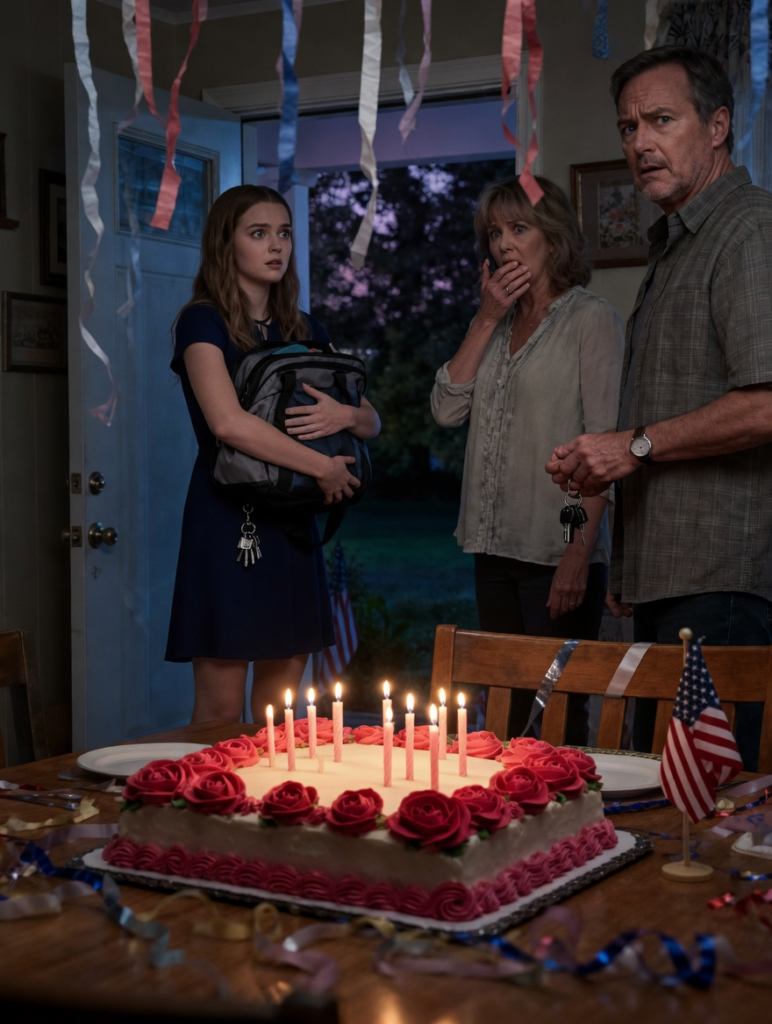
On the morning of her birthday, Carol Whitaker stood in the kitchen frosting a cake covered in pink roses. The roses were clumsy and sweet, better suited for a child half Lauren’s age, but Carol seemed pleased with them. She turned the cake stand slowly, lips pursed.
“The bakery wanted seventy-five dollars for something this size,” she said. “Seventy-five. For sugar and flour. I told your father that’s ridiculous.”
Dennis, standing on a chair in the dining room, was taping a drooping string of paper decorations across the archway. “I think it looks nice,” he said, though he had not looked at the cake.
Lauren stood by the counter, holding a mug of coffee gone lukewarm. “It’s fine, Mom.”
Carol glanced over. “Fine?”
“It looks nice.”
Her mother studied her face for a moment, searching for offense where none had been offered. Carol was good at that. In their house, emotions were often discovered in Lauren before Lauren was allowed to decide whether she felt them.
“Well,” Carol said, smoothing frosting along the edge, “I wanted it to be special. You only turn twenty-three once.”
Lauren almost smiled at that. The sentence was technically true, yet every age she had turned had somehow felt like something she was expected to lend to Emily.
Dennis climbed down from the chair and dusted his hands. “This year will be different,” he said, with a kind of hopeful firmness that made Lauren ache more than anger could have.
She looked at him. His hair had thinned near the crown. His shirt was wrinkled from work. He was not a cruel man, not in the obvious ways. He did not shout, did not drink himself into rages, did not vanish for days. He simply folded whenever pressure appeared, and Emily had learned to press exactly where he bent.
“Sure,” Lauren said.
All afternoon, the house prepared itself for a party that felt more like a test. Carol cleaned surfaces that were already clean. Dennis set plates in the dining room, then moved them twice. Lauren showered, curled her hair, and put on a navy dress she had bought herself from a clearance rack. It fit better than she expected. For a moment, standing before the mirror, she saw not the daughter who waited, not the sister who understood, not the easy child who asked for too little, but a woman with tired eyes and a spine she had spent years pretending not to have.
Downstairs, the candles were in place.
Emily had not come by all day.
That, more than anything, confirmed it.
At exactly 5:42 p.m., as Lauren reached the bottom step, Carol’s phone rang.
Her mother looked at the screen, and every line in her face changed.
“It’s Emily,” she whispered.
Lauren felt nothing at first. No shock, no sharp stab of disappointment. Only a deep, almost calm recognition, like hearing a song she hated from the opening note.
Carol answered. “Emily? Honey, what’s wrong?”
Dennis’s hand moved toward his keys before the answer came.
Lauren stood in the doorway between the hall and dining room, watching them become themselves. Carol’s mouth tightened. Dennis leaned closer, eyebrows drawn, already preparing to leave the life in front of him for the crisis on the phone.
“She says she’s at urgent care,” Carol said, covering the receiver with her hand. “She feels dizzy and can’t drive.”
Dennis looked at Lauren. For three seconds, maybe four, conflict moved across his face. In those seconds, Lauren could almost see him trying to be two fathers at once. Then he failed in the direction he always failed.
“We’ll celebrate when we get back,” he said.
The dining room held its breath. The cake waited with its childish roses. The candles stood tall and untouched. The paper decorations sagged from the archway as if exhausted by the performance.
Lauren looked at all of it, then at her parents.
And she smiled.
“Don’t worry,” she said softly. “You won’t have to.”
**Part Two**
Neither of them understood her at first.
Carol was already turning toward the front door, purse strap hooked over one shoulder, phone still pressed against her ear. Dennis had his keys in his hand, thumb rubbing over the metal edge the way he did when he was anxious. Lauren’s words seemed to reach them late, as though the room had translated them only after a delay.
Carol stopped first. “What exactly is that supposed to mean?”
Lauren rested one hand on the back of a dining chair. It was strange, how steady she felt. She had imagined this moment so many times that she expected tears, or rage, or some trembling speech she would regret. Instead, all she felt was the clarity that comes after a storm has passed and revealed what the wind has broken.
“It means go take care of Emily,” she said. “That’s what you always do.”
Dennis frowned. “Lauren, not tonight.”
A small laugh escaped her before she could stop it. Not because anything was funny, but because the sentence was so perfectly absurd.
“Exactly,” she said. “Not tonight. Not anymore.”
Carol’s expression hardened. It was the face she wore whenever Lauren’s hurt became too inconvenient to acknowledge. “Your sister is sick.”
“Emily is always something.”
The truth landed like a glass dropped on tile.
Carol lowered the phone slightly. “You’ve become so cold.”
“No,” Lauren said. “I just stopped pretending I don’t notice.”
Dennis stepped toward her, using the soft voice he saved for moments when he wanted a conflict to dissolve without anyone admitting fault. “We’ll only be gone an hour. We’ll come back, relight the candles, and make the best of it.”
The best of it.
Lauren had lived on that phrase the way some people lived on leftovers. Make the best of it when Emily’s emergencies ruined family vacations. Make the best of it when Lauren’s school award ceremony had two empty seats because Emily had called saying she “couldn’t be alone.” Make the best of it when Lauren had her wisdom teeth removed and Carol spent the afternoon in the hallway whispering into the phone because Emily’s boyfriend had stopped replying to her messages. Make the best of it when Lauren’s internship celebration ended with cold pasta under foil because Emily had locked herself out of her apartment and needed both parents to rescue her.
There had always been a reason. There had always been an explanation. Emily was sensitive. Emily was fragile. Emily felt things deeply. Emily spiraled. Emily needed support.
No one ever said Emily was manipulative.
No one ever said she had learned that attention came fastest when wrapped in panic.
Lauren reached into her bag and removed the folded envelope.
Dennis looked at it as though it might burn him. “What’s that?”
“My lease.”
The word seemed to empty the room.
Carol blinked. “What lease?”
Lauren opened the envelope but did not unfold the papers. She did not need to show them proof. She only needed to say the truth out loud.
“The lease for my apartment.”
Dennis’s face went slack. Carol’s first reaction was not fear. It was offense.
“You went behind our backs?”
Lauren looked at her mother carefully. That, more than anything, told the story of their family. Not Are you safe? Not Why did you feel you had to hide this? Not How long have you been unhappy?
Behind our backs.
As though Lauren’s independence were a betrayal rather than a survival plan.
“I planned a life you weren’t included in,” Lauren said. “There’s a difference.”
Carol’s phone rang again, shrill and demanding. Emily’s name glowed on the screen. The sound split the moment cleanly in half, and Lauren watched her mother choose without choosing. Carol answered immediately.
“We’re coming, sweetheart. Just stay there. No, don’t try to drive. We’re coming.”
Dennis looked toward the door, then back at Lauren. The old choreography pulled at him. Lauren could almost see the invisible strings.
Her mother’s voice softened as she listened to Emily. “I know, honey. I know you’re scared.”
Lauren stood ten feet away with a lease in her hand and a packed life waiting upstairs. Still, Emily was the one being comforted.
Something in Lauren, something that had been fraying for years, finally separated without sound.
She turned and walked upstairs.
No dramatic slam. No sobbing retreat. Just the measured steps of someone who had finally stopped waiting to be stopped.
In her room, the suitcase slid easily from beneath the bed. The duffel bags were heavier than she expected, though she had packed them herself. Clothes. Shoes. Her laptop. Certification textbooks. A folder with her birth certificate, Social Security card, banking papers, and the title company documents she was studying for work. The envelope of cash came out of the old winter boot and went into the side pocket of her backpack.
She paused once, looking around the room.
There were no posters on the walls anymore. No childhood trophies. No evidence of the girl who had grown up here except faint pinholes above the desk and a dent in the carpet where a bookcase used to stand. It startled her, how little there was to say goodbye to. The room had not felt like a sanctuary in years. It had been a waiting area.
When she came downstairs, Carol had ended the call.
Dennis stared at the bags. “Lauren, wait.”
“For what?”
“For us to come back so we can talk.”
She shifted the duffel higher on her shoulder. “You’ve had years.”
Carol stepped into her path. “You are not leaving this house like this.”
Lauren’s voice stayed quiet. “Move, Mom.”
Carol recoiled as if Lauren had shouted. “All of this over one missed birthday?”
There it was. The reduction. The minimizing. The desperate attempt to compress years of neglect into a single evening, as if the wound could be made small enough to dismiss.
Lauren looked at the cake again. Pink roses. White frosting. Candles waiting for fire.
“No,” she said. “I’m leaving because of all of them.”
Dennis’s face crumpled in a way that might have broken her once. Carol’s mouth opened, then closed. Emily’s crisis hovered over them, urgent and invisible, still more powerful than Lauren’s presence.
For a moment, nobody moved.
Then Dennis whispered, “Please don’t do this.”
Lauren almost told him that she was not doing anything to him. She was doing something for herself. But she had spent too many years translating her pain into sentences other people could survive. Tonight, she no longer wanted to make her leaving comfortable.
She stepped around her mother and opened the front door.
Cool evening air entered the house. It smelled faintly of rain and cut grass. For one brief second, Lauren expected some final interruption. Emily appearing in the driveway. Carol collapsing into tears. Dennis suddenly finding the courage to say the words that might have mattered.
But no one came to save the moment.
So Lauren saved herself.
She carried her bags to the car, placed them in the trunk, and returned once more to the dining room. Her parents watched in stunned silence as she took a knife from the table and cut a slice from the birthday cake. The frosting smeared against the blade. She put the slice into a small plastic container, snapped the lid shut, and held it against her chest.
Carol looked bewildered. “What are you doing?”
Lauren picked up her keys.
“Celebrating,” she said.
Then she walked out of the house before anyone else’s emergency could steal the rest of her life.
**Part Three**
Lauren did not look back as she drove away.
Later, that would matter more than she expected. In every version she had imagined, leaving had been louder. She thought she would sob so hard she would have to pull over. She thought she might scream at a red light, or circle the block, or turn around because the guilt would become too heavy before she reached the main road. She had imagined herself shattered by the act of choosing herself.
Instead, the night opened in front of her.
Charlotte’s suburban streets passed in a blur of porch lights and dark lawns. Her suitcase thumped once in the trunk when she turned too sharply. The boxed slice of cake sat on the passenger seat, sliding a little whenever she braked, absurd and precious and hers. At a stoplight, Lauren glanced at it and felt something rise in her throat, not grief exactly, but a kind of fierce tenderness for the girl she had been. The girl who had waited at restaurant tables. The girl who had smiled over cold cupcakes. The girl who had mistaken being easy to disappoint for being loved well.
“I’m sorry,” she whispered, though she was not sure whether she was speaking to that girl or to herself now.
The studio apartment was twenty-eight minutes away. It sat in a modest beige building with dim exterior lights and a narrow walkway lined with shrubs that needed trimming. The leasing manager, Teresa, had agreed to meet her late after Lauren called from a gas station and explained only that she needed to sign tonight, not tomorrow. Lauren had expected questions. Teresa asked none.
She was a broad-shouldered woman in her fifties with silver-threaded hair pulled into a bun and reading glasses hanging from a chain around her neck. She wore sweatpants, a cardigan, and the expression of someone who had seen enough private disasters to know when not to pry.
“You got your cashier’s check?” Teresa asked.
Lauren nodded.
“ID?”
Lauren handed it over.
They signed the papers in the leasing office under fluorescent lights that buzzed overhead. The pen left a blot of ink near Lauren’s thumb. Teresa made copies, slid keys across the desk, and looked at Lauren with a softness that almost undid her.
“First place on your own?”
“Yes.”
Teresa nodded once. “Then let me say this officially. Welcome home.”
Home.
Lauren had not expected the word to hurt.
The apartment was empty except for dust along the baseboards and the smell of fresh paint. When she unlocked the door, the silence inside did not feel hostile. It felt unused, waiting. She carried in her bags one by one, each trip making the place more real. Suitcase by the closet. Duffels by the wall. Backpack on the kitchen counter. Cake in the refrigerator, though she opened it once just to make sure it was still there.
She had no bed yet. The mattress delivery would come in the morning, assuming the company kept its window. She spread a blanket on the floor, folded her coat as a pillow, and lay on her back beneath the unfamiliar ceiling. Outside, a car door shut. Somewhere upstairs, water ran through pipes. Her phone buzzed for the first time at 8:13 p.m.
Dad.
She watched the screen light up until it went dark.
At 8:16, Mom.
At 8:18, Dad again.
Then texts began arriving.
Please answer.
Lauren, where are you?
Your mother is very upset.
Emily is fine.
We need to talk.
You made your point.
Don’t do this like a stranger.
That final line made her sit up.
Like a stranger.
As if strangers were the ones asked to understand every broken promise. As if strangers were told to swallow disappointment because someone else’s feelings were always louder. As if strangers knew exactly how it felt to stand beside their own birthday cake while their parents walked out the door.
Lauren set the phone facedown on the floor.
For a long time, she listened to it vibrate.
Then she slept.
Morning came pale and quiet through the blinds. For one confused second, Lauren did not know where she was. Then she saw the suitcase, the blank walls, the little kitchen with the crooked cabinet handle, and remembered.
Nineteen missed calls.
Eleven messages.
The newest one was from Carol.
You embarrassed this family.
Lauren read it while sitting cross-legged on the floor. Her hair was tangled. Her back ached from sleeping without a mattress. The apartment was cold because she had not figured out the thermostat. Still, she felt calmer than she had in years.
Another message followed.
Emily really was sick.
Then another.
You have always been jealous of her needs.
Lauren stared at that one for a long time.
There it was, written plainly. Not jealous of Emily’s life, or beauty, or relationships, or success. Jealous of her needs. As though needing love, needing consistency, needing parents who stayed through one dinner, one ceremony, one birthday, were shameful desires Lauren had failed to outgrow.
She did not answer.
The mattress arrived at noon. The delivery men tracked dirt onto the floor, apologized, and leaned the rolled foam against the wall. Lauren tipped them five dollars because that was all the cash she could spare from her wallet. After they left, she wrestled the mattress onto the bed frame she had ordered secondhand and laughed when it expanded with a loud sigh, nearly knocking her backward.
The laugh surprised her.
It was small, but real.
That afternoon, she bought a shower curtain, a cheap frying pan, one blue towel, and a set of plates from a discount store. The cashier wished her a good day. Lauren almost said, “I moved out last night,” because the fact sat inside her like a bell wanting to ring. Instead, she smiled and carried her bags to the car.
Three days passed before Emily texted.
Wow. So you really turned my health scare into something about you.
Lauren read the sentence twice. Not because it wounded her deeply, but because it was so perfectly Emily that it seemed almost mechanical. There was no question. No curiosity. No concern about where Lauren was. Just outrage that the performance had not produced the expected result.
Lauren did something she had never done before.
She blocked her.
Her thumb hovered over the button for only a second. Then Emily’s name disappeared from reach.
The silence that followed felt enormous.
At work, no one knew what had happened, not at first. Lauren continued processing closing documents, answering emails, checking signatures, catching missing initials in mortgage packets. The title company smelled of printer toner and burnt coffee. Her supervisor, Marianne, noticed she looked tired and asked if everything was all right.
“I moved,” Lauren said.
“Oh?” Marianne looked up from her monitor. “Good move or bad move?”
Lauren considered that.
“Necessary,” she said.
Marianne nodded as if that answered everything.
The days became practical. Lauren assembled a lamp badly and decided crooked light was still light. She bought groceries and cooked pasta in a pot too small for the job. She learned which neighbor played music on Friday nights, which washing machine in the laundry room stole quarters, and how the sun crossed her apartment wall around four in the afternoon.
Every small task became proof.
She could do this.
She could build a life no one else knew how to interrupt.
But freedom did not arrive as pure joy. Some evenings, guilt still found her. It came while brushing her teeth, while folding towels, while lying in the dark. She would imagine Carol crying at the kitchen table, Dennis pacing the living room, the cake drying beneath plastic wrap. She would wonder whether leaving had been cruel.
Then she would remember her twelfth birthday. Her sixteenth. Her nineteenth. The internship dinner. The award ceremony. The wisdom teeth. The way her parents had looked at the door even while she stood in front of them holding her lease.
And guilt would turn, slowly, into grief.
Grief was different. Guilt asked her to go back. Grief simply asked her to tell the truth.
A week after she moved, Dennis called from a number she had not blocked. Lauren almost ignored it. Then, after four rings, she answered.
His voice was careful. “Hi, sweetheart.”
She closed her eyes. “Hi, Dad.”
“Can we meet?”
Lauren looked around her apartment. The dishes in the sink. The half-built bookshelf leaning against the wall. The birthday cake container, now empty, washed and sitting near the drying rack.
“Just you,” she said.
A pause.
“Just me,” he agreed.
**Part Four**
They met at a coffee shop halfway between the house Lauren had left and the apartment she had chosen.
It was raining that afternoon, a steady gray rain that blurred the windows and made every passing car sound distant. Lauren arrived first, because she hated the idea of being watched while walking in. She chose a table near the back, ordered tea she barely wanted, and kept both hands wrapped around the cup for warmth.
Dennis came in five minutes late.
He looked older than he had on her birthday. Not dramatically, not enough for anyone else to notice, perhaps, but Lauren noticed. His shoulders seemed lower. The skin beneath his eyes was shadowed. He spotted her, hesitated, then walked over with the hesitant smile of a man approaching a door that might not open.
“Hey,” he said.
“Hi.”
He sat across from her. For a while, neither spoke. Dennis stirred his coffee though he had not added sugar. The spoon clicked against the ceramic cup, again and again, until Lauren wanted to reach across and still his hand.
Finally, he said, “Your mother thinks you’re punishing us.”
Lauren leaned back slightly. “That would require effort. I’m simply done participating.”
Dennis winced.
Part of her wanted to soften it. That instinct was old and deeply trained. Lauren had spent years trimming her anger into something her parents could hold. But she was tired of making her pain polite.
He took a breath. “We didn’t know you were that unhappy.”
The sentence should have made her furious. Instead, it made her sad.
“You didn’t ask.”
“We thought…” He rubbed a hand over his face. “You always seemed fine.”
Lauren looked out the rain-streaked window. A woman hurried past under a red umbrella, head down, one hand clutching her coat closed.
“I seemed fine because fine was useful,” Lauren said. “Fine didn’t cause problems. Fine didn’t make you choose. Fine let everyone keep doing what they were already doing.”
Dennis said nothing.
“You know what hurt the most?” she asked.
He looked at her then.
“It wasn’t just that Emily always pulled you away. It was that after enough years, I could predict it better than weather forecasts. I knew my birthday wasn’t really mine. I knew the decorations were temporary. I knew one call from Emily could erase me again, and I knew both of you would act surprised when I was hurt.”
His mouth tightened. “Emily struggles, Lauren.”
“I know.”
“She has anxiety. She gets overwhelmed.”
“I know.”
“She’s not as strong as you.”
There it was. The compliment that had never been a compliment. The golden chain. Lauren had been praised for needing less until needing less became the price of being loved.
She set her cup down carefully. “You made me strong because you left me no other option.”
Dennis looked wounded, but he did not interrupt.
“The problem was never that Emily needed things,” Lauren continued. “People need things. I needed things too. The problem is that you taught Emily she could need them whenever she wanted, especially when attention was on someone else. And you taught me I was selfish for noticing.”
The words remained between them.
For the first time in Lauren’s memory, Dennis did not immediately defend Emily. He did not tell Lauren to be fair, to understand, to calm down. He simply looked at the table, eyes shining in a way he tried to hide.
“I’m sorry,” he said.
Lauren wanted the apology to enter her like medicine. Instead, it touched only the surface. It was not that she doubted he meant it. She believed he did, at least in that moment. But an apology was small compared to a childhood. It could mark the beginning of repair, maybe, but it could not become the repair itself.
“Thank you,” she said.
He looked up, hopeful.
“But I’m not moving back.”
The hope faded.
“I figured,” he said quietly.
“And I’m not unblocking Emily.”
He nodded, though this cost him more.
“And I’m not going to keep explaining the same wound until everyone agrees I’m allowed to have it.”
Dennis closed his eyes.
When he opened them, he seemed less like her father than a man forced to inspect the wreckage of a house he had lived in comfortably because someone else kept sweeping the broken glass away.
“Your mother isn’t ready to hear this,” he said.
Lauren gave a tired smile. “Mom only hears what lets her stay the victim.”
“Lauren.”
“She texted me that I embarrassed the family.”
Dennis flinched.
“She said Emily really was sick. She said I was jealous of Emily’s needs.”
He looked down.
“Did you know that?”
He did not answer quickly enough.
Lauren nodded once. “That’s what I thought.”
The meeting ended without resolution, but not without truth. Dennis walked her to the door. Rain had slowed to a mist. He stood beside her beneath the awning, hands in his coat pockets.
“Can I still call you?” he asked.
Lauren looked at him. He seemed smaller in the gray light, but maybe he had always been smaller than she needed him to be.
“Sometimes,” she said. “Not to pressure me. Not to speak for Mom. Not to update me on Emily.”
He swallowed. “Okay.”
“And Dad?”
“Yes?”
“You have to decide whether you want peace or honesty. Because you can’t keep choosing peace and then act surprised when nothing gets better.”
He stared at her for a long moment.
Then he nodded.
Weeks passed.
Lauren worked. Studied. Slept better. Some nights, loneliness sat at the foot of her bed like an animal she had not yet learned to name, but it no longer frightened her the way her childhood home had. Loneliness, she discovered, could be honest. It did not pretend to be love while abandoning her at the table.
She completed her paralegal certification on a Thursday afternoon. The email arrived while she was eating soup from a chipped bowl over her kitchen counter. For a moment, she simply stared at the screen. Then she laughed, then cried, then printed the confirmation at work the next day because she did not own a printer.
Marianne brought her a cupcake from the bakery downstairs. “Certified women deserve frosting,” she said.
Lauren smiled so hard her cheeks hurt.
Not long after, at the title company, she caught an error in a closing file that would have delayed a sale and cost a client thousands in penalties. The mistake was buried deep in a legal description most people would have skimmed. Lauren found it at 6:40 p.m. after everyone else had gone home. Marianne called her into the office the next morning and offered her a promotion to case coordinator.
“It comes with more responsibility,” Marianne warned.
Lauren thought of every family crisis she had carried without title, salary, or thanks.
“I can handle responsibility,” she said.
The raise was not enormous, but to Lauren it felt like a door opening. She bought herself a real dining table, small and round, with two chairs. She placed it near the window and ate dinner there every night for a week just because she could.
Then, two months after her birthday, the family pattern collapsed.
Dennis called on a Sunday evening. Lauren almost did not answer, but something about the time made her curious. Emily usually preferred weekday disasters, when work schedules and obligations made rescue more dramatic.
“Lauren,” he said, and his voice sounded hollow. “Do you have a minute?”
She stood at her kitchen counter trimming the stems of supermarket flowers. She bought them every Friday now, a small bouquet from the clearance bucket near the checkout. They never lasted long, but they made the apartment feel witnessed.
“What happened?” she asked.
He exhaled. “Emily called last night saying her car had been stolen.”
Lauren closed her eyes.
“We spent hours dealing with it. Police report, insurance, everything. Turns out it wasn’t stolen. She left it two streets away after a fight with Mark. She was drunk. It got towed.”
Lauren did not speak.
“Your mother is furious,” Dennis said. “Emily is saying we’re attacking her. It’s been… bad.”
The flowers in Lauren’s hand smelled faintly green and sweet.
For years, Emily’s crises had been softened by Lauren’s compliance. Lauren had been the quiet counterweight, the dependable daughter who canceled her own plans, absorbed her parents’ guilt, and made the household feel less broken by not demanding anything. Without her there, the full force of Emily’s chaos had nowhere to spread. It crashed directly into the two people who had mistaken indulgence for care.
Dennis’s voice lowered. “You were right about the pattern.”
Lauren looked at the flowers, at their fragile petals opening despite being cut from their roots.
“I know,” she said.
It was not triumph. Triumph would have been easier. What she felt was grief again, mixed with relief and something like pity. Her father was only beginning to see a room she had lived in her whole life.
“I’m sorry,” he said.
This time, she believed he understood a little more.
But understanding, she had learned, was not the same as change.
**Part Five**
Carol never truly apologized.
She sent messages sometimes, always carefully shaped to sound like reconciliation while avoiding responsibility. I hope you’re eating well. Your father says your job is going nicely. It would be nice if you came by soon. The house feels different without you. Once, near Thanksgiving, she wrote, I’m sorry you feel we didn’t do enough.
Lauren read that one while sitting at her new dining table, the apartment glowing with lamplight around her. She almost responded. Her thumbs even moved over the screen.
Then she stopped.
I’m sorry you feel was not an apology. It was a locked door painted to look open.
Emily did not apologize either. Through relatives and accidental mentions, Lauren heard pieces of her sister’s version. Lauren had abandoned the family. Lauren had always resented her. Lauren wanted attention. Lauren made one birthday into a war. The irony was so sharp it might have cut her if she had not already stepped away from the blade.
At first, Lauren wanted everyone to know the truth. She imagined explaining the history to aunts, cousins, family friends. She imagined presenting evidence like a lawyer building a case: the restaurant at twelve, the parking lot at sixteen, the internship dinner, the urgent care call, the stolen car that was not stolen. She wanted the world to understand that leaving had not been sudden. It had been years in the making.
But gradually, the need faded.
Not because the truth mattered less.
Because Lauren mattered more than convincing people committed to misunderstanding her.
Her life grew in small, steady ways. She painted one wall of her apartment a soft green after Teresa gave her permission and a leftover roller from maintenance. She bought curtains that made the room warmer in the morning. She found a used bookshelf and filled it with certification manuals, mystery novels, and thrift-store poetry collections she bought because no one was there to ask why she needed them.
She became friendly with June, the neighbor across the hall, a retired school librarian with silver curls and an alarming ability to know when cookies were needed. June had a habit of knocking once and entering conversations as if they were already in progress.
“You work too much,” June declared one evening when she found Lauren carrying files from her car.
“I’m ambitious.”
“You’re tired.”
“Both can be true.”
June considered that. “Fine. Eat this banana bread ambitiously.”
Lauren laughed and accepted it.
At work, she grew more confident. Clients began asking for her by name. Marianne trusted her with complicated closings. Lauren learned the rhythm of legal documents, the quiet satisfaction of catching what others missed, the power of precision. She liked the work more than she expected. There was comfort in rules written clearly, in signatures placed where they belonged, in problems that could be solved by attention instead of emotional sacrifice.
Dennis called every other Sunday for a while. Sometimes the calls were awkward. Sometimes they were brief. He told her about repairing the fence, about a new manager at his office, about trying to convince Carol to see a therapist, though Lauren could tell from his tone that Carol considered therapy something other families needed. He did not mention Emily unless Lauren asked, and she rarely did.
One Sunday, Dennis said, “I found an old video.”
Lauren was folding laundry on her bed. “Of what?”
“Your tenth birthday. You had that purple sweater. You kept trying to get everyone to sing faster because you wanted cake.”
A memory flickered. Purple sweater. Chocolate frosting. Emily rolling her eyes in the background.
“I remember,” Lauren said.
Dennis was quiet. “You looked so happy.”
The sentence landed gently and painfully.
“I was a kid,” she said.
“I know.” His voice roughened. “I wish I had paid more attention.”
Lauren pressed a towel flat across her knees. Outside, late afternoon light warmed the floorboards.
“Me too,” she said.
That was all. No absolution. No punishment. Just the truth, sitting between them like something they might learn to live with.
By the time Lauren’s twenty-fourth birthday approached, she realized she was not dreading it.
The realization came suddenly, in the cereal aisle of the grocery store. She was reaching for oatmeal when she saw a display of birthday candles near the endcap, bright striped boxes stacked beside disposable plates. Her body braced out of habit. Then nothing happened. No sinking stomach. No calculation of what might go wrong. No mental rehearsal of disappointment.
She stood there holding the oatmeal, startled by her own peace.
A year ago, her birthday had been a trapdoor.
Now it was just a day.
And maybe, if she wanted, something more.
She decided to host dinner at her apartment. Not a party exactly, because the word still felt too large, but a gathering. She invited Marianne and two coworkers from the title company, Teresa from the leasing office, and June from across the hall. When Dennis asked if he could see her that weekend, Lauren paused.
“I’m having people over Saturday,” she said.
“Oh.” He tried to hide the hurt. “That’s good.”
She looked around her apartment, at the green wall, the curtains, the little table that had become the center of her life.
“You can come Sunday for coffee,” she said.
His breath caught slightly. “I’d like that.”
Saturday arrived bright and cool. Lauren spent the morning cleaning unnecessarily, then forced herself to stop before anxiety turned the apartment into a museum. June arrived first, carrying a bouquet of yellow flowers and a folding chair under one arm.
“I brought seating and life,” she announced.
Teresa came next with paper plates and a bottle of sparkling cider. Marianne brought takeout from Lauren’s favorite Thai restaurant because she had once mentioned craving it during a long closing. The two coworkers arrived laughing, one with chips, the other with a grocery-store cheesecake because Lauren had said she liked cheesecake better than traditional birthday cake but had never had one with candles.
“Then tonight we correct history,” Marianne said, sticking a pack of candles into the grocery bag.
The apartment filled with voices.
Not chaos. Not crisis. Just warmth.
People sat wherever they could, on the chairs, on the floor cushions, on the edge of the bed. They passed containers of noodles and curry across the coffee table. Someone spilled sauce and Teresa cleaned it with the efficiency of a woman who managed apartments for a living. June told a story about confiscating love notes from eighth graders and accidentally reading one aloud during attendance. Lauren laughed until her stomach hurt.
At some point, she stepped into the kitchen to get more napkins and found herself looking back at the room.
Her room.
Her people, gathered not because they had to repair something, not because someone had manipulated them into panic, but because they wanted to be there. The realization moved through her slowly. For years, Lauren had believed love was something proven by how much disappointment she could endure without complaint. But here, in this small apartment with mismatched chairs and takeout containers, love looked lighter. It looked like remembering her favorite food. Bringing extra seating. Buying cheesecake. Showing up without being begged.
Marianne called, “Birthday woman, get in here.”
Lauren returned to find the cheesecake on the table, candles pushed crookedly into the top. Someone had dimmed the lamp. The flames trembled gold in the soft dark.
For a moment, Lauren could not move.
Twenty-three years of birthdays stood behind her. Restaurants abandoned before appetizers. Songs interrupted. Candles never lit or lit too late. Her father’s apologetic eyes. Her mother’s excuses. Emily’s name glowing on phone screens like a command.
Then the room began singing.
Not beautifully. Not in tune. June was too slow, Marianne too loud, Teresa laughing halfway through. It was imperfect and ridiculous and complete.
Lauren looked at the candles until the flames blurred.
Make a wish, someone said.
She closed her eyes.
But there was nothing urgent to ask for. Not because life had become perfect. It had not. Her family was still fractured. Carol still hid behind half-apologies. Emily still lived inside the storm of her own making. Dennis was trying, unevenly and late. Lauren still had lonely nights, unpaid bills, doubts, and days when healing felt less like freedom than like learning to walk after years of sitting still.
But she had keys in her own bag. Her name on her own lease. A job she was proud of. Flowers on Fridays. A table where no one could abandon her unless she invited them in first. She had taken her life back not in one grand victory, but in a hundred ordinary choices that all said the same thing.
I am here.
I matter.
I will not leave myself again.
Lauren opened her eyes and blew out the candles.
Smoke curled upward. Everyone cheered.
“What did you wish for?” Teresa asked.
Lauren smiled, wiping quickly beneath one eye before anyone could make too much of it.
“I already got it,” she said.
The next day, Dennis came for coffee. He arrived with a card and, awkwardly, a small potted plant.
“I didn’t know what to bring,” he said.
Lauren took it from him. “A plant is good.”
He stepped inside carefully, as though entering a place where he had not yet earned the right to be comfortable. His eyes moved over the green wall, the bookshelf, the table, the flowers still fresh from the night before.
“It’s nice,” he said.
“It is.”
They drank coffee at the little round table. Dennis asked about work. Lauren told him about a difficult closing and watched him listen, really listen, without checking his phone. When it buzzed once, he glanced at the screen, silenced it, and turned it facedown.
Lauren noticed.
He noticed her noticing.
“It’s your mother,” he said. “It can wait.”
The words were small. They did not rewrite history. They did not give Lauren back the birthdays she lost. But they placed one new brick somewhere different, and for now, that was enough.
After he left, Lauren stood in the doorway of her apartment holding the potted plant against her hip. The hallway smelled faintly of laundry detergent and June’s vanilla candles. Somewhere outside, traffic moved steadily along the road beyond the complex. Life continued, not dramatically, not perfectly, but fully.
A year earlier, her parents had rushed out the door to rescue Emily again, and Lauren had finally understood that no one was coming back in time to choose her.
So she had chosen herself.
She had left first.
And everything after that had begun.