Chapter 1: The Feast of the Martyr
The scent hit me the moment I turned my key in the lock. It was the rich, buttery aroma of roasted chicken, mingling heavily with the sharp sting of charred rosemary and caramelized onions. On any other day, in any other life, it would have been the welcoming fragrance of a home at peace. Today, it was the smell of a hostage situation.
I pushed the heavy oak door open, the hinges groaning in the suffocating late-afternoon heat. Before my briefcase even hit the hardwood of the foyer, the sound registered. It was a jagged, desperate wailing—the frantic, breathless screams of our three-week-old son, Leo. It wasn’t the fussy cry of a child wanting a pacifier. It was the raw, primal shriek of an infant pushed past the brink of exhaustion and hunger.
A cold dread coiled in my gut, freezing the blood in my veins. I dropped my keys, the metal clattering against the console table, and broke into a run down the hallway.
The living room looked like the aftermath of a localized hurricane. The coffee table was pushed askew. A pot of water had completely boiled over on the open-concept stove, the angry hiss of steam rising like a warning flare. But none of that mattered. My eyes locked onto the beige sectional sofa.
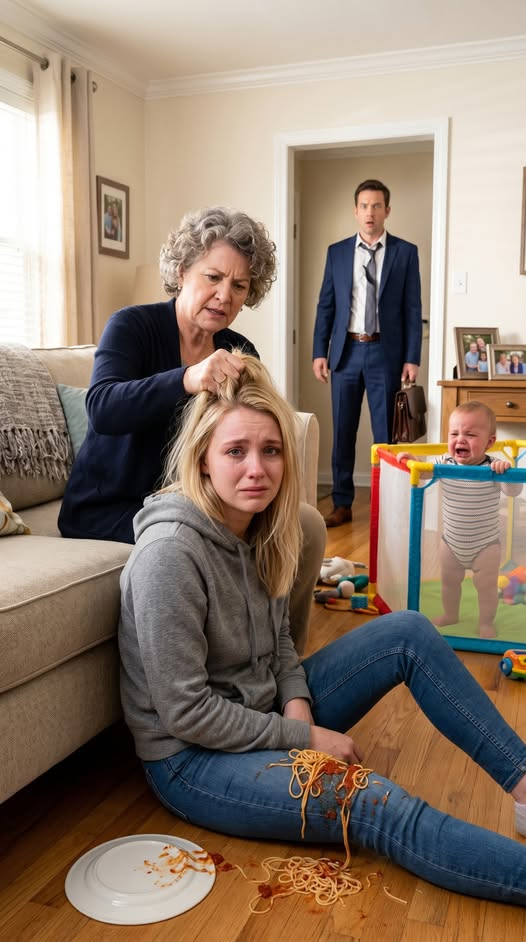
Clara was sprawled across the cushions. She wasn’t sleeping. Her posture was all wrong—her limbs thrown at unnatural, heavy angles, one arm dangling limply toward the rug. Her face, usually flushed with the gentle warmth I had fallen in love with, was terrifyingly white. Pale as wet paper. Her lips were slightly parted, drawing in shallow, ragged breaths that barely moved her chest. The dark, bruised circles under her closed eyes looked like thumbprints of soot. She had been pushed far past the precipice of physical exhaustion. She had collapsed.
Just ten feet away, sitting in the center of our mahogany dining table, was my mother, Eleanor.
She was perfectly composed, wearing a pressed cream blouse, a string of pearls resting against her collarbone. A linen napkin was draped elegantly over her lap. She held a silver knife in her right hand and a fork in her left, methodically slicing a piece of the golden-brown roast chicken—the exact, labor-intensive meal Clara had tearfully promised me she was too weak to cook that morning.
Leo was wailing from the bassinet near the window, his tiny face purple with rage, his fists punching the air.
My mother didn’t flinch. She didn’t look up. She brought a piece of perfectly seasoned chicken to her mouth, chewed with slow, deliberate satisfaction, and swallowed. Then, she took a sip from a crystal glass of Pinot Grigio.
“Mom,” I breathed out, the word tasting like ash in my mouth.
Eleanor dabbed the corner of her lips with her napkin. She finally turned her head, her gaze sweeping over Clara’s motionless, unconscious body with the detached irritation of someone looking at a piece of mildly offensive modern art. She rolled her eyes, a sharp exhalation escaping her nose.
“Drama queen,” she muttered.
The room went completely, terrifyingly silent in my mind. The roaring in my ears—a lifetime of making excuses for her, thirty-four years of rationalizing her casual cruelty as ‘tough love,’ decades of bending my spine to accommodate her relentless narcissism—simply ceased. It didn’t fade; it violently snapped.
I didn’t explode into a screaming fit. I didn’t throw my briefcase. Instead, I experienced a profound, terrifying stillness. It felt as if a fault line had cracked open right through the center of my chest, swallowing the obedient, terrified little boy she had raised. In his place, staring at the woman casually eating a meal paid for with my wife’s consciousness, stood a man who was ready to completely dismantle her existence.
I moved. I bypassed the dining table entirely, dropping to my knees beside the sofa. I pressed two trembling fingers against Clara’s neck. Her pulse was there, but it was weak, a fluttering moth against my skin. “Clara,” I whispered, brushing the damp hair from her forehead. She didn’t stir.
“She’s just putting on a show,” my mother called out from the table, her voice dripping with bored condescension. “New mothers are always so incredibly theatrical. In my day, I had the house spotless and a roast on the table three days after you were born. She needs to learn some stamina.”
I scooped Leo out of the bassinet. His tiny body was rigid, soaked in his own panicked sweat. I held him to my chest, his frantic heart beating furiously against my collarbone. I looked back at Clara, my beautiful, broken wife, and then at the woman casually cutting another piece of meat. The umbilical cord of my blind loyalty didn’t just detach in that second; it incinerated.
I am going to destroy her, I thought, the realization ringing with a cold, clinical clarity.
But as I reached for Clara’s shoulder to shake her awake, the front door—the one I had just closed—suddenly clicked open. My mother had given a key to someone else.
Chapter 2: The Line in the Sand
The heavy oak door swung inward, and my aunt Patricia stepped into the foyer, carrying a bakery box and wearing a cheerful, oblivious smile. “I brought dessert!” she chimed, her voice oblivious to the suffocating tension in the room.
I ignored her completely. My focus was entirely on the pale woman on the sofa. I pressed my palm flat against Clara’s cheek. “Clara. Sweetheart, wake up. Come on, open your eyes.”
Clara groaned, a low, wretched sound from the back of her throat. Her eyelids fluttered, heavy and confused. When she finally registered my face, a fresh wave of tears instantly spilled over her lashes, tracking down her chalky skin. She instinctively tried to push herself up, her eyes darting in blind panic toward the bassinet.
“I’ve got him,” I said softly, bouncing Leo gently against my chest until his screams dissolved into exhausted, hiccuping sobs. “I’ve got him. You’re okay.”
“The chicken,” Clara rasped, her voice trembling violently. “She said… she said if I didn’t make the chicken, I was starving her. She said I was a useless wife.”
The temperature in the room plummeted. I stood up, keeping Clara behind the physical barrier of my legs, holding my son tightly. I turned slowly to face the dining table. My aunt Patricia had frozen in the archway, the bakery box drooping in her hands, her eyes wide as she took in the scene.
“You made her cook?” I asked. My voice wasn’t loud. It was dangerously, unnaturally low. The voice of a stranger.
Eleanor took another sip of wine, utterly unbothered by the shifting atmosphere. She elegantly crossed her legs. “She offered. The house is filthy, and she thinks exhaustion is an excuse for laziness. She needs to learn discipline. Honestly, you indulge her too much.”
Clara’s fingers weakly tightened around the fabric of my trousers. “No,” she whispered, a broken plea.
I looked at the woman who raised me. For my entire life, she had conditioned me to believe that her vicious criticisms were a form of maternal guidance. If I felt hurt, I was too sensitive. If I objected, I was ungrateful. But staring at her now, with my starving son against my chest and my wife half-dead on the upholstery, the illusion was gone. I saw her clearly for the very first time. I saw pure, unadulterated malice wrapped in a cashmere cardigan.
“I’m taking them out of here,” I stated.
Eleanor laughed. It was a sharp, ugly, scraping sound. “Don’t be ridiculous. Where are you going to go? This is my son’s house. I am a guest. I belong here.”
“No,” I replied, my eyes as dead and cold as the marble countertops she had forced Clara to scrub. “It’s mine.”
I didn’t wait for a response. I didn’t engage in the screaming match she so desperately craved to feed her victim complex. I turned to Clara, hauled her up into my free arm, and supported her entire weight against my side. “Where’s the diaper bag?” I asked her quietly.
“By the door,” she mumbled, her head lolling against my shoulder.
“What are you doing?!” Eleanor’s composure finally fractured. Her chair scraped violently against the hardwood as she stood up. “You are not walking out of this house! Do not turn your back on me! I demand respect!”
I grabbed the diaper bag by the straps, practically carrying my wife and child toward the garage. Patricia stepped back, pressing herself against the wall as if we were radioactive.
“If you walk out that door, you are dead to me!” Eleanor shrieked from the dining room, her voice finally losing its polished veneer, descending into the shrill screech of a cornered predator. “You ungrateful little boy! I gave you everything! You owe me!”
I opened the door to the garage. I didn’t look back. I buckled Leo into his car seat with shaking, adrenaline-fueled hands. I helped Clara into the passenger seat, reclining it so she could rest. The muffled sounds of my mother screaming about “respect and gratitude” echoed through the walls.
I got into the driver’s seat, slammed the door, and turned the ignition. As the engine roared to life, I didn’t feel the crushing, familiar weight of guilt that had dictated my entire adult life. I felt the first terrifying, liberating rush of absolute freedom.
I backed out of the driveway, the tires squealing against the asphalt. But as I glanced in the rearview mirror, my chest tightened. My mother was standing on the front porch, flanked by my aunt. She wasn’t crying. She was furiously typing on her phone, her face twisted in a sneer of absolute certainty. She knew I would come back. She knew I always came back to apologize. And she held the spare keys to the fortress.
Not this time, I swore to myself. But she has the keys.
Chapter 3: The War Room
The sanctuary of the Wellington Hotel was bathed in the dim, golden glow of a bedside lamp. The heavy blackout curtains were drawn shut against the setting sun, turning the room into a hermetically sealed bunker against the outside world. The air conditioning hummed a low, steady drone that masked the silence of the city below.
Clara was finally asleep. Deeply, truly asleep. I had ordered room service—broth and bread—and coaxed her into eating half of it before the sheer exhaustion pulled her under. The terrifying pallor had slowly begun to recede from her cheeks, replaced by a faint, healthy pink. Leo was asleep in a hotel crib at the foot of our bed, his tiny belly full of formula, his breathing finally even and calm.
I sat in the velvet armchair by the window, entirely still, stepping fully into the role I should have assumed the day I said my vows. The protector. The shield.
The blue light of my smartphone illuminated my face in the dark room. The screen was a graveyard of digital shrapnel. I had 47 missed calls and 82 text messages, all from Eleanor.
I scrolled through them, my thumb moving with detached precision. The texts were a masterclass in psychological manipulation, oscillating wildly between aggressive victimhood and furious entitlement.
‘You are tearing this family apart for a weak woman,’ read one from 5:14 PM.
‘Aunt Patricia is in tears. How could you abandon your own mother to care for a house she let fall into ruin?’ followed at 5:30 PM.
By 7:00 PM, the tone had shifted. ‘I am locking the deadbolts. If you want back into your own home, you will come alone, and you will apologize to me on your knees. You cannot treat me like this.’
I didn’t reply to a single one. I was operating with the cold, unfeeling efficiency of a man dismantling a live bomb. Every emotion, every trace of filial obligation, had been surgically removed.
Instead of texting her back, I opened my browser. I searched for a 24-hour commercial locksmith service in the area. I typed out a message to the dispatcher: ‘Need immediate, full-house lock replacement and deadbolt drilling. High security. Meet me at [My Address] at exactly 7:00 AM. Cash payment.’ The confirmation pinged back within two minutes.
Next, I opened my email. I drafted an urgent message to my attorney, David. Eleanor had been staying with us for five weeks under the guise of “helping with the baby.” Under state law, she had likely established tenant rights by overstaying her visit. I couldn’t just throw her bags on the lawn; she would call the police, play the frail old woman, and turn it into a circus. I needed a legal guillotine.
‘David,’ I typed. ‘I need an expedited 30-day notice to vacate drawn up tonight. The occupant is my mother. The grounds are emotional distress, hostile environment, and active endangerment of a minor and a postpartum dependent. I need a process server to meet me at my house at 7:00 AM. Do whatever it takes. Bill me double.’
The “drama queen” my mother had mocked was currently resting safely beneath a down comforter. But the “obedient son” she relied on to absorb her venom was currently finalizing the paperwork for her absolute eradication.
The hours ticked by. I sat in the dark, watching the rhythmic rise and fall of my wife’s chest. At 5:00 AM, my phone buzzed on the armrest. It was David. Attached was a PDF file with a severe, legally binding seal. Notice to Quit.
At 6:30 AM, I stood up. I quietly walked to the bed and leaned down, pressing a soft, lingering kiss against Clara’s warm forehead. She shifted slightly but didn’t wake. I walked over to Leo’s crib, lightly touching his soft cheek. They were safe here. The hotel security was tight, and I had left strict instructions at the front desk that absolutely no one was to be given my room number.
I grabbed my car keys. I wasn’t driving back to my house to negotiate. I wasn’t going back to apologize. I was going back to execute a hostile takeover of my own life.
I pulled out of the hotel parking garage just as the sun began to bleed over the horizon. My phone buzzed in the cup holder. A new text from Eleanor.
‘I know you’re awake. I made coffee. Come home and let’s talk like adults without her whispering poison in your ear. Aunt Patricia is coming over at 8 to help me clean up Clara’s mess.’
My grip on the steering wheel tightened until my knuckles turned white. She wasn’t just waiting. She was bringing an audience.
Chapter 4: The Eviction
The morning air was thick with humidity as I pulled onto my street. The neighborhood was quiet, the manicured lawns bathed in the soft, deceptive light of dawn. I parked two houses down, killing the engine.
Exactly at 6:58 AM, a white commercial van with Apex Security Systems painted on the side rolled to a stop at my curb. A moment later, a gray sedan pulled up behind it. A man in a cheap, ill-fitting beige suit stepped out, holding a thick manila envelope.
I stepped out of my car and walked toward them. The air felt charged, heavy with the impending collision.
“You the homeowner?” the locksmith asked, a burly guy with a tool belt slung over his shoulder.
“I am,” I said, my voice steady. “I want the front, back, and garage doors rekeyed. I want the deadbolts replaced with heavy-duty commercial cylinders. Can you do it fast?”
“I work fast,” he grunted, grabbing a heavy electric drill.
I turned to the man in the suit. “You have the paperwork?”
He tapped the envelope against his leg. “Signed and sealed. Ready when you are.”
We walked up the driveway in a tight formation. The scent of dark roast coffee drifted through the screen of the open kitchen window. She was awake. She was waiting for her prodigal son to come crawling back, begging for forgiveness, ready to sacrifice his wife’s sanity on the altar of her ego.
I bypassed my keys. I walked up to the heavy oak door and rang the doorbell. It was a formal announcement of my arrival as an adversary, not a resident.
Footsteps echoed in the foyer. The deadbolt clicked, and the door swung open.
Eleanor stood there, wearing a silk robe, holding a steaming ceramic mug. Her face instantly pulled into a smug, victorious smile. “So,” she sighed dramatically, not even looking past my shoulder. “You finally came to your senses. It’s about time. Tell Clara she needs to be here by noon to scrub the kitchen floor. The grease she left…”
She trailed off. Her eyes finally flicked upward, registering that I was not alone. She frowned, her perfectly plucked eyebrows drawing together as she looked at the burly locksmith and the stoic man in the cheap suit.
“Who are these people?” she demanded, her voice hardening. “I didn’t authorize any contractors.”
I didn’t answer her. I didn’t say a single word. I simply took one step to the right, opening the floor to the process server.
The man in the suit stepped up to the threshold. “Eleanor Vance?” he asked flatly.
“Yes?” she replied, her voice laced with sudden, sharp confusion.
The man thrust the thick manila envelope against her chest. She reflexively brought her free hand up to grab it. “You’ve been served,” he stated, turning on his heel and walking casually back down the driveway.
Eleanor stared at the envelope. Her hand began to tremble slightly. “What… what is this?” she whispered. She ripped the flap open, tearing the paper, and pulled out the legal documents.
I watched her face. I watched the exact moment the arrogant, untouchable illusion she had lived in for six decades shattered into a million pieces. The color drained from her face so rapidly I thought she might faint. Her eyes darted back and forth across the bold legal print: Notice to Vacate… Endangerment… Hostile Environment… Immediate Eviction Proceedings.
Simultaneously, the locksmith stepped past her onto the porch, raised his heavy drill to the doorframe, and pulled the trigger. The deafening, aggressive whine of the drill biting into metal shattered the quiet morning.
Eleanor gasped, stepping backward into the foyer. “What are you doing?!” she shrieked over the noise. The coffee mug slipped from her fingers, shattering against the hardwood floor, sending hot liquid and ceramic shards exploding across the entryway. “You can’t do this! This is my house! I am your mother!”
I stepped over the puddle of coffee, crossing the threshold. I looked down at her, my expression utterly devoid of mercy, devoid of history, devoid of love.
“You were my mother,” I replied, my voice slicing through the noise of the drill. “Now, you’re a trespasser.”
“You little bastard!” she screamed, her face twisting into a mask of pure, hideous rage. She lunged forward, her hand raised high, aiming a vicious slap directly at my face.
She didn’t make contact.
My hand shot up, catching her wrist mid-air with a grip like a steel vice. I didn’t squeeze to break, but I held her firmly, immovably. The kinetic energy of her attack died instantly. She gasped, trying to yank her arm away, but I held fast.
For the first time in her entire life, Eleanor looked at my face and realized she had absolutely no power. She wasn’t looking at the boy she could manipulate with guilt; she was looking at a brick wall.
“Let go of me,” she whimpered, the rage instantly evaporating into genuine fear.
I released her wrist, letting her arm drop limply to her side. “You have exactly twenty minutes to pack a bag with your essentials,” I told her, checking my watch. “After twenty minutes, I am calling the police to have you escorted off my property for trespassing. The rest of your things will be shipped to a PO Box of your choosing.”
She stared at me, her mouth opening and closing like a suffocating fish. Then, a ragged, hysterical sob tore from her throat. She turned and fled up the stairs, stumbling over her robe, rushing to throw her clothes into a suitcase, finally understanding that her reign of terror was permanently, irreversibly over.
I stood in the foyer, the drill whirring behind me, breathing in the scent of spilled coffee. The poison was being drained. But as I heard the squeal of tires outside, I knew the fallout was just beginning. Aunt Patricia had arrived.
Chapter 5: The Fortress Built
Six months later, the contrast in our lives was so absolute it felt as though we had teleported into a different dimension.
The heavy, suffocating dread that used to hang in the corners of my own home—the anxiety of trying to please an unpleasable monster—had entirely evaporated. In its place was the profound, quiet peace of a fortress heavily secured.
Through the grapevine of terrified, gossiping relatives, I heard the brutal reality of Eleanor’s new existence. Without my financial buffer and emotional subjugation, she had rapidly burned through her goodwill. She was currently living in a cramped, beige extended-stay motel two states over. She had tried to move in with Aunt Patricia, but within three weeks, her toxic, relentless complaining and demands had alienated even her most loyal enabler. Patricia had packed her bags and left them on the porch. Eleanor was entirely, utterly alone. She had never seen her grandson again.
Back at the house, sunlight poured through the sheer curtains of a spotless, warm living room. The air smelled of lavender and fresh laundry.
Clara was sitting on the beige sectional sofa—the exact same spot where I had found her unconscious, pale as a ghost. But now, she was radiant. The hollows under her eyes were gone, replaced by the vibrant, rosy glow of health and genuine happiness. She was laughing, a bright, melodic sound that filled the house, as she laid on her back, lifting a chubby, giggling Leo into the air like an airplane.
“Incoming!” she cheered, blowing a raspberry against his stomach, sending him into a fit of breathless infant hysterics.
I stood in the kitchen, leaning against the marble countertops. I was wearing an apron over my t-shirt, wearing oven mitts, and pulling a massive, perfectly browned pot roast out of the oven. I was entirely unbothered by the fact that I was doing the cooking. In fact, I reveled in it. The kitchen was my domain now, a place of nourishment rather than a battlefield of subjugation.
I set the roasting pan on the stove, listening to the sizzle of the meat, watching my family play in the living room. The transformation within myself was the most shocking part of the last six months.
I had expected guilt. I had braced myself for the crushing, agonizing remorse of abandoning a parent. Society, television, and my own upbringing had promised me that cutting off my mother would leave a gaping hole in my soul.
It was a lie.
There was no guilt. There was only a fierce, unapologetic, breathtaking relief. The energy I used to expend managing her moods, translating her insults, and walking on eggshells was now entirely poured into my marriage and my son. I had completely shed the toxic conditioning of my youth. I was no longer a passive peacemaker; I was a ruthless protector of my family’s peace, and I loved the man I had become.
“Smells amazing, Chef,” Clara called out from the sofa, sitting up and bouncing Leo on her knee. He babbled happily, pointing a tiny, dimpled finger toward the kitchen.
“Give me ten minutes to let it rest, and I’ll plate it up,” I smiled, pulling off the oven mitts.
I walked over to the island to pour two glasses of sparkling water. As I reached for the lime, my phone, resting on the counter, suddenly vibrated. The screen lit up.
It was my birthday.
The caller ID simply read: Blocked Number.
It buzzed steadily against the granite. I knew exactly who it was. The voicemail notification popped up a moment later. It was a three-minute audio file. I knew the script without hearing a single word: she would be crying, begging for a second chance, weaponizing the day of my birth to pry open the heavy steel doors I had locked against her. She would talk about how short life is, about family, about forgiveness.
I stared at the screen, the blue light reflecting in my eyes. The old me would have listened. The old me would have felt a phantom pain in my chest.
What do I do now? I thought, my thumb hovering over the glass screen.
Chapter 6: The Ghost Erased
One year later.
The living room was completely unrecognizable from the dark, tense war zone it had once been. Today, it was an explosion of color. Pastel balloons clung to the ceiling via static electricity, a massive banner reading “HAPPY 1ST BIRTHDAY LEO!” hung across the mantelpiece, and the chaotic, beautiful noise of a dozen people filled the air.
We had invited our real family—the family we chose. David, my lawyer, was sitting in the armchair, nursing a craft beer and laughing at a joke. A few of Clara’s closest friends from her book club were gathered around the kitchen island, picking at a massive charcuterie board.
In the center of it all was Clara. She looked absolutely breathtaking in a simple sundress, her hair pulled back, handing out slightly lopsided slices of homemade funfetti cake to our friends. She was glowing, vibrating with a deep, untouchable security.
I stood in the doorway of the hallway, holding my phone, watching the scene unfold like a man watching a miracle.
My phone vibrated in my palm.
I looked down. It was happening again. The “New Voicemail” icon appeared, flagged from the same blocked number that had tried to reach me exactly one year ago. Eleanor. A ghost rattling chains outside a fortress she could no longer breach.
I stared at the notification. I actively searched my body for a reaction. I checked my chest for the familiar tightening of anxiety. I checked my stomach for the acidic burn of guilt. I checked my mind for a fleeting desire to hear her voice, just to know she was still alive.
There was nothing.
I didn’t feel anger. I didn’t feel sadness. I felt the absolute, untouchable, sprawling emptiness one feels when looking at a stranger on a subway train. She was entirely irrelevant to my existence.
With a calm, steady thumb, I swiped left on the notification. I hit the small, red trash can icon. Delete.
I didn’t listen to a single second of it. I erased her from the digital ether just as thoroughly as I had erased her from our lives.
I slipped the phone into my pocket, leaving the digital ghost in the dark, and stepped forward, walking back into the overwhelming warmth of the party. I walked up behind Clara, wrapping my arms securely around her waist, resting my chin softly on her shoulder. She leaned back into me instantly, completely relaxed, trusting my weight.
“Having fun?” I murmured in her ear over the noise of the party.
“The best,” she smiled, turning her head to kiss my cheek.
My mother had told me that I was spoiling my wife. She had screamed that I was tearing my family apart, that I was a weak, ungrateful boy who would ruin his own life.
Just then, Leo toddled over to us on unsteady, chubby legs. His face, hands, and the front of his overalls were absolutely covered in bright blue frosting. He let out a squeal of joy, reached up with his sticky hands, and grabbed my pant leg, hugging my knee as tight as his little arms could manage.
I bent down, ignoring the frosting, and scooped my son up into my arms. He threw his head back and laughed, a sound so pure it felt like a religious experience.
As I stood there, holding my son, with my wife leaning against my side and a house full of people who actually loved us, I realized the most profound truth of my entire life.
I didn’t tear my family apart. I simply tore away the monster, so my real family could finally begin to live.
If you want more stories like this, or if you’d like to share your thoughts about what you would have done in my situation, I’d love to hear from you. Your perspective helps these stories reach more people, so don’t be shy about commenting or sharing.
Chapter 1: The Extinguished Candle
The scent of artificial strawberry flavoring and melting wax is a specific kind of tragedy when it’s tied to the worst memory of your life.
It was a Tuesday evening in a cramped, two-bedroom apartment that constantly smelled of damp drywall. We were gathered around a chipped veneer dining table beneath a cheap, flickering fluorescent ceiling light that buzzed like a dying wasp. In the center of the table sat a grocery-store sheet cake. Written in uneven blue icing were the words: Happy 10th Birthday, Evan!
Evan, my beautiful, sensitive boy, was wearing a paper crown he had folded himself. He was looking up, his dark eyes wide and pleading, waiting for his father to sing.
Richard was not looking at the cake. He was looking at his wrist. The heavy gold of his Rolex flashed violently under the harsh lighting, a visual representation of the wealth he hoarded for himself while mocking the modest, suffocating life he relegated us to. He was wearing a bespoke charcoal suit, the fabric perfectly tailored, contrasting obscenely with my faded maternity-leave sweatpants and Evan’s hand-me-down t-shirt.
“Richard, please,” I whispered, the words catching in my throat. I didn’t want to beg in front of our son, but desperation had stripped me of my pride months ago. “He’s been waiting all day. Just five minutes. Just cut the cake with him.”
Richard exhaled sharply through his nose, a sound of pure, unadulterated disgust. He didn’t look at me with pity, or even anger. He looked at me the way one looks at gum scraped off a shoe.
“I don’t have five minutes, Clara,” he snapped, his voice a cold, sterile blade slicing through the humid air of the kitchen. “I have a flight to Milan in three hours. Some of us actually have to build a legacy instead of sitting around in this squalor playing house.”
“Dad?” Evan’s voice was small, trembling like a leaf in a storm. He reached out a small hand, his fingers brushing the fabric of Richard’s suit jacket. “Are you leaving again?”
Richard violently recoiled, stepping back as if the touch of his own ten-year-old son was toxic. “Don’t wrinkle the wool,” he hissed. He looked down at Evan, his expression hardening into something monstrous. “Stop embarrassing me, Evan. Stop whining. It’s pathetic.”
The silence that followed was suffocating. Evan’s hand dropped to his side, his lower lip quivering as the first tear broke free, tracking a shiny path down his cheek.
Richard turned on his heel. He didn’t look back. He grabbed his leather duffel bag by the door, stepping over the small pile of Evan’s carefully wrapped birthday presents—gifts I had pawned my engagement ring to afford.
I followed him to the door, my heart hammering against my ribs. Through the screen, I saw the street. Idling against the curb like a sleek, metallic predator was a cherry-red convertible. Sitting behind the wheel was Vanessa Vale.
She was a junior executive at Richard’s firm, ten years my junior, with cascading blonde hair and a designer silk scarf tied around her neck. She looked toward our apartment, caught my eye through the screen, and smiled. It wasn’t a smile of embarrassment or guilt. It was the terrifying, patient smile of a woman who knew she had already won, watching the loser sweep up the debris.
Richard opened the door, the draft instantly blowing out the single, glowing blue “10” candle on the cake behind me. A thin trail of gray smoke drifted toward the ceiling.
“Richard, you can’t just leave us like this,” I pleaded, grabbing the doorframe.
“I just did,” he replied. “My lawyer will contact you. Don’t call my phone.”
The door slammed shut. The draft died. The lock clicked.
I stood there for a long moment, the taste of copper flooding my mouth—I had bitten down on my own lip so hard to stop from screaming that it was bleeding. I tasted blood, and in the air, the lingering ghost of strawberry cake. I turned around to see my ten-year-old son staring at the closed door, a visceral, silent scream trapped behind his wide, devastated eyes.
I rushed to him, pulling his small, trembling body into my chest, burying my face in his hair as he finally began to sob. I held him, rocking him back and forth on the linoleum floor, promising him that I would fix it, that I would protect him.
But as I held my broken boy in the dim light of our ruined home, my cell phone, resting on the counter next to the cake, buzzed with an incoming text message. I reached up blindly and pulled the screen toward my face. It was from an unknown number.
‘Enjoy the apartment, Clara. The lease was canceled yesterday. You have 72 hours to vacate.’
The candles had died in the draft, but as I read those words, my quiet heartbreak instantly metamorphosed into absolute, blinding terror.
Chapter 2: The Alchemy of Ice
The next twenty-four hours were not a descent into hell; they were a systematic, calculated burial alive.
At 6:00 AM, my debit card was declined at the grocery store while trying to buy milk. The cashier, a girl no older than nineteen, looked at me with a mixture of pity and annoyance as the machine beeped its fatal red warning. I ran to the ATM in the parking lot. Balance: $0.00. Richard had emptied our joint checking and savings accounts—accounts holding the money I had earned before I quit my job to raise his child—at 3:00 AM.
At noon, a man in a cheap beige suit knocked on the door of the apartment we were legally being evicted from. He handed me a thick manila envelope. Petition for Dissolution of Marriage.
By 5:00 PM, my phone was ringing incessantly. Not with offers of help, but with the fallout of Richard’s narrative. His mother, a woman who had always viewed me as a peasant who had tricked her aristocratic son, left a voicemail calling me a “parasitic burden” who was finally getting what she deserved. The few friends I thought I had from Richard’s social circles went entirely dark, ghosting my texts with the brutal efficiency of high society discarding a liability.
I was thirty-two years old. I had a ten-year-old son, a degree in art history I hadn’t used in a decade, zero dollars to my name, and nowhere to sleep by Friday.
I sat on the floor of the empty living room, the boxes stacked around me casting long, depressing shadows in the fading evening light. My split lip was swollen and throbbing, a physical manifestation of my helplessness. Evan was sitting cross-legged on his mattress in the other room, packing his few remaining toys into a garbage bag with a terrifying, silent efficiency.
My phone rang. It was Richard’s number.
I answered it, putting it on speakerphone, resting it on the carpet between my knees.
“Did you get the papers?” Richard’s condescending, impossibly calm voice echoed through the empty room.
“You emptied the accounts, Richard,” I croaked, my voice stripped of all moisture. “How am I supposed to feed him tonight?”
“That is a ‘you’ problem, Clara,” he sighed, the sound of ice clinking in a glass audible in the background. “I am offering you a one-time settlement. Fifty thousand dollars. It’s enough to get you a trashy little apartment and a used car. In exchange, you sign full physical and legal custody over to me—though he’ll be going to boarding school in Switzerland, obviously—and you sign an airtight NDA.”
“You want to take my son?” The words barely registered. They were too monstrous to comprehend.
“I don’t want him,” Richard sneered. “But Vanessa thinks having an heir looks good for my corporate profile. You have no skills, Clara. No money. No family. You are a ghost. Don’t make this ugly. Take the fifty grand and disappear.”
For a moment, I felt the familiar urge to weep, to beg, to curl into a fetal position and let the world crush me into dust. But as I stared at the blank screen of the phone, something broke inside me. It wasn’t a loud shattering; it was the quiet, terrifying snap of a freezing lake icing over.
Instead of crying, a cold, unnatural laugh bubbled up from my chest. It was a jagged, foreign sound that hurt my throat, bleeding past my split lip.
I looked up. Evan was standing in the doorway. He was holding his garbage bag of toys. He wasn’t crying anymore. He was staring at me with hardened, unblinking eyes, his small fists clenched at his sides so tightly his knuckles were stark white. He had heard every word.
“Was it my fault?” Evan whispered, his voice devoid of childhood innocence.
I stopped laughing. The despair evaporated, replaced by a terrifying, manic clarity. I looked at the boy who had just been discarded like a piece of broken machinery.
“No,” I promised him, my voice dropping an octave, sounding like a vow made to the old gods. “Never.”
I hung up the phone without another word to Richard. I pulled the heavy stack of divorce papers toward me. With zero dollars to my name and eviction imminent, I grabbed a pen. I was going to sign the insulting settlement. I was going to take his fifty thousand dollars and run.
Not out of defeat.
But because, as my bruised, trembling fingers flipped to the final page of Richard’s pristine, aggressively drafted corporate disclosures, my eyes locked onto a catastrophic, hidden legal anomaly. It was buried in the fine print of an offshore LLC holding company—a structural flaw in his empire so glaring, so arrogant, that his high-priced lawyers had overlooked it.
I signed my name on the dotted line, sealing my temporary doom, but my eyes were burning with a new, dark fire. I had just found the loose thread. And I was going to spend the next decade pulling it until he was entirely unraveled. But as I slid the papers into the return envelope, a heavy, aggressive pounding on the front door shattered the silence. The landlord hadn’t waited 72 hours. He was here with the police.
Chapter 3: The Long Game
Ten years is a long time to hold your breath, but when you are breathing pure vengeance, you learn how to survive on very little oxygen.
The trajectory of the next decade was a grueling, agonizing dual-narrative of blood, sweat, and absolute obsession.
For the first three years, we lived in a studio apartment above a 24-hour laundromat. The relentless thrum of the commercial washing machines vibrated through the floorboards, a constant reminder of our poverty. I worked from 6:00 AM to 4:00 PM as an administrative assistant at a mid-level accounting firm. From 5:00 PM to 2:00 AM, while Evan did his homework at the kitchen table, I scoured the internet, community college courses, and stolen law library textbooks.
I didn’t just learn corporate law and forensic accounting; I consumed them. I dissected the anomaly I had found in Richard’s paperwork on the night of our eviction. I traced his assets, his shell companies, his aggressive leverages. I mapped his empire on a corkboard hidden in my closet, connecting the dots with red string like a deranged detective. I transformed myself from a discarded housewife into a lethal, invisible financial strategist.
And Evan. My beautiful, broken Evan.
He channeled his childhood trauma into a relentless, terrifying ambition. He didn’t play video games. He didn’t go to prom. He traded stock options on his phone during high school lunch breaks using the seed money I had managed to salvage from Richard’s insulting settlement. By the time he was eighteen, he possessed a mind that terrified veteran Wall Street brokers. He was a prodigy of predatory finance, a shark born in a bathtub who was finally ready for the ocean.
Together, we built Aegis Capital. On paper, it was a faceless venture capital firm specializing in distressed debt acquisition. In reality, it was a weapon forged for a single purpose.
While we climbed the sheer cliff face of poverty in the shadows, Richard and Vanessa lived in the blinding, arrogant sunlight. The tabloids tracked their lifestyle: a facade of endless luxury built on a crumbling foundation. Richard was expanding his real estate portfolio aggressively, fueled by massive, high-interest loans. Vanessa’s insatiable materialism—the yachts, the private jets, the diamonds—was bleeding his liquid accounts dry faster than he could replenish them. Richard’s arrogance convinced him he was too big to fail.
He didn’t know that the ocean beneath his empire was swarming with a predator he had created.
A scene from year eight stands out with crystal clarity.
Evan, now eighteen and wearing a crisp white dress shirt, sat in our newly leased, dimly lit, high-tech office in the financial district. His dual monitors glowed, reflecting a complex, chaotic web of data: Richard’s failing real estate holdings.
I walked in, placing a cup of black coffee on his desk. My hands, once soft, were now slightly calloused, carrying the phantom scars of the laundromat years. I leaned over his shoulder, my eyes scanning the sprawling digital map of our enemy’s life. I pointed a finger at a vulnerable, highly leveraged offshore account linked to Richard’s crown jewel—a massive downtown commercial development.
“He over-leveraged the downtown project,” I said quietly, the thrill of the hunt humming in my veins. “He used the pension funds of his own employees as collateral. If the market dips even two percent, he’s underwater, and the bank will call the loan.”
Evan smirked. It was a cold, calculating expression that looked nothing like the crying ten-year-old boy I remembered. His eyes, dark and bottomless, reflected the scrolling green data.
“I know,” Evan replied softly. “And I just bought that mortgage from the bank through three blind proxies. The bank wanted the toxic asset off their books. We hold the paper now.”
He turned his chair, looking up at me, the glow of the screen illuminating the sharp angles of his jaw. “We own him, Mom.”
Across town, at that exact moment, my hidden algorithms pinged. A public police scanner feed I monitored flagged an incident at Richard’s estate. Later, a contact I paid at a private security firm sent me the security footage. It showed Richard violently smashing a crystal champagne flute against a marble wall in his foyer, his face purple with rage, as Vanessa screamed at him hysterically over a black card that had just been declined at a boutique in Paris.
The trap was set. The jaws were open.
Evan leaned back in his leather chair, his finger hovering over the single ‘Enter’ keystroke that would trigger the hostile takeover of his father’s final, desperate remaining asset, plunging Richard into immediate, catastrophic bankruptcy.
“Do it,” I whispered.
But before Evan’s finger could strike the key, a sudden, urgent, violent pounding echoed against the frosted glass of our locked office door. We froze. Nobody knew we were in this building. Nobody knew who Aegis Capital truly belonged to. I reached into my desk drawer, my hand wrapping around the cold steel of a heavy paperweight, as the doorknob began to violently twist.
Chapter 4: The Predator’s Lair
The pounding stopped. A sleek, black envelope had been slipped under the door. I snatched it up, my heart racing, only to find an invitation to an exclusive municipal gala. A false alarm. The universe playing a cruel trick on my nerves. I nodded to Evan. He pressed the key. The digital guillotine fell.
Two weeks later, the bleeding was terminal.
The climax of our decade-long war did not take place in a courtroom or a dark alley. It took place in a setting of ultimate, indisputable power: Evan’s sprawling, monolithic penthouse office on the 60th floor, overlooking the city skyline like a king regarding his conquered territory.
The room was vast, intimidating, and freezing cold. The walls were floor-to-ceiling glass, offering a dizzying view of the metropolis. There were no family photos, no warm colors. Just sleek black marble, brushed steel, and the oppressive weight of total authority.
At 3:00 PM, my intercom buzzed. “Mr. Vance is here to see the managing partner,” my secretary announced, her voice perfectly neutral.
“Send him in,” I instructed, my voice steady, though my pulse was a war drum in my ears.
I stepped into the shadows near the corner of the room, blending into the dark paneled wall. Evan sat in his massive, high-backed leather chair, turned completely away from the door, facing the window.
The heavy mahogany doors swung open.
Richard walked in.
He did not look like a conqueror. He looked like a corpse that had been forced to keep walking. He was visibly aged, the arrogance that once held his spine straight now replaced by the hunch of a desperate, hunted animal. He was sweating profusely, the moisture staining the collar of a suit that looked cheapened by his ruined posture. His eyes darted around the cavernous office, terrified of the mysterious billionaire who had systematically bought up every single cent of his debt over the last two weeks, pushing him to the absolute brink of federal indictment for fraud.
He stood awkwardly in the center of the room, clutching a leather portfolio to his chest like a shield.
“Please, sir,” Richard began, his voice cracking, rehearsing the desperate pitch he had likely practiced in his car for hours. “I appreciate you taking this meeting. My company just needs a bridge loan. A temporary influx of capital to stabilize the downtown project. I have collateral. I have…”
He trailed off, swallowing hard as the silence in the room stretched to an agonizing length.
Slowly, deliberately, the high-backed leather chair swiveled around.
Evan, immaculate in a bespoke midnight-blue suit, a Patek Philippe watch gleaming on his wrist, stared back. He didn’t look angry. He looked at Richard with the exact same cold, sterile annoyance his father had used on him ten years ago.
Richard froze. His jaw went slack. The portfolio slipped a fraction of an inch from his grip. He blinked rapidly, his brain desperately trying to reject the impossible data his eyes were feeding him.
“Evan…?” Richard whispered, the word sounding like a ghost escaping his lips.
From the shadows, I stepped forward. My heels clicked sharply against the marble floor, echoing like gunshots in the silent room. I was wearing a devastatingly sharp, tailored crimson dress, my hair perfectly styled, my posture unbreakable. My gaze was like crushed glass.
Richard gasped. He physically stumbled backward, his heel catching on the edge of the plush rug, and he fell hard onto his hands and knees. The portfolio spilled open, scattering his worthless financial projections across the floor.
“Clara,” he wheezed, looking up at us from the floor, his face devoid of all color. The visceral shock, the absolute denial, and finally, the sheer, crushing terror washed over his features as he realized the truth. The “losers” he had discarded, the peasants he had left to rot, were not just surviving. They were the architects of his demise. They were the masters of his fate.
Evan leaned forward, resting his chin on his steepled fingers. He didn’t raise his voice. He didn’t need to.
“Mom,” Evan smirked, the silence in the room deafening, his eyes boring holes into the trembling man on the floor. “Are you ready to make him pay?”
Richard dropped his forehead to the carpet, tears of genuine, pathetic terror streaming down his face. “Please,” he sobbed, the sound pathetic and hollow. “Please, I’m ruined. The SEC is investigating. I’ll go to prison. I’ll do anything. Please, Clara. I’m your family.”
“You lost the right to use that word a decade ago,” I said, my voice dropping the temperature in the room by ten degrees. I walked slowly toward him, stopping until the toe of my designer stiletto was an inch from his trembling fingers.
I crouched down, bringing my face level with his ear. He smelled of sour sweat and cheap alcohol.
“You aren’t getting a bridge loan, Richard,” I whispered, every syllable a razor blade. “I am going to let the bank foreclose. I am going to let the SEC tear you apart. But I will keep you out of federal prison. On one condition.”
He looked up at me, his eyes bloodshot and pleading, a drowning man begging for an anchor. “Anything.”
I leaned in closer and whispered the horrific condition. I watched as his soul finally snapped, his eyes widening in absolute horror as he realized the true, devastating cost of his survival. But as I stood up to summon security to throw him out, Evan’s private, heavily encrypted cell phone on the desk lit up with a blaring red warning screen, a sound we had never heard before.
Chapter 5: The Weight of Ashes
The condition was simple, brutal, and flawlessly executed.
To stay out of federal prison, Richard had to legally sign over his name, his brand, and every remaining physical asset to Aegis Capital. He was forced to sign a legally binding confession of massive corporate fraud, which I locked in a vault, ensuring that if he ever spoke our names to the press, the confession would be sent to the FBI. He was stripped of everything. He was a ghost.
Two months later, the sky above the city was the color of a bruised plum, weeping a cold, relentless autumn rain.
I sat in the back of my chauffeured town car, the heated leather seats providing a stark contrast to the miserable world outside. Through the heavily tinted glass, I watched the rear entrance of the massive downtown commercial building—the very building Richard had built, the one Aegis Capital now owned outright.
A figure emerged from the service doors.
It was Richard. He was wearing a faded, oversized blue janitorial uniform, a plastic rain poncho clinging pathetically to his stooped shoulders. He was pushing a heavy, squeaking trash cart toward the industrial dumpsters. He looked small. He looked broken.
As he struggled to lift a heavy bag of refuse, a cherry-red convertible came speeding down the wet alleyway. It was Vanessa. She didn’t have the yacht or the private jet anymore. She had managed to keep the car.
She drove right past him. She didn’t slow down. The tires hit a deep pothole, sending a massive spray of dirty, oily rainwater directly over Richard’s legs and into his face. He stumbled back, dropping the garbage bag, which split open, spilling coffee grounds and wet paper over his cheap boots.
Vanessa’s brake lights didn’t even flicker. She disappeared around the corner, abandoning him in a cheap apartment just as she had advised him to abandon us ten years prior. She had told him he was “dragging her down.” Poetic justice delivered at sixty miles per hour.
I watched Richard through the glass. His shoulders began to shake. He sank down onto the wet pavement, resting his head against the filthy dumpster, and broke down completely, sobbing into the rain.
I sat back against the leather seat. I waited for the rush of euphoria. I waited for the triumphant fanfare, the soaring feeling of absolute vindication that movies and books promise you when you destroy your monster.
It didn’t come.
I felt no joy. I felt no anger. I didn’t feel triumph.
I only felt a profound, quiet emptiness where a decade of white-hot rage used to live. The fire that had kept me warm in the laundromat, the hatred that had fueled my midnight studies, was gone. Looking at the pathetic, soaking-wet man crying in the trash, I realized he wasn’t a monster anymore. He was just a pathetic, empty shell of a human being.
My revenge hadn’t healed the past; it had simply balanced the ledger.
“Ma’am?” My driver, Thomas, glanced at me through the rearview mirror. “Should we wait?”
I looked at Richard one last time. He held no power over me anymore. His memory was no longer a weapon; it was just dust. The true victory wasn’t breaking him; it was the unbreakable bond I had forged with my son, and the empire we had built from the scraps he left behind.
“No, Thomas,” I said, pressing the intercom button, my voice light and genuinely at peace for the first time in ten years. “Drive, please. We’re done here.”
The car pulled smoothly away from the curb, leaving the alley and its ghosts behind. Justice had been brutally served, and the past was finally silenced.
But my newfound peace was short-lived.
Later that night, as I was reading in my study, Evan burst through the oak doors, his face paler than I had seen it since he was a child. He was holding the encrypted cell phone that had blared the warning in the penthouse two months ago.
“Mom,” Evan breathed, his voice tight with real fear. “The offshore accounts we seized from Richard… they weren’t just holding his money. I just cracked the ledger’s secondary encryption.”
He turned the phone around. “Richard was laundering money for the Cartel. And by seizing his assets, we just stole three hundred million dollars from them. And they know exactly who we are.”
Chapter 6: The Conquerors
One year later.
The cartel threat had been a terrifying trial by fire, a war fought in the deepest shadows of the financial underworld. It had required every ounce of our intellect, every ruthless instinct we had honed, and millions in private security. But we hadn’t just survived; we had outmaneuvered them, utilizing international legal loopholes to freeze their assets and force a silent, unbreakable truce. We had proven that we were no longer prey to anyone.
Tonight, the air was electric, thick with the scent of expensive orchids and sea salt.
The balcony of our magnificent coastal estate overlooked the glittering, sprawling city skyline. There were no cheap, buzzing fluorescent ceiling lights here. There was only the soft, endless glow of a thousand stars reflecting off the dark surface of the ocean.
Inside the massive ballroom, a string quartet played softly over the hum of the city’s elite. It was Evan’s 21st birthday.
I stood by the marble balustrade, the cool night breeze playing with the hem of my silk gown. I looked at my son as he stepped out onto the balcony to join me. He was no longer a frightened boy, and he was no longer the hyper-focused, traumatized teenager seeking blood. He was a man. He was confident, grounded, and terrifyingly brilliant, but most importantly, he had learned how to smile again. The darkness we walked through hadn’t corrupted him; it had forged him into diamond.
Evan walked up beside me, handing me a crystal flute filled with vintage champagne.
“Happy birthday, Evan,” I smiled, looking into his eyes. The old scars, the phantom pain of that night in the damp apartment, were completely faded. They were just stories now.
He clinked his heavy crystal glass against mine, the sound pure and clear, ringing out over the edge of the balcony.
“We did it, Mom,” Evan said softly, looking out over the city lights. His voice was filled with a profound, quiet awe. “We took the worst day of our lives, the absolute bottom of the barrel, and we bought the world with it.”
I took a sip of the champagne, letting the bubbles dance on my tongue. I thought about the laundromat. I thought about the red convertible. I thought about the man crying in the alleyway. I looked out over the empire of lights below, a kingdom we had built from the scraps of a shattered, ten-dollar strawberry cake.
“No, my love,” I corrected him softly, reaching out to rest my hand over his. “We didn’t buy the world.”
I looked at my son, the architect of my survival, the partner in my ascension, and smiled with the untouchable authority of a queen who had survived the siege.
“We conquered it.”
We raised our glasses to the magnificent empire we had forged from the ashes, confident we had won the ultimate war. We were untouchable. We were the authors of our own fate, completely unaware that the long, dark shadows stretching across the far end of our balcony belonged to someone who had been watching our brutal, magnificent rise to power from the very beginning.