Maisie was five years old, all elbows and questions and tiny pink sneakers that lit up when she ran across a room.
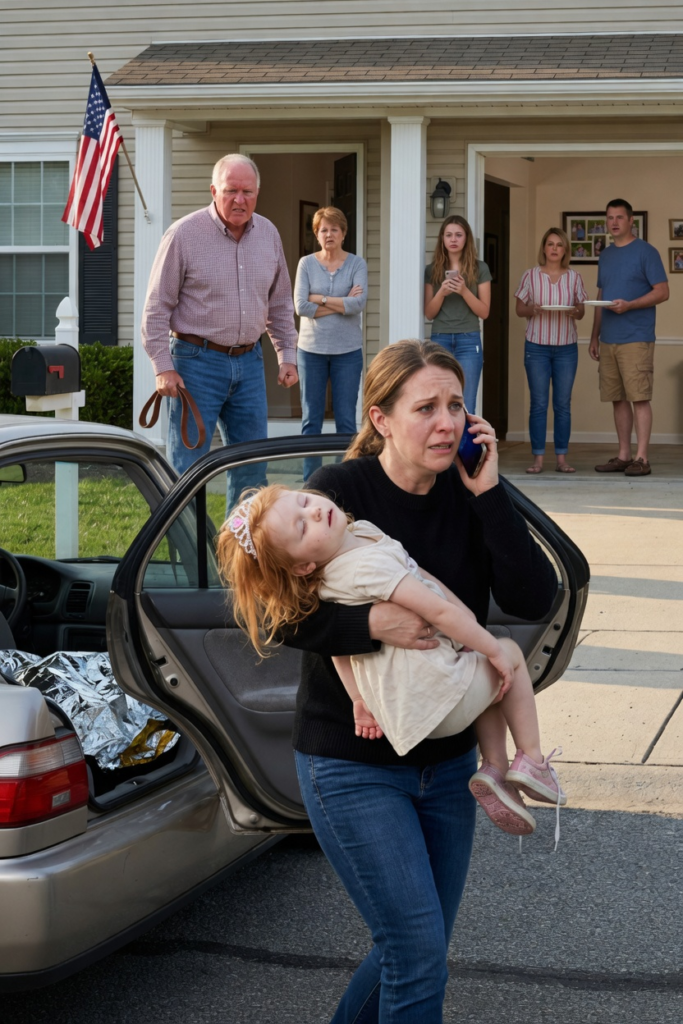
That afternoon, one of those sneakers was still fastened neatly to her foot, and the other had come loose, the lace dragging against my wrist as I held her against my chest.
Her hair smelled like strawberry shampoo.
There was a faint smear of bubblegum toothpaste at the corner of her mouth because she had insisted on doing it herself that morning, standing on the step stool in our bathroom and grinning at her reflection like clean teeth could make a regular Saturday feel fancy.
A plastic tiara, the kind that came in a dollar-store princess pack, had slipped sideways into her hair.
She had been wearing it all day because my sister Brooke said there would be kids at the cookout and Maisie decided that meant she should arrive prepared for a royal occasion.
Now her eyes were closed.
Her body was too quiet.
Behind me, my mother spoke like the problem was not the limp child in my arms, but the scene I was making.
“Honestly, Sarah, take her and go,” Diane Caldwell said, every word clipped and cold. “You embarrassed us in front of Brooke’s husband’s family. Don’t come back here again.”
For a second, I could not move.
My father stood by the living room rug with his belt hanging from one hand.
Ray Caldwell’s face was flushed red, his jaw hard, his chest lifted as if he had done something brave, not something unforgivable.
He had always had a way of filling a room before he said a word.
Retired union man, lawn trimmed on Fridays, flag mounted straight on the porch, truck washed even when the house felt like a place nobody could breathe.
People outside our family called him steady.
People inside our family knew steadiness was just what he called control.
My sister Brooke stood beside him, crying into her hands, but even then her tears looked practiced around the edges.
Brooke had always known how to look wounded without stepping into the fight.
She could shake, sob, apologize later, and somehow still leave me alone in the middle of the room when it mattered.
I looked at my mother first because some stupid, buried part of me still wanted her to become the person I had needed since I was a kid.
I wanted her to look at Maisie and gasp.
I wanted her to snatch the belt from my father’s hand.
I wanted her to say, “Ray, what have you done?”
Instead, she looked past my daughter’s pale face and straight at me, irritated that I had disturbed a family gathering.
Then I looked at Brooke.
Her mouth opened once.
No sound came out.
My father shifted his grip on the belt, not because he was about to use it again, but because he wanted all of us to remember that he could.
That was when Maisie’s head rolled softly against my shoulder.
Something in me went quiet.
Not calm.
Not peaceful.
Just clear.
There are moments when fear stops being a cage and becomes a door.
I turned away from them.
No speech.
No threat.
No final look that would make a movie scene out of it.
I walked.
The living room smelled like lemon cleaner, warm carpet, and grilled meat drifting in from the backyard where the cookout had been happening before everything split open.
The hallway floor felt slick under my shoes.
I remember the sound of my own breathing, fast and ugly, and the scrape of Maisie’s loose sneaker lace against the sleeve of my sweater.
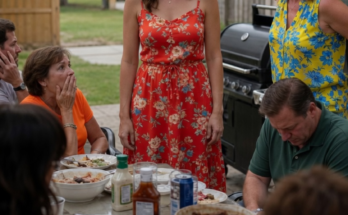
Brooke’s in-laws stood in the dining room doorway with paper plates in their hands.
One woman had a scoop of potato salad sliding toward the edge of her plate, and she did nothing about it.
One man looked away as if eye contact might make him responsible.
Nobody stepped between me and Ray.
Nobody said, “That’s enough.”
Nobody said, “Call an ambulance.”
Nobody said, “She’s only five.”
In my family, silence had always been the price of staying included.
My father’s temper was treated like weather, and the rest of us were expected to dress for it, duck from it, excuse it, and then pretend no tree had fallen through the roof.
As a child, I learned the rules early.
Do not correct him in front of company.
Do not make your mother choose.
Do not expect Brooke to help if Brooke can stay clean by staying quiet.
Do not cry too loudly, because loud crying becomes disrespect.
Those rules had followed me into adulthood like dust in the seams of old furniture.
I had broken some of them when I became a mother.
I broke more when I left my marriage and started over in a two-bedroom apartment near Maisie’s school, with secondhand furniture, grocery lists on the fridge, and a calendar full of pickup times, dentist appointments, and shifts I could not afford to miss.
Still, I kept bringing Maisie to family things.
Birthdays.
Thanksgiving.
Brooke’s cookouts.
My mother’s Sunday lunches when she wanted to pretend we were the kind of family that set a table and became decent for two hours.
I told myself it was for Maisie.
I told myself every child deserved grandparents and cousins and a backyard where people knew her name.
Maybe the truth was uglier.
Maybe I kept going back because some daughter part of me still waited outside a locked door with both hands full of hope.
That afternoon, the door finally closed.
I passed the family photos lining the hallway, and the frames flashed by like evidence.
Brooke in a dance recital.
Brooke in a graduation gown.
Brooke at her wedding, my mother glowing beside her.
Me in the background of a Fourth of July picture, half turned away, holding a paper cup and looking like I had wandered into someone else’s memory.
There were pictures of Maisie too, but fewer.
One from her preschool Christmas program.
One from last Easter, when she stood near the porch steps with a basket in her hand and Ray complained she was too loud before the egg hunt even started.
I should have listened to that.
I should have listened to every small warning I explained away because the big one had not happened yet.
At the front door, I caught sight of myself in the narrow mirror.
My hair had slipped from its clip.
My lipstick was smeared.
Maisie’s cheek rested against my shoulder, her lashes still, her mouth soft and parted.
Behind us, the living room looked ordinary.
Couch pillows.
Framed photos.
A bowl of chips on the coffee table.
My father’s belt hanging from his hand.
That was when the thought came, plain and merciless.
If I stayed in that house one more minute, I might not carry my daughter out breathing.
I shoved the door open with my hip and stepped into the afternoon.
The sunlight hit me so hard I almost stumbled.
The street looked exactly the same as it had ten minutes earlier, which felt like an insult.
Sprinklers clicked over green lawns.
A golden retriever barked from behind a fence.
A boy on a bike looped around the end of the block, slow and careless, the way children ride when the world still feels built to catch them.
My old Honda sat in the driveway under my father’s porch flag.
The small American flag moved in the breeze, neat and bright, while everything beneath it felt rotten.
I opened the back door with one shaking hand and laid Maisie across the seat on the emergency blanket I always kept in the car.
The blanket had handled spilled apple juice, wet playground shoes, sudden cold mornings in the school pickup line, and one stomach bug I still tried not to remember.
Now I spread it under my daughter like I was arranging a hospital bed with nothing but panic.
Her tiara slipped farther into her hair.
I touched her cheek.
“Maisie,” I whispered.
No answer.
My phone nearly fell out of my hand twice before I unlocked it.
The screen said 4:18 p.m.
I remember that because the number burned itself into me.
A time can become a scar when it divides your life into before and after.
I pressed 911.
The operator answered with the kind of steady voice that belongs to strangers trained to stand at the edge of other people’s disasters.
“911, what’s your emergency?”
“My daughter,” I said.
My voice sounded smaller than I expected.
“She’s five. She isn’t waking up. My father hit her.”
There was one tiny pause, not long enough to be unprofessional, but long enough for the words to become real in the air.
“What’s your location?”
I gave the address.
My parents’ address.
The house number I had written on school forms as my emergency backup because I had wanted to believe emergency meant safe.
“Is she breathing?”
I bent into the back seat so fast my shoulder hit the car frame.
For one awful second, I could not tell.
Then her chest rose.
Barely.
So slight it looked like a question.
“Yes,” I said, and the relief hit so hard I thought I might be sick. “Yes, but she won’t open her eyes.”
“Stay on the line with me. EMS is on the way. Keep her airway clear. Do not move her unless there is immediate danger.”
I did what she told me.
I tilted Maisie’s chin.
I kept my fingers light against her shoulder.
I talked because silence felt like a place I could lose her.
“Baby, it’s Mommy. Stay with me. Stay right here. You hear me? Stay right here.”
The dispatcher asked clear questions.
Was she conscious?
No.
Was she breathing normally?
No, not normally, but breathing.
Was there bleeding?
I did not see any.
Was the person who hurt her still nearby?
I looked toward the house.
The front door was partly open.
The porch flag snapped in the wind.
The hallway behind the door was dark compared to the white glare of the afternoon.
“Yes,” I said. “He’s still here.”
Inside, I heard my mother’s voice, muffled but sharp.
Then the door opened wider.
Diane stepped out onto the porch with her arms folded across her chest.
She had not grabbed her purse.
She had not grabbed a towel, water, keys, anything a grandmother might bring while running toward a child in trouble.
She looked annoyed.
“What exactly do you think you’re doing?” she snapped.
I stared at her from the open car door.
For years, my mother’s disappointment had been one of the strongest forces in my life.
It could change what I wore, what I said, whether I stayed for dessert, whether I apologized when I had not done anything wrong.
But at that moment, with my daughter lying silent in the back seat, Diane’s anger finally looked small.
“I called 911,” I said.
Her mouth tightened.
“Don’t you dare make this bigger than it is.”
Bigger than it is.
The words landed in me with a strange, cold calm.
My daughter was five years old.
My father had a belt.
My mother was worried about the size of the story.
Then Ray appeared behind her in the doorway.
He still held the belt in one hand.
He did not look frightened.
He looked offended, as if I had insulted him by refusing to keep his violence private.
“Get off that phone,” he said.
The dispatcher’s voice sharpened in my ear.
“Ma’am, is he speaking to you right now?”
“Yes,” I said.
“Is there a weapon?”
I looked at the belt.
I looked at my father’s fist.
“It’s a belt,” I said. “He’s holding a belt.”
My mother’s eyes flashed toward the street, toward the neighbor’s house, toward the boy on the bike who had finally stopped pedaling.
She cared that people might see.
That was the pattern of my whole childhood, suddenly clean and visible.
The injury mattered less than the audience.
The harm mattered less than the stain.
Brooke appeared in the hallway behind them.
Her face was wet, and her hands were shaking.
At first, I thought she was going to do what she always did.
Cry.
Freeze.
Let my mother speak for her.
Let my father own the room.
Then I saw the phone in her hand.
She held it against her stomach, screen glowing through her fingers.
Something about her expression changed the air.
My mother noticed it too.
“Brooke,” she said, low and warning.
Ray did not turn around, but his shoulders tightened.
I kept one hand on Maisie and one hand around my phone.
The dispatcher told me units were on their way.
I heard the words, but they sounded far off.
All I could focus on was my sister standing inside the doorway, looking like a woman who had reached the end of a lie she had helped carry.
“Sarah,” Brooke said.
My name came out broken.
“Don’t hang up.”
My mother’s head snapped toward her.
Ray finally turned.
Brooke flinched, but she did not lower the phone.
That one small movement hurt to watch because it showed me exactly how afraid she was and exactly how long she had been afraid.
“What are you doing?” Ray demanded.
Brooke swallowed.
Her lips trembled.
Behind her, Brooke’s husband’s family stood frozen in the dining room, still holding their plates, still trapped between politeness and horror.
The woman with the potato salad was crying now.
The man who had looked at his shoes was finally looking at my father.
Maybe it should not have mattered, but it did.
Witnesses change a room.
Not because they are brave, but because secrets hate daylight.
“Tell them to send police too,” Brooke said.
My mother made a sound I had never heard from her before, something between a gasp and a hiss.
“Stop it,” she said. “You don’t know what you’re saying.”
“Yes, I do,” Brooke whispered.
Then she slid down the hallway wall until she was sitting on the floor.
Not gracefully.
Not dramatically.
Her knees gave out, and her shoulder hit the baseboard, and the phone stayed clutched in her hand like it was the only solid thing left.
I watched my sister collapse, and for one terrible second I felt the old pull to help her.
That had been my role too.
Help Brooke.
Understand Brooke.
Give Brooke time.
Forgive Brooke because she cried afterward.
But Maisie made a small sound in the back seat, so faint I almost mistook it for air moving through her nose.
I turned back to my daughter.
“Baby?” I whispered. “Maisie?”
Her eyes did not open.
The dispatcher asked me to describe the sound.
I tried.
I failed.
My words tangled, and still the operator stayed calm.
“Keep talking to her,” she said. “Help is close.”
Help is close.
I repeated it in my head because I needed a sentence to stand on.
On the porch, my father stepped forward.
My mother grabbed his arm, not to stop him from frightening me, but to stop him from being seen doing it.
That difference was everything.
“Ray,” she whispered. “The neighbors.”
He shook her off.
“Sarah,” he said, pointing the belt toward me now. “You’re going to ruin this family over a brat who needed discipline?”
The word hit me harder than I expected.
Brat.
Trash.
Problem.
Embarrassment.
They had dressed their contempt in different clothes all afternoon, but it had the same face.
I did not scream.
I wanted to.
I wanted to throw every plate from that cookout against the porch.
I wanted to tell him exactly what kind of man needs a belt to feel powerful in front of a child.
Instead, I stayed where I was.
One hand on my daughter.
One hand on the phone.
Breathing because Maisie was breathing.
Then Brooke raised her phone.
Her face had gone gray.
“I recorded what you said after,” she sobbed.
Everything stopped.
Even the dog behind the fence went quiet, or maybe I just stopped hearing it.
My mother’s folded arms dropped.
Ray stared at Brooke like he had never truly considered that one of us might preserve proof instead of swallowing it.
Brooke’s voice shook so hard the words almost broke apart.
“I recorded Mom telling everyone to say Maisie fell.”
My mother’s face emptied.
Not softened.
Emptied.
Like someone had turned off every expression except fear.
Ray’s face did something worse.
It changed from anger into calculation.
That was the look I knew from childhood.
The look before the apology he did not mean.
The look before he decided who to blame.
The look before a room full of people quietly agreed to remember something wrong.
The first siren cut through the neighborhood.
It came faint at first, then louder, bouncing between the houses, making the boy on the bike step back onto the curb.
A neighbor opened her front door.
Brooke’s husband appeared behind the in-laws, his face pale, one hand braced on the dining room wall.
My mother whispered, “Brooke, give me the phone.”
Brooke pulled it against her chest.
“No.”
It was the smallest word.
It might have been the first honest one she had said all day.
Ray moved toward her.
The dispatcher heard my breath change.
“Ma’am, what is happening now?”
“He’s going back inside,” I said. “Toward my sister.”
“Stay outside. Do not reenter the house.”
I looked at Maisie.
I looked at Brooke on the floor.
I looked at my mother standing between the porch and the doorway, suddenly trapped between the daughter she had trained to stay quiet and the daughter who had finally run.
For the first time in my life, I did not go back in to save everybody.
I stayed with my child.
That choice felt both obvious and brutal.
The ambulance siren grew louder.
A second siren joined it.
My mother looked toward the street, and all the color drained from her mouth.
Ray turned back toward me, and for a second his eyes met mine across the driveway.
I had seen that look a thousand times.
At dinner tables.
In hallways.
Through bedroom doors left open a crack.
It used to make me smaller.
That day, it did not.
Because the operator was on the line.
Because neighbors were watching.
Because Brooke’s phone was in her hand.
Because my daughter’s breath, shallow as it was, kept lifting the blanket on the back seat.
The first emergency vehicle turned onto the block.
Its lights flashed red against the polished side of my father’s truck, against the porch posts, against the little American flag that had kept waving like nothing was wrong.
My mother stepped down one porch stair, palms open now, voice suddenly soft.
“Sarah,” she said. “Let’s not destroy your father over one mistake.”
One mistake.
I almost laughed.
It came out as a broken breath.
A mistake is forgetting milk.
A mistake is backing into a mailbox.
A mistake is burning burgers because you got distracted at a cookout.
A five-year-old lying silent in the back seat while everyone inside rehearses a lie is not a mistake.
The EMTs were close enough now that I could see them through the windshield.
The dispatcher asked me one more question, clear and careful.
“Sarah, did anyone in that house tell you to lie about what happened?”
My mother froze.
Ray froze.
Brooke covered her mouth with both hands.
And I looked down at Maisie’s tiny face, at the toothpaste smear and the crooked tiara and the loose sneaker lace still resting against my wrist.
For the first time all day, I knew exactly what kind of mother I was going to be.
Not the quiet daughter.
Not the family fixer.
Not the woman who made bad things sound smaller so other people could sleep.
I opened my mouth to answer.