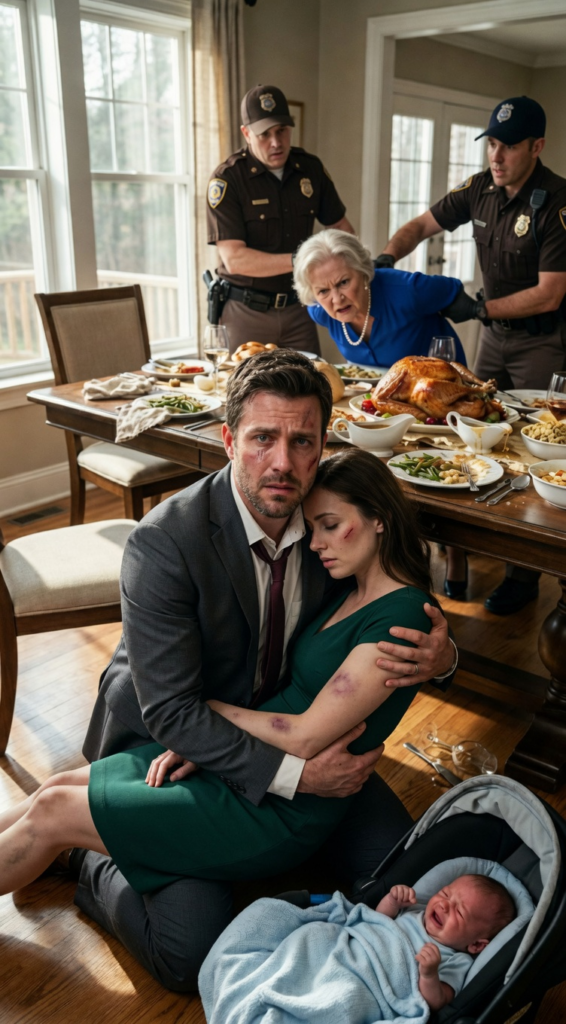
The baby’s scream hit me before I even managed to turn the key in the front door.
It wasn’t a normal cry of hunger or a fussy whimper. It was sharp, jagged, and entirely desperate—the kind of primitive, breath-stealing shriek that slices straight through muscle and bone, anchoring itself directly in a father’s chest.
I dropped my heavy leather travel bag and my keys onto the hardwood floor of the foyer and ran.
I had been gone for exactly forty-eight hours. It was my first business trip since my wife, Elena, had given birth to our son, Leo, six weeks ago. I hadn’t wanted to go. Elena was still recovering from a brutal, complicated emergency C-section. But my mother, Margaret, had practically insisted on moving into our guest room to “take the burden off.” She had smiled her perfect, practiced smile, holding my hands, promising me that she would treat Elena like a queen.
I believed her. Because even at thirty-four years old, a son desperately wants to believe that the monster in his childhood closet has finally turned into a grandmother.
Our sprawling, sunlit living room looked like a crime scene poorly disguised as a family home.
Elena was lying on the expensive Persian rug, completely motionless. Her face was ashen, her lips pale and parted. Beside her, resting dangerously close to the edge of the heavy oak coffee table, was Leo’s bassinet. My newborn son was screaming so hard his tiny face was a mottled, terrifying shade of purple, his little fists shaking with the sheer, exhausting effort of his cries.
And then, I saw her.
Sitting at the formal dining table, less than ten feet away from my collapsed wife and my screaming infant, was my mother.
She was eating.
She wasn’t on the phone dialing 911. She wasn’t holding a wet cloth to Elena’s forehead. She wasn’t rocking her crying grandson. She was casually slicing into a massive, perfectly roasted chicken, surrounded by bowls of garlic mashed potatoes, glazed carrots, and fresh bread.
It was the exact, labor-intensive meal Elena had promised me, through tears of exhaustion the night before my flight, that she would absolutely not attempt to cook.
I froze in the archway, my brain completely unable to process the absolute sociopathy of the tableau before me.
My mother lifted her silver fork, took a delicate bite of the chicken, chewed slowly, and glanced down at my unconscious wife.
“Drama queen,” Margaret muttered, taking a sip of her iced tea.
In that exact fraction of a second, something deep inside the architecture of my soul simply went silent.
It didn’t explode into rage. It didn’t shatter into panic. It just went terrifyingly, profoundly quiet.
I crossed the room in three long strides. I bypassed my mother entirely. I reached into the bassinet and lifted Leo, pulling his tiny, trembling body tight against my chest, supporting his fragile neck. The moment he felt my heartbeat, his screams hitched into ragged, breathy sobs.
Holding my son with one arm, I dropped to my knees beside Elena.
“Elena,” I said, my voice barely a whisper, terrified of what I might find. I pressed two fingers to the clammy skin of her neck. Her pulse was there, but it was incredibly fast and weak, fluttering like a trapped moth. I gently patted her cheek. “Baby. Elena, please wake up. I’m here.”
Her dark eyelashes fluttered. She let out a small, broken moan, trying to speak, but only a faint, dry breath escaped her lips.
From the dining table, my mother let out a loud, theatrical sigh of irritation.
“Oh, Arthur, please don’t encourage her,” Margaret said, wiping the corners of her mouth with a linen napkin. “New mothers these days are always so incredibly theatrical. She just needs attention. I raised you and your brother without collapsing on the floor every five minutes. She’s fine.”
I turned my head slowly and looked at her.
For thirty-four years, I had called this woman ‘strong.’ I knew she was difficult. I knew she was controlling and deeply critical. But I had always rationalized it as strength. She had always taught me that cruelty was just honesty in a sharp suit. She had always insisted that love required harsh discipline. I had believed her my entire life because children are programmed to believe the monsters, especially when the monsters are the ones tucking them in at night.
But looking at her now, sitting comfortably while my family suffered on the floor, the childhood illusion evaporated. I saw her with absolute, horrifying clarity.
“You made her cook?” I asked, my voice devoid of any inflection.
Margaret took another bite of carrots. “I certainly did not make her do anything. I simply mentioned that your Aunt Susan and Uncle Richard were stopping by for a late lunch, and it would be incredibly embarrassing if she didn’t have a proper meal prepared to welcome them. She offered.”
Elena’s cold fingers weakly twitched against the carpet, searching for me. I grabbed her hand. She squeezed my fingers with what little strength she had left.
“No,” Elena whispered, a single tear escaping her closed eyes, sliding into her dark hair.
My mother’s eyes hardened into two chips of black flint. “She needed to learn how to manage a household, Arthur. You spoil her rotten. The house was filthy when I arrived, the baby cries constantly because she doesn’t know how to soothe him, and she actually thinks being a little tired is an excuse to lay in bed all day.”
I didn’t argue. I didn’t yell. I stood up slowly, cradling Leo securely against my chest, and bent down to scoop my semi-conscious wife into my other arm. The adrenaline made her feel as light as a feather.
“I’m taking them out of here,” I said, turning toward the front door.
Margaret laughed, a dry, dismissive sound. “Don’t be absolutely ridiculous, Arthur. Put her back on the sofa and sit down. You are overreacting. Furthermore, this is my son’s house. You aren’t taking my grandson anywhere.”
I paused in the foyer. I turned back to face her, feeling a cold, calculating calm wash over me that frightened even myself.
“No, Mother,” I said softly. “It’s mine.”
Her smug smile twitched, just for a millimeter.
I carried my family out into the blinding afternoon sun, securing Elena in the passenger seat and strapping Leo into his car base. My mother followed us out onto the porch, abandoning her meal, suddenly realizing I was actually leaving. She began shouting down the driveway about respect, about family loyalty, about how ungrateful Elena was.
I didn’t answer her. I started the engine.
I only looked back once through the rearview mirror.
Margaret stood in the doorway of the grand, expensive house she thought she ruled by divine right. Her arms were crossed, but her posture was rigid.
And for the very first time in my entire life, my mother looked uncertain.
But as I put the car in drive, speeding toward the nearest emergency room, I knew her uncertainty wouldn’t last. She would regroup. She would attack. And I needed to be ready, because a monster never lets its prey escape without a bloodbath.
At the quiet, upscale hotel we checked into after leaving the hospital, Elena slept for fourteen uninterrupted hours.
The emergency room doctor had been furious. He told me that severe dehydration, dangerous physical exhaustion, acute stress, and a terrifyingly low blood sugar drop had pushed her healing body entirely past its breaking point. When the doctor gently asked Elena how long she had been denied adequate sleep and food, she couldn’t answer. She just turned her face into the stark white hospital pillow and cried without making a single sound.
Watching her cry in absolute silence hurt me far worse than screaming ever could have. It was the physical manifestation of a woman who had been conditioned to believe that her pain was an inconvenience to others.
I fed Leo every two hours that night in the dim light of the hotel suite. Between bottles and burping him, I sat in an armchair, watching Elena’s chest rise and fall, mercilessly replaying every single warning sign I had foolishly ignored over the past two years.
My mother subtly criticizing Elena’s “weak constitution” when she had morning sickness. My mother insisting she move in “temporarily” after the birth to ensure the baby was raised with “traditional standards.” My mother casually telling our extended relatives at a barbecue that Elena was inherently lazy because she hired a cleaning service twice a month. My mother smiling a chilling, triumphant smile whenever Elena apologized for things she hadn’t even done wrong.
By the time the sun crested over the city skyline, painting our hotel room in soft gold, my smartphone showed seventy-three missed calls.
Then came the barrage of text messages.
You have completely embarrassed me. You basically kidnapped my only grandchild. Your manipulative wife is successfully turning you against your own blood. Come home immediately and apologize before I change the locks on the doors.
I almost laughed out loud at that last one. She truly believed she owned my reality.
At exactly noon, my older brother, David, called. David had always been the golden child, the one who navigated our mother’s treacherous waters by simply agreeing with whoever she wanted to destroy on any given day.
“Mom called me in hysterics,” David said, his voice laced with accusatory exhaustion. “She said Elena completely lost her mind and attacked her in the kitchen.”
I was standing by the floor-to-ceiling hotel window, looking down at the highway traffic moving like a river of glittering knives. “Did she?”
David hesitated. He knew our mother. But he also knew the path of least resistance. “Look, Arthur, I know Mom can be intense sometimes, but she was just trying to help. She said Elena threw a fit over cooking lunch.”
“Elena fainted, David,” I stated, my voice devoid of emotion. “She collapsed from sheer physical exhaustion while Mom sat at the table eating the food she had literally forced a postpartum woman to cook while her grandson screamed.”
Silence stretched over the cellular line.
Then, David said, his voice dropping softer, parroting the script he had been handed: “Mom said Elena was just pretending to be asleep to get sympathy. You know how she is, man.”
I closed my eyes, pressing my forehead against the cool glass of the window.
That was the magic trick. That was how Margaret survived. My mother never actually needed the truth. She only ever needed to speak first, and to speak loudly enough, to make everyone else involved doubt their own sanity.
But in her arrogant haste to paint Elena as the villain, my mother had forgotten one very crucial, incredibly dangerous detail.
I was no longer the frightened little boy she used to corner in the kitchen, forcing me to apologize for breathing too loudly.
I was a senior corporate contracts attorney. My entire career was built on dismantling liars, uncovering hidden clauses, and orchestrating flawless, undeniable executions in federal courtrooms.
I documented absolutely everything.
When Elena was six months pregnant, she became intensely anxious about sudden infant death syndrome and baby monitor failures. To ease her mind, I had a state-of-the-art, military-grade interior camera system installed in the house. My mother had openly mocked us for it, calling us pathetic, paranoid millennials.
Because she thought the cameras were a joke, she never bothered to ask exactly where the lenses were hidden.
The kitchen. The nursery. The grand living room. The foyer.
All of them were recording 24/7.
I opened my laptop on the hotel desk, pouring myself a black coffee, and accessed my secure cloud server.
I knew my mother was cunning. I checked the system logs. Sure enough, at 8:00 AM on the day she forced Elena to cook, Margaret had intentionally unplugged the main WiFi router in the den, likely believing that disabling the internet would blind the cameras.
She didn’t know that I had paid a premium for a system with a localized, battery-backed internal hard drive that continued recording and simply uploaded the cached files the moment the internet connection was restored—which I had done remotely from my phone while waiting in the hospital.
I spent the next two hours quietly, methodically reviewing and clipping the footage.
There was high-definition video of my mother standing over Elena in the kitchen, yelling at her for chopping the vegetables too slowly while Elena physically shook. There was crystal-clear audio of Elena begging, “Please, Margaret, I need to lie down, I feel dizzy,” and my mother snapping back, “You can lie down after you mop the kitchen floor. Guests are coming.” There was thirty agonizing minutes of Leo screaming in his bassinet while my mother sat a mere three feet away, casually scrolling through Facebook on her phone, ignoring his cries.
And then, the final, damning clip.
Elena collapsing like a puppet with its strings cut, hitting the rug hard. My mother pausing her chewing, looking at the unconscious body of my wife. “Drama queen.”
I saved the files into a highly encrypted folder. I didn’t send them to anyone yet. Not to David. Not to our gossiping aunts. Not to my mother. Timing in litigation is everything.
Instead, I made a series of very quiet phone calls.
I called my property management firm and had the digital access codes to the house wiped and reset. I called my private banker. I called the senior partner at my law firm to secure a family law associate.
By the third day at the hotel, the silence from my end made my mother arrogant. She thought I was hiding in shame. She thought she had won.
She became bold. She escalated the war.
She took to Facebook, posting a long, weeping diatribe: “I am utterly heartbroken. My youngest son has completely abandoned his loving mother for a manipulative, unstable woman who weaponizes my precious grandson against me. I only tried to help her, and she repaid me with violence.”
The extended relatives swarmed the comment section like flies on a carcass. Poor you, Margaret. She always seemed so fragile and ungrateful. A devoted mother like you should never be treated this way. Arthur should be ashamed.
Margaret called me again that night. This time, her tone wasn’t angry. It was smug, dripping with the sickly-sweet venom of total victory.
“Everyone knows exactly what she is now, Arthur,” she purred into the phone. “You are making a fool of yourself. Bring my grandson home to me tonight, leave her at that hotel to cool off, and I may eventually find it in my heart to forgive you.”
Elena was sitting on the edge of the hotel bed beside me. She was still incredibly pale, but her eyes were awake. She was holding Leo with both arms, clutching him against her chest as if he were the last warm, safe thing left in the entire world.
I looked at my wife. I put the call on speakerphone so Elena could hear the monster’s voice.
“My grandson,” Margaret repeated, the entitlement oozing through the speaker. “My house. My family. Don’t throw it all away for a girl who can’t even cook a chicken.”
Elena’s eyes were wet with unshed tears, but as she looked at me, her gaze steadied. The fear was receding, replaced by the profound, primal need to protect her son.
“You’re right about one thing, Mother,” I said, my voice perfectly level, devoid of any warmth. “Everyone absolutely should know the truth.”
Then, I ended the call.
I didn’t argue. I didn’t defend my wife. I opened the family group chat, which included David, my aunts, my uncles, and Margaret herself.
And I uploaded the first video file.
But as the progress bar hit 100%, my phone buzzed with an incoming email from the state. My mother hadn’t just posted on Facebook. She had initiated a strike that could destroy us entirely.
The email preview on my screen made the blood in my veins run entirely cold.
It was an automated notification from the State Department of Child and Family Services (DCFS). An anonymous complaint had been filed, alleging severe infant neglect and postpartum psychosis at my home address, specifically naming Elena as an unfit, dangerous mother.
Margaret hadn’t just tried to win a family argument. She had actively tried to have my newborn son ripped from his mother’s arms by the government.
The sheer, breathtaking evil of her escalation completely severed whatever tiny, frayed thread of familial obligation I had left. I looked at Elena, happily burping Leo on her shoulder, entirely unaware that a bureaucratic guillotine had just been positioned over her neck.
I closed the email. I would deal with the state tomorrow. Tonight, I was going to burn my mother’s kingdom to the absolute ground.
The internet, specifically our massive, gossiping extended family network, did not whisper.
It roared.
Within an hour of me dropping the compiled, high-definition video file into the family group chat, the notification bells on my phone sounded like a continuous alarm. I didn’t add any dramatic music. I didn’t write a long, defensive paragraph of insults. I didn’t need to.
The raw, unedited footage spoke with a voice far colder and more devastating than any anger I could muster.
The family watched Elena, barefoot and physically shaking, chopping vegetables while Margaret sat on a barstool, sipping tea and criticizing her weight. They heard Elena’s desperate, breathless plea, “Please, Margaret, I feel dizzy,” and heard my mother’s vicious reply, “Then sit on the floor after you finish mopping.” They watched thirty minutes of baby Leo screaming in the background while Margaret scrolled through her phone, annoyed by the noise but refusing to comfort him.
And then, they watched the final, inescapable clip.
My wife collapsing on the rug. My mother continuing to chew her roast chicken. “Drama queen.”
By midnight, the cowardly relatives who had aggressively attacked Elena in the Facebook comments began frantically deleting their posts.
David called me at 1:00 AM. He was crying. Actual, sobbing tears of a thirty-six-year-old man who realized he had been protecting a sociopath his entire life.
“Arthur, my God,” David stammered over the line. “I didn’t know. I swear to you, I didn’t know she was doing that. She told me Elena threw a plate at her!”
“No, David,” I replied, my voice as hard as granite. “You didn’t know because you never bothered to ask. You just blindly took the side of the person who screams the loudest. Do not call this number again.” I hung up and blocked him.
The next morning, driven by a desperate, panicked need to reclaim her narrative and her territory, Margaret arrived at my house.
I knew she was there because the security app on my phone alerted me. I sat at the hotel desk, watching the live feed from the front porch camera.
Margaret stood there with two large vintage suitcases, a face twisted in blazing fury, jabbing her manicured finger into the digital keypad of the front door. The lock buzzed red. Access denied. She typed it again, harder. Red.
She began to pound on the heavy oak door with the flat of her palm. “Arthur! Open this door right now! I know you’re in there! Stop this childish tantrum!”
I pressed the microphone button on the app, routing my voice through the porch intercom.
“It was never your home, Margaret,” I said. My voice echoed across the quiet suburban lawn.
She froze, staring wildly up at the camera lens, realizing I wasn’t even inside.
“You can’t lock me out of this house!” she spat, her face flushing an ugly, mottled red. “I am your mother! I helped you pick the drapes!”
“You were a guest,” I corrected her, my tone clinical. “And your invitation has been permanently revoked.”
“I raised you!” she screamed, completely losing the polished, society-matron persona she wore like armor.
“You abused me for eighteen years,” I countered smoothly. “And then, because you couldn’t control me anymore, you tried to break my wife.”
Her face twisted into a mask of pure, unfiltered hatred. “That useless, lazy little—”
“Careful,” I interrupted, letting a smile touch my lips even though she couldn’t see it. “This camera is recording audio, too. And I’m sure the social worker assigned to our case would love to hear your thoughts.”
Her mouth snapped shut so fast I could almost hear her teeth click together.
“Check your email, Margaret,” I said, before cutting the microphone feed entirely.
That afternoon, she received a certified legal notice terminating any and all permission to enter or remain on my property. Any attempt to cross the property line would result in an immediate arrest for criminal trespassing. My firm’s senior litigator also sent her a massive cease-and-desist demand for defamation, meticulously cataloging screenshots of every single Facebook post, every comment, and every lie she had spread.
But a cease-and-desist is just a piece of paper to a narcissist. I knew she wouldn’t stop. She would simply change tactics. She would try to starve me out emotionally.
So, I decided to starve her out financially. And she had absolutely no idea the guillotine was already falling.
For the past seven years, ever since my father passed away leaving behind nothing but debts and a heavily mortgaged condo, I had quietly paid my mother’s bills.
I paid the exorbitant HOA fees for her luxury condominium. I paid the premium insurance on her Mercedes. I paid her out-of-pocket medical premiums and her country club dues. I did it because it was expected, and because she gladly accepted hundreds of thousands of dollars while simultaneously telling everyone in our social circle that I was a “stingy, ungrateful son who owed her far more.”
I logged into my private banking portal.
I didn’t do it cruelly. I didn’t do it illegally. I did it with the cold, sterile precision of a surgeon removing a malignant tumor.
I systematically canceled every single automated transfer. I removed my name as the guarantor on her accounts. I canceled the supplemental platinum credit card that was issued in her name but tied directly to my personal line of credit.
Cleanly. Permanently.
By 4:00 PM the following day, her credit card was predictably declined at a high-end salon downtown.
She called me twenty-six times in the span of three hours.
I let it ring until the twenty-seventh call. Then, I finally answered.
“You cannot do this to me!” Margaret hissed, her voice vibrating with a panic I had never heard before. The reality of her vulnerability was finally crashing down on her. “My card was declined in front of the girls! Do you have any idea how humiliated I was? Turn the accounts back on immediately!”
“I already did it, Margaret,” I said, leaning back in the hotel armchair. “You are completely financially independent now. Congratulations.”
“I’ll tell everyone in the family that you abandoned your widowed mother to starve!” she threatened, her breathing ragged.
“They already saw the video, Mother,” I reminded her gently. “They already saw exactly what you do when you think no one is supposed to be watching. No one is coming to save you. Not even David.”
There was a long, horrifying silence on the line. The realization that she had played her final card, and lost, finally settled in her bones.
“You will deeply regret choosing that weak little girl over your own mother,” she whispered, her voice dripping with pure venom.
I looked across the hotel room. Elena was sitting by the window in a patch of warm afternoon sunlight. She was wearing one of my oversized shirts, softly humming a lullaby, with Leo fast asleep against her chest. For the first time in six weeks, there was real color in her cheeks. The oppressive, suffocating shadow of my mother’s presence had been lifted, and my wife was finally, beautifully breathing again.
“No,” I said, feeling an absolute, profound peace. “My only regret is that I didn’t choose her sooner.”
I hung up and permanently blocked her number.
The consequences for Margaret came with a terrifying, unstoppable momentum.
David, terrified of his own wife’s disgust after she saw the kitchen videos, flatly refused to let Margaret move into their guest house when she realized she couldn’t pay her condo fees. The prestigious church group she prided herself on quietly asked her to step down from the women’s leadership committee to “focus on her family issues.” Two of my cousins, who had regularly trusted her with childcare, suddenly withdrew their kids, citing scheduling conflicts.
Her friends stopped calling. The family group chat, which had been her personal courtroom and echo chamber for decades, became her silent, solitary sentence.
But I wasn’t finished.
I took the anonymous DCFS report she had filed against Elena. I compiled it with the high-definition footage of my mother ignoring a screaming infant, verbally abusing a postpartum woman, and deliberately unplugging the internet router to hide her actions. I handed the entire dossier over to the state investigator who knocked on my hotel door.
I didn’t file a report against Elena, as my mother had hoped. I used the state’s own investigation to formally document my mother’s gross negligence and elder/child endangerment.
Nothing dramatic happened overnight. Real, devastating consequences in the adult world rarely arrive with cinematic thunder and lightning.
They arrive with endless paperwork. With unsmiling state investigators knocking on your door at dinner time. With permanent, un-erasable public records. With stern legal warnings. With heavy wooden doors closing in your face, one by one.
Margaret desperately tried to fight back. She told the investigators the videos were deepfakes or edited out of context. So, I legally released the full, unedited timestamps and the raw data files directly to the attorney handling the matter.
She claimed Elena was mentally unstable and a danger to the baby. So, Elena’s obstetrician and a licensed psychiatrist wrote sworn, notarized affidavits explaining that Elena was suffering from severe medical exhaustion directly caused by prolonged psychological abuse and a deliberate lack of support orchestrated by Margaret.
My mother’s fortress of lies collapsed, brick by brick, like a rotten wall in a hurricane.
But as the dust settled, I realized that returning to the house where Elena had collapsed would never bring us peace. We needed a new foundation.
Three months later, the air inside our new home smelled like lavender baby lotion and fresh paint.
We had sold the grand, expensive house in the suburbs—the one my mother felt she had an intrinsic right to rule—and bought a beautiful, mid-century modern home nestled quietly by the river. It was smaller, cozier, and surrounded by ancient weeping willows.
There was absolutely no guest room for Margaret.
Elena had spent the last two weeks painting the nursery a soft, calming sage green. I had spent that time learning how to awkwardly but enthusiastically fold tiny, impossible baby onesies.
On a rainy Sunday morning, while we were sitting on a plush rug in the living room, Leo laughed for the very first time. It was a bright, bubbling sound that filled the entire house. Elena covered her mouth, and I watched tears stream down her face. But she wasn’t crying from exhaustion or fear. She was crying because, for the first time since our son was born, experiencing pure joy had finally stopped feeling dangerous.
As for my mother, the financial reality of her situation had forced a brutal downgrade.
Unable to afford her luxury condominium or her car, and completely ostracized by her wealthy social circle, she had moved into a small, cramped rented apartment on the industrial side of town.
David still called me occasionally, usually to check in on Leo. During one of those calls, he mentioned that our mother still furiously insists to anyone who will listen that she was deeply, unfairly betrayed by her ungrateful sons.
And maybe she was.
She was betrayed by hidden cameras she thought were a joke. She was betrayed by undeniable, timestamped paperwork. She was betrayed by her own arrogant assumption that the quiet, obedient son she had molded would always bow his head to keep the peace.
One crisp evening in late autumn, I walked out to the mailbox at the end of our driveway. Inside, buried between bills and catalogs, was a letter. The handwriting on the envelope was elegant, sharp, and unmistakable.
I didn’t open it immediately. I carried it inside and set it on the kitchen counter.
Elena was at the stove, humming softly, stirring a pot of soup. Leo was bouncing happily in his jumper near the island. She noticed the envelope and paused, her wooden spoon hovering. The shadow of the past flickered in her eyes for a brief second.
“Who is it from?” Clara asked, her voice cautious but steady.
I looked at the envelope. I knew exactly what was inside. There would be no genuine apology. There would only be twisted accusations, guilt trips underlined in red ink, and demands wrapped in the guise of maternal love. It was a hook, cast into the dark, hoping to drag me back into the abyss.
I looked at my wife. She was healthy now. She was fiercely strong. She smiled, and Leo babbled back at her, his tiny hand reaching out to grab the edge of her apron.
This was my family. This was the fortress I was born to protect.
“It’s nothing important,” I said, holding her gaze.
I picked up the thick envelope, tore it deliberately in half, and then in half again, never breaking eye contact with Elena. I dropped the shredded pieces of my mother’s desperation directly into the trash can.
Then, I walked over, kissed my wife on the forehead, picked up my son, and went back to living my beautiful, quiet life.