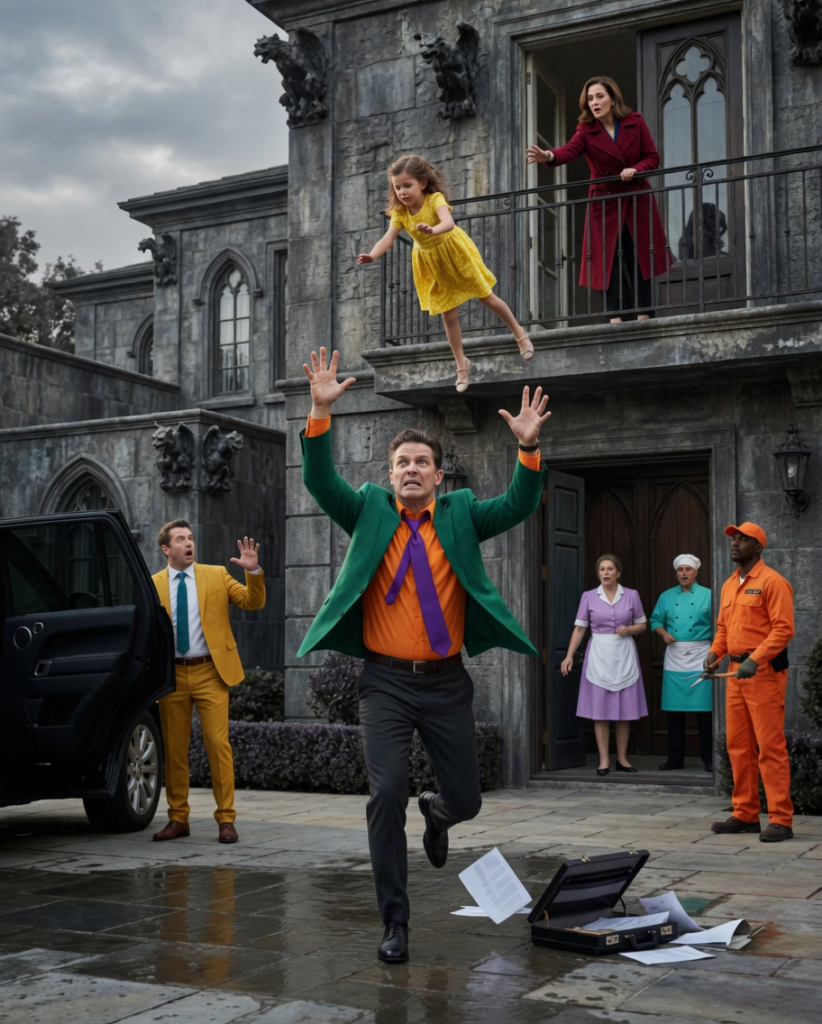
The last thing six-year-old Lily Whitaker heard before her fingers began to slide from the balcony rail was Valerie Crane’s whisper beside her ear.
“Goodbye, little mouse.”
The metal was cold enough to sting her palms.
Below her, the stone courtyard smelled of wet concrete after the sprinklers, and from somewhere inside the house came the soft, tired scent of chicken soup cooling on the stove.
A dry autumn wind lifted the hem of Lily’s pink dress and pressed it hard against her knees.
Children do not understand death.
But Lily understood danger.
She understood the hand between her shoulder blades.
She understood the quiet pressure.
She understood that Valerie did not want her to come back inside.
The Whitaker estate stood behind black iron gates outside Chicago, three stories above a gray courtyard trimmed with clipped hedges and polished stone paths.
It was the kind of house people slowed down to look at from the road.
From far away, it looked safe.
Inside, it was too quiet.
On the shelf beside the balcony door, Lily’s old rag doll rested on its side, one button eye loose, its faded cotton arms open the way her mother’s arms used to be.
Marissa Whitaker had sewn that doll’s blue dress by hand during Lily’s first winter.
Lily still slept with it most nights.
Valerie hated the doll.
She said it made the room look shabby.
She said Lily was old enough to stop carrying dead memories around like toys.
Daniel had never heard that sentence.
That was part of the problem.
Valerie did not push Lily the way monsters push people in movies.
She was too careful for that.
She placed one hand between Lily’s shoulder blades and pressed gently, almost tenderly, so from the driveway it might have looked like a stepmother steadying a child who had leaned too far over the rail.
It was not care.
It was murder wearing a soft voice.
Lily’s body tipped forward.
Her fingers scraped against the iron.
The courtyard blurred.
The sky disappeared.
Her scream got trapped somewhere behind her teeth.
Then she saw the black SUV turning through the open gates.
Her father’s car.
Daniel Whitaker had come home from London three days early.
Not because a meeting ended.
Not because his assistants rearranged his calendar.
Not because the household expected him.
At 12:06 p.m., while a multimillion-dollar negotiation sat open across a polished conference table, his phone had lit up with a voice message from Lily.
“Daddy, are you coming home today?” she had asked.
There was a pause after that.
Then her voice came back smaller.
“It feels scary quiet with Valerie.”
The room in London had kept talking for several seconds after Daniel heard it.
Charts were still on the screen.
A banker was still explaining risk.
Someone from legal was still sliding a paper toward him.
The old Daniel might have waited until the break.
The old Daniel might have told himself that children got lonely, houses got quiet, and Valerie was probably overwhelmed.
The old Daniel was the man who had trusted schedules more than instincts.
That man had died slowly over the last two years.
Daniel stood up, closed the folder in front of him, and said, “I’m leaving.”
No one in the room knew what to do with that.
He was not a man who left negotiations.
He was not a man who rushed.
He was not a man who let emotion show where money was watching.
But guilt does not always make a man wiser.
Sometimes it makes him fast.
Two years earlier, Marissa Whitaker had died in a private hospital while Daniel was overseas signing a contract.
Afterward, three missed calls stayed in his call history like tiny black nails.
7:42 p.m.
7:47 p.m.
7:51 p.m.
He saw those numbers more often than he saw his own face.
At the funeral, Lily had been four years old.
She stood beside the casket in a small black dress, clutching the hand-stitched quilt Marissa used to keep folded in the family closet.
Her hair was tied with a crooked ribbon because Daniel had tried to do it himself and failed twice before Tammy helped him.
Lily looked up at him and asked, “Why didn’t you save Mommy, Daddy?”
Daniel had no answer.
He had money.
He had staff.
He had private doctors on speed dial.
He had a boardroom full of people who stood when he entered.
He had no answer for his child.
That silence followed him into every room after that.
Every morning, Daniel woke at 5:30 without an alarm.
He put on the same gray suits.
He knotted the same navy ties.
He drank coffee he barely tasted.
At night, he slept on only one side of the bed where Marissa used to lie.
The other pillow remained untouched.
Clean.
Accusing.
Final.
Valerie entered the house one year after the funeral.
She was not dramatic at first.
That was what made her dangerous.
She arrived with organized folders, careful smiles, and an ability to make grief look inefficient.
She drove Lily to kindergarten when Daniel had early calls.
She signed pediatric clinic forms.
She managed housekeepers.
She corrected delivery invoices.
She learned how to put chicken soup and cornbread on the table the way Marissa had done on cold nights.
At first, Daniel mistook usefulness for kindness.
He gave Valerie keys.
He gave her access to Lily’s room.
He gave her permission to tell teachers, “I’m here to pick up Lily.”
That is how some betrayals begin.
Not with shouting.
Not with broken glass.
With permission handed over by someone too tired to carry grief and a household at the same time.
By the time Daniel understood that Valerie did not love Lily, it had almost become too late.
The signs had been small.
A doll moved to a closet shelf.
A lunchbox forgotten twice in one week.
A pink sweater Daniel knew Lily loved suddenly missing.
Valerie called those things discipline.
She said Lily needed structure.
She said Daniel spoiled her because he felt guilty.
That last part was true enough to make him quiet.
Cruel people love a truth they can bend into a weapon.
Daniel’s plane landed back in the United States with one message still replaying in his head.
It feels scary quiet with Valerie.
He did not call ahead.
He did not tell the house staff.
He did not warn Valerie.
At 3:17 p.m. that Monday, the Whitaker Estate security log recorded the line that would later matter most.
“Owner’s SUV entered the property.”
The foyer camera caught the vehicle before it stopped.
Nick, Daniel’s driver, still had one hand near the gear shift when Daniel looked up toward the balcony.
And the world split.
His daughter was falling.
Daniel’s briefcase hit the stone driveway before the SUV fully stopped.
The lock clicked.
The rear door flew open.
Daniel launched himself toward the courtyard so violently that Nick would later write in his police statement, “He didn’t get out. He shot forward like something had snapped inside him.”
Above them, Valerie stood by the railing.
She was smiling.
Not panicked.
Not guilty.
Calm enough to make every witness’s face empty.
The gardener stopped with pruning shears open in his hand.
Tammy, the housekeeper, froze in the kitchen doorway holding a wet towel that dripped steadily onto the tile.
The cook never turned off the stove.
The soup pot kept tapping under its lid, a small domestic sound continuing while the courtyard learned what terror looked like.
Nick stood with the SUV door still open.
He was not looking at the vehicle anymore.
He was looking at the little girl in the air.
Nobody moved.
Then Lily found one word with all the breath she had left.
“Daddy!”
Daniel did not think about the height.
He did not measure the distance.
He did not ask why Valerie’s hand was still hovering forward.
He did not ask why her smile had not disappeared fast enough.
For one raw second, something violent moved through him.
He imagined taking the stone steps three at a time.
He imagined his hands around the truth before the law could name it.
Then he locked his jaw so hard a muscle jumped in his cheek.
Rage was useless if Lily hit the ground.
His face did not twist with fear.
It emptied.
That frightened everyone more than screaming would have.
Daniel Whitaker no longer looked like a widower.
He did not look like a businessman.
He did not look like a man who had punished himself for two years over three missed calls.
He looked like a father who had just made a promise to the dead.
This time, he would not be too late.
Valerie saw his face and finally understood that he had seen everything.
Her color drained.
Daniel was already beneath the balcony.
He did not shout.
He did not curse.
He did not even look at Valerie.
He bent his knees, lifted both arms, and moved.
Lily fell into him with a force that drove him backward onto the wet stone.
The sound of impact made Tammy scream.
Daniel curled around Lily before his own body finished hitting the ground.
His shoulder struck first.
Then his back.
Then his head snapped against the stone hard enough that Nick shouted his name.
Daniel did not answer him.
He was too busy checking Lily’s face.
“Breathe,” he said.
His voice was low.
It was not a request.
It sounded like an order he was giving the universe.
Lily sucked in one broken breath.
Then another.
Then she started crying so hard her little body shook against his chest.
Daniel closed his eyes for half a second.
Only half.
When he opened them, he looked up at the balcony.
Valerie was backing away from the rail.
“No,” she said.
No one had accused her yet.
That was the first mistake she made.
Nick was already calling emergency services.
Tammy was on her knees beside Daniel, crying and reaching for Lily without daring to touch her.
The gardener stood in the courtyard with both hands shaking.
The cook kept whispering, “Oh my God, oh my God,” like a prayer she had forgotten how to finish.
Daniel sat up slowly with Lily locked against him.
His face was scraped.
His suit was wet across the back.
His right hand trembled only once before he pressed it flat against Lily’s hair.
Valerie appeared at the top of the stone stairs.
She had changed her expression by then.
Now she looked horrified.
Now she looked like a woman who had rushed too late.
“Daniel,” she called down, breathless. “She leaned too far. I tried to grab her.”
Nobody answered.
That silence was worse than any accusation.
Nick lowered his phone just enough to say, “I saw your hand.”
Valerie turned on him so quickly the mask slipped.
“You saw nothing.”
Tammy flinched.
The gardener looked at the ground.
The cook stopped whispering.
Daniel’s phone, still inside the open briefcase, lit up on the driveway.
The voice message from 12:06 p.m. began playing again through the speaker, thin and scared in the open air.
“Daddy, are you coming home today? It feels scary quiet with Valerie.”
Lily clutched Daniel’s shirt.
Valerie went still.
That was when Daniel finally spoke.
“Nick,” he said.
“Yes, sir.”
“Save that.”
Nick nodded once.
“Already recording.”
Valerie’s mouth opened.
For once, nothing useful came out.
Within minutes, the estate no longer felt like a home.
It felt like a scene being preserved.
The security footage was downloaded.
The courtyard camera was flagged.
The foyer footage was copied.
Nick gave the exact time of entry.
Tammy gave the exact position of Valerie’s hand.
The gardener gave the detail no one else had noticed.
He had seen Valerie look down before she stepped back.
Not after.
Before.
That detail mattered.
Daniel listened while holding Lily on the couch in the front sitting room, refusing to let anyone take her from him until the paramedics arrived.
Lily had no broken bones.
She had bruises on her palms from the railing and a scraped knee from the catch, but she was alive.
Daniel’s shoulder was dislocated.
He refused pain medication until Lily was examined.
A paramedic told him twice that he needed to sit down.
Daniel said, “I am sitting down.”
He never took his eyes off Valerie.
By 4:02 p.m., the first officer had Daniel’s statement.
By 4:19 p.m., the courtyard footage had been preserved.
By 4:31 p.m., Valerie stopped saying Lily had leaned too far.
She started asking for an attorney.
The change was small.
Everyone heard it.
Lily sat wrapped in Marissa’s quilt, the same one she had held at the funeral two years earlier.
Her rag doll lay in her lap.
The doll’s loose button eye pointed toward the window as if it had seen too much.
Daniel crouched in front of his daughter despite the pain in his shoulder.
He asked, “Did she hurt you before today?”
Lily looked at Valerie, then at the floor.
That was answer enough to stop the room from breathing.
Daniel did not press her.
He only said, “You are safe now.”
Lily whispered, “She said Mommy made you weak.”
Tammy covered her mouth.
Nick looked away.
Daniel stayed perfectly still.
That stillness had become the most frightening thing in the house.
“What else did she say?” he asked.
Lily’s fingers tightened around the doll.
“She said if I was gone, you could have a real family.”
Valerie made a sound then.
Not a denial.
Something smaller.
A broken little breath from someone realizing the child had words after all.
Daniel stood.
The motion was slow because his shoulder was injured, but no one in the room mistook slowness for weakness.
He looked at the officer.
“You heard that.”
“Yes, sir,” the officer said.
Daniel looked at Nick.
“You recorded it.”
“Yes, sir.”
Daniel looked at Valerie last.
For the first time since the balcony, he gave her his full attention.
Valerie tried to cry.
It did not work.
“You don’t understand,” she said. “I gave up everything for this house.”
Daniel’s expression did not change.
“No,” he said. “You mistook access for ownership.”
There are sentences that end relationships.
There are sentences that end illusions.
That one ended both.
Valerie was removed from the house before sunset.
She kept looking back at Daniel as if some old habit might make him soften.
It did not.
The woman who had once signed Lily’s clinic forms, managed the kitchen deliveries, and walked through the halls like she belonged there left through the front door with an officer beside her.
The black iron gates closed behind her.
For the first time in a year, the estate felt quiet in a different way.
Not safe yet.
But no longer pretending.
That night, Daniel did not sleep in his room.
He stayed in the chair beside Lily’s bed with his shoulder strapped, his head aching, and Marissa’s quilt tucked around his daughter’s legs.
Lily woke twice.
Both times, she reached for him before she opened her eyes.
Both times, he was there.
At 5:30 the next morning, Daniel woke without an alarm.
For the first time in two years, he did not put on the gray suit.
He did not knot the navy tie.
He did not check his overnight messages.
He made toast badly.
He burned one edge black.
Lily ate the middle anyway.
Then she looked at him across the kitchen table and asked, “Are you going away again?”
Daniel set down his coffee.
“No.”
She studied him the way children study promises after adults have broken enough of them.
“For how long?”
He reached across the table and touched the rag doll’s faded cotton arm.
“For as long as you need me.”
That was not a dramatic answer.
It was not a rich man’s answer.
It was not the kind of line that fixes trauma in one morning.
But Lily nodded.
Sometimes a child does not need a perfect promise.
Sometimes she just needs one adult to stop leaving.
In the weeks that followed, Daniel changed the house one decision at a time.
The balcony lock was replaced.
The staff access rules were rewritten.
The school pickup list was stripped down to one name.
His.
He documented everything.
He preserved the voice message.
He kept the security logs.
He gave statements.
He sat through interviews he would rather have avoided because avoidance was how danger had entered the house in the first place.
He also learned how to braid Lily’s hair badly.
He learned which cereal she picked when she was pretending not to be sad.
He learned that she liked her soup warmer than he did and her cornbread with too much butter.
He learned that grief had made him absent, but guilt did not have to keep him useless.
Months later, when Lily stood in the courtyard again, she did not go near the balcony side.
Daniel did not force her.
He sat with her on the lower steps while the sun warmed the stone.
The same courtyard that had learned terror now held a small girl eating crackers from a paper napkin.
Her rag doll sat beside her.
One button eye still loose.
Still watching.
Lily leaned against Daniel’s side and asked, “Do you think Mommy saw?”
Daniel looked at the balcony.
Then at his daughter.
“Yes,” he said.
Lily thought about that.
Then she said, “Do you think she was mad?”
Daniel swallowed.
For two years, he had imagined Marissa angry with him.
For the missed calls.
For the silence.
For not saving her.
Now he looked at Lily’s small hand resting safely on his sleeve and understood something he had been too broken to see.
Love does not ask the living to stay punished forever.
It asks them to do better with the next breath.
“I think,” Daniel said carefully, “she wanted me to catch you.”
Lily looked up at him.
“And you did.”
He nodded.
This time, he had not been too late.
The estate still had black iron gates.
It still had gray stone walls.
It still looked, from the road, like a place where money could solve anything.
But inside, it was different now.
There was a child’s backpack by the door.
There was a burned piece of toast in the trash.
There was chicken soup on the stove because Lily asked for it, not because someone was trying to imitate a dead woman.
And upstairs, on Lily’s shelf, the rag doll sat facing the room with both cotton arms open.
Not like a memory trapped in a house.
Like something finally allowed to stay.