Chapter 1: The Fragile Heiress of Sterling Oaks
This is the chronicle of my own private coup d’état—the moment I stopped being a patient tenant in my own life and became the cold architect of a dynasty’s destruction. They thought the stone walls of Sterling Oaks were thick enough to stifle the truth; they didn’t realize that even the oldest granite eventually cracks under the weight of a secret as heavy as mine.
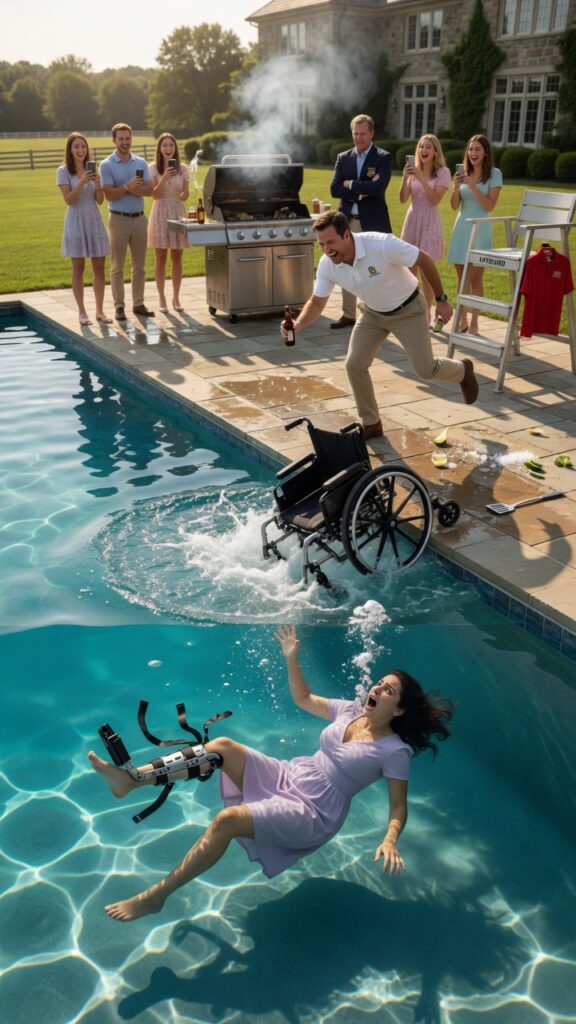
The sun over Sterling Oaks was a brilliant, deceptive gold, casting long shadows across a patio that smelled of expensive charcoal and the salt-tinge of a heated infinity pool. To anyone else, this was the social event of the season—the annual Sterling summer gala in the heart of Virginia’s horse country. To me, it was a gauntlet of whispers and the biting chill of a family that viewed my existence as a technical error in their grand blueprint of success.
I sat in my custom wheelchair at the edge of the flagstone, the weight of the carbon-fiber leg brace on my left leg feeling like a lead anchor. It wasn’t a prop. It wasn’t a choice. It was a $30,000 marvel of biomechanical engineering designed to stabilize a spine that had been shattered in a car “accident” exactly twelve months ago. I was the ghost in the machine, a Senior Structural Analyst who could no longer stand, living in a house built by a man who only valued what he could build with his bare hands.
“STOP PLAYING DEAD FOR SYMPATHY!”
My father, Arthur Sterling, didn’t even look at me as he bellowed. He stood by the massive industrial grill, a glass of twenty-year-old scotch in one hand and a silver spatula in the other. He was the king of Sterling Construction, a man who believed that physical weakness was a moral failing. To Arthur, an injury was just a “delay in the schedule,” and after a year, he had decided the project of my recovery was over-budget and behind time.
“Elena, take those damn metal contraptions off and help your brother with the coolers,” Arthur sneered, his voice carrying over the smooth jazz and the hollow laughter of our cousins. “You’ve been sitting in that chair like a queen for a year. The doctors said you needed ‘rehab,’ and in this family, rehab means moving, not mooching! You’re just trying to guilt-trip me into a larger share of the inheritance by acting like a Victorian invalid. It ruins the image of the Sterling brand.”
I gripped the armrests of my chair, my knuckles turning white. “Dad, the nerve damage is L4-L5 level. I literally cannot feel my left foot today. The weather change caused an inflammation—the physical therapist said—”
“The physical therapist is a thief taking my money to watch you sit on a yoga ball,” Arthur snapped, finally turning to face me. His eyes were hard, flinty, and devoid of the warmth a father should have for a child who had nearly died. “You’re a Sterling. We don’t break; we rebuild. And if you won’t rebuild, you’re just debris.”
My brother, Mark, walked by, intentionally bumping the wheel of my chair with his hip, nearly tipping me over. He was the heir apparent—brash, athletic, and possessed of a cruelty that Arthur mistook for “leadership qualities.” He looked at my brace with a disgust that bordered on the pathological.
“Sure, El,” Mark mocked, leaning down to grab a beer from a nearby bucket. “And I’m the Pope. You’re just lazy. You realized that if you stay in that chair, you don’t have to pull your weight at the firm. You get to sit in the AC while I’m out at the job sites. It’s the ultimate scam, and frankly, it’s insulting to those of us who actually work for a living.”
I looked away, my eyes finding the new “lifeguard” I had insisted on hiring for the party. He was a man in his late forties, dressed in a simple red polo and board shorts, sitting in the high chair with a zinc-covered nose. To my family, he was Silas, a temp-agency hire, a “nobody” paid to watch the kids splash. To me, he was Dr. Silas Sterling (no relation, though the irony was delicious)—the Chief of Orthopedic Surgery at the city’s top trauma center and the man who had performed the three-level fusion on my spine.
I had hired him undercover because I was terrified. I knew the “tough love” narrative in my house was reaching a boiling point. I understood systems; I saw the stress fractures forming in our family dynamic. I knew that in their eyes, my medical reality was just a barrier to their convenience, and they were the type of men who removed barriers with demolition tools.
Mark leaned down, his breath smelling of hops and malice. He whispered into my ear, “I’m tired of looking at that brace, El. It’s an eyesore. Today, we’re going to see if you can really swim, or if you’re as much of a liar as I think you are.”
Cliffhanger: Mark’s hand moved toward the lock on my wheelchair’s brakes, and for the first time, I saw the true, predatory intent reflecting in the blue water of the pool—a look that said he didn’t care if I ever came back up.
Chapter 2: The Deep End of Betrayal
The world tilted as the brakes clicked open with a sharp, metallic snap.
“Mark, don’t,” I gasped, my heart hammering against my ribs. “I can’t balance without the chair. The brace isn’t locked into a standing position.”
“Then learn to fly,” Mark grinned, his face a mask of sadistic glee.
It wasn’t a nudge. It wasn’t a playful shove. Mark stepped back and delivered a full-force, calculated kick to the carbon-fiber hinge of my leg brace. I heard the sickening crack of the expensive composite material—the very thing holding my spine in alignment—shattering under the weight of his heavy work boot.
Before I could scream, his hands were on the back of my chair, and with a violent heave, he sent me spiraling off the flagstones and directly into the ten-foot deep end of the infinity pool.
The water was a shock of ice that stole the air from my lungs. I sank instantly. My legs were dead weight, unresponsive and heavy, and the broken shards of the brace acted like a ballast, dragging me toward the blue-tiled floor of the pool. The pressure began to mount in my ears, and the sunlight above became a shimmering, unreachable ceiling of gold.
Above the surface, through the distortion of the water, I saw the silhouettes of my own blood.
My cousins were laughing. They were holding up their iPhones, capturing the “hilarious prank” for their social media feeds. My father, Arthur, stood ten feet away, his arms crossed over his chest, the grill smoke swirling around him like a dark shroud. He didn’t move. He didn’t reach for the life ring mounted on the wall. He didn’t even drop his scotch.
“Let her struggle a bit,” I heard Arthur’s muffled voice through the water, sounding like the judgment of a cold god. “Maybe the cold will finally wake up her ‘nerves’ and her work ethic. She needs to realize that nobody is going to carry her through life. It’s time for the Sterling ‘sink or swim’ test.”
Mark stood at the edge, laughing so hard he had to lean on his knees. “Look at her! She’s doing the ‘drowning’ act now! Give her an Oscar! She’s so committed to the bit she’s actually letting herself sink!”
I tried to kick, but my brain’s signals hit a brick wall at the base of my spine. I clawed at the water, my chest burning as my lungs pleaded for oxygen, the carbon dioxide building up until my vision sparkled with dark stars. I watched the bubbles of my last breath rise to the surface—silver pearls of my life escaping—and I realized with a terrifying clarity that my family wasn’t waiting for me to swim.
They were waiting for me to disappear.
They wanted the “problem” of the broken daughter solved. A “tragic accident” at a pool party was the perfect corporate solution to an inconvenient heir. It would be a clean write-off. My vision began to dim at the edges, the bright Virginia sun turning into a distant, fading spark of a world that no longer wanted me.
Cliffhanger: As my hand fell limp against the bottom of the pool and the darkness began to take me, a massive, silent wake broke the surface above, and a shadow dived with the speed and precision of a hunting shark.
Chapter 3: The Surgeon’s Intervention
I didn’t feel the impact when he hit the water, but I felt the hands.
They weren’t the panicked, fumbling hands of a teenager working a summer job. They were firm, clinical, and possessed of a terrifying, measured strength. Dr. Silas Sterling didn’t just grab me; he executed a perfect chin-lock, stabilizing my neck and spine even as he hauled my limp, water-logged body toward the surface. He moved through the water with an efficiency that suggested he had spent as much time in the ocean as he had in the operating room.
We broke the surface, and I choked, a mix of chlorine and bile burning my throat. Silas swam me to the concrete deck, but he didn’t just dump me there. He used the edge of the pool to hoist me up with a grace that kept my torso perfectly straight.
“Call 911! Now!” Silas roared. His voice wasn’t a request; it was a command that sliced through the music and the drunken laughter of the party like a guillotine.
“Hey, back off, kid!” Mark yelled, swaggering over with a fresh beer in his hand, his face flushed with the thrill of his “prank.” “She’s fine. She’s just holding her breath to make us look bad. You’re ruining the vibe of the party, ‘lifeguard.’ Put her back in her chair and go get me a towel.”
Silas didn’t even look at him. He laid me flat on the concrete, his fingers already dancing across the base of my skull and down my vertebrae in a high-speed neurological assessment. He was checking for a “step-off,” a sign of a fresh fracture.
“I said call an ambulance!” Silas repeated, his gaze snapping up to Mark.
For the first time, Mark saw the man behind the “lifeguard” disguise. Silas wasn’t a college kid. He was a man with a surgical scar on his brow and eyes that held the cold, lethal intelligence of someone who dealt with the finality of life and death every single morning.
“Listen, ‘lifeguard’,” Arthur stepped forward, his face flushed with scotch and indignation. “You’re on my property, which means you follow my rules. This is a family matter. My daughter is a malingerer, and you’re encouraging her. Get out of the way before I fire the agency that sent you and make sure you never work in this town again.”
“You can’t fire me, Arthur,” Silas said, his voice dropping into a register of quiet, vibrating fury that made the guests step back. He reached into the waterproof pouch at his waist and pulled out a heavy, laminated medical ID. “Because I don’t work for an agency. And I’m not a lifeguard.”
Cliffhanger: Silas placed his hand on the small of my back, his face turning a lethal shade of white as he felt a sickening, jagged misalignment in the bone that hadn’t been there when he cleared me for the party that morning.
Chapter 4: The Diagnosis of a Crime
“I am Dr. Silas Sterling,” he said, and the silence that followed was so heavy it felt as if the very air had been sucked out of the estate.
Arthur froze, the spatula slipping from his hand and clattering onto the flagstones. Even he knew the name. Silas Sterling was a titan of medicine, the man he had begged—and paid half a million dollars—to fly in from Switzerland a year ago to put his daughter back together after the crash.
“I am the Chief of Orthopedic Surgery at Vance Memorial Trauma,” Silas continued, standing up and looming over Mark. Mark, who was usually a head taller than everyone, suddenly looked very, very small, his “Golden Son” aura evaporating in the sun. “I am the man who spent twelve hours in the OR sewing your daughter’s spinal cord back together after the ‘accident’ you all seem to have conveniently forgotten. And I just felt her L4 and L5 vertebrae shift.”
“Now, look, Doctor—” Arthur began, his voice shaking, his “CEO” bravado crumbling.
“Shut up, Arthur,” Silas growled, his voice like grinding stones. “Mark, that kick didn’t ‘expose a liar.’ That kick shattered a $30,000 carbon-fiber brace and caused a fresh spinal fracture in an already compromised column. In medical terms, it’s a catastrophic relapse. In legal terms?”
Silas reached up to the “lifeguard” sunglasses tucked into his shirt and pulled out a tiny, high-definition body-cam hidden in the frame—a device I had provided to him.
“In legal terms, it’s Aggravated Assault with a Deadly Weapon and Attempted Murder of a Protected Person,” Silas said, his words falling like lead weights. “I didn’t come here to watch your pool, Arthur. I came here because Elena called my office three days ago, crying, telling me she was afraid you would kill her if she didn’t ‘recover’ fast enough for your corporate timeline. I’ve been recording every word of your ‘scam’ accusations and your refusal to help her while she was drowning. I have recorded the intent, the act, and the negligence.”
Mark’s face turned the color of curdled milk. “It… it was a joke! We were just having fun! She’s my sister!”
“A joke involves a punchline, Mark,” Silas said, stepping into his personal space, “not a wheelchair and a spinal fusion. I’ve already uploaded the footage to a secure federal server in real-time. The ‘joke’ is that you just filmed your own confession for three hundred witnesses.”
Arthur tried to step in, his “fixer” instincts kicking in. “Doctor, let’s be reasonable. We can settle this. I’ll double your research grant. Triple it. We can handle this internally. It’s a family matter, and family looks out for its own.”
Dr. Sterling pulled out his phone and tapped the screen, the blue light reflecting in his eyes like a vengeful spirit.
“It was a family matter,” Silas said. “Until you let her sink. Now, it’s a Federal Bureau of Investigation matter. Look at the gate, Arthur. The schedule has changed.”
Cliffhanger: At the end of the long, winding driveway of Sterling Oaks, the silent gold gates were being shoved open by three black SUVs, their sirens finally wailing as they tore across the manicured lawn toward the patio.
Chapter 5: The Weight of Justice
The paramedics swarmed the patio, their movements a sharp, professional contrast to the frozen, panicked statues of my relatives. They loaded me onto a backboard with a level of care I hadn’t felt in my own home for a year. I was no longer “debris”; I was a patient, a victim, and a person.
Mark didn’t even get to put his beer down. Two federal agents tackled him to the flagstones right next to the pool, his face pressed into the very water he had thrown me into. The handcuffs clicked with a finality that echoed off the stone walls of the mansion.
“Arthur Sterling? You’re being detained as an accessory to aggravated assault and for the suspected tampering of a witness,” an agent said, shoving my father against the side of his expensive industrial grill. The scotch glass shattered on the ground—a perfect metaphor for his legacy.
Arthur looked at me, his eyes wide and pleading, the mask of the great “Contractor” finally gone. “Elena! Tell them! Tell them it was a misunderstanding! I’m your father! I built this for you!”
I looked at him from the backboard, my head stabilized by the foam blocks. I felt the cold water still dripping from my hair, and for the first time in a year, I felt a sensation in my left foot. It wasn’t pain. It was a sharp, electric spark of life—the nerves finally screaming out as the physical pressure of the broken brace was removed.
“You aren’t a father, Arthur,” I said, my voice raspy but as clear as a bell. “You’re a contractor. You only care about the facade. And you just lost the lease on my life. I am terminating our agreement.”
Dr. Silas Sterling leaned into the ambulance as they prepared to slide me in. He took my hand, his grip steady and warm, the only thing that felt real in the world of Sterling Oaks.
“The brace was destroyed, Elena,” he whispered, “but while I was in the pool, I found the GoPro Mark dropped during the struggle. It has footage from this morning… footage of him admitting to Arthur that he was the one who loosened the lug nuts on your car last year to ‘scare’ you into giving up your seat on the board. They didn’t just try to kill you today. They’ve been trying to demolish you since the start to clear the way for their own ambitions.”
The air in the ambulance felt cleaner than the air at Sterling Oaks. I realized then that my “paralysis” hadn’t just been in my spine; it had been in my surroundings. I had been paralyzed by the need for their approval, by the hope that if I just tried hard enough, they would love the version of me that was “fixed.”
Cliffhanger: As the ambulance doors closed, I looked at Arthur being shoved into a patrol car, his “Sterling” reputation incinerated. I looked down at my toes. They moved. Just a fraction of an inch, but it was a movement of my own making.
Chapter 6: The New Sterling Legacy
One Year Later
The boardroom of Evergreen Infrastructure (formerly Sterling Construction) was silent as I walked in. I didn’t use a wheelchair. I didn’t even use a brace. I walked with a slight, measured limp and a polished mahogany cane—a symbol of my own resilience rather than my family’s engineering.
I sat at the head of the table, in the seat where Arthur used to preside over his empire of fear.
Mark was serving fifteen years for attempted murder and the sabotage of my vehicle. Arthur was bankrupt, his assets seized in the massive civil suit I had won, his reputation incinerated by the viral body-cam footage that had been shared globally as a warning against “tough love” abuse. He was currently living in a state-run facility, experiencing the very kind of “dependency” he had mocked me for.
I reached into my bag and pulled out a small, acrylic block. Inside it was a shattered shard of the carbon-fiber brace from that day at the pool. I set it on the mahogany table like a cornerstone.
“My father and brother thought they were kicking a liar that day,” I said to the new board of directors, my voice echoing with a confidence they couldn’t buy. “But they were actually kicking the foundation of their own prison cell. They told me I was ‘playing dead’ for sympathy. I think they’ve found that playing prisoner for the next two decades isn’t nearly as much fun as they anticipated.”
The board members nodded, their respect earned by my logic and my survival, not my last name. I had restructured the company to focus on accessible housing and medical infrastructure—building things that actually mattered.
I walked out of the building and found Dr. Silas Sterling waiting by his car. He looked at me, then at the cane, and then at the woman who had rebuilt herself.
“How are the nerves today, Elena?” he asked, his eyes warm.
I looked at the horizon, the weight of the Sterling name finally feeling like a badge of honor instead of a burden of shame. I smiled, and for the first time, the smile reached my eyes.
“The nerves are fine, Silas,” I said, stepping toward the car. “I’m heading to the coast this weekend. I hear the water is deep.”
“Planning on swimming?” he chuckled.
“No,” I said, looking back at the glass tower I now owned. “This time, I’m planning on making waves that will change the tide for everyone.”
If you want more stories like this, or if you’d like to share your thoughts about what you would have done in my situation, I’d love to hear from you. Your perspective helps these stories reach more people, so don’t be shy about commenting or sharing.