The first thing I noticed when I walked through the automatic doors of St. Charles Medical Center was the smell.
Not the bright lobby.
Not the volunteers in blue vests.Not the polished floors shining under too much fluorescent light.
It was the sharp hospital scent of antiseptic, plastic gloves, cafeteria coffee, and cold air being pushed through vents that never seemed to sleep.
My boots squeaked across the linoleum as I crossed toward the elevators.
That sound followed me like a warning.
My name is Andrew Mercer, and I had spent six years as an Army medic before I came home to Bend and took a job supervising construction crews.
Hospitals were not unfamiliar to me.
I knew the smell of bandages.
I knew the clipped rhythm of nurses’ shoes.
I knew the quiet panic people tried to hide behind vending machines, phone chargers, and paper cups of coffee they forgot to drink.
But this time was different.
This time it was Marin.
My niece was eight years old, small for her age, all brown hair, sharp questions, and serious eyes that made her look like she was always listening to something adults could not hear.
She used to run at me whenever I came through the door.
She asked about my truck, my tools, and whether the big yellow excavator at my jobsite was really as loud as it looked.
Sometimes she climbed into the passenger seat of my pickup while it sat in my mother’s driveway and pretended she was helping me read blueprints.
I kept peppermint gum in the glove box because she liked the snap of the wrapper and the way it made her eyes water.
That was the Marin I knew.
The Marin my mother called me about at 9:12 that morning sounded like someone else’s child.
“She’s okay,” Mom said before I even asked.
Her voice was too careful.
Too smooth.
Like she had already practiced it.
“Tessa is with her. It was just an accident.”
“What kind of accident?” I asked.
There was a pause.
Not long.
Long enough.
“She fell at home,” Mom said. “Down the stairs, I think. Tessa said not to make a big thing of it.”
Just an accident.
People love that word when they want a door closed before anyone looks inside.
I told my foreman I had a family emergency, grabbed my keys, and drove straight to the hospital.
The whole way there, I kept seeing Marin’s face in my mind.
Not crying.
Not hurt.
Just looking up at me from my passenger seat with that serious little frown, asking why adults said things they did not mean.
I did not have a good answer then.
By that afternoon, I was afraid I was about to get one.
The elevator ride to the third floor felt longer than it should have.
I stood alone under the buzzing light, thumb pressed against the metal railing hard enough to feel the ridges dig into my skin.
At the second floor, a little boy got on with his grandmother.
He had a balloon tied to his wrist, and it bobbed against the ceiling like it had no idea where it was.
When the doors opened to pediatrics, the hallway tried too hard to be cheerful.
Cartoon animals marched across the walls.
A giraffe stretched its neck toward the ceiling tiles.
A lion smiled with too many teeth.
Soft blue clouds floated above doors where real children were learning things no child should have to learn.
Somewhere nearby, a machine beeped steadily.
Someone laughed too loudly from behind a curtain.
Room 314 was halfway down the hall.
I stopped outside the door before I went in.
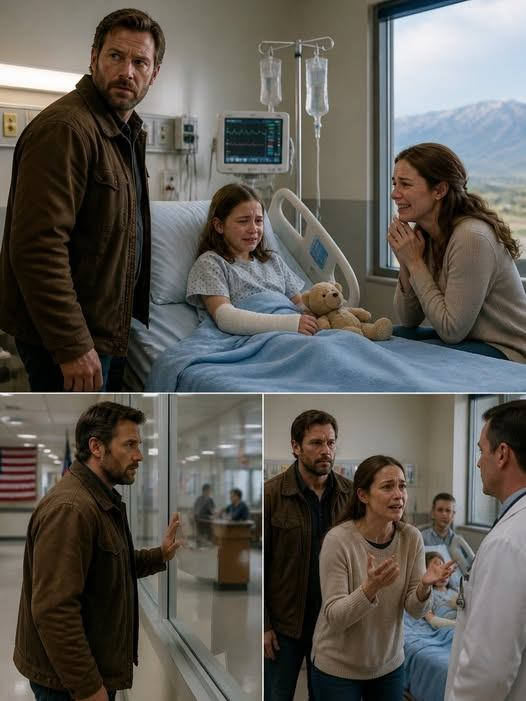
Through the small rectangular window, I saw my sister Tessa sitting beside the bed.
Her blonde hair was pulled into a ponytail.
One leg was crossed over the other.
Her thumb moved over her phone screen.
She looked polished in the way she always did when other people might be watching.
Mascara neat.
Sweater expensive.
Face arranged into concern without quite reaching her eyes.
Marin lay in the bed beside her.
Her left arm was wrapped in a cast, white against the pale blue gown.
The blanket was pulled too high, but not high enough to hide the dark marks along her side where the fabric shifted.
Her brown hair spread across the pillow.
She was awake, staring at the ceiling like she had found something there safer than looking at the room.
I pushed the door open.
Tessa looked up immediately, and her face brightened into a smile that arrived too fast.
“Andrew,” she said. “You came.”
“Mom called.”
I moved past her to the bed and looked down at Marin.
She did not turn her head at first.
Only her eyes moved toward me.
Then away again.
That was the first real thing that scared me.
Marin usually shouted my name before I got fully through a doorway.
This child looked like making noise might cost her something.
“Hey, kiddo,” I said softly.
Her fingers picked at the edge of her cast.
She did not smile.
Tessa stood and smoothed the front of her sweater.
“She fell down the stairs,” she said quickly, like she had been waiting to say it. “I told her a hundred times not to run in the house wearing socks, but you know how kids are.”
I looked at my sister.
Tessa was thirty-six, two years older than me.
When we were kids, she had been the wild one.
The one who could talk herself out of trouble with a grin.
The one who could leave me holding the blame because I was quieter.
After her husband Zachary died three years earlier, something in her changed.
The old brightness stayed, but it turned brittle around the edges.
Shiny enough to fool people from far away.
Sharp if you got too close.
“That must have been scary,” I said, turning back to Marin. “Falling down the stairs.”
Marin’s small hand stilled on the cast.
She did not answer.
“The doctor said she’ll be fine,” Tessa continued, her voice light and quick. “Six weeks, maybe eight. They’re just watching her for a bit and finishing paperwork. We should be home soon.”
Home.
The word sat wrong in the room.
At 4:27 p.m., I signed the visitor log at the pediatrics desk.
At 4:31, I noticed the hospital intake form clipped outside Marin’s room said fall at home, adult witness: mother.
At 4:34, I saw Marin turn her face toward the wall every time Tessa spoke.
One detail can be fear.
Two can be coincidence.
Three is a pattern asking you not to look away.
I pulled the visitor chair closer and sat beside the bed.
“Can I talk to her alone for a minute?”
Tessa’s smile froze.
“What?”
“Just want to check in,” I said. “Uncle-to-niece stuff.”
“I’m her mother,” Tessa replied, and her voice sharpened beneath the sweetness. “I should be here.”
“Five minutes.”
It was not a question.
Her jaw tightened.
For a second, I saw the Tessa from childhood, the one who hated being told no because she always believed she could push long enough to make the world bend.
Then she grabbed her purse off the chair and stood too quickly.
“Fine,” she said. “I need coffee anyway. But don’t upset her. She’s been through enough.”
The door clicked shut behind her.
I waited.
Ten seconds.
Fifteen.
Twenty.
Old habits do not leave just because the uniform does.
I listened for her footsteps fading down the hallway.
I listened for the pause that meant she might still be outside the door.
I listened for the shift in sound that told me the space was ours for now.
Then I leaned forward, resting my elbows on my knees.
“You okay?” I asked quietly.
Marin kept looking at the ceiling.
A tear slipped sideways from the corner of her eye and disappeared into her hair.
“You don’t have to talk if you don’t want to,” I said. “But I’m here, and I’m listening.”
Her chin trembled.
She pulled her good arm across her chest, as if she could hold herself together by force.
“It hurts,” she whispered.
“I know,” I said, keeping my voice even though something cold had already started settling under my ribs. “Bones can hurt a lot.”
“Not that.”
The words were barely there.
I felt the room change.
It was not dramatic.
No lights flickered.
No machine screamed.
But I knew the feeling, the way air could turn heavy when a person finally placed one piece of truth on the table and everybody understood more was underneath it.
“What do you mean, kiddo?”
Her lower lip shook.
She pressed it flat, trying too hard to be brave.
“Everything hurts.”
I reached out slowly and touched the hand without the cast, giving her time to pull away.
She did not.
Her fingers were cold, so cold they felt like she had been holding snow.
“How did you fall?” I asked.
She swallowed.
I waited.
The cartoon lion on the wall kept smiling beside us, ridiculous and bright, while my niece stared at the ceiling and breathed like each breath had to be negotiated.
“I didn’t.”
Two words.
Small enough to disappear if the wrong adult wanted them to.
Heavy enough to split my life into before and after.
My jaw tightened so hard I felt it in my temples, but I did not let my face change too much.
Children notice everything.
Frightened children notice even more.
I had learned that in places far from Oregon, kneeling beside people who needed calm more than outrage.
“Okay,” I said gently. “Thank you for telling me.”
Her eyes moved to mine then, red and swollen, too old for eight.
“You have to go when visiting hours end, right?”
The question came too quickly, like it had been waiting behind her teeth.
I looked toward the door.
“That’s usually the rule.”
“What time is it?”
I checked my watch.
“Four-thirty.”
“Visiting hours end at eight.” Her voice dropped even lower. “That’s what Mom said.”
The way she said Mom made my skin go cold.
“She said you’d have to leave at eight,” Marin whispered. “She said she’d stay with me tonight.”
I stood before I meant to, and the chair scraped against the floor.
Marin flinched.
I immediately lowered myself back down, slower this time, bringing my face level with hers.
“I’m not mad at you,” I said. “I promise.”
Her fingers twisted in the blanket.
“Has she scared you before?” I asked, choosing every word carefully.
Marin’s eyes filled again.
“I can’t.”
“You can tell me anything.”
“I can’t,” she repeated, and her voice cracked. “She said if I tell, it’ll be worse.”
The words hit harder than I expected.
Not because I had not suspected something.
Because suspicion still gives you a tiny place to hide.
A child’s whisper does not.
I looked at the cast, the blanket, the sterile room with its cartoon walls and tiny chairs.
I saw Tessa sitting there scrolling through her phone while her daughter stared at the ceiling.
For one ugly heartbeat, I wanted to walk out and find my sister by the coffee machine.
I wanted to make her explain every bruise.
I wanted to watch that polished mask crack.
Then Marin’s fingers tightened around mine, and I stayed where I was.
Rage feels useful until a child needs you calm.
“Marin,” I said, and my voice came out rougher than I wanted.
I softened it immediately.
“Listen to me. You are not in trouble.”
She turned her head just enough to look at the door.
“Please don’t leave me alone tonight.”
Her good hand shot out and grabbed my wrist with surprising strength.
Her fingers dug into my skin, not enough to hurt, but enough to tell me she was holding on to the only solid thing she could find.
“Please,” she said again, tears spilling now. “You’ll understand at night.”
For a moment, I could not speak.
There are promises adults make because they sound comforting, and there are promises that become a line in the ground.
I had made too many easy promises in my life.
I knew better than to make one unless I meant to stand in front of it.
I covered her small hand with mine.
“I won’t let anything happen to you,” I said. “I promise.”
Tessa returned six minutes later with a paper coffee cup she had not drunk from.
Her eyes moved from my face to Marin’s hand on my wrist.
Then to the blanket.
Then back to me.
“Everything okay?” she asked.
“She’s tired,” I said.
It was the closest thing to the truth I could say without giving away what Marin had trusted me with.
Tessa smiled, but it did not land anywhere real.
At 5:18, I stepped into the hallway and asked the nurse at the station whether overnight visitors were allowed for pediatric patients.
She glanced at the computer, then at me.
“Usually one parent or guardian,” she said.
“What if the child asks for someone else?”
That made her pause.
Her badge said Carrie.
She was maybe in her forties, with tired eyes and a coffee stain on one sleeve of her navy scrubs.
“Depends on the situation,” she said carefully.
“What if the situation is that the child is afraid?”
Carrie looked past me toward Room 314.
A lot can happen in a hospital hallway without anyone saying the real words.
Her fingers moved over the keyboard.
“I’ll make a note,” she said.
“Please do.”
At 7:42 p.m., Carrie came into Marin’s room for vitals.
She checked the wristband.
She checked the cast.
She asked Marin if she needed anything.
Marin looked at Tessa first.
Then she looked at me.
“Can Uncle Andrew stay?” she whispered.
The room went so quiet I could hear the monitor breathe.
Tessa laughed once.
It was too small and too sharp.
“Sweetheart, Uncle Andrew has work tomorrow. Don’t be dramatic.”
Carrie’s pen stopped moving.
I said nothing.
Marin stared at the blanket.
Carrie wrote something on the overnight observation chart and left with her face carefully blank.
At 7:58, the hallway lights dimmed for overnight quiet.
At 8:06, Tessa came back from another coffee run with the same untouched cup.
At 8:11, Carrie stepped into the room again and told me visiting hours were technically over.
Technically.
I heard the word she did not say after it.
“Understood,” I said.
I bent down near Marin.
Her eyes had gone glassy with panic.
“I’ll be close,” I whispered so softly only she could hear.
Then I stepped out like I was leaving.
I did not go to the elevator.
I stopped beside the vending machines, where the camera dome reflected the whole pediatric hallway in a tiny curved mirror.
I waited until the nurse disappeared behind the station.
I waited until the beeping in Room 314 was the only steady sound.
I waited until Tessa’s voice dropped so low I could not make out the words.
Then I moved back down the hallway, quiet as I knew how, and looked through the narrow window in my niece’s door.
Tessa was standing over Marin’s bed.
The blanket was pulled tight in her hand.
Marin’s good hand was moving slowly toward the call button near the pillow.
Tessa saw it.
She picked up the cord and tucked it behind the bed rail.
The air went out of me.
Marin looked toward the window.
When she saw me, her eyes widened like she had been praying for that exact second.
My hand was already on the door handle when Carrie appeared at the end of the hallway carrying a thin blue folder.
She slowed when she saw me.
Then she looked through the same window.
Her expression changed.
Not surprise.
Recognition.
She opened the folder just enough for me to see the top page.
Pediatric safety note.
7:42 p.m.
Child requested uncle.
Carrie’s mouth trembled.
“Mr. Mercer,” she said quietly, “I tried to page the attending twice. Your sister told the desk you had already left.”
Inside the room, Tessa finally turned.
For the first time all day, the smooth concern drained off her face.
Marin’s hand was still reaching for a call button she could not reach.
Carrie took one step toward the door.
She placed her badge against the scanner.
“Before I open this,” she said, “I need you to tell me exactly what that child told you.”
I looked through the glass at my niece.
Her lips moved once.
Help.
That was enough.
“She told me she didn’t fall,” I said.
Carrie closed her eyes for half a second.
When she opened them, the nurse was gone from her face.
What replaced it was a woman who had seen too many children try to tell the truth without being given permission.
She opened the door.
Tessa stepped back immediately.
“What is this?” my sister snapped.
Her voice was still quiet, but the polish was gone.
“Ma’am,” Carrie said, “I need you to step away from the bed.”
“I’m her mother.”
“Step away from the bed.”
The second time, Carrie’s voice carried down the hall.
Another nurse looked up from the station.
Tessa’s eyes flicked toward me.
There it was.
Not fear for Marin.
Fear of being seen.
I moved into the room and went straight to the side of the bed.
Marin grabbed my sleeve with her good hand.
Her fingers were shaking so hard the fabric trembled.
“I’m here,” I said.
Carrie untucked the call-button cord from behind the bed rail and placed it back near Marin’s pillow.
Then she checked the chart at the foot of the bed.
“I’m calling the charge nurse,” she said. “And the attending.”
Tessa let out a dry little laugh.
“This is ridiculous. My daughter is injured and you’re letting my brother upset her.”
“Your daughter asked for him to stay,” Carrie said.
“She’s eight. She doesn’t know what she wants.”
Marin made a sound then.
Not a sob.
Not a word.
A small, broken breath.
I felt it through my sleeve where she held me.
The second nurse came in, followed by a woman in dark scrubs who introduced herself as the charge nurse.
Nobody raised their voice.
That somehow made it more serious.
The charge nurse asked Tessa to wait in the hallway.
Tessa refused.
Carrie documented the refusal on the chart.
I saw the pen move.
Time.
Behavior.
Exact words.
There are moments when paperwork is not cold.
Sometimes paperwork is the first wall between a child and the person who has been scaring her.
The attending physician arrived at 8:37.
He was gray-haired, calm, and tired in the way doctors get when their work has taught them not to be easily shocked.
He asked Marin if she wanted her mother in the room while they talked.
Marin shook her head.
Tessa said, “She doesn’t mean that.”
The doctor looked at her.
“Then we will make sure she can answer without pressure.”
That was the sentence that broke something in my sister.
Her face tightened.
The expensive sweater, the neat mascara, the careful voice — none of it helped her now.
The charge nurse led her into the hallway.
Tessa went, but she looked back at Marin in a way that made my niece press closer to my side.
The doctor pulled the curtain halfway for privacy.
He crouched so he was not towering over the bed.
He asked simple questions.
Not leading ones.
Not dramatic ones.
“Can you tell me what happened before your arm hurt?”
Marin looked at me.
I nodded once.
“You won’t get in trouble,” I said.
She swallowed.
Then she told him.
Not all at once.
Children do not lay out fear like a report.
They hand it over in pieces.
A sentence about the stairs.
A sentence about being grabbed.
A sentence about being told what to say.
A sentence about nights when Tessa came into her room angry after everyone else was asleep.
Carrie’s pen moved steadily.
The doctor listened without flinching.
I held Marin’s hand and kept my face calm because she deserved one adult in the room who did not make his feelings her burden.
By 9:06, hospital security stood outside the door.
By 9:14, the charge nurse told me a mandatory report had been made.
By 9:28, Tessa was no longer allowed back into Room 314 without staff present.
She did not scream.
That would have been easier to hate.
She cried just enough to draw pity from anyone who did not know where to look.
“Andrew,” she said from the hallway, “you don’t understand. I’m her mother. I lost my husband. I’ve been doing everything alone.”
There it was again.
The explanation before the apology.
The grief held up like a badge.
I stepped into the doorway but did not leave the room.
Marin could still see me.
“Then you should have asked for help,” I said.
Tessa stared at me.
“You think you’re better than me?”
“No,” I said. “I think she’s eight.”
That was all.
No speech.
No performance.
Just the one fact everyone had talked around all day.
She’s eight.
My mother arrived at 10:03 in the same cardigan she wore to church, hair uncombed, face pale with confusion.
Tessa tried to reach her first.
“Mom, tell them,” she said. “Tell them Andrew is overreacting.”
My mother looked from Tessa to the security guard to Marin behind the glass.
Then she saw the call button sitting on the pillow where Carrie had placed it back within reach.
Something in her face collapsed.
“Tessa,” Mom whispered. “What did you do?”
My sister looked offended before she looked ashamed.
That told me more than any confession could have.
The night did not end quickly.
Nights like that do not.
There were forms.
Questions.
Phone calls.
A police report.
A hospital social worker who arrived with a soft voice and a folder thick enough to make my stomach twist.
There was a safety plan written in careful language.
There was a note that Marin was not to be discharged to Tessa.
There was my signature, then my mother’s, then a second call to confirm where Marin could safely go after the hospital released her.
At 1:16 a.m., Marin finally fell asleep.
Her hand was still curled around my sleeve.
I sat in the chair beside her bed and did not move.
The monitor beeped.
The hallway lights hummed.
Somewhere near the nurse station, someone replaced an empty coffee pot with a full one.
By morning, Tessa was gone from the hall.
Not free of consequences.
Just gone from that doorway.
Carrie came in at 6:22 with a new wristband, a new chart note, and a paper cup of water for me.
She set it on the rolling table.
“You did the right thing,” she said.
I looked at Marin sleeping in the bed.
Her face was softer in sleep, but not peaceful yet.
Peace would take longer.
“She did the hard part,” I said.
Carrie nodded.
“They usually do.”
When Marin woke up, she looked around the room before she looked at me.
I understood what she was checking for.
“She’s not here,” I said.
Her eyes filled, but this time the tears came differently.
Less like fear.
More like her body had been holding its breath for too long and finally remembered air existed.
“Am I in trouble?” she whispered.
I leaned forward.
“No.”
“Is Mom?”
That question landed harder than I expected.
Because she was still her mother.
Because children can be hurt by someone and still love them.
Because safety is not the same as satisfaction.
I chose every word.
“The adults are going to make sure you are safe,” I said. “And your mom is going to have to answer for what happened.”
Marin looked at the ceiling again.
For a second, she was the same little girl I had seen when I first walked in.
Then her eyes moved to the call button beside her pillow.
She touched it with one finger.
“Can I use it if I’m scared?”
“Every time,” I said.
She nodded.
Later that morning, when the doctor came in, Marin answered him with her own voice.
Small.
Shaky.
But hers.
My mother sat in the corner with both hands around her coffee cup, crying silently into the steam.
She had believed Tessa’s version because believing the truth would have meant admitting she had missed something under her own family’s roof.
I did not blame her in that moment.
There would be time for anger later.
There would be time for questions.
There would be time to go back through every family dinner, every canceled visit, every time Marin got quiet when Tessa walked into a room.
But that morning, Marin needed breakfast.
So I cut up her pancakes with the plastic fork the cafeteria sent up.
I opened the peppermint gum wrapper from my jacket pocket and placed one piece on the bedside table for later.
I helped her hold the cup with her good hand.
Care is not always dramatic.
Sometimes care is making sure the call button is within reach.
Sometimes it is sitting in an ugly vinyl chair all night so an eight-year-old can sleep.
Sometimes it is believing a child before the whole story makes sense.
Two days later, Marin left the hospital with my mother and me.
The cast was still heavy.
The bruises were still there.
The paperwork had only begun.
But when we rolled her wheelchair through the lobby, she looked up at the little American flag near the reception desk, then at the automatic doors opening to the morning light.
“Can we stop by your truck?” she asked.
“Yeah,” I said. “We can stop by my truck.”
“Do you still have the gum?”
I smiled for the first time in days.
“Always.”
In the parking lot, the air smelled like rain on hot pavement and cafeteria coffee drifting out behind us.
My boots squeaked faintly on the covered sidewalk.
The same sound as before.
But it did not feel like a warning this time.
It felt like a promise being kept.
Marin sat in the front seat of my pickup while my mother loaded the discharge bag into the back.
Her cast rested in her lap.
Her small fingers unwrapped the peppermint gum slowly.
Then she looked at me with those serious eyes.
“You came back,” she said.
I swallowed around the ache in my throat.
“I told you I would.”
She nodded like that was the most important paperwork of all.
And maybe it was.
Because the night before, when she begged me not to leave her alone, she was not asking for a hero.
She was asking for one adult to stay close enough to see what happened after everyone else stopped looking.
This time, someone did.
This time, the door did not close before anyone looked inside.