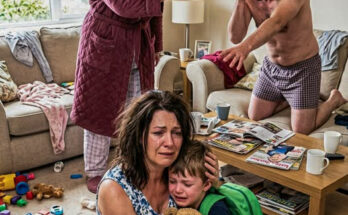
My mother-in-law slapped my 6-year-old daughter because she wouldn’t give her dress to my sister-in-law’s kid. When I confronted them, my SIL spat in my face, saying, “You should teach your daughter some manners.” My husband just stood there nodding: “You know they’re right.” I didn’t scream. I didn’t hit back. I just grabbed my daughter and left the venue immediately. That night, I packed our bags and left, what I did next left all of them speechless.
The Pink Dress That Ended Everything
### Part 1
The slap sounded louder than the band.
That is the part I remember most clearly, even now. Not the champagne glasses clinking under the chandeliers. Not the DJ calling Mark and Lisa back to the dance floor. Not the smell of buttercream frosting and white roses drifting through the reception hall.
Just that sharp crack of Beth Johnson’s hand against my six-year-old daughter’s face.
Rose had been holding the skirt of her dress with both hands, the way little girls do when they feel beautiful and are trying not to show it too much. It was pale pink with tiny embroidered flowers scattered along the hem. We had found it at a boutique outlet three weeks earlier, tucked between stiff Easter dresses and clearance racks. Rose touched it like it was made of moonlight.
“Mommy,” she had whispered, “can I wear this to Uncle Mark’s wedding?”
I had checked the price tag twice and bought it anyway.
That day, in the reception hall, she looked like a little blossom under the warm gold lights. Her hair was curled at the ends. Her shoes had tiny pearl buckles. She had been careful all afternoon not to spill juice on herself.
Then Sophia saw the dress.
Sophia was Carol’s daughter, five years old, with Shirley Temple curls, a permanent pout, and the kind of confidence only a spoiled child can have. She pointed at Rose from across the kids’ table and said, “I want that one.”
At first, I thought she meant a cupcake.
Then Carol looked at Rose’s dress and smiled that thin, nasty smile I had learned to dread.
“Amber,” she said, dragging my name out like gum stuck to her shoe, “let the girls switch dresses. Sophia loves that one.”
I laughed softly because I honestly thought she was joking.
Rose stepped closer to me.
“Oh,” I said, keeping my voice gentle, “Rose picked this out special for today. Maybe Sophia can borrow a bow or something?”
Carol’s smile dropped.
Beth appeared beside her like she had been summoned by conflict. David’s mother always moved quietly until she wanted everyone to notice her. She wore navy silk, diamonds at her throat, and the expression of a woman who believed every room should rearrange itself around her.
“What’s going on?” Beth asked.
“Sophia wants Rose’s dress,” Carol said. “Amber is being difficult.”
I felt heat crawl up my neck. Across the room, David was laughing with his cousins near the bar, his back turned to us.
Beth looked at my daughter, not with affection, not even with patience. She looked at Rose like Rose was a napkin someone had placed on the wrong table.
“Rose,” Beth said, “take off the dress and give it to Sophia.”
Rose’s little fingers tightened in the fabric.
“No,” she whispered. “It’s mine.”
Beth’s face hardened.
I stepped forward. “Beth, absolutely not.”
The slap came before I finished the sentence.
Rose’s head turned with the force of it. For one impossible second, she didn’t make a sound. Her blue eyes went wide, her mouth opened, and then the cry came out of her like something had torn loose inside.
I moved toward my child, but Carol blocked me.
“You should teach your daughter some manners,” she hissed.
Then she spat in my face.
Warm saliva hit my cheek and slid toward my jaw.
I froze. Not because I was weak. Not because I didn’t know what to do. I froze because some part of my mind understood, with terrifying clarity, that whatever I did in the next thirty seconds would decide the rest of my life.
I looked past Carol.
David had finally turned around.
He had seen Rose crying. He had seen his mother standing there with her hand still raised. He had seen Carol in my face.
And my husband nodded.
“You know they’re right, Amber,” he said. “Rose needs to learn to share.”
Something inside me went very quiet.
I wiped my cheek with the back of my hand. Then I walked around Carol, knelt in front of Rose, and touched her burning cheek as gently as I could.
“We’re leaving,” I said.
Behind me, Beth scoffed. “Don’t be dramatic. It was a little slap.”
David called my name once, sharp and embarrassed, like I was the one ruining the wedding.
I didn’t answer.
I carried Rose’s little purse, held her hand, and walked out past the cake table, past the guest book, past the huge framed photo of Mark and Lisa smiling like nothing ugly could happen on a day covered in white flowers.
Outside, the evening air smelled like cut grass and rain on pavement. Rose was shaking so badly I had to buckle her into her car seat twice.
“Mommy,” she whispered, touching her cheek, “was I bad?”
My hands stopped on the seat belt.
That question did what the slap had not. It nearly broke me.
“No, baby,” I said, my voice steady only because it had to be. “You were not bad.”
As I closed her door, my phone buzzed.
A text from David lit up the screen.
Don’t make this bigger than it is.
I stared at those seven words under the dim parking lot light, and for the first time in eight years, I wondered exactly how long my husband had been waiting for me to disappear.
### Part 2
I drove home without turning on the radio.
Rose fell asleep ten minutes into the ride, her cheek pressed carefully against the soft edge of her booster seat. Every few miles, headlights swept across her face and showed the red mark blooming beneath her eye. I kept both hands on the wheel, tight enough that my knuckles ached.
Our house sat at the end of a quiet cul-de-sac with trimmed hedges, a brick mailbox, and porch lights David had insisted we keep on timers because “appearances matter.” That was one of his favorite phrases. Appearances matter. He used it when I asked why his mother had a key to our house. He used it when I didn’t want to attend Carol’s birthday dinner after she called me “temporary family.” He used it whenever I asked him to choose us.
I parked in the garage and sat there for a moment, listening to the engine tick as it cooled.
Then I looked at my sleeping daughter and said out loud, “No more.”
I carried Rose inside and laid her on her bed. She stirred when I took off her shoes.
“Are we home?” she mumbled.
“For now,” I whispered.
Her room smelled like strawberry shampoo and crayons. Stuffed animals lined the wall beside her pillow. On her desk sat the picture she had drawn that morning of herself in the pink dress, standing between me and David. She had colored David’s tie blue because she said blue was a happy color.
I turned the drawing face down.
Then I went to my closet and pulled out the black suitcase from the top shelf.
I packed fast, but not carelessly. Clothes first. Rose’s school records. Birth certificate. Passports. Her favorite stuffed rabbit. My laptop. The folder of documents I had kept hidden in a storage bin labeled Christmas lights.
That folder had started as a habit. I worked as a paralegal at Morrison and Associates, a family law firm downtown, and documentation was practically my religion. For three years, I had saved screenshots, voicemails, receipts, and notes after every ugly incident with David’s family.
Beth criticizing Rose’s weight when she was four.
Carol “joking” that Rose was too sensitive to survive in the Johnson family.
David telling me I embarrassed him whenever I objected.
At the time, I told myself I was just keeping proof for my own sanity. I never thought I would use any of it.
My phone buzzed nonstop on the dresser.
Beth: You owe everyone an apology.
Carol: Your kid is spoiled because you let her act like a princess.
David: Come back before people start asking questions.
There it was again. Not “Is Rose okay?” Not “I’m sorry.” Not “My mother crossed a line.”
People.
Questions.
Appearances.
I screenshotted every message.
At 1:13 a.m., I walked into David’s office.
The room smelled like leather, coffee, and the cedar drawer liners he ordered online because he liked “executive touches.” His desk was spotless. Files labeled by quarter sat in a locked cabinet beside the window.
I knew where he kept the spare key. Behind the framed photo of him shaking hands with his firm’s founder.
The cabinet opened with a soft click.
At first, I found what I expected. Tax records. Mortgage statements. Investment summaries.
Then I found the folder marked Contingency.
Inside were bank statements for an account I had never seen. Nearly fifty thousand dollars, moved in small transfers over eleven months. There were notes from consultations with two divorce attorneys. Printed pages about custody strategies. A list in David’s handwriting titled Concerns About Amber.
My name looked wrong on that page.
Too emotional.
Overprotective.
Unstable when stressed.
Influenced by sister Rachel.
I read the words once, then again, feeling the air drain from the room.
The last document was a life insurance update. Three months earlier, David had changed the beneficiary structure. Rose remained listed, but Beth had been named proposed guardian of funds if I was “unable to serve.”
Unable.
The word sat on the page like a cold hand.
I took photos of everything, each page flat beneath the desk lamp. I put the folder back exactly where I found it and locked the cabinet.
When I turned around, Rose was standing in the doorway in her pajamas, clutching her rabbit.
“Mommy?” she said. “Are we going on a trip?”
I swallowed hard and crossed the room to her.
“Yes, sweetheart. We’re going to Aunt Rachel’s.”
“What about Daddy?”
I looked past her, down the hall, at our wedding photos lining the wall. Eight years of smiling in frames. Eight years of me pretending patience was the same thing as love.
“Daddy made a choice tonight,” I said carefully. “And now I have to make one too.”
Rose nodded like she understood more than she should.
At 2:47 a.m., as I loaded the last suitcase into the car, David texted again.
Amber, you’re embarrassing me. Come back when you calm down.
I stood in the garage with the suitcase handle in my hand and laughed once.
Not because it was funny.
Because I had just found proof that while I was trying to save my marriage, my husband had already been preparing to destroy me.
### Part 3
Rachel opened her front door before I even knocked.
She was wearing flannel pajama pants, one sock, and the expression of someone who had been waiting years for the phone call she hoped would never come. Her porch light made her hair look silver at the edges, though she was only thirty-six.
Then she saw Rose’s face.
“Oh my God,” she whispered.
Rose was half-asleep in my arms, heavy and warm against my shoulder. Rachel didn’t ask questions. She just stepped aside and let us in.
Her house smelled like coffee, laundry detergent, and the cinnamon candles she burned year-round. It was smaller than mine, noisier too, with toys in baskets and sneakers by the stairs. But the moment the door closed behind us, I felt safer than I had in years.
Rachel made up the couch for me and tucked Rose into the guest room beside her own daughter, Emma. When Rose whimpered in her sleep, Rachel’s jaw clenched so hard I could see the muscle jump.
“Tell me everything,” she said.
So I did.
I told her about Sophia demanding the dress. About Carol. About Beth’s hand. About David nodding like our daughter’s pain was a reasonable price for family peace.
Rachel listened without interrupting. She was an emergency room nurse, which meant she had the terrifying ability to stay calm while her eyes filled with murder.
When I finished, she said, “We need a doctor to document that cheek.”
“I know.”
“And police.”
“I know.”
“And a lawyer who eats men like David for breakfast.”
For the first time all night, I almost smiled. “I know one.”
But morning came first.
Rose woke up quiet. That scared me more than tears would have. She sat at Rachel’s kitchen table in one of Emma’s oversized T-shirts, pushing cereal around her bowl while sunlight fell across the bruise on her cheek.
Emma, who was eight and blunt in the way only children can be, looked at Rose and said, “Who hit you?”
Rachel froze by the coffee maker.
Rose looked down. “My grandma.”
Emma frowned. “Grandmas aren’t supposed to hit.”
“No,” I said, sitting beside Rose. “They are not.”
That small sentence seemed to loosen something in my daughter. Her lip trembled, and she leaned into me, hiding her face against my side.
At nine, Rachel drove us to a pediatrician she trusted, Dr. Kim, a woman with soft gray curls and very serious eyes. She spoke to Rose gently, asked permission before touching her face, and took photographs from several angles. She measured the bruise. She asked Rose what happened without leading her.
Rose answered in a tiny voice.
“Grandma Beth wanted my dress. I said no. She hit me.”
Dr. Kim’s pen paused for half a second. Then she kept writing.
When Rose was in the hallway picking a sticker, Dr. Kim looked at me.
“This is not a light tap,” she said. “The bruising pattern is consistent with an adult hand striking a child with force. I’m documenting it as suspected physical abuse.”
The words landed like stones.
I had known it. Of course I had known it. But hearing a doctor say abuse made the room tilt.
Dr. Kim printed copies of everything. She also gave me the number for a child psychologist and advised me to file a police report immediately.
In the parking lot, I strapped Rose into her seat and kissed the top of her head.
“Am I in trouble?” she asked.
“No,” I said. “The grown-ups who hurt you are.”
Back at Rachel’s house, David finally called.
I let it ring twice before answering.
“What the hell do you think you’re doing?” he snapped. “You can’t just take my daughter and disappear.”
“Our daughter,” I said.
“You’re being ridiculous. Mom barely touched her.”
I looked through the sliding glass door at Rose sitting on the patio with Emma, both of them drawing with sidewalk chalk.
“Your mother hit her hard enough to leave a bruise.”
“She needed discipline.”
The world narrowed.
“David,” I said, very quietly, “listen to yourself.”
He exhaled with theatrical patience. “Amber, come home. We’ll talk when you calm down.”
There it was again.
Calm down.
As if rage was the problem and not the reason for it.
“I filed a medical report this morning,” I said. “Next is the police.”
Silence.
Then his voice changed. Lower. Sharper.
“You don’t want to start a war with my family.”
I looked at my daughter, who was drawing a pink flower beside a crooked sun.
“No,” I said. “Your family started it.”
I hung up before he could answer.
My hands shook afterward, but not from fear. From the strange, unfamiliar feeling of refusing to shrink.
That afternoon, I called Margaret Chen.
Margaret was a senior attorney at my firm, famous for walking into custody hearings with one slim folder and leaving opposing counsel looking like they had survived a natural disaster.
She picked up on the second ring.
“Amber,” she said, before I could explain, “Linda Morrison called me. I was hoping you would reach out.”
I sat down slowly.
“You know?”
“I know enough to tell you to bring every document you have,” Margaret said. “Medical records, screenshots, financial papers, photos, journals. Everything.”
My mouth went dry. “When?”
“Today.”
Then she added, in a voice I had heard only once before, right before she destroyed a man who had hidden assets from his disabled wife, “And Amber?”
“Yes?”
“Do not warn David about anything else.”
### Part 4
Margaret’s office always felt less like an office and more like a command center.
There were legal pads stacked in color-coded piles, banker’s boxes against the wall, framed degrees behind her desk, and a whiteboard covered in case timelines. Outside her window, downtown traffic crawled between glass buildings, but inside that room, everything was still.
Rachel sat beside me. Rose was at home with Emma and Rachel’s husband, watching a movie and eating grilled cheese cut into triangles.
I placed my folder on Margaret’s desk.
Then I placed a second folder.
Then a flash drive.
Then my phone.
Margaret looked at the pile and raised one eyebrow.
“I work in family law,” I said. “I know better than to show up empty-handed.”
For the first time that day, she smiled.
For two hours, she reviewed my life in pieces.
Text messages. Photos. Voicemails. Journal entries. Medical documents. The pictures I had taken in David’s office. Notes from incidents I had almost convinced myself were too small to matter.
Beth telling Rose to stop crying because “pretty girls are pleasant girls.”
Carol taking a cupcake out of Rose’s hand at a birthday party and giving it to Sophia because “Sophia asked first.”
David telling me, “You always make my mother sound worse than she is.”
Margaret didn’t react much. She rarely did. But her pen moved faster and faster.
When she reached the life insurance document, she stopped.
“How did you find this?”
“In his office.”
“Did you take the original?”
“No. Photos only.”
“Good.”
Rachel leaned forward. “Is that bad?”
Margaret’s gaze stayed on the page. “It is interesting.”
I had learned enough from working near attorneys to know interesting was often worse than bad.
Margaret tapped the document. “Three months ago, he names Beth as proposed guardian of Rose’s funds if you’re unable to serve. At the same time, he’s consulting divorce lawyers and building notes about your supposed instability.”
My stomach tightened. “You think he was planning to take her?”
“I think he was preparing options,” Margaret said. “And people who prepare options usually intend to use them.”
The room felt colder.
Margaret laid out the plan without drama. Emergency custody. Divorce filing. Protective order. Police report. No direct communication with David except through counsel. No responding to Beth or Carol except by saving everything.
“We control the narrative,” she said. “Not with gossip. With evidence.”
By four o’clock, I was in a police station giving a statement under fluorescent lights. The officer taking the report was young but serious. He looked at the medical records, the photos of Rose’s face, the screenshots.
When he asked if there were witnesses, I almost laughed.
“Half a wedding reception,” I said.
He wrote that down.
That night, David’s family discovered I was not coming home.
Beth left a voicemail first.
“You are making a terrible mistake, Amber. David provides for you. Rose needs stability. You’re being selfish, and when this little tantrum ends, don’t expect us to forget it.”
Carol texted eleven times.
You’re insane.
You ruined Mark’s wedding.
Sophia cried because of your brat.
No one hit her that hard.
I saved everything.
David called from a blocked number at 10:08 p.m. I didn’t answer. He left a message.
“You want to play legal games? Fine. But remember who has money, Amber. Remember who people respect.”
Rachel listened to it with me at the kitchen table. Her face went pale.
“He sounds like he’s threatening you.”
“He is,” I said.
But underneath the fear, something else was beginning to grow.
A shape. A spine. A version of me I had forgotten.
The next morning, Margaret filed.
By noon, David had been served.
By two, Beth was calling relatives, telling them I had kidnapped Rose.
By three, Carol was posting vague quotes online about “toxic people who weaponize children.”
By four, my boss, Robert Morrison, called me into his office.
His voice was careful. Too careful.
“Amber,” he said, “I received a call from your husband this morning.”
I closed my eyes.
Of course he had.
David would never swing first where people could see. He would smile, adjust his tie, and whisper poison into the right ears.
“What did he say?” I asked.
Mr. Morrison hesitated.
“He said you were having a mental health crisis. He said you had become unstable, that you were making false accusations against his family, and that he was concerned about your ability to function in a legal environment.”
The office seemed to stretch around me.
For one second, I was back in the reception hall with spit on my cheek and my daughter crying behind Carol’s body.
Then Mr. Morrison said, “I asked him to put his concerns in writing.”
My eyes opened.
He slid a printed email across the desk.
“And he did.”
### Part 5
David’s email was a gift wrapped in arrogance.
I read it twice in Mr. Morrison’s office while Margaret sat beside me, silent and sharp as a blade.
Amber has been emotionally volatile for some time.
She has an unhealthy attachment to our daughter.
She has always resented my mother’s role in our family.
I am concerned she may misuse firm resources to support false claims.
Every sentence was designed to sound reasonable. That was David’s talent. He could make cruelty sound like concern if he used enough professional vocabulary.
Mr. Morrison watched me carefully.
“Amber,” he said, “Linda told me what happened at the wedding.”
Linda was his wife. She and I had become friends through Rose’s school two years earlier, bonding over bake sales and husbands who worked too much. I had not called her after the wedding. I hadn’t needed to. News moved through women faster than men ever believed.
“I didn’t want to drag the firm into this,” I said.
“You didn’t,” Mr. Morrison replied. “David did.”
Margaret placed copies of the medical report, police report, and screenshots on his desk.
Mr. Morrison read them slowly. The more he read, the darker his expression became.
When he reached Carol’s text saying no one hit her that hard, he took off his glasses and rubbed the bridge of his nose.
“I owe you an apology,” he said.
“You didn’t do anything.”
“I almost believed him for ten minutes.”
That honesty hit me harder than I expected.
David’s version of me had always been waiting in the wings. Dramatic Amber. Sensitive Amber. Amber who couldn’t take a joke. Amber who overreacted. He had rehearsed that character for years in front of his family, and I had laughed along sometimes because arguing made dinners worse.
Now he had tried to bring her into my workplace.
Mr. Morrison leaned back in his chair. “Your position here is secure. If you need leave, take it. If you need resources, ask.”
Margaret nodded once. “We may need a witness from the firm regarding David’s attempt to interfere with Amber’s employment.”
“You’ll have it,” he said.
Then he looked at me. “There’s something else. Carol’s husband, Tom Brennan, and I went to law school together. He needs to know what his wife is part of.”
I didn’t know Tom well. He was tall, quiet, and polite in the exhausted way of men who had learned to survive loud wives by disappearing into work. At family events, he often stood at the edge of the room holding a drink he barely touched while Carol performed outrage for attention.
Mr. Morrison called him that evening.
By the next afternoon, Tom was sitting in Margaret’s office with his hands folded so tightly his knuckles were white.
Carol had told him there had been “a misunderstanding” at the wedding.
“She said Rose threw a tantrum,” Tom said. “She said Beth tapped her hand.”
Margaret slid the medical photos across the table.
Tom stared at them.
Then he closed his eyes.
“Carol spat on you?” he asked me.
“Yes.”
“In front of the children?”
“Yes.”
His face changed. Not dramatically. Not loudly. Something simply shut down behind his eyes.
“My firm represents children in abuse and neglect cases,” he said. “Carol knows that.”
No one responded.
He stood a few minutes later, moving like a man twice his age.
“I’m sorry,” he said to me. “I am so sorry.”
That apology, from someone who had not hurt my child, made me realize how empty David’s silence had been.
Over the next week, more cracks appeared.
Lisa, Mark’s new wife, called me crying. She had seen the slap but had been pulled away by Mark before she could speak.
“I wanted to say something,” she whispered. “But Beth told me not to ruin my own wedding.”
“Lisa,” I said, tired beyond politeness, “your wedding was already ruined when a grown woman hit a child.”
She cried harder.
Then she told me something I had not known.
Two years earlier, at a Fourth of July barbecue, Beth had grabbed another child by the arm hard enough to leave finger marks. The family had brushed it off. David had told me the boy was “wild” and his parents were “looking for attention.”
I remembered that barbecue. I remembered the boy’s mother leaving early. I remembered Beth laughing later over potato salad.
A detective called me the next morning.
“Mrs. Johnson,” he said, “we’ve begun interviewing witnesses. I need to ask you something.”
My grip tightened around the phone.
“Okay.”
“Were you aware that your daughter may not have been the first child Mrs. Johnson struck?”
I looked across Rachel’s kitchen at Rose, who was carefully cutting a pancake into tiny squares.
The room blurred at the edges.
“No,” I said. “But somehow, I’m not surprised.”
### Part 6
The emergency custody hearing took place on a Thursday morning that smelled like rain and wet wool.
I wore a navy dress I had bought for work years earlier and low heels because Margaret told me court was not the place to prove anything with uncomfortable shoes. Rachel sat behind me. David sat across the aisle with his attorney, his tie perfectly knotted, his face arranged into wounded confusion.
Beth was not allowed inside the courtroom for the custody matter, but I saw her in the hallway before we went in. She stood near a vending machine with Carol, whispering fiercely. When her eyes met mine, she smiled.
Not warmly.
Possessively.
Like she still believed Rose was a toy I had borrowed.
David tried that same smile when the judge entered.
The judge was a woman in her sixties with silver hair cut bluntly at her chin. She wasted no time.
Margaret presented the medical records, the police report, screenshots, voicemails, and David’s email to my employer. David’s attorney argued that I had overreacted to “an isolated family discipline issue” and that removing Rose from her father was harmful.
The judge looked over her glasses.
“Counsel,” she said, “are you characterizing a grandmother striking a six-year-old across the face hard enough to bruise as a discipline issue?”
David’s attorney hesitated.
That hesitation was the first crack in the morning.
Then David testified.
He spoke softly, reasonably, and with just enough sadness to look human.
“I love my daughter,” he said. “I think Amber is overwhelmed. My mother made a mistake, but Amber has escalated everything beyond repair.”
Margaret stood for cross-examination.
“Mr. Johnson,” she said, “when your mother struck Rose, did you check on your daughter?”
David blinked. “There was a lot happening.”
“Yes or no?”
“No.”
“Did you ask whether she was hurt?”
“I didn’t think—”
“Yes or no?”
“No.”
“Did you tell your wife your mother was wrong?”
David’s jaw tightened. “Not in that moment.”
“In that moment, did you tell Amber that your family was right?”
He glanced at his attorney.
Margaret waited.
“Yes,” he said.
The courtroom was silent except for the rain tapping against the windows.
Margaret walked to her table and picked up one printed text message.
“Mr. Johnson, after your wife left with your injured child, your first written message to her was, ‘Don’t make this bigger than it is.’ Bigger than what?”
David’s face flushed.
“A misunderstanding.”
“A misunderstanding involving a bruised child?”
He said nothing.
Then Margaret asked the question I will never forget.
“If your mother slapped Rose again tomorrow because Rose refused to obey her, what would you do differently?”
David looked annoyed, as though the question was unfair.
“I would try to calm everyone down.”
Margaret turned slightly toward the judge.
“Not protect Rose?”
“I didn’t say that.”
“But your first instinct would be to calm everyone down?”
David’s silence answered for him.
The judge granted temporary emergency custody to me before lunch. David received supervised visitation only, pending psychological evaluation and further hearings. Beth and Carol were barred from contact with Rose.
When the ruling came down, I felt Rachel grab my shoulder from behind. I didn’t cry. Not there. I sat still, hands folded, while David stared at me like I had stolen something from him.
In the hallway afterward, he broke away from his attorney.
“You happy now?” he hissed.
I looked at him for a long moment.
“No,” I said. “My daughter was assaulted and her father failed her. Happy isn’t anywhere near this.”
His face twisted. “You’re turning her against me.”
“No, David. You did that when you stood there nodding.”
I walked away before he could answer.
That afternoon, Rose had her first session with Dr. Martinez, the child psychologist Margaret recommended. The office had soft lamps, bins of toys, and a rug shaped like a lake. Rose spent most of the session drawing.
At the end, Dr. Martinez asked to speak with me privately.
“She is showing signs of trauma,” she said. “Hypervigilance. Excessive apologizing. Fear of adult anger.”
My throat tightened. “From the slap?”
Dr. Martinez’s expression was gentle but firm.
“Not only from the slap. Children often reveal patterns before adults are ready to name them.”
She handed me one of Rose’s drawings.
In it, Rose wore her pink dress. I stood beside her. Between us and three angry stick figures was a tall black fence.
At the top of the page, in careful kindergarten letters, Rose had written:
No Grandma Gate.
I pressed the paper to my chest in the parking lot and finally cried.
Not because we had lost.
Because for the first time, I understood how long my daughter had been asking me for a fence.
### Part 7
Discovery is a polite legal word for opening drawers people thought were locked.
Over the next several months, David’s drawers opened one by one.
His bank records came first. The hidden account was not an accident. He had moved money slowly, always under amounts that would draw attention, always from bonuses or “miscellaneous reimbursements” he never mentioned to me.
Then came his attorney consultations.
Three different firms. Three different dates. All before the wedding.
The notes were clinical.
Client concerned wife may restrict child’s relationship with paternal family.
Client reports wife is overly emotional and dependent on sister.
Client seeking strategy to preserve father’s rights if wife relocates.
I sat in Margaret’s conference room reading those summaries while the air conditioner hummed overhead and traffic hissed on the street below.
“He was building a case against me,” I said.
Margaret sat across from me, red pen in hand. “Yes.”
“For months.”
“Yes.”
My marriage had not ended in the reception hall. It had been ending quietly in office buildings where David drank bottled water and described me as a future problem.
The private investigator report came later, and it was almost funny in the bleakest way.
David’s team had hired someone to dig into my life. They wanted instability. Affairs. Hidden debt. Anything.
The investigator found a clean driving record, consistent employment, strong references, and a sister who loved me enough to be inconvenient.
But he also found things David’s own attorney had not wanted us to see.
Notes about Beth researching grandparent custody rights.
Emails between David and Carol discussing “how to handle Amber if she ever tries to cut Mom off.”
A message from David to Beth that made my hands go cold.
If Amber leaves, we need to move fast before Rachel gets in her head.
Rachel read it over my shoulder and made a sound I had never heard from her before.
“Before I get in your head?” she said. “Like you don’t have one?”
There were recordings too.
David had recorded arguments between us for months, probably hoping to catch me yelling. What he captured instead was himself.
In one recording, my voice shook as I said, “Your mother told Rose she looked chubby in her swimsuit. She cried for an hour.”
David answered, “Mom grew up different. Stop making everything abuse.”
In another, I said, “Carol took Rose’s toy and gave it to Sophia.”
David replied, “Sophia is younger. Rose needs to learn she won’t always get her way.”
Then came the worst one.
It was late at night. I recognized the dishwasher running in the background.
My voice said, “I don’t want Beth alone with Rose anymore.”
David laughed, low and tired. “You’re ridiculous.”
“She scares her.”
“She toughens her up. The world won’t care about Rose’s feelings, Amber. Maybe my family is doing her a favor.”
I stopped the audio.
Margaret said nothing.
Rachel stood and walked out of the room.
I sat there staring at the phone on the table, feeling something inside me settle into a permanent shape.
Until then, some foolish corner of my heart had imagined David as weak. Cowardly, yes. Conditioned by his family, yes. But maybe redeemable someday.
That recording killed the maybe.
He had not failed to see the harm.
He had renamed it.
He had called pain preparation. Fear respect. Cruelty family.
That week, David started leaving voicemails that swung wildly between apology and accusation.
“Amber, I know Mom went too far. I should have handled it better.”
Then six hours later:
“You’re destroying my life over a dress.”
Then the next morning:
“Please let me see Rose without some stranger watching us. I’m her father.”
I saved every message.
Rose’s supervised visits with David began in a family services building that smelled like disinfectant and old carpet. The first time, she cried in the car and asked if Grandma Beth would be there.
“No,” I said. “The judge said she can’t.”
“Can judges stop grandmas?”
“Sometimes,” I said. “When moms ask for help.”
She considered that.
“Did you ask loud?”
I looked at her in the rearview mirror.
“Yes,” I said. “Very loud.”
During those visits, David brought gifts. Dolls, books, stuffed animals too young for her. Rose accepted them politely and placed them in the donation box at Rachel’s house afterward.
One afternoon, after a visit, she climbed into my car and said, “Daddy says Grandma misses me.”
My fingers tightened on the steering wheel.
“What did you say?”
“I said I don’t miss her.”
I turned around.
Rose’s chin trembled, but her eyes were steady.
“Was that mean?”
“No,” I said. “That was honest.”
That night, Margaret called.
“They filed a motion,” she said.
“For what?”
“To expand visitation and challenge your stability.”
I stared at the kitchen wall where Rose’s new drawing hung, this one of a house surrounded by flowers.
Margaret’s voice sharpened.
“They’re going to use your own protective actions and call them alienation.”
Outside, rain began tapping the window.
I looked toward the hallway where my daughter slept with a night-light shaped like a moon.
For the first time since leaving, I felt real fear.
Not because they had evidence.
Because they had confidence.
### Part 8
David’s family walked into the next hearing like people arriving at a charity gala.
Beth wore pearls. Carol wore cream, which felt like a choice. David wore a gray suit and the wounded expression he had perfected. Their attorney carried a leather binder thick enough to look intimidating.
Margaret carried one slim folder.
I had seen that folder before. It was never a good sign for the other side.
David’s attorney argued that I was poisoning Rose against her paternal family. He used words like gatekeeping, emotional transfer, and maternal anxiety. He said Rose deserved a relationship with “loving relatives who had made one regrettable mistake.”
Margaret let him talk.
Then she called Dr. Martinez.
Rose’s psychologist explained, calmly and precisely, that Rose’s fear was not coached. She described the drawings, the nightmares, the way Rose flinched when adults raised their voices in the waiting room. She explained that forced contact with Beth or Carol would be harmful.
David’s attorney tried to suggest children could be influenced.
Dr. Martinez looked at him over her notes.
“Of course children can be influenced,” she said. “They can also be injured. My job is to know the difference.”
Then Margaret played David’s recordings.
Not all of them. Just enough.
Mom grew up different.
Stop making everything abuse.
She toughens her up.
The courtroom air shifted.
I watched Beth’s face as her son’s own voice filled the room. Her mouth tightened, not in shame but irritation. She looked offended that private cruelty had become public inconvenience.
Carol whispered something to David. He shook his head once, sharply.
The judge denied their motion.
Beth made a sound under her breath, too low for the judge but loud enough for me.
“This is absurd.”
The bailiff looked at her. She went quiet.
Outside the courthouse, reporters were waiting.
At first, the case had been local gossip. Then someone leaked enough of the police report for the story to spread. Wealthy grandmother accused of assaulting six-year-old at wedding over dress. Sister-in-law accused of spitting on child’s mother. Father sides with family.
People love a headline until they realize real children bleed beneath it.
I hated the attention. I hated seeing Rose reduced to “the little girl in the pink dress” by strangers online. But publicity did what private pleading never could.
It made the Johnsons uncomfortable.
Beth’s hospital volunteer position was suspended pending investigation. For fifteen years, she had introduced herself as a volunteer coordinator at the children’s hospital, letting people assume kindness came with the badge. Now the hospital quietly removed her from patient areas.
Carol was asked to step back from the school board “until matters resolved.” She posted a long statement about false narratives and cancel culture. The comments did not go the way she expected.
David’s firm placed him on administrative leave after clients began asking questions.
He blamed me for all of it.
“You’re enjoying this,” he said in one voicemail. “You always hated that my family had status.”
I listened while folding Rose’s laundry in Rachel’s guest room. Tiny socks. Unicorn pajamas. The pink dress, washed and hanging from the closet door because Rose refused to let me pack it away.
I did not enjoy any of it.
Enjoyment was a luxury for people who had not watched their child learn fear.
The fallout reached Tom too.
Carol’s husband filed for separation. I heard it from Margaret, then later from Tom himself when he called to ask if I would object to him submitting a statement.
“I have a daughter,” he said. “I should have paid attention sooner.”
Sophia.
I had thought of her often, with complicated sadness. She was spoiled, yes. But spoiled children are not born. They are trained to believe other people’s boundaries are obstacles. Carol and Beth had taught her that wanting something was the same as deserving it.
One evening, after Rose had gone to sleep, Rachel and I sat on the porch drinking tea gone cold.
“Do you ever feel bad?” she asked carefully. “About the consequences?”
I knew what she meant.
The lost jobs. The public humiliation. The marriages cracking open.
I watched a moth throw itself against the porch light again and again.
“I feel bad that they made consequences necessary,” I said.
Rachel nodded.
The next day, I went to Rose’s school to pick up paperwork. She had started attending temporarily near Rachel’s house, and the staff knew not to release her to anyone but me or Rachel.
As I crossed the parking lot, I saw a navy sedan idling near the curb.
For a second, I didn’t understand why my body went cold.
Then the driver’s window rolled down.
Beth Johnson looked at me over the rim of her sunglasses.
And in the back seat, beside an empty booster, was a folded pink dress I had never seen before.
### Part 9
I did not move toward Beth’s car.
That was the first smart thing I did.
The second was taking out my phone and recording before I said a word.
Beth noticed. Her lips thinned.
“Still dramatic,” she called through the open window.
The school parking lot was bright with afternoon sun. Children’s voices floated from the playground behind the fence. Somewhere nearby, a car door slammed and a woman laughed. It felt obscene that the world could sound normal while Beth sat ten yards from my daughter’s school with a dress in her back seat.
“You are not allowed to contact Rose,” I said.
“I’m not contacting Rose. I’m talking to you.”
“You are at her school.”
Beth removed her sunglasses slowly, like she was in a movie where she got the last line.
“I brought a replacement. Since you destroyed my family over the other one.”
My hand shook, but the camera stayed on her.
“You need to leave.”
“You think a judge can erase blood?” she asked. “Rose is my granddaughter.”
“No,” I said. “She is a child you hit.”
Beth’s eyes hardened.
“She was defiant.”
There it was.
Not regret. Not shame. Not even strategy.
Truth.
I heard it clearly on my recording, and judging by the way her mouth snapped shut afterward, so did she.
A school security officer approached before I could respond. Rachel had told the principal everything, and the office staff had been watching for unfamiliar cars.
“Ma’am,” the officer said to Beth, “you need to leave the property.”
Beth looked past him at me.
“This isn’t over.”
“Actually,” I said, “that depends on how much more evidence you want to give me.”
She drove away with her tires whispering over the asphalt.
I sent the recording to Margaret from the parking lot. Within hours, she filed for a stricter protective order. The detective added the incident to the criminal case file. The school documented it.
That evening, Rose asked why I looked upset.
I wanted to lie. I wanted to say work was hard or traffic was bad. But children who live around secrets learn to fear closed doors.
“Grandma Beth came to your school today,” I said.
Rose went still.
“She didn’t see you. She didn’t talk to you. The school helped me, and she had to leave.”
Rose’s lower lip trembled. “Did she bring Sophia?”
“No.”
“Did she want my dress again?”
The question punched the air out of me.
“No, baby.”
Rose looked down at her hands. “Daddy said Grandma misses me.”
I sat beside her on the bed.
“What do you think about that?”
She picked at a loose thread on her blanket.
“I think she misses being the boss.”
I closed my eyes for one second.
Six years old.
She was six years old, and she understood power better than half the adults in David’s family.
The criminal case moved slowly. Painfully slowly. Detective Martinez interviewed relatives, friends, wedding guests, hospital volunteers, school parents. Each interview seemed to pull another thread loose.
David’s aunt Evelyn became one of the most important witnesses.
She was Beth’s sister-in-law and had the tidy, observant nature of a woman who had survived that family by writing things down instead of screaming. For years, she had kept journals about gatherings because, as she told the detective, “I thought one day someone would deny everything.”
She was right.
Her journals described Beth pinching children under tables, grabbing arms, shaming kids for crying, and laughing afterward with other adults. One entry mentioned Rose at age four hiding behind my legs while Beth complained that I was raising “a weak little flower.”
I remembered that day.
I remembered David telling me not to start trouble.
Trouble had been there all along. I had simply been trained to step around it.
Meanwhile, David’s calls grew stranger.
Some days he cried.
“I miss my family,” he said once.
I almost answered, You had one.
Other days he raged.
“You think Michael Morrison and Margaret Chen make you untouchable? You’re nothing without lawyers.”
He was wrong, but I understood why he needed to believe it. If I was only strong because other people helped me, then he didn’t have to admit I had been strong while standing alone in that reception hall.
At Rose’s next therapy appointment, she brought the pink dress in a tote bag.
Dr. Martinez told me later that Rose had placed it on the rug and said, “This is the dress that made everyone tell the truth.”
When I heard that, I sat in my car outside the therapist’s office and cried so hard I couldn’t drive.
That night, Rose climbed into my lap even though she was getting too big for it.
“Mommy,” she whispered, “does Daddy think Grandma was right?”
I held her close, smelling the apple shampoo in her hair.
The answer mattered.
A soft lie would comfort her for a minute and hurt her for years.
So I told the truth carefully.
“Daddy made a very wrong choice. He cared more about keeping Grandma happy than keeping you safe.”
Rose was quiet.
Then she asked the question I had feared most.
“Can dads stop loving you if you don’t obey?”
### Part 10
The trial began eighteen months after the wedding.
By then, Rose and I no longer lived at Rachel’s house. I had rented a small townhouse two hours away, near my new job at a victim advocacy law firm. It had creaky stairs, a tiny fenced yard, and a kitchen window that caught the morning light. Rose planted marigolds in a row by the back steps and named them after colors.
Yellow. Orange. More Yellow.
It was not the house I had imagined when I married David.
It was better.
Still, the trial dragged us back.
The courthouse smelled like floor polish and old paper. News vans waited outside on the first day, though the judge restricted cameras near witnesses. I wore a gray blazer and carried a notebook I barely used. Margaret sat beside me, not as my divorce attorney that day but as the person who had helped me survive long enough to testify.
Beth faced assault on a minor.
Carol faced assault for spitting on me and related disorderly conduct charges.
They had rejected plea deals twice because Beth insisted she had “done nothing criminal.” Carol followed her mother’s lead the way she always had, even when it marched her toward disaster.
The prosecutor called me first.
I described the dress. Sophia pointing. Carol demanding. Beth ordering my child to undress in the middle of a reception hall as if Rose’s body and belongings were family property.
Then I described the slap.
The defense attorney tried to make me sound emotional.
“You were angry, correct?”
“Yes.”
“Very angry?”
“My daughter had been hit.”
“So your memory may be affected by emotion.”
I looked at him.
“My memory is affected by being her mother. That does not make it inaccurate.”
A few people in the gallery shifted. The judge glanced at them, and they went still.
The medical evidence came next. Dr. Kim testified about the bruise pattern and force. Dr. Martinez testified about trauma, fear, and Rose’s repeated statements that she had not felt safe around Beth before the wedding.
Then came the witnesses.
Lisa testified with her hands trembling. She admitted she had stayed silent that night because Beth pressured her not to ruin the wedding.
“I regret that,” she said, crying. “I will regret it forever.”
Mark testified reluctantly. He tried to protect his mother with vague answers until the prosecutor showed him his earlier statement. Then he admitted Beth had slapped Rose and that David had not intervened.
Aunt Evelyn brought her journals.
The defense objected to portions, but enough came in to show pattern and intent. Beth’s face went red as Evelyn read entries in a steady voice.
July 4. Beth grabbed Tyler by the arm and told him crying was manipulation.
Thanksgiving. Beth told Rose she was too pretty to be unpleasant, then took away her dessert when she refused to hug Carol.
Christmas. Beth said modern parents were weak and children needed fear.
Fear.
The word seemed to echo.
Carol testified in her own defense, which was a mistake.
She claimed she had only “accidentally spit while talking.” The prosecutor played a clip from a guest’s phone showing her leaning toward me deliberately.
Carol’s face crumpled with fury.
“That video is taken out of context,” she snapped.
“What context makes spitting in someone’s face acceptable?” the prosecutor asked.
Carol had no answer.
Beth testified last.
She wore a soft lavender jacket and used her church voice.
“I love my grandchildren,” she said. “I believed Rose needed correction. I was raised with discipline. People today call everything abuse.”
The prosecutor approached with a photograph of Rose’s bruised cheek.
“Is this love?”
Beth looked at the photo for less than a second.
“It was not my intention to bruise her.”
“That wasn’t my question.”
Beth’s mouth tightened.
“No,” she said finally.
The jury saw everything. The medical photos. The wedding footage. The texts. The school parking lot recording where Beth called Rose defiant.
David was not on trial, but his shadow hung over every day.
When he testified, he looked smaller than I remembered. He admitted he had seen the aftermath, admitted he had told me they were right, admitted he did not check Rose’s injury until later because he “trusted his mother’s judgment.”
The prosecutor asked him, “Do you regret that?”
David looked toward me.
I felt nothing.
“Yes,” he said.
But regret spoken under oath is not the same as remorse earned in private.
The jury deliberated for seven hours.
I spent those hours in a side room with Rachel, drinking bad coffee from a paper cup while my phone stayed face down on the table. Rose was at home with a sitter, making a science project about butterflies. She knew the trial was happening. She knew adults were deciding consequences. She did not know every detail, and she did not need to.
At 4:38 p.m., the bailiff told us the jury had reached a verdict.
My knees almost failed when I stood.
Beth looked confident when we entered.
Carol looked sick.
The foreperson unfolded the paper.
And in the silent courtroom, everything Beth Johnson had denied for eighteen months came down to two words.
### Part 11
Guilty.
The word did not explode through the courtroom.
It landed.
Heavy. Final. Clean.
Beth’s face went blank first, as if she had misheard. Then her hand flew to her pearls. Carol made a strangled sound and turned toward Tom, forgetting for one wild second that he no longer sat with her.
He sat two rows behind me, alone.
Beth was convicted of assault on a minor. Carol was convicted of assault. Sentencing came later, but the verdict was enough to shift the air in my lungs. I had not realized how shallowly I had been breathing for a year and a half until I could finally inhale.
Rachel grabbed my hand.
I looked down and saw that she was crying.
I was not.
Not yet.
Outside, reporters shouted questions. Margaret guided me past them with one hand at my elbow. The sky was bright and cold, the kind of winter afternoon that makes every sound crisp.
“Amber, do you have a statement?”
I stopped once.
“My daughter was hurt,” I said. “Today, twelve people agreed that what happened to her was not discipline. It was violence. That is all that matters.”
Then I went home.
Rose was at the kitchen table gluing paper butterflies to a poster board. Yellow wings. Blue wings. Purple wings with glitter she had somehow gotten in her hair.
When she saw my face, she put down the glue stick.
“Did the judge make a fence?” she asked.
I knelt beside her.
“Yes,” I said. “A bigger one.”
She wrapped her arms around my neck, and that was when I cried.
Sentencing happened six weeks later.
Beth received four months in jail, two years of probation, mandatory anger management, and no contact with Rose. Carol received sixty days, community service, probation, and the same no-contact order.
People argued online that the sentences were too light. Others said they were too harsh. I stopped reading comments. Justice is not a comment section. Justice is my daughter sleeping through the night.
The divorce finalized shortly after.
I received primary custody, the house equity split in my favor because of David’s hidden funds, child support, and strict supervised visitation terms. David was allowed to see Rose twice a month in a supervised setting, with no discussion of Beth, Carol, court, or “family loyalty.”
He hated those restrictions.
I loved them.
The house sold in spring. I walked through it one last time before closing, the rooms empty and echoing. In Rose’s old bedroom, sunlight fell on the square of carpet where her bed had been. I remembered the drawing she had made the morning of the wedding, all three of us smiling.
I did not cry there.
That house had never been safe. It had only been decorated.
Our townhouse became home slowly. Rose chose yellow curtains. I bought secondhand bookshelves. Rachel visited every other weekend with Emma, and the girls turned the tiny yard into a kingdom of chalk roads and flower crowns.
I started work at a firm that helped women and children leave dangerous homes. My first week, I organized intake files for a mother whose husband had convinced everyone she was unstable. I read her notes and saw my own life in different handwriting.
When she came in for her appointment, eyes swollen from crying, she apologized for taking up space.
I handed her tissues and said, “You don’t have to apologize here.”
I meant it for her.
I meant it for me too.
David’s life shrank.
His prestigious firm never fully took him back. Clients had moved on. His name carried whispers. He found work at a smaller company for less money and moved into an apartment with beige walls and rented furniture.
He left messages sometimes through the parenting app.
I’m working on myself.
I understand more now.
Please tell Rose I love her.
I never blocked those messages from Rose entirely. Dr. Martinez helped me handle them honestly. Rose could choose when to read them. Usually, she chose not to.
One Saturday after visitation, she climbed into my car and stared out the window.
“He said Grandma is sorry,” she said.
I kept my voice calm. “What did you say?”
“I said sorry is when you care that you hurt someone, not when you’re mad you got in trouble.”
I had to pull over.
Not because I was upset.
Because I was proud in a way that made it hard to see the road.
Years passed.
Rose grew taller. The pink dress grew smaller. It stayed in a garment bag in her closet, not because she wanted to wear it, but because she wanted to remember that the story had not ended with the slap.
It had begun there.
Then, seven years after the wedding, when Rose was thirteen, David filed a petition requesting expanded visitation.
His argument was simple.
He had changed.
Rose was older.
It was time to repair the father-daughter relationship.
The court scheduled a hearing.
And for the first time, Rose asked if she could speak to the judge herself.
### Part 12
By thirteen, Rose had her own way of going quiet.
At six, quiet had meant fear. At thirteen, it meant she was thinking.
She was taller than my shoulder then, all long limbs and serious eyes, with a curtain of dark blonde hair she constantly tucked behind one ear. She loved science, hated peas, and had inherited Rachel’s talent for saying devastating things in a polite tone.
When David filed for expanded visitation, I found her sitting on the floor of her room beside the open closet.
The garment bag lay across her knees.
Inside was the pink dress.
It looked impossibly small.
“I don’t remember how it felt to wear it,” she said.
I sat beside her. “That’s okay.”
“I remember the sound.”
My chest tightened.
She traced the plastic zipper of the garment bag.
“I remember your face more than hers.”
“My face?”
“You looked scary,” Rose said. Then she glanced at me quickly. “Not scary to me. Scary for me.”
I did not know what to say.
She looked back at the dress.
“I want to tell the judge I don’t want more visits.”
“You can,” I said. “But you don’t have to carry adult decisions.”
“I know.” She lifted one shoulder. “But this one is about me.”
She was right.
The hearing was scheduled for a gray morning in October. By then, my life looked nothing like it had when I ran from the wedding venue.
I had married Michael the year before.
He was not dramatic. He did not sweep in like a movie hero. He came into our lives gently, first as a friend from a community legal fundraiser, then as the man who fixed Rachel’s porch railing without making a big deal of it, then as someone Rose asked to come to her school robotics night.
He never tried to replace anyone.
That was why Rose trusted him.
The first time she called him “my real dad,” she was twelve and half-asleep on the couch after a fever. Michael heard it from the kitchen and stood very still, holding a bowl of soup like it had become sacred.
I did not marry him because Rose needed a father.
I married him because he understood that love protects without needing applause.
On the morning of David’s hearing, Michael made pancakes and did not offer advice. Rachel came too, because Rachel would have fought a bear in traffic if Rose asked.
At the courthouse, David looked older. His hair had thinned at the temples. His suit was nice but not tailored the way his old ones had been. He smiled when he saw Rose, and she gave him a polite nod.
Polite.
Distant.
Safe.
David’s attorney argued that he had complied with all court orders, attended parenting classes, maintained employment, and deserved the opportunity to rebuild. He did not mention Beth except to say David had “maintained appropriate boundaries.”
Margaret, still representing us after all those years, stood and said, “Rose is old enough for her preferences to be heard.”
The judge agreed to speak with Rose privately in chambers, with attorneys present but without parents.
I watched my daughter walk through that door wearing a green sweater and black flats. Not pink. Not flowers. Her own choice.
The door closed.
I sat with my hands folded so tightly Michael covered them with his.
“You raised her for this,” he whispered.
“For court?”
“For truth.”
Twenty minutes later, Rose came out.
Her face was pale but calm.
The judge returned to the bench and summarized carefully.
Rose did not want expanded visitation. She did not feel emotionally safe with David beyond the current structure. She felt he had never fully accepted responsibility without blaming others. She considered Michael a primary father figure. She wanted the right to decline visits as she got older.
David stared straight ahead.
The judge denied his petition.
Visitation remained limited. Rose was granted more control over participation.
David stood abruptly. “Your Honor, she’s a child. She doesn’t understand what she’s throwing away.”
The judge looked at him with an expression I remembered from that first emergency hearing.
“Mr. Johnson,” she said, “children often understand harm long before adults understand accountability.”
David sat down.
In the hallway afterward, he approached Rose slowly.
“Rosie,” he said, voice breaking. “Please. I’m trying.”
Rose looked at him for a long time.
“My name is Rose,” she said.
His face crumpled.
“I’m your dad.”
She nodded once. “You were supposed to be.”
Then she walked past him and took Michael’s hand.
I did not look back at David.
Outside, the October air smelled like wet leaves and exhaust. Rose breathed in deeply, like she had been underwater.
When we reached the car, she turned to me.
“Can we take the dress out of the bag when we get home?”
I studied her face. “Why?”
She looked toward the courthouse doors, where David had not followed.
“Because I don’t want it to feel like evidence anymore,” she said. “I want it to feel like mine.”
### Part 13
That evening, Rose laid the pink dress across our dining room table.
The house was loud around us in the best possible way. Our two younger kids, Lily and James, were arguing in the living room over whose block tower had been “emotionally damaged.” Michael was washing dishes. Rachel had stayed for dinner and was pretending not to cry into her coffee.
Rose smoothed the skirt with both hands.
The flowers along the hem were still beautiful. Tiny stitched petals. Pale green leaves. A dress bought by a mother who wanted her little girl to feel special at a family wedding.
For years, I had looked at it and seen the slap.
Rose looked at it differently now.
“I think I want to keep it,” she said. “But not in the closet.”
“Where?”
She thought for a moment. “Maybe in a shadow box. With a picture of us now.”
“Us now?”
“Yeah.” She smiled a little. “So people know I didn’t stay that little.”
That was Rose.
Always turning a wound until it faced the light.
We had the dress framed a month later. Not as a shrine to pain, but as a marker. Beneath it, Rose placed a small handwritten card.
My dress. My no. My life.
It hangs now in the hallway outside her room.
People sometimes ask if that is strange. To display the object that caused so much damage.
They misunderstand.
The dress did not cause the damage.
Beth’s entitlement did. Carol’s cruelty did. David’s cowardice did. A family system built on obedience did.
The dress only revealed it.
Beth served her jail time and came out smaller in the eyes of everyone who used to fear her. Her hospital volunteer position was permanently terminated. The women who once invited her to committees stopped calling. She still lived in the same house, I heard, but she no longer hosted holidays with thirty people orbiting her dining table.
Carol’s marriage to Tom ended. He received primary custody of Sophia, which felt like the first merciful thing that had happened to that child. Carol remarried once, loudly and expensively, then divorced again when her new husband discovered that charm and control often wear the same perfume.
David never became the man he claimed he was trying to be.
He became quieter. Less successful. More careful with his words. But careful is not the same as changed. He saw Rose a few times a year until she was old enough to refuse entirely. She sent him polite birthday texts. He sent long replies she rarely read.
When she graduated eighth grade, he mailed a card with a check inside.
Rose kept the card for one day, then placed the check in her college fund and threw away the envelope.
“Money is useful,” she said. “Guilt is not.”
I did not correct her.
As for me, I built a career out of helping women recognize the sound of locks opening.
Sometimes they came to my office ashamed. They whispered that maybe it was not that bad. They said he never hit me, or his mother means well, or I don’t want to break up the family.
I never told them what to do.
I simply asked, “Do you feel safe telling the truth at home?”
Most already knew the answer.
My life now is not perfect. No real life is. The sink still clogs. Kids still get fevers at midnight. Bills still arrive on days when the bank account looks tired. Michael forgets wet towels on the bed, and I still overpack for every trip because some part of me remembers leaving with only what fit in a car.
But our home is safe.
No one is punished for saying no.
No one has to hug someone who scares them.
No one calls fear respect.
On Rose’s sixteenth birthday, she wore a pale pink dress to dinner.
Not the same one, of course. This one was sleek and simple, with thin straps and a skirt that moved when she walked. She picked it herself. When she came downstairs, Michael whistled softly, and Lily gasped like Rose was famous.
I stood in the kitchen holding a cake knife, unable to speak.
Rose noticed.
She walked over and bumped her shoulder against mine.
“Good pink this time,” she said.
I laughed, then cried, then laughed again.
That night, after everyone went to bed, I stood in the hallway looking at the framed little dress. For a long time, I had thought of that wedding as the night my marriage ended.
I understand it differently now.
It was the night my pretending ended.
The night my daughter learned I would choose her in public, loudly, permanently.
The night David showed me that late apologies are worth less than early courage.
People love to ask whether I forgive them.
They ask softly, as if forgiveness is the final chapter required to make a woman’s story respectable.
My answer is simple.
No.
I do not forgive Beth for raising her hand to my child.
I do not forgive Carol for spitting in my face and teaching her daughter that wanting is more important than kindness.
I do not forgive David for standing there, nodding, while Rose cried.
I released them from my daily thoughts. I built a life beyond their reach. I stopped letting their names decide the weather in my house.
But forgiveness?
No.
Some doors close because you slam them. Others close because you finally understand they should never have been open.
The pink dress still hangs under glass, small and delicate and powerful.
A reminder that my daughter’s no mattered.
A reminder that my silence ended before my life did.
And a reminder that sometimes one little girl refusing to give up her dress is enough to bring an entire cruel family to its knees.
THE END!