When I woke from the coma, I did not know whether it was day or night.
I only knew pain had weight.
It sat on my chest, throbbed behind my eyes, and pinned every limb in place.
Then I heard my son.
Emiliano was crying the way children cry when they are trying to be brave for someone else—quietly, like even their fear has to stay polite.
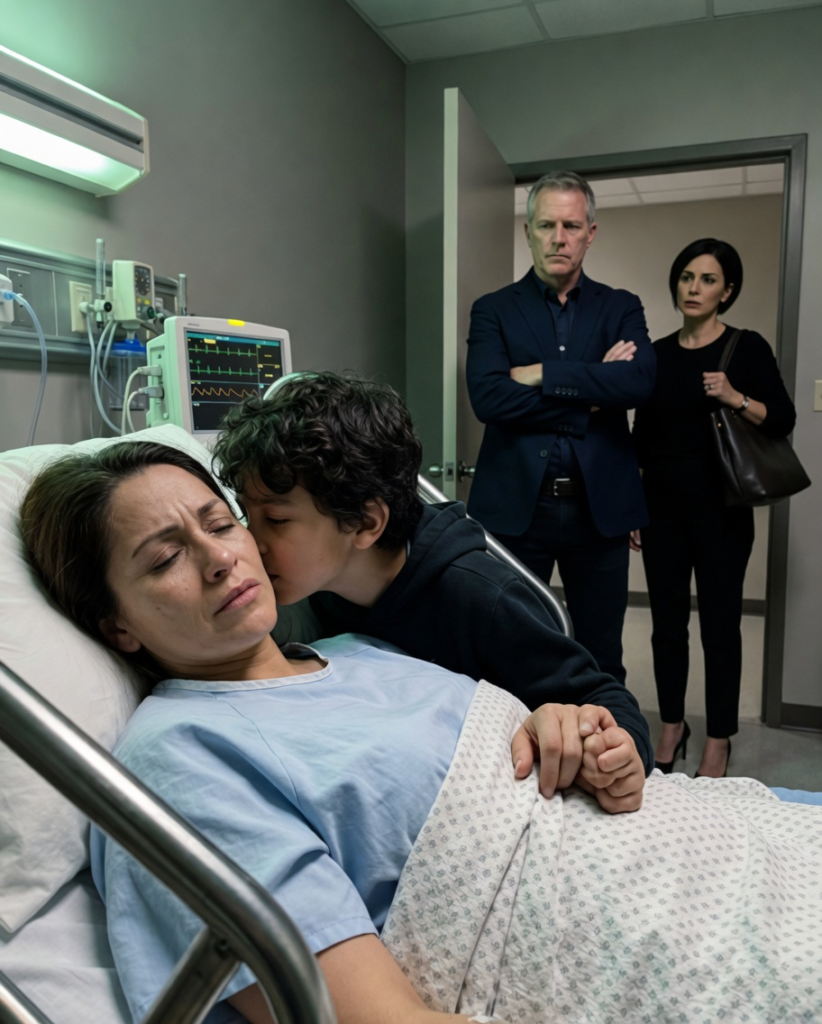
His small hand wrapped around mine, and his lips brushed my ear.
“Mom, don’t open your eyes.
Dad is waiting for you to die.”
Terror cleared more of my mind than medicine ever could.
I tried to move.
I tried to open my eyes.
I tried to squeeze his fingers hard enough to tell him I was there.
Nothing happened.
My body would not obey me.
A nurse had spoken nearby earlier, and through the fog I had caught only fragments: twelve days, coma, multiple injuries, severe concussion, miracle.
Twelve days since my SUV went over a cliff on the road to Toluca.
Twelve days since everyone around me had accepted the clean, simple version of events: Isabel lost control.
But I did not remember losing control.
I remembered standing in my bedroom the night before, still in my work clothes, while my husband held out a stack of papers with a smile that made my stomach tighten.
“Sign this, sweetheart.
It’s just to protect the house.” The house had belonged to my mother before she died.
Dario had never once cared about protecting it until his business began swallowing money faster than he could borrow it.
He had never mentioned safeguards until the collection calls started arriving after midnight and he began stepping onto the balcony whenever his phone rang.
In public, Dario was the kind of man waiters remembered and neighbors praised.
He kissed my cheek in front of other people.
He carried grocery bags dramatically.
He called me his queen.
In private, he became careful, then impatient, then cold.
He wanted access to my accounts because marriage meant trust.
He wanted my signature because paperwork was stressful and I was better with details.
He wanted the house transferred into a corporate structure because liability was complicated and he was thinking of our future.
Every explanation sounded polished until you looked too closely.
Then the edges cut.
What made it worse was Renata.
My sister had once been the person I told everything to.
After our mother died, she started coming over more often, always with concern on her face and advice on her tongue.
She said Dario was under pressure.
She said men made mistakes when they felt disrespected.
She said I should stop being suspicious of every document, every missing statement, every half-deleted message on his phone.
When I found a practice sheet in Dario’s desk with my signature traced over and over, Renata took it from my hand, laughed too quickly, and called it paranoid nonsense.
That was the day I stopped telling her what I knew.
Instead, I went to Julia Méndez, the lawyer who had handled my mother’s estate.
I showed her the papers Dario wanted me to sign.
She read them once, then looked up so sharply that my blood ran cold.
They were not protections.
They were a path.
One would have given Dario authority over the house if I were incapacitated.
Another made it easier to move money.
A third would have made challenging later transfers much harder.
Julia redrafted my will, moved everything into a trust for Emiliano, and told me, very plainly, to keep copies somewhere Dario could not find.
I did more than that.
I hid Julia’s card and a short note in Emiliano’s school atlas, the one no one ever opened unless there was homework.
I made it sound like a game because he was nine and I could not bear to tell him the whole truth.
If anything happened to me and he felt afraid, he was to call Julia.
I remember kissing the top of his head afterward and hating myself for planting fear in a child.
I had no idea how soon he would need it.
The next morning I was driving toward Toluca, still angry, still replaying Dario’s smile in my head, when the brake pedal dropped uselessly under my foot.
There was no warning.
No gradual failure.
Just empty resistance and the terrible certainty that the car was no longer mine.
I remember the guardrail rushing up, the wheel jerking in my hands, the violent scream of metal, and then the impossible feeling of falling sideways through air.
After that, darkness swallowed everything.
In the hospital, I listened while the truth walked in wearing my husband’s voice.
Dario told Emiliano I could not hear him.
He called me a vegetable.
Renata arrived in her heels and expensive blouse and spoke in that soft, poisonous tone she used when she wanted to sound compassionate.
Dario said he was not going to keep paying for a body that would never wake.
Renata said we could sign everything later.
Then, in a lower voice that was still not low enough, Dario said they needed to get the boy out of the country as soon as I died.
Every word struck harder than the crash.
Emiliano cried and said he wanted to stay with me.
Dario told him I did not decide anything anymore.
My son, with a courage that still makes my throat burn when I remember it, shouted back that I did.
Then he said the name Dario had not expected to hear.
“She told me to call Lawyer Julia.” The silence that followed was instant and total.
I felt the room change.
The door clicked locked.
Dario muttered that the boy knew something.
And in the middle of my panic, one finger twitched.
Emiliano saw it, but he was smarter than either of the adults terrifying him.
He bent close and whispered, “If you’re awake, don’t move again.
I already called someone.” When Dario demanded to know what he had said, my son answered, “I said I love her.” A minute later Renata announced the notary was downstairs.
Dario gripped my hand hard enough to send pain up my arm and told me I was going to sign one way or another.
I lay still and listened to my own heartbeat climb.
Then someone knocked.
“That must be the notary,” Dario said.
Renata told them to let him in.
But when the door opened, the first voice I heard was male, calm, and official.
“Good afternoon, Dario.
Before you touch Isabel again, you’re going to explain why the brake line in her SUV was cut clean through.” Another pair of footsteps came in right behind him, quick and purposeful.
Julia.
Even in my half-conscious state, I recognized the rhythm of her walk.
Relief hit so hard it hurt.
Detective Tomás Salazar introduced himself while two uniformed officers moved to either side of the room.
Julia did not waste a second.
She informed the charge nurse, the hospital administrator, and everyone else present that no document would be placed in my hand or near my bed without legal review.
The notary, she said, was downstairs and extremely interested in explaining why he had been summoned to witness a signature from a woman in a coma.
Something small and sealed was placed on the tray beside me.
Salazar said it had been recovered from Renata’s car.
He did not say what it was yet.
Dario recovered first, because lying had always come most naturally to him.
He put warmth into his voice and outrage into his breathing.
He asked who had filled my son’s head with nonsense.
He said we were a grieving family being harassed during a medical crisis.
He said I had been under stress, that I sometimes drove too fast, that any cut line could have happened in the crash.
Renata nodded along, adding soft little phrases about trauma and confusion and everyone wanting what was best for me.
For a few seconds, if you did not know them, they sounded almost convincing.
Salazar did not blink.
The vehicle inspection, he said, had been performed before the SUV was moved from impound.
The rear brake line had a smooth, deliberate slice with none of the tearing or crushing expected from the fall.
There were no skid marks on the road because I never had working brakes to use.
The tow technician photographed everything.
Then Julia spoke, and I could hear Dario’s confidence crack.
She told the room I had updated my will three weeks earlier.
Any attempt to obtain a transfer of property, emergency authority, or financial control from me in that condition was fraudulent and would be treated as such.
The sealed item on my tray finally rustled open.
Paper.
Several sheets.
Salazar read them out loud one by one, and each word landed like a hammer.
Emergency passport application for Emiliano.
Travel consent forms carrying a forged version of my signature.
A one-way ticket leaving the country that same evening.
Renata made a small sound, part gasp, part whimper.
Dario said it was all a misunderstanding, that they had been planning to take Emiliano somewhere peaceful while the family recovered.
Julia asked, very mildly, why a peaceful family trip required fake paperwork and a departure scheduled before my doctors had even made a prognosis.
I wanted to open my eyes then.
I wanted to sit up and look at their faces.
But my body was still a prison, and all I had was hearing.
So I listened as years of manipulation began to tear.
Salazar asked Dario why he had called the hospital billing office twice that morning to discuss ending long-term care before speaking to my surgeon.
He asked Renata why she had searched emergency custody rules on her phone.
He asked why neither of them had informed Julia, my attorney, that a notary had been summoned.
Dario kept talking, talking, talking, because silence would have sounded too much like guilt.
But underneath his words I heard the thing I had never heard before from him: fear.
Then Emiliano spoke.
His voice was small, but every adult in the room stopped for him.
“I have something,” he said.
There was a rustle of fabric and a zipper.
“I didn’t know if it was important.
Mom told me to call Julia if I was scared, so I did.
And then I got this too.” Julia asked him, gently, what he meant.
My son said that after Dario told him to wait outside earlier, he had hidden near the vending machines with my old tablet.
He had turned on the voice recorder because he thought no one would believe him otherwise.
Salazar asked for the device.
A silence stretched long enough for my pulse to hammer in my ears.
Then I heard a tap, a faint hiss, and the thin speaker quality of a recording beginning.
First came elevator music and distant wheels on tile.
Then Renata’s voice, stripped of all sweetness.
“You said cutting the brakes would make it look clean.” Dario answered immediately.
“Lower your voice.” Renata kept going, breathing fast.
“I told you the cliff was too much.
If she wakes up, everything collapses.” Dario replied with the flat impatience of a man irritated by a problem he thought he had already solved.
“Then she doesn’t wake up.
We get the papers signed, take the boy, and Julia can fight ghosts.”
No one in the room spoke when the recording ended.
The silence was worse than shouting.
Then Renata broke first.
She began saying Dario had planned it, Dario had insisted, Dario had promised nobody would ever know.
Dario cursed her and knocked something metal off the tray.
An officer moved.
A chair scraped back.
Someone shouted my son’s name.
Salazar ordered both of them to stay where they were.
Dario tried one last time to sound wronged, but his voice was gone now.
What remained was raw and ugly.
When the handcuffs clicked onto his wrists, I felt something in me unlock too.
I forced my eyes open on the sound of Emiliano crying.
Light stabbed straight through my skull, but I did not care.
Everything was white and blurred at first—the ceiling, the fluorescent glare, the outline of Julia’s dark suit, the flash of a police badge.
Then my vision steadied enough to find the only face I needed.
My son was standing beside the bed, shaking, tears all over his cheeks, staring at me like I had come back from the dead.
I squeezed his hand this time.
Weakly, clumsily, but enough.
“Mom,” he gasped, and then he folded over me carefully, terrified of hurting me, and I learned what surviving felt like.
The next days came in pieces: morphine haze, scans, broken sleep, statements interrupted by pain.
But the facts kept sharpening.
The mechanic’s photographs matched the recording.
Security footage from a hardware store showed Dario buying a cable cutter two nights before the crash.
Garage camera footage from a neighbor across the street caught Renata’s car outside our house close to midnight, long after she had claimed to be home.
When police searched Dario’s office, they found copies of forged property forms, printouts of my policy information, and messages between him and Renata that made the affair between them impossible to deny.
In those messages, betrayal had no poetry left.
Renata called me difficult.
Dario called me an obstacle.
They talked about money the way butchers talk about cuts of meat.
There were debts I had not known the full size of, loans tied to a failing restaurant venture, and desperate plans stacked on desperate plans.
Dario had assumed that if I died before my new documents took effect, he could still maneuver through grief, guardianship, and confusion.
When he realized Julia might block him, he shifted to the house, to emergency authority, to getting Emiliano out of the country before anyone could challenge custody.
Renata was supposed to help him make it look like family concern.
Julia made sure that plan died completely.
Because my will had been executed and filed before the crash, everything passed exactly as I intended: into a protected trust for Emiliano, with Julia overseeing the legal side until I recovered.
No one could sell the house.
No one could move my son.
No one could sign anything in my name.
The notary gave a statement.
The hospital documented Dario’s pressure to obtain a signature from an unconscious patient.
Even the billing calls he made that morning became part of the case.
The story they had tried to shape as tragic widowhood turned into a map of premeditation.
Renata accepted a plea deal after three weeks.
She admitted she had known about the plan to tamper with the brakes, that she had lured me into lowering my guard, and that she had helped prepare the false travel documents for Emiliano.
In exchange, she testified against Dario in court.
I watched her do it from a wheelchair, still relearning how to trust my own balance.
She cried on the stand, of course.
She always cried beautifully.
But once you know a person can watch you lying broken in a hospital bed and call you almost a good wife, tears stop looking like innocence.
Dario went to trial convinced he could still talk his way around the edges of the truth.
He blamed pressure.
He blamed debt.
He blamed Renata.
He suggested the recording had been misunderstood, that I had become paranoid and Julia had weaponized it.
Then the prosecutor played Emiliano’s recording for the jury.
They heard the contempt in Dario’s voice when he said Julia could fight ghosts.
They saw the hardware store footage.
They read the texts.
They heard the notary and the tow technician and the hospital staff.
The verdict came back guilty on attempted murder, conspiracy, fraud, and child endangerment.
He did not look at me when the sentence was read.
My recovery took longer than the trial.
Bones heal on their own schedule.
Nerves are slower.
Fear is slowest of all.
For months I woke at the slightest mechanical sound.
I checked locks twice.
I flinched whenever a phone buzzed behind a closed door.
Emiliano slept in my room the first week I was home, then the second, then only on the nights when thunderstorms rolled in.
We made rules together.
No secrets in this house.
No adult gets trusted just because they smile well.
If something feels wrong, we say it out loud.
Children should not have to learn those rules so young.
Mine did.
Sometimes people asked which betrayal hurt more: the husband who wanted my assets or the sister who helped him plan my disappearance.
I never knew how to answer.
Dario had chosen greed over love long before the cliff.
Renata had chosen envy over blood.
One tried to end my life.
The other stood beside the bed and mocked the life still in me.
There are wounds that arrive with noise, and others that settle in quietly and stay.
Renata was the quiet kind.
Months later, when the scars had faded from red to silver and Emiliano had stopped checking that my bedroom door was open before he slept, he asked me a question while we were making dinner.
“Do bad people always look bad?” I looked at the steam rising from the pot, at my son’s careful face, and thought about charm, perfume, family photos, and signatures on false papers.
“No,” I told him.
“That’s why we listen when something feels wrong.” He nodded like he was storing the answer somewhere permanent.
We still live in my mother’s house.
The bougainvillea outside the kitchen window blooms too brightly every spring, as if nothing terrible ever happened there.
Sometimes I stand at that window and think about the night Dario smiled and asked me to sign, and the morning my brakes failed, and the hospital room where my son became the bravest person I know.
I survived because a nine-year-old boy refused to believe the adults around him.
Even now, that is the part that haunts me most: not that evil came wearing a husband’s face, but that a child saw it clearly before I was willing to name it.