The first thing I remember about that morning is the smell.
Salt water, diesel, and coffee that had gone bitter in a paper cup someone abandoned on the concrete barrier.
The second thing I remember is the sound of chains moving above me in the damp air.
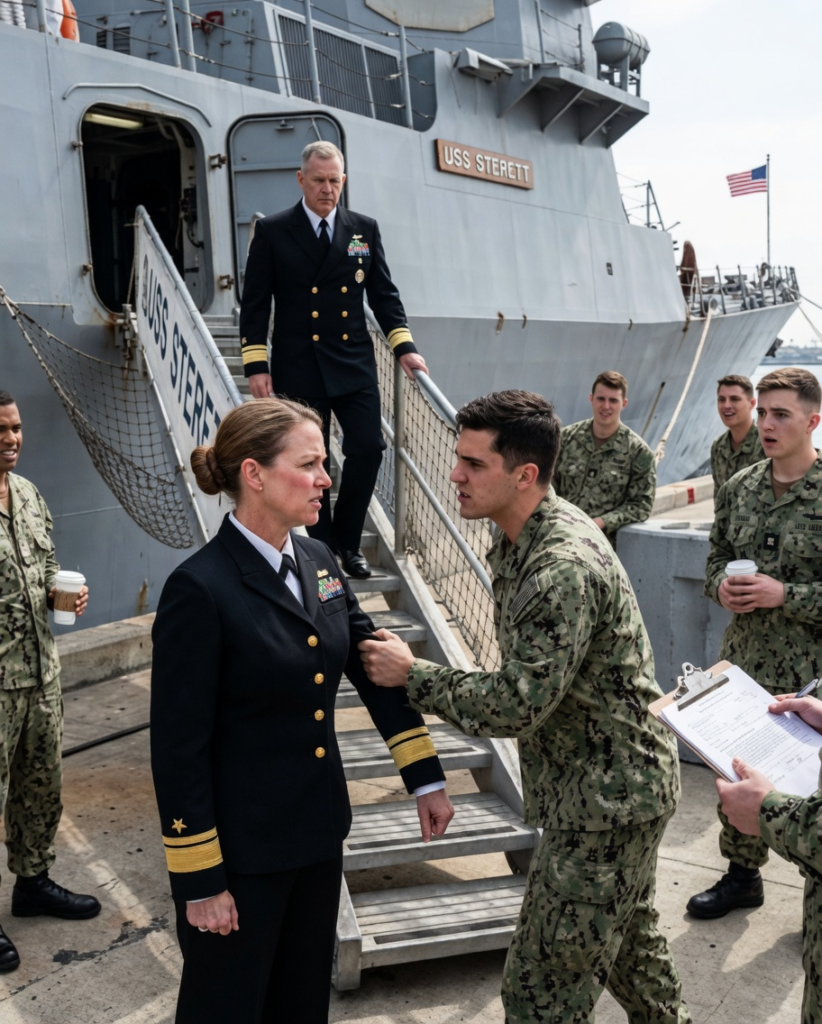
They clinked lightly against metal, ordinary and steady, while the gray side of the USS Sterett rose beside the gangway like a wall built to keep small feelings out.
I had no reason to be nervous.
My inspection order had been transmitted, logged, and acknowledged before I ever stepped onto the pier.
The base office had my name.
The watch desk had my arrival window.
My staff packet had the preliminary safety checklist, the inspection scope, the names of the departments we would walk through, and the routing sheet that had already moved through enough hands to make my visit official in every way that mattered.
At 0810, my arrival was no longer a rumor.
It was a record.
Still, I stood there for half a second longer than I needed to, looking at the gangway rail and listening to the water knock against the pier.
You can learn how to speak in front of admirals.
You can learn how to stand in a room full of officers who are waiting for you to prove you belong there.
You can learn how to read a briefing book at midnight, sleep four hours, and still walk into a meeting with your voice steady.
But family is different.
Family knows where the old bruise is.
My old bruise had a name.
Brandon.
He was my little brother, though nobody in my father’s house ever treated him like he was little when praise was being handed out.
Brandon enlisted right out of high school, and my father turned it into a neighborhood event.
Retired Army Sergeant Major Owens wore his old cap, stood in the driveway with his chest out, and told anyone close enough to hear that his son was finally carrying the family name the right way.
There were photos on the porch.
There was a grocery-store sheet cake on the kitchen counter.
There was my father clapping Brandon on the shoulder like he had just returned from battle instead of signed enlistment papers.
When I graduated with honors, Dad said it was nice.
When I got my first command, he asked whether the job came with an office.
When I sent him the promotion photo with two stars on my shoulders, he stared at it across the Sunday breakfast table and said, “They hand out titles differently now.”
My mother looked down at her coffee.
Brandon laughed through his nose.
I smiled, because by then I had spent decades learning how to be careful with my own face.
A woman in uniform learns many forms of discipline.
Some are written in manuals.
Some are learned at dinner tables where nobody tells the loudest man to stop.
I was not at the USS Sterett that morning to confront my brother.
I was there because the inspection had been scheduled, routed, and approved, and because the job required me to walk aboard that ship with my staff and do the work in front of whoever happened to be standing there.
That should have been simple.
Brandon made it family.
“You’ve got a lot of nerve showing up here in that costume, Sandra,” he called from behind me.
His voice carried across the pier too easily.
It had the lazy confidence of a man who thought every room was still my father’s living room.
“Does Mom know you stole her good ironing board to crisp up those fake sleeves?”
A few sailors laughed.
Not loudly at first.
Just enough.
One short laugh near the rail.
Another from somewhere behind him.
A small sound, but I knew what small sounds can become when nobody stops them.
I stopped at the base of the gangway and watched the morning light catch along the metal rail.
My glove had a rough seam inside the palm, and I pressed my fingers into it until the little sting brought me back to myself.
Rank is not a weapon unless you make it one.
That was a rule I had carried longer than some people carry wedding vows.
So I did not turn around quickly.
I did not snap.
I did not give him what he wanted.
Then Brandon’s hand landed on my shoulder.
Not a tap.
Not a brush.
A grab.
He caught the sleeve right over the gold lace and spun me hard enough that my heels clicked against the concrete.
For one second, the whole pier seemed to narrow to the heat of his fingers through the fabric.
His face was too close.
He smelled like stale coffee and morning breath, and behind it was that familiar scent of borrowed confidence.
“I’m talking to you,” he said.
Not said, really.
Hissed.
“The guys are laughing, Sis. They think it’s some Halloween joke. What are you doing here? Trying to find a husband, or just playing dress-up to feel important?”
The young sailor with the clipboard looked down so fast the papers shook.
Another sailor lifted his coffee halfway to his mouth and forgot to drink.
One man near the gangway pretended to study a painted line on the deck like it had become urgent.
That is how public humiliation works.
It makes witnesses out of people who do not want the responsibility.
The whole pier froze in pieces.
Boots stopped scraping.
A whistle died halfway through someone’s mouth.
Even the harbor noise seemed to pull back, leaving only Brandon’s hand on my sleeve and the little crease forming under his fingers.
I thought about my father’s phone calls.
There had been three of them before I left the hotel that morning.
I had seen his name flashing while the small television played the San Diego weather and the iron moved over my sleeve at 5:30 a.m.
I knew what he would say.
Be nice to your brother.
Do not embarrass him.
He has always been sensitive about your career.
Sensitive was the family word for everything Brandon did that nobody wanted to name.
Sensitive was laughing at my medals.
Sensitive was asking whether my office had curtains.
Sensitive was Dad introducing me as “our Sandra, she works around officers,” then turning to introduce Brandon as “my Navy man.”
They had been sanding me down for thirty years.
A little joke here.
A little dismissal there.
A little family peace purchased with my silence.
Brandon tightened his grip.
“Go back to the office,” he said. “Before you get us both in trouble.”
For one ugly heartbeat, I wanted to peel his fingers off my uniform one by one.
I wanted to tell him that I had briefed people whose decisions moved fleets while he was still letting Dad polish his ego for him.
I wanted to say every sentence I had swallowed in that old kitchen while my father called ambition arrogance only when it wore my face.
Instead, I looked him directly in the eye.
“Remove your hand from my person, Petty Officer.”
My voice did not rise.
That made it worse for him.
Brandon blinked once.
Then he smiled.
“Or what?” he said. “You gonna report me to the PTA?”
A couple of sailors made a sound that was almost a laugh, but weaker this time.
They could feel it shifting.
People always feel it before they admit it.
Some disrespect is loud because it is stupid.
Some disrespect is loud because nobody ever made it expensive.
Brandon shoved my shoulder backward, not enough to knock me down, but enough for everyone to see it.
That mattered to him.
The audience mattered.
The little demonstration mattered.
His fingers pressed into the sleeve I had ironed before sunrise, and that crease seemed to cut deeper than the shove.
Then the hatch above us opened.
The sound rolled down the gangway, metal against metal, clean and final.
A one-star admiral stepped into the daylight and stopped so abruptly the sailor behind him nearly collided with his back.
His eyes went to my shoulder first.
Then to Brandon’s hand.
Then to my face.
He recognized me immediately.
He had been in a briefing with me two months earlier, had sat three chairs down while I asked questions nobody else wanted to ask, and had requested follow-up notes from my office by the end of the day.
He was not my friend.
He was not family.
He was something far more dangerous to Brandon in that moment.
He was a professional witness.
He came down one step.
Then another.
Brandon’s smile twitched, but he held on to it like a man gripping the last rail before a fall.
The admiral looked at Brandon’s fingers and spoke.
“Take your hand off her.”
Five words.
No shouting.
No performance.
No room for Brandon to wrap it in a joke and hand it back to the crowd.
Brandon’s fingers opened slowly.
The crease stayed.
The admiral reached the bottom of the gangway and stood beside us with his shoulders square and his face unreadable.
He did not look at me for permission.
That was one of the most merciful things he could have done.
He looked at Brandon.
“Name and rate.”
For the first time that morning, my brother did not answer quickly.
His mouth opened.
Nothing came out.
The young sailor with the clipboard swallowed and looked at the top sheet.
“Petty Officer Brandon Owens, sir.”
The admiral’s eyes never left my brother.
“At 0810,” the sailor continued, his voice thin, “inspection party arrival was logged at the base office. Visitor manifest confirms flag arrival.”
There it was.
Not family.
Not attitude.
Not Sandra being dramatic.
A log entry.
A manifest.
A record.
The kind of thing my father could not talk over from a kitchen chair.
The admiral turned slightly toward the quarterdeck.
“Enter it in the watch log,” he said. “Physical contact with a visiting flag officer during official inspection.”
Brandon’s face changed so completely that for one second I almost felt sorry for him.
Almost.
His confidence did not crack like glass.
It drained.
His jaw loosened.
His shoulders fell by half an inch.
His eyes flicked to the sailors, then to me, then to the admiral, searching for the old door that always opened when he needed to escape consequences.
There was no door.
Only the pier, the ship, the witnesses, and his handprint in the crease of my sleeve.
My phone buzzed in my coat pocket.
Dad again.
The name lit up against the dark fabric.
Brandon saw it.
So did the admiral.
For one strange second, my brother looked at that phone with hope.
That was how deep the old story ran in him.
He still believed our father could step between him and the real world.
The admiral looked from the phone to Brandon.
Then he looked at me.
“Ma’am,” he said quietly, “before you answer that call, you should know what your brother just forced me to document.”
I did not answer the phone.
I let it ring until it stopped.
No one moved.
The sailor with the clipboard wrote so carefully I could hear the pen moving across the page.
Brandon stared at the watch desk as if the entry might vanish if he refused to breathe.
The admiral asked for my preference regarding the inspection schedule.
That small courtesy steadied me more than any apology would have.
“We continue,” I said.
My voice sounded like mine again.
Not my father’s daughter.
Not Brandon’s sister.
Mine.
The admiral gave one sharp nod.
Then he turned to Brandon.
“You will step away from the inspection party.”
Brandon tried to speak then.
“Sir, she’s my sister.”
The admiral’s expression did not change.
“That is not a defense.”
It was the cleanest sentence I had heard in thirty years.
Brandon looked at me as if I had betrayed him by standing still long enough for other people to see him clearly.
Maybe that was the part he could not forgive.
Not my rank.
Not the inspection.
Not the watch log.
The seeing.
Two sailors came down from the gangway and positioned themselves near him, not touching him, just close enough to make direction obvious.
Brandon stepped back.
His heel caught slightly on a seam in the concrete.
Nobody laughed.
That silence hurt him more than any reprimand could have.
The inspection went on.
We walked through compartments.
We reviewed safety procedures.
We checked documentation, asked questions, listened to junior sailors, and looked at the places where a ship tells the truth about itself.
I did my job.
That was the part Brandon never understood about me.
I had not built my life around proving him wrong.
I had built it around doing the work well enough that his opinion could not reach it.
Still, the incident followed us.
It was in the careful way sailors straightened when I entered.
It was in the quick looks exchanged near ladders and hatches.
It was in the way the young man with the clipboard kept his papers pressed too tightly against his chest, as if he was afraid they might accuse him too.
By the time we finished the first section, my father had called twice more.
I did not answer.
At 1046, a text came through.
Be kind to your brother. He says you embarrassed him.
I stood in a passageway beneath fluorescent lights and looked at those words for a long time.
He says you embarrassed him.
Not, What happened?
Not, Are you all right?
Not, Did he put his hands on you?
Just the old order in a new sentence.
Be kind.
I typed nothing back.
The admiral was speaking with one of the department heads a few feet away, so I stepped aside near a bulkhead and let myself have one private breath.
Thirty years teaches you to survive dismissal.
It does not teach you how to react when somebody finally documents it.
When the inspection paused near midday, my father called again.
This time, I answered.
“Sandra,” he said, and his voice already carried accusation. “What did you do to your brother?”
For a moment, I heard our kitchen behind him in my mind.
The clink of his coffee mug.
The television low in the living room.
The sound of my mother pretending not to listen.
“I didn’t do anything to Brandon,” I said.
“He called me upset. He said you humiliated him in front of his crew.”
“He put his hand on me during an official inspection.”
“He’s your brother.”
There it was.
The family constitution in three words.
I looked down at the crease still faintly visible in my sleeve.
“He is a petty officer,” I said. “I was there as a visiting flag officer. He grabbed my uniform in front of witnesses after mocking my rank.”
My father went silent.
Not because he understood.
Because I had used words he could not push aside as feelings.
“He didn’t know,” Dad said finally.
“He didn’t ask.”
“He probably thought you were making too much of it.”
“He always does.”
The line hummed.
Somewhere outside, gulls screamed over the harbor.
My father lowered his voice.
“You could have handled it privately.”
That almost made me laugh.
Privately was where families buried things they did not want to repair.
Privately was where my father had kept every insult Brandon threw, every promotion he discounted, every dinner-table joke he let land.
Privately had been the room where I was expected to disappear.
“No,” I said. “He made it public when he put his hand on me.”
My father inhaled sharply.
“You’re going to ruin him.”
That sentence finally reached the place in me he had been aiming at for years.
Not because it was new.
Because it was old.
It was the same fear in a uniform.
The same warning in a different room.
Do not be too much.
Do not stand too tall.
Do not let your brother feel small.
“Dad,” I said, “I am not ruining Brandon. I am refusing to hide what he did.”
He had no answer for that.
The call ended without goodbye.
By late afternoon, the incident had moved through the proper channels.
There were witness statements.
There was a watch log entry.
There was a notation attached to the inspection file.
Nothing theatrical happened.
No one dragged Brandon away.
No sirens came.
No speech was made for the pier to remember.
Real consequences rarely look like movies.
They look like a pen moving across a form.
They look like a supervisor asking the same question twice because the first answer was not good enough.
They look like a man realizing his last name is not evidence.
Brandon was not allowed near the inspection party for the remainder of the visit.
His division chief met with him before we departed.
I did not ask for the details.
I did not need them.
The future he had imagined for himself, clean and protected and always explainable, now had a record beside it.
Maybe he would recover from it.
Maybe he would spend years pretending he had been the victim.
Brandon had always been good at that.
But something permanent had changed.
He had learned that a joke could become a statement.
A grab could become an entry.
A sister could become an officer in front of witnesses.
When I left the ship, the sun had burned through the morning gray and the pier looked almost ordinary again.
The abandoned paper cup was still on the barrier, collapsed at the rim.
The harbor still smelled like diesel and salt.
The American flag at the stern moved lightly in the wind.
The young sailor with the clipboard approached me before I reached the end of the gangway.
“Ma’am,” he said, “I’m sorry I laughed.”
He looked about twenty.
Young enough to still be learning which silences become part of you.
I studied his face for a moment.
“You stopped laughing,” I said.
His eyes flicked up.
“That matters too.”
He nodded like the sentence had been heavier than he expected.
At the hotel that night, I hung my uniform carefully over the back of the chair.
The crease in the sleeve had softened, but it had not disappeared.
I could have steamed it out.
I did not.
Not yet.
I sat on the edge of the bed while the television played another weather report and my phone lay beside me with no new calls from my father.
For the first time all day, the quiet did not feel like punishment.
It felt like space.
My mother texted at 9:18 p.m.
Your father is upset.
I looked at the message until the screen dimmed.
Then another one came.
Are you okay?
Three words.
Late, small, imperfect.
Still, they were different from the ones I had been given before.
I typed back, I am.
Then I added, I always was.
I thought of Brandon on the pier, smiling until the world stopped smiling with him.
I thought of my father’s voice saying I would ruin him.
I thought of the admiral’s five words and the way they had landed, not like thunder, but like a door closing.
Take your hand off her.
That was all it took.
Not a speech.
Not revenge.
Not thirty years of explanations.
Just one clear sentence spoken in front of people who could not pretend they had not heard it.
For most of my life, my family acted as if rank was something I wore only until I walked back into their house.
A costume.
A phase.
A title handed out differently now.
But that morning on the pier, with salt in the air and diesel on the wind, the old story finally met a record it could not erase.
I had not made rank a weapon.
Brandon had made disrespect a habit.
And for the first time, habit met consequence.