“Only important people are invited.
Not you.”
My father said it in the tone he used when he wanted other people to laugh before they realized he was being cruel.
Charles Morgan had spent a lifetime perfecting that voice.
It could bounce off factory walls, cut through football crowds, and still somehow sound polished enough that anybody who challenged him looked oversensitive.
But I knew the difference between a joke and a wound.
I had known it since I was twelve.
He said it near the coffee urn at American Legion Post 138, loud enough for the banker to hear, loud enough for Coach Henderson to smirk into his Styrofoam cup, loud enough for a row of women by the sheet cake to suddenly become fascinated with their frosting roses.
It spread through the room the way shame always does in small towns — quickly, quietly, and with a hundred careful averted eyes.
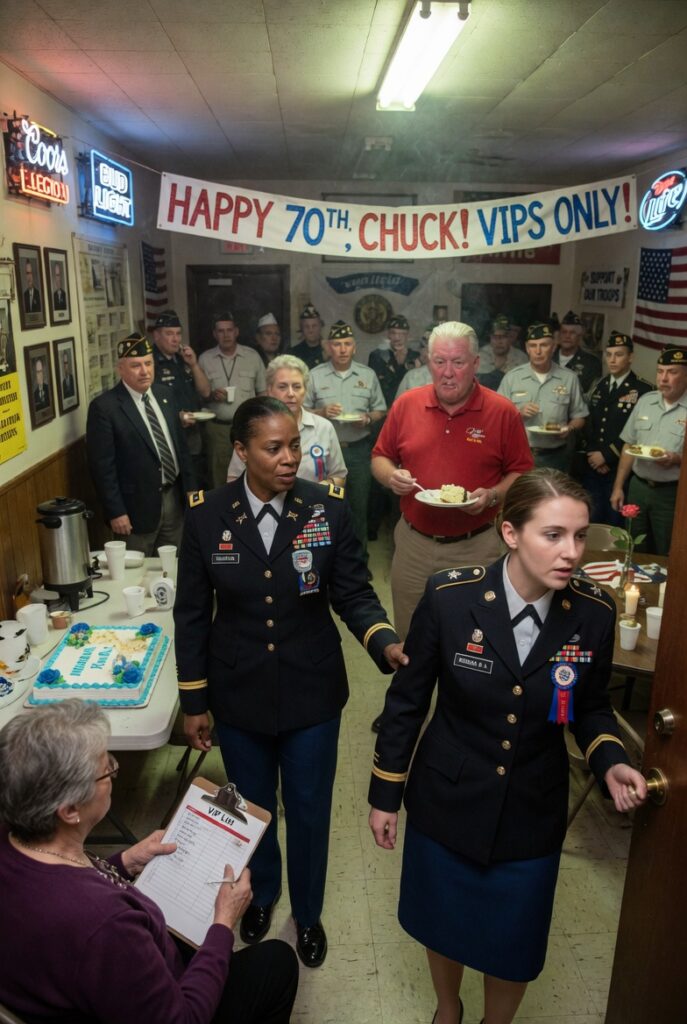
I had come in Army dress blues.
He had come as himself.
Outside, Lancaster, Ohio carried its usual September smell: damp river air, diesel drifting off the road, cut hay from fields on the edge of town.
Inside the Legion hall, it was burned coffee, sugary frosting, old wood paneling, and the permanent ghost of every chili supper and fish fry ever held there.
Neon beer lights hummed on the wall.
The POW/MIA table near the flag stood under a cheap spotlight, one rose and one empty chair trying hard to hold more dignity than the rest of the room.
Above the bandstand, a banner hung crooked: HAPPY 70TH, CHUCK! VIPS ONLY!
That part had not been a joke either.
He had written it on the Facebook invite like he was proud of it.
He meant the mayor, the coach, the banker, the city councilman who shook every hand twice and remembered nobody’s birthday unless an election was near.
He meant the kind of men my father collected because being seen with them made him feel taller.
He did not mean me.
I had only planned to drop off a gift and leave.
I parked in the back lot behind pickup trucks and church vans, walked in through the side entrance, and intended to hand Paula at the door an envelope with a feed store gift card and disappear before the band got to its second country cover.
My mother would have wanted me to show up.
Five years earlier, before cancer took her voice down to a whisper and then took everything else with it, she had stood at the farmhouse sink with a spoon in a chipped teacup and told me, “Don’t let your father make you small, Rachel.
The world will work hard enough at that without his help.”
I had carried that sentence farther than anything else she ever gave me.
That afternoon, before the party, I stopped by the farmhouse to check on the dog and pick up one of Mom’s old quilts for the VA clinic.
Dad was in the garage, bent over a workbench, scraping a spark plug with a wire brush like his truck still belonged to another decade.
Sports radio crackled from a shelf.
The whole place smelled of gasoline, dust, and cold tools.
“You still carrying that coin?” he asked without looking up.
I touched the pocket over my heart.
“Always.”
He nodded once.
No warmth.
No curiosity.
Just acknowledgement, like the coin mattered but the woman carrying it did not.
Then he said, “Mayor’s coming tonight.
Coach too.
Important people.”
I should have let it go.
Instead I said, “Sounds crowded.
Want me to bring back Mom’s pie plates from Aunt Linda’s pantry?”
He flinched at my mother’s name and covered it the way he covered everything difficult — with a jab.
“Only important people are invited.
Not you.”
Something old and practiced locked into place behind my ribs.
“Copy,” I told him.
The Army’s word for I heard you.
Not I agree.
At the Legion hall, Paula peered over her reading glasses when I came in.
“Ray, honey, I don’t have your name on the list.”
“It’s okay,” I said.
“I’m just dropping something off.”
I slipped the envelope into the donation box by her elbow, the same beat-up cardboard box that had survived raffles, funeral collections, car washes, and half the town’s bad ideas.
I could feel people noticing me in fragments: veterans in embroidered caps, wives with perfect hair, teenagers pouring soda for service hours.
Then Dad saw me.
He crossed the room wearing the same smile he used at school board meetings, church dinners, and any moment when he wanted control to look like charm.
“Rachel,” he said, like I was a scheduling mistake.
“Didn’t think I’d see you.”
“I was leaving,” I said.
“Good,” he replied.
“Tonight’s a special crowd.
You understand.”
I understood plenty.
I understood that humiliation lands harder when it is familiar.
I understood that some fathers know exactly how to turn a daughter into an apology for taking up space.
So I turned toward the door.
That was when a hand closed gently over my sleeve.
I looked down and saw four silver stars.
When I turned, the woman standing behind me was General Eleanor Whitaker, one of those faces you only expect to see on a command screen or in a briefing packet, not under the fluorescent lights of a Legion hall in rural Ohio.
She was a Black woman in immaculate dress uniform, her expression calm in a way that made everybody else’s nerves show.
The entire room seemed to inhale at once.
“Captain Rachel Morgan?” she asked.
“Yes, ma’am.”
My father’s smile flickered.
He knew enough about the Army to know rank when he saw it.
He knew enough about me to recognize my voice when it dropped into that clipped, automatic answer.
He had never liked hearing that tone.
It reminded him there was a world where I belonged without his permission.
General Whitaker released my sleeve and looked past me, taking in the crooked banner, the banker by the urn, the mayor trying to decide whether to clap, and my father rooted in place at center room.
“You’re her father?” she asked him.
Dad straightened.
For one strange second, I saw hope move across his face, as if he still believed this might somehow be about him.
“That’s right,” he said.
“Chuck Morgan.”
Her eyes didn’t leave his.
“Then you should stay close.”
One of her aides stepped forward carrying a leather case and a dark folder.
Paula actually dropped her stamp.
Coach Henderson stopped halfway through a sip of coffee.
General Whitaker turned to the room.
“I had planned to keep this private,” she said.
“Captain Morgan requested no ceremony, no photographs, and no public attention.
That was her condition.”
She paused.
“But after hearing what was said to her at that door, I decided silence would be the wrong kind of respect.”
Nobody moved.
The general asked for the microphone from the bandstand.
The singer handed it over without argument.
When Whitaker spoke again, the room went still enough to hear the refrigeration unit hum behind the bar.
“Eight months ago,” she said, “I was visiting a temporary medical evacuation hub at a forward airfield overseas.
Weather had grounded one wave of flights, backed up another, and packed a hangar full of injured personnel, medics, and equipment that was already running past safe limits.
Then a hard landing put more wounded on the ground at once.
Seconds later, the power failed.”
I felt the room tilt inward around me.
I had not wanted this story told here.
Not like this.
Not with my father in front of me and the whole town behind him.
Whitaker went on anyway.
“Captain Morgan was not the highest-ranking officer there,” she said.
“She was not the oldest, the loudest, or the most decorated.
But when the lights went out, when communications dropped, and when people started waiting for somebody else to take charge, she did.”
The general’s voice stayed even, but it carried the weight of memory.
“She built a triage lane with emergency lights and truck batteries.
She reassigned aircraft crews.
She hand-ventilated a patient when equipment failed.
She refused the first evacuation seat so a nineteen-year-old private could take it instead.
She kept that site functioning until daylight and she kept every patient in that hangar alive long enough to make it home.
I know that because I was standing twenty feet away, watching her do it.”
Something shifted in the room.
The kind of shift that happens when gossip gives way to fact.
The coin in my pocket suddenly felt heavier.
Whitaker lifted one hand toward me.
“The coin she carries is mine.
I gave it to her that morning because she was the calmest person in the worst room I had seen in years.”
My father looked at my chest pocket like he had never seen it before, though he had asked about that coin more than once.
He had only ever asked whether I still carried it.
Never why I earned it.
The general wasn’t finished.
“That is not the only reason I am here tonight,” she said.
“Several months after that incident, Captain Morgan learned that veterans in this county were missing VA appointments because the local transport van kept breaking down.
She contacted my office looking for grant information.
She used her own money to close the gap when the grant came up short.
She requested that her name be left off the paperwork and that any memorial acknowledgment carry only her mother’s initial.”
A stunned silence rolled across the hall.
Parked outside that very building was the wheelchair-accessible van the Legion had been thanking the councilman for all summer.
The mayor looked at the councilman.
The councilman looked at the floor.
My father’s face changed in slow, visible stages.
Confusion first.
Then disbelief.
Then the sharp, private panic of a man realizing the story he had been telling about himself all night had just collapsed in public.
“She never told us that,” he said, and it came out thinner than I had ever heard his voice.
I finally answered.
“You never asked.”
The words landed harder than I meant them to.
Maybe harder than he deserved in that exact second.
Not harder than he had earned over years.
General Whitaker opened the leather case from her aide.
Nestled inside was a medal I had expected to receive quietly the following week at Rickenbacker, in a clean hangar with folding chairs and official remarks.
I had begged for small.
I had begged for forgettable.
Whitaker looked at me, not at the room.
“Captain Morgan, the Army intended to present this in a formal ceremony.
But since this town has gathered tonight to celebrate important people, I can think of no more appropriate moment.”
She turned back to the room.
“For heroism and voluntary risk of life in service to others, Captain Rachel Morgan is hereby recognized with the Soldier’s Medal.”
Nobody breathed for one beat.
Then Paula started clapping with tears running down her face.
Coach Henderson stood.
One veteran at the back slapped his palm against the table so hard the silverware jumped.
The applause built awkwardly at first, then all at once, until the entire Legion hall was on its feet except my father.
Whitaker pinned the medal to my uniform with practiced hands.
Up close, her voice dropped low enough for only me to hear.
“You don’t have to shrink for anybody,” she said.
I swallowed and nodded.
It was the closest I’d come to crying in uniform in years.
The mayor asked if I wanted the microphone.
Everything in me wanted to say no.
But my mother had been right about one thing more than any other: once you stop making yourself small, silence feels different.
So I took the microphone.
“Thank you,” I said, and my voice sounded steadier than I felt.
“I didn’t come here for this.
I came to drop off a birthday gift and leave before the second song.”
A strained laugh moved through the room.
I looked toward the POW/MIA table, then back at the faces in front of me.
“My mother used to say the world already does enough to make people feel small.
We don’t need help from family.
And she also taught me that being important has very little to do with banners, front tables, or who gets their hand shaken twice.
It has everything to do with what you do when nobody’s clapping.”
No one laughed then.
“This town raised me,” I said.
“The people in rooms like this taught me service before the Army ever did.
Some of you know that.
Some of you forgot.
Either way, I’m still here.
And I’m still my mother’s daughter.”
That was all I said.
It was enough.
Afterward, people who had spent years nodding at me like I was a passing inconvenience suddenly wanted to shake my hand.
The banker apologized for not recognizing me.
Coach Henderson called me impressive in the same tone he used for winning quarterbacks.
Paula hugged me so hard she nearly bent the medal pin.
My father said nothing.
When the crowd thinned, I slipped out the side door into the parking lot.
The air was cooler now, carrying river damp and the smell of grass.
The new veterans van sat under the lot light, and for a second I just stood there looking at it, thinking of my mother’s name hidden in the paperwork where nobody in town had noticed.
I heard the door open behind me.
Dad came out slower than I expected, hands empty, shoulders rounded.
Without the crowd, he looked suddenly older than seventy.
“You made your point,” he said.
I turned to face him.
“That wasn’t the point.”
He winced, and for once he didn’t cover it with anger.
“I didn’t know she was going to do that.”
“That also wasn’t the point.”
He looked at the ground.
The parking lot light flattened the lines in his face and deepened the tiredness under his eyes.
“I know that now.”
We stood there with all the years we hadn’t handled properly hanging between us.
Finally he said, “Every time you came home in that uniform, your mother looked at you like she’d lit the whole sky herself.
And I was proud too, before you ask.
I was.
But I was also angry.
You had this whole world I didn’t understand.
Then she got sick and I couldn’t fix it, and you kept leaving because you had to, and every time you left it felt like this house got smaller.”
I listened because it was the first honest thing he had said to me in a long time.
Honesty, I had learned, is not the same as absolution.
He let out a breath.
“That banner was stupid.
The invite was worse.
I kept telling myself it was a joke.
But jokes don’t leave bruises that last that long.”
My throat tightened.
“No.
They don’t.”
He nodded once.
“Your mother used to say I only knew how to praise people I wanted something from.
She was right about that too.”
It was such a plain confession that it startled me more than the public scene inside had.
I told him what my mother told me at the sink.
I said it slowly, so there was no place for either of us to hide from it.
“I’m done being small for you.”
He closed his eyes for half a second, then opened them again.
“I know.”
I should say the next part was easy.
It wasn’t.
Forgiveness did not arrive all at once with the cool air and the medal on my chest.
Nothing in me suddenly turned soft.
But something did turn clear.
“There’s a ceremony next week at Rickenbacker,” I said.
“If you come, come as my father.
Not because a general embarrassed you.
Not because the mayor saw it.
Not because you need a better story to tell.
Just as my father.”
He looked at me the way he used to look at storm damage after a long night — as if he finally understood the repair would take time and work and no guarantee.
“All right,” he said.
A week later, he came.
No VIP banner.
No mayor.
No banker.
No coach.
Just my father in a pressed shirt that fit him badly, sitting in the third row beside Paula from the Legion and holding a paper sack on his lap like he didn’t know what else to do with his hands.
After the ceremony, he handed me the sack.
Inside were my mother’s pie plates from Aunt Linda’s pantry and a folded note in his block handwriting.
It said, I should have asked.
I’m proud of you.
Dad.
That was not a full healing.
It was not a movie ending.
It did not erase every sharp thing he had ever said or every year I learned to brace before I walked into a room with him.
But it was real.
He stayed after the ceremony and helped load quilts into the veterans van.
On the drive back, he asked me about the coin again.
This time he asked the whole question.
I told him the whole story.
People in town still talked about what happened at the Legion.
Some thought General Whitaker humiliated a seventy-year-old man on his birthday.
Some thought she simply refused to let a woman be cut down in public one more time.
I never bothered settling the argument.
The truth was simpler than either side liked.
A room full of people had watched my father decide who mattered.
Then they watched him be wrong.
Whether he deserved grace after that depended on who you asked.
Whether I deserved to stand there without shrinking never did.