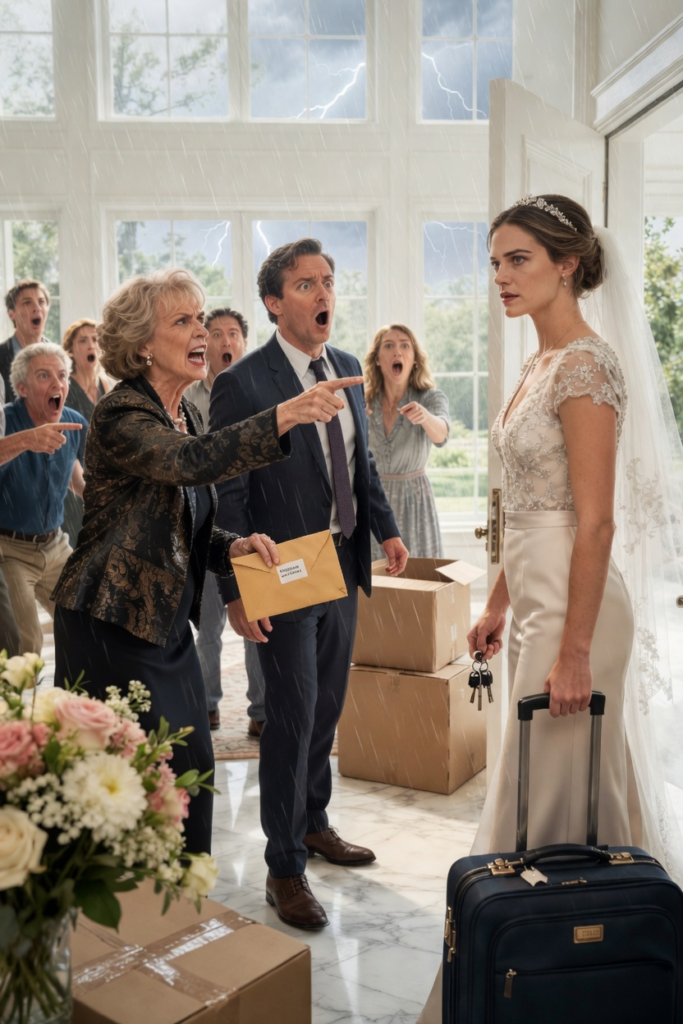
Just 20 Days After Our Wedding, My Mother-In-Law Said To Me: “The Apartment You’re Living In Is Family Property; You Must Pay $1,500 In Rent Every Month.” I Smiled And Replied: “In That Case, I’ll Just Move Back To My Own Apartment.” At That Moment, My Husband Asked… “What Apartment?”
### Part 1
Twenty days after my wedding, the scent of white roses still followed me like a ghost.
I could be standing in the kitchen, waiting for coffee to drip through Brad’s chrome machine, and suddenly I’d be back at the Chicago Botanic Garden, under a white floral arch, my father’s hand trembling around mine as he walked me toward the kind of family people whispered about in country clubs. Bradley Thompson III had looked at me like I was the only woman in Illinois. His blue eyes had been soft, almost wet, when he slid the platinum band onto my finger.
“I do,” he had said.
“I do,” I had whispered back, believing him.
Now I stood barefoot on heated marble in a Gold Coast apartment that still felt like a museum I had accidentally slept in. Three thousand square feet, twenty-three floors above Lake Michigan, furniture old enough to have opinions, art selected by Katherine Thompson’s decorator, not by me. Even the robe Brad wore had been monogrammed by his mother.
“You want coffee, sweetheart?” Brad asked from the doorway.
“I’m good,” I said, staring at the gray lake beyond the glass. “I’ve got a Henderson meeting at ten.”
He smiled in that patient way he’d started using since the honeymoon. “You work too hard. You know you don’t have to anymore.”
There it was, soft as silk, heavy as a hand on my shoulder.
“I like my job,” I said. “I’m good at it.”
“Of course you are.”
He said it lovingly, but not seriously.
Before I could answer, the intercom buzzed. Brad pressed the button.
“Mrs. Thompson is here,” Miguel, the doorman, said.
Katherine. At nine in the morning. No warning.
Brad’s face brightened. “Send her up.”
He didn’t ask me if I had time. He didn’t notice I was still in my robe.
By the time I changed into jeans and a sweater, Katherine was already perched in the living room, ankles crossed, hands folded around a porcelain espresso cup. Her gardenia perfume reached me before her smile did.
“Emma, darling,” she said. “You look rested.”
Not well. Not pretty. Rested. Like I’d been idle.
“Good morning, Katherine. What brings you by?”
“Can’t a mother visit her son?”
Brad sat beside me on the sofa and placed his hand on my knee. It should have felt comforting. Instead, it felt like a label.
Katherine set down her cup. “There’s a small matter Bradley Jr. and I wanted to address. This apartment is a Thompson family asset. It belongs to the trust.”
I waited.
“For tax and estate purposes,” she continued, pulling a document from her Birkin bag, “we need to formalize your occupancy.”
She slid the paper across the glass table.
A lease.
“For market value, this apartment would rent for at least eight thousand a month,” she said. “We’re only asking fifteen hundred. A token amount, really.”
The room went quiet except for the hum of traffic far below.
I looked at Brad. He stared into his coffee.
“You want me to pay rent,” I said slowly, “to live with my husband?”
“It’s just paperwork,” Brad said too quickly. “Legal stuff. Doesn’t change anything.”
But it changed everything.
Katherine’s eyes stayed on mine, cool and bright. She had planned this. They had waited twenty days after the wedding, long enough that I couldn’t call it a trap without sounding dramatic.
A strange calm settled over me.
“Well,” I said, smiling, “then I’ll move back into my own apartment.”
Brad looked up. “What apartment?”
“My apartment in Lincoln Park,” I said. “The one I bought with my grandmother’s inheritance.”
Katherine’s smile froze.
Brad’s expression shifted from confusion to something darker. “You kept it?”
“Of course I kept it. It’s mine.”
For the first time since I had married into the Thompson family, Katherine looked surprised.
I stood, grabbed my bag, and kissed Brad lightly on the cheek. “I’m late for work.”
The elevator ride down felt endless. My phone buzzed before I reached the lobby.
Brad: We need to talk about keeping secrets.
I stared at the words until the screen went dark, wondering why my apartment felt like a secret to him, and why his mother had looked less offended than afraid.
### Part 2
Miguel opened the front door for me with his usual smile. “Have a good day, Mrs. Thompson.”
“It’s Emma,” I said automatically.
He winked. “Ms. Johnson, then.”
That tiny correction almost made me cry.
Outside, April wind sliced off the lake and shoved itself under my coat. Chicago looked clean and hard in the morning light, all glass towers and wet pavement. I walked twelve blocks to my office because I needed the cold air to keep me from shaking.
My Lincoln Park apartment had exposed brick, old hardwood floors I’d sanded myself, and a tiny balcony where I grew basil every summer. It was not grand. It did not have a doorman or lake views or antique French sofas no one was allowed to sit on. But it was mine. I had never hidden it from Brad. I’d shown him photos when we were dating.
“Quaint,” he’d said then, smiling.
I had thought he meant charming.
At noon, my sister Mia was already waiting at RL, wearing her courtroom blazer and the expression she used on lying executives.
“You sounded like someone died,” she said as I sat.
“Just my marriage.”
Her face didn’t change. “What did he do?”
I told her everything: Katherine, the lease, Brad’s silence, my apartment, the text about secrets. Mia listened without interrupting. That was how I knew she was furious.
“So,” she said finally, “twenty days into marriage, your mother-in-law tries to charge you rent to live with your husband, and when you mention your own property, Brad acts like you buried a body in Schaumburg.”
“Basically.”
The waiter came. Mia ordered two glasses of Pinot Noir even though it was Tuesday afternoon.
“Emma,” she said, leaning in, “this is not normal.”
“I know.”
“No, you don’t. You’re telling it like it’s some weird rich-people thing. It’s not. It’s financial control.”
The word control sat between us like a third glass.
Mia pulled out her phone. “Send me your prenup.”
My stomach tightened. “Why?”
“Because men who accuse women of keeping secrets usually have a filing cabinet full of their own.”
The prenup. Brad had handed it to me two days before the wedding. His family attorney, Gregory Stevenson, had called it standard. Brad had kissed my forehead and said his parents were old-fashioned. I had been exhausted from flowers, seating charts, and final fittings. I signed because I loved him, because I wasn’t marrying him for money, because I thought only suspicious people treated marriage like a war.
“I’ll send it tonight,” I said.
“No. Send it now.”
I did.
At work, an enormous arrangement of white roses arrived at four. Same roses as my bouquet. Same perfect, scentless white petals. The card was in Brad’s handwriting.
I’m sorry about this morning. Dinner tonight? I’ll cook. Love you.
Chloe, my assistant, smiled from the doorway. “Newlywed apology?”
“Something like that.”
When I got home, the apartment smelled like garlic, wine, and rosemary. Brad stood at the stove in jeans and a soft gray sweater, looking so much like the man I had married that my heart betrayed me.
“Osso buco,” he said. “Your favorite.”
We ate by candlelight at a table meant for twelve. For a while, he was gentle. He asked about my day. He poured wine. He touched my wrist like he still knew me.
Then he said, “About your apartment.”
I set down my fork. “What about it?”
“If you’re not living there, maybe we should sell it. Put the money somewhere smarter. My advisor could handle it.”
“I have a tenant.”
“We could buy out the lease.”
“I like having it.”
“We don’t need the income, Em.” His smile tightened. “I make enough for both of us.”
“I know. That’s not the point.”
“What is the point?”
“That I had a life before I married you.”
His jaw flexed. “When you married me, you became part of my family. We do things a certain way.”
“Meaning?”
“We consolidate. We plan. We don’t keep separate escape routes.”
Escape routes.
The words hit something deep in me.
Later, Brad held me in bed like nothing had happened. At 2:17 a.m., his phone buzzed. He slipped out quietly, but the bedroom door didn’t close all the way.
“Mom, it’s two in the morning,” he whispered. “No, I didn’t push too hard. If we push, she’ll push back. You don’t know her like I do. I understand what’s at stake. I’ll handle it tomorrow.”
I lay frozen in the dark.
What was at stake? My apartment? My money? Or something I hadn’t even found yet?
### Part 3
The next morning, Brad kissed my temple and acted as if he hadn’t spent the night taking strategy calls from his mother.
“Dinner tonight?” he asked. “Just us. No heavy stuff.”
“Sure,” I said.
He smiled, relieved.
I waited until the elevator doors closed behind him, then changed into a black dress and walked to First National Bank on LaSalle Street. The safety deposit box room was cold enough to raise goose bumps on my arms. An older attendant led me to a private table and left me alone with the small metal box I had opened one week before the wedding.
At the time, I had felt silly. Dramatic. A middle-class woman marrying into money, pretending she needed emergency documents like a spy.
Inside were my passport, birth certificate, apartment deed, financial statements, a copy of my will, and a USB drive with the prenup.
My phone buzzed.
Mia: Call me now.
I stepped outside into the sharp morning sun. “What’s wrong?”
“Where are you?”
“First National.”
“Good. Stay there. I’m five minutes away.”
Her Audi pulled up crookedly at the curb, which told me more than her voice did. Mia never parked badly unless someone deserved prison.
We drove to a small park near the river. She handed me a stack of printed pages with yellow highlights bleeding through the paper.
“Martin from Contracts read it,” she said. “He called it one of the most aggressive prenups he’s seen outside a celebrity divorce.”
My hands went cold.
“It says you disclosed your apartment, savings, retirement account. Around eight hundred thousand in assets.”
“Right.”
“Brad disclosed forty-seven million in liquid assets.”
I stared at her. “What?”
“That’s not counting trusts. The apartment you live in, the cars, the family properties, Thompson Enterprises holdings, all outside marital property.”
I looked down at the page. The words blurred.
Mia tapped a highlighted paragraph. “If you divorce, you get one year of support based on your current income, unless they decide you harmed the Thompson family’s reputation.”
“They decide?”
“In their sole discretion.”
I laughed once, sharp and ugly. “That can’t be real.”
“Oh, it’s real. There’s more. Annual financial reviews. Social conduct clauses. Mandatory mediation with a Thompson-approved arbitrator. And if you have kids, disputes go through experts approved by the family.”
The park around us kept moving. Joggers. Cars. A dog barking at a pigeon. My whole life had shifted, and the city didn’t care.
“They told me it was boilerplate,” I whispered.
“Boilerplate doesn’t have a clause about insufficient deference to family traditions.”
That phrase made me feel sick.
I remembered Brad pressing the pen into my hand two days before the wedding. His thumb had brushed my knuckle. “Just a formality, sweetheart.”
Not a formality. A cage with my signature on it.
That night, Brad chose a dim restaurant with dark wood walls and candles in brass holders. He ordered steak and red wine. He talked about work, acquisition meetings, his father’s blood pressure. Normal husband things.
I waited until the plates arrived.
“I read the prenup.”
His knife stopped.
“Really read it,” I said.
He exhaled through his nose. “Emma.”
“The social standing clause. The financial audits. The children clauses. I want it amended.”
His face closed. “We’ve been married three weeks. Why are you already talking about divorce?”
“I’m talking about fairness.”
“You signed it.”
“I signed it under pressure.”
“My parents paid for a wedding that cost more than most people’s houses,” he said, voice low. “They welcomed you into this family, and now you’re acting like they robbed you.”
“They wrote a contract that treats me like staff.”
His eyes flashed. “That’s not fair.”
“No, Brad. It isn’t.”
For a moment, I saw anger. Not irritation, not hurt. Real anger. Then it vanished, replaced by exhaustion.
“The business is under pressure,” he said quietly. “There’s an environmental lawsuit. It could get ugly. My mother worries about public scandals. The prenup protects you too.”
It was a good answer. Too good.
In the cab home, he held my hand. “Trust me.”
I wanted to. That was the worst part.
Later, in the closet, I texted Mia from the dark.
He says the prenup protects me from a lawsuit.
Her reply came fast.
Maybe. Also, don’t get pregnant.
I stared at those words, one hand drifting toward my stomach, and realized with a slow, cold panic that I was two days late.
### Part 4
Evelyn Shaw’s office looked like a place where hope went to get billed by the hour.
She was in her fifties, gray-eyed, dressed in black, and utterly unimpressed by my new last name. She didn’t offer tea. She didn’t soften the blow.
“I read your prenup,” she said. “You’re in trouble.”
“How much trouble?”
“Are you pregnant?”
The question landed like a slap.
“I don’t know.”
“Find out today.”
She opened a folder. “The Thompson family trust is built like a fortress. Brad’s personal assets are minimal. The rest is protected by entities, trusts, and holding companies. The prenup makes sure you never touch any of it.”
“I don’t want his money.”
“That’s nice. They don’t believe you.”
She pushed the highlighted agreement across the desk. “More importantly, this gives them behavioral control. Reputation. Conduct. Financial activity. Family standards. If you stay, we renegotiate. If you leave, we build a case.”
“What kind of case?”
“Duress. Fraud. Coercive control. Anything we can prove.”
I stared at her. “You make marriage sound like litigation.”
“In your case, it already is.”
When I left, I called Sophia, my best friend from Northwestern and the most relentless investigative reporter I knew.
“Meet me,” she said after hearing my voice. “Twenty minutes. Randolph Street.”
At the coffee shop, I told her everything. She listened with her elbows on the table, eyes narrowing.
“The environmental lawsuit,” she said, “I’ve heard whispers. Old manufacturing site. Groundwater contamination. Sick families. Thompson Enterprises has kept it quiet with NDAs and settlements.”
Brad had made it sound like a business inconvenience. Sophia made it sound like poison.
“The timing is interesting,” she said.
“What timing?”
“You met Brad after the lawsuit was filed. Got engaged as discovery heated up. Married right before depositions. A wholesome bride from Evanston, teacher father, librarian mother, successful but not threatening. That’s useful press.”
“No,” I said, but my voice cracked.
“I’m not saying Brad doesn’t love you. I’m saying people can love you and still use you.”
That afternoon, I bought three pregnancy tests at a Walgreens two neighborhoods away. I paid cash and felt ridiculous for feeling watched.
At home, I locked myself in the guest bathroom. The first test showed two pink lines before the timer even finished.
So did the second.
So did the third.
Pregnant.
I sat on the tile floor, the bathroom smelling faintly of lemon cleaner and fear. I should have felt joy. Brad and I had talked about children in hazy, romantic ways. A boy with his eyes. A girl with my stubborn chin. Sunday pancakes. Lake house summers.
Instead, Evelyn’s voice filled my head.
If you’re pregnant, everything changes.
A knock made me jump.
“Emma?” Brad called. “You okay?”
I shoved the tests into my purse under the sink. “Just not feeling great.”
He opened the door when I came out, tie loosened, smelling faintly of cigar smoke. His hand went to my forehead.
“You’re warm.”
“I’m fine.”
“We can skip dinner with my parents.”
“No,” I said too quickly. “I’ll go.”
At Gibson’s, Katherine was already in the booth, martini untouched, eyes sharp.
“Emma, darling,” she said. “You look pale.”
“Long day.”
Brad’s hand found mine under the table.
Katherine smiled. “Bradley tells me you retained Evelyn Shaw. Interesting choice.”
I looked at Brad. He studied the wine list.
“She’s reviewing documents,” I said.
“Family matters should stay in the family.”
Dinner tasted like metal. Katherine offered a “compromise” on the rent. One thousand a month instead of fifteen hundred. She said it like mercy.
“You want me to pay rent,” I said, “to sleep beside my husband.”
She smiled. “Normal people pay rent, darling.”
After dinner, Sophia called my burner phone while I sat in the closet, shoes pressing into my hip.
“I found something,” she said. “Brad’s ex. Chloe Bennett. Art Institute curator. Serious girlfriend. She got pregnant two years ago.”
My throat closed.
“What happened?”
“She disappeared to Zurich. Signed papers. No social media, no real job history after that. Her roommate said she was crying when she left.”
I thought of the tests hidden under the sink, three little white sticks that had turned my body into a battleground.
Then Sophia said, “Emma, whatever you do, don’t tell Brad yet.”
And in the dark closet, with my husband calling my name from the bedroom, I realized the woman before me hadn’t left Brad’s life.
She had been removed.
### Part 5
I didn’t sleep that night.
Brad did. He slept on his side, one hand curved loosely near my waist, like some part of him wanted to protect me even while the rest of him scared me to death.
At breakfast, Katherine called. Brad put her on speaker before I could leave the kitchen.
“Darling,” she said, “I’ve arranged for us to attend the Children’s Hospital luncheon next week. It’s time you took your proper place.”
“My proper place?”
Brad looked warningly at me over his coffee.
“In the family,” Katherine said, sweet as poison. “You’ll wear the blue dress.”
Not one of my blue dresses. The blue dress. Carolina Herrera. Chosen by Katherine. Altered by Katherine. Approved for photographs.
After Brad left for work, I stood in his study for a long time, listening to the apartment. The refrigerator hummed. A siren wailed somewhere down on Lake Shore Drive. The old clock on the mantel ticked with rich, smug patience.
His laptop sat closed on the desk.
I knew his password. He’d told me months ago when I needed to print boarding passes. His childhood dog, then his birthday. I hated how easy it was.
The screen lit up.
I didn’t know what I expected to find. Emails to Katherine. Financial statements. Something about Chloe.
Instead, there was a folder on the desktop labeled Emma.
Inside were my résumé, college transcripts, credit report, background check, old articles I’d written, photos from my social media going back years. There was a memo dated two weeks after our wedding.
Subject: Postnuptial Considerations re: E. Johnson Thompson.
My stomach went hollow.
The draft agreement was worse than the prenup. More financial disclosures. More conduct rules. Mandatory resignation from employment upon pregnancy. Prenatal medical care through Thompson-approved providers. A clause about reproductive decisions requiring “family consultation.”
In the margin, someone had written: Too aggressive. Discuss with E.
Brad’s handwriting.
Below it, sharper handwriting: Necessary given current situation. Proceed.
Katherine.
I closed the laptop and sat in the leather chair, shaking so hard my teeth clicked.
That evening, I asked Brad about Chloe Bennett.
We were in the bedroom. He was unbuttoning his cuffs, back turned, hair still damp from the shower.
“What about her?” he said.
“You dated her.”
“A long time ago.”
“She was pregnant.”
His hands stopped.
The silence told me more than any answer.
“Who told you that?” he asked.
“Does it matter?”
He turned around slowly. His face had changed. The warmth was gone. “Chloe was complicated.”
“Pregnancy usually is.”
“She wasn’t right for this family.”
The phrase hit me like cold water.
“For this family,” I repeated.
“That came out wrong.”
“Did she leave voluntarily?”
He rubbed his forehead. “Emma, you’re digging into things you don’t understand.”
“Then explain them.”
He came toward me, softening his voice. “It was before us. It has nothing to do with you.”
“It has everything to do with me.”
His gaze dropped for half a second to my stomach.
Half a second. Barely anything. Enough.
“Are you pregnant?” he asked.
I kept my face still. “I’m asking what happened to Chloe.”
“Answer me.”
“Answer me first.”
He exhaled, then sat on the edge of the bed. “She wanted things I couldn’t give her. My mother got involved. There were lawyers. Money. A job overseas. She agreed.”
“She agreed, or she surrendered?”
His eyes flashed. “You think I’m a monster?”
“I don’t know what you are.”
That hurt him. I saw it. I wanted to take it back, which made me hate myself.
“If you were pregnant,” he said quietly, “I’d be happy. Terrified, but happy.”
He looked sincere. He always looked sincere.
Later, after he fell asleep, I sat on the bathroom floor and took the pregnancy tests from under the sink. I wrapped them in tissue, sealed them in a plastic bag, and hid them in the lining of an old suitcase Brad had never noticed.
Then I opened a new note on my phone.
Timeline, I typed.
Day 20: Katherine demanded rent.
Day 21: Brad asked me to sell apartment.
Day 22: Late-night call. “What’s at stake.”
Day 23: Prenup reviewed.
Day 24: Pregnant. Chloe Bennett.
My hands stopped over the keyboard.
Because I finally understood the question.
Was I Brad’s wife, or was I the acceptable version of Chloe?
### Part 6
Katherine’s charm offensive started three days later.
She sent flowers to my office. Not white roses this time. Yellow tulips with a card that said, Fresh beginnings, darling.
At the Children’s Hospital luncheon, she held my elbow so tightly I found crescent marks in my skin afterward. She introduced me to women with pearl earrings and thin smiles.
“My daughter-in-law Emma,” she said again and again. “So accomplished. So devoted to family.”
They asked where I grew up, what my parents did, whether I intended to continue working “after children.”
“Evanston,” I said. “My dad taught high school history. My mom’s a librarian.”
Their smiles dimmed at the edges.
In the car afterward, Katherine sighed. “Must we say high school history? It sounds so political.”
“It’s his job.”
“Was his job,” she corrected. “He’s retired. A long, distinguished career in education sounds better.”
“Better than the truth?”
“Truth needs presentation.”
That night, Brad poured champagne.
“Mom said you did well,” he said.
“She wants me to rewrite my father.”
“She wants you to understand the room.”
“I understood the room perfectly.”
Brad frowned. “The lawsuit is sensitive. Reporters are looking for angles. We need a clean family story right now.”
A clean family story.
I set the champagne down untouched.
After that, I began noticing small things. A file on my desk at work moved overnight. My assistant Chloe asked oddly specific questions about my lunch plans. Brad knew I’d stopped at a pharmacy before I mentioned it. Katherine referenced a conversation I’d had with Mia in a restaurant restroom.
Then I found the camera.
I was home with a migraine, the kind that made light feel like broken glass. Around noon, the pain softened enough for me to wander into Brad’s study looking for a book. As I reached up, a tiny green blink pulsed from the smoke detector.
Not the normal power light.
A lens.
I didn’t touch it.
I walked slowly through the apartment, every nerve alive. A mantel clock with an oddly thick face. A motion sensor in the hallway. A digital thermometer on the refrigerator that I’d never seen Brad use.
At a Verizon store two blocks away, I bought a prepaid phone with cash.
Then I called Sophia from a bench near the park.
“I think the apartment is bugged.”
She went silent for one second. “Don’t say more on that phone. Newberry Library. One hour.”
In a study room that smelled like old paper, Sophia slid a small black device across the table.
“RF detector,” she said. “Basic, but useful.”
“I feel insane.”
“You’re not insane. Thompson Enterprises has a security division. Officially executive protection. Unofficially, rich people hire them when they want problems monitored.”
“Problems like me.”
“Exactly.”
She leaned closer. “I found Chloe. Zurich. But she’s not living like some woman who got a dream job. Her apartment is paid by a shell company linked to Thompson Holdings.”
My mouth dried.
“And there’s a child,” Sophia said. “A boy. About eighteen months old. Name Leo. No father listed.”
For a moment, all sound in the library disappeared.
“She had the baby?”
“Looks like it.”
“Brad’s baby?”
“Maybe. There’s a trust fund. Same offshore structure the Thompsons use.”
That night, I waited until Brad slept, then swept the apartment with the detector.
Smoke detector: shriek.
Mantel clock: shriek.
Kitchen thermometer: shriek.
I stood in our bedroom doorway, watching Brad breathe in the dark. The man who told me he loved my independence had put cameras in the rooms where I cried, dressed, slept.
Or his mother had.
Did that distinction even matter?
The next morning, Katherine called.
“Darling,” she said brightly, “let’s do a spa day. You’ve seemed tense.”
The word tense sounded like a diagnosis.
At lunch after the spa, she watched me push arugula around my plate.
“Bradley says you’ve been tired. Nauseous.”
I went still.
“Stress,” I said.
“Perhaps.” She smiled. “Or perhaps something more joyful.”
Her gaze dropped to my stomach.
I smiled back, and for the first time in my life, I understood prey animals.
Katherine knew, or thought she knew. And if she knew, I had hours, maybe days, before my baby became a Thompson asset.
### Part 7
I planned to deny the pregnancy for as long as I could.
Brad ruined that at breakfast.
Katherine had arrived with croissants from a bakery I disliked and a folder full of “prenatal lifestyle recommendations.” Brad sat beside me, pale and restless, tapping one finger against his coffee cup.
“We need to talk about your career,” Katherine said.
“My career is fine.”
“Sixty-hour weeks are not appropriate for a pregnant Thompson wife.”
The kitchen went silent.
I looked at Brad. He finally met my eyes.
“How did you know?” I asked.
His face crumpled with relief before guilt covered it. “You’ve been sick. You stopped drinking wine. I found the pharmacy receipt.”
I thought I had thrown it away. Apparently not well enough.
Katherine stood and came around the island, taking my face in both hands. Her palms were cold.
“A grandchild,” she whispered. “This changes everything.”
“Does it?”
“Of course. You’ll resign today. Dr. Evans can see you this afternoon. We’ll adjust the trust documents.”
My chair scraped back. “I’m not resigning.”
“Don’t be emotional.”
“I’m not emotional. I’m employed.”
Brad reached for my hand. “Mom’s worried.”
“No. She’s managing inventory.”
His eyes flashed with warning, but I was done taking warnings at my own breakfast table.
I left for work with Katherine calling my name behind me.
At the office, I locked my door and called Sophia.
“They know.”
“Damn it.”
“She wants me to quit and see Dr. Evans.”
“Do not see him,” Sophia said immediately. “He’s tied to Thompson Enterprises. Handles sensitive family medical issues.”
The phrase made my skin crawl.
After work, I told Brad to meet me at the Art Institute. The Hopper room. The place he’d first said he loved me.
He arrived in a navy suit, looking tired and handsome and trapped.
“Tell me about Chloe,” I said.
His face went gray.
“Not the polite version. The truth.”
People drifted around us, whispering in front of Nighthawks, unaware that my marriage was bleeding out beside them.
Brad rubbed both hands over his face. “Chloe got pregnant. The lawsuit had just been filed. The timing was bad. My mother said if it became public, it would destroy the company.”
“So you sent her away.”
“We provided for her.”
“You paid her to disappear.”
“She agreed.”
“Because your lawyers gave her choices?”
He looked at the floor.
I stepped closer. “And Leo?”
His eyes snapped up. “How do you know that name?”
“I know enough.”
His voice dropped. “Emma, stop digging. Please.”
“No.”
He grabbed my arm. Not hard enough to bruise, but hard enough to remind me he could. “You don’t understand what these people can do.”
“These people? You mean your family?”
He let go as if burned.
I told him about the cameras. The postnup draft. The folder labeled Emma. The offshore transfers Sophia had traced.
His face changed with each word. Shock, anger, fear, then shame.
“You went through my laptop.”
“You watched me in my own bedroom.”
“For protection.”
“From who?”
He didn’t answer.
I placed a hand over my stomach. “Here are my terms. I keep my job. I choose my doctor. The cameras go. The prenup gets amended fairly. Katherine stays out of my medical care.”
His laugh was hollow. “You don’t know what you’re asking.”
“I know exactly what I’m asking.”
“My mother will burn the city down before she lets you dictate terms.”
“Then I’ll give Sophia the story.”
His eyes widened. “You wouldn’t.”
“Brad, you married a woman you never bothered to know.”
For a moment, he looked like he might break. “I love you.”
“I believe you think you do.”
That hurt him more than yelling would have.
He agreed to the cameras. Agreed to the doctor “for now.” Agreed I could finish the Henderson campaign. On the prenup, he only said, “I’ll try.”
Try was not enough.
As I walked out of the museum alone, my phone buzzed with a message from Sophia.
Found Geneva clinic payments. Chloe story may be bigger than a secret child.
I stopped on the steps, cold air filling my lungs.
Bigger than a child? What could be bigger than that?
### Part 8
The cameras disappeared three days later.
A technician came while I was at work. When I got home, the smoke detector was open on the table, wires exposed like veins. Brad had left a note beside the parts.
Done. I love you.
It should have felt like progress.
Instead, my assistant Chloe was fired that afternoon.
“Restructuring,” my boss said, not meeting my eyes.
I found Chloe in the supply room, crying into a paper towel.
“They offered me six months’ severance if I signed an NDA,” she whispered. “A woman from Thompson Enterprises HR said it would be better for everyone.”
My stomach dropped. “Were you reporting on me?”
She sobbed harder. “I’m sorry. I thought it was security. Your schedule, visitors, if you seemed stressed. I didn’t know.”
I believed her, which made it worse.
That night, I confronted Brad.
“You fired my assistant.”
“She was reporting to my mother.”
“So you bought her silence.”
“We protected you.”
I almost laughed. The Thompsons used that word the way other families used salt.
The doorbell rang at nine.
Katherine swept in carrying a manila folder. She didn’t take off her coat.
“Gregory finalized the postnup,” she said. “You sign tonight.”
“No.”
Her smile was calm. “Then we proceed with option two.”
Brad went still. “Mom.”
“What option two?” I asked.
“A legal separation petition. Emergency medical oversight. Your recent behavior has been unstable.”
“Unstable because I found your cameras?”
“Because you are pregnant, secretive, hostile, and associating with people who intend to harm this family.”
I looked at Brad.
He poured scotch and drank it too fast.
“Say something,” I told him.
He closed his eyes. “Sign it for now. We’ll fix it later.”
The words cut cleaner than betrayal usually does. No shouting. No slammed door. Just my husband asking me to surrender because resisting was inconvenient.
Katherine placed the agreement on the table. “Initial pages three, six, and nine. Full signature at the end.”
I stared at the document, then at her.
“I’ll sign if I see the offshore account statements.”
Brad’s head jerked up.
Katherine’s eyes narrowed. “Excuse me?”
“The Cayman account. The Zurich payments. I want to know what my marriage is worth.”
Silence.
Then Katherine gave Brad one sharp nod.
He opened a banking app and handed me his phone.
The transfers were there. Three hundred thousand after our wedding. Monthly payments to Zurich. But lower in the history, older transactions caught my eye.
One hundred thousand to a Geneva medical clinic.
Then two hundred thousand more.
Centre Medical de la Fertilité.
“Fertility treatment?” I asked.
Brad looked sick.
Katherine’s voice turned icy. “Private medical arrangements.”
“For Chloe?”
Brad whispered, “It wasn’t what you think.”
“Then what was it?”
Katherine answered for him. “Chloe wanted a child. Bradley helped fund the process. A donor was used. The child is not biologically Bradley’s.”
I stared at Brad. “Is that true?”
His silence was awful.
“It was a mistake,” he said finally. “I was trying to help.”
“A business arrangement?” I asked.
Katherine’s smile returned. “An unfortunate misunderstanding.”
The room tilted. Had Sophia been wrong? Had Chloe’s son never been Brad’s? Or was this just another better-packaged lie?
I signed the postnup with a hand so steady it didn’t feel like mine.
Emma Grace Johnson.
Then, under it, Emma Grace Thompson.
Two names. Two women. One trapped.
After Katherine left, I told Brad I needed to sleep alone. In the guest room, I retrieved my second burner phone from a vent behind the headboard.
I texted Malcolm, the private investigator Evelyn had recommended.
Need everything on Centre Medical de la Fertilité, Geneva. Chloe Bennett. Two years ago. Rush.
His reply came minutes later.
Clinic has powerful clients. This will cost double.
I typed back:
Triple, if you prove who the father is.
Then I lay in the dark with one hand over my stomach, wondering whether my baby was loved, wanted, or simply the Thompson family’s next clean transaction.
### Part 9
Katherine allowed me one meeting with Sophia.
Allowed. That word alone should have made me run.
We met at the Peninsula tea lounge. A security man stood near the entrance with his hands folded in front of him, pretending not to watch us. Katherine sat in the lobby like a queen awaiting tribute.
Sophia stood when I approached. “You look awful.”
“I signed it.”
Her face hardened. “Emma.”
“I had to buy time.”
We sat. Bone china clinked around us. Women laughed softly over finger sandwiches. Everything smelled like bergamot and money.
“Tell me Geneva,” I said.
Sophia leaned close. “Malcolm found a former clinic administrator. Chloe was a patient, but not for IVF. She was already pregnant when she arrived.”
My breath caught.
“Four months,” Sophia said. “High-risk prenatal care. Brad was listed internally as biological father.”
I closed my eyes.
“The two-hundred-thousand-dollar payment wasn’t fertility treatment,” she continued. “It was tied to delivery costs and a sealed adoption file.”
“Adoption?”
“The baby didn’t stay with Chloe.”
The room blurred.
“Then where is he?”
“Unknown. The file is sealed. But there’s a flight record. Geneva to London. Private jet. One infant listed as Thompson, L.”
The security man began walking toward us.
Sophia grabbed my hand under the table. “They took her baby, Emma.”
I couldn’t breathe.
The guard stopped beside us. “Time’s up, Mrs. Thompson.”
“One more minute,” I said.
“Now.”
Sophia shoved a folded napkin toward me. He snatched it first, opened it, and crumpled the phone number inside.
“No contact,” he said.
Katherine was waiting in the lobby. “Sentimental goodbyes are so messy. Come. Dr. Evans is expecting us.”
“I’m not seeing him.”
“You signed an agreement requiring proper prenatal care. Evans is proper.”
His office looked like a luxury hotel suite. Cream walls. Soft lighting. Fresh orchids. Dr. Evans had gentle hands and empty eyes.
“Let’s confirm dates,” he said.
The ultrasound gel was cold. The screen flickered, then a tiny shape appeared, curled like a comma. A heartbeat filled the room, fast and miraculous.
“Ten weeks, three days,” Evans said.
Katherine smiled from the corner. “Ten weeks. How wonderful.”
I had told them eight.
My buffer was gone.
“We’ll do genetic screening today,” Evans said, preparing a needle.
“For what?”
“Standard markers. Also predispositions. Mental health history. Temperament indicators, when available.”
“Temperament?”
Katherine’s voice was smooth. “For trust planning.”
They were testing my baby to see if it was good enough to inherit a cage.
That night, cramps woke me at 2:00 a.m.
Sharp pain tore across my lower abdomen. I curled around it, gasping.
Brad shot upright. “Emma?”
“Hospital,” I said. “Not Evans. Northwestern.”
“Evans can meet us—”
“No.” I gripped his wrist. “Northwestern. Now.”
The emergency room was bright, loud, and smelled like antiseptic. I gave them Dr. Lena Rodriguez’s name, the doctor Sophia had recommended. Brad argued, but I was the patient.
Dr. Rodriguez arrived with kind eyes and a voice that did not bend.
After examining me, she said, “The baby’s heartbeat is strong. But your blood pressure is dangerously high. Stress can do real harm.”
Then she looked at me carefully. “Do you feel safe at home?”
The question broke me.
I told her everything. Surveillance. Postnup. Evans. Geneva. Katherine.
She listened without interrupting.
“I’m admitting you overnight,” she said. “Observation. That gives you time in a safe place. Call someone you trust.”
I called Mia from the hospital phone.
“I’m at Northwestern,” I said. “The baby’s okay. I’m not. Bring Evelyn.”
Mia’s voice went instantly awake. “I’m coming.”
As I hung up, I saw Brad through the glass, sitting in the hallway with his head in his hands.
He looked devastated. He looked frightened.
And for the first time, I wondered whether he was afraid for me, or afraid I had finally escaped.
### Part 10
Mia arrived before dawn in leggings, a trench coat, and the expression of a woman ready to sue God if necessary. Evelyn arrived twenty minutes later with a leather briefcase and no visible emotion.
I gave them the burner phone with Malcolm’s message.
Have file. Hard copies only. Too sensitive for digital. Meet tomorrow.
Evelyn read it twice. “If this proves a pattern of reproductive coercion, it could unwind the postnup and give us leverage against the entire family.”
“Leverage,” I said. “That word again.”
“It’s ugly because it works.”
Mia sat on the bed beside me and took my hand. “You’re not going to that meeting.”
“I have to.”
“No. You’re pregnant, in the hospital, and being watched.”
“She’s right,” Evelyn said. “But Malcolm may not release it to anyone else.”
“Then I go,” Mia said.
I shook my head. “He doesn’t know you.”
For once, Evelyn hesitated. Then she said, “We’ll do it carefully.”
At six, Brad was allowed into my room. He looked destroyed, hair rumpled, shirt wrinkled, eyes red.
“The baby’s okay,” I said.
He exhaled like he’d been holding his breath for hours. “Thank God.”
“We need to talk about Leo.”
All color left his face.
I told him what Sophia had found. Prenatal care. Adoption file. Flight to London. His name as biological father.
Brad sat down slowly.
“It was my mother’s idea,” he whispered.
That sentence was not innocence. It was confession.
“Chloe was pregnant. Mom said Chloe wasn’t suitable, but the child could still be useful. Thompson blood. Raised by the right people. No scandal. No messy mother. Chloe would be paid.”
My whole body went cold. “Useful?”
His face twisted. “I was a coward. I told myself the child would have a better life. I told myself Chloe agreed.”
“Did she?”
He covered his face. “Not really.”
A silence fell so heavy I could hear the monitor beside my bed ticking with my pulse.
“Why tell me now?” I asked.
“Because I don’t want to do it again.”
“To me.”
“To you. To our baby.” His voice broke. “Emma, I love you.”
I believed, finally, that he did.
I also understood that his love had never been stronger than his fear.
“Then testify,” I said. “Tell the truth.”
He looked at me like I’d asked him to cut off his own hand. “My mother will destroy me.”
“She already did.”
The door opened.
Katherine entered with Dr. Evans behind her and two security men in the hall.
“Bradley,” she said, voice clipped. “I’ve arranged Emma’s transfer to a private facility. She needs rest away from outside influences.”
A private facility. A locked place. A place where Katherine’s doctors could decide I was unstable.
“No,” I said.
Katherine ignored me. “Bradley, sign the consent.”
Brad stood. For a second, he was a boy in front of his mother, all terror and obedience.
Then he stepped between us.
“No.”
Katherine blinked. “Excuse me?”
“She stays here. With her doctor.”
Her face hardened. “Do not embarrass yourself.”
“No,” he said again, louder. “Get out.”
I had never seen Katherine speechless. It lasted only a moment, but I kept it like a photograph.
“You foolish boy,” she whispered. “You have no idea what you’ve done.”
After she left, Evelyn got a call. Her expression sharpened.
“Katherine just filed an emergency petition claiming you’re endangering the pregnancy and family interests. Hearing in two hours.”
Brad sat down hard.
Mia swore.
Evelyn looked at me. “We need the Geneva file now.”
Against medical advice, with Dr. Rodriguez documenting my condition and Mia hovering like a guard dog, I left the hospital through a side exit.
Malcolm met us inside the Cultural Center, near a quiet marble stairwell. He wore a Cubs cap and carried a plain envelope.
“They’re watching Michigan Avenue,” he said. “This has everything.”
I opened it with shaking hands.
Clinic forms. Brad listed as father. Adoption contract. Payments. A flight manifest to London. Names of the adoptive parents.
Charles and Eleanor Vance.
“Distant cousins,” Brad whispered behind me.
I turned. He had followed us.
“Emma,” he said urgently, “my mother’s judge is already moving. Evelyn says we need to file first.”
I clutched the envelope to my chest.
The truth was finally in my hands, but Katherine was already reaching for my child.
### Part 11
Evelyn filed first.
That was all she cared about for twenty frantic minutes: time stamps, jurisdiction, exhibits, emergency motions, the kind of legal chess that made my head spin. I sat in her conference room with a hospital bracelet still around my wrist, one hand on my stomach, while Mia paced and Brad stared at the Geneva documents like they might burst into flames.
The hearing happened in Judge Alvarez’s chambers, not a courtroom. That made it worse. No distance. No gallery. No place to hide.
Katherine arrived in a cream suit with Gregory Stevenson at her side. She didn’t look at me. She looked at Brad like he had died and disappointed her by continuing to breathe.
Gregory began smoothly. “Your Honor, Mrs. Emma Thompson has demonstrated erratic behavior, including fleeing medical supervision, consorting with private investigators, and creating stress that may endanger the unborn Thompson heir.”
Judge Alvarez, silver-haired and sharp-eyed, lifted one hand. “I’ve read your filing.”
Evelyn stood. “Then I hope Your Honor has also read ours.”
“I have,” the judge said. “The exhibits are disturbing.”
Katherine’s jaw tightened.
Evelyn placed the Geneva file on the desk. “We can show a documented pattern. The Thompson family used money, medical pressure, surveillance, and legal threats to separate a pregnant woman from her child. My client is now facing the same machinery.”
“That is outrageous,” Katherine snapped.
Judge Alvarez looked at her over reading glasses. “Mrs. Thompson, let your lawyer speak.”
Gregory’s smile thinned. “The Swiss adoption was private, legal, and irrelevant.”
“Then unseal it,” Evelyn said.
Katherine went still.
There it was. The crack.
Judge Alvarez turned to Brad. “Mr. Thompson, you are named in both matters. Where do you stand?”
Brad looked at his mother.
Her eyes ordered him home.
Then he looked at me.
“I stand with my wife,” he said.
The room changed.
Katherine made a sound low in her throat.
Brad’s voice shook, but he continued. “The adoption was coerced. Chloe Bennett was pressured. I participated. I’m ashamed. My mother is trying to control Emma’s pregnancy in the same way. I withdraw support for any petition against my wife.”
Katherine stood. “You idiot.”
“Sit down,” Judge Alvarez said coldly.
Katherine did not sit. Gregory pulled her sleeve until she did.
Judge Alvarez granted a temporary restraining order against Katherine. No contact. No third-party contact. No medical interference. No surveillance. I was granted exclusive use of my Lincoln Park apartment, and Brad’s visits would be arranged through counsel.
When the judge said “for the safety of the mother,” my throat tightened.
Mother.
Not asset. Not heir vessel. Mother.
Afterward, in the hallway, Brad approached me.
“I’ll send your things,” he said. “I’ll stay at the club.”
“Thank you.”
His eyes filled. “Emma, Leo…”
“When this is over,” I said, “tell the truth about him. All of it.”
He nodded.
I did not hug him.
Katherine passed us on her way out. Her face was pale with rage.
“You think a teacher’s daughter can break this family?” she whispered.
Mia stepped forward. “Try violating that order and find out.”
Katherine smiled at me, thin and venomous. “This is not over.”
I believed her.
That night, I slept in my Lincoln Park apartment for the first time in months. The air smelled faintly of dust, old wood, and the peppermint tea I used to drink before Brad. My herbs on the balcony were dead, brown stems rattling in the wind, but the brick wall glowed warm under the streetlight.
I locked the door.
Then I locked it again.
For the first time since my wedding, no one was watching me sleep.
But at 1:06 a.m., my old phone lit up with a message from a blocked number.
You can’t protect what already belongs to us.
### Part 12
The story broke on a Thursday morning.
I was making toast in my small kitchen, wearing sweatpants and one of my father’s old Northwestern hoodies, when Sophia called.
“Don’t panic,” she said, which of course made me panic.
“What happened?”
“Tribune. Business section. It’s live.”
The headline filled my screen.
Thompson Empire Rocked by Secret Adoption Scandal Amid Environmental Lawsuit
Below it was Sophia’s article. Not my name, not directly. She had protected me where she could. But the shape of the story was unmistakable: wealthy family, pregnant bride, surveillance, medical pressure, Geneva adoption, a woman in Zurich silenced by money and fear.
My hands shook so badly the toast burned.
By noon, every Chicago outlet had picked it up. By three, national sites were using words like dynasty, coercion, and toxic inheritance. By five, Thompson Enterprises released a statement calling the allegations “deeply misleading.” By six, Chloe Bennett gave a short interview from Zurich.
I watched it alone on my laptop.
She looked thinner than in the photos Sophia had shown me. Older, somehow, though she couldn’t have been more than thirty-five. Her hair was pulled back, her face bare.
“I was told I had no choice,” Chloe said, voice trembling but clear. “I signed papers I did not understand because I was scared. I want to know where my son is.”
I cried for her. For Leo. For myself. For every woman who had mistaken expensive rooms for safety.
Brad came the next day with a box of my remaining things. He stood in my living room, looking around at the exposed brick, the mismatched bookshelves, the thrift-store lamp I loved.
“It feels like you,” he said.
“It is me.”
He nodded, absorbing the wound.
“My father had a heart episode,” he said. “Mild. The board is forcing him to step back. My mother’s been removed from all family committees.”
“I’m sorry about your father.”
“Don’t be sorry about my mother.”
I didn’t answer.
He set the box down. Inside were my books, framed photos, a sweater, and the little ceramic bowl my grandmother had made in a pottery class. The bowl had a crack down one side. Katherine’s staff had packed crystal safely but not this.
Brad saw my face. “I’ll replace it.”
“You can’t.”
He flinched.
We stood in the quiet.
“I’m filing for divorce,” I said.
He closed his eyes.
“I know.”
“I won’t reconcile.”
“I know,” he said again, softer.
“Do you?”
He looked at me then, really looked. Not like a husband trying to persuade. Like a man finally arriving late to the truth.
“I love you,” he said.
“I know.”
“And it doesn’t matter.”
My throat tightened. “No. It doesn’t.”
He nodded once, as if accepting a sentence.
We worked out temporary arrangements through Evelyn. Brad could attend medical appointments only if I invited him. Katherine could not come near me, my apartment, my workplace, or my doctor. The postnup was challenged and suspended pending review. My job remained mine.
The Henderson campaign launched two weeks later. I presented from a conference room with swollen ankles and a ginger candy tucked in my cheek. When the client approved the final direction, my team applauded. I went to the restroom and cried quietly, not because of Brad, but because some part of me had been afraid I’d never again be a person who could finish something.
That evening, Mia brought Thai food and assembled the crib with profanity and a power drill. Sophia sat cross-legged on the floor, reading instructions upside down.
“You know,” Mia said, tightening a screw, “Grace Johnson has a nice ring to it.”
I touched my stomach. “Grace?”
“For Nana.”
The baby kicked.
All three of us froze.
Then Sophia whispered, “Well, she voted.”
For one soft minute, the room filled with laughter instead of fear.
Then my phone buzzed.
Unknown number.
A photo appeared.
A little boy with Brad’s blue eyes stood in an English garden, holding a red toy truck.
Under it, one line:
Leo is closer than you think.
### Part 13
I sent the photo to Evelyn, Sophia, and Brad.
Brad called within thirty seconds.
“Where did you get this?”
“Unknown number.”
He sounded like he was running. “That’s him. That’s Leo.”
“You’re sure?”
“I get a photo once a year through Gregory. Same eyes. Same scar near his eyebrow.” His voice broke. “Emma, that’s my son.”
The photo had not come from Katherine. Evelyn’s investigator traced the number to a prepaid phone activated near Heathrow. Sophia found out that Charles and Eleanor Vance had quietly left Surrey two days after the Tribune article ran. Chloe’s Swiss attorney filed to unseal the adoption. A British family court opened a review.
The Thompson machine was cracking in countries I had never visited.
But my own life became smaller, and I was grateful for that. Work. Doctor appointments. Prenatal yoga where I mostly lay on a mat and tried not to resent women with uncomplicated husbands. Sunday dinners with my parents, who never once said I told you so, though my father’s jaw worked every time Brad’s name came up.
Brad attended one ultrasound at my invitation. He cried when he learned the baby was a girl.
“A daughter,” he whispered.
“Yes.”
He looked at me carefully. “Grace?”
I stiffened. “How did you know?”
“Mia told me. Accidentally. She threatened to kill me if I made it weird.”
Despite myself, I laughed.
He smiled, then lost it quickly. “It’s a beautiful name.”
“It’s her name.”
“I know.”
The divorce moved faster than I expected because Brad didn’t fight it. Evelyn said guilt could be legally useful, which was the most Evelyn sentence imaginable.
At the first hearing, Brad agreed to child support, medical expenses, strict custody guidelines, no unsupervised contact with Katherine, no Thompson doctor unless I approved, no press access to Grace, no trust documents I didn’t review with my own counsel.
Outside the courtroom, Katherine waited.
She looked older. Not humbled. Never that. But reduced, like someone had turned down the light behind her.
“You think you’ve won,” she said.
I rested a hand on my stomach. “I think I survived.”
“That child is Thompson blood.”
“She is my daughter.”
Katherine’s eyes burned. “Blood finds its way home.”
Evelyn stepped between us. “That’s a restraining order violation waiting to happen. Leave.”
Katherine looked past Evelyn, straight at me. “You’ll get tired. Women like you always do. Independence is charming until the bills arrive.”
I smiled then, because finally she had said something truly stupid.
“I paid my own bills before Brad. I’ll pay them after him.”
She walked away first.
I kept that victory too.
Six months after the wedding, I went into labor during a thunderstorm. Rain hammered the hospital windows. My mother held my hand. Mia argued with a vending machine in the hall. Sophia brought a notebook, then cried too hard to write anything.
Brad waited outside until I said he could come in.
When Grace was born, she screamed like she had an objection to the entire world and expected immediate correction. The nurse placed her on my chest, slippery and warm and furious. Her tiny fist opened against my skin.
“Hi, baby girl,” I whispered. “I’m your mom.”
The room narrowed to her breath, her weight, her damp hair under my lips.
Brad came in later. He washed his hands twice before touching her. When he held Grace, his face folded with tenderness so raw I had to look away.
“She’s perfect,” he said.
“She is.”
“I started therapy,” he said quietly. “Real therapy. Not family-approved damage control.”
“Good.”
“I’m going to England next month. Chloe agreed to meet me. Maybe Leo too, eventually.”
“I hope you do right by him.”
“I will try.”
I looked at him over our daughter’s sleeping face. “Trying is for practice. He needs more than that.”
Brad nodded. “I know.”
For once, I believed that he did.
But belief was not forgiveness, and tenderness was not a door back in.
When he left, I held Grace close and watched rain smear the city lights into gold.
### Part 14
The final divorce decree arrived by email on a quiet morning in September.
Grace was asleep in a sling against my chest, making tiny humming sounds like an old refrigerator. My apartment smelled like coffee, baby shampoo, and the basil I had replanted on the balcony. Sunlight touched the exposed brick wall. The hardwood floor creaked when I crossed the room.
Everything was smaller than the Gold Coast apartment.
Everything was mine.
I read the decree twice. Evelyn had already reviewed it. My name would return fully to Emma Grace Johnson. Grace would carry Johnson as her legal last name, with Thompson listed for Brad’s parental records but not as her identity. Brad had accepted it after one painful conversation.
“She’ll know who I am?” he had asked.
“Yes,” I said. “But she won’t belong to your family.”
He had nodded, eyes wet. “Fair.”
Fair. A small word. A hard-won one.
Katherine had moved to Switzerland “for health reasons,” which Sophia said meant the board had exiled her politely. Thompson Enterprises settled the environmental lawsuit for an amount nobody would confirm but everyone called historic. Bradley Sr. retired. Gregory Stevenson resigned from two nonprofit boards and stopped appearing in society pages.
Chloe Bennett’s case moved slowly, but it moved. Leo had been located with the Vances. Chloe had seen him once under court supervision. Brad had flown to London and sat in a waiting room for four hours before being told the child wasn’t ready.
He sent me one message afterward.
I deserve this.
I replied:
Leo does not. Keep showing up.
That was the kindest thing I had left for him.
He came to see Grace twice a week. He brought diapers, not toys chosen by assistants. He learned how to warm bottles and how to sit through her crying without panicking. Sometimes I saw the man I had loved. Sometimes I saw the boy Katherine had built. I never confused either of them with a husband again.
One evening, when Grace was three months old, Brad stood in my doorway after a visit. Rain tapped softly against the windows.
“I know I don’t have the right to ask,” he said, “but do you think someday you could forgive me?”
Grace slept in my arms, her cheek pressed against my collarbone.
“No,” I said.
He looked down.
“I hope you become better,” I continued. “I hope you become the father Grace deserves. I hope you find Leo and spend the rest of your life making amends. But forgiveness is not a debt I owe you because you finally told the truth.”
He nodded slowly. “I understand.”
I wasn’t sure he did. But he left without arguing.
After I signed the decree, I printed one copy and placed it in the same safety deposit box where I had once hidden my passport, apartment deed, and prenup. The old documents were still there, but they no longer felt like emergency supplies. They felt like proof.
Proof that I had been cautious.
Proof that I had not been cautious enough.
Proof that I got out anyway.
That night, Mia and Sophia came over with takeout, grocery-store flowers, and a bottle of sparkling cider because I was still nursing. My parents arrived with a lasagna and enough opinions to feed the building. We ate from mismatched plates on the floor because the dining table was covered in baby laundry.
Grace slept through all of it, one tiny fist raised beside her face like a judge calling order.
“To Emma Johnson,” Mia said, lifting her plastic cup.
“To Grace Johnson,” Sophia added.
My mother wiped her eyes. My father pretended not to.
I looked around my little apartment: deadbolts, brick, basil, women laughing, my daughter breathing, my name restored.
Twenty days after my wedding, my mother-in-law had asked me for rent.
She thought she was reminding me I owned nothing in her world.
Instead, she reminded me I already had a home, a name, and a life she had never been able to buy.
I did not forgive them.
I did not go back.
I signed the last paper, kissed my daughter’s warm forehead, and turned off the light in my own apartment, where the silence did not feel like a threat anymore.
It felt like safety.
It felt like home.
THE END!