When my son and daughter-in-law failed to show up for my housewarming party, I did not cry, call, or send a wounded little text asking where they were. I did not stand at the front window waiting for headlights that never turned into my driveway. I did not apologize to my guests for their absence or make excuses about traffic, exhaustion, or one of Chloe’s sudden headaches that always seemed to arrive whenever the attention in a room was not arranged around her.
I simply refilled the wine, served the crab cakes while they were still hot, and let my friends admire the house I had bought with my own money.
That was new for me.
For most of my life, I had been the kind of woman who softened every blow before it landed, especially when it came from family. I explained people’s bad manners before anyone else had to notice them. I turned selfishness into stress, neglect into busyness, entitlement into youth, and cruelty into misunderstanding. I had done it as a wife, as a mother, as a widow, and, most dangerously, as a woman who had convinced herself that being needed was almost the same as being loved.
It is not.
Need can look like love from a distance. It can call you Mom. It can hug you in the driveway and say, “I don’t know what we’d do without you.” It can show up at your kitchen table with red eyes and unpaid bills and a story about how this month was just unusually hard. It can make you feel noble while it quietly empties your bank account, your peace, and eventually your self-respect.
Love, real love, does not ask for a key to your house the morning after it could not be bothered to attend your celebration.
My name is Evelyn Whitaker. I was sixty-four years old the night I stood in the great room of my new coastal estate, barefoot on pale oak floors, listening to the last echoes of laughter fade into the rafters. Outside, beyond the glass wall of the living room, the Atlantic was only a dark shimmer under a half moon. The tide rolled in and out beyond the dunes with the steady patience of something that had seen human foolishness for thousands of years and never once been impressed.
The house was ridiculous in the best possible way. Three stories of white cedar shingles, slate roof, tall windows, and wide porches that wrapped around the back like open arms. It sat on two acres just north of Newport, Rhode Island, where the air smelled of salt, cut grass, and old money. I had not grown up with old money. I had grown up in a split-level outside Providence with a father who repaired marine engines and a mother who stretched a pot roast into three dinners. I had spent my childhood believing wealth was something that happened to other people in houses we drove past slowly on Sunday afternoons.
And now I owned one of those houses.
Two point five million dollars, wired in full after years of careful investing, one business sale, one life insurance payout I wished I had never had to receive, and the stubborn refusal to spend the rest of my life shrinking just because my husband was gone.
My late husband, Daniel, would have loved that house.
He would have pretended not to at first. He would have walked through the foyer, looked up at the staircase curving like something out of a movie, and said, “Evie, this is too much house for two people.” Then he would have found the back porch, seen the ocean, and stood there with his hands on his hips, quiet for a long time. That was how Daniel loved things. He grew still around them. After thirty-eight years of marriage, I could read his silences better than most people’s speeches.
He had been gone four years by then.
Four years, and I still sometimes turned to tell him something. Not the big things. Those I had learned to carry differently. It was the small things that betrayed me. A gull stealing bread from someone’s picnic. A neighbor painting his front door the exact wrong shade of green. A new brand of coffee that tasted like burnt acorns and dishonesty. I would think, Daniel needs to hear this, and then the world would tilt for half a second before righting itself again.
Buying the coastal house had been the first major decision I made without imagining his vote. Not because I had stopped loving him, but because grief, if you survive it long enough, eventually asks whether you intend to keep living too.
I intended to.
The housewarming party was meant to mark that.
My friends arrived in a cheerful procession of flowers, wine, pastries, and compliments. Nora from my book club cried when she saw the view from the kitchen. “This is not a house,” she declared, pressing one hand dramatically to her chest. “This is a Nancy Meyers movie with better lighting.” My old neighbor Teresa brought a lemon olive oil cake and told everyone three separate times that I had “earned every square inch.” My cousin Margot showed up in a linen jumpsuit and said, “If I disappear tonight, check the guest suite closet, because I may be moving in.”
I laughed more that night than I had in months.
The kitchen was my favorite room. It had a white marble island long enough to land a small airplane on, deep blue lower cabinets, brushed brass hardware, and windows over the sink that faced the garden. I had chosen every detail myself. Not for resale. Not for children. Not for imagined future grandchildren covered in jam. For me. For the way morning light crossed the floor. For the way my hands felt resting on the smooth stone. For the quiet satisfaction of opening drawers and finding exactly what I had chosen to put there.
All evening, people moved through the house exclaiming over one feature or another. The library with built-in shelves waiting to be filled. The sunroom with its wicker chairs and lemon trees. The west wing, which at that point still held two beautifully prepared guest suites, each with fresh linens, thick towels, and little ceramic dishes of wrapped mints because I had once stayed in a bed-and-breakfast in Maine that did the same thing and had never forgotten it.
“Julian must be thrilled,” Nora said at one point while we stood near the fireplace.
I smiled. “I hope so.”
“Is he coming tonight?”
“He said they would.”
That was before the text.
It came at 7:18, just as I was carrying a tray of warm mushroom tartlets from the kitchen to the dining room.
Mom, sorry. Chloe is completely wiped out. She wants to sleep in tomorrow. We’ll swing by some other time. Hope it goes great.
I stood there with the tray in my hands while the party hummed around me. Music low through hidden speakers. Laughter near the bar cart. Someone admiring the staircase. My thumb hovered over the screen.
For a moment, the old Evelyn rose up. The mother who would have typed, Of course, sweetheart. Tell Chloe to rest. Love you. The woman who would have taken their absence and wrapped it carefully so it did not cut anyone else. The widow who would have told herself, Don’t be dramatic. Young people are busy. It’s only a party.
But something in me had shifted in the months between signing the closing documents and hosting that party.
Maybe it was the house. Maybe it was the ocean. Maybe it was simply age. There is a clarity that comes when you realize you have fewer years ahead than behind, and not all of them should be spent begging people to treat you decently.
I read the text once.
Then I locked my phone and carried the tray into the dining room.
“More tartlets,” I announced.
No one at the party knew anything had happened. That felt important. For once, I did not let Julian and Chloe’s choice become the center of my evening. I did not step into the hallway to call. I did not apologize for them. I did not explain their absence with that strained, loyal smile mothers use when their children disappoint them in public. I did not give Chloe the satisfaction of being discussed.
I let my friends celebrate me.
Later, after everyone left, I walked through the house alone, collecting glasses and crumpled cocktail napkins. My heels were by the stairs, abandoned around ten o’clock when Teresa insisted that “women over sixty with good wine do not need to suffer for elegance.” The dishwasher hummed. The last candle on the mantel was burning low. Outside, the garden lights glowed softly along the stone path.
I checked my phone again before bed.
No follow-up from Julian.
No message from Chloe.
No apology. No congratulations. No “Can’t wait to see it.”
Just absence.
I went upstairs, washed my face, and stood for a long time at the window in my bedroom, looking out toward the black ocean. My room was enormous, with a fireplace, a sitting area, and French doors to a private balcony. The first night I had slept there, I had felt almost guilty. As if comfort beyond a certain size required permission. Women of my generation were trained to justify pleasure. We could buy nice things if they were practical, if they were for the family, if they represented investment or hospitality or sacrifice in a better dress. Buying beauty for its own sake felt faintly dangerous.
But I had bought the house because I wanted it.
That night, for the first time, I said it out loud.
“This is mine.”
The words sounded strange in the quiet room.
Then they sounded true.
I slept better than I expected.
The next morning, I woke just after seven to gulls screaming above the dunes and sunlight spilling over the bed. I made coffee in the kitchen, took it out to the back patio, and sat wrapped in a cream cardigan while the ocean wind lifted my hair. The garden still smelled faintly of last night’s party: trampled grass, roses, smoke from the outdoor fire pit. I opened the news on my tablet and tried to read about interest rates, but the pleasure of the morning kept distracting me.
At 8:36, my phone buzzed.
Chloe.
Saw the pictures. Nice place. Julian and I need a key this afternoon so we can come and go whenever.
No good morning.
No apology.
No “I’m sorry we missed your party.”
No “Congratulations on the home you built from grief and discipline and years of work.”
Just: We need a key.
I stared at the message with my coffee halfway to my mouth.
Chloe Whitaker had always possessed a special talent for turning assumptions into instructions. She did not ask whether she could host Thanksgiving at my old house; she texted me a menu and told me which dishes I should prepare. She did not ask whether I could watch her dog while she and Julian went to Miami; she sent me the pickup time and the vet’s number. She did not ask whether I would contribute to their anniversary trip; she told me Julian was “too proud” to mention they were short and then sent a link to the resort.
She had been in my life for six years, married to Julian for four, and in that time she had learned exactly where the old me was soft.
The old me would have tried to negotiate the tone.
The old me would have written, Sweetheart, let’s talk about it when you visit.
The old me would have called Julian and asked whether Chloe was upset.
The woman sitting on the patio of her own coastal estate, drinking coffee she had bought, in a robe she loved, in a house she owed to no one, typed one word.
No.
I pressed send.
Then I took a sip of coffee.
It was still hot.
Five minutes later, Julian called.
I looked at his name on the screen and felt the old pull, that deep maternal instinct to answer quickly, to soothe the distress before I knew what caused it. Julian was my only child. My baby. The boy who had once fallen asleep on my chest with his fist curled in my blouse. The teenager who brought me wildflowers from the side of the road after my mother died. The young man who cried into my shoulder the night Daniel’s diagnosis became terminal. Love does not disappear because disappointment grows around it.
That is what makes boundaries so hard.
I answered on the fourth ring.
“Good morning, Julian.”
“Mom.” His voice was tight. “Chloe’s really upset.”
“I imagine so.”
“She showed me your text.”
“I assumed she would.”
“Why would you say no like that?”
“Because she asked for something I am not giving.”
He exhaled sharply. I could picture him pacing. Julian always paced when he was uncomfortable. As a child, he had worn a faint track into the carpet outside the kitchen whenever he was in trouble. “Mom, it’s not a big deal. We’re family.”
“That is true.”
“So why can’t we have a key?”
“Because this is my home.”
There was a pause. “We know that.”
“Do you?”
“That’s unfair.”
“Julian, you and Chloe were too tired to come to my housewarming party last night. That is your choice. But people who cannot make time to celebrate my home do not need permanent access to it.”
He groaned. “Mom, Chloe really was exhausted.”
“Then she should rest.”
“She’s excited to see the house.”
“Then you can both visit when we arrange a time.”
“That’s not the same.”
“No,” I said. “It isn’t.”
His tone shifted, softened, became the one he used when he wanted me to remember he was still my child. “Mom, come on. Don’t make this weird.”
There it was.
Do not make this weird.
People love that phrase when they are trying to convince you that your reasonable response to their behavior is the problem.
I looked out at the water. “I’m not making anything weird, Julian. I’m being clear.”
“Chloe feels like you’re excluding us.”
“I invited you last night. You did not come.”
“She didn’t feel up to being around a crowd.”
“Then she should not feel up to having a key to my house.”
“Mom.”
“My answer is no.”
The silence that followed was different. Not confusion. Recognition, maybe. Julian had heard me say no before, of course. No, you can’t have candy before dinner. No, you can’t take the car without asking. No, I will not lie to your teacher. But in adulthood, my no had softened into delays, compromises, eventual surrender. He was not used to it having walls.
“I guess we’ll talk later,” he said.
“I’m sure we will.”
I hung up before he could begin again.
For a few minutes, I sat very still.
Then I smiled.
Not because I wanted conflict. I did not. I hate conflict. Most people who pride themselves on “telling it like it is” are either lying or exhausting. But there was relief in discovering that a simple no could stand by itself. It did not need decoration. It did not need apology. It did not need a ten-point legal defense.
No.
The rest of the day was beautiful.
I went into town, bought fresh cod from the fish market, a bunch of tulips from a roadside stand, and a new pair of gardening gloves. I walked along the marina and stopped for clam chowder at a place where the owner knew my name because I had gone there twice and apparently small coastal towns operated on accelerated familiarity. By the time I returned home, the sunlight had shifted golden across the lawn.
There were six missed calls from Chloe.
I deleted the notifications without listening.
Two days passed.
They were peaceful enough that I almost believed Chloe would retreat into offended silence for a while. That was one of her patterns. If a room refused to bend, she stepped out and punished everyone with absence until someone went searching for her.
I did not search.
On Wednesday afternoon, I was in the kitchen preparing dinner for two neighbors I had invited over, an older couple named Susan and Patrick Bell, who lived three houses down and had already become the kind of people who returned a borrowed serving dish with cookies inside. I was chopping fennel when I heard tires crunching over the gravel drive.
The kitchen window faced the side approach. I looked up and saw Julian’s black SUV.
My first thought was that he had come alone to talk.
Then Chloe got out of the passenger side carrying two large moving boxes.
I put down the knife.
Julian opened the back hatch and lifted another box. He looked uncomfortable. Chloe looked determined, which meant she had already decided the scene would end in her favor.
I wiped my hands on a towel and walked to the front door.
I did not open it immediately.
That was another new thing. Old Evelyn opened the door as soon as family arrived, as if blood created automatic entry. New Evelyn stood behind the sidelight and watched Chloe shift a box against her hip, reach for the handle, and try to turn it.
Locked.
Her expression flickered with irritation.
She knocked, loud and flat.
I opened the door six inches.
“Hello, you two.”
Chloe brightened artificially. “Evelyn. Finally. This box is heavy.”
“I can see that.”
She made a small motion forward. I did not move.
“We just wanted to see the house properly,” she said. “And I brought a few things to put in the guest room. Our basement is insane right now, and there’s no point paying for storage when you have all this space.”
Julian looked at me quickly, then away.
“All this space,” I repeated.
Chloe laughed like we were agreeing. “Exactly. I mean, this place is huge. You’re never going to use all of it.”
I opened the door wider but kept my body in the frame. The foyer behind me gleamed in the afternoon light. “Today isn’t a good time. I have guests coming for dinner, and I’m cooking.”
“This will take two seconds.”
“No.”
Her smile stiffened. “Excuse me?”
“You can come another time, after calling first. But you are not leaving boxes here.”
Julian shifted. “Mom, it’s just temporary.”
“How temporary?”
He looked at Chloe.
She answered. “Until we figure out what we’re doing with the basement.”
“And when will that be?”
“Why does it matter?”
“Because this is my home, Chloe. Not your storage unit.”
Her mouth dropped open. “Wow.”
I smiled pleasantly. “Yes. Wow.”
Julian stepped forward, voice low. “Mom, please. Don’t start.”
“I haven’t started anything.”
“You’re being kind of harsh.”
“Harsh would be letting you unload boxes and then resenting you for it. I’m being honest before that happens.”
Chloe’s eyes narrowed. “You have two guest suites.”
“I do.”
“So why are you acting like we’re asking for your bedroom?”
“Because I did not offer either guest suite for storage.”
Julian’s face flushed. “We drove all the way out here.”
“Without being invited.”
Chloe made a sound of disbelief. “Family doesn’t need an invitation.”
“To visit, perhaps not always. To claim space in my house, yes.”
She stared at me as if I had begun speaking a foreign language.
I had never been rude to Chloe. Not once. I had swallowed the little comments, the dramatic sighs, the expensive requests disguised as inconveniences. I had smiled when she rearranged my Thanksgiving table settings without asking. I had paid for things she never thanked me for. I had watched her correct Julian in public with a sweetness sharper than vinegar. She had mistaken my manners for weakness.
Many people do.
“I’m going back to my cooking,” I said. “You’re welcome to call next week and arrange a visit. Without boxes.”
Chloe looked at Julian. “Are you seriously going to let her talk to me like this?”
Julian looked at me, then at his wife, then at the boxes.
For one second, I saw the boy I raised and the man Chloe managed fighting inside his face.
The man Chloe managed won.
“Mom,” he said quietly, “this isn’t like you.”
“No,” I said. “It isn’t.”
Then I shut the door.
I heard Chloe on the other side immediately. “Unbelievable.”
Julian murmured something I could not make out.
“She’s doing this to embarrass me,” Chloe snapped.
I walked back to the kitchen, turned the music up, and finished chopping fennel.
My hands did not shake.
That night, after Susan and Patrick left, I sat at my desk in the little office off the kitchen and opened my online banking.
The encounter at the door had clarified something I had avoided looking at directly: Chloe felt entitled to my house because I had trained her to feel entitled to my money.
For three years, I had been transferring money to Julian every month. At first, it had been temporary. Julian had taken a new job with a higher ceiling but a lower base salary, and he and Chloe were struggling with rent on their upscale apartment in the city. They were embarrassed. I was widowed and lonely and eager to feel useful. I set up a monthly transfer “until things stabilized.”
Things stabilized.
The transfer stayed.
At some point, Julian’s salary improved. Chloe began posting weekend trips, new furniture, boutique fitness classes, spa days, and dinners in restaurants where salads cost more than the shoes my mother wore to church. I noticed, of course. I am not a fool. But I told myself they were young. I told myself life was expensive. I told myself Daniel would have wanted us to help Julian. I told myself helping them did not hurt me.
But it did.
Not financially. Not really. The amount was significant but manageable. What hurt was the effect. I had become the invisible foundation under their lifestyle. They were not grateful because gratitude requires recognizing a gift. To them, my support had become part of the weather. Reliable. Unquestioned. Boring until absent.
I opened the scheduled transfers tab.
There it was. Monthly transfer to Julian Whitaker. First business day. Same amount, every month.
I hovered over Cancel.
The old Evelyn whispered, This will hurt him.
The new Evelyn answered, No. It will reveal him.
I clicked.
The bank asked me to confirm.
I did.
There was no dramatic sound. No music. No thunder over the ocean. Just a small confirmation message on a screen.
Scheduled transfer canceled.
I sat back in my chair and took a deep breath.
Then, because I was in a mood for truth, I opened a spreadsheet.
I had kept records. I always kept records. Daniel used to tease me that I could not buy strawberries without a receipt folder. But after he died, financial clarity had become one of my ways of not falling apart. I tracked insurance, investments, home maintenance, charitable giving, taxes, and, yes, family assistance.
I had not totaled Julian and Chloe’s support in a while.
That night, I did.
Monthly transfers. Emergency rent help before the transfers began. Two car repairs. A credit card payoff Julian swore was a one-time mistake. Part of Chloe’s dental procedure because she wanted veneers before their anniversary trip. Dog surgery. A “short-term” loan for furniture. Their vacation after Chloe’s “stressful year.” A contribution toward Julian’s professional certification course, which he completed, and Chloe’s interior design course, which she abandoned after six weeks because the instructor “didn’t understand her vision.”
The total made me sit very still.
Over ninety thousand dollars in direct assistance, not counting gifts, meals, travel, or the emotional cost of listening to Chloe complain about my “old-fashioned taste” while wearing earrings I had helped pay for indirectly.
Ninety thousand dollars.
I printed the spreadsheet and placed it in a folder.
Not because I planned to show it to them. Not yet.
Because numbers steady me. They always have. Feelings can be argued with. Numbers just stand there.
The following weekend, I called a contractor I trusted, a broad-shouldered man named Luis who had renovated my old kitchen fifteen years earlier and still sent me Christmas cards with photos of his grandchildren.
“Luis,” I said, “I need a small job done quickly.”
“Small job in a big house?” he said. “Those are my favorite lies.”
I laughed. “A keypad lock. Double doors leading into the west wing.”
“Security concern?”
“Boundary concern.”
He paused, then said, “Ah. Family?”
“Family.”
“I can be there Saturday.”
By Saturday afternoon, the west wing doors had a sleek electronic keypad lock. Luis installed it neatly, tested it three times, and showed me how to change the code.
“You sure you don’t want a backup code for your son?” he asked gently.
“I’m sure.”
He nodded like a man who had heard enough family stories to understand.
After he left, I stood in the hallway looking at the locked doors.
The west wing had two guest suites, each more generous than the first house Daniel and I rented as newlyweds. For weeks after moving in, I had imagined Julian and Chloe staying there. I pictured future grandchildren, perhaps, running between rooms in pajamas. I pictured holidays, wet beach towels, pancakes, noise. I had prepared for a version of family that required mutual care.
But Chloe had looked at those rooms and seen square footage she could claim.
So I changed them.
Over the next several days, I transformed the first suite into a library. I ordered deep green velvet chairs, a walnut writing table, brass lamps, and enough bookshelves to make my heart feel full. I unpacked boxes of novels Daniel and I had collected over decades, books I had not touched since he died because grief made some objects too loud. Holding them now felt different. Less like pain. More like inheritance.
The second suite became my painting studio.
I had painted when I was young. Not well enough to become an artist, but well enough to lose hours inside color. Marriage, motherhood, work, Daniel’s illness, and widowhood had pushed it aside. Now I ordered easels, canvases, oils, drop cloths, and a rolling cart for brushes. I chose the room because it faced north and caught a cool, steady light. By the time I finished setting it up, there was no bed, no dresser, no room for Chloe’s boxes or assumptions.
The west wing was mine.
A locked door is not always a punishment.
Sometimes it is a declaration of self.
On Sunday evening, Julian called.
“Mom,” he said carefully, “could Chloe and I come by tomorrow for coffee?”
I was priming a canvas in the studio. “Of course.”
“Five?”
“That works.”
He hesitated. “Chloe wants to look at the rooms. She has ideas.”
“I’m sure she does.”
“She just wants to help.”
“I don’t need help decorating.”
“It would mean a lot to her.”
“Then she should prepare herself for disappointment.”
“Mom.”
“Five o’clock, Julian.”
The next day, they arrived precisely on time. No boxes this time. Chloe wore wide-leg cream trousers, a camel coat, and the expression of a woman arriving to inspect property she had already emotionally purchased. Julian looked tired.
I served coffee and lemon cake in the great room because manners still mattered to me, even when other people misplaced theirs. The ocean was rough beyond the windows, waves breaking white against the distant rocks. Chloe looked around, taking inventory. Her gaze lingered on the hallway.
“This cake is lovely,” she said.
“Thank you.”
“Julian mentioned you finished the west wing.”
“I did.”
“I’d love to see where we’ll stay when we come for weekends.”
Julian closed his eyes briefly.
I poured cream into my coffee. “There are no guest rooms in the west wing anymore.”
Chloe’s smile froze. “What do you mean?”
“I converted them.”
“Converted them into what?”
“A library and a painting studio.”
Her laugh came out sharp. “A painting studio?”
“Yes.”
“You don’t paint.”
“I do now.”
“You haven’t painted in years.”
“Then I’m overdue.”
She set down her cup. “Evelyn, that is a complete waste of space.”
“No, it isn’t.”
“You turned two perfectly good guest rooms into hobby rooms?”
“Yes.”
She looked at Julian as if waiting for him to intervene. He did not.
“So where are we supposed to stay?”
“At your apartment.”
Her face flushed. “You know what I mean. When we visit.”
“When you visit, you can come for the day. If I invite overnight guests, I’ll make arrangements.”
“We’re not guests. We’re family.”
“That has been mentioned several times.”
Chloe stood abruptly. “I’m going to look.”
I did not stop her.
She marched down the hall in the direction of the west wing. I remained seated, cutting myself a small piece of lemon cake. A few seconds later came the electronic beep of the keypad, followed by another beep, then an irritated rattle of the handle.
Chloe returned with two bright spots of color on her cheeks.
“You locked it.”
“Yes.”
“You put a lock inside your own house.”
“I did.”
“To keep us out.”
“To keep my private space private.”
“This is insane.”
“It feels very sane from where I’m sitting.”
She turned to Julian. “Say something.”
Julian rubbed his forehead. “Chloe, maybe we should just have coffee.”
“No. Your mother is locking us out like criminals.”
I set down my fork. “Chloe, you showed up uninvited with boxes and tried to put them in my guest room. You demanded a key to my home the morning after missing my housewarming party. Today you attempted to walk into a private part of my house after being told it was no longer available to you. A lock is not an insult. It is a response.”
Her mouth opened, then closed.
Julian stared at me.
The room seemed to hold its breath.
I had expected anger. I had not expected how calm I would feel. Boundaries, once spoken, can have their own gravity. People who are used to pushing may still push, but if you stop stepping backward, they eventually meet the wall.
Chloe grabbed her coat. “I can’t be around this energy.”
“That is your choice.”
Julian rose slowly. “Mom—”
“I love you,” I said, and I meant it. “But I am done confusing love with access.”
He looked wounded. I let him.
They left after twelve minutes.
The first of the month arrived on a Tuesday.
I was on the back porch with breakfast, flipping through a gardening magazine and making notes about fall bulbs, when Julian called. I knew before answering what had happened.
“Good morning,” I said.
“Mom.” His voice was strained. “Did something happen with the bank?”
“No.”
“Our transfer didn’t come.”
“I canceled it.”
Silence.
“You what?”
“I canceled the monthly transfer.”
“Why?”
“Because it was temporary assistance that continued long after the temporary situation ended.”
“Mom, rent comes out tomorrow.”
“Then I hope you budgeted for it.”
“You know we count on that money.”
“That is precisely why it needed to stop.”
His breathing changed. “Chloe ordered a sectional last week because she thought—”
He stopped.
“Because she thought I would keep subsidizing your life,” I finished.
“That’s not fair.”
“No, Julian. What was not fair was allowing your wife to treat my home like future shared property while my money quietly supported the apartment she prefers to my company.”
He sounded suddenly younger. “We’re going to be in the red.”
“Then cancel the sofa.”
“It’s custom.”
“Then sell something else.”
“You’re being cold.”
“I’m being honest.”
“Mom, Chloe is going to lose her mind.”
“Then you should stop making her emotions my responsibility.”
He did not answer.
I softened, but only slightly. “Julian, you are thirty-two years old. You have a good job. Chloe is capable of working more than freelance mood-board projects for friends who pay her in compliments. You have options. What you no longer have is my automatic financial rescue.”
“We’re your family.”
“And I love you. But love is not a salary.”
His voice cracked a little. “Dad would be disappointed.”
That one landed.
For a moment, I saw Daniel in the hospital bed, thinner than he should have been, holding Julian’s hand and telling him to look after me. Not after my money. Not after my house. Me. I felt grief rise hot behind my eyes, and with it, anger.
“Do not use your father as a weapon because your rent is due,” I said quietly.
Julian inhaled sharply.
“I’m sorry,” he whispered.
“Good. That apology should concern you.”
I hung up.
Then I sat very still until my hands stopped trembling.
Boundaries do not mean you feel nothing. They mean you stop letting feelings make every decision.
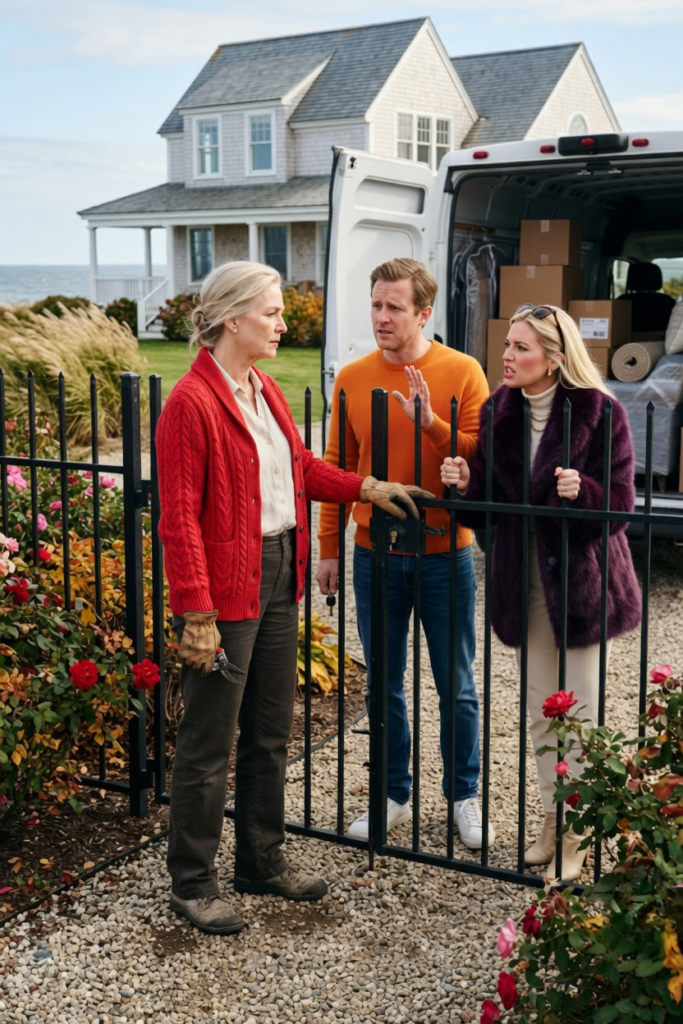
Three days later, Chloe and Julian arrived with a moving van.
I was in the garden pruning roses. The morning had warmed into noon, and I had dirt under my nails. The roses were old, planted by the previous owner decades ago, and they required patience. Cutting away dead wood always looks brutal until spring proves the point.
The van slowed at the iron gate, a white rental truck with green lettering. Julian stepped out first, pale and anxious. Chloe followed, wearing oversized sunglasses and fury like perfume.
I did not move toward the gate.
Chloe gripped the bars. “Open it.”
“No.”
“We need to come in.”
“No.”
Julian stepped closer. “Mom, please. We got an eviction warning. The rent bounced. We need somewhere to stay for a few weeks.”
“How many weeks?”
He looked away.
Chloe snapped, “Why does that matter? Your son is about to be homeless.”
“My son is standing beside a rental van because he and his wife attempted to maintain a lifestyle they could not afford.”
“We wouldn’t be in this position if you hadn’t cut us off with no warning.”
“You had warning. You simply mistook my kindness for a permanent income stream.”
Chloe shook the gate once. “You are unbelievable. You have all this.” She gestured violently toward the house. “All this space. This giant palace. And you would rather let us sleep in a truck?”
“You will not sleep in a truck.”
“You don’t know that.”
“I know Julian has a job, possessions to sell, a landlord to negotiate with, and the ability to make adult decisions.”
Julian looked at me through the bars. “Mom, I know we messed up. But just let us get inside and talk.”
“No.”
His face changed. Not anger. Panic. He had expected me to bend once the crisis had wheels. They both had. That was why they came with the van. They believed logistics would pressure me more effectively than words. Once the boxes were unloaded, once their clothes were upstairs, once Chloe was crying in my foyer, I would not be able to undo it. The old Evelyn would have opened the gate because the alternative felt cruel.
The new Evelyn understood that some people create emergencies specifically to bypass consent.
Chloe took off her sunglasses. Her eyes were wet, but not with sadness. “You’re a heartless old woman.”
Julian flinched.
I looked only at him. “Is that how you see me?”
He swallowed. “No.”
“Then act like it.”
Chloe laughed bitterly. “Oh, now she’s doing the wounded mother routine.”
I turned my gaze to her. “Chloe, you have mistaken my patience for stupidity. That was your mistake, not mine.”
Her lips parted.
“You are not moving into my house. Not for three weeks. Not for three nights. Not with boxes. Not with tears. Not with a van parked at my gate. If Julian wants a relationship with me, he is welcome to build one that is not dependent on my money or my property. But you will not bring chaos into my home and call it family.”
“You’ll regret this,” she hissed.
“I have regretted many things,” I said. “This will not be one of them.”
Julian stood there as if something inside him had cracked open.
“Mom,” he said quietly, “what are we supposed to do?”
“Go home. Talk to your landlord. Return what you can. Sell what you must. Make a budget. Decide what kind of marriage you have when my money is no longer in the room.”
Chloe made a disgusted sound. “Come on, Julian.”
He did not move immediately.
For one second, I thought he might stay. Not to beg. Not to fight. Just to stand there and finally see the difference between his mother and his safety net.
But Chloe turned toward the van, and he followed.
The truck reversed awkwardly, gravel grinding under the tires, then disappeared down the road.
I went back to the roses.
I cut away a dead cane near the root.
A week later, Chloe posted on social media.
I did not have an account under my own name anymore because after Daniel died, I grew tired of strangers liking photographs of grief they did not understand. But Nora sent me a screenshot with the caption: Thought you should see this, but don’t let it ruin your morning.
Chloe had written:
It’s heartbreaking when people with more than enough choose cruelty over family. Some people would rather sit alone in a mansion than help their own children through a hard time. Money really shows who people are.
There were comments, of course.
That’s awful. Praying for you.
Some mothers-in-law are so toxic.
Stay strong, babe.
Family should always help family.
I read them while standing in my studio, a brush in my hand, ultramarine blue drying on my palette.
For five minutes, I let myself feel the old humiliation. The urge to defend. To explain. To post receipts. To show the spreadsheet. To show the missed housewarming text, the key demand, the boxes, the monthly transfers, the moving van at my gate.
Then I placed the phone facedown on the table.
Nora texted again: Want me to comment?
I replied: No.
Then, after a pause, I added: But thank you.
The post spread through the small family network that still overlapped with Chloe’s performance. Daniel’s sister, Margaret, called me that afternoon. She was seventy, blunt, and had never fully liked Chloe.
“Do you want to tell me what’s going on before I form an opinion loudly?” she asked.
I laughed despite myself. “Chloe and Julian are angry because I stopped giving them money and refused to let them move in.”
“How much money?”
“Monthly for three years.”
“How much monthly?”
I told her.
Margaret was silent for so long I checked the phone to make sure the call had not dropped.
Finally, she said, “Daniel would haunt you for letting that continue.”
“I know.”
“Good. I just wanted to make sure.”
Two days later, Julian called.
I almost let it go to voicemail. Then I answered.
“Mom?”
“Yes.”
“I’m sorry about Chloe’s post.”
“Did you ask her to take it down?”
He hesitated.
That was answer enough.
“Julian.”
“I tried.”
“Did you ask her, or did you mention that maybe it wasn’t helping?”
He sighed. “I don’t know how to talk to her right now.”
“That is something you need to learn.”
“She says you humiliated us.”
“No. I stopped hiding the consequences.”
“I know.” His voice was rough. “I’m starting to see that.”
I walked to the window. Outside, wind moved through the dune grass. “Are you calling for money?”
“No.”
“Are you calling because Chloe told you to?”
“No.”
“Then why are you calling?”
He was quiet.
When he spoke, his voice was smaller than I had heard it in years. “Because I don’t know how it got this bad.”
That softened something in me.
Not enough to open the gate.
Enough to listen.
“Start with the truth,” I said.
He let out a breath. “We’ve been living beyond our means for years.”
“Yes.”
“I knew it, but I didn’t know how much.”
“You chose not to know.”
“Maybe.”
“No, Julian. Not maybe. You chose not to know because knowing would require you to change.”
He did not argue.
I heard a door close in the background. Maybe he had stepped outside. Maybe he was calling from work. “Chloe handled most of the spending.”
“And who handled the pretending?”
That one landed.
He laughed once, sadly. “Me, I guess.”
“Your wife is responsible for her choices. You are responsible for yours.”
“I know.”
“Do you?”
“I’m trying to.”
That was the first honest conversation we had had in years.
It did not fix anything. People romanticize moments of recognition as if awareness itself is transformation. It is not. Awareness is only the first step, and sometimes people take that step, look at the distance ahead, and return to denial because denial has better furniture.
But something had shifted.
Julian did not ask for money.
I did not offer it.
A month passed.
Then another.
The season changed. Autumn settled over the coast with cold mornings and bright afternoons. The hydrangeas faded from blue to papery green. I learned which windows rattled when the wind came hard from the east. I hosted friends often. I painted badly and joyfully. I filled the library shelves and spent evenings reading in the green velvet chair while the ocean struck the rocks below with rhythmic force.
I also learned things through other people, because families are terrible at silence even when they pretend they want privacy.
Julian and Chloe gave up the upscale apartment and moved into a smaller rental forty minutes inland. Chloe sold the custom sectional at a loss and blamed Julian for “not fighting harder.” She deleted the social media post after Margaret commented, “How much monthly support did Evelyn provide before this heartbreaking cruelty?” Apparently, that had quieted the sympathy chorus rather quickly.
Julian began taking lunch to work instead of buying it. He sold the second car. Chloe picked up more freelance design work, though she complained online about “being forced into survival mode by people who could help but won’t.” Julian started seeing a financial counselor through his employer. That detail came from Margaret, who heard it from Daniel’s cousin Paul, who heard it from Julian himself at a hardware store. Families are inefficient but persistent news organizations.
Then, one Sunday in late October, Julian called and asked if he could come over alone.
I said yes.
He arrived with no boxes, no Chloe, and a bouquet of grocery-store flowers that looked slightly crushed from the drive. He stood at my front door wearing jeans and a navy sweater, his hair too long, his face thinner. For a second, I saw every version of him at once: baby, boy, teenager, groom, panicked man at my gate.
“Hi, Mom.”
“Hello, sweetheart.”
His eyes flicked to my face, surprised by the endearment.
I had not stopped loving him.
That was never the issue.
We sat on the back patio wrapped in blankets, drinking tea. The ocean was gray and restless. Julian held his mug with both hands.
“I’m sorry,” he said after a while.
I waited.
“I’m sorry we missed your party. I’m sorry Chloe texted you about the key like that. I’m sorry we came with boxes. I’m sorry about the van.” He swallowed. “And I’m sorry I let you pay for so much without really thinking about what that meant.”
“Thank you.”
He looked down. “I wish I could say I didn’t know. But I did know. Not the total, maybe, but enough. I knew we couldn’t afford the apartment without your transfer. I knew Chloe was spending like it would never stop. I knew I should have told her no.”
“Why didn’t you?”
He smiled without humor. “Because it was easier to let you say yes.”
That hurt.
It also sounded like truth.
“I raised you better than that,” I said.
“I know.”
“No. Listen to me. I raised you to be kind, but I may also have taught you that my comfort mattered less than everyone else’s. That was my mistake. But you are old enough now to choose differently.”
“I’m trying.”
“How?”
He took a breath. “I opened a separate account for bills. My paycheck goes there first. Rent, utilities, insurance, debt payments, groceries. What’s left is what’s left. I canceled two subscriptions Chloe didn’t even know we had. We’re paying off the credit card. Slowly.” He paused. “Chloe hates it.”
“I imagine.”
“She says I’m acting like you.”
“That may be the nicest thing she’s ever said about me.”
He laughed, then rubbed his eyes.
“Are you two okay?” I asked.
He looked toward the water. “I don’t know.”
There it was. The thing money had hidden. Their marriage had been built on style, ease, and my quiet assistance. Remove the assistance, and the structure began to show its cracks.
“I love her,” he said. “But I don’t know if we want the same life.”
“That is an important thing to know.”
“She thinks you should help because you can.”
“And what do you think?”
He turned the mug between his palms. “I think being able to help doesn’t mean you’re obligated to be used.”
I looked at him.
There are sentences mothers wait years to hear without knowing it.
“Good,” I said softly.
He left after two hours. At the door, he hugged me tightly, not with the absent quickness of obligation, but with something real and heavy. I held him for a moment, then let go first.
That mattered too.
Over the winter, Julian came by once a month, always alone. Sometimes we had coffee. Sometimes we walked on the beach. Sometimes we talked about Daniel. Sometimes we did not talk about anything important at all. He never asked for money. I never offered. Slowly, cautiously, we began building a relationship that did not depend on my usefulness.
Chloe did not visit.
She sent one email in January, long and theatrical, accusing me of manipulating Julian, undermining their marriage, and “weaponizing wealth.” I forwarded it to a folder and did not respond. A younger version of me might have written back point by point. Older Evelyn understood that some messages are not invitations to communicate. They are attempts to drag you back into a courtroom where the other person plays judge, jury, and victim.
In February, Julian told me he and Chloe were separating.
He said it on the beach, hands in his coat pockets, wind turning his ears red.
“I’m sorry,” I said.
He nodded. “Me too.”
“Are you safe?”
He looked surprised. “Yeah. I mean emotionally it’s bad, but yes.”
“Do you need a place to stay?”
The question came out before I could stop it. I regretted it instantly, not because I did not want to help him, but because help had become dangerous territory between us.
Julian looked at me carefully.
Then he said, “No. I found a small apartment near work. I can afford it.”
Pride rose in me so quickly it hurt.
“I’m glad,” I said.
“I wanted to ask,” he admitted. “But I knew I shouldn’t.”
“There is a difference between asking and expecting.”
“I know.”
“If you ever truly need help, you can talk to me. But I am no longer the foundation under avoidable choices.”
He nodded. “That’s fair.”
We walked in silence for a while.
At the water’s edge, he bent and picked up a flat gray stone, turning it over in his hand the way Daniel used to do. The resemblance hit me so hard I had to look away.
“Dad would have liked this place,” Julian said.
“Yes.”
“He would have told you it was too big.”
“At first.”
“Then he would have claimed the porch.”
I laughed.
Julian smiled. “I miss him.”
“I do too.”
“I think I got lost after he died,” he said quietly.
I looked at him.
He kept his eyes on the water. “You were so sad, and I didn’t know how to help. Chloe kept saying we needed to keep living, keep moving, keep building our own life. And then you were helping us, and I told myself it made you feel connected. Like you wanted to do it.”
“I did, sometimes.”
“I know. But I took advantage of that.”
“Yes.”
He nodded. “I’m sorry.”
“I believe you.”
Forgiveness is not the same as returning to the old arrangement. I could forgive Julian and still not give him a key. I could love him and still keep the west wing locked. I could welcome him for coffee and still let him pay his own rent. Those truths would have once seemed contradictory to me. Now they felt like maturity.
Spring arrived slowly that year.
The garden woke in stages. Crocuses first, then daffodils, then the roses putting out cautious green. I painted more. Still badly, but less apologetically. Nora said my seascapes looked “emotionally convincing even if physically questionable,” which I chose to take as praise. Susan and Patrick came for dinner often. Margaret visited for a week and spent most of it sitting in my library reading crime novels and muttering, “This is how rich widows should live.”
Julian visited in April.
He looked healthier. Lighter. He had moved into his apartment. He was cooking for himself, badly but improving. Chloe had filed for divorce after realizing separation did not scare him back into submission. She wanted spousal support, half of assets they did not have, and reimbursement for “lifestyle expectations.” Julian had hired a lawyer and, for the first time in his adult life, was reading every document before signing it.
“I keep hearing your voice,” he told me. “Numbers just stand there.”
“That was your father’s line to me when I panicked over bills in our twenties.”
“Really?”
“Yes. He was very annoying when he was right.”
Julian smiled.
That afternoon, after lunch, he looked toward the hallway. “Is the west wing still locked?”
“Yes.”
“Can I see it?”
I studied him.
There was no demand in his face. No expectation. Just curiosity, maybe a little sadness.
I stood. “Come on.”
At the keypad, I entered the code without hiding it dramatically but without announcing it either. The lock clicked open.
Julian followed me inside.
The library came first. Shelves full now, warm lamps, green chairs, Daniel’s old chessboard by the window. Julian paused in the doorway.
“This is beautiful.”
“Thank you.”
“You actually read all these?”
“Some of them twice. Some I keep because owning them makes me feel smarter.”
He laughed.
Then I showed him the studio. Canvases leaned against the wall. Brushes stood in jars. Paint stained the table. A half-finished ocean scene sat on the easel, more feeling than accuracy.
Julian stepped closer. “You made this?”
“I did.”
“It’s good.”
“It is not.”
“It feels like here.”
That was better than good.
I looked around the room, at the space I had reclaimed from imagined guests and real entitlement. “This room saved me a little.”
Julian nodded. “I think you needed something that was only yours.”
“Yes,” I said. “I did.”
He turned to me. “I’m sorry I didn’t see that sooner.”
“So am I.”
When he left that day, I did not give him the code.
He did not ask.
A year after the housewarming party, I hosted another gathering.
This one was smaller. Nora, Teresa, Susan and Patrick, Margaret, a few friends from town, and Julian. No Chloe. No tension sitting in the corner wearing perfume. Julian brought flowers and a bottle of wine he could afford. Not expensive. Thoughtful. He arrived early and asked if I needed help setting up.
I let him arrange chairs on the patio.
At sunset, everyone stood outside with glasses in hand while the sky turned coral over the water. The house glowed behind us, warm and full. Someone made a toast. I do not remember exactly what was said. Something about new beginnings, chosen peace, and not waiting until you were dead to enjoy your own life. Everyone laughed.
Julian stood beside me.
After the toast, he leaned down and kissed my cheek.
“Happy house anniversary, Mom.”
I smiled. “Thank you.”
“You were right, you know.”
“About what?”
“The key.”
I looked at him.
He stared out at the water. “If you had given it to us, we would have taken over. Maybe not all at once, but we would have. Chloe would have pushed, and I would have let her. You saying no probably saved whatever relationship we still had.”
I took his hand.
“Sometimes a locked door keeps people out,” I said. “Sometimes it keeps love from turning into resentment.”
He squeezed my hand once.
Later, after the guests left and Julian drove back to his apartment, I walked through the quiet house alone. Not lonely. Alone. There is a difference so large it can take a lifetime to learn.
The dishwasher hummed, just as it had the night of the first party. The marble island was cool under my palm. The west wing doors stood closed at the end of the hall, the keypad glowing faintly in the dim light. Outside, the garden shifted in the night wind, roses bending but not breaking.
I thought about the text Chloe had sent that morning.
Need a key this afternoon so we can come and go whenever.
I thought about my answer.
No.
One word. Small enough to fit inside a breath. Strong enough to change the architecture of a family.
I used to believe love meant leaving every door open. I know better now. Love without boundaries becomes trespassing. Generosity without limits becomes dependency. Family without respect becomes a beautiful word people use while reaching into your pockets.
My son has my love.
He does not have automatic access.
My home is not a backup plan, not a storage facility, not an inheritance showroom, not a stage for someone else’s importance.
It is my sanctuary.
I built a life inside it that is clear, independent, peaceful, and entirely my own.
And every morning, when I carry my coffee to the patio and watch the ocean rise silver under the sun, I remember the lesson that arrived late but not too late.
Family may get my heart.
But the keys stay with me.
THE END.