By the time Carissa Hale got home that Tuesday night, the city had already turned the color of wet steel.
Chicago in late October had a way of making every window look lonely. The towers downtown glowed through mist, traffic hissed on Lake Shore Drive, and people who had spent the day pretending to be important were peeling themselves out of office clothes and trying to remember who they were at home. Carissa parked in the narrow driveway behind the brick two-story she had bought three years earlier in Lincoln Park, sat with both hands still resting on the steering wheel, and let her eyes close for exactly six seconds.
Six seconds was all she gave herself.
Then she went inside.

She had argued three motions in Cook County that day, fielded two panicked calls from junior associates who billed like they were allergic to clarity, and signed a stack of documents thick enough to refinance a stranger’s life. The kind of day that would have crushed some people had simply been Tuesday for her. She kicked off her heels in the mudroom, carried her laptop bag into the kitchen, and started water boiling for pasta because cooking, unlike people, still responded to effort.
Damen Cross was already home.
He had been home for hours.
He was stretched across the couch in gray joggers and a faded Northwestern sweatshirt he had not earned, one ankle over the other, remote in hand, sports highlights flashing across the television. An empty energy drink can sat on the coffee table beside a plate he had somehow managed to leave there instead of walking it the additional twelve feet to the sink.
When she walked in, he turned his head just enough to register her shape.
“Hey, babe,” he said. “Smells good.”
He said it the way some men said grace—out of habit, without reverence.
Carissa didn’t answer right away. She set the pot, salted the water, opened the refrigerator, and started moving with the precision of a woman who knew that if she stopped even for a moment, fatigue would crawl up her spine and pin her to the kitchen floor.
Damen wandered in only after the pasta was plated.
He leaned against the counter while she set two bowls down at the table, and there was something too casual in his face, a looseness around his mouth she recognized from depositions and bad clients. It was the expression people wore when they had already decided what was fair and were simply waiting for everyone else to catch up.
Carissa sat down, twirled spaghetti around her fork, and was two bites in when he said, “So my ten-year reunion is next month, and I need Nikki to come with me.”
At first, the sentence did not register as language.
It was sound. Air. One more distraction in a life full of them.
Then it arranged itself.
Nikki.
Her younger sister.
Need.
Come with me.
Carissa kept chewing because sometimes the body moved more slowly than humiliation. She swallowed. Set the fork down. Looked at him.
“What did you just say?”
Damen rolled one shoulder as if she were the one making the moment heavy. “My high school reunion. Next month. I need Nikki to come with me.”
Carissa stared long enough for a lesser man to feel stupid. Damen only reached for the Parmesan.
“Why,” she asked carefully, “would my sister be coming to your reunion?”
He didn’t look embarrassed. That was the first wound.
He didn’t even look cautious. That was the second.
“Because I need her there,” he said.
The kitchen went strangely clear around her. She heard the ceiling fan, the refrigerator compressor, the muffled rumble of an L train a few blocks away. Small household sounds seemed to sharpen whenever something catastrophic was trying to masquerade as ordinary.
“Try again,” Carissa said.
Damen sprinkled cheese over his pasta like he was explaining weather. “Back when we first started dating, some of the guys met Nikki at that barbecue your cousin hosted in Naperville. They assumed she was my girlfriend. I never corrected them. It was nothing. Then people moved, years passed, social media did what it does, and they all basically think I ended up marrying her.”
Carissa did not blink.
Damen looked up finally, saw that she wasn’t following his timeline toward the place he wanted it to end, and added the part he clearly thought would solve it.
“So I need Nikki to come with me as my wife.”
He said wife in the tone a man might use for coat or receipt.
Carissa felt the blood drain out of her face so completely it almost fascinated her. “You told your friends you married my sister.”
He exhaled, impatient already. “I didn’t tell them. Exactly. I just didn’t correct anything.”
“That is lying.”
“It is not a big deal.”
He said that too fast.
And there it was—that familiar, polished dismissal he used whenever he needed to shrink a disaster down to a scheduling inconvenience. Carissa had spent ten years watching him do it to overdue bills, bounced ideas, failed jobs, forgotten birthdays, bruised feelings, and now apparently to the fact that he had built a parallel version of his life in which she had been edited out and replaced by the prettier woman in her own family.
“Why can’t I go?” she asked, though she already knew.
Damen made a face, the one he made when she forced him to say ugly things aloud. “Because if I show up with you, then I have to explain why I’m not married to Nikki.”
Carissa let the silence stretch.
He kept going, because men like Damen often mistook silence for opportunity.
“These people remember her. They remember she was hot. They remember me with a beautiful girl on my arm. If I show up with…” He stopped.
“With what?” Carissa asked.
He looked straight at her.
“With someone else, it turns into a whole thing.”
Someone else.
Not my wife.
Not Carissa.
Not the woman paying the mortgage.
Not the woman whose last three bonuses had kept their lives from collapsing under the weight of his unfinished plans.
Someone else.
Carissa had spent years in boardrooms where men used euphemism like a weapon. She knew how language hid contempt. But nothing in those rooms had ever hit as cleanly as the sentence she was now hearing from the man she had married.
“So your solution,” she said, and she was almost proud of how level her voice still sounded, “is for my sister to impersonate me for a night because your ego can’t survive the truth.”
Damen leaned back in his chair. “That’s dramatic.”
“No,” Carissa said. “Dramatic would be me throwing this bowl at your head.”
He gave her a humorless little smile, as though her anger were a child trying on adult clothes. “It’s one night, Carissa. One event. These people don’t matter. I’ll do whatever you want after. Nice dinner. Weekend trip. You’re acting like this means something it doesn’t.”
Carissa looked at him for a long moment and felt something old stirring beneath the shock—something that had been collecting quietly for years in places she no longer checked. Every offhand jab. Every subtle comparison. Every time he had made her feel like she was too serious, too tired, too sharp, too much work, too little light. Every time he had benefited from the life she built and then resented her for building it better than he could.
“What does Nikki think about this?” she asked.
Damen’s fork paused halfway to his mouth.
It was a tiny hesitation. Barely visible.
That made it worse.
“I already asked her,” he said. “She said yes.”
Carissa inhaled once.
“You asked her,” she repeated, “before you asked me.”
He shrugged. “Logistics.”
There are moments when betrayal does not feel hot, the way movies teach people to expect. It feels cold. Clinical. Like someone reading your bloodwork aloud. Like numbers settling into place.
Carissa had been supporting Nikki for two years by then. Rent. Car insurance. The phone bill Nikki always forgot about until service got interrupted. Emergencies that looked suspiciously like salon appointments. A security deposit after yet another roommate disaster. A laptop because “everything in my life is falling apart” and she needed “just one person to help without making me feel bad.”
That person had always been Carissa.
Because Carissa was the one who got things done.
It had started in childhood and simply never stopped.
Nikki had been born with golden lashes, a fast smile, and a talent for crying at exactly the right moment. Adults adored her in the way people adore beautiful fires from a safe distance. She was “spirited” when she was irresponsible, “sensitive” when she was manipulative, “still figuring things out” long after the age where other women were expected to have figured things out already.
Carissa, on the other hand, had been praised for being “so mature” at twelve, which was the kind of compliment that usually meant a child had learned too early that no one was coming.
Their mother, Linda Hale, had spent years explaining Nikki to the world.
She’s just emotional.
She feels things deeply.
You know how your sister is.
What Linda never had to explain was Carissa. Carissa made straight A’s, packed her own lunches, filled out scholarship forms without being asked, and learned that when she did things well enough, adults left her alone. Which in some homes passed for love.
By law school, Carissa had mistaken reliability for identity.
By marriage, she had mistaken endurance for devotion.
Now she sat across from her husband, listening to him explain that the identity he had preferred all these years had belonged to her sister.
“Okay,” Carissa said.
Damen’s eyebrows lifted. “Okay?”
She nodded once and picked up her fork again.
It was not surrender. It was reconnaissance.
“Okay,” she repeated. “One night.”
Relief loosened his shoulders immediately. That, more than anything, made her want to scream. He had counted on this. Counted on her absorbing the blow, calculating the cost of resistance, and choosing peace over pride.
“See?” he said. “I knew you’d understand.”
Carissa twirled another bite of pasta she no longer tasted.
She had understood plenty.
She understood that her husband had been ashamed of her for years in ways both petty and profound.
She understood that her sister had said yes too quickly for this to have been the first conversation.
And she understood, with a calm that frightened even her, that the next thing she did mattered more than the rage trying to rise in her throat.
That night, she washed the dishes by hand though the dishwasher was empty. Damen went back to the couch and laughed at something on television. She watched his reflection in the dark kitchen window instead of the sink.
A woman can spend a long time missing the shape of her own unhappiness if her days are crowded enough.
Carissa had not married Damen because he was extraordinary. She had married him because at twenty-six, he had seemed easy in all the places her life was hard. He was handsome in a loose, careless way that photographs well. He made waiters laugh. He could talk to strangers at bars and somehow leave them feeling charmed instead of handled. When they met, she had been a first-year associate living on caffeine and anxiety, billing hours in a sterile office where every man over forty seemed to smell faintly of ambition and leather. Damen had felt like sunlight then. Not serious enough to compete with her seriousness. Not polished enough to make her feel watched.
He liked that she was smart, he said.
He liked that she “had her life together.”
He liked that she could order wine without staring at the menu like a test.
At first, his admiration had felt like rest.
Later, it began to feel like resentment in a nicer shirt.
The first year of marriage, he quit a job at a marketing firm because the culture was “toxic.” The second year, he left a sales position because his manager “didn’t know how to use talent.” Then came a real estate phase, a podcast phase, a craft beer distribution idea, an app concept he never built, and finally a long season of claiming he was “in transition” while Carissa’s paychecks carried the weight of everything from property taxes to dental insurance.
She told herself then what competent women often tell themselves in private.
It’s temporary.
He’s trying.
Marriage is not a ledger.
Love is more than what someone earns.
And for a long time, those things had felt true enough to survive on.
But survival makes poor architecture.
After midnight, while Damen snored downstairs because he had fallen asleep with the TV on, Carissa opened her laptop at the kitchen counter and logged into the bank accounts.
Automatic transfers glowed back at her like insults she had personally programmed. Nikki’s rent. Nikki’s utilities. Nikki’s car payment. Nikki’s phone. Recurring generosity laid out in perfect monthly order.
Carissa clicked through the history and watched her own kindness become evidence.
Twenty-three thousand, eight hundred dollars over twenty-one months.
She sat back in the chair and laughed once, quietly, because if she didn’t laugh she might break something expensive.
Then she opened Nikki’s social media accounts—not because she was a jealous woman by nature, but because jealous women and careful women often behaved identically while being judged very differently.
Nothing obvious. No public posts. No photos together.
But there were hints if you knew where to look.
A mirror selfie in a green dress Carissa had never seen, captioned: can’t wait for november.
A blurry story from two weeks earlier: a man’s hand holding a wine glass across a dark restaurant table, only the cuff visible, the watch unmistakably Damen’s because Carissa had bought it for him on their eighth anniversary after he spent six months hinting that all his friends had “real watches now.”
Carissa stared at the image until the edges of it blurred.
Then she closed the laptop and went to bed in the guest room without touching her own side of the mattress.
The next evening, she came home early.
No warning. No text.
She walked in through the front door at five-thirty and heard laughter coming from the living room—Nikki’s bright, airy laugh, followed by Damen’s lower one, the version he used when he was flirting or getting away with something. Carissa slipped off her heels on instinct and stepped closer without announcing herself.
They were on the couch.
Not in a compromising position. That would have been almost merciful. No, what she saw was worse in its casualness. Nikki sat cross-legged facing him, wearing jeans and one of Carissa’s old cardigans she must have taken years earlier and never returned. Damen leaned forward, elbows on his knees, phone in hand, reading from notes while Nikki repeated the lines back to him.
“How did we meet?” he asked.
Nikki smiled. “At Lindsey Barron’s birthday party in Oak Brook. I was standing by the back window pretending I didn’t know anyone, and you came over with a drink and said you were impressed by my commitment to looking like I hated everyone.”
Damen grinned. “Good. Again, but slower.”
Carissa did not move.
That was her story.
Her exact story.
Lindsey Barron had been a law school friend. Oak Brook had been the suburb. The back window. The joke about hating everyone. The drink in his hand. The first laugh she ever gave him.
It was not just that they were rehearsing for a lie.
They were stealing her memories to make the lie breathe.
Carissa stepped into the room.
Neither of them jumped. That would have at least suggested conscience.
Instead, Damen looked up like he’d been expecting her eventually and said, “Hey. You’re early.”
Nikki gave a little wave. “We’re practicing.”
Carissa let her gaze move from one face to the other. “I can see that.”
Damen patted the couch cushion beside him as if she were joining family game night. “You can actually help. We’re trying to make sure the timeline sounds natural.”
Carissa remained standing. “You’re using my timeline.”
Damen frowned like she was being tedious. “It’s the easiest one to remember.”
Nikki examined her nails. “It’s not like you own a meet-cute, Carissa.”
There was no apology in her voice. Not even discomfort. Just that familiar younger-sister entitlement, as if the world had again presented her with something Carissa had built and she had decided it would fit her better.
Carissa sat in the armchair across from them because she suddenly wanted to see how far they would go in front of her.
They went very far.
They stole the story of the rooftop proposal overlooking the river. They stole the anniversary dinner at the French restaurant in River North where Carissa had cried into a linen napkin because she had been so absurdly happy then she didn’t know what else to do with it. They stole the weekend in Saugatuck, Michigan, where she and Damen had gotten caught in the rain and ended up drinking bourbon from paper cups in a motel because every nicer place in town had been booked.
When Carissa corrected a detail—“It was French, not Italian”—Damen rolled his eyes.
“Does that matter?”
“It mattered when it happened.”
He gave Nikki a look and spoke in a higher-pitched imitation that was almost comically cruel. “It mattered when it happened.”
Nikki laughed.
Carissa felt the laugh hit somewhere below the sternum.
“Why don’t you go do some work?” Nikki said with a sweet smile. “Isn’t that your zone?”
There are women who throw wine.
Carissa had always admired them.
She only nodded, stood, and walked upstairs.
Halfway to the landing, she stopped. Not because she heard words. Because she heard tone.
Laughter changed shape when it was safe. It softened. It dropped. It became private.
Carissa turned slowly and looked through the banister.
Damen had lifted his hand to Nikki’s face.
His thumb was brushing the curve of her cheekbone the way it had brushed Carissa’s years earlier on nights when he still looked at her like she was a destination instead of a utility. Nikki leaned toward his hand with her eyes half-closed. Their faces tilted. Their mouths hovered.
They were about to kiss in Carissa’s house, on Carissa’s couch, under the framed black-and-white print Carissa had bought in New York the year she made partner.
A floorboard shifted under Carissa’s foot.
Both of them jerked apart.
And then, instantly, the performance began.
“It’s not what it looks like,” Damen said.
“We were practicing,” Nikki added. “For affection.”
Carissa came down the stairs at a measured pace and sat back in the armchair.
“Of course,” she said. “Affection rehearsal.”
Damen laughed too hard. “Exactly.”
Carissa folded her hands in her lap to hide the trembling. “Good to know.”
She didn’t confront them then.
She had spent too many years in litigation to waste a cross-examination on unprepared witnesses.
Nikki left around seven-thirty, brushing past Carissa with a nervousness she tried to disguise as irritation. Damen showered and then moved toward the bedroom like the day had ended in his favor.
Carissa stood in the doorway and blocked him.
“No,” she said.
He blinked at her. “Move.”
“No.”
He looked genuinely startled. That told her how often she had made herself easier to handle.
“I’m not doing this,” he said.
“We are absolutely doing this.”
He sighed, the sigh of a man exhausted by consequences arriving on time. “Carissa, you’re taking this somewhere insane.”
“Then stop me with the truth.”
“We told you the truth.”
“Then say it cleanly,” she said. “Why did you touch my sister’s face like that?”
He crossed his arms. “Because we were practicing.”
“Why did you both jump apart?”
“Because you walked in looking like a prosecutor.”
“You still haven’t denied that something is going on.”
His jaw tightened. “Because there is nothing going on.”
“Look me in the eye and say you are not sleeping with Nikki.”
He looked at her. He looked away.
That was enough.
Carissa felt the realization arrive the way a doctor might deliver a terminal result—calmly, with nowhere left to mishear.
“You are,” she said.
He dragged a hand through his hair. “Jesus Christ.”
“You are.”
“This is exactly why I can’t talk to you!” he snapped. “Everything becomes a courtroom. Everything becomes an accusation.”
“What would you prefer?” she asked. “A thank-you note?”
Damen stepped closer. “You know what this is really about? Control. You cannot stand that there is one room in this world you don’t control. At work, everyone listens to you. At home, you think you get to manage my feelings the same way you manage contracts.”
Carissa held his gaze. “I am asking whether you are having an affair with my sister.”
“And I am telling you that your obsession with interrogating me is why this marriage is dead.”
Carissa went still.
There it was.
Not denial.
Not remorse.
Not even an attempt at believable innocence.
Just blame dressed up as insight.
The room seemed to tip around her. Not because she hadn’t already known, but because he had finally chosen the lie so completely that he no longer needed to protect even the outline of decency around it.
“You’re saying the marriage is dead,” she said.
“I’m saying if you can’t trust me, maybe we shouldn’t be married.”
It was a line he had probably imagined as powerful. It landed like a child threatening to run away from a house he didn’t own.
Carissa stepped aside from the doorway.
“Then don’t sleep here tonight.”
He stared. “What?”
“You heard me.”
He laughed under his breath. “You cannot kick me out of my own bedroom.”
“Watch me.”
For a moment, he looked like he might challenge her physically. Then something in her face made him think better of it. He grabbed a pillow from the bed, muttered something about her being unbelievable, and went downstairs.
Carissa stood alone in the bedroom they had once painted together on a weekend in June, the room where he had promised her a family “someday, when timing makes sense,” the room where she had stayed up through the night after her father died and listened to him breathe while she understood that grief was lonelier beside a sleeping person than it was alone.
She sat on the edge of the bed and did not cry.
Instead, she called her office, left a message canceling her eight-thirty meeting, and then she grabbed her coat and keys.
Nikki lived in a one-bedroom walk-up in Lakeview that Carissa was paying for.
The drive there took twenty-two minutes and all of Carissa’s remaining restraint.
She climbed the stairs fast enough to wake half the building and knocked so hard the cheap brass numbers on Nikki’s door rattled.
No answer.
Carissa knocked again.
“Nikki,” she said. “Open the door.”
“It’s late,” Nikki called through the wood. “Can we do this tomorrow?”
“No.”
Silence.
Then, “You’re scaring me.”
The sentence almost made Carissa laugh.
“Open the door or I keep knocking until the neighbors call the police.”
The lock clicked.
Nikki opened it barely four inches and tried to keep her face arranged in wounded innocence. It had always been her best look.
Carissa pushed the door open and stepped inside.
The apartment smelled like vanilla spray, takeout containers, and money Carissa had earned.
“How long?” Carissa asked.
Nikki folded her arms. “How long what?”
“How long have you been sleeping with Damen?”
Nikki shook her head so quickly it looked rehearsed. “I’m not sleeping with him.”
“What’s the birthmark on his left hip shaped like?”
Nikki’s mouth parted.
For a fraction of a second, the answer flashed in her eyes before she could stop it. A crescent. That’s what it was. Carissa had known it for ten years. Nikki knew it too.
The room emptied out.
Whatever softness had remained in Carissa hardened cleanly.
“Right,” she said.
“Carissa, wait—”
“No.”
Nikki reached for her arm. Carissa stepped back.
“It’s not what you think.”
“It is exactly what I think.”
Nikki’s eyes filled with tears on cue. “He said you two were basically over.”
“That’s convenient.”
“He said you were always working, always exhausted, always making him feel small.”
Carissa stared at her little sister and felt a fatigue older than either of them. “And that made you sleep with my husband?”
Nikki’s face twisted. “Why do you always say things like that? Like I’m the villain in some movie? You’ve never understood what it’s like to be me.”
Carissa laughed then—not loudly, not bitterly, just once, because the sentence was so offensively ridiculous it broke the air around it.
“No,” she said. “You’re right. I have never known what it’s like to be the person everyone rescues while pretending she’s drowning.”
“Don’t do that.”
“Do what? Name it?”
Tears ran down Nikki’s cheeks now, but Carissa saw something underneath them she had rarely allowed herself to name before. Not shame. Not regret. Anger. Nikki hated being seen clearly more than she hated hurting people.
“I loved him too,” Nikki whispered.
Carissa looked at her for a long time.
There are some betrayals so obscene they arrive with their own dark clarity. There is relief inside them—not because they hurt less, but because confusion dies.
“Then you can have him,” Carissa said. “What you cannot have anymore is my money.”
Nikki’s expression changed instantly.
“What?”
“I’m canceling every transfer tonight.”
“Carissa—”
“Your rent, your phone, the car. All of it.”
“You can’t do that to me.”
“Watch me.”
Nikki began crying harder. “I’ll lose this apartment.”
“That sounds like a problem for the woman who thought sleeping with her sister’s husband was a smart long-term housing strategy.”
“You’re being cruel.”
“No,” Carissa said quietly. “I’m being finished.”
She left before Nikki could recover enough to switch tactics.
Back in her car, she sat for a full minute with her forehead against the steering wheel. Not crying. Breathing. Just breathing, because rage without air becomes useless fast.
Then she opened the banking app on her phone and canceled every recurring payment one by one.
Each confirmation screen asked if she was sure.
Carissa pressed yes with the calm of a woman signing exit papers for parts of her life that had already died.
When she got home, Damen was in the kitchen waiting.
“You went to Nikki’s.”
Carissa set her keys down. “Yes.”
“What did you say to her?”
“The truth.”
He gave a short, disbelieving laugh. “So you did something stupid.”
She looked at him. Really looked. The handsome face. The tired eyes that still somehow imagined themselves misunderstood rather than responsible. The body she had once wanted simply because it was his.
“What did you tell her about us?” Carissa asked.
Damen spread his hands. “That things have been bad for a while.”
“That is not an answer.”
“It’s close enough.”
“And what exactly have you told your brother?”
The question landed.
His eyes narrowed. “Why are you talking about Jackson?”
Carissa hadn’t meant to ask it yet. But the name was out now, and she watched the smallest shift move through him—wariness, possessiveness, insecurity. The Cross brothers had spent their whole lives living in each other’s shadows, except only one of them acted like light was finite.
“I’m curious,” she said. “Does he know you’ve been lying about your life for a decade?”
Damen scoffed. “Jackson thinks he’s better than everybody.”
“Maybe he just is better than you.”
His face hardened.
The silence that followed had edges.
Carissa went upstairs, packed two overnight bags, then unpacked them again because she suddenly remembered something essential: she did not need to leave her own house.
That night she slept in the guest room again. At 2:14 a.m., her phone buzzed on the nightstand.
An unknown number.
She almost ignored it.
Then a second message arrived from the same number.
Jackson here. Damen called me ranting. Are you okay?
Carissa stared at the screen in the dark.
Jackson Cross had always unsettled Damen without trying. The older brother by eighteen months, the one who finished things. Built things. Paid for things. The one who had started a logistics company in his late twenties and sold half of it five years later for more money than Damen could bear to think about. Jackson was not flashy. He did not peacock. Which somehow made it worse. He wore good suits without advertising them. Drove reliable cars instead of performance cars. Bought a house in Evanston and owned it outright before forty. He did not brag because he did not need witnesses.
Damen had spent years calling him arrogant.
Carissa had always suspected what he meant was impossible to manipulate.
She typed back before she could overthink it.
No. I’m not okay.
Three dots appeared almost instantly.
Do you want to talk?
Carissa stared at the ceiling, then at the door, then finally wrote the one honest sentence she had maybe never let herself say to anyone in real time.
Yes.
They met the next morning at a coffee shop in Old Town just after eight.
Carissa hadn’t slept much, but she showed up dressed for battle—camel coat, dark slacks, hair pinned back, the face she wore to court when she wanted men to mistake her calm for mercy. Jackson was already there, standing when she walked in, one hand around a paper cup, concern plain in his eyes but not exaggerated. That was the first relief.
He did not overreact for the pleasure of seeming caring.
He simply asked, “Do you want coffee before or after you ruin my brother?”
Carissa actually smiled.
“Before,” she said.
They sat near the window. Outside, dog walkers and young parents and people with headphones moved through the cold as if the world had not tilted overnight. Carissa told him everything.
Not just the reunion plan. All of it.
The financial support for Nikki. The rehearsed memories. The almost-kiss on the couch. The confrontation. The birthmark question. The canceled payments. The way Damen had never truly denied anything, only shifted blame until blame itself began to feel like the point.
Jackson listened without interrupting.
He did not say “I can’t believe it,” because he could.
He did not say “there must be more to the story,” because he understood there was already too much.
When she finished, he looked down at his coffee, then back at her.
“He’s always needed an audience,” Jackson said quietly. “Even as a kid. If he wasn’t being admired, he wanted to be rescued. It didn’t matter which as long as the room still revolved around him.”
Carissa let out a breath she hadn’t realized she’d been holding. “That sounds familiar.”
Jackson gave a humorless half-smile. “When our dad used to compare us, Damen acted like it was cruelty to expect anything from him. But the truth was he only wanted the fun part of being exceptional. He never wanted the cost.”
Carissa looked at this man across from her, this brother who had been standing at the edge of family dinners for years with a patient distance she had mistaken for coldness. It occurred to her then that people often called disciplined men cold simply because they could not control them with chaos.
“I need a favor,” she said.
He waited.
“A real one.”
Jackson leaned back slightly. “Okay.”
Carissa folded and unfolded the napkin in front of her. In any other room, under any other set of facts, the request would have sounded insane. In this room it sounded inevitable.
“He wants Nikki at that reunion because he’s terrified of looking like he lied,” she said. “He wants the room to validate the fantasy he built.”
Jackson’s gaze sharpened. “And?”
“And I want him to see what it feels like when the room turns.”
Understanding moved across Jackson’s face slowly, then all at once.
“You want me to go with you.”
“Yes.”
He did not answer immediately.
Carissa rushed to fill the silence. “Not because I need a date. Not because I’m trying to use you to make him jealous. Although I’m not above that anymore, apparently. I want—” She stopped. Restarted. “I want him to stand there with my sister on his arm and look up and see that I am no longer the woman he gets to edit out. And I want the one person he’s spent his whole life measuring himself against standing next to me while it happens.”
Jackson considered that.
“What exactly would you need from me?”
Carissa met his eyes. “Be seen with me. Be kind to me. Hold my hand if it looks natural. Nothing beyond that unless I ask.”
Jackson nodded once. “Okay.”
She blinked. “That’s it?”
“That’s it.”
“You don’t need time?”
“I’ve had about thirty-eight years of context,” he said. “That helps.”
For the first time since the kitchen, Carissa felt something other than pain in her chest.
Not relief exactly.
Alignment.
“What if it makes things worse?” she asked.
Jackson’s mouth twitched. “For whom?”
That afternoon, Damen texted twelve times.
Where are you.
Did you talk to Jackson.
Don’t drag him into this.
You’re acting unstable.
We need to handle this privately.
You always have to make everything humiliating.
Call me.
Carissa.
She did not respond to any of them.
Instead she went to work, billed six hours, called her family attorney from a private conference room, and started asking questions women too often postpone until after the damage is expensive.
Whose name is on the deed?
Mine only.
What about the cars?
One leased in my name. One paid off in mine.
Joint accounts?
Yes, but he contributes very little.
Retirement?
Separate.
Any children?
No.
Infidelity relevant?
Not much for division. Very relevant for your clarity.
The attorney, a sharp-eyed woman named Denise Kessler whom Carissa knew by reputation and now liked on sight, asked her one question that stuck.
“Do you want to save the marriage,” Denise said, “or do you want to stop losing yourself inside it?”
Carissa had no answer right away.
That was answer enough.
The first dinner with Jackson happened that Friday at a steakhouse in River North that Damen always dismissed as “too corporate” whenever Carissa wanted to celebrate something. Jackson picked her up at seven in a charcoal overcoat and dark suit, not overdone, not underdone, exactly appropriate in the way affluent men often were when they had learned long ago that competence is its own kind of style.
Carissa wore a black dress she had bought two years earlier and never found the right room for because Damen had once said it made her look “intense.”
That night, she was in the mood to be intense.
When she came downstairs, Damen was in the foyer with one hand on the banister. He looked at her, then at the lights outside, then back at her face.
“No.”
Carissa paused. “No what?”
“You are not going out with him.”
She almost admired the reflex.
“With whom?”
“My brother.”
She stepped past him toward the front door. “Watch me.”
Damen caught her arm.
Not hard enough to leave a mark. Hard enough to remind both of them that marks were not the threshold for wrong.
Carissa stopped moving and looked down at his hand.
Then she screamed.
Not in fear.
In volume.
A sharp, full-throated sound that bounced off the foyer walls and would absolutely carry through the transom and into the street where Jackson’s headlights had just swept across the front windows.
Damen let go instantly.
Carissa smoothed the sleeve of her dress, looked him directly in the eye, and said quietly, “Interesting. So you do know how fast to release a woman when you think someone might hear.”
Then she opened the door and walked outside.
Jackson took one look at her face and one look at Damen in the hallway behind her and asked, “Everything okay?”
Carissa smiled without humor. “It will be.”
Dinner itself was almost shockingly normal.
That was what made it dangerous.
Jackson asked about her cases and actually listened to the answers instead of waiting for a place to redirect the conversation back to himself. He remembered she took her bourbon neat and that she hated being asked if she was “one of those women who likes whiskey to seem cool.” He did not flatter her intelligence like it was a surprising quirk. He assumed it as fact and built conversation from there.
At one point, halfway through the main course, Carissa laughed so suddenly and genuinely she startled herself.
Jackson saw it happen and smiled. “There you are.”
It was such a small sentence. It landed with unreasonable force.
When he dropped her off, he walked her to the door and kissed her cheek—not possessively, not performatively, just enough to be warm.
Damen was visible through the front window, standing in the dark living room with his arms crossed.
Carissa went to bed that night understanding two things she had not allowed herself to understand before.
First: her marriage had not merely become unhappy. It had become contemptuous.
Second: she had forgotten what it felt like to sit across from a man and not feel managed.
The dinners continued.
Once a week at first, then twice.
Sometimes they were actually dinners. Sometimes coffee. Sometimes a late walk along the lake after work with both of them in coats against the wind, talking about nothing dramatic—books, parents, the absurdity of school fundraisers, the way Chicago made every season feel like a test of character. Jackson never pushed for confession. He asked, and when she answered, he made space around the answer instead of crowding it.
At home, Damen came apart in predictable stages.
First he mocked it.
“So what, this is your revenge now? You and Jackson playing house to upset me?”
Carissa shrugged. “Interesting theory.”
Then he minimized it.
“You don’t even like him like that.”
“Do I not?”
Then he turned suspicious in the way unfaithful people so often do when they realize other people are also capable of keeping secrets.
He started checking the location history on the shared iPad. Started asking neighbors if they had seen her car. Started standing in the kitchen when she got home with the expression of a man convinced he had been wronged by being treated as he treated others.
One night, after Carissa came back from a gallery opening Jackson had invited her to, she found Nikki in the house.
Not visiting. Installed.
Shoes off by the door. Wineglass in hand. Curled into the corner of the couch while Damen sat too close beside her with the remote, both of them looking up at Carissa like they had spent the evening deciding how much of the truth they could force her to witness before she broke.
“What is she doing here?” Carissa asked.
Nikki crossed one leg over the other. “Spending time with someone who isn’t ashamed of wanting me around.”
Carissa looked at Damen. “You let her in.”
“This is my house too,” he said.
“No,” Carissa replied. “It’s the house you live in because I bought it.”
His face darkened.
Nikki laughed softly, but there was tension in it. Even she knew property records were less emotional than whatever story she had been telling herself about destiny.
“Get out,” Carissa said.
Nikki set the glass down. “You don’t get to talk to me like some random woman.”
Carissa held her gaze. “Random women generally have more dignity.”
Damen stood then, moving half a step in front of Nikki like a man protecting the person he wanted from the one who had funded him.
“Don’t do this.”
Carissa’s voice sharpened. “How long?”
Neither answered.
She looked at Nikki. “How long?”
Nikki stared back with her chin high, the tears absent this time, stripped away because maybe she was too tired or maybe she had finally decided that shame was harder than cruelty.
“Since spring,” Nikki said.
Damen snapped, “Nikki—”
She turned on him. “What? She already knows.”
Carissa felt something inside her go completely still.
Since spring.
It was November.
Seven months.
Seven months of borrowed rent and stolen weekends and conversations that must have happened in the spaces around her life while she was working late or traveling for hearings or sitting across from her husband at dinner believing boredom was the worst thing in the room.
“You slept with him while I was paying your electric bill,” Carissa said.
Nikki’s face tightened. “You always say things like that, like help comes without strings.”
“It came with exactly one string,” Carissa said. “Don’t betray me.”
“That is so self-righteous.”
Damen stepped in. “Can we stop making this all about money?”
Carissa turned to him slowly. “That is easy for the only two people in this room who never paid any.”
There was a beat of silence.
Then Nikki said the thing Carissa would remember for years, not because it was the cruelest sentence spoken that night, but because it was the most revealing.
“He chose me,” Nikki said. “You can throw numbers around all you want. At the end of the day, he chose me.”
Carissa looked at her little sister and finally understood something she should have understood sooner. Nikki had not merely taken what was available. She had wanted the win.
Not the man.
The win.
The proof that even now, even with Carissa’s career and house and stability and discipline, she could still step into the center of any room and walk out with the thing Carissa loved.
That knowledge hurt, but it also clarified.
Carissa took out her phone, opened the photo of the deed Denise had sent earlier that week, and held it up.
“You both have until Monday to figure out how humiliating you want the next steps to be,” she said. “Because if either of you is still in this house after that, I begin the formal process.”
Damen laughed, but there was fear in it now. “You’d really do that.”
Carissa met his eyes. “I am beginning to suspect you don’t know me at all.”
On Sunday morning, their mother called.
Of course she did.
Linda Hale still lived in the same split-level house in Naperville where both girls had grown up, though Tom Hale had died four years earlier after a second stroke and the place had felt half-empty ever since. Carissa almost didn’t answer. Then she saw the time—8:12 a.m.—and knew this was not a social call. Linda only called that early when she wanted to manage reality before it hardened.
“Your sister is beside herself,” Linda said without greeting.
Carissa poured coffee and held the phone between shoulder and ear. “Good morning to you too.”
“Don’t be sarcastic. She says you cut off her money overnight.”
“Yes.”
Linda exhaled sharply. “Carissa.”
There it was. Her name in that tone. The tone reserved for moments when Carissa had again failed to be infinitely absorbent.
“She says she and Damen are in love.”
Carissa smiled at the kitchen wall. “Did she say that before or after she admitted she’s been sleeping with my husband for seven months?”
Linda fell silent for a fraction too long.
So Nikki had not led with that.
Interesting.
“She said the marriage was already in trouble,” Linda said.
“Then she should have the courage to date after the divorce, not during it.”
“Things are not always that simple.”
“They are exactly that simple.”
Linda shifted tactics. “You know Nikki has always been fragile.”
Carissa closed her eyes.
There are sentences that can age thirty years in a second.
There it was again—the family religion. Nikki the fragile. Nikki the vulnerable. Nikki the one circumstances happened to. And Carissa, by implication, the sturdy one. The one built to carry what weaker people dropped.
“Mom,” Carissa said quietly, “if you use the word fragile to describe the woman who slept with her sister’s husband in a house her sister paid for, this call ends.”
Linda bristled. “You don’t have to be cruel.”
Carissa’s laugh this time was so soft it almost disappeared. “I’m beginning to think everyone in this family mistakes accuracy for cruelty whenever it lands in the wrong place.”
She ended the call before her mother could answer.
That afternoon she met Denise Kessler in her office and signed the first set of papers.
Not because she enjoyed the symbolism. Because paperwork was the one language betrayal could not gaslight.
By the second week of November, the reunion was four days away.
Carissa had not yet told Damen exactly what she planned. She did not owe him spoiler alerts for his own collapse.
But he sensed something.
He moved through the house with the defensive vigilance of a man who knew a door was opening somewhere behind him and didn’t know whether it led to disgrace or exposure or both. He tried tenderness once, awkwardly, in the kitchen.
“I know things got messed up,” he said while she was slicing lemons. “But we’ve had a whole life together, Carissa.”
She didn’t look up. “Have we.”
He leaned against the counter. “You know what I mean.”
“Do I?”
“I’m serious.”
“So am I.”
He watched her for a moment. “You really want to blow everything up over this.”
Carissa finally lifted her eyes. “You’ve been lying to people for ten years about who your wife is.”
“It was stupid. Fine. But it’s not worth ruining everything.”
“You already ruined everything.”
“No, I made a mistake.”
“A mistake,” she repeated. “Like buying the wrong wine. Like texting the wrong person. Not like putting your mistress in my place and asking for my blessing.”
Damen’s face tightened at the word mistress.
“Don’t call her that.”
Carissa held his gaze. “What would you prefer? Sister-wife? understudy? replacement model?”
He pushed away from the counter hard enough to rattle the fruit bowl. “You know what your problem is? You make everything uglier than it has to be.”
“No,” she said. “I remove the flattering lighting.”
He left before he could lose.
Men like Damen hated rooms where language belonged to someone else.
On the morning of the reunion, Chicago woke cold and bright. One of those cutting November Saturdays when the sky looks hard enough to crack and every tree seems ashamed of having trusted spring.
Carissa went to the salon.
Not because she needed to look beautiful for him.
Because beauty had been used against her for too long, and she had decided she would wear her version of it like a verdict.
Her hair was smoothed into soft dark waves that made her cheekbones look sharper. Her makeup was understated but precise. She chose a black silk dress with a high neckline and long sleeves, elegant in a way that suggested money without pleading for notice. The red lipstick came last. She stood in front of the mirror at home, fastening diamond studs she had bought herself after winning a major arbitration three years earlier, and watched her own face settle into something she had not seen in a long time.
Not hardness.
Authority.
Downstairs, Damen was already dressed.
Navy suit.
White shirt.
Tie slightly loosened because he imagined that made him look relaxed and successful.
He stared when she entered the room.
For one second, desire crossed his face so plainly it almost made her pity him. Here was the woman he had spent years diminishing, and now that she had stepped fully back into view, he looked at her as if he had just realized what kind of creature he had been insulting in captivity.
“You look…”
He didn’t finish.
Carissa picked up her clutch. “I know.”
“You’re not going.”
She smiled. “I absolutely am.”
“Don’t do this.”
“Which part?” she asked. “Attend my husband’s reunion? Wear black? Or arrive with better company than you?”
Color rose in his neck. “You think this is some game.”
“No,” she said. “I think this is an ending.”
Jackson picked her up at seven sharp.
He was in a charcoal suit with a black tie and no trace of nerves in the way he held himself, though when Carissa got in the car he looked at her for a full second and said, “He really was insane.”
She laughed. “That’s the nicest thing anyone has said to me all week.”
The reunion was being held in a ballroom at a historic downtown hotel that had hosted too many weddings and political fundraisers to care about one more beautiful scandal. Valets took the car. Doormen opened the entrance. Through the revolving doors, Carissa could already see clusters of people under chandeliers, drinks lifting and lowering in practiced circles of recognition.
And there, near the registration table, stood Damen.
With Nikki on his arm.
She wore emerald green.
Of course she did.
It was close enough to bridal without being white, dramatic enough to signal victory, soft enough to claim innocence later. She had curled her blonde hair into loose waves and painted her mouth a glossy pink that made her look younger than thirty, which was likely the point. She was smiling up at Damen with the shiny, eager face of a woman who believed she had finally been chosen in public.
Carissa felt Jackson’s hand settle lightly at the small of her back.
“Ready?” he asked.
She looked straight ahead.
“I’ve never been more ready for anything.”
They entered together.
It took less than ten seconds.
That was all it took for the first friend to notice Jackson, the second to notice the woman on his arm, and the third to realize that the woman on Jackson’s arm was not the blonde standing beside Damen.
Conversations faltered.
Damen looked up.
The expression that crossed his face would remain with Carissa long after every other detail of the night blurred. It moved in clean stages—recognition, confusion, calculation, fear. Fear not just because she had arrived, but because of how she had arrived. Because she was radiant. Because Jackson was beside her. Because nothing about her looked wounded or pleading or private.
Because for the first time in years, she looked like the central fact in the room.
“Carissa,” Damen said.
His voice cracked on the second syllable.
She smiled as if greeting him at a charity event. “Hi, Damen.”
Nikki’s smile vanished.
Jackson’s hand remained at Carissa’s back, not possessive, not theatrical, simply steady. It was the kind of touch that said not alone.
A man in a burgundy blazer with thinning hair stepped forward, looking between Carissa and Nikki as if trying to solve an algebra problem with suddenly unfamiliar numbers.
“Uh,” he said to Damen, laughing uncertainly, “aren’t you going to introduce us?”
Damen opened his mouth.
Carissa beat him to it.
“Of course,” she said warmly. “I’m Carissa Hale. Damen’s wife.”
The man blinked.
The air changed.
Not dramatically at first. No gasps. No dropped glasses. Just the subtle intake that happens when a room realizes it may have just been standing inside a lie.
Nikki spoke too quickly. “She means—”
“I mean I’ve been legally married to Damen for ten years,” Carissa said. “Nikki is my younger sister.”
The man in burgundy actually looked at Jackson, as if maybe the older brother would save the situation by laughing it off. Jackson did not move.
A woman nearby said, “Wait, what?”
Another voice behind her: “I thought Nikki was the wife.”
“Yes,” Carissa said, still smiling, “Damen has apparently been under that impression socially for quite some time.”
“Carissa,” Damen said through clenched teeth, “stop.”
She turned to him. “Why? You asked for a performance. I’m participating.”
Phones came out.
Not many. A few. Enough.
Damen stepped closer and lowered his voice. “You are humiliating yourself.”
Carissa’s smile thinned. “No,” she said softly. “I’m humiliating you. That’s why you can feel it.”
Nikki found her voice next. “This is not what it looks like.”
Carissa looked at her sister in the emerald dress and felt a calm so complete it almost felt holy.
“Then what does it look like, Nikki?” she asked. “Because from where I’m standing, it looks like you’re pretending to be me in public after sleeping with my husband in private.”
That hit harder than any shout could have.
There was an audible reaction then—a collective shift, a breath, a murmur, the strange little current of excitement that runs through groups of adults the moment a social gathering turns into a crime scene without blood.
Damen’s face flamed. “Jesus Christ.”
“No,” Carissa said. “This was all you.”
A woman with silver bracelets lifted one hand hesitantly. “I’m sorry, I genuinely don’t understand. Damen, you’ve shown pictures of Nikki for years.”
Carissa nodded. “Yes. Because that was easier than explaining he married the other sister.”
The sentence traveled.
She saw it happen.
The other sister.
Maybe she should not have said it. Maybe it was too cruel. But cruelty had already happened. This was only filing.
Damen looked like he might lunge for her arm again, but Jackson shifted slightly between them and whatever was left of Damen’s courage retreated into posture.
“Tell them,” Carissa said. “Tell them why I’m wrong.”
Damen looked around the room and discovered something men like him often discover too late—that charm requires momentum, and once momentum breaks, explanation starts to sound like confession.
“It was just a misunderstanding that got out of hand,” he said.
Carissa laughed softly. “Ten years is not misunderstanding. It’s branding.”
Nikki’s eyes were wet now. For anyone who did not know her, she might have looked pitiful. Carissa knew better. These were not grief tears. These were collapse tears. Tears for a story failing to hold.
“We weren’t trying to hurt you,” Nikki whispered.
Carissa turned fully toward her. “You rehearsed my memories in my living room.”
Nikki flinched.
Carissa kept going.
“You repeated the story of my proposal. My first anniversary dinner. My first trip with him. You took pieces of my life and tried them on like dresses. So forgive me if I don’t believe this was accidental.”
No one in the circle said a word.
It was one of the most intoxicating silences Carissa had ever heard.
Not because people agreed with her.
Because for once they were not interrupting the truth to make room for comfort.
The man in burgundy blazer looked at Damen with open disgust now. “Dude,” he said.
Sometimes a whole reputation can be punctured with one syllable.
Damen rounded on him. “Stay out of it.”
Then Nikki did something spectacularly foolish.
Maybe panic made her do it. Maybe ego. Maybe she truly believed if she attacked first she could still control the angle of the damage.
“He told me you didn’t even want him anymore,” she said to Carissa. “He said you were cold and obsessed with work and made him feel like a failure every day of his life.”
The room seemed to contract around them.
Carissa turned her head slowly toward Damen.
He didn’t deny it.
There was the smallest flash of regret across his face—not for the affair, not for the lie, but for being dragged into a room where the ugly parts had to stand upright.
“Did you?” Carissa asked.
Damen swallowed. “Things were complicated.”
“You told my sister your wife was the reason you were cheating.”
“No, I—”
“You told her I didn’t want you.”
He rubbed one hand over his mouth. “Carissa—”
The name sounded exhausted.
As if he were the one being asked to carry too much.
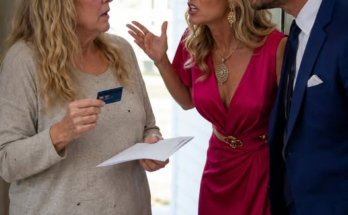
Carissa opened her clutch and took out the envelope.
Everything about that moment felt slow.
The crackle of the paper.
The way a woman near the bar leaned forward.
The way Nikki seemed to realize a half-second too late that this was not merely exposure. It was a handoff.
Carissa held the envelope out to Damen.
“What is this?” he asked.
“You’ve spent ten years pretending I wasn’t your wife,” she said.
THE END