My father broke my knees with a brick and my mother laughed… Years later, when they thought they had won, they discovered what they had created.
The brick didn’t appear out of nowhere.
I was already in my father’s hand when he went out into the yard that afternoon, walking slowly, with a calmness that was more frightening than a scream. In our house, the worst punishments didn’t come with fury. They came with ceremony.
I was fifteen years old.
My sister April, two years older, stood on the porch, sobbing with her hands covering her face, feigning an innocence she’d practiced since childhood. It didn’t matter that she’d started the fight. It didn’t matter that she’d thrown me into the kitchen first, that she’d smashed the glass on me, that she’d called me a nuisance every chance she got. In that house, April didn’t start fires. April just pointed out where to look when everything was already burning.
“She pushed me first,” I said, still believing that the truth was of some use.
April sobbed louder.
—He’s lying. He always lies.
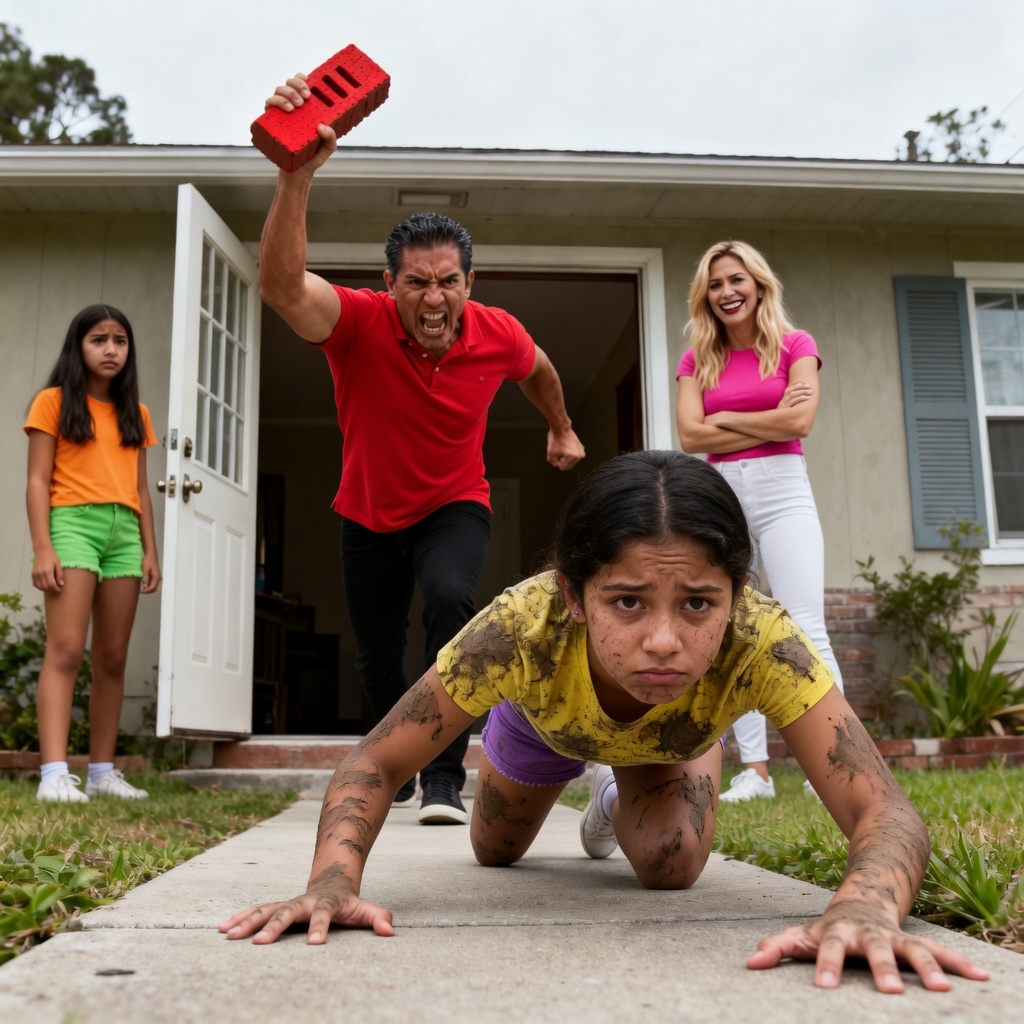
My father didn’t answer me right away. He paced the edge of the entrance, brick in hand, as if he were pondering. As if what he was about to do was an act of education. As if he could somehow dignify cruelty simply by carrying it out patiently.
My mother watched from the window with a cup of coffee.
He never intervened.
She liked to let him be the monster, then pretend she was just a woman trapped in a bad marriage. But no. My mother wasn’t trapped. My mother enjoyed the show when the pain wasn’t hers to bear.
“I didn’t do anything to her,” I repeated, louder. “She pushed me first. She…”
“Shut up,” my father said.
Just one word.
Dry. Final.
I kept quiet, not out of obedience, but because the verdict was already there in his tone.
Then he turned towards me.
—Did you lay your hands on your sister?
“No,” I replied. “She hit me and…”
The brick fell.
He didn’t raise his arm. He didn’t make a scene. He took a step toward me and released it with brutal precision, as if he were unloading a tool.
It fell on my knees.
Even today I hear that sound when I sleep: a dull thud, followed by a horrible cracking sound, like a thick branch breaking in winter.
At first I didn’t scream.
I couldn’t.
I couldn’t breathe. My vision went blank. I opened my mouth and nothing came out, because the pain didn’t feel like pain. It felt like another language. Something too big for my body.
I looked down.
My knees were in bad shape. Twisted. Swelling at an absurd rate. Bruising was starting to spread under the skin as if it were racing itself. I touched them reflexively and almost vomited from the pain.
My father looked down at me and smiled contemptuously.
—You don’t talk as much now, do you?
I made a small sound. Ugly. Broken.
He dropped the brick to the ground and walked away.
My mother came out at that moment, with her cup of coffee still in her hand, as if she had been waiting for her entrance into a play.
He didn’t ask if I was okay.
He didn’t bend down.
He didn’t scream for help.
Serious.
It wasn’t a big laugh. It was worse. It was that brief chuckle of people who feel clever when they find the perfect insult.
“That’s what useless things deserve,” she said before taking a sip. “You’re going to stain my entrance.”
April lowered her hands from her face. When she saw that I couldn’t stand up, something very much like satisfaction appeared on her face.
My father approached once more, leaning in just enough for me to smell his lotion and his old rage.
“You’re a flaw we forgot to throw away,” he told me, as if he were talking about the weather.
Then he went inside the house.
No ambulance.
No hospital.
Without guilt.
My mother threw a bag of frozen peas onto my legs as if she were feeding a dog.
—Put it on and stop the drama.
I tried to get up.
I couldn’t.
My legs buckled. The stones in the courtyard cut my palms when I tried to steady myself. I felt blood in my mouth because I had bitten my tongue without realizing it.
I had to crawl.
I crossed the open doorway, stepped onto the cold floor of the house, and heard April behind me saying I was going to get her rug dirty. As if that mattered more than the fact that my feet weren’t feeling right.
I spent three days locked in my room.
Without a doctor.
Without painkillers.
Without bandages.
Just an old towel I stole from the bathroom to wrap my knees around when they started turning colors I didn’t even know existed on human skin.
Down below, meanwhile, everything remained normal.
Covered.
Television.
Laughter.
My family behaving as if they hadn’t disabled their own daughter, but had only removed a broken object from the path.
I didn’t cry.
Not because it was strong.
But because in that house, crying was fuel. It gave them something to talk about. It gave them material. It gave them pleasure.
So I lay there staring at the ceiling fan, counting the blades over and over again, until the pain stopped being pure chaos and became something colder.
More useful.
I started to memorize.
The floorboards in the hallway creaked when my father walked by.
How my mother’s steps changed when she was about to take revenge on someone.
At what exact moment did April’s laughter turn into a lie?
On the fourth day I sat on the edge of the bed and forced myself to put my feet on the floor.
My knees gave out.
The pain went right through me to my teeth.
But I didn’t fall.
I gripped the desk so tightly my fingers went numb. I saw stars. I felt sweat on my back. My whole body trembled.
And yet I remained standing.
Limping, I reached the mirror.
She had a pale face, sunken eyes, and the tired expression of someone too young to look like that.
I looked at myself for a long time.
And I said to myself, barely in a whisper:
—I’m still here.
Downstairs, my mother started laughing again at something on television.
I kept that laugh inside me as if it were a photograph.
Not to forgive her.
To remember her.
Because that day I understood something that stayed with me for years: they believed that pain would make me small.
They didn’t know that pain can also make you precise.
And as I stood in front of the mirror, my knees burning and my heart frozen, I began to understand that one day I would no longer crawl.
One day, in that same family that called me a defect, someone was going to learn what it costs to raise a daughter by beating her… and turn her into a witness.
PART 2
In my house, time didn’t heal anything, it only trained you. At sixteen, I learned to walk silently. At seventeen, I learned to answer without saying a word. At eighteen, I mastered the empty smile my mother used to tell her friends that I was “overcoming my difficult phase.” My knees healed poorly: I could walk, yes, but I ran with pain, climbed stairs slowly, and every winter I felt my bones remembering on their own. My father called that “building character.” April called it a joke. I heard her say once on the phone that I would never inherit anything because the house, the cars, a second property in San Miguel, and even my mother’s “charitable” foundation were all in her name. That’s when I understood the kind of twisted intelligence they lived with: they weren’t just cruel, they also believed themselves to be untouchable. So I started gathering evidence. Not for theatrical revenge, but because in that house, the truth was worthless unless it came with documents. I photographed deeds, transfers, bank statements, tax returns, fake donations, straw man names, and the transactions of the supposed foundation. I learned about loans, fraud, and how sophisticated people sweep their dirty laundry under the legal rug. I worked nights in a warehouse using a shortened version of my middle name so no one would connect my salary to my family. I saved in silence. I studied online. I endured humiliation without reacting. And one day, when I had enough copies, enough money, and enough distance within myself, I rented a small warehouse two municipalities away and stored everything that could bring them down. Then I started sending the information little by little: to creditors, to tax authorities, to a local journalist, to those who could investigate my mother’s foundation and the assets frozen in April’s name. I didn’t send threats. I didn’t give speeches. Just facts. The system did the rest. The calls started. The shouting inside the house changed tone. They weren’t laughing at me anymore: they were accusing each other. My father was demanding answers about missing money, my mother swore someone had betrayed them, April was crying, saying she didn’t understand anything. And just when things really started to move, I left. I moved to a tiny apartment in Guadalajara, using my middle name, with a laptop, some clothes, a new toothbrush, and the first lock that truly felt like mine. From afar, I watched it all fall apart: frozen accounts, investigations, journalists asking questions, my mother’s mask crumbling before the entire city. April started writing to me. First with threats, then with offers, and finally with pleas. I didn’t reply. The day I crawled across the floor with broken knees, I learned that empathy didn’t exist in that family. They only understood consequences. While their world was falling apart, I started volunteering at a real women’s shelter, not the fake one my mother called charity.There, no one made fun of my limp. No one asked me why I walked like that. They just gave me work, trust, and kind silence. It was the first time I understood that being broken didn’t make me useless. It made me dangerous in the best way: capable of rebuilding myself without asking permission.
PART 3
When the local newspaper finally published the investigation into the foundation and the hidden assets, my family tore each other apart in public. My mother wept on camera, my father screamed that it was all a conspiracy, and April tried to keep up the charade on social media, pretending she was “blessed,” until the money stopped supporting the act. Months later, I returned to the house for the last time. It wasn’t the same anymore: empty walls, sold furniture, the smell of cheap cleaner, and defeat. I found them in the kitchen, older, smaller, more real than they had ever been. Without saying much, I left the same red brick and a photo of myself as a child on the counter. On the back, I had written: “You had everything and did everything to leave me with nothing. Now keep that.” My father asked me what I wanted. I told him the truth: I wasn’t there for the house, or for their meager money, or for pleasure. I had already taken away what mattered: the mask, the reputation, and the certainty that they could destroy me without paying a price. April wept. My mother tried to say something and couldn’t. My father called me sick. I looked at him with a calmness I didn’t even know existed and said, “Maybe. Or maybe you made me this way.” Then I left. Some time later, I legally changed my name, moved far away, and took a permanent job at the shelter. I started therapy. I learned something that took me years to believe: surviving wasn’t the same as living. My knees still crack when it’s cold. Some mornings I still walk like that teenager in the courtyard. But the pain no longer belongs to them. Sometimes I hear from others that my father faced fraud charges, that my mother made a deal to avoid something worse, that April ended up working a job she hated and sharing a roof with an aunt who didn’t treat her like a queen. It doesn’t bring me happiness. It brings me closure. Because the point was never to see them suffer. The point was to stop suffering for them. One night, already in my new apartment, I saw myself in the bathroom mirror brushing my teeth. Behind me there were no footsteps, no cruel laughter, no hand holding a brick. Only silence. A pure silence. I stared at myself for a long time and said aloud, “I am whole.” And for the first time in my life, that phrase rang true. Because the flaw they tried to destroy had learned to live. Without them.