My 8-year-old daughter was mocked at school for carrying an old military backpack—the only thing we had left of her father. When I asked the school for help, they told me she needed counseling instead. But a week later, her teacher called and said something I will never forget: “You won’t believe what they did.”
My daughter was just six years old when the officers came to our home to tell us that my husband had been killed in action overseas.
Alice didn’t cry at first. She simply sat there, clutching his military backpack—the only thing they had brought back to us.
It was worn, sun-faded, and tired. The straps were beginning to fray, and dried dirt was still embedded deep in the stitching.
“Daddy carried this,” Alice whispered, holding onto it as if letting go wasn’t an option.
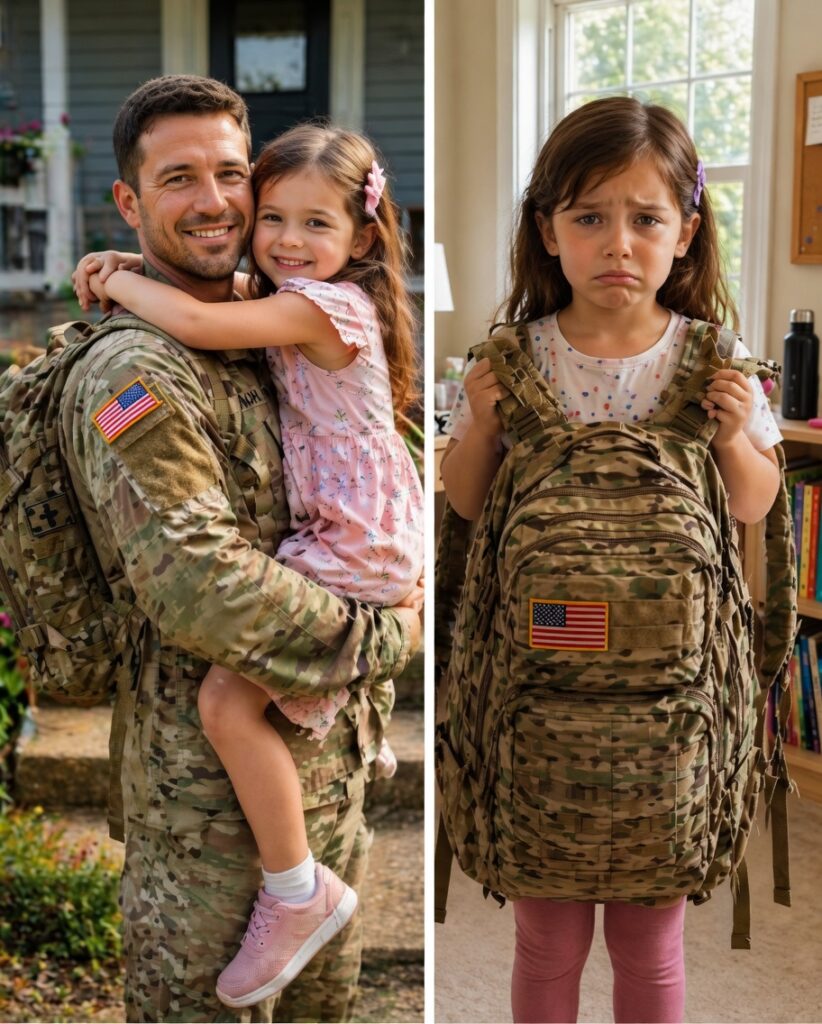
She’s eight now. And for the past one year and nine months, that backpack has gone everywhere with her.
At first, I thought it was just a phase—a part of how she was processing her grief. So I let her keep it close.
We adjusted the straps as much as possible, but it still hung too large on her small frame.
I tried replacing it once.
I took her to a store filled with bright, cheerful backpacks—glittering stars, unicorns, and sequins that shimmered and changed color under her touch.
“What about a new backpack? These are cute,” I suggested gently.
She glanced at them… then tightened her grip around her dad’s old bag.
“I want this one. It was Daddy’s. It still smells like him.” She paused before adding softly, “He called me Alice-bug.”
I swallowed hard. “I remember.”
She traced her fingers over a torn patch. “I think he’d want me to keep it.”
That was the end of the conversation.
I knew it might become an issue at school. Children can be unkind.
I just didn’t realize how cruel it would become.
At first, it was only looks.
Children stared when she stepped out of the car.
Then came the whispers.
Then, one day, a boy laughed and pointed at her bag.
Every afternoon, I would ask, “How was school?”
And every afternoon, she would shrug and say, “Fine.”
But everything changed when she started second grade.
One day, she stood quietly in the kitchen doorway.
“Mom?”
I turned. “What is it?”
She hesitated. “A girl pointed at my backpack today and asked why I was carrying a trash bag.” Her voice dropped. “She said my parents must be poor.”
“Who said that?”
She shrugged. “Just a girl.”
“What did you say back?”
“Nothing.”
The next morning, I went to the school.
I spoke to her teacher and the counselor. I explained everything—how Alice had lost her father, how much that backpack meant to her.
The counselor smiled sympathetically.
“Children notice differences,” she said. “Sometimes the easiest way to help socially is to reduce the thing that makes them stand out.”
I stared at her. “You mean the backpack.”
The teacher folded her hands. “It may help her fit in better.”
“And if she is very attached,” the counselor added, “that may be something worth exploring in counseling.”
That was the moment I understood—they weren’t going to help her.
Yes, she needed support in dealing with grief. But they were using that as an excuse to ignore the bullying.
They were asking me to change my daughter… instead of addressing the cruelty around her.
I left feeling sick.
And things only got worse after that.
One afternoon, Alice came home and walked straight to her room without even saying hello.
I followed her down the hallway.
“Baby?”
She stopped but didn’t turn around.
“A girl asked if I use a trash bag for school because I live in a dumpster.”
Then she went inside and shut the door.
I sat outside for almost an hour, listening to her cry.
The next morning, despite everything, she still put the backpack on.
Her eyes were red and swollen.
“I’m not leaving him at home,” she said.
I nodded, unable to trust my voice.
But after I dropped her off, I sat in the car, feeling like I had failed her in a way I couldn’t yet put into words.
At 11:12, my phone rang.
It was the school.
I answered immediately.
“Ma’am, I need you to come to the school right now,” her teacher said, her voice shaking.
My heart stopped. “What happened to my daughter? Is Alice hurt?”
“No, but…” she hesitated. “You need to come now. Ma’am… you won’t believe what they did to her.”
I was already reaching for my keys.
On my way out, I made a call.
I had tried handling this through the school. It hadn’t worked.
Now, I was done asking.
He picked up on the second ring.
“I need you at Alice’s school,” I said. “Something happened, and it sounds bad.”
When I arrived, he was already there—along with three other men and a woman.
We walked in together.
Heads turned. Conversations stopped.
Students and staff alike stepped aside as we moved down the hallway.
When we reached the office, the receptionist looked up—and froze.
Her eyes flicked from me to the group behind me: members of my husband’s unit, standing in full dress uniform.
“Conference room,” she said quietly.
When I opened the door, the first thing I saw was Alice.
She was sitting in a chair, her shoulders shaking, her face red and blotchy, her hands clenched tightly in her lap.
The second thing I saw was the backpack.
It sat on the table.
Covered in dark smears.
Banana mush clung to the zipper. Something thick and foul was oozing down one side.
“What happened?” I asked.
Her teacher looked close to tears.
“During lunch, several students took Alice’s backpack.”
My gaze shifted to three children sitting across the room. Two girls and a boy. Pale. Silent.
One girl’s mother stood beside her, her expression tense—as if she still didn’t fully grasp the gravity of what had happened.
The teacher continued.
“They threw it into the cafeteria trash can.”
A boy in the corner spoke up.
“She was crying and trying to grab it, but they kept holding it up and laughing.”
One of the girls nodded quickly.
“They said it belongs there.”
Something inside me went very, very still.
Behind me, Ryan—my husband’s closest friend—stepped forward.
“May I say something?”
I nodded. If I spoke, I might lose control.
Ryan cleared his throat.
“That backpack belonged to a man I served with. He carried it through combat. It came home because he didn’t.”
His voice hardened.
“You’re not mocking a backpack. You’re mocking a man who died defending this country and its people.”
One of the mothers shifted uncomfortably.
“They’re just kids. They didn’t know.”
I turned to her.
“Didn’t know what? Not to humiliate a crying child? Not to bully someone for being different? What exactly did you NOT teach your child that led to this?”
Her face flushed deep red.
She said nothing.
Then I looked at the principal.
“I came to this school weeks ago. I told her teacher and the counselor she was being targeted. I asked for help—and I was told to remove the backpack.”
The counselor started to speak.
“We only meant—”
“You meant it was easier to blame my daughter’s grief than to deal with the real problem.”
Silence filled the room.
Alice began crying again—quiet, broken sobs.
I went to her and wrapped her in my arms.
Across the room, one of the girls started crying too.
I stood and faced them.
“Do you understand now?”
They all nodded.
The first girl whispered, “I’m sorry we called your backpack trash.”
The boy added, his voice shaking, “And I’m sorry we threw it away.”
The second girl sobbed harder. “I’m sorry.”
The principal cleared his throat.
“There will be disciplinary action. Effective immediately. We will also be reviewing supervision procedures and staff response.”
“There should have been intervention before this,” I said firmly.
One of the mothers stepped forward, tears in her eyes.
“I am so sorry.”
I gave a single nod.
I didn’t have anything kind left to say.
I picked up the backpack.
Seeing it like that broke something in me.
Ryan stepped closer.
“Let me take it. We’ll clean it and repair it. Properly. Respectfully.”
Alice looked up at him.
“Really?”
For the first time, his voice softened.
“Really.”
A few days later, the school held an assembly.
There were speeches about kindness, respect, and military families.
The words were polished—but this time, they were backed by action.
The children who had bullied Alice stood up and apologized in front of their class.
The counselor resigned before the month ended.
I don’t know if it was because of this… and I don’t care.
What I remember is Alice standing at the front of the room.
She wore a clean dress. In her hands, she held the backpack.
It had been cleaned. Repaired. Restored.
Still his.
Just cared for.
She looked nervous—but when she spoke, her voice was steady.
“This was my dad’s,” she said. “He died overseas. I bring it to school because it makes me feel close to him. It’s old, but that doesn’t mean it’s trash.”
The room was completely silent.
Then she added:
“Some things are important even if other people don’t understand them yet.”
I had to look down at my hands.
I was crying.
People say grief is something you move through… something you leave behind.
I don’t believe that.
I think grief changes shape—and stays with you.
Sometimes it’s heavy.
Sometimes it sits quietly in the background.
Sometimes it shows up in a school hallway… disguised as a child’s old backpack.
But love does that too.
Love lingers—in fabric, in nicknames, in habits.
It lives on in the things we refuse to throw away… because they still carry a piece of someone who meant everything to us.
Alice still carries the backpack to school.
And every morning, before she gets out of the car, she taps the front pocket once—gently, like she’s making sure something precious is still there.
Maybe she is.
Maybe we both are.