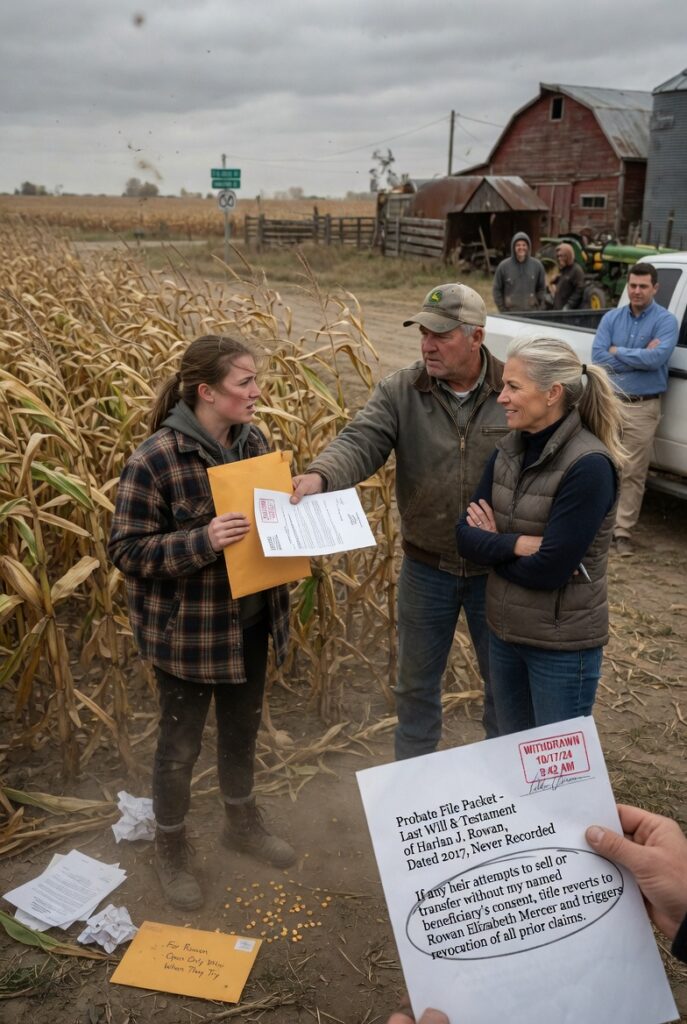
The first time I heard the word sold, I was standing in the middle of our family farm with dust on my boots and a hard October wind running through the corn like something alive.
It came low at first, pressing through the rows in long, whispering breaths, then rose and moved across the field in waves, making the dry leaves rasp and shiver against each other. It was the kind of sound I had known my whole life, a sound that could mean rain coming in from the west, or deer crossing the back acres at dawn, or my grandfather walking the fence line with his hands in his coat pockets, stopping every few yards to look at the ground as if the soil might say something useful if a man listened long enough.
That day, it sounded like warning.
My father didn’t ease into it. He didn’t clear his throat or soften his voice or even pretend he knew what he was about to do to me. He said it the way some men read the weather report, flat and practical, as if what he was announcing was no more personal than a temperature drop.
“We sold the farm.”
He said it loud enough for the hired hands near the equipment shed to hear. Loud enough for the man in the clean button-down shirt standing by his truck to hear. Loud enough, maybe, to make it feel real to himself.
Then he added, “To a developer. It’s done.”
My mother stood beside him with her arms folded and her chin lifted, wearing the same satisfied smile she used to wear when she corrected me in front of company. It was never a wide smile. My mother never wasted emotion where a thin, precise expression would do more damage. It was the smile of someone who believed the public part mattered most. The performance. The lesson. The moment where everyone in the room understood where power sat.
Behind them, a man in polished boots and a crisp blue shirt held a folder against his ribs and kept checking his watch like our land was just another item on his calendar.
I didn’t yell.
That surprised my mother first. You could always tell when she expected a reaction because something bright and anticipatory came into her eyes, as if she had already built the next move around my emotion. She was waiting for outrage. Waiting for tears. Waiting, maybe, for me to ask why in that raw, wounded voice people use when they still believe explanation changes anything.
I gave her nothing.
I blinked once and said, “You sold it when Grandpa’s estate still isn’t settled.”
The wind went through the corn again. Far off, metal clanged near the shed. One of the men over there paused and glanced in our direction, then pretended not to be listening.
My father’s eyes narrowed.
Not because I had insulted him. Because I had said something factual, and facts were always the most offensive thing you could place in front of him when he was trying to perform authority.
“Your grandfather is gone,” he snapped. “This land was always going to be ours to handle, and you should be grateful we’re even telling you.”
Grateful.
My family used that word the way some people use duct tape. Over cracks. Over questions. Over any part of reality that needed to be held down before it complicated the story they preferred.
My stomach tightened, but my voice stayed level.
“If it’s yours to handle,” I said, “show me the probate file number.”
My mother’s smirk deepened. She turned slightly toward the man with the folder as if I were entertainment arranged for his benefit.
“Listen to her,” she said, almost laughing. “Always acting like she’s the judge.”
I looked past her and met the man’s eyes.
“Who are you?” I asked.
He hesitated only a second, but it was enough. Enough for me to see he had expected anger, maybe, but not process. Not a direct question. Not this tone. Then he put on a smile so polished I could almost hear it click into place.
“Evan Mercer,” he said. “Cedar Ridge Development. We’re excited to bring jobs and housing to the county.”
He said it like a blessing. Like men in tucked shirts and expensive watches always said it when they arrived in places where other people had roots. Progress. Opportunity. Growth. Language with no mud on it. Language that never mentioned what had to be uprooted to make room for it.
My father shoved a stack of papers at my chest hard enough to make me step back.
“Sign,” he said. “And stop acting entitled.”
I didn’t take the papers.
I let them hang between us for a second, his hand rigid, the edges fluttering slightly in the wind.
“Sign what?” I asked calmly.
His lips curled.
“Acknowledgment. Consent. Whatever the lawyer said. You don’t own anything here, but this makes it smoother.”
My mother leaned in slightly, her voice sweet and sharp at the same time.
“You don’t own anything here,” she repeated, like she wanted the sentence to sink into the dirt.
For a second my throat tightened. Not because I believed her. Because I knew exactly what my grandfather had told me the summer I came back from college and found him sitting on the porch with a ledger open on his lap and a weathered manila envelope beside him.
It was late afternoon then. Cicadas were running hot in the trees. The porch boards creaked every time either of us shifted. Grandpa had looked older that summer, not frail exactly, but quieter in his body. More deliberate. He had built his life out of weather and work, and both had started showing in the way he sat, the way he got up, the way he looked at the horizon as if he was measuring how much time he had left against how much land he still loved.
He tapped the envelope once with two knuckles.
“Someday,” he said, “you’ll need proof.”
I remember laughing a little. “Proof of what?”
“People act different when land becomes money.”
At the time, I thought he meant survey disputes, taxes, county assessments, the little wars rural people carry in their pockets for decades.
I didn’t think he meant my parents.
Now I looked past them toward the farmhouse, toward the line of old sycamores Grandpa had refused to cut because his mother had planted them, toward the barn where he had taught me to drive a tractor before I was old enough to sit legally behind a steering wheel on public roads.
Then I looked back at my father.
“I’m not signing anything on the hood of your truck,” I said. “If this is legitimate, it will survive daylight and paperwork.”
My father’s face flushed.
“Don’t do this, Natalie.”
He only used my full name when he wanted to sound bigger than he was.
“Do what?” I asked. “Ask for records?”
Evan Mercer cleared his throat, trying to keep himself outside the family part of the explosion.
“Ms. Rowan,” he said, “we have a signed purchase agreement. We’ve already scheduled a survey team. We’re closing soon.”
“Which title company?” I asked.
His mouth opened. Closed.
My mother’s eyes flicked once toward him. A tiny movement. But it was enough.
“That doesn’t matter,” my father snapped.
“It matters,” I said, still flat. “If the deed is already transferred, it’s recorded somewhere. If it isn’t recorded, it isn’t real.”
My mother laughed softly, the sound almost affectionate if you didn’t know her.
“Go play detective,” she said. “You’ll come back and apologize when you realize you’re not in charge.”
My father shoved the papers forward again.
“Sign and stop acting entitled.”
This time I took the stack.
Only because paper has fingerprints and ink has a timeline.
I scanned the first page and my stomach went cold for a clean, practical reason. There was no case number, no probate reference, no deed instrument number, just vague, sloppy language about acknowledgment and consent and a line for my signature placed beneath a paragraph that said I had been informed of a pending transfer and had no objection to it.
It wasn’t a real document meant to protect anyone on it.
It was a prop.
A tool meant to silence me.
I handed it back.
“No,” I said.
My father’s jaw hardened.
“Then you can watch the bulldozers come,” he said loudly enough for the men by the shed to hear.
My mother stepped closer, lowering her voice so it felt personal.
“You always needed attention,” she whispered. “This is why you ended up alone.”
I didn’t answer that. I didn’t give her what she wanted. My mother’s favorite victories had always depended on getting me to bleed in public.
So I turned, walked to my truck, got in, and drove off the farm without slamming the door, without spinning gravel, without throwing one dramatic look over my shoulder.
Because the only place that mattered now wasn’t the porch or the barn.
It was the county.
Twenty minutes later, I pulled into the parking lot of the Hawthorne County Clerk and Recorder’s Office, a low brick building with tired landscaping, a flag out front snapping in the same wind that had followed me off the farm, and a lobby that always smelled faintly of toner, dust, and old paper.
Inside, the lighting was flat and honest. Government buildings never cared whether anyone looked good in them. The floors were waxed to a dull shine. A woman at a side counter was flipping through plat maps. Somewhere behind a door, a machine made that rhythmic clack-thunk of stamps hitting forms.
A small sign near the entrance read:
ALL RECORDS ARE PUBLIC
Good.
I approached the front desk and waited until the clerk looked up.
She was middle-aged, hair pulled back tight, reading glasses hanging on a chain against a navy blouse. There was something in her face I trusted immediately—not warmth, exactly, but fatigue sharpened into competence. She looked like someone who had spent years watching families attempt to convert lies into paperwork and had developed very little patience for performance.
“Hi,” I said. “I need the deed history for the Rowan farm parcel and the probate file for my grandfather, Walter Rowan.”
Her eyes flicked over me once, assessing. Not rude. Just measuring the shape of the request.
“Address?”
I gave it.
She typed. The keyboard clicks were loud in the quiet room. The glow from her monitor reflected faintly in her lenses. She clicked again, scrolled, clicked again.
Then she paused.
Not the normal pause of someone searching.
The pause of someone seeing something she didn’t expect.
“What’s your name?” she asked.
“Natalie Rowan.”
“And your relationship to Walter Rowan?”
“Granddaughter.”
She nodded once, stood, and went to a back shelf of binders and file boxes.
When she came back, she didn’t bring a binder.
She brought a thin folder and set it on the counter with more care than the act required.
“Okay,” she said slowly. “The parcel shows a recent transfer.”
My pulse didn’t spike. It narrowed.
“Recorded?” I asked.
“Yes.”
“Can you print the last two recorded instruments?” I said. “With the instrument numbers and the grantor information.”
She nodded and turned back to the printer station.
The machine whirred, pulled, clicked. Two sheets slid out. She carried them over and placed them in front of me.
The developer’s name was there in clean print.
Cedar Ridge Development
But the line above it turned my stomach in a colder way.
It didn’t say Dennis and Gail Rowan.
It said:
Estate of Walter Rowan
I kept my face still.
“There’s an estate transfer,” I said quietly. “Where’s the probate case?”
The clerk clicked again. Then frowned.
“That’s the issue.”
“What issue?”
She turned slightly toward her screen and typed faster now, moving between windows.
“There’s no active probate case under Walter Rowan in Hawthorne County,” she said. “Not filed here.”
For a moment the room seemed to get quieter around us.
No active probate.
No estate opened.
And yet the land had been conveyed from the estate.
My hands felt cold.
Not panic.
Clarity.
“So how,” I asked, “did they transfer estate property?”
The clerk stared at the screen another second, then scrolled further and stopped. Her expression changed around the eyes.
“There’s an attached packet,” she said. “Scanned. Older.”
She clicked.
A new window opened. I couldn’t see the details from where I stood, just the label on a folder icon.
Scanned packet – Will
The clerk’s face changed completely.
She lowered her voice.
“Ms. Rowan,” she said, “this was never filed, and it changes who owns the farm.”
For a second I didn’t move.
Not because I didn’t understand what she meant. Because I understood too well.
If there was a will sitting in an old scanned packet that had never been probated, then my parents had not just sold land.
They had outrun the truth on purpose.
I leaned in slightly.
“Print it,” I said. “Certified copy if you can.”
She hesitated. Her nameplate read Mara Ellison.
“I can print what’s scanned,” Mara said carefully. “But I can’t give legal advice.”
“I’m not asking for advice,” I replied. “I’m asking for records. And I want the deed history certified.”
Mara nodded once, but instead of printing immediately, she did something I didn’t expect. She clicked into another panel on her screen, smaller, hidden at the side.
“Before I print this,” she said quietly, “I need to see whether the packet was accessed recently.”
My chest tightened.
“Why?”
“Because when something is ‘lost’ and then suddenly shows up attached to a transfer,” she said, “it usually means someone knew it existed.”
She scrolled through the log, her eyes moving left to right. Then she stopped.
Her lips parted slightly, and she looked up at me for a fraction of a second.
“It was opened yesterday,” she said softly.
“By who?”
She clicked once more, and a user line populated on the screen.
Not my father’s name.
My mother’s.
Gail Rowan
Timestamped yesterday morning.
Less than an hour before the estate transfer had been recorded.
My throat went cold.
“So she came here,” I said.
Mara nodded.
“She used the public kiosk under her own ID for a records request. That creates a trace.”
A trace.
The best kind of proof.
Mara straightened.
“I’m going to get my supervisor.”
I waited while she disappeared through a back door. My reflection hovered faintly in the glass partition above the counter, pale and still. I could feel my own breathing now, measured and a little too controlled, like I was holding the edges of myself together by force.
A minute later she returned with a man in a gray cardigan and a badge clipped to his belt.
His nameplate read Glenn Pritchard.
He had the look of a man who had spent thirty years letting other people panic while he continued alphabetizing facts.
“Ms. Rowan?” he asked.
“Yes.”
He glanced at Mara’s screen, then at the deed printouts in my hand.
“You requested deed history and probate records.”
“I requested deed history and the estate authority behind a transfer recorded yesterday,” I said. “Your system shows no active probate case, but there’s a deposited will packet that was never filed.”
Glenn’s eyes narrowed very slightly.
“That packet,” he said, “appears to be a deposited will for safekeeping.”
The words landed like a lock turning.
My grandfather had told me about the envelope. He hadn’t been sentimental that day on the porch. He had been methodical. Strategic. He had known exactly what kind of people he was leaving behind him.
“I need a certified copy,” I said.
Glenn nodded once.
“We can certify that it is a true copy of what is on file in our deposited will records. We cannot certify it as admitted to probate because it wasn’t.”
“I understand.”
He motioned to Mara.
“Print it.”
Mara opened the scanned packet and hit print.
The first page appeared on the screen before it went to the machine: a cover sheet with my grandfather’s name, a date stamp from years earlier, and the simple bureaucratic phrasing of a document too important to need decoration.
Then the printer started.
This time it ran longer. Multiple pages. Glenn stood beside it like he was guarding evidence, which, in a way, he was. When the last page slid out, he gathered them, added a certification sheet, stamped it, signed it with quick practiced strokes, and placed the packet in front of me.
I didn’t flip through it fast.
I turned the first page slowly.
Last Will and Testament of Walter Rowan
The room held still around me.
My eyes moved down through the preamble and then into the part that mattered. The part where land becomes a sentence.
Grandpa had done it properly. Legal description. Metes and bounds. Parcel number. Every detail you need when you want to stop people from saying later that you “meant something else.”
Then the line that changed the temperature of my blood.
He left the farm to me.
Not shared.
Not after some life estate.
Not someday, maybe, if circumstances were right.
To me.
I kept reading.
He had also named an executor.
My eyes dropped to the line and stayed there a second longer than they had to.
Natalie Rowan
My hand stayed steady, but something in my body went cold all over. My grandfather had not merely loved me. He had trusted me. Enough to put my name where control lived.
Miles came up beside me then.
He had driven separately because when I left the farm I hadn’t had time to call him beyond saying, “Meet me at the county office. Something is wrong.”
Now he stood shoulder to shoulder with me in the quiet lobby, his coat still unbuttoned, breath faintly quick from hurrying in.
“What is it?” he asked.
“There’s a will,” I said.
He leaned in to read.
“Oh my God,” he whispered. “He gave it to you.”
“Yes.”
Mara, on the other side of the counter, spoke softly.
“There’s also a clause.”
I turned another page.
Not exactly in the will itself, but referenced there and listed in the packet notes.
“A no-contest clause,” Mara said.
I found it. Legal language Grandpa’s attorney must have insisted on, the kind meant to make greedy people hesitate because it turns scheming into forfeiture.
My jaw tightened.
“That clause didn’t stop them,” I said. “It dared them.”
I looked up at Glenn.
“If this was deposited here, how did an estate transfer get recorded yesterday without probate?”
Glenn didn’t flinch.
“We record what is presented if it meets recording standards,” he said carefully. “We don’t adjudicate ownership. That’s the court’s job.”
“Then what did they present?”
He nodded to Mara.
She clicked back to the transfer instrument and opened the attachment list.
Mara’s face hardened as she scrolled.
“Affidavit of heirship,” she said.
Of course.
The fastest lie in a rural county. Cheap. Efficient. Familiar.
She opened it.
The document claimed Walter Rowan had died intestate—without a will. It claimed his heirs were Dennis Rowan and Gail Rowan. It claimed they had authority to convey estate property to Cedar Ridge Development.
My eyes moved down the signature block.
Dennis Rowan.
Gail Rowan.
Both notarized.
Then the witnesses. Two “disinterested parties,” supposedly. Their names meant nothing to me, but the addresses did. Same post office box in town. The kind of detail that looks harmless until you’ve lived among people who know exactly how to make fraud wear overalls.
“And this,” Mara added, “was recorded before the will packet was pulled up.”
I looked at her.
“But my mother opened the will yesterday,” I said.
Mara nodded.
“Yes. Which means she accessed it and still proceeded with an affidavit claiming there was no will.”
My throat tightened, not from fear but from precision. The shape of it had become unmistakable now. They hadn’t misunderstood. They hadn’t assumed. They hadn’t gotten ahead of paperwork.
They had lied under oath after reading the truth.
I shifted the will packet into one hand and said, “I want certified copies of the affidavit of heirship, the transfer instrument, and the access log showing Gail Rowan viewed the deposited will packet yesterday.”
Glenn nodded once.
“We can certify the recorded instruments,” he said. “The access log we can provide as an internal record printout.”
“Do it.”
While Mara printed, I stepped to the side and called the one attorney I knew who didn’t waste words.
Tessa Marlo had handled a property line dispute for Miles’s uncle two years earlier and left grown men twice her size looking politely disassembled.
She answered on the second ring.
“Natalie.”
“Tessa,” I said. “My parents recorded an affidavit of heirship and transferred the family farm from my grandfather’s estate to a developer yesterday. The county clerk just found a deposited will packet that was never probated. It names me as devisee and executor. And the access log shows my mother viewed it yesterday before the transfer was recorded.”
Tessa went quiet for half a beat.
That was how lawyers like her sounded when they were already choosing a legal path.
“Okay,” she said. “You are going to open probate today. Emergency petition. Then we file notice of pending action against the property. That developer does not get clean title.”
“What about stopping bulldozers?”
“We seek a temporary restraining order if anyone tries to enter or disturb the land. But first I need every certified page you have in my inbox.”
“I can have them in ten minutes.”
“Good. Do not confront your parents. Let the record do it.”
I hung up.
When I turned back, Mara was stapling the certified sets with careful hands while Glenn added stamps and signatures, each one a small hard nail in a coffin my parents had built for themselves.
Then Mara slid one more sheet toward me.
“This is the copy request history,” she said quietly.
I looked down.
There it was.
Gail Rowan
Timestamped yesterday.
Paid at counter.
Deposited will packet copy fee.
For a second I just stared at the line.
My mother had not only viewed the will.
She had paid for a copy.
She had stood in this building, in this dull fluorescent honesty, purchased the truth, and then gone out and signed an affidavit swearing the truth did not exist.
Something clicked into place inside me. Not anger. That was too soft a word now. This was colder. Cleaner. The kind of certainty that makes your hands stop shaking.
Glenn looked at me over the rim of his glasses.
“Ms. Rowan, you should file the will with probate immediately.”
“I’m going there now.”
As I turned toward the probate hallway, my phone buzzed.
A text from my father.
Don’t make this ugly. The survey crew is coming tomorrow. Sign the papers like an adult.
I looked at the message for a second, then put my phone back in my pocket.
That wasn’t a threat.
It was a deadline.
And it told me exactly what they were trying to do.
They weren’t just selling land.
They were racing to scar it before a judge could stop them.
I didn’t leave the building. I walked down the hallway to the probate window with the certified will packet pressed against my ribs like it was something alive.
The air smelled like old carpet and copier toner. People lined the wall clutching folders, envelopes, manila packets swollen with marriages ending, parents dying, assets being renamed. Government buildings reduce life to paper, but everyone standing in them knows the paper is just where grief and greed go to put on clean clothes.
When it was my turn, I slid the packet under the glass.
“I need to file this will for probate,” I said. “And I need to open an estate case today. Emergency if possible.”
The probate clerk was younger than Mara, sharp-eyed, tired-looking, with a ponytail so tight it made her cheekbones look severe. She flipped through the first pages, then stopped at the deposit stamp.
“This is a deposited will for safekeeping,” she said slowly.
“Yes.”
“And the access log shows my mother viewed it yesterday before the transfer was recorded.”
That sentence changed her posture.
Not sympathy.
Procedure.
“Name of decedent?”
“Walter Rowan.”
She typed. Frowned.
“No case exists.”
“Exactly.”
She looked up.
“We don’t stop recording,” she said carefully. “But we can open probate, appoint an executor, and once a case exists, you can record notice against the parcel.”
“Do it.”
She slid a petition form toward me.
I filled it out standing there at the side counter, my handwriting steady, my thoughts not. Date of death. Known heirs. Known assets. Proposed executor.
When I got to the line asking whether a will existed, I checked yes and wrote:
Deposited will located and certified copy attached.
When I got to the line asking for the proposed executor, I wrote my own name with a steadier hand than I expected.
Natalie Rowan
The clerk reviewed the petition.
“You’ll need a hearing for appointment,” she said. “We can request expedited, but it depends on the judge’s calendar.”
“I need expedited. A survey crew is scheduled for tomorrow.”
Her mouth tightened. She glanced at the will again.
“You should have counsel.”
“I do.”
I slid Tessa’s card under the glass.
The clerk read it and nodded once.
“Okay. Filing fees.”
I paid. The receipt chirped out. She stamped the petition packet and handed me a paper with a fresh case number at the top.
Seeing a case number beside my grandfather’s name felt like the ground shifting back beneath my feet.
Now there was a court file.
Now there was a place for the truth to stand.
“I need something else,” I said. “I need the recorder notified that probate is open.”
She nodded.
“Your attorney can file a notice of probate and a notice of pending action. But once the case hits the system, you can record the case number today.”
“How long until it hits?”
“Within the hour.”
Then she lowered her voice slightly.
“And Ms. Rowan—if that affidavit of heirship was knowingly false, that’s serious.”
“I know.”
I stepped aside and called Tessa again.
“It’s filed,” I said. “New case number. Petition and emergency motion submitted.”
“Good. Now we cloud the title. Go back to recording. I’m emailing you language for notice of probate and notice of pending action right now.”
Within seconds, two PDFs hit my inbox.
Short.
Clean.
Deadly.
I printed them at the public kiosk down the hall and returned to Mara’s desk.
She looked up and recognized me immediately.
“You opened probate.”
“Yes,” I said. “I need to record these against the farm parcel today.”
She took the papers, checked the case number, and nodded.
“Give me ten minutes.”
While she worked, I watched the front doors more than the screen over the counter. Part of me expected my parents to come storming in with righteous voices and bad documents and the certainty that volume could still outrun recordkeeping.
They didn’t.
Which meant they were still confident.
That never lasts long once the county starts stamping your lies.
Mara returned with the recorded notice receipts, instrument numbers across the top, barcodes at the side, and the neat rectangular county stamp that looked like the government’s version of a hard stare.
“This is now in the public record,” she said quietly. “Anyone searching title will see there is a pending probate action.”
“Will it stop the transfer?”
“It won’t erase it,” she said. “But it clouds it. And it warns them.”
Warn them.
That was enough for the next ten minutes.
I stepped into the lobby and called the developer number from the paper my father had tried to shove into my chest earlier.
The receptionist voice was smooth, expensive, and trained.
“Cedar Ridge Development.”
“My name is Natalie Rowan,” I said evenly. “The farm parcel you believe you purchased is now subject to a pending probate action. A will was located and filed today. A notice of pending action has been recorded. You do not have clean title.”
Silence.
Then: “One moment.”
A man came on the line.
Measured voice. Legal posture.
“This is Cole Jensen, counsel for Cedar Ridge.”
“Mr. Jensen,” I said, “my parents represented that they had authority as heirs. They represented falsely. They recorded an affidavit claiming there was no will. The will exists. I am the named executor and devisee. The title chain now shows recorded notices this afternoon.”
A longer silence.
“If what you’re saying is accurate,” he said carefully, “your parents committed fraud against the buyer.”
“Yes.”
Another pause.
Then: “We will not proceed with any entry or development activity until this is resolved.”
“Put that in writing.”
A small exhale.
“I will.”
When I hung up, another text from my father appeared almost instantly.
You think paperwork can stop progress? The survey crew has already been paid.
I didn’t answer.
I went back to the probate counter and asked the clerk whether the emergency motion had been assigned.
She checked her screen.
“Assigned,” she said. “No hearing time yet. You may get a call.”
Tomorrow morning, I thought.
Too late if they got machines onto the land before sunrise.
I stepped into a quieter corner near the vending machines and called Tessa again.
“They’re still sending the survey crew tomorrow,” I said.
“Then we seek a TRO tonight,” she said. “If the duty judge will hear it, we go now. If not, we’re first on in the morning. In the meantime, you go back to the farm.”
“What do I do there?”
“You do not engage. You photograph everything. If any crew arrives, you tell them calmly there is a recorded pending action and an open probate case. You give them instrument numbers. If they ignore you, you call the sheriff.”
The sheriff.
Hearing that word stripped the last layer of family drama off it. This wasn’t a private betrayal anymore. It was land theft in clean clothes.
I drove back as the sun started lowering itself toward the tree line, the sky going from hard blue to the pale burnished gold that always made the fields look holy for about fifteen minutes before dark.
The farm road was rutted the way it had always been. The mailbox still leaned. The sycamores still threw long shadows over the pasture. But at the front gate, something had changed.
Fresh survey stakes stood along the edge of the field, thin wooden markers with bright ribbons tied to them. Red. Orange. Cheap color against old dirt.
And wired to the gate was a brand-new sign.
NO TRESPASSING – PROPERTY UNDER CONTRACT
My father stood beside it like he had erected a monument.
My mother leaned against his truck, smiling as if the sign itself pleased her.
When I got out, my father lifted his chin.
“You came back,” he said. “Ready to sign like an adult?”
I didn’t raise my voice. I reached into my folder, took out the recorded notice receipt, and held it up.
“There’s a probate case now,” I said evenly. “And a notice of pending action recorded against the parcel. Your affidavit claiming there was no will is false.”
My mother’s smile didn’t disappear.
It sharpened.
“That won’t stop tomorrow,” she said softly.
“Why?” I asked.
“Because tomorrow morning,” she said, “the survey crew is coming with a sheriff.”
My stomach tightened, but my voice stayed calm.
“The sheriff won’t escort a fraud.”
My father’s eyes narrowed.
“Watch.”
Then my phone buzzed. Unknown number. A voicemail notification appeared before I could even react. The transcript preview popped onto the screen.
Miss Rowan, this is the sheriff’s office. We received a complaint that you’re trespassing on Cedar Ridge property…
I played the voicemail slowly, on speaker.
My father’s mouth curled.
My mother’s eyes shone.
I looked at them.
“You called the sheriff on me.”
My father shrugged.
“You’re trespassing.”
I didn’t argue the sentence.
I called the sheriff’s office back.
The dispatcher answered on the second ring.
“This is Natalie Rowan,” I said. “I just received a voicemail stating there’s a complaint that I’m trespassing on Cedar Ridge property. I need the incident number, the reporting party name, and the deputy assigned.”
Her tone shifted almost immediately. Cautious. Recorded.
“Ma’am, are you on scene?”
“Yes. At the family farm gate.”
“Stand by.”
Keyboard clicks. A pause.
“There is a complaint. Called in this evening. Deputy is en route.”
“Incident number?”
She gave it. I repeated it back.
“And the reporting party?”
Another pause.
“Gail Rowan.”
My mother did not move. Not even a blink. But I saw her eyes flick once. Just once.
That was enough.
“Thank you,” I said. “Please add to the call notes that a probate case was filed today and a notice of pending action has been recorded against the parcel. I have the instrument numbers.”
The dispatcher hesitated.
“Okay. I’ll note that.”
I hung up and looked at my mother.
“You use the sheriff like a prop,” I said quietly.
My father snapped, “Stop talking. Just sign.”
I ignored him.
Instead I took out my phone and photographed everything. The sign. The stakes. The gate. The wide line of the pasture with the ribbons already planted. My parents standing there, the truck behind them, the house beyond, all of it arranged like evidence waiting to be labeled.
A patrol SUV rolled up five minutes later, gravel crunching under the tires.
Deputy Scott Landry stepped out wearing the neutral face of a man who had learned that half of rural law enforcement was property disputes and the other half was family.
He approached the gate, looked at me first, then my parents.
“Ma’am, are you Natalie Rowan?”
“Yes.”
“Deputy Landry.”
He nodded toward my parents.
“They say you’re trespassing on property under contract with Cedar Ridge Development.”
My father stepped forward instantly.
“She’s been harassing us,” he said. “We sold the farm. She refuses to accept it. She’s trespassing and threatening workers.”
I didn’t react to the word threatening. That’s one of the advantages of documentation. People can say anything they want. Paper has fewer moods.
Deputy Landry looked at me.
“What’s your side?”
I didn’t say my side.
I said facts.
“There is a probate case filed today for my grandfather’s estate. A will was located and filed. A notice of pending action has been recorded against the parcel. The county recorder instrument numbers are here. If Cedar Ridge wants to dispute ownership, that’s for probate court. But the title is clouded right now.”
My mother scoffed.
“She’s lying. There’s no will.”
I didn’t turn toward her.
“My mother viewed the deposited will packet yesterday morning,” I said to the deputy, “and then signed an affidavit claiming there was no will. The county has the access log.”
Deputy Landry’s expression tightened slightly at the word affidavit.
He held out a hand toward my father.
“Do you have paperwork?”
My dad shoved his stack forward like a man presenting proof of manhood.
“Purchase contract. We already closed. She’s just mad.”
Deputy Landry flipped through the pages slowly.
Then he tapped one sheet.
“Where’s the recorded deed?”
My father’s mouth tightened.
“It’s in process.”
The deputy looked at me.
“Do you have the recorded notice?”
“Yes.”
I handed him the receipts. He read them. Then he stepped aside and spoke into his radio.
“Dispatch, can you run a records check on the parcel and confirm any recorded notices today? Instrument number is—”
He read it off.
While he waited, my mother leaned slightly toward me, her voice low.
“You think you’re so smart.”
I kept my eyes on the deputy and said nothing.
People like my mother hate silence when silence is backed by records.
The radio crackled.
“Parcel shows notice of pending action recorded this afternoon and probate-related notice. Title flagged for dispute.”
Deputy Landry looked back at my parents.
“Okay,” he said, voice firmer now. “This is a civil dispute with active filings. I’m not removing her for trespass tonight.”
My father flushed dark red.
“So she can just do whatever she wants?”
“No,” the deputy said. “Neither can you.”
He turned slightly toward my mother.
“Ma’am, you called in a trespass complaint, but the title is flagged. If you want this resolved, you resolve it in court.”
“She’s harassing us.”
“Then you request a protective order. You don’t weaponize a trespass call when ownership is in dispute.”
My father tried another angle.
“The survey crew is coming tomorrow. The sheriff will escort them.”
Deputy Landry’s eyes sharpened.
“No one is getting escorted onto disputed land based on a private contract. Not while there’s a recorded pending action.”
I held up my phone.
“Cedar Ridge counsel confirmed they will not proceed with entry or development until this is resolved.”
The deputy glanced at the email on my screen and nodded once.
“Good.”
Then he looked back at my parents.
“And one more thing. This call log shows the reporting party is Gail Rowan. If it’s determined that false statements were made to provoke a law enforcement response, that can be addressed.”
My mother blinked twice.
My father’s mouth opened, then closed.
The deputy turned to me.
“Do you want them trespassed from your presence right now?”
That almost made me laugh.
“No,” I said. “I want you to document that they posted a no-trespassing sign claiming Cedar Ridge ownership while a pending action is recorded.”
He nodded.
“I will.”
He photographed the sign, the stakes, my parents’ paperwork, my recorder receipts. Then he made notes in a small pad, writing with the slow economy of a man who understood that what he chose to record tonight would matter later.
Before he left, he looked at all of us and said, “Do not escalate this. If a crew arrives tomorrow and anyone attempts to enter or disturb the land, call us immediately.”
Then he pointed, not rudely but very clearly, at my parents.
“And stop calling this in as trespass while the title is flagged.”
My father said nothing.
My mother gave him her best sweet voice.
“Of course, Deputy. We just want peace.”
Peace.
Another word she used when she meant control.
When the patrol SUV drove away, the farm fell silent again except for the wind.
My mother stepped closer. Her voice dropped.
“You think you stopped us? You didn’t.”
“The will matters,” I said.
She smiled thinly.
“It doesn’t, if it was never filed and Walter is gone.”
I looked at her for a long second.
“The will matters,” I repeated, “and the fact that you accessed it yesterday matters more.”
Something passed through her face then. Not guilt. Never that. Recognition. She had just understood, truly, that I had proof of knowledge, not just proof of existence.
My father jabbed a finger toward my truck.
“Go home. Tomorrow you’re going to watch this farm change anyway.”
I got in the truck and drove straight to Tessa’s office.
She met me at the door with her suit jacket off, her sleeves rolled once, and a stack of printed filings already clipped together on her conference table.
“What do you need?” I asked.
“Your affidavit. And the most damning proof.”
I set the certified will copy on the table.
Then the access log.
Then the receipt showing my mother had paid for a copy of the will packet yesterday.
Tessa stared at that line for a full second.
Then she looked up at me.
“This isn’t just a title dispute anymore,” she said.
“What is it?”
She tapped the receipt.
“It’s evidence they knew the will existed and still swore under oath that it didn’t.”
Her phone buzzed.
She glanced at the screen and answered.
I watched her listen. Watched her eyes narrow. Then she covered the receiver and looked at me.
“They found something else in the deposited packet.”
My stomach tightened.
“What?”
“A second page that wasn’t scanned with the first set.”
I stared at her.
“What page?”
She uncovered the phone, asked two clipped questions, listened again, then hung up.
“A handwritten codicil,” she said. “And it names the person who gets the farm if your parents ever try to sell it.”
For a second all I could hear was the hum of her office lights.
Tessa printed the codicil the minute the clerk’s office sent the emergency scan over. She didn’t treat it like a curiosity. She treated it like a loaded weapon.
When the page slid from the printer, she placed it in front of me.
Walter Rowan’s handwriting.
Not typed. Not polished. Not something Dennis and Gail Rowan could later claim had been “misunderstood.”
The paper was dated years after the will, signed, witnessed, and direct in the blunt, practical voice my grandfather used whenever he was most serious. He referenced the same farm parcel by legal description. No ambiguity. No sentimental language. Just instructions.
Tessa tapped the key paragraph once.
Then she read it aloud.
“If Dennis Rowan or Gail Rowan attempt to sell, transfer, encumber, or contract the farm in any manner, they are immediately disinherited, and the farm shall pass solely to Natalie Rowan as trustee, with instructions to record notice and seek immediate injunctive relief.”
I sat very still.
My grandfather had not only given me the farm.
He had predicted this exact betrayal.
He had imagined my parents doing precisely what they had done and built a consequence into the paper years before they ever made their move.
Tessa looked up.
“This doesn’t just change ownership,” she said. “It shows intent. It shows Walter anticipated interference from them specifically.”
I thought about my mother standing at the county counter yesterday, buying a copy of the will packet. I thought about my father’s text: Don’t make this ugly. I thought about the stakes already in the ground, the sign on the gate, the sheriff call.
“I’m ready,” I said.
Tessa filed the emergency request that night with the duty judge.
It wasn’t dramatic the way television trains people to expect. No crowded courtroom. No sudden gasps. Just after-hours procedure, a clerk who sounded tired but efficient, an electronic filing confirmation, and a video hearing from Tessa’s office on a laptop propped atop a stack of appellate reporters.
The judge appeared on screen in his chambers with his tie loosened and reading glasses low on his nose. He had the expression of a man who had seen far too many families destroy themselves over property to find any of it novel.
“Ms. Marlo,” he said, “I have your emergency motion. Tell me why this cannot wait.”
Tessa answered like a scalpel.
“Your Honor, a farm parcel belonging to the estate of Walter Rowan was transferred yesterday to a developer based on an affidavit of heirship claiming the decedent died intestate. Today, a deposited will was located, certified, and filed for probate. The will names Ms. Rowan as executor and sole devisee of the farm. Additionally, the decedent’s deposited packet contains a handwritten codicil specifically disinheriting Dennis and Gail Rowan if they attempt to sell or encumber the farm. We also have an access log and receipt showing Gail Rowan obtained a copy of the will packet yesterday before signing the affidavit claiming no will existed.”
The judge’s eyes lifted.
“Codicil?”
Tessa held it up to the camera.
“Yes, Your Honor.”
He read from his screen, then stopped at the receipt.
I could tell because his pen paused.
“Copy fee,” he read aloud. “Deposited will packet. Paid by Gail Rowan yesterday.”
His expression flattened into something colder than anger.
Then he read the codicil paragraph silently, once, then again.
When he looked up, his voice had changed.
“Ms. Rowan,” he said to me, “are you asking this court to restrain entry and disturbance of the land pending probate determination?”
“Yes,” I said. “They’ve already placed survey stakes and posted signage claiming the developer owns it. They are trying to change the property before the court can act.”
“Has the developer entered yet?”
“Not physically,” Tessa answered. “Counsel indicates they will not proceed at present. But the respondents are still directing activity on the land and misrepresenting authority.”
The judge nodded once.
“Then I am not relying on anyone’s goodwill.”
He looked down again, wrote something, and then said the sentence that changed tomorrow.
“I am granting a temporary restraining order. No entry by the developer. No survey activity. No grading, staking, or alteration of the property pending hearing. Dennis Rowan and Gail Rowan are restrained from representing authority over the parcel. Violation will be treated as contempt.”
Tessa didn’t smile. Neither did I.
“Thank you, Your Honor.”
But the judge wasn’t done.
He lifted the receipt again.
“And I am directing the clerk to forward the affidavit of heirship, the access log, and this receipt to the district attorney for review. If the affiants obtained the will and swore there was none, that is not mistake.”
That night the order was served electronically and in person.
Tessa’s process server took a paper copy to my parents’ house.
Cedar Ridge’s counsel got notice.
The county recorder received the order and attached a restraining notice to the parcel record.
By midnight, anyone searching the farm’s public file would see what my parents had tried to outrun:
Disputed. Restrained. Watched.
I went to the farm before sunrise.
Not to argue.
To witness.
The fields lay under a thin gray light that made everything look suspended. The barn roof was damp with dew. The sycamores stood dark and still. In the distance, the corn moved a little under the morning breeze, softer now than the day before.
I parked by the gate and waited.
The survey crew arrived first. Two trucks. Bright safety vests. Equipment cases. Men stepping out with that particular neutral efficiency of people who do not care whose land it is as long as the paperwork is clean and the check clears.
Then a sheriff’s unit rolled in behind them.
My father got out of his truck with a look I recognized from childhood—the one he wore when he believed authority had finally come dressed in a uniform to prove him right. My mother stood beside him in a dark coat with her arms folded, chin up, face set in the satisfaction of someone who thinks the script is about to return to its intended order.
Then Deputy Landry stepped out of the patrol unit with the TRO in his hand.
He didn’t look at me first.
He looked at the survey crew chief.
“Sir,” he said, “I have an order this morning.”
My father’s expression changed. Just once. Quick.
Deputy Landry lifted the pages and read aloud, clear enough for the crew to hear over the wind.
“No entry, no disturbance, no survey activity.”
Then he looked directly at the crew chief.
“You start work and you’ll be documented violating a court order. Pack up.”
The crew chief didn’t argue. He looked at my father, then at the deputy, made the correct professional choice, and motioned to his men.
My mother stepped forward.
“This is ridiculous,” she snapped. “She manipulated the court.”
Deputy Landry didn’t blink.
“Ma’am, you’ve been served. Step back.”
My father’s face went red.
“You can’t do this,” he barked. “We already sold it.”
Deputy Landry looked at him and said, flat as stone, “Then you should have sold something you had the right to sell.”
The survey crew started loading equipment back into the trucks.
My mother turned toward me, voice rising so the men could hear.
“Your grandfather is gone. You don’t get to pretend you’re queen of this land.”
I held up the recorded notice and the TRO.
“I’m not pretending,” I said. “I’m recording.”
And then my father made the worst decision of his life.
Maybe he thought motion would look like power. Maybe he believed the performance still mattered if he did it hard enough. Maybe he simply couldn’t stand one more second of being contradicted by paper in front of strangers.
He reached down, grabbed one of the survey stakes near the gate, and yanked it out of the ground.
Deputy Landry’s posture changed instantly.
“Sir. Stop.”
My father didn’t.
He threw the stake into the ditch with a wild, furious motion, like if he could rip enough wood from the soil he could unmake the court order, the notices, the will, the whole humiliating truth.
Deputy Landry stepped in.
“Hands behind your back.”
My father spun toward him.
“For what?”
“For violating the order and interfering after being directed to stop.”
The cuffs clicked onto my father’s wrists in the same wind that had moved through the corn the day before. The sound was small. Clean. Final.
My mother made a strangled, furious sound and took a step forward.
“He’s an old man!”
Deputy Landry didn’t blink.
“He’s an adult. And he was warned.”
Two additional units pulled up at the road because Landry had already called for backup. Procedure. Witnesses. Record.