The judge said my full name slowly, like each part of it had weight.
“Emily Rose Bennett Whitfield.”
Caleb’s head snapped toward the bench.
Vivian stopped touching his arm.
For six years, Caleb had called me Emily when he wanted to sound kind, Em when he wanted something, and nothing at all when he wanted me small.
But no one used Bennett anymore.
Not since my mother died.
Not since I married him.
Not since Caleb convinced me that my old last name was something to put away, like a coat from a life that no longer fit.
The judge looked down at the paper in his hand again.
Then he looked at Caleb.
“Mr. Whitfield,” he said, “were you aware of the contents of this filing?”
Caleb straightened his tie.
His confidence came back too quickly.
“Your Honor, I have no idea what that document is,” he said. “But I can assure you my wife has been emotionally unstable for months.”
My wife.
He said it like a possession.
The judge did not blink.
“Do not answer questions I did not ask.”
The room went silent again.
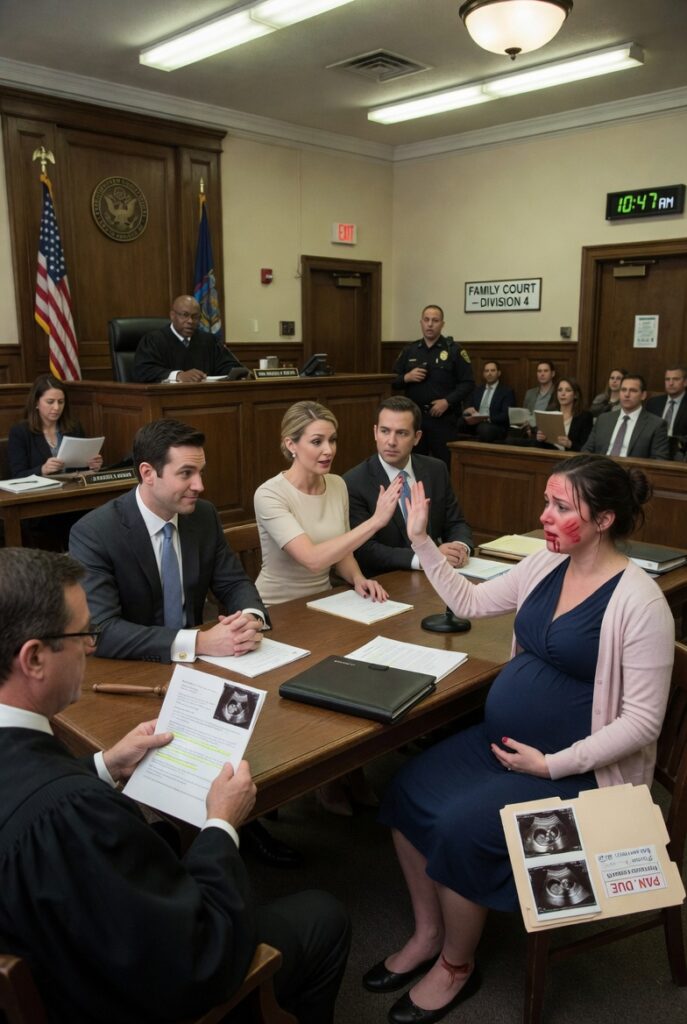
The bailiff had already closed the doors. Two people near the back whispered, then stopped when the judge’s eyes moved in their direction.
My cheek still burned.
My baby kicked once, hard enough to make me tighten my hand over my stomach.
The judge saw it.
His expression changed, but only for a second.
“Mrs. Whitfield,” he said more gently, “did you submit this supplemental packet?”
“I don’t know,” I whispered.
My voice sounded thin in that room.
“My attorney was supposed to file evidence, but he didn’t show up.”
Caleb let out a small laugh.
“There it is,” he said. “The confusion. This is exactly what I’ve been telling everyone.”
The judge turned sharply.
“One more word before I ask you for it, and I will hold you in contempt.”
Caleb’s mouth closed.
For the first time that morning, I saw fear touch his face.
Not much.
Just enough.
The judge lifted the paper.
“This packet was delivered to chambers at 8:12 this morning by courier. It includes medical records, bank records, corporate documents, text messages, and a sworn statement from Attorney Marcus Reed.”
My heart stumbled.
Marcus.
My attorney.
He hadn’t abandoned me.
He had been late because he was doing something Caleb could not control.
The judge continued.
“It also includes a request for emergency protective orders and financial restraint.”
Vivian’s face drained of color.
Caleb leaned toward his lawyer.
His lawyer did not lean back.
That was when I understood something.
Caleb’s own attorney had not known everything.
The judge opened another page.
“Mrs. Whitfield, I need you to answer carefully. Did you sign a transfer of interest in Bennett House Holdings eleven months ago?”
The name hit me harder than Vivian’s hand had.
Bennett House Holdings.
I had not heard it spoken aloud in years.
It had been my mother’s company.
Not glamorous. Not famous.
A handful of rental properties, two small commercial buildings, and the old brick house in Ohio where she had raised me after my father left.
She worked two jobs to keep that company alive.
She cleaned office buildings at night and answered tenant calls during lunch breaks.
When she died, I was twenty-four and grieving so hard I signed anything placed in front of me.
Caleb handled everything.
He said he was protecting me.
He said paperwork was too much for me.
He said husbands and wives did not keep separate worries.
I remembered sitting at our kitchen table while rain hit the windows.
He had slid a stack of papers toward me beside a mug of tea I had not asked for.
“Just estate cleanup,” he had said.
I signed because I trusted him.
I signed because my mother was gone.
I signed because grief makes even intelligent people tired.
Now the judge was staring at me.
“I signed papers,” I said. “I don’t know what they were.”
Caleb muttered something under his breath.
The judge heard it.
“Stand up, Mr. Whitfield.”
Caleb’s chair scraped the floor.
The sound made me flinch.
The judge saw that too.
“Did you present your wife with documents transferring her inherited property interests into a private entity controlled by you?”
Caleb smiled, but it looked wrong.
“Your Honor, married couples share assets all the time.”
“That was not my question.”
His attorney rose slowly.
“Your Honor, I need a moment with my client.”
“You will have one,” the judge said. “After I finish securing this courtroom record.”
Vivian tried to step back.
The bailiff shifted closer to the aisle.
The judge turned one page.
“Ms. Cross,” he said.
Vivian froze.
“I didn’t do anything,” she said immediately.
Nobody had asked her if she had.
That made several heads turn.
The judge’s gaze lowered to the packet.
“These messages indicate you contacted Mrs. Whitfield’s physician’s office twice, representing yourself as family.”
Vivian’s lips parted.
“No. That’s not—”
“And that you attempted to obtain information about her pregnancy, due date, and emergency contact status.”
My stomach turned cold.
I looked at Vivian.
She looked away.
Caleb’s jaw tightened.
That was the face he made at home before a door slammed.
The judge did not raise his voice.
That made it worse.
“Mrs. Whitfield,” he said, “did you authorize Ms. Cross to contact your doctor?”
“No.”
The word came out steadier than I expected.
I looked at Caleb.
For six years, I had been afraid of what would happen if I contradicted him in public.
Now everyone was watching.
And he could not close the door.
He could not lower his voice.
He could not turn the car around in a parking lot and tell me I was embarrassing him.
The judge placed both hands on the bench.
“Earlier this morning, I believed this was a routine dissolution hearing,” he said. “It is not.”
Caleb’s attorney closed his eyes for half a second.
That tiny movement told me more than any speech could have.
The judge looked at the bailiff.
“Document the assault that occurred in this courtroom.”
Vivian gasped.
“Assault? She provoked me.”
The bailiff moved toward her.
“She is eight months pregnant,” the judge said. “And you struck her in my courtroom.”
Vivian looked to Caleb.
For the first time all morning, he did not look back.
That was the second slap she received, though no hand touched her.
The judge turned to me.
“Mrs. Whitfield, are you safe returning to your current residence?”
The question broke something open in me.
Not because it was dramatic.
Because it was simple.
No one had asked me that in months.
My friend Ashley had asked if I needed the couch another week.
The nurse had asked if I was eating enough.
The woman at the grocery store had asked if I wanted help carrying bags.
But no one with power had looked me in the face and asked if I was safe.
I tried to answer.
Nothing came out.
The judge waited.
He did not rush me.
Finally, I shook my head.
“No.”
Caleb exploded.
“This is absurd. She left voluntarily.”
I turned toward him.
My cheek still burned.
My hand still shook.
But my voice came from somewhere deeper now.
“I left because you canceled my card at the pharmacy.”
A murmur passed through the room.
Caleb’s eyes sharpened.
I kept going because stopping felt more dangerous.
“I left because you told me the house locks could be changed before I got back from my appointment.”
His lawyer whispered, “Caleb.”
I did not stop.
“I left because Vivian texted me a picture of the nursery and said it looked better without me in it.”
Vivian’s face crumpled with panic.
“I never—”
“It is in the packet,” the judge said.
Three words.
That was all it took.
Vivian sat down like her knees had disappeared.
Caleb stared at me with the same expression he used when I overcooked dinner, misplaced a receipt, or cried too loudly in the bathroom.
Disbelief.
Not because I was lying.
Because I had dared to tell.
The doors opened behind us.
Everyone turned.
Marcus Reed walked in with his tie loosened and his briefcase in one hand.
His face was pale.
There was a bruise along his cheekbone.
“I apologize to the court,” he said. “I was delayed.”
The judge’s eyes narrowed.
“Delayed how?”
Marcus looked at Caleb.
Then at me.
“Someone had my car boxed in outside my office garage this morning. My phone disappeared from my reception desk. I had to get here by cab.”
Caleb laughed once.
It sounded fake even to him.
“That is ridiculous.”
Marcus set another folder on the table.
“I also have the original courier receipt, Your Honor. And copies of the messages Mr. Whitfield’s assistant sent last night instructing staff to delay Mrs. Whitfield’s counsel by any available means.”
Vivian whispered, “Caleb.”
There was no affection in it.
Only fear.
The judge looked at Caleb’s attorney.
“Counsel, I strongly suggest you advise your client to stop reacting visibly to every piece of evidence.”
Caleb sat down.
Not because he wanted to.
Because for once, someone else controlled the room.
Marcus came to my side.
“I’m sorry,” he said quietly.
I shook my head.
I could not accept kindness yet.
It felt too unfamiliar.
The judge reviewed the new folder.
Then he issued orders with the calm precision of someone placing sandbags before a flood.
Temporary protection.
Exclusive use of the marital home.
Immediate reinstatement of medical coverage.
Frozen transfers from marital and disputed business accounts.
No contact from Caleb or Vivian except through counsel.
An investigation into the asset transfers involving my mother’s holdings.
Each order landed like a board being nailed across a door Caleb had used for years.
He objected.
The judge overruled.
He objected again.
The judge warned him once.
Then Caleb made the mistake of looking at me and saying, “You’ll regret this.”
The courtroom went still.
The judge leaned forward.
“Mr. Whitfield, you just threatened a pregnant woman in open court after evidence of coercive control was placed before me.”
Caleb’s attorney put a hand on his sleeve.
Caleb shook it off.
“She is my wife.”
The words hung there.
That was the ugliest truth of the morning.
He thought being my husband gave him rights over my fear.
The judge’s voice dropped.
“No,” he said. “She is a party before this court. And right now, she is under this court’s protection.”
I looked down at my folder.
For months, it had felt like a box of shame.
Bills I could not pay.
Messages I should have reported sooner.
Ultrasound pictures from appointments I attended alone.
But now it looked different.
Not like proof that I had failed.
Proof that I had survived long enough to be believed.
Vivian was escorted out first.
She did not look at me.
Her cream sleeve brushed the same table where my medical bills lay.
Caleb remained seated, staring straight ahead as if the room had betrayed him.
That was how men like him saw consequences.
Not as justice.
As betrayal.
When the hearing finally paused, Marcus helped me stand.
My legs trembled under me.
The bailiff asked if I needed medical attention.
I almost said no automatically.
Then I remembered my hand on my stomach.
“Yes,” I said.
It was a small word.
It felt enormous.
In the hallway, the courthouse looked the same as it had that morning.
Same benches.
Same vending machine humming near the wall.
Same people holding folders and pretending not to listen.
But I was not the same woman who had walked in.
Ashley arrived twenty minutes later, breathless, wearing leggings, a sweatshirt, and the worried face of someone who had been waiting for bad news.
When she saw my cheek, she covered her mouth.
I thought I would cry then.
Instead, I said, “The baby is okay.”
Because that was the only fact I could hold.
At the hospital, they monitored me for hours.
The nurse dimmed the lights.
Ashley sat beside the bed with bad coffee in a paper cup.
My phone kept lighting up.
Unknown numbers.
Caleb’s mother.
A board member from his company.
A reporter whose name I did not recognize.
I turned the screen face down.
For once, I did not owe anyone an explanation before I owed myself peace.
Near midnight, Marcus called.
He told me the emergency orders had been entered.
He told me I could return to the house with law enforcement present.
He told me the Bennett transfers were already under review.
Then he paused.
“There is one more thing,” he said.
I closed my eyes.
I was tired of one more thing.
“What?”
“The judge recognized your middle name because of your mother,” Marcus said. “Years ago, before he was on the bench, he represented a tenant in one of her buildings. She refused to evict that woman during chemotherapy. He never forgot her.”
I turned my face toward the dark hospital window.
My mother had been gone for years.
Still, somehow, one quiet mercy she had shown a stranger had reached forward and stood beside me in court.
The next morning, I went back to the house with two deputies and Ashley.
The nursery door was open.
Vivian had changed the curtains.
She had moved my mother’s rocking chair into the garage.
For some reason, that hurt more than the slap.
Ashley found it behind a stack of boxes.
Dust on the arms.
One leg scratched.
But still whole.
We carried it back together.
I sat in it before we packed anything else.
The house was quiet.
Not peaceful yet.
Just quiet.
On the kitchen counter, Caleb had left his wedding ring beside a set of keys.
Maybe he meant it as an insult.
Maybe he meant it as a warning.
I did not touch the ring.
I picked up the keys.
Then I placed my mother’s old company folder beside them.
For years, Caleb had made me believe leaving meant losing everything.
That morning, I learned the truth.
Leaving did not return everything all at once.
It did not erase fear.
It did not heal a cheek, restore a bank account, or make betrayal clean.
But it gave me back one thing he had worked hardest to take.
My name.
Emily Rose Bennett.
I said it out loud in the empty kitchen.
My baby moved.
Outside, a patrol car idled in the driveway.
Morning light came through the window and fell across the manila folder, the keys, and the ring I refused to pick up.
For the first time in months, the silence did not feel like punishment.
It felt like a door finally staying open.