The ballroom shimmered with a kind of perfection that felt almost unreal, as if hunger, pain, or desperation had never been allowed to cross its threshold.
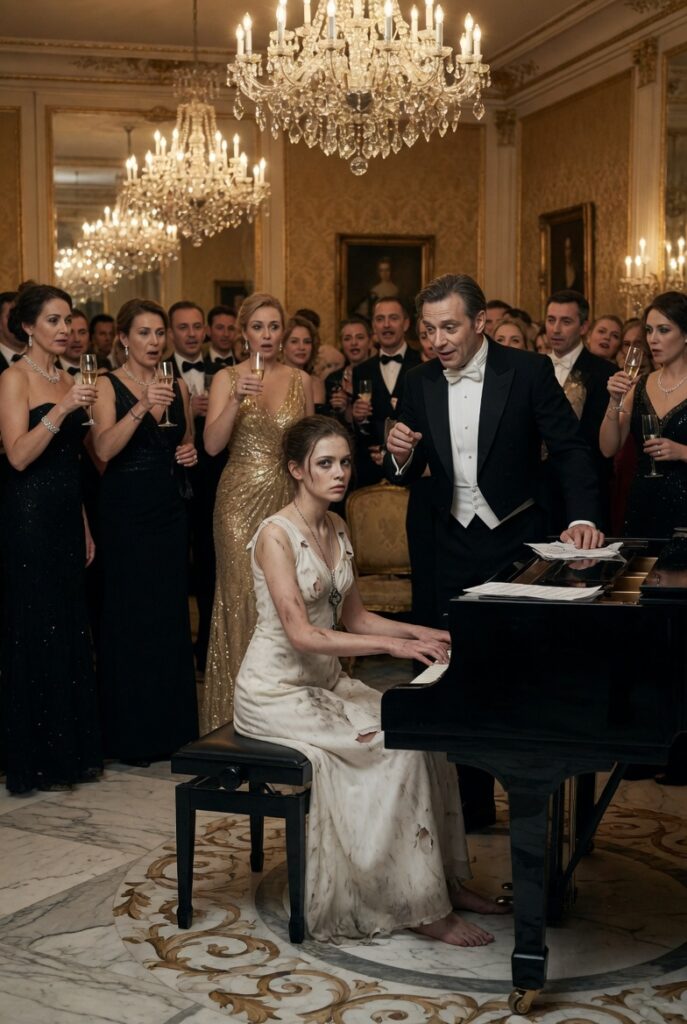
Crystal chandeliers blazed overhead, scattering light across polished marble floors so smooth they reflected every movement like a mirror. Gold detailing ran along the walls, catching the glow and multiplying it until the entire space seemed to pulse with quiet luxury. Servers moved gracefully through the crowd, carrying trays of champagne and delicate hors d’oeuvres, while soft laughter floated between elegantly dressed guests who had never known what it meant to go without.
It was a world built on abundance.
A world where no one asked for anything—because they never had to.
And then—
a single, sharp piano chord shattered it.
The sound cracked through the room like glass breaking.
Conversations stopped mid-sentence. Heads turned instinctively, almost in unison, drawn toward the grand piano at the center of the ballroom.
Sitting there was a girl who did not belong.
She was barefoot.
Her white dress was torn at the hem, stained with dust and time. Dirt marked her arms, her face, her knees. Her hair fell unevenly around her shoulders, as though it had been cut without care. And yet—despite everything—there was something steady in the way she sat, something unyielding in the way her small hands hovered above the keys.
Her eyes moved across the crowd, taking in the glittering room, the fine suits, the jeweled gowns.
And then she spoke.
“Can I play for a plate of food?”
Her voice was soft, trembling just enough to reveal how much it cost her to ask—but not enough to break.
For a single moment, the entire ballroom froze.
It was the kind of silence that comes not from compassion, but from disbelief.
Then the laughter began.
It spread in ripples—quiet at first, then sharper, more confident. A few women covered their mouths behind crystal glasses, their eyes gleaming with amusement. A man in a perfectly tailored tuxedo smiled—a slow, practiced smile that mistook cruelty for elegance.
He stepped forward, his shoes clicking lightly against the marble as he approached the piano.
“This isn’t a shelter,” he said, his tone smooth, dismissive.
More laughter followed, louder now, encouraged.
The girl’s face didn’t change immediately.
But something in her eyes dimmed—not from shock, but from recognition. As if she had heard that kind of laughter before. As if she already knew how heavy it could feel when it settled on your shoulders.
Still, she didn’t move.
She didn’t run.
She didn’t beg again.
Instead, she lowered her gaze to the piano.
Her fingers trembled slightly as she lifted her hands. For a moment, it looked as though she might stop herself—might decide the humiliation was too much.
But then she pressed the keys.
The first notes were soft.
So soft they barely seemed real.
But they were beautiful.
Not just pleasant—beautiful in a way that carried weight, that demanded attention. The sound moved through the air differently than the laughter had. It didn’t scatter. It gathered.
One by one, conversations faded.
A woman in gold froze mid-sip, her glass hovering near her lips as she forgot to drink. A man near the back turned fully toward the piano, his expression shifting from amusement to something uncertain.
The laughter died—not all at once, but in fragments.
Until it was gone.
Even the man in the tuxedo stopped smiling.
Because he knew that melody.
Not vaguely.
Not distantly.
He knew it perfectly.
It was a song that had lived in this room years ago, played by a young pianist whose presence had once filled the ballroom just as completely as the chandeliers’ light.
A woman who had disappeared one winter—after whispers, after scandal, after a story no one in this room ever spoke about directly anymore.
The man stepped closer to the piano now, his movements slower, no longer confident.
“Who taught you that?” he asked.
The girl’s fingers hovered above the keys, the last note still echoing faintly in the air.
Then she looked up at him.
“My mother.”
The words landed heavier than the music.
Color drained from his face.
The room seemed to shrink, the walls closing in slightly as the weight of something long buried began to rise.
“She said she played it here…” the girl added, her voice quieter now, but somehow sharper.
A soft gasp moved through the crowd.
The man took an involuntary step forward.
“What was her name?” he asked, though part of him already knew.
The girl opened her mouth to answer—
and as she did, something slipped into the light.
A thin silver chain around her neck shifted, revealing a small key that caught the chandelier’s glow.
The man saw it.
And every trace of blood left his face.
For a long, suspended moment, no one moved.
Not the guests.
Not the servers.
Not even the man standing just feet from the piano.
Because the melody could be explained.
It could be learned. Remembered. Passed down.
But the key—
the key could not.
Years ago, when the pianist vanished, the story had been simple.
Convenient.
She had stolen from the estate, they said. Jewelry, money, documents from a private office upstairs. She had run away in disgrace, and the family had quietly erased her from memory.
It was a story that fit neatly.
And neat stories are easy to believe.
But the truth had never been neat.
Only three people had known it.
The pianist.
The man standing at the piano.
And the former owner of the estate—now long dead.
That key opened a hidden compartment beneath the piano bench. Inside it, years ago, the pianist had hidden letters, signed documents, and something far more dangerous than either—
a marriage certificate.
Proof that she had not been a thief.
She had been his wife.
Legally.
Secretly.
And disastrously inconvenient to the inheritance that everyone in that ballroom had helped protect.
The girl’s gaze didn’t waver.
“My mother said if you saw the key first,” she whispered, “you’d know I was telling the truth.”
The silence in the room changed.
It was no longer about discomfort.
No longer about curiosity.It was about fear.
Because this was no longer a story about a hungry child.
This was blood.
Legacy.
A truth that refused to stay buried.
The man tried to speak, but no words came.
Because the girl at the piano was no longer just a stranger.
She was his daughter.
The daughter he had been told was dead.
The daughter he had convinced himself no longer existed.
The pianist had fled years ago not because she was guilty—but because she had been hunted. Because she had been carrying a child. Because she had understood that the family would erase more than her name if they were given the chance.
The girl leaned forward slightly, reaching beneath the bench with steady hands. Without hesitation, she found the hidden keyhole.
She inserted the key.
A sharp, echoing click cut through the silence.
Several people flinched.
She opened the compartment slowly and pulled out a small bundle wrapped in faded cloth.
Her hands tightened around it for a moment before she unfolded the top layer.
A note rested there.
Written in a woman’s hand.
If she returns here hungry, then none of you deserved us.
The words seemed to settle over the room like dust.
The man’s composure cracked—not dramatically, not loudly—but enough.
Enough for everyone to see.
Enough for them to understand.
He had not stepped forward to dismiss a beggar.
He had stepped forward to face something he had abandoned.
The girl held the bundle close, her small fingers gripping it as if it were the only solid thing in the room.
Then she looked up at him again.
“My mother told me to ask you one thing,” she said.
Her voice trembled now—but not with fear.
With something deeper.
Something heavier.
“Before I took the food.”
The man didn’t move.
Didn’t breathe.
The entire ballroom seemed to narrow, every light, every eye, every ounce of attention collapsing into that single moment.
And then she asked:
“Why did you leave us in the dark… while you kept the lights?”
The question didn’t echo.
It didn’t need to.
Because it landed exactly where it was meant to.
And suddenly, the chandeliers didn’t look warm anymore.
The gold didn’t shine the same way.
The laughter that had filled the room just minutes earlier felt distant, hollow, almost shameful.
The ballroom, for all its beauty—
looked guilty.