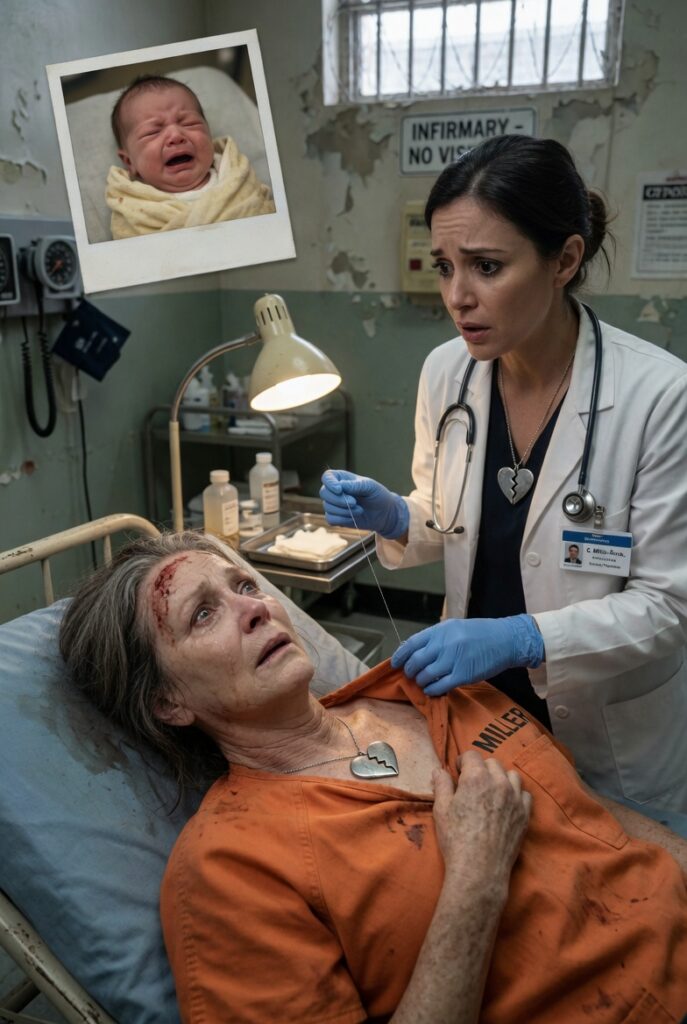
Chloe went still.
She slowly looked down at the chain peeking out from beneath my gray uniform collar. I watched her eyes trace the curve of the silver until they stopped at the other half of the heart. The same jagged line on the edge. The same tiny dent in one corner. The same broken piece I had snapped with a pair of rusted pliers thirty years ago, crying in a cell that still smelled of sour milk and disinfectant.
The needle remained suspended between her fingers.
—”Where did you get that?” she asked, but she no longer sounded like a doctor. She sounded like a little girl.
I didn’t know whether to breathe or die.
With trembling hands, I reached under my uniform and pulled the full chain out until the pendant was in plain sight. The naked half of the heart hung between us like a truth newly unearthed.
—”I broke it the day they took you from my arms,” I said in a whisper. “One half went with you. The other stayed with me. Because it was the only promise I could make myself… that even if I didn’t know where you were, the heart was still one.”
Chloe took a step back. Not out of rejection, but out of fear. The kind of fear that comes when life suddenly cracks open and what comes out doesn’t fit into anything you thought you knew about yourself.
—”No,” she murmured. “No, that can’t…”
She reached for her neck and gripped her half tightly, as if she suddenly needed to prove she wasn’t dreaming.
—”My parents told me this necklace came from my biological mother, yes… but that doesn’t mean…”
—”Your name was Chloe before you even left this place,” I told her. “I chose it because there was a bougainvillea vine tangled in the high window of my cell, and another inmate told me that flower could withstand the harshest sun and never stop blooming. And Ross… they gave you the name Ross because the social worker insisted you needed a different last name to start over. But I asked them to let you keep Miller. Even if it was hidden. Even if it was only halfway.”
Her face changed completely. The professional coldness was gone. It was a collapse. Her lips trembled. Her breath grew short. She looked at the tray, the door, my hands, the necklace, as if searching for a practical exit from something that had none.
At that moment, a guard walked in.
—”Are we done here, Doctor? The inmate has to be back in the block in ten minutes.”
Chloe took a second to answer. When she did, her voice hardened again, but I had already heard the crack.
—”No. She has a head trauma with probable complications. No one moves her until I authorize it.”
The guard raised her eyebrows.
—”But it was just a fall…”
—”I said no one moves her.”
The woman left grumbling. Chloe locked the door. Then she turned back toward me, slowly, as if her feet were made of lead.
—”What is your full name?” she asked.
—”Lucia Miller.”
She covered her mouth with her hand. I saw the tears rising from her chest to her eyes, but she forced them down. I wanted to touch her, to call her “daughter” just once, but I remained sitting on that prison cot with wrists stained by the years and the brutal certainty that love can also arrive late.
—”I…” she started, but couldn’t finish.
—”You don’t have to believe me right now,” I said. “Look for the file. The adoption one. The prison records. Whatever you want. I’ve lived thirty years with plenty of time left to wait.”
That was the only thing that made her move. She nodded once. Curt. A doctor again. She finished my stitches with precise but no longer cold hands. Every time her fingers brushed my skin, I felt like life was giving me back something it had bitten away from me. When she finished, she checked my right pupil and frowned.
—”Does your head hurt a lot?”
—”Yes.”
—”Are you nauseous?”
—”For a while now.”
Her look changed immediately. The doctor was back.
—”I need to transfer you for a CT scan. Now.”
—”Chloe…”
—”Not right now,” she interrupted, her voice trembling. “Right now I can’t be anything else. Right now I have to be your doctor.”
Your doctor. Not your daughter. And yet, in that “right now” fit all the hope in the world.
They put me on a gurney to take me to the prison’s external clinic. The hallway smelled of chlorine and hot metal. The ceiling lights passed over me like miscounted years. Chloe walked beside me without touching me, reading orders, requesting tests, speaking with a confidence that made me burst with pride. Every time someone said “Dr. Ross,” I wanted to stand up and scream: “Her name is Chloe. Her name is what I called her when I had nothing else to give.”
The scan didn’t take long. The news did. Chloe walked in with the film in her hand, her face drained of color.
—”You have a subdural hematoma,” she said. “There is internal bleeding. We have to operate today.”
I looked at her without fully understanding. Or perhaps understanding too much.
—”Am I going to die?”
She went silent for a second. Then she stepped closer and, for the first time since seeing the necklace, she took my hand. It was a medical gesture. Formal. Necessary. But her hand was shaking.
—”Not if I get there first,” she said.
And in that sentence—so clean, so firm—I recognized something I hadn’t seen in thirty years, yet something that had belonged to me since before she was born: my way of fighting.
Before taking me down to surgery, she returned with a thin folder. Her adoption file. She held it pressed to her chest as if she didn’t yet dare open it in front of me.
—”Everything matches,” she murmured. “The date. The prison. The name. The note where you asked them to keep Miller. Even the necklace.”
I was already trembling. Not out of fear of the operation, but from seeing her there, one step away, and still not knowing if I had the right to call her daughter.
—”I never wanted to leave you,” I told her. “Your father broke things in me that can’t be seen. The night you were born, he wanted to sell some jewelry and then he wanted to sell you to pay a debt. I killed him when he threw me against your crib. It wasn’t brave. It was animal instinct. But the public defenders said a poor woman with a history of domestic violence always looks guilty when she finally defends herself. They gave me thirty-two years. You were three months old when I signed the adoption.”
Chloe closed her eyes. She didn’t let go of my hand.
—”My parents… the ones who raised me… they are good people,” she said, almost with guilt.
—”I prayed for that all these years.”
—”They are. They loved me well. They never hid that I was adopted. I just… we just had no way to find you. And I didn’t know if I wanted to look. I was afraid of finding abandonment where they taught me love.”
—”I didn’t abandon you,” I whispered, broken. “I let you go so you wouldn’t grow up seeing bars before you saw trees.”
The tears finally won. She bowed her head just enough for a tear to fall on her white sleeve.
—”I know,” she said. “I know now.”
They separated us because it was time for surgery. The anesthesiologist began to prepare me. The lights grew colder. The whole room sounded of metal, wheels, and short orders. I searched for her with my eyes among the green scrubs, until she stood before me again, in a mask and cap, but those eyes were still the same. My baby’s eyes. My blood’s eyes. The woman I had thought of every birthday, counting the years with scratches on the wall.
—”I need you to sign this, Mrs. Lucia Miller,” she said.
I took the pen. Before signing, I looked up.
—”If I make it out of this… will you let me hug you?”
Her eyelashes fluttered.
—”If you make it out of this,” she said, and now she truly sounded like a daughter, “you’re going to have to hug me very tight. Because I’ve spent thirty years not knowing where to put all of this.”
I signed, crying. The anesthesia began to creep up my arm like a heavy sleep. The last thing I felt before drifting off was her gloved hand on my forehead and a very soft, almost childlike voice pressed to my ear:
—”Don’t leave me again, Mom.”
I woke up in intermediate care with my head bandaged and a dry throat. For a moment, I didn’t know if everything had been real or a cruelty invented by the head injury. Then I saw the silver heart on the side table, now joined. Someone had sent the two halves to be soldered together.
I started crying before I even saw her walk in. She came in without her lab coat, in simple clothes, with deep circles under her eyes and a cardboard box in her hands. She looked more tired than I did, as if in a single night she had had to rearrange thirty years of history.
—”I kept these for you,” she said, setting the box on my lap.
Inside were my letters. The thirty-some letters I wrote over the years to the adoption department that were always returned or, worse, lost along the way. There were open envelopes, closed ones, some yellowed. All in my own handwriting, growing older over time. All saying the same thing in different words: that I was alive, that I loved her, that if one day she wanted to find me, not to be afraid of what she found here.
—”My mom found them in the file they gave them when I turned twenty-one,” Chloe said. “They didn’t show them to me then. They were afraid of hurting me, I suppose. Or of losing me a little. They read them with me last night.”
I looked up. —”Are they angry?”
—”No. They’re downstairs. Waiting if… if you want to meet them.”
That disarmed me more than anything. Because life, which had already taken enough from me, wasn’t coming now to compete for love. It was coming to put the pieces together.
I met them the next day. Rose and Ernest Ross. People with clean hands and eyes tired from crying. She hugged me as if she had been practicing for years. He asked for my forgiveness for not knowing sooner that my letters existed. I had nothing to forgive them for. They had done the only thing I dreamed of that morning in prison when they tore my baby from my chest: they loved her well.
Chloe sat between the four of us, and for the first time, I didn’t know who was saving whom.
Then came other truths. A lawyer from an organization that handled cases of women imprisoned for self-defense reviewed my file at Chloe’s request. They found botched forensic reports, ignored testimonies, photos of old injuries that were never submitted. My case had been buried for years under the dust of an archive no one cared about. No one, until my daughter’s hands trembled upon recognizing a broken heart.
I didn’t walk free the next day. Stories like mine are never fixed with the speed at which they break. But six months later, a court corrected part of the injustice that had swallowed half my life. They commuted the sentence. They recognized the prior domestic violence. They granted early release based on age, health, and time served.
The day I crossed the prison gate, the sun hurt my eyes. Thirty years of seeing the sky in pieces doesn’t prepare anyone to have it whole. Chloe was outside. Not in a white coat this time, but in a simple dark blue dress and the complete heart around her neck. As soon as she saw me, she started crying just like I did. She walked toward me slowly at first, then running, and then—finally—she hugged me.
Not as a doctor. Not with professional care. She hugged me as a daughter. As if she wanted to fit thirty years into a single squeeze. I kissed her hair, her forehead, her hands, everything my years and my trembling would let me reach.
—”Forgive me,” I told her.
She pulled back and took my face in her hands.
—”No, Mom. It’s your turn for something else.”
—”What?”
She smiled through her tears.
—”To live. Now it’s your turn to live.”
And so I walked out. Not with a suitcase. Not with an apology from the State. Not with all the time they stole from me. I walked out with my daughter on my arm, with the heart finally whole on her chest, and with the certainty that, although they tore me from her when she still smelled of milk, love found the most impossible way back: dressed in white, with a doctor’s hands, just in time to save my life.