PART 2
You did not move at first.
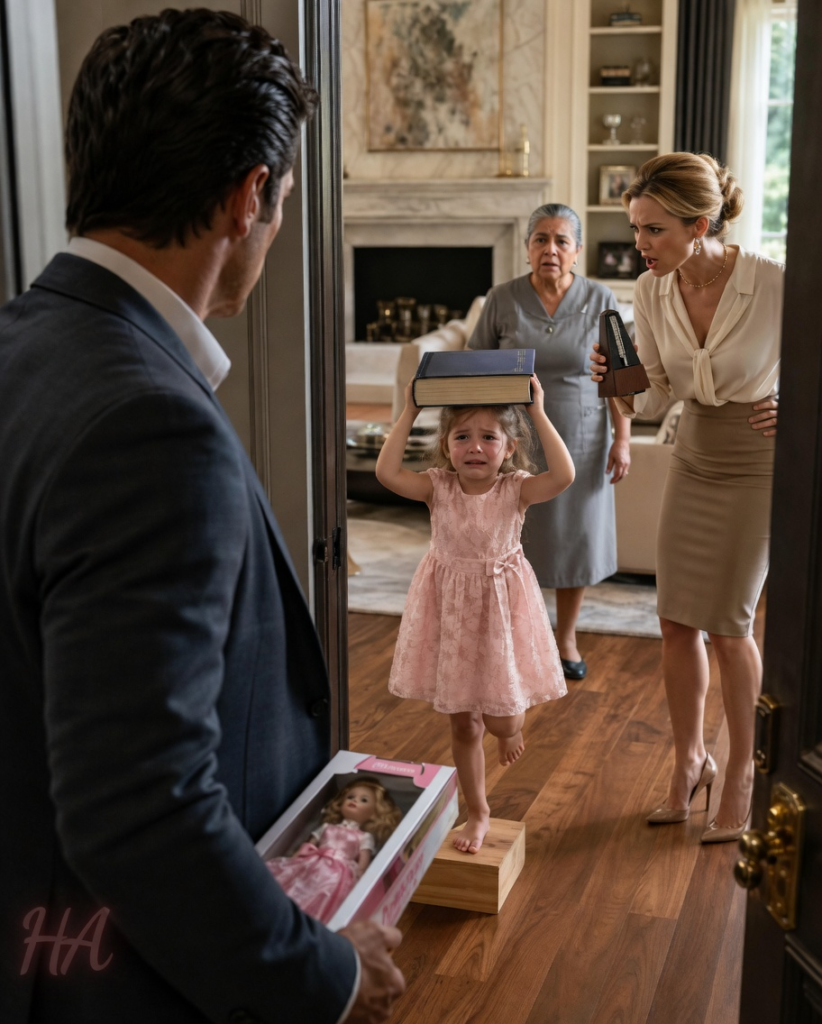
For one frozen second, your mind refused to accept what your eyes were seeing. The woman who smiled beside you at charity dinners, the woman who kissed your daughter’s forehead in front of guests, the woman who told doctors Renata was “fragile,” was standing three feet away from your child with a stopwatch in one hand and a wooden ruler in the other.
Renata’s small arms trembled at her sides. Her thin little foot shook on the block of wood. The heavy dictionary wobbled on her head, and every time it slid even slightly, Estefanía’s mouth tightened with disgust.
—Again, Renata —she snapped in Spanish, cold as glass—. Pretty girls have discipline. Weak girls become burdens.
Your daughter squeezed her eyes shut.
—Please, Mami… I’m hungry.
The word hit you harder than any business betrayal, any lawsuit, any headline ever could.
Hungry.
That morning, Renata had forced down that green drink while you watched. She had said her stomach hurt. She had looked pale, cold, terrified… and you had believed the lie because believing it was easier than stopping your life long enough to see the truth.
Estefanía stepped closer.
—Hungry girls are greedy girls. Greedy girls get fat. And fat little girls embarrass their fathers.
Your hand tightened around the small gift bag with the doll inside until the paper crumpled.
Renata swayed.
The dictionary fell.
It hit the floor with a heavy slap.
For one terrible second, silence filled the room.
Then Estefanía exploded.
—Start over.
Renata began sobbing, not loudly, not like a normal child asking for help. She cried like someone who had learned that crying too much only made things worse.
—No, please… I did it already… please…
Estefanía grabbed the dictionary from the floor and slammed it against the table.
—Pick it up.
That was when you opened the door.
Not slowly.
Not dramatically.
You pushed it so hard it struck the wall.
Estefanía spun around, and for the first time since you had married her, the perfect mask broke completely. Her face went white. Her mouth opened, but nothing came out.
Renata saw you and collapsed off the wooden block.
—Papi!
You crossed the room in three strides and caught her before her knees hit the floor. She felt too light in your arms. Too cold. Her little body clung to you with a desperation that made something ancient and violent wake up inside your chest.
—Alejandro —Estefanía whispered—. You’re supposed to be on a plane.
You looked at her over Renata’s shaking head.
—Yes —you said quietly—. That was your mistake.
Estefanía recovered fast. Too fast.
Her eyes moved to the book, the stopwatch, the wooden block, then back to your face. You could almost see her building a lie in real time.
—This is not what it looks like. The occupational therapist recommended balance exercises. Renata has coordination issues. I was helping her.
Renata buried her face against your neck.
—Papi, don’t leave me.
Four words.
That was all it took to destroy every excuse you had ever made for yourself.
You held her tighter and looked at the woman you had brought into your home. The woman you had allowed near your child. The woman who had studied your grief, learned your schedule, smiled at your weakness, and turned your house into a prison while you were away.
—Doña Lupita! —you shouted.
Footsteps rushed down the hallway.
The old housekeeper appeared at the door, breathless, eyes wet before she even saw the scene clearly. The moment she saw Renata in your arms, her face crumpled.
—Señor…
You turned to her.
—Call Dr. Salazar. Now. Tell him it is an emergency. Then call my lawyer, Gabriel Ortega. Tell him to come here with a notary and two security officers from the company.
Estefanía’s expression sharpened.
—A lawyer? Alejandro, don’t be ridiculous. You’re emotional.
You stepped toward her, still holding Renata.
—Do not speak.
She blinked.
You had never used that voice with her before. In boardrooms, men twice your age had learned to fear it. At home, you had buried it under exhaustion, guilt, and the fantasy that peace was the same thing as love.
Now it filled the room like a locked door.
Estefanía lifted her chin.
—You are going to regret humiliating me in front of the staff.
You looked at Renata’s trembling hands.
—No. I’m going to regret not doing it sooner.
Doña Lupita vanished to make the calls.
You carried Renata out of the room, but your daughter panicked the moment you reached the hallway.
—No, papi, no, no, no…
—What is it, mi amor?
Her tiny fingers dug into your shirt.
—The cameras.
Your blood went cold.
—What cameras?
Renata looked over your shoulder at Estefanía, who had gone still.
The silence answered before your child could.
You turned slowly.
Estefanía’s eyes flickered.
There it was.
Fear.
Not fear for Renata. Not fear because she had hurt a child. Fear because the wrong person had finally heard the right word.
You looked at Doña Lupita, who had returned with the phone pressed to her chest.
—Show me.
The old woman swallowed hard.
—Señor, I tried to tell you.
Estefanía snapped.
—Lupita, careful.
You took one step toward your wife.
—Careful is finished.
Doña Lupita led you down the hall toward a small linen closet near the family room. Behind stacks of towels and imported blankets, she pulled out a black tablet hidden inside an old sewing basket.
Your stomach dropped.
On the screen were live feeds from different rooms in the house.
Renata’s bedroom.
The playroom.
The kitchen.
The staircase.
The family salon where you had just found her.
You stared at the images, your ears ringing.
—Who installed these?
Doña Lupita could barely speak.
—Señora Estefanía said they were for safety. But later… she used them to watch the niña. To know if she ate snacks. To know if she sat down when she was told to stand. To know if I tried to give her food.
Renata whispered against your shoulder.
—She said if I told you, she would send Lupita away. And then nobody would know when I was bad.
You closed your eyes.
For months, your daughter had been trying to tell you with stomachaches, silence, drawings, nightmares, and cold little hands. And you had answered with business trips, tired kisses, and the blind arrogance of a man who thought money could protect what love had neglected.
Estefanía appeared in the hallway.
—This is insane. You are letting a servant poison your mind.
Doña Lupita flinched.
You did not.
—Servant? —you repeated.
Estefanía realized too late what she had said.
You handed Renata carefully to Doña Lupita.
—Take her to my bedroom. Lock the door. Stay with her until the doctor arrives.
Renata grabbed your sleeve.
—Papi, don’t go with her.
You crouched until your face was level with hers.
—Listen to me, Renata. You are not bad. You are not weak. You are not a burden. What happened here was not your fault.
Her lower lip trembled.
—Even if I dropped the book?
You almost broke.
—Especially if you dropped the book.
You kissed her forehead.
—No one is ever going to hurt you in this house again.
Doña Lupita took her away, whispering soft comfort into her hair.
When the door at the end of the hall closed, you turned back to Estefanía.
She folded her arms, choosing arrogance because fear no longer fit.
—You have no idea what it takes to raise a girl properly. Mariana spoiled her. Lupita babies her. You abandon her. Someone had to teach her discipline.
You stared at her.
—She is four.
—Exactly. This is when character is formed.
—You starved her.
—She was on a controlled plan.
—You made her stand on one foot with a dictionary on her head.
—Posture training.
—You threatened her.
—Correction.
—You told her she embarrassed me.
Estefanía’s face hardened.
—Because she does.
The words landed between you like a corpse.
For a moment, you heard nothing but the distant hum of the mansion’s air conditioning.
Then you laughed once, softly.
It was not amusement.
It was the sound of every door in your heart closing against her.
—There it is.
She swallowed.
—Alejandro…
—Say it again.
—You are twisting my words.
—Say what you really think of my daughter.
She stepped back.
You stepped forward.
—No audience. No charity cameras. No guests from Monterrey society. No perfect lipstick. Say it.
Her nostrils flared.
—She is not normal. She is clingy, timid, dramatic, always sick, always crying. You look at her and see Mariana. Everyone does. Do you know what it is like to live in a house where a dead woman is treated like a saint and I am expected to raise her broken child?
Your hands curled into fists at your sides.
You did not touch her.
That was not the revenge she deserved.
She deserved the kind that came with signatures, witnesses, locked accounts, public truth, and no escape route.
—Thank you —you said.
She frowned.
—For what?
You reached into your pocket and lifted your phone.
The recording light was on.
Estefanía’s face drained of color.
You had started recording the moment Renata said “the cameras.”
—Alejandro, delete that.
—No.
—That is private.
—So was my daughter’s suffering.
She lunged for the phone.
You stepped back before she could reach it.
The front gate intercom chimed through the house.
Doña Lupita’s voice came over the hallway speaker.
—Señor, Dr. Salazar is here.
—Let him in.
Estefanía’s breathing changed.
—A doctor is not necessary.
You looked at her.
—A doctor is only the beginning.
Within twenty minutes, the mansion stopped feeling like a home and became something closer to a crime scene.
Dr. Salazar arrived with his leather bag and the expression of a man who understood emergencies before people explained them. Gabriel Ortega arrived ten minutes later, silver-haired, calm, carrying a briefcase and followed by a notary and two private security officers from Villarreal Holdings.
Estefanía tried to regain control at the staircase.
She softened her voice. She dabbed at her eyes. She told Gabriel there had been a misunderstanding, that you had always been unstable around Renata because grief made you overprotective.
Gabriel did not even blink.
He had known you for fifteen years.
He had seen you negotiate billion-dollar contracts without raising your voice.
He turned to you.
—Where is the child?
—My bedroom.
Dr. Salazar examined Renata there, while you sat on the edge of the bed holding her hand.
Your daughter answered questions in whispers. How often did she eat? What happened if she asked for food? What were the exercises? Did anyone hit her? Did anyone threaten her? Did anyone tell her not to tell you?
Every answer took another piece out of you.
No, Estefanía did not hit her often.
Only pinched.
Only pulled her arm hard.
Only made her kneel.
Only locked her in the dressing room when she cried.
Only made her hold books.
Only made her skip dinner if she “failed.”
Only told her you would stop loving her if you knew how difficult she was.
Only.
That word became unbearable.
Dr. Salazar removed the stethoscope from his ears with a controlled, professional anger that frightened you more than shouting would have.
—She is dehydrated. Underfed. Exhausted. Her pulse is elevated, and her anxiety response is severe. I want bloodwork done today. I also want a child psychologist involved immediately.
Renata looked terrified.
—Do I have to go away?
You took her face gently in your hands.
—No. She does.
Your daughter stared at you like she did not know if she was allowed to believe in rescue.
Then she leaned into your chest and cried with her whole body.
Downstairs, Estefanía was making calls.
You could hear her voice floating through the foyer, sweet and wounded.
—My husband had some kind of episode… yes, because of the flight… no, of course I love Renata… you know how children exaggerate…
Gabriel stood beside you in the hall and listened.
—She’s building a defense already.
—Good —you said.
Gabriel studied your face.
—Good?
You looked toward the staircase.
—Let her build it. Then we’ll bury it.
For the next hour, you did not shout.
That scared Estefanía more than rage would have.
You sat at the head of the dining table while Gabriel placed documents in front of you. The notary witnessed everything. Security stood by both exits. Dr. Salazar remained upstairs with Renata and Lupita.
Estefanía entered the dining room like a queen summoned by peasants.
—This is humiliating.
You signed the first document.
—You are removed as an authorized user on all household accounts effective immediately.
Her smile twitched.
—Excuse me?
You signed the second.
—All joint credit lines are frozen pending legal review.
—You can’t do that.
Gabriel spoke calmly.
—He can. The accounts are under Villarreal Holdings family protection structures. You were granted limited spousal access, not ownership.
Estefanía’s eyes moved fast.
You signed the third document.
—The cars registered under company assets are being recalled.
She laughed, but it came out thin.
—You are taking my car?
—No —you said. —I am taking back mine.
You signed the fourth.
—You are removed from the foundation board.
That one hit.
Her entire social identity lived inside the Villarreal Children’s Wellness Foundation. She had posed at galas, held orphaned babies for photographs, given speeches about compassion while your own daughter went hungry upstairs.
—You wouldn’t dare.
You looked at her.
—Watch me.
Gabriel slid another folder across the table.
—This is a temporary separation filing, request for emergency protective custody, and notice to vacate.
Estefanía stared.
—Vacate?
—You have two hours to pack personal belongings under supervision.
Her mask cracked again.
—This is my home.
For the first time all day, you leaned forward.
—This was Mariana’s home. Then it became Renata’s home. You were a guest I made the mistake of marrying.
Her face twisted.
—You think people will believe you? You think Monterrey society will side with a grieving widower and a dramatic little girl over me?
You tapped your phone.
—No. I think they will believe you.
She froze.
You played the recording.
Her own voice filled the dining room.
“She is clingy, timid, dramatic… always sick, always crying…”
Then:
“Do you know what it is like to live in a house where a dead woman is treated like a saint and I am expected to raise her broken child?”
The room went silent.
Estefanía looked at the notary.
Then Gabriel.
Then security.
Then you.
—That recording is illegal.
Gabriel cleared his throat.
—Mexico permits recordings when one party to the conversation consents, and he was present. We can discuss admissibility later. But socially? Publicly? Professionally? It is devastating.
Estefanía’s mouth opened and closed.
You did not smile.
You did not enjoy it.
You wanted to, but you did not.
Because upstairs, your daughter was still afraid to ask for a sandwich.
—Pack —you said.
That was when she made her final mistake.
She reached for the dining table centerpiece, grabbed a crystal vase, and hurled it at the wall.
It shattered.
Security moved immediately.
Estefanía screamed.
—You ruined my life for that weak little brat!
The words echoed up the staircase.
You saw Renata appear at the top landing in Doña Lupita’s arms.
Her eyes were huge.
Your daughter heard it.
Every adult in the house heard it.
Even Estefanía heard it, and for half a second she looked like she wanted to pull the words back.
Too late.
You stood.
—Get her out.
Security escorted Estefanía upstairs to pack only what Gabriel allowed: clothes, personal documents, toiletries, jewelry proven to be hers before marriage. Nothing from Mariana’s rooms. Nothing purchased through Villarreal accounts after the wedding. Nothing belonging to Renata.
She screamed from the bedroom.
She cursed Doña Lupita.
She threatened Gabriel.
She promised you would crawl back.
You stayed in the hallway outside Renata’s room and listened to none of it.
Your daughter sat on your bed with a plate of chicken soup, rice, and sliced apples. She looked at the food like it was a trick.
—Can I eat all of it?
You sat beside her.
—You can eat as much as you want.
She picked up one apple slice and held it without biting.
—Will my stomach get mad?
You understood then what Estefanía had done.
She had not only starved Renata’s body.
She had taught her to fear hunger itself.
—Your stomach is not bad —you said softly. —Your body was asking for help.
Renata looked down.
—Mami said I was greedy.
—Estefanía lied.
She looked up quickly.
—Am I allowed to call her Estefanía?
Your throat tightened.
—Yes.
She took the smallest bite of apple.
Chewed.
Waited.
Nothing terrible happened.
Then she took another bite.
You turned your face away so she would not see your tears.
At 5:46 p.m., Estefanía left the mansion with two suitcases and a face full of hatred.
She paused at the front door and looked back at you.
—You think this makes you a good father?
The question found the softest wound in you.
For years, you had confused providing with parenting. You had built companies, expanded assets, hired staff, paid doctors, bought private schooling, and created a life so comfortable that no one had looked closely at the lonely child inside it.
You deserved that question.
But not from her.
—No —you said. —What I do next will decide that.
The door closed behind her.
The mansion exhaled.
That night, you did not sleep.
You sat on the floor beside Renata’s bed because she begged you not to leave the room. Every time her breathing changed, you looked up. Every time she moved, she reached one hand down to check if you were still there.
At 2:13 a.m., she whispered into the dark.
—Papi?
—Yes, mi amor?
—When you go to work, will she come back?
You stood and moved closer.
—No.
—What if she has a key?
—The locks changed already.
—What if she tells people I lied?
You sat on the edge of the bed.
—Then I will tell the truth louder.
She thought about that.
—What if you forget?
The question destroyed you quietly.
You took her tiny hand.
—Then you remind me. And if I ever start forgetting again, Doña Lupita will hit me with a frying pan.
For the first time in months, Renata gave a tiny laugh.
It was barely a sound.
But it was there.
The next morning, the house changed.
Not in the pretty way people changed furniture before guests arrived. It changed like a body recovering from poison.
The wooden block was thrown away.
The dictionary went back on a shelf, where books belonged.
The cameras were removed by a security technician while Gabriel documented every device, every storage file, every hidden memory card.
Then came the footage.
You thought you were ready.
You were not.
You watched only enough to know what happened in your house while you were gone. Estefanía forcing Renata to stand still while she ate lunch in front of her. Estefanía pouring half of Renata’s dinner into the trash and telling Lupita the child had finished it. Estefanía making Renata repeat sentences in the mirror.
“I am difficult.”
“I must earn love.”
“I will not embarrass Papi.”
You walked out after that one and threw up in the downstairs bathroom.
Gabriel found you there.
He did not offer comfort.
Good lawyers knew when comfort was insulting.
—We have enough —he said.
—For what?
—For court. For social services. For the board. For anyone she calls before dinner.
You rinsed your mouth and looked at yourself in the mirror.
You looked older than you had yesterday.
Maybe that was good.
Maybe a man needed to age ten years in one day to understand what he had ignored.
—Do it all —you said.
—Alejandro, once this begins, it becomes public.
You gripped the sink.
—She hurt my daughter in private because she trusted my silence. Give her public.
Gabriel nodded.
By noon, the first calls began.
Estefanía had reached her mother.
Then her friends.
Then two women from the foundation board.
By 1:30 p.m., the story had become that you suffered a breakdown after a canceled flight and accused your devoted wife of abuse because you could not move on from Mariana.
By 2:10 p.m., someone had already called a journalist.
By 2:45 p.m., Gabriel sent the first formal notice to the foundation board with medical documentation, video stills, and Estefanía’s removal.
By 3:00 p.m., every board member had stopped answering her calls.
But the true reversal came at 4:18 p.m.
A message arrived from the director of Renata’s kindergarten.
Señor Villarreal, I am sorry to disturb you. Given what you have reported, I feel obligated to tell you something we should have told you sooner.
You called immediately.
The director sounded nervous.
For months, teachers had noticed bruises on Renata’s arms. Small ones. Easy to explain. They had noticed she begged classmates for crackers. They had noticed she panicked when someone dropped a book.
And once, during art time, Renata had drawn a woman with very long arms standing over a small girl without a mouth.
—Why didn’t anyone call me? —you asked.
The director began to cry.
—Your wife told us Renata was in therapy for behavioral problems. She said calling you directly would destabilize the child. She provided medical letters.
—From whom?
The director hesitated.
—Dr. Medina.
You knew that name.
Estefanía’s cousin.
A cosmetic physician with no right diagnosing your daughter’s mental health.
You closed your eyes.
The web was wider than you thought.
—Send everything to Gabriel Ortega.
—Señor, I am deeply sorry.
You looked through the glass wall of your office toward the garden, where Renata sat under a tree with Doña Lupita, wrapped in a blanket despite the warm afternoon.
—Sorry is not a plan.
By sunset, Gabriel had a new file.
By morning, Dr. Medina had a legal notice.
By the end of the week, the school had opened an internal investigation.
And Estefanía had lost the story.
But revenge was not the same thing as healing.
You learned that the hard way.
The first week after she left, Renata ate like a bird and slept like a soldier in enemy territory. She hid crackers under her pillow. She flinched at the sound of high heels. She apologized when she spilled water, when she yawned, when she asked for a blanket, when she laughed too loudly.
Every apology became a knife.
Every “sorry, Papi” reminded you of how long she had survived without rescue.
The child psychologist, Dr. Valeria Cruz, came to the house three times a week. She explained that Renata needed routine, safety, and proof repeated so often that her nervous system could finally believe it.
—Children do not heal because adults make promises —Dr. Cruz told you. —They heal when adults become predictable.
So you became predictable.
You canceled trips.
You moved meetings to video.
You had breakfast with Renata every morning at the same table where she once shook over green drinks.
You ate pancakes when she ate pancakes.
You let her pour too much syrup because joy mattered more than control.
You walked her to school yourself, and when she froze at the classroom door, you knelt in front of her in your suit and said, “I will be here at pickup.”
Then you were.
Every single time.
The first day, she ran to you like she expected you to disappear.
The fifth day, she smiled before running.
The tenth day, she walked out holding a drawing.
This one had a house with yellow windows.
A small girl stood in the garden.
She had a mouth.
You kept it in your wallet.
Meanwhile, Estefanía fought like a cornered animal.
She filed statements accusing you of emotional instability.
She claimed Doña Lupita was manipulating Renata for money.
She claimed the videos were taken out of context.
She claimed discipline was being confused with abuse.
She claimed you had always been absent, which was the only sentence in her entire defense that contained enough truth to hurt you.
Then she demanded a private settlement.
Gabriel read the email aloud in your office.
“She is willing to agree to a quiet separation in exchange for confidentiality, continued financial support, and retention of her public role in charitable work.”
You laughed.
Gabriel looked up.
—No?
—Send her one sentence.
—Which sentence?
You looked at Renata’s yellow-window drawing on your desk.
—My daughter’s silence is no longer for sale.
Gabriel sent it.
Two days later, the hearing began.
You arrived at court holding Renata’s hand until Dr. Cruz gently took her to a child-friendly waiting room. Doña Lupita came too, wearing her best black dress and clutching a rosary like she might have to fight the devil herself.
Estefanía arrived surrounded by expensive perfume and poorer judgment.
She wore white.
Of course she did.
Her mother held her arm. Two friends followed behind her with faces arranged into sympathy. But when they saw you, Gabriel, Dr. Salazar, Dr. Cruz, the notary, the security reports, and the evidence boxes, their sympathy became uncertainty.
Inside, Estefanía cried beautifully.
She told the judge she loved Renata.
She said motherhood had been forced on her too quickly.
She said she had only tried to help a troubled child develop discipline.
She said you were punishing her because she could not replace Mariana.
Then Gabriel played the audio.
Not all of it.
Just enough.
“She is not normal…”
“Her broken child…”
“Weak little brat…”
The courtroom changed temperature.
Estefanía stopped crying.
Her lawyer stopped taking notes.
The judge’s face hardened in a way you would remember for the rest of your life.
Then came Dr. Salazar.
Then Dr. Cruz.
Then Doña Lupita.
Your old housekeeper walked to the front like a woman carrying ten years of loyalty and four months of guilt.
She told the court how Estefanía timed Renata’s meals.
How she threatened to fire her if she gave the child extra food.
How she made Renata stand for “posture training.”
How Renata whispered prayers that her father’s plane would come home early.
At that, you lowered your head.
You had thought the canceled flight saved your daughter.
Now you understood.
Your daughter had been praying for rescue before the storm ever formed.
When it was your turn, Gabriel warned you to stay controlled.
You did.
Mostly.
You told the judge about Mariana, about grief, about your mistake in thinking a full house meant a safe child. You admitted you had been absent. You admitted you missed signs. You admitted the truth no father wants spoken aloud.
—I failed her first.
The courtroom went silent.
You looked at the judge.
—But I am here now. And I am asking the court to make sure the person who hurt my daughter never gets close enough to teach her fear again.
Estefanía stared at you with hatred.
You did not look away.
The emergency order was granted.
No contact.
No access to the residence.
No access to Renata’s school.
No access through third parties.
Full temporary custody remained with you.
A separate criminal complaint would proceed.
Estefanía’s mother gasped as if consequences were vulgar.
Estefanía stood too quickly.
—You think this is over?
You finally looked tired.
—No. I think my daughter’s life just started again.
Outside the courthouse, reporters were waiting.
Not many.
Enough.
Someone asked if your marriage was ending.
Someone asked if the abuse allegations were true.
Someone asked if Villarreal Holdings would issue a statement.
You did not stop.
But at the car door, you turned back.
—My daughter is safe. That is the only statement that matters today.
The clip went everywhere by evening.
Estefanía’s carefully curated world collapsed in public.
Sponsors withdrew from events she hosted.
The foundation erased her name from its website.
Women who had praised her elegance began claiming they had “always sensed something cold.”
Men who once admired her called her “unstable” with the cowardice of people who only condemn cruelty after evidence makes it fashionable.
You ignored all of them.
Public shame was not healing Renata.
Pancakes were.
Bedtime stories were.
Showing up was.
One month later, Renata asked if she could visit Mariana’s garden.
Behind the mansion, past the pool and the trimmed hedges, there was a small rose garden Mariana had designed before she got sick. For three years, you avoided it because the smell of roses made grief feel physical.
Renata stood at the entrance holding your hand.
—Did my real mommy like flowers?
You knelt beside her.
—She loved them.
—Did she like me?
The question almost knocked the air out of you.
—She loved you more than anything in the world.
Renata looked at the roses.
—Estefanía said she left because I cried too much.
You closed your eyes.
There were cruelties that should have no language.
But they did.
And your daughter had been forced to carry them.
—Your mommy did not leave you, Renata. Her body got very sick. She fought very hard to stay.
Renata touched a pale pink rose.
—Was I good enough for her?
You took both her hands.
—You never had to be good enough. You were her baby. That was enough.
She nodded, but you could tell belief would take time.
So you sat with her in the garden.
You told her how Mariana sang off-key. How she burned toast. How she cried the first time Renata laughed. How she once told you that if anything happened to her, your job was not to make Renata perfect.
Your job was to make sure she knew she was loved.
Renata listened carefully.
Then she leaned against you.
—You forgot for a while.
It was not an accusation.
That made it worse.
You nodded.
—Yes. I did.
—But you remembered?
You looked at the roses.
Then at her.
—Yes. And I will keep remembering every day.
Six months passed.
The mansion became loud again.
Not party loud.
Child loud.
There were crayons in drawers where imported silverware used to be perfectly arranged. There were stuffed animals in the formal living room. There was a tiny pink scooter abandoned in the hallway beneath a painting worth more than most cars.
You stopped caring about the wrong things.
Renata gained weight.
Her cheeks filled out.
Her hair shone.
She still had hard days. She still hid food sometimes. She still froze if someone spoke sharply. But she also laughed now, real laughter, the kind that began in her belly and surprised her when it came out.
Doña Lupita became less housekeeper and more grandmother by royal decree of a four-year-old.
Dr. Cruz helped Renata make a “brave box” full of things that reminded her she was safe: a small rose petal pressed in paper, a photo of Mariana, a pancake sticker, a keychain shaped like a yellow house, and the little doll you had bought on the day your flight was canceled.
Renata named the doll Stormy.
Because storms, she told you, could bring daddies home.
The final court decision came nearly a year later.
By then, Estefanía’s beauty had become irrelevant, which seemed to wound her more than anything. Without your money, your house, your name, your foundation, and your silence, she was just a woman who had mistaken cruelty for power.
The judge awarded you full custody protections and extended the no-contact order.
Dr. Medina faced professional sanctions for providing misleading letters.
The school changed its reporting procedures.
And Estefanía, under pressure from evidence she could no longer explain away, accepted a legal agreement that barred her from approaching Renata, speaking publicly about her, or profiting from any story connected to the Villarreal family.
It was not the kind of revenge people imagined.
No shouting in the rain.
No dramatic slap.
No ruined wedding.
No blood.
It was colder than that.
Her name disappeared from the boards she had used to polish herself.
Her access disappeared.
Her money disappeared.
Her audience disappeared.
Her power disappeared.
Piece by piece, document by document, signature by signature, you erased every weapon she had used.
And you did it while making Renata breakfast.
On the anniversary of the canceled flight, you did not realize the date at first.
Renata did.
She came into your office wearing yellow rain boots even though the sky was clear.
—Papi, today is Storm Day.
You looked up from your laptop.
—Storm Day?
She nodded seriously.
—The day the storm made your plane come back.
You closed the laptop.
Some meetings deserved to die instantly.
—What do people do on Storm Day?
Renata climbed into the chair across from you.
—They eat pancakes for dinner. And nobody does posture exercises. And books stay on tables.
You smiled.
—Excellent holiday.
She looked proud.
That evening, the kitchen smelled like butter, maple syrup, and warm vanilla. Doña Lupita complained that pancakes for dinner were nonsense while making the biggest stack in the house. Renata stood on a step stool beside you, stirring batter with total concentration.
Some flour got on her nose.
You did not correct it.
She looked up suddenly.
—Papi?
—Yes?
—Am I still hard to love?
The bowl nearly slipped from your hands.
You turned off the stove.
Doña Lupita quietly left the kitchen.
You crouched beside your daughter.
—No, Renata. You were never hard to love.
She searched your face.
—Then why did she say that?
You breathed in slowly.
Because some people hate what they cannot control.
Because some people enter a house and see love as competition.
Because some people hurt children and call it discipline so they can sleep at night.
But Renata was five now.
She did not need all the darkness.
She needed the truth she could carry.
—Because something inside Estefanía was broken, and instead of fixing it, she tried to make you feel broken too.
Renata thought about that.
—But I’m not?
You touched the flour on her nose.
—No. You are kind. You are brave. You are funny. You are allowed to be hungry, tired, loud, quiet, messy, scared, happy, angry, and loved. All at the same time.
Her eyes filled.
—Even if I drop things?
You smiled through the ache.
—Especially then.
She threw her arms around your neck.
You held her in the middle of the kitchen, surrounded by pancake batter and second chances.
Later that night, after Doña Lupita went to bed and Renata fell asleep with Stormy tucked under one arm, you walked alone to the family salon.
The room had changed.
The dark curtains were gone.
The wooden block was gone.
The metronome was gone.
In their place were shelves of picture books, a soft rug, a small yellow table, and drawings taped crookedly along the wall.
One drawing stopped you.
A house with bright windows.
A garden full of roses.
A tall man holding the hand of a little girl.
Above them, in careful uneven letters, Renata had written:
PAPI CAME BACK.
You stood there for a long time.
People would later say your revenge was brutal because Estefanía lost everything.
They were wrong.
Your revenge was not that she was exposed.
It was not that she was removed from your home.
It was not that society turned its back on her.
Your real revenge was quieter.
It was Renata asking for seconds.
It was Renata laughing with syrup on her chin.
It was Renata sleeping through the night.
It was Renata learning that love did not have to be earned by pain.
And every morning after that, when your daughter ran into the kitchen with bare feet and a hungry smile, the woman who had tried to break her lost all over again.
Because the child she wanted silent had found her voice.
And the father she counted on being absent had finally come home.